Overview
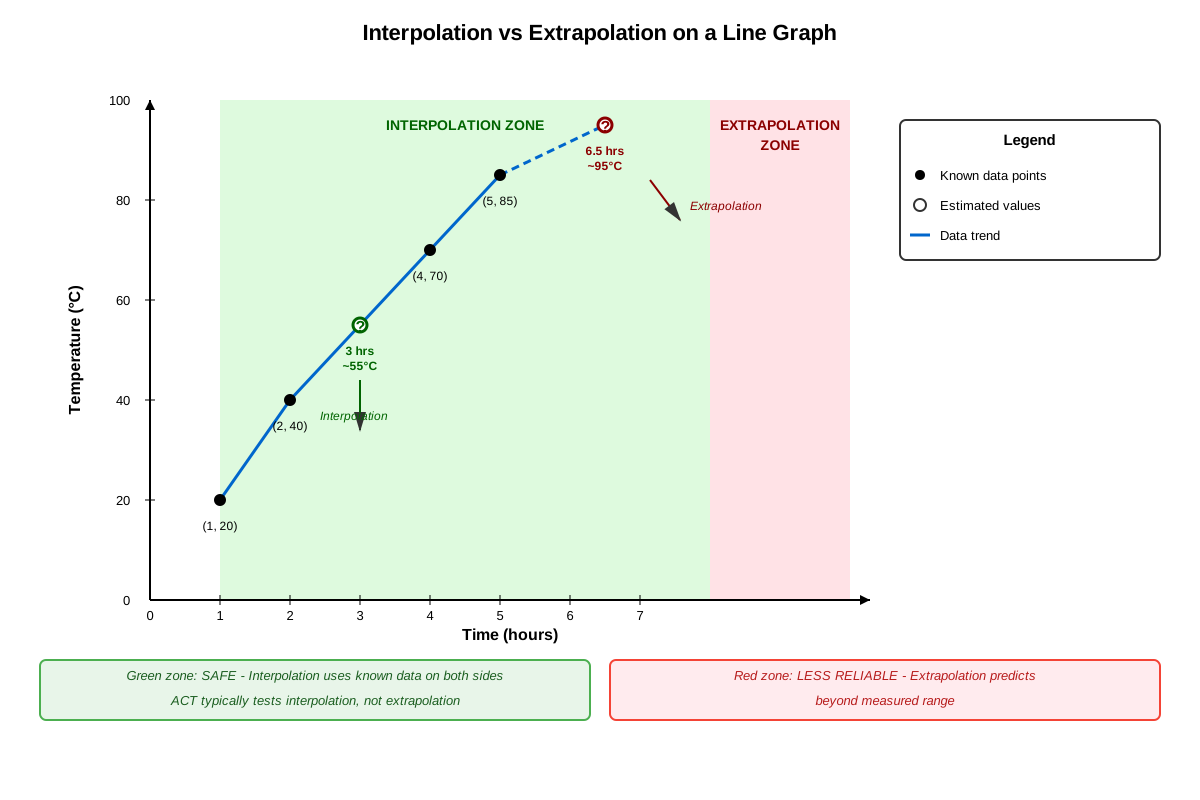
Interpolation is a fundamental data analysis skill that appears frequently on the ACT Science test, particularly within Data Representation passages. This technique involves estimating unknown values that fall between two known data points on a graph, table, or chart. Unlike extrapolation, which requires predicting values beyond the given data range, interpolation works within the boundaries of provided information, making it a more reliable and commonly tested skill.
On the ACT Science section, interpolation questions typically require students to read graphs or tables carefully and determine values that aren't explicitly labeled. These questions test both analytical reasoning and attention to detail—two critical skills for success on standardized tests. Students who master interpolation can quickly and accurately extract information from complex data presentations, giving them a significant advantage in time management and accuracy.
Understanding interpolation is essential because it serves as a bridge between simple data reading and more complex analytical tasks. This skill connects directly to trend analysis, data interpretation, and scientific reasoning—all core competencies evaluated throughout the ACT Science section. Mastering ACT interpolation questions builds confidence in handling the diverse data representation formats that appear across multiple passages in every test administration.
Learning Objectives
- [ ] Identify when Interpolation is being tested in ACT Science passages
- [ ] Explain the core rule or strategy behind Interpolation
- [ ] Apply Interpolation to ACT-style questions accurately
- [ ] Distinguish between interpolation and extrapolation scenarios
- [ ] Estimate intermediate values using proportional reasoning
- [ ] Recognize common graph types where interpolation is required
- [ ] Execute interpolation calculations within 30 seconds per question
Prerequisites
- Basic graph reading skills: Understanding x-axis and y-axis labels, scales, and units is essential for locating data points accurately
- Proportional reasoning: The ability to understand ratios and proportions enables estimation of values between known points
- Table interpretation: Familiarity with reading rows and columns helps identify the appropriate data range for interpolation
- Number line concepts: Understanding relative position on a continuous scale supports accurate value estimation
- Basic arithmetic: Addition, subtraction, multiplication, and division skills are necessary for calculating intermediate values
Why This Topic Matters
Interpolation represents one of the most practical applications of data analysis in both academic and real-world contexts. Scientists regularly use interpolation to estimate measurements between recorded data points, whether analyzing temperature changes, population growth, chemical concentrations, or physical properties. This technique allows researchers to make informed predictions without conducting additional experiments for every possible value.
On the ACT Science test, interpolation questions appear in approximately 15-20% of all Data Representation passages, making this a high-yield topic for focused study. These questions typically appear as straightforward data reading tasks but require careful attention to scale and proportional relationships. Students who can quickly and accurately interpolate values gain precious time for more complex reasoning questions later in the section.
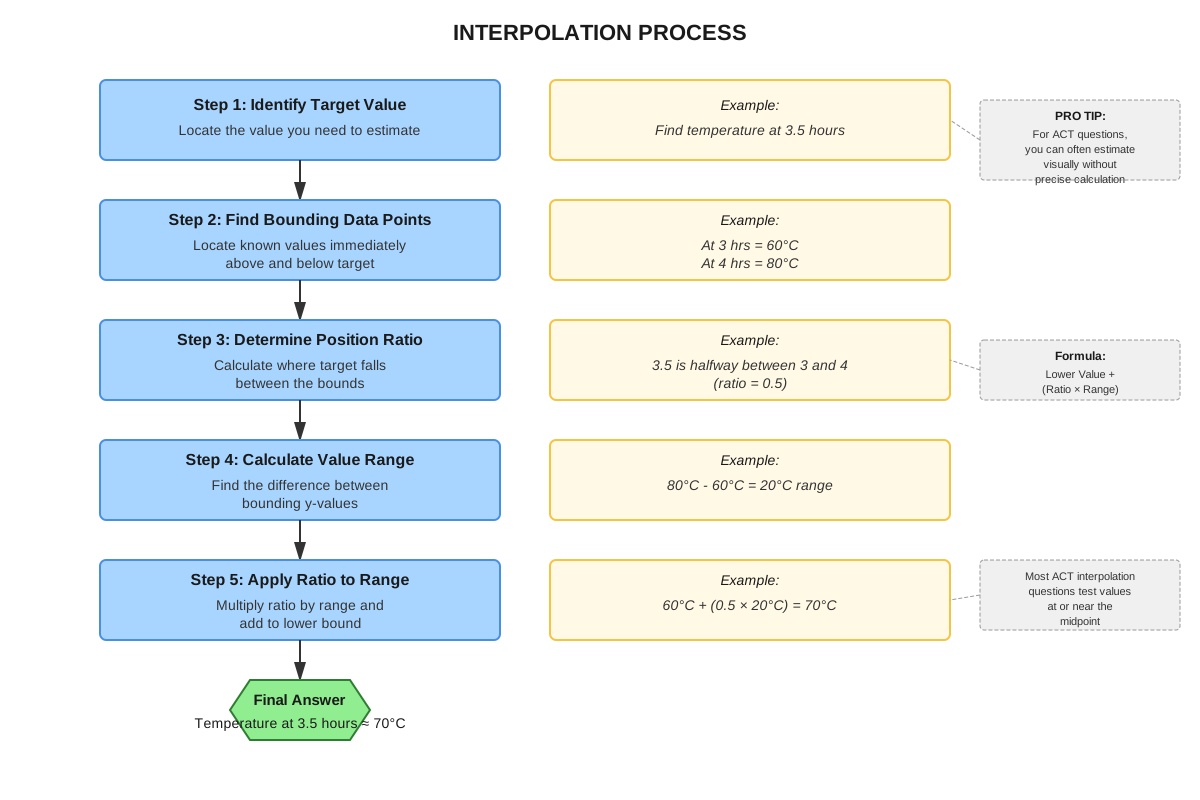
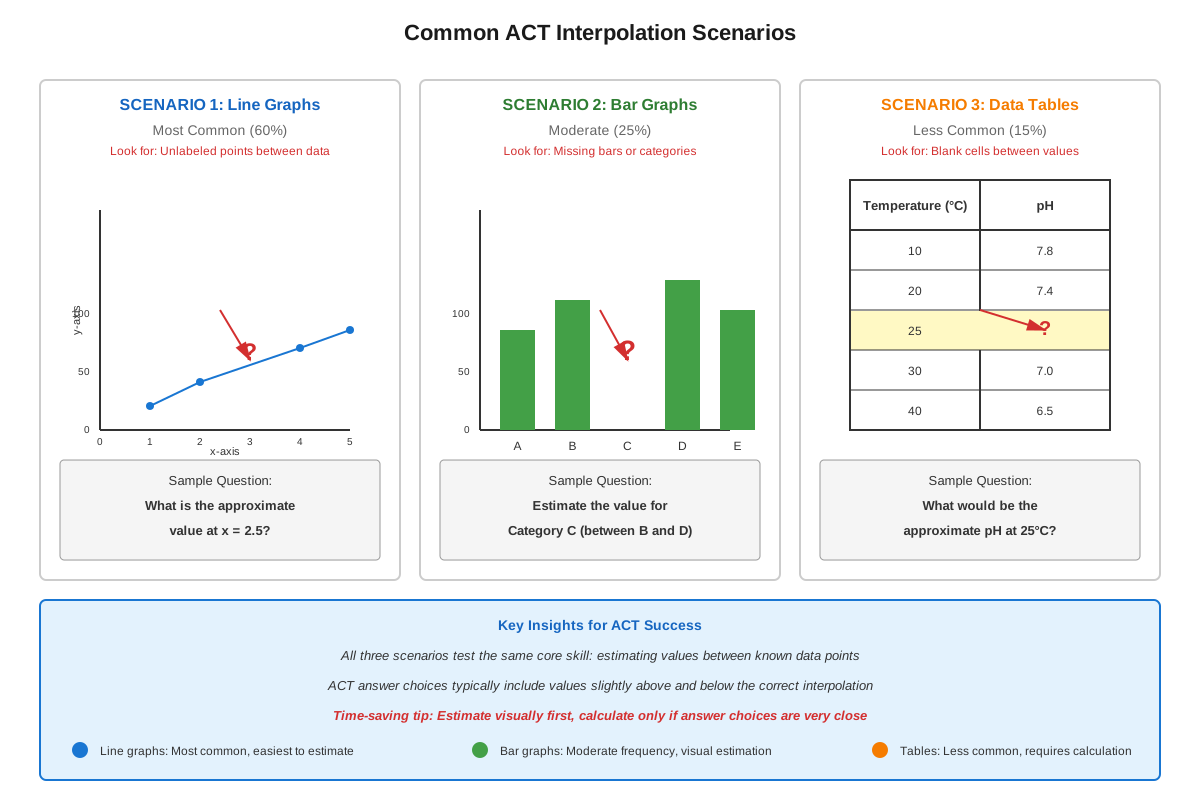
The ACT presents interpolation challenges in multiple formats: line graphs with unlabeled intermediate points, bar graphs requiring estimation between categories, scatter plots with trend lines, and tables with missing values. Questions might ask students to determine the approximate temperature at 3.5 hours when data points exist at 3 and 4 hours, or to estimate the concentration at pH 6.5 when values are given for pH 6 and pH 7. Recognizing these patterns and applying systematic interpolation strategies ensures consistent accuracy across diverse question types.
Core Concepts
Definition and Fundamental Principle
Interpolation is the process of estimating an unknown value that falls between two known data points within a given dataset. The fundamental assumption underlying interpolation is that the relationship between data points follows a predictable pattern—most commonly, a linear relationship on the ACT. When interpolating, students determine where an intermediate value would logically fall based on the surrounding known values.
The core principle involves proportional reasoning: if a target value is positioned halfway between two known points, the interpolated result should be approximately halfway between their corresponding values. This proportional relationship extends to any fractional position—a value one-quarter of the way between two points should yield a result one-quarter of the distance between their values.
Linear Interpolation Method
Linear interpolation assumes a straight-line relationship between two adjacent data points. This method is the most common approach tested on the ACT because it provides reasonable estimates quickly and doesn't require complex calculations. The process follows these steps:
- Identify the two known data points that bracket the unknown value (one point above and one below the target)
- Determine the position of the unknown value relative to these points
- Calculate the proportional distance between the known points
- Apply the same proportion to the difference in their corresponding values
- Add or subtract the calculated amount from the appropriate starting point
For example, if a graph shows that at x = 10, y = 50, and at x = 20, y = 70, finding the y-value at x = 15 involves recognizing that 15 is halfway between 10 and 20. Therefore, the y-value should be halfway between 50 and 70, yielding y = 60.
Visual Interpolation on Graphs
When working with graphs, interpolation often involves visual estimation rather than precise calculation. The ACT Science section typically provides graphs with gridlines that facilitate this process. Students should:
- Locate the target x-value on the horizontal axis
- Draw an imaginary vertical line upward until it intersects the data curve or line
- Draw an imaginary horizontal line from the intersection point to the y-axis
- Read the approximate y-value at this intersection
This visual method works efficiently for line graphs, curve graphs, and scatter plots with trend lines. The key is maintaining accuracy while working quickly—ACT questions rarely require precision beyond the nearest gridline or half-gridline increment.
Table Interpolation
Tables present interpolation challenges differently than graphs. When a table shows discrete values and asks for an intermediate value, students must:
- Identify the two rows or columns that bracket the target value
- Assess whether the relationship appears linear by checking if differences between consecutive values are consistent
- Calculate the proportional position of the target within the range
- Apply proportional reasoning to estimate the result
For instance, if a table shows that at 30°C the reaction rate is 12 units/min, and at 40°C it's 16 units/min, estimating the rate at 35°C requires recognizing that 35°C is halfway between the given temperatures, suggesting a rate of approximately 14 units/min.
Interpolation vs. Extrapolation
Understanding the distinction between these two techniques is crucial for ACT success:
| Aspect | Interpolation | Extrapolation |
|---|---|---|
| Position | Between known data points | Beyond the range of known data |
| Reliability | High—based on observed patterns | Lower—assumes patterns continue |
| ACT Frequency | Very common | Less common, more challenging |
| Risk Level | Low—data supports the estimate | Higher—predictions may be inaccurate |
| Calculation | Uses surrounding data points | Uses trend from existing data |
The ACT heavily favors interpolation questions because they test data reading skills without requiring students to make unsupported assumptions about trends beyond the measured range.
Non-Linear Interpolation Considerations
While most ACT interpolation questions assume linear relationships, some passages present curved data where simple proportional reasoning may be less accurate. In these cases:
- Recognize the curve direction: Is it increasing at an accelerating rate, decelerating, or following a more complex pattern?
- Estimate conservatively: Choose answer choices that reflect the curve's behavior rather than assuming a straight line
- Use visual judgment: The curve's shape between points provides guidance for reasonable estimates
- Consider the context: Scientific relationships often follow predictable patterns (exponential growth, logarithmic decay) that inform better estimates
For curved data, students should still identify the bracketing points but adjust their estimates based on whether the curve bends toward or away from a straight-line path between those points.
Concept Relationships
Interpolation serves as a foundational skill that connects to multiple aspects of ACT Science data analysis. The relationship flow begins with basic graph reading → enables → interpolation → supports → trend analysis → leads to → prediction and hypothesis evaluation.
Within the topic itself, identifying bracketing data points → enables → proportional reasoning → produces → accurate value estimation. This internal sequence must become automatic for efficient test performance.
Interpolation connects directly to prerequisite knowledge of proportional reasoning, as the core calculation method relies on understanding ratios and fractional positions. It also builds upon table and graph interpretation skills, since students must first accurately read existing data before estimating intermediate values.
The skill extends forward to more advanced topics like extrapolation (predicting beyond data ranges), trend line analysis (understanding overall patterns), and experimental design evaluation (assessing whether data collection intervals are appropriate). Students who master interpolation find these advanced topics more accessible because they've developed strong intuition for data relationships.
High-Yield Facts
⭐ Interpolation estimates values BETWEEN known data points, never beyond the data range
⭐ Linear interpolation assumes a straight-line relationship between adjacent points
⭐ Visual estimation on graphs is faster and usually sufficient for ACT answer choices
⭐ The target value's proportional position between known points determines the interpolated result
⭐ ACT interpolation questions typically require accuracy only to the nearest gridline or labeled increment
- Interpolation is more reliable than extrapolation because it works within observed data boundaries
- Tables and graphs both require interpolation skills but use different visual approaches
- Curved data requires adjusting estimates based on the curve's direction and steepness
- Most ACT interpolation questions can be solved in 20-30 seconds with practice
- Answer choices for interpolation questions are usually spaced far enough apart that precise calculation isn't necessary
- Interpolation questions often appear early in Data Representation passages as "warm-up" questions
- The ACT never requires complex mathematical formulas for interpolation—proportional reasoning suffices
- Recognizing when NOT to interpolate (when data shows discontinuous jumps) is equally important
Quick check — test yourself on Interpolation so far.
Try Flashcards →Common Misconceptions
Misconception: Interpolation and extrapolation are the same thing → Correction: Interpolation estimates values between known data points within the measured range, while extrapolation predicts values beyond the data range. The ACT tests these as distinct skills, with interpolation being far more common and reliable.
Misconception: Interpolated values must be calculated with mathematical precision → Correction: ACT Science questions are designed so that visual estimation and proportional reasoning provide sufficient accuracy. Answer choices are typically spaced far enough apart that calculations to multiple decimal places are unnecessary and waste valuable time.
Misconception: All data relationships are linear, so halfway between two points always means halfway between their values → Correction: While linear interpolation is the default approach, some ACT passages present curved relationships where the interpolated value may be higher or lower than the linear midpoint. Always observe the curve's shape when estimating.
Misconception: Interpolation requires using the exact formula (y = y₁ + (x - x₁) × (y₂ - y₁)/(x₂ - x₁)) → Correction: While this formula is mathematically correct, the ACT rewards efficient problem-solving. Proportional reasoning ("the target is 3/4 of the way between points, so the answer is 3/4 of the way between values") is faster and equally accurate for test purposes.
Misconception: If a table doesn't show a value, it can't be determined → Correction: Tables with consistent intervals and patterns specifically invite interpolation. The absence of a labeled value often signals that the question will test interpolation skills.
Misconception: Interpolation only works with numbers, not with qualitative data → Correction: While numerical interpolation is most common, the ACT occasionally tests conceptual interpolation, such as estimating whether a characteristic at an intermediate condition would be "moderate" when endpoints show "low" and "high."
Worked Examples
Example 1: Line Graph Interpolation
Question: A scientist measures the growth of bacteria over time. The graph shows that at 2 hours, there are 100 bacteria, and at 4 hours, there are 180 bacteria. Approximately how many bacteria are present at 3 hours?
Solution Process:
Step 1: Identify the bracketing data points
- Lower point: (2 hours, 100 bacteria)
- Upper point: (4 hours, 180 bacteria)
- Target: 3 hours
Step 2: Determine the proportional position
- 3 hours is exactly halfway between 2 and 4 hours
- Position = 1/2 of the distance between points
Step 3: Calculate the value range
- Difference in bacteria count: 180 - 100 = 80 bacteria
- Half of this difference: 80 ÷ 2 = 40 bacteria
Step 4: Apply to the starting point
- Starting value: 100 bacteria
- Add half the difference: 100 + 40 = 140 bacteria
Answer: Approximately 140 bacteria at 3 hours
Connection to Learning Objectives: This example demonstrates applying interpolation to ACT-style questions accurately by using proportional reasoning to estimate an intermediate value on a line graph.
Example 2: Table Interpolation with Non-Midpoint Target
Question: A chemistry experiment records pH levels at different temperatures. The table shows pH = 6.2 at 25°C and pH = 7.0 at 35°C. What is the approximate pH at 30°C?
Solution Process:
Step 1: Identify bracketing values
- Lower point: 25°C → pH 6.2
- Upper point: 35°C → pH 7.0
- Target: 30°C
Step 2: Calculate proportional position
- Temperature range: 35 - 25 = 10°C
- Target distance from lower point: 30 - 25 = 5°C
- Proportional position: 5/10 = 1/2 (halfway)
Step 3: Calculate pH range
- pH difference: 7.0 - 6.2 = 0.8
- Half of difference: 0.8 × 1/2 = 0.4
Step 4: Add to starting pH
- Starting pH: 6.2
- Add proportional difference: 6.2 + 0.4 = 6.6
Answer: pH ≈ 6.6 at 30°C
Alternative Quick Method: Recognize that 30°C is exactly halfway between 25°C and 35°C, so the pH should be halfway between 6.2 and 7.0. The average of these values is (6.2 + 7.0)/2 = 6.6.
Connection to Learning Objectives: This example shows how to identify when interpolation is being tested (missing table value between known points) and explains the core strategy (proportional reasoning with fractional positions).
Exam Strategy
Recognition Triggers
Watch for these trigger phrases that signal interpolation questions:
- "approximately"
- "closest to"
- "between [value A] and [value B]"
- "at [intermediate value]"
- "estimate"
- "based on the data"
When you see a question asking for a value that isn't explicitly labeled on a graph or listed in a table, immediately recognize this as an interpolation opportunity.
Systematic Approach
Follow this efficient process for every interpolation question:
- Scan for the target value (5 seconds): Locate what the question is asking for on the x-axis or in table headers
- Identify bracketing points (5 seconds): Find the two known values immediately above and below the target
- Assess proportional position (5 seconds): Determine if the target is at the midpoint, one-quarter, three-quarters, or another clear fraction
- Estimate or calculate (10 seconds): Use visual estimation for graphs or quick mental math for tables
- Verify against answer choices (5 seconds): Confirm your estimate falls within the reasonable range
This 30-second process ensures accuracy without sacrificing speed.
Process of Elimination Tips
- Eliminate extremes first: If interpolating between 20 and 40, immediately eliminate any answer choice below 20 or above 40
- Use the midpoint as reference: Calculate or estimate the midpoint value, then eliminate answers that are unreasonably far from it
- Consider curve direction: For non-linear data, eliminate answers that ignore the curve's behavior
- Check units: Eliminate any answer with incorrect units or unrealistic magnitude
Time Management
Interpolation questions should be among the fastest to answer in Data Representation passages. Allocate:
- Simple linear interpolation: 20-30 seconds
- Complex table interpolation: 30-45 seconds
- Curved graph interpolation: 45-60 seconds
If an interpolation question takes longer than one minute, you're likely overcomplicating it. Use visual estimation and proportional reasoning rather than attempting precise calculations.
Common Traps to Avoid
- Don't extrapolate when asked to interpolate: Verify that your target value falls within the data range
- Don't assume perfect linearity without checking: Glance at the overall pattern before applying linear interpolation
- Don't over-calculate: The ACT rewards efficient approximation over mathematical precision
- Don't ignore scale: Pay attention to axis scales and intervals—they affect your estimate significantly
Memory Techniques
The "BRACKET" Mnemonic
Boundaries: Identify the two data points that bracket your target
Range: Calculate the range between these boundaries
Assess: Determine the proportional position of your target
Calculate: Find the proportional difference in values
Keep: Add or subtract from the starting point
Estimate: Round to a reasonable answer
Test: Verify against answer choices
Visual Anchor: The Ladder Method
Imagine interpolation as climbing a ladder between two rungs. If you need to place your foot halfway up, you wouldn't put it at the top or bottom rung—you'd place it in the middle. This visual helps remember that interpolated values must fall proportionally between known points.
The "Inside, Not Outside" Rule
Create a mental image of a fence with two posts (your known data points). Interpolation means staying inside the fence, while extrapolation means going outside. This simple spatial metaphor helps distinguish the two concepts instantly.
Proportional Position Shortcuts
Memorize these common fractional positions for quick recognition:
- 1/4 position: Target is 25% of the way from lower to upper point
- 1/2 position: Target is exactly halfway (most common on ACT)
- 3/4 position: Target is 75% of the way from lower to upper point
When you recognize these standard positions, estimation becomes nearly instantaneous.
Summary
Interpolation is a high-yield ACT Science skill that involves estimating unknown values between two known data points within a dataset. This technique relies on proportional reasoning: determining where a target value falls relative to bracketing points, then applying the same proportion to estimate the corresponding result. The ACT tests interpolation through graphs, tables, and charts, typically requiring visual estimation rather than complex calculations. Success depends on quickly identifying bracketing data points, assessing proportional position (especially recognizing midpoints), and applying linear interpolation assumptions unless the data clearly shows non-linear patterns. Students must distinguish interpolation (within data range) from extrapolation (beyond data range) and recognize trigger phrases like "approximately," "estimate," and "between." Efficient interpolation combines systematic approach with time-saving shortcuts, allowing students to answer these questions in 20-45 seconds while maintaining high accuracy. Mastering this skill provides a foundation for more advanced data analysis tasks and ensures consistent performance on 15-20% of Data Representation questions.
Key Takeaways
- Interpolation estimates values BETWEEN known data points using proportional reasoning
- Visual estimation on graphs is faster and sufficiently accurate for ACT answer choices
- The proportional position of the target value determines the interpolated result
- Linear interpolation (assuming straight-line relationships) is the default ACT approach
- Interpolation questions should take 20-45 seconds; longer suggests overcomplication
- Always verify that the target value falls within the data range (not beyond it)
- Recognizing midpoint positions enables instant mental calculation without formal formulas
Related Topics
Extrapolation: Building on interpolation skills, extrapolation involves predicting values beyond the measured data range by extending observed trends. Mastering interpolation provides the foundation for understanding when and how to make these less certain predictions.
Trend Analysis: Interpolation skills directly support identifying overall patterns in data, including increasing/decreasing trends, rates of change, and relationship types. Students who can accurately interpolate individual points develop better intuition for broader data patterns.
Data Representation Passage Strategy: Interpolation is one component of the comprehensive skill set needed for Data Representation passages, which also includes direct data reading, graph type recognition, and multi-variable analysis.
Experimental Design Evaluation: Understanding interpolation helps students assess whether experiments collected data at appropriate intervals and whether conclusions are supported by the available data points.
Practice CTA
Now that you've mastered the concepts and strategies for ACT interpolation, it's time to put your knowledge into action! Complete the practice questions to reinforce these skills and build the speed and confidence you need for test day. Each practice problem is designed to mirror actual ACT Science questions, giving you authentic preparation. Don't forget to review the flashcards to cement the high-yield facts and trigger phrases in your memory. Consistent practice with these resources will transform interpolation from a potential challenge into one of your fastest and most reliable question types. You've got this—let's turn this knowledge into points!
Sign up free to keep reading
Create a free AnvayaPrep account to finish this ACT guide on Interpolation — plus flashcards and practice questions.