Overview
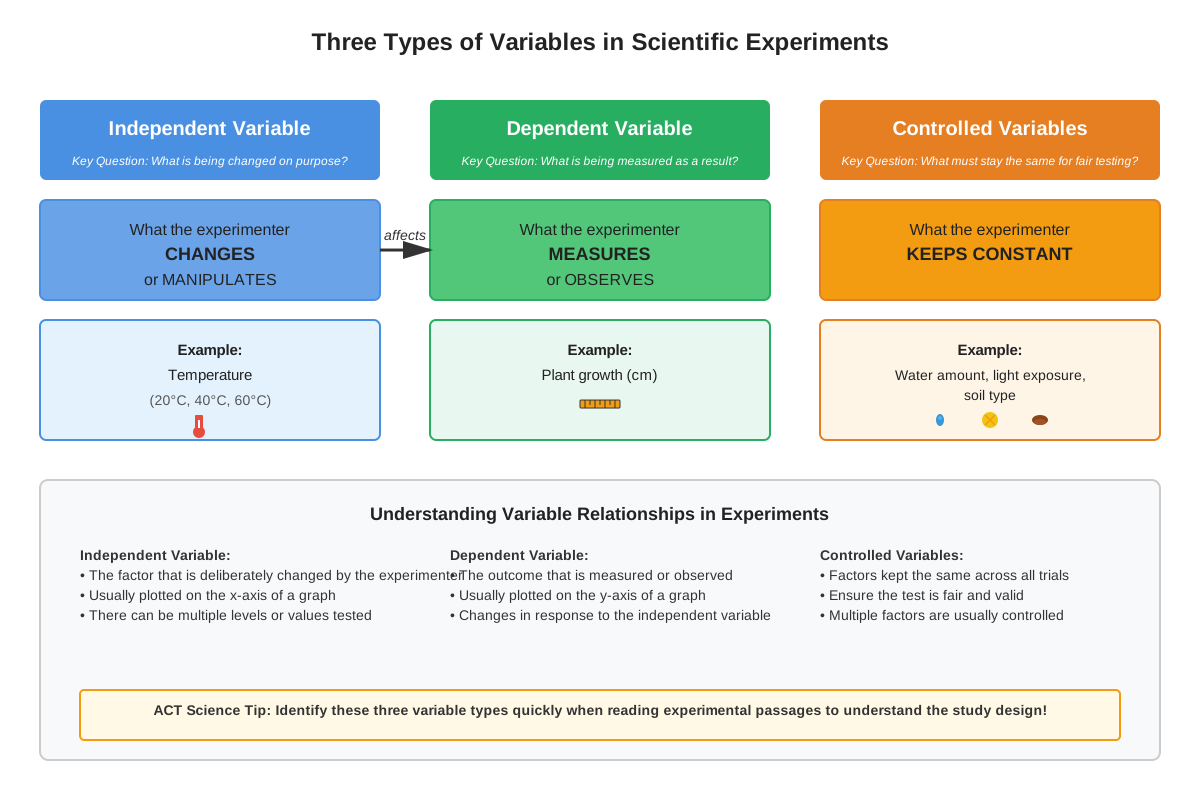
Identifying variables is a foundational skill in the ACT Science section that appears across multiple passage types and question formats. This skill involves recognizing and distinguishing between independent variables (factors that are deliberately changed or manipulated in an experiment), dependent variables (outcomes that are measured or observed), and controlled variables (factors kept constant to ensure fair testing). Mastery of variable identification is essential because it forms the basis for understanding experimental design, interpreting data tables and graphs, and analyzing scientific relationships presented in ACT passages.
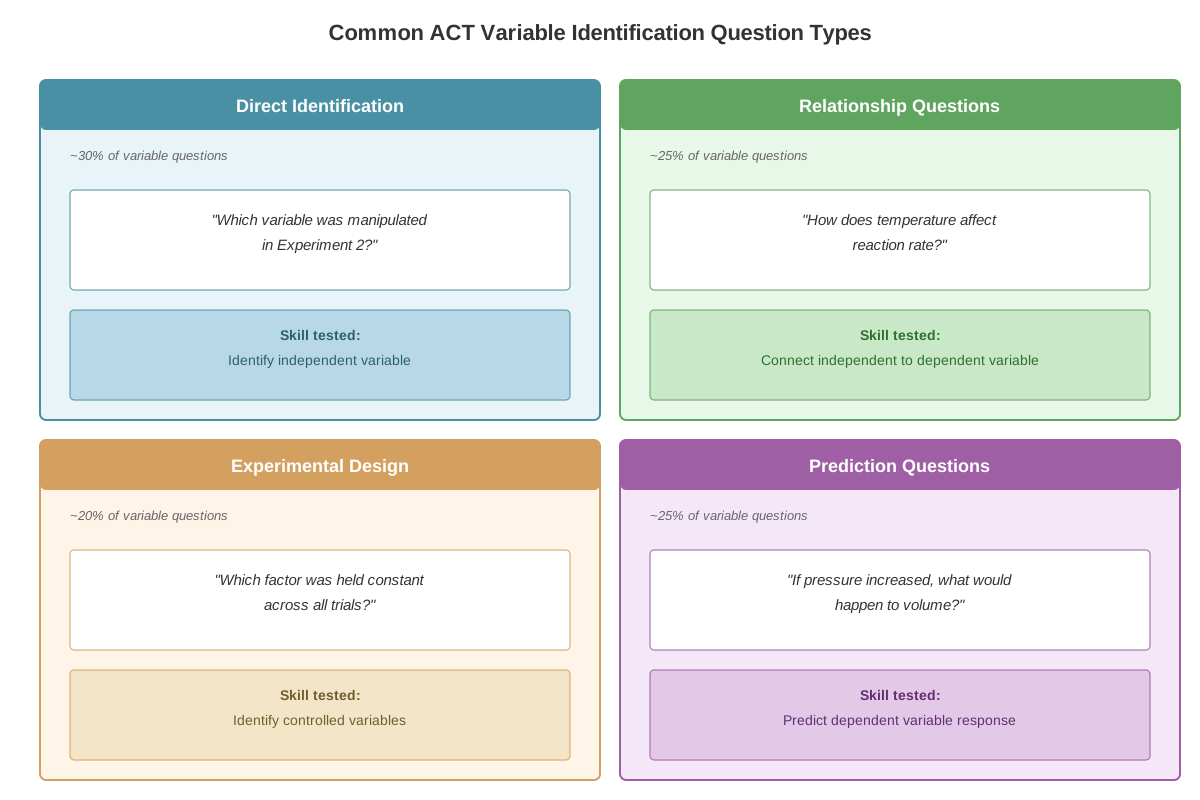
The ACT Science test consistently includes questions that require students to identify which variables are being manipulated, which are being measured, and how changes in one variable affect another. These questions may appear directly ("Which variable was manipulated in Experiment 2?") or indirectly through questions about experimental design, data interpretation, or hypothesis testing. Students who can quickly and accurately identify variables gain a significant advantage in understanding passage content and answering questions efficiently.
ACT identifying variables connects to broader scientific reasoning skills tested throughout the Science section. Variable identification underpins data representation questions, supports research summaries analysis, and enables students to evaluate conflicting viewpoints passages. This skill also relates directly to understanding cause-and-effect relationships, recognizing patterns in data, and making predictions based on experimental results—all high-frequency question types on the ACT Science test.
Learning Objectives
- [ ] Identify when Identifying variables is being tested in ACT Science passages
- [ ] Explain the core rule or strategy behind Identifying variables in experimental contexts
- [ ] Apply Identifying variables to ACT-style questions accurately and efficiently
- [ ] Distinguish between independent, dependent, and controlled variables in complex experimental designs
- [ ] Recognize how variables are represented in tables, graphs, and experimental descriptions
- [ ] Predict how changes in independent variables will affect dependent variables based on data patterns
- [ ] Evaluate whether an experiment properly controls variables to test a specific hypothesis
Prerequisites
- Basic understanding of scientific experiments: Recognizing that experiments test relationships between factors through systematic observation and measurement
- Ability to read data tables and graphs: Essential for locating where variables are displayed and how their relationships are represented
- Familiarity with cause-and-effect relationships: Understanding that changes in one factor can produce changes in another helps identify which variables are independent versus dependent
- Knowledge of the scientific method: Provides context for why scientists manipulate certain factors while keeping others constant
Why This Topic Matters
Variable identification appears in approximately 15-20% of all ACT Science questions, making it one of the most frequently tested skills on the exam. Questions testing this skill appear across all three passage types: Data Representation (5-6 passages), Research Summaries (3 passages), and Conflicting Viewpoints (1 passage). Students who master variable identification can answer these questions in 20-30 seconds each, creating valuable time for more complex analysis questions.
In real-world scientific practice, identifying variables is fundamental to designing valid experiments, interpreting research findings, and drawing accurate conclusions. Scientists must clearly define what they're changing (independent variable), what they're measuring (dependent variable), and what they're keeping constant (controlled variables) to ensure their results are meaningful and reproducible. This skill translates directly to critical thinking in medicine, engineering, environmental science, and any field requiring data-driven decision-making.
On the ACT, variable identification questions commonly appear as: direct questions asking which variable was manipulated or measured; questions requiring students to identify what differs between experimental trials; questions about what would happen if a specific variable changed; and questions asking students to design new experiments or trials. Recognizing these question types quickly allows students to locate relevant information efficiently and avoid common traps in answer choices.
Core Concepts
Independent Variables
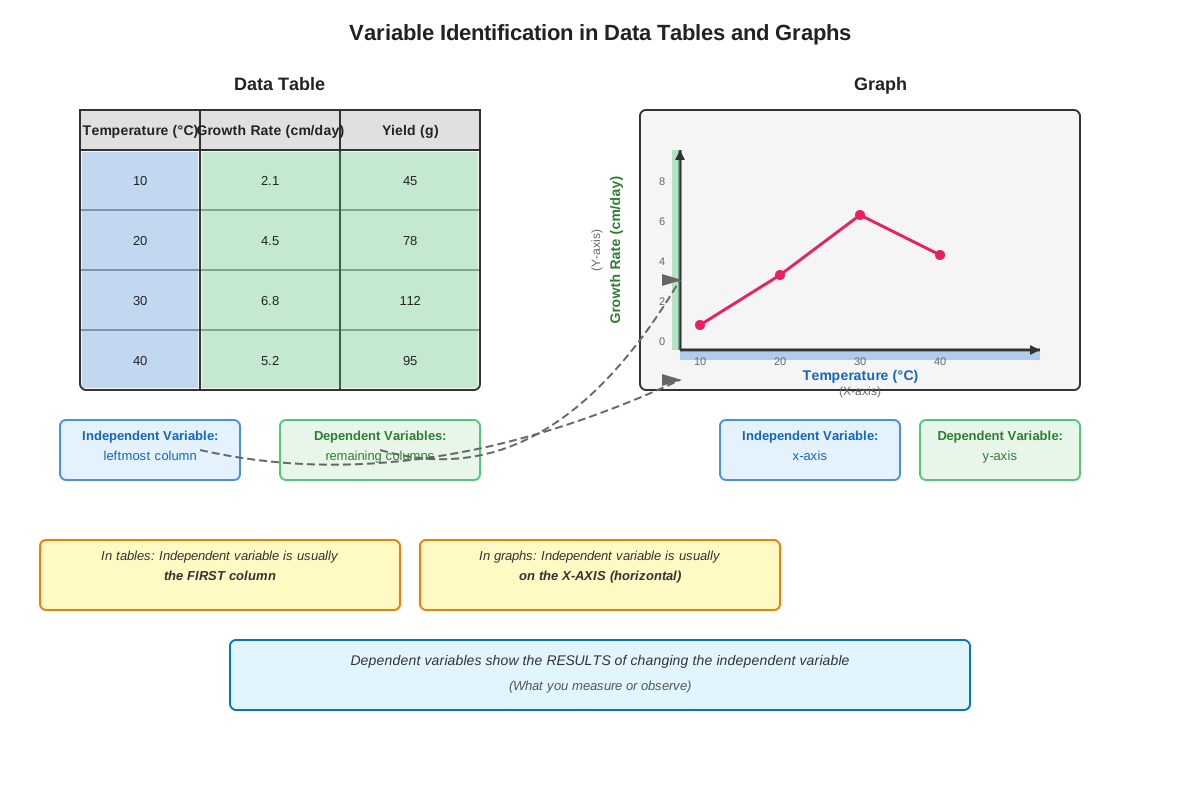
The independent variable is the factor that researchers deliberately change, manipulate, or select in an experiment. This variable is "independent" because its values are chosen by the experimenter rather than resulting from the experiment itself. On the ACT, independent variables are typically found on the x-axis of graphs, in the leftmost column of data tables, or explicitly stated in experimental descriptions as the factor being "varied," "changed," or "tested."
Common independent variables in ACT passages include: temperature, time, concentration, pH, mass, distance, wavelength, and type of material or organism. When reading an experiment description, look for phrases like "Students tested three different temperatures," "The concentration was varied from 0.1 M to 0.5 M," or "Five trials were conducted at different depths." These phrases signal that temperature, concentration, or depth is the independent variable.
Dependent Variables
The dependent variable is the outcome that researchers measure, observe, or record in response to changes in the independent variable. This variable "depends on" the independent variable—its values result from the experimental conditions rather than being predetermined. On ACT graphs, dependent variables typically appear on the y-axis, while in data tables they occupy columns to the right of the independent variable column.
Dependent variables are often identified by phrases such as "measured," "recorded," "observed," "determined," or "calculated." Examples include: reaction rate, growth rate, pressure, volume, light intensity, population size, and percentage of a substance. If a passage states "Students measured the time required for the reaction to complete at each temperature," then time is the dependent variable and temperature is the independent variable.
Controlled Variables
Controlled variables (also called constants or control variables) are factors that experimenters deliberately keep the same across all trials to ensure that observed changes in the dependent variable result only from changes in the independent variable. Proper control of variables is essential for valid experimental design. On the ACT, controlled variables are often mentioned in the experimental setup description but may not appear in data tables or graphs.
Examples of controlled variables include: using the same equipment for all trials, maintaining constant room temperature (when temperature isn't the independent variable), using identical sample sizes, keeping the same time duration for observations, or using the same type of container. ACT questions may ask what was held constant, what should be controlled in a new trial, or whether an experiment properly controlled variables.
Multiple Variables in Complex Experiments
Some ACT passages present experiments with multiple independent variables or multiple dependent variables. When two independent variables are tested, the experiment typically uses a factorial design where different combinations of the variables are tested. For example, an experiment might test both temperature (20°C, 30°C, 40°C) and pH (5, 7, 9), creating nine different experimental conditions.
To identify variables in complex experiments:
- Read the experimental description carefully to determine what factors are being deliberately changed
- Identify what outcomes are being measured for each condition
- Note what factors are mentioned as being kept constant
- Check table headers and graph axes to confirm which variables are displayed
- Look for patterns in how data is organized—independent variables typically organize rows or columns
Variable Relationships
Understanding how variables relate to each other is crucial for ACT success. Variables can show direct relationships (as one increases, the other increases), inverse relationships (as one increases, the other decreases), or no relationship (changes in one don't consistently affect the other). The ACT frequently tests whether students can identify these relationship patterns from data.
| Relationship Type | Description | Graph Pattern | Example |
|---|---|---|---|
| Direct (Positive) | Both variables increase together | Upward slope | Temperature increases → reaction rate increases |
| Inverse (Negative) | One increases while other decreases | Downward slope | Altitude increases → air pressure decreases |
| No Relationship | No consistent pattern | Scattered or flat | Shoe size → test score |
| Non-linear | Relationship exists but isn't straight | Curved line | Time → population growth (exponential) |
Concept Relationships
Variable identification serves as the foundation for understanding experimental design, which in turn enables data interpretation and scientific reasoning. The relationship flows: Identifying Variables → Understanding Experimental Design → Interpreting Data → Drawing Conclusions. Without correctly identifying which variables are independent, dependent, and controlled, students cannot accurately interpret what an experiment tests or what its results mean.
Within the topic itself, the three variable types are interconnected: the independent variable is chosen to test its effect on the dependent variable, while controlled variables are identified by determining what factors could affect the dependent variable but aren't being tested. This creates a logical framework: Independent Variable (cause) → affects → Dependent Variable (effect), while Controlled Variables (potential confounds) → are held constant.
Variable identification connects to prerequisite knowledge of the scientific method by applying its principles to specific experimental scenarios. It also enables progression to more advanced topics like analyzing experimental design flaws, comparing multiple experiments, and evaluating conflicting scientific viewpoints. The skill of recognizing variable relationships in data directly supports graph interpretation, trend analysis, and prediction questions—all high-frequency ACT question types.
High-Yield Facts
⭐ The independent variable is what the experimenter deliberately changes or manipulates; it typically appears on the x-axis of graphs or in the first column of tables
⭐ The dependent variable is what the experimenter measures or observes; it typically appears on the y-axis of graphs or in subsequent columns of tables
⭐ Controlled variables are factors kept constant across all trials to ensure fair testing
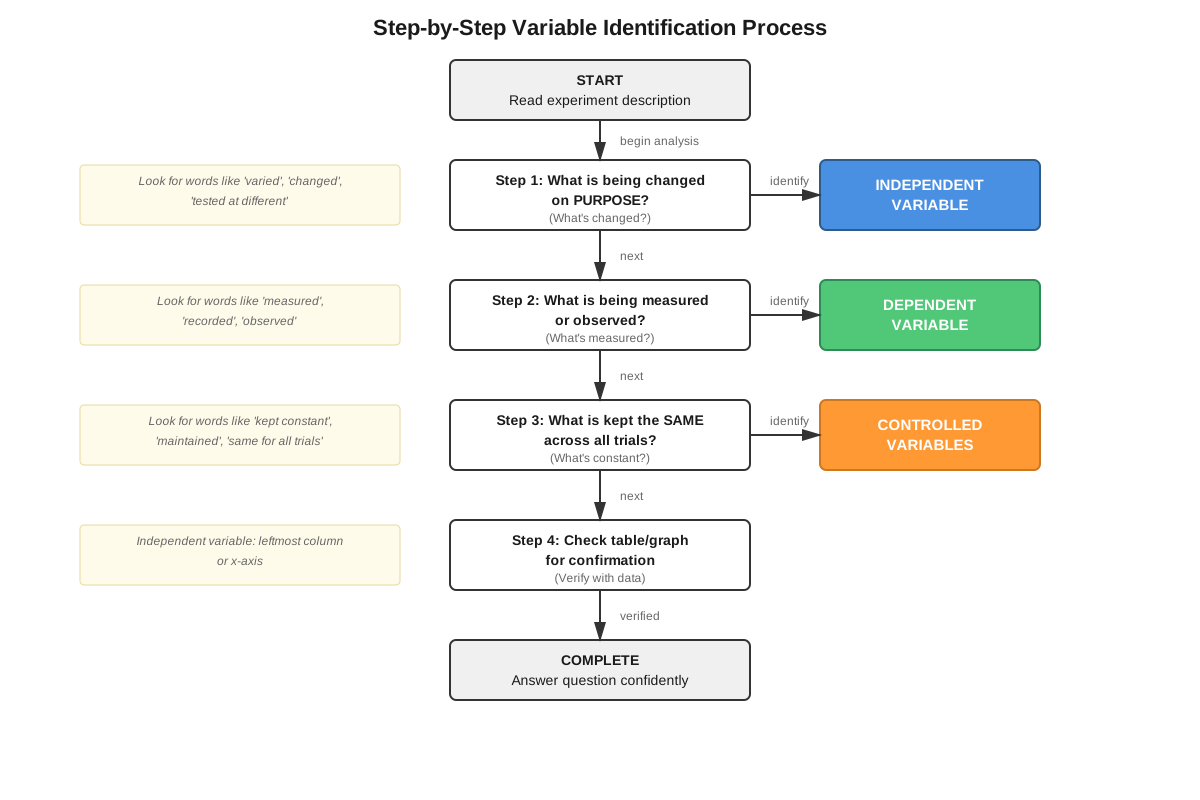
⭐ Look for action words like "varied," "changed," or "tested" to identify independent variables, and "measured," "recorded," or "observed" to identify dependent variables
⭐ In a well-designed experiment, only one independent variable should change at a time to establish clear cause-and-effect relationships
- Multiple trials with the same conditions indicate that experimenters are controlling for random variation and improving reliability
- When comparing two experiments, identify what variable differs between them to understand what relationship is being tested
- The units of measurement (°C, mL, seconds, etc.) help identify what variables are being measured
- If a passage describes "three groups" or "four trials," the factor that differs between groups/trials is likely the independent variable
- Variables can be quantitative (numerical values like temperature or mass) or qualitative (categories like species type or material composition)
- Time can be either an independent variable (when experimenters measure outcomes at different time points) or a controlled variable (when all measurements occur at the same time)
- The presence of a "control group" indicates a controlled variable—the control group represents the baseline condition without the experimental treatment
Quick check — test yourself on Identifying variables so far.
Try Flashcards →Common Misconceptions
Misconception: The independent variable is always on the left side of a table and the dependent variable is always on the right.
Correction: While this is the typical convention, ACT passages occasionally present tables with dependent variables in earlier columns or with multiple dependent variables. Always read table headers and the experimental description to confirm which variables are which, rather than relying solely on position.
Misconception: Every factor mentioned in an experiment description is a variable being tested.
Correction: Many factors mentioned are controlled variables kept constant across trials. Only factors that are deliberately changed between trials or groups are independent variables. Read carefully to distinguish between what "was varied" versus what "was kept constant" or "was the same for all trials."
Misconception: An experiment can only have one independent variable and one dependent variable.
Correction: Complex experiments may test multiple independent variables simultaneously (factorial designs) or measure multiple dependent variables to assess different outcomes. The ACT includes passages with multiple variables of each type, requiring careful identification of each.
Misconception: The dependent variable causes changes in the independent variable.
Correction: Causation flows from independent to dependent variables, not the reverse. The independent variable is the cause (what's manipulated), and the dependent variable is the effect (what's measured). This directional relationship is fundamental to experimental logic.
Misconception: If two variables both change during an experiment, they must both be independent variables.
Correction: When the independent variable changes, the dependent variable changes in response—that's the point of the experiment. Both variables change, but only the independent variable is deliberately manipulated by the experimenter. The dependent variable changes as a result of those manipulations.
Misconception: Controlled variables don't matter for answering ACT questions.
Correction: Questions frequently ask what was held constant, what should be controlled in a new trial, or whether an experimental design properly controls variables. Additionally, identifying controlled variables helps distinguish them from independent and dependent variables, preventing confusion.
Worked Examples
Example 1: Biology Experiment with Plant Growth
Passage Summary: Students investigated how light intensity affects plant growth. They placed identical bean plants at distances of 10 cm, 30 cm, 50 cm, and 70 cm from a light source. After 14 days, they measured the height of each plant. All plants received the same amount of water, were kept at the same temperature, and were planted in the same type of soil.
Question: In this experiment, which of the following was the dependent variable?
A. Distance from light source
B. Plant height
C. Amount of water
D. Type of soil
Solution Process:
Step 1: Identify what was deliberately changed (independent variable)
- The passage states plants were placed at different distances (10, 30, 50, 70 cm)
- Distance from light source was manipulated by the experimenters
- This is the independent variable
Step 2: Identify what was measured (dependent variable)
- The passage states "they measured the height of each plant"
- Plant height is the outcome being observed
- This is the dependent variable
Step 3: Identify what was kept constant (controlled variables)
- Amount of water: "same amount"
- Temperature: "same temperature"
- Type of soil: "same type"
- These are controlled variables
Step 4: Select the correct answer
- The dependent variable is what was measured as an outcome
- Answer: B. Plant height
Connection to Learning Objectives: This example demonstrates identifying variables in a straightforward experimental design and recognizing the key phrases ("measured," "same") that signal variable types.
Example 2: Chemistry Experiment with Multiple Variables
Passage Summary: Researchers studied the rate of a chemical reaction under different conditions. In Experiment 1, they tested the reaction at 20°C, 40°C, and 60°C, keeping the concentration of reactants constant at 0.5 M. In Experiment 2, they tested the reaction at concentrations of 0.3 M, 0.5 M, and 0.7 M, keeping the temperature constant at 40°C. For both experiments, they measured the time required for the reaction to reach completion.
Question: What was the independent variable in Experiment 2?
A. Temperature
B. Concentration
C. Time to completion
D. Type of reaction
Solution Process:
Step 1: Focus on Experiment 2 specifically
- Don't confuse variables from Experiment 1 with those in Experiment 2
- Experiment 2 tested concentrations of 0.3 M, 0.5 M, and 0.7 M
Step 2: Identify what was deliberately changed in Experiment 2
- Concentration was varied (0.3, 0.5, 0.7 M)
- Temperature was kept constant at 40°C (controlled variable)
- Concentration is the independent variable for Experiment 2
Step 3: Identify what was measured
- "They measured the time required for the reaction to reach completion"
- Time is the dependent variable (same for both experiments)
Step 4: Eliminate incorrect answers
- A: Temperature was controlled in Experiment 2, not varied
- C: Time was measured (dependent variable), not manipulated
- D: The same reaction was used throughout (controlled variable)
- Answer: B. Concentration
Connection to Learning Objectives: This example shows how to identify variables when multiple experiments are presented, demonstrating that the same factor can be an independent variable in one experiment and a controlled variable in another.
Exam Strategy
When approaching ACT Science questions about identifying variables, follow this systematic process:
Step 1: Read the experimental description first before looking at data tables or graphs. The description typically states what was "varied," "changed," "tested" (independent variable) and what was "measured," "recorded," "observed" (dependent variable).
Step 2: Check graph axes and table headers to confirm variable identification. The x-axis and leftmost table column usually show the independent variable, while the y-axis and subsequent columns show dependent variables. However, always verify this against the experimental description.
Step 3: Watch for trigger words and phrases:
- Independent variable: "varied," "changed," "tested," "manipulated," "set at," "different," "ranging from"
- Dependent variable: "measured," "recorded," "observed," "determined," "calculated," "resulting," "effect"
- Controlled variable: "constant," "same," "identical," "kept at," "maintained," "controlled"
Step 4: Use process of elimination by categorizing each answer choice as independent, dependent, or controlled. Questions asking for the independent variable can eliminate any answer that was measured (dependent) or kept constant (controlled).
Exam Tip: If you're unsure which variable is which, ask yourself: "What did the scientists choose before starting the experiment?" (independent) versus "What did they find out after doing the experiment?" (dependent).
Time allocation: Variable identification questions should take 20-30 seconds each. If you spend more than 45 seconds, make your best guess and move on. These questions test recognition, not complex analysis, so the answer should become clear quickly once you identify the variable types.
Common trap answers: The ACT often includes controlled variables as answer choices for questions asking about independent or dependent variables. Always verify that your chosen answer was actually changed (for independent) or measured (for dependent), not kept constant.
Memory Techniques
DRY MIX Mnemonic:
- Dependent
- Responding
- Y-axis
- Manipulated
- Independent
- X-axis
This mnemonic helps remember that the Dependent variable is the Responding variable on the Y-axis, while the Manipulated Independent variable goes on the X-axis.
The "Cause and Effect" Visualization:
Picture an arrow flowing from independent to dependent: Independent → Dependent. The independent variable is the cause (what you do), and the dependent variable is the effect (what happens). Controlled variables are like walls on either side, keeping everything else constant.
The "Recipe" Analogy:
Think of an experiment like baking cookies:
- Independent variable: What you change (oven temperature)
- Dependent variable: What you measure (cookie texture)
- Controlled variables: What you keep the same (ingredients, baking time, cookie size)
C.H.A.N.G.E. for Independent Variables:
- Chosen by experimenter
- Hypothesis being tested
- Altered deliberately
- Not a result
- Graph's x-axis
- Experiment's starting point
Summary
Identifying variables is a critical skill for ACT Science success, appearing in 15-20% of all questions across multiple passage types. The three main variable types are independent variables (factors deliberately changed by experimenters), dependent variables (outcomes measured or observed), and controlled variables (factors kept constant for fair testing). Independent variables typically appear on graph x-axes or in the first column of tables and are signaled by words like "varied" or "changed." Dependent variables usually appear on y-axes or in subsequent table columns and are indicated by words like "measured" or "recorded." Controlled variables are mentioned in experimental descriptions as being "constant" or "the same" across trials. Mastering variable identification requires reading experimental descriptions carefully, checking how data is organized in tables and graphs, and understanding the cause-and-effect relationship where independent variables affect dependent variables. This foundational skill enables students to interpret experimental designs, analyze data patterns, and answer questions about scientific relationships efficiently and accurately.
Key Takeaways
- Identifying variables requires distinguishing between independent (manipulated), dependent (measured), and controlled (constant) variables in experimental contexts
- Independent variables are the cause—what experimenters deliberately change—and typically appear on x-axes or in first table columns
- Dependent variables are the effect—what experimenters measure as outcomes—and typically appear on y-axes or in subsequent table columns
- Trigger words like "varied," "changed," and "tested" signal independent variables, while "measured," "recorded," and "observed" signal dependent variables
- Controlled variables are kept constant to ensure that changes in the dependent variable result only from changes in the independent variable
- Variable identification questions appear frequently on the ACT and should be answered quickly (20-30 seconds) by reading experimental descriptions and checking data organization
- Understanding variable relationships (direct, inverse, or no relationship) enables prediction and data interpretation questions
Related Topics
Experimental Design Analysis: Building on variable identification, this topic examines how experiments are structured, including control groups, sample size, and validity. Mastering variable identification is essential before evaluating whether an experimental design properly tests a hypothesis.
Graph and Table Interpretation: Variables identified in experimental descriptions must be located and analyzed in data displays. Understanding which variable is which enables accurate reading of trends, patterns, and relationships in graphical data.
Comparing Multiple Experiments: Many ACT passages present two or three related experiments. Identifying what variable differs between experiments reveals what relationship is being tested and enables comparison of results.
Hypothesis Testing and Prediction: Once variables are identified, students can evaluate whether data supports or refutes hypotheses and predict outcomes if variables change. Variable identification is the first step in this analytical process.
Practice CTA
Now that you've mastered the core concepts of identifying variables, it's time to apply this knowledge to ACT-style questions. Complete the practice questions to reinforce your understanding of independent, dependent, and controlled variables in various experimental contexts. Use the flashcards to drill the key trigger words and variable types until recognition becomes automatic. Remember: variable identification is a high-frequency, high-yield skill that appears throughout the ACT Science section. The time you invest in practicing this foundational skill will pay dividends across multiple question types and passage formats. You've got this—now prove it with practice!
Sign up free to keep reading
Create a free AnvayaPrep account to finish this ACT guide on Identifying variables — plus flashcards and practice questions.