Overview
In the ACT Science section, understanding how to work with hypotheses is fundamental to success on Research Summaries passages, which constitute approximately one-third of all science questions on the exam. A hypothesis is a testable prediction or proposed explanation for a phenomenon that scientists develop before conducting experiments. On the ACT, students must identify hypotheses, distinguish them from other scientific statements, understand how experiments test them, and evaluate whether data supports or refutes them.
The ability to recognize and work with hypotheses extends beyond isolated questions—it forms the foundation for understanding experimental design, data interpretation, and scientific reasoning. When students master ACT hypothesis questions, they develop critical thinking skills that apply across all Research Summaries passages, where experiments are specifically designed to test one or more hypotheses. This topic bridges the gap between understanding what scientists observe (data) and why they conduct specific experiments (to test predictions).
Hypothesis-related questions appear in multiple formats on the ACT Science test: direct identification questions asking which statement represents the hypothesis, questions requiring students to determine what results would support or contradict a hypothesis, and questions asking students to predict outcomes based on hypothetical scenarios. Mastering this topic provides the analytical framework necessary for tackling the more complex aspects of scientific investigation, including experimental design, variable manipulation, and conclusion drawing.
Learning Objectives
- [ ] Identify when a hypothesis is being tested in ACT passages
- [ ] Explain the core rule or strategy behind hypothesis identification and evaluation
- [ ] Apply hypothesis concepts to ACT-style questions accurately
- [ ] Distinguish between hypotheses, theories, observations, and conclusions
- [ ] Determine whether experimental data supports or refutes a given hypothesis
- [ ] Predict what experimental results would be expected if a hypothesis were correct
- [ ] Formulate alternative hypotheses based on conflicting data sets
Prerequisites
- Basic understanding of the scientific method: Necessary because hypotheses represent a specific stage in scientific inquiry, positioned between observation and experimentation
- Ability to read and interpret graphs and tables: Required since hypothesis evaluation depends on analyzing experimental data presented in visual formats
- Understanding of independent and dependent variables: Essential because hypotheses typically predict relationships between these variables
- Familiarity with cause-and-effect relationships: Important for recognizing the predictive nature of hypotheses and understanding how experiments test causal claims
Why This Topic Matters
Hypothesis questions appear in approximately 40-50% of all Research Summaries passages on the ACT Science test, making this one of the highest-yield topics for exam preparation. These questions typically appear as 2-3 questions per passage, and students who master hypothesis identification and evaluation can quickly gain 6-9 points on the Science section. The ACT specifically tests whether students can think like scientists by evaluating proposed explanations against experimental evidence.
In real-world scientific practice, hypotheses drive the entire research process. Scientists formulate hypotheses to explain observations, design experiments to test these predictions, and revise their understanding based on results. Medical researchers use hypotheses to develop new treatments, environmental scientists use them to predict climate patterns, and engineers use them to solve technical problems. Understanding hypotheses helps students appreciate how scientific knowledge advances through systematic testing rather than random discovery.
On the ACT, hypothesis questions commonly appear in several formats: "Which of the following hypotheses is supported by the results of Experiment 2?", "According to the hypothesis, if X increases, Y should...", "The scientist conducted this experiment to test the hypothesis that...", and "Which result would contradict the hypothesis?" These questions test both comprehension and analytical reasoning, requiring students to connect abstract predictions with concrete data.
Core Concepts
Definition and Characteristics of a Hypothesis
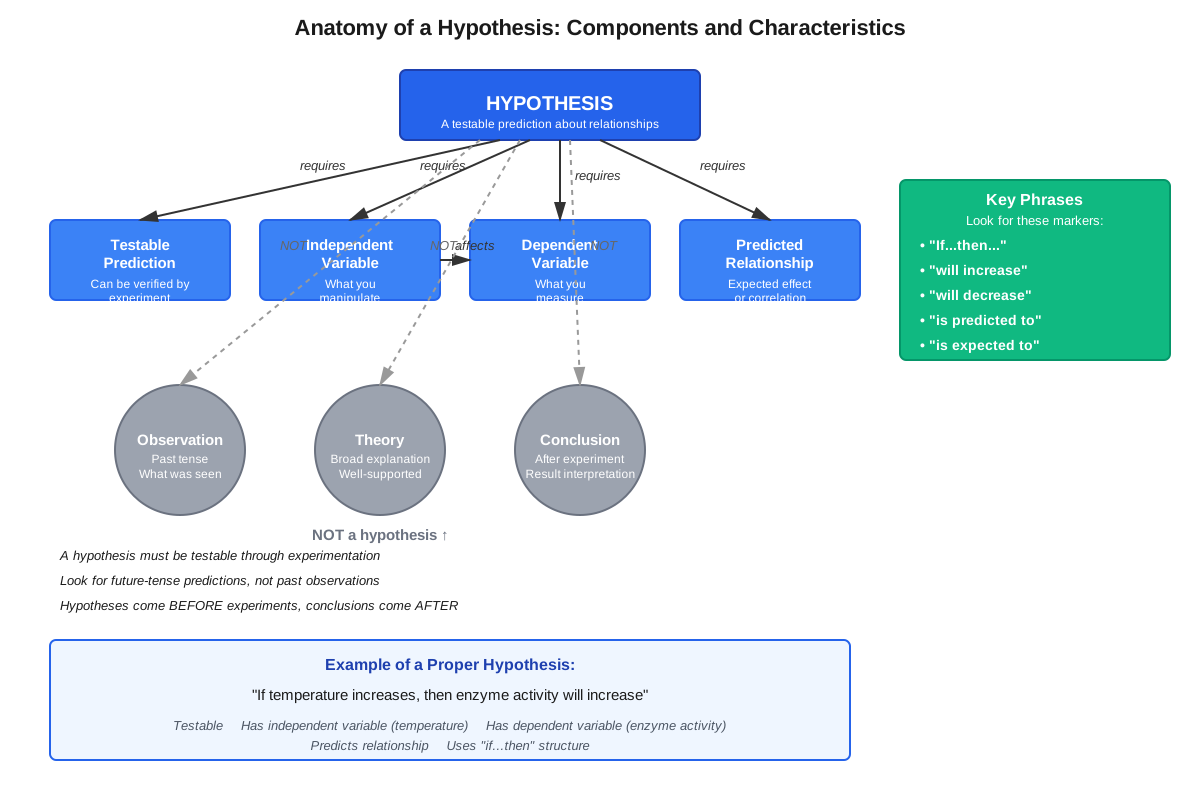
A hypothesis is a specific, testable statement that predicts a relationship between variables or proposes an explanation for an observed phenomenon. Unlike vague guesses, scientific hypotheses must be falsifiable, meaning they can potentially be proven wrong through experimentation. On the ACT, hypotheses typically follow an "if-then" structure: "If [condition], then [predicted outcome]" or state a direct relationship: "[Variable A] affects [Variable B] by [mechanism]."
Key characteristics that distinguish hypotheses from other scientific statements include:
- Specificity: Hypotheses make precise predictions rather than general statements
- Testability: They can be evaluated through experiments or observations
- Predictive power: They forecast what should happen under specific conditions
- Tentative nature: They represent proposed explanations subject to revision based on evidence
Types of Hypotheses on the ACT
The ACT Science section presents several types of hypotheses that students must recognize:
Causal hypotheses propose that one variable directly causes changes in another. Example: "Increasing temperature causes the reaction rate to increase." These are the most common type on the ACT and typically involve manipulating an independent variable to observe effects on a dependent variable.
Correlational hypotheses predict that two variables change together without claiming direct causation. Example: "As altitude increases, air pressure decreases." While these suggest relationships, they don't necessarily explain why the relationship exists.
Mechanistic hypotheses explain how or why a phenomenon occurs by proposing an underlying mechanism. Example: "Enzyme X breaks down substrate Y by binding to its active site, which lowers the activation energy required for the reaction." These often appear in biology and chemistry passages.
Comparative hypotheses predict differences between groups or conditions. Example: "Plants grown in red light will grow taller than plants grown in blue light." These frequently appear in experimental design passages comparing multiple treatment groups.
Identifying Hypotheses in ACT Passages
On the ACT, hypotheses may be explicitly labeled or embedded within passage text. Students must recognize several common presentation formats:
| Presentation Format | Example Phrase | Location in Passage |
|---|---|---|
| Direct statement | "The scientist hypothesized that..." | Introduction or before experiment description |
| Purpose statement | "To test whether..." | Beginning of experiment section |
| Prediction | "It was predicted that..." | Before results presentation |
| Implicit in design | Experiment compares conditions | Must be inferred from experimental setup |
When hypotheses are not explicitly stated, students should look for the research question the experiment addresses and convert it into a predictive statement. For example, if a passage states "Scientists investigated whether fertilizer type affects plant growth," the implicit hypothesis might be "Different fertilizer types will produce different growth rates in plants."
Testing Hypotheses Through Experiments
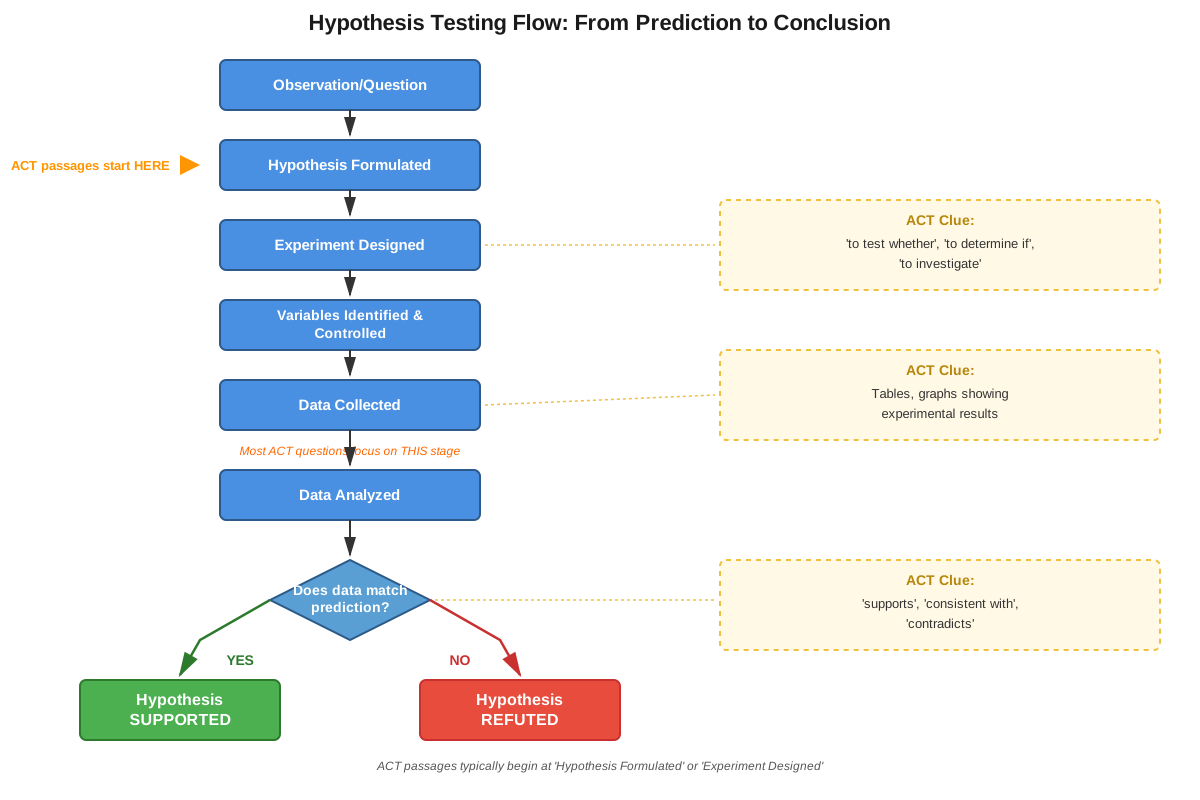
Experiments are specifically designed to test hypotheses by creating conditions where predicted outcomes can be observed and measured. The ACT frequently asks students to understand this connection between hypothesis and experimental design.
A well-designed experiment to test a hypothesis includes:
- Manipulation of the independent variable: The factor the hypothesis predicts will cause an effect
- Measurement of the dependent variable: The outcome the hypothesis predicts will change
- Control of extraneous variables: Other factors held constant to ensure valid results
- Control group or baseline: A comparison condition to evaluate the effect
For example, if the hypothesis states "Increasing carbon dioxide concentration increases the rate of photosynthesis," an appropriate experiment would manipulate CO₂ levels (independent variable), measure photosynthesis rate (dependent variable), while keeping light, temperature, and water constant (controlled variables).
Evaluating Hypotheses with Data
The ACT frequently tests whether students can determine if experimental results support or refute a hypothesis. This requires comparing predicted outcomes with actual results:
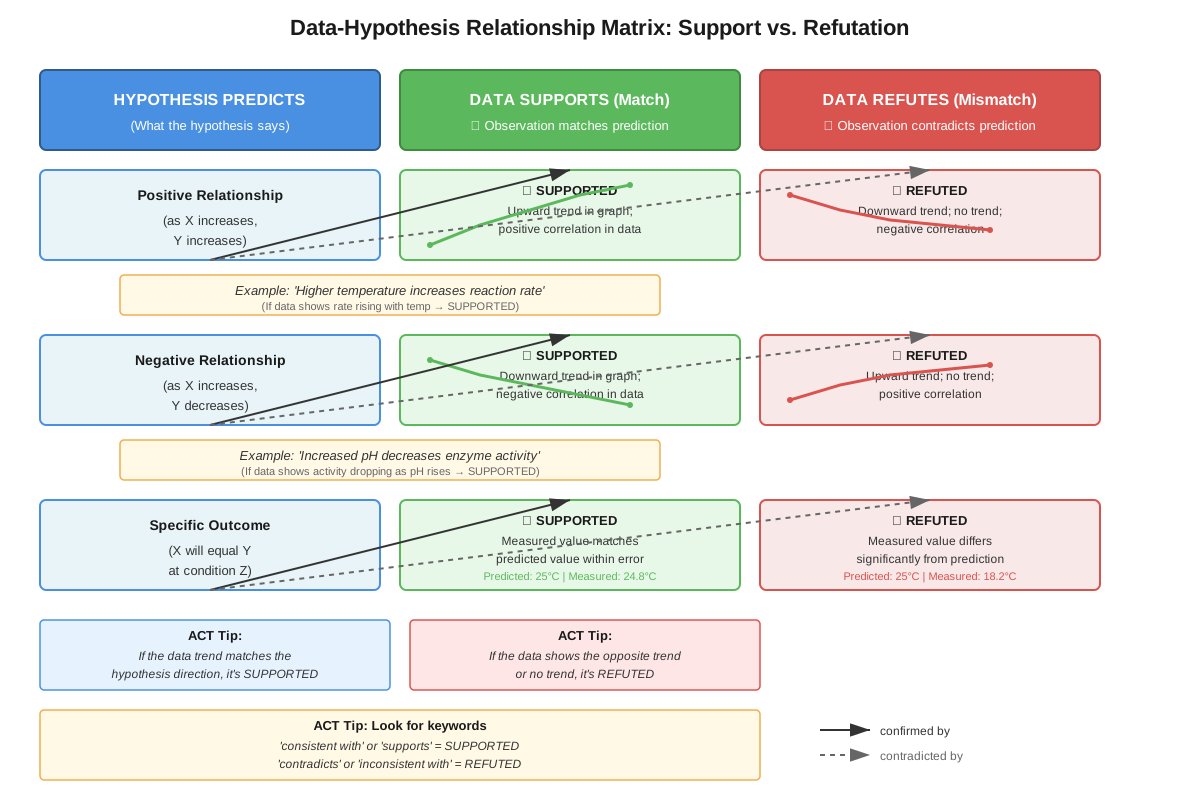
Supporting evidence occurs when experimental data matches the hypothesis's predictions. If a hypothesis predicts "As temperature increases, solubility increases," and data shows solubility rising from 20g/L at 20°C to 40g/L at 40°C to 60g/L at 60°C, the hypothesis is supported.
Refuting evidence occurs when data contradicts predictions. Using the same hypothesis, if data showed solubility decreasing as temperature increased, the hypothesis would be refuted.
Inconclusive results occur when data neither clearly supports nor refutes the hypothesis, often due to no significant difference between conditions or high variability in measurements.
Distinguishing Hypotheses from Related Concepts
Students must differentiate hypotheses from other scientific statements that appear in ACT passages:
| Concept | Definition | Example | Key Difference from Hypothesis |
|---|---|---|---|
| Observation | Factual description of what was seen/measured | "The solution turned blue" | Describes what happened, doesn't predict |
| Theory | Well-established explanation supported by extensive evidence | "Cell theory" | Broader scope, extensively tested |
| Law | Description of consistent natural pattern | "Law of conservation of mass" | Describes what always happens, not a prediction to test |
| Conclusion | Interpretation of results after experiment | "The data shows temperature affects rate" | Comes after testing, not before |
| Prediction | Specific forecast for one experiment | "Trial 3 will yield 45 mL" | More specific than hypothesis, applies to single instance |
Concept Relationships
The concept of hypothesis serves as the central organizing principle for Research Summaries passages, connecting multiple elements of scientific investigation. Observations → lead to → Questions → which generate → Hypotheses → that guide → Experimental Design → producing → Data → used to → Evaluate Hypotheses → resulting in → Conclusions.
Within hypothesis work itself, several concepts interconnect: Hypothesis identification requires understanding experimental purpose, which connects to variable relationships. Hypothesis evaluation depends on data interpretation skills, which rely on graph and table reading abilities. Alternative hypotheses emerge from conflicting data, which requires critical analysis of experimental limitations.
The relationship between hypotheses and variables is particularly important: hypotheses predict how the independent variable (manipulated factor) will affect the dependent variable (measured outcome). Understanding this relationship enables students to predict experimental results and evaluate whether data supports predictions. When multiple hypotheses exist, they often propose different relationships between the same variables, requiring students to determine which prediction matches the actual data.
High-Yield Facts
⭐ A hypothesis is a testable prediction made before conducting an experiment, not a conclusion drawn afterward
⭐ Hypotheses typically predict relationships between independent and dependent variables
⭐ Data supports a hypothesis when experimental results match predictions; data refutes a hypothesis when results contradict predictions
⭐ The ACT often asks students to identify what results would support or refute a given hypothesis
⭐ Hypotheses must be falsifiable—there must be a possible experimental outcome that could prove them wrong
- Hypotheses can be explicitly stated ("The scientist hypothesized that...") or implicit in the experimental design
- Multiple hypotheses can be tested in a single experiment by comparing different treatment groups
- A hypothesis is not proven true by supporting data; it is only supported or consistent with the evidence
- Conflicting results from different experiments may indicate that alternative hypotheses should be considered
- The null hypothesis (no effect or no difference) is an important concept when evaluating whether observed differences are meaningful
- Hypotheses often use conditional language: "if," "then," "will," "should," "affects," "causes"
Quick check — test yourself on Hypothesis so far.
Try Flashcards →Common Misconceptions
Misconception: A hypothesis is the same as an educated guess or opinion.
Correction: While hypotheses are tentative, they must be based on prior knowledge or observations and must be testable through experimentation. They are specific predictions about measurable outcomes, not casual guesses.
Misconception: If data supports a hypothesis, the hypothesis is proven true.
Correction: Scientific hypotheses are never "proven" in absolute terms. Supporting data increases confidence in a hypothesis, but it remains open to revision if future evidence contradicts it. Scientists say data "supports" or is "consistent with" a hypothesis rather than "proves" it.
Misconception: A hypothesis that is refuted by data represents a failed experiment.
Correction: Refuting a hypothesis is a valuable scientific outcome. It eliminates incorrect explanations and guides researchers toward better hypotheses. The experiment succeeds if it produces clear, reliable data, regardless of whether that data supports or refutes the hypothesis.
Misconception: The hypothesis is always explicitly stated in ACT passages.
Correction: Many ACT passages present hypotheses implicitly through the experimental design or research question. Students must infer the hypothesis by identifying what relationship the experiment is designed to test.
Misconception: Observations and hypotheses are the same thing.
Correction: Observations are factual descriptions of what was seen or measured, while hypotheses are predictive statements about what should happen under certain conditions. Observations often lead to hypotheses, but they serve different roles in the scientific process.
Misconception: A hypothesis must use "if-then" format.
Correction: While "if-then" statements are common, hypotheses can be stated in various ways: "X affects Y," "As X increases, Y decreases," or "X is caused by Y." The key is that they make testable predictions about relationships between variables.
Worked Examples
Example 1: Identifying and Evaluating a Hypothesis
Passage Summary: Scientists investigated whether different wavelengths of light affect the rate of photosynthesis in aquatic plants. They placed identical plants in tanks illuminated with red light, blue light, green light, or white light, keeping all other conditions constant. After two weeks, they measured oxygen production as an indicator of photosynthesis rate.
Results:
- Red light: 45 mL O₂/hour
- Blue light: 42 mL O₂/hour
- Green light: 18 mL O₂/hour
- White light: 50 mL O₂/hour
Question: Which hypothesis is best supported by the experimental results?
A) All wavelengths of light produce equal rates of photosynthesis
B) Green light produces the highest rate of photosynthesis
C) Different wavelengths of light produce different rates of photosynthesis
D) Light wavelength does not affect photosynthesis rate
Solution Process:
Step 1: Identify what the experiment tested. The experiment manipulated light wavelength (independent variable) and measured oxygen production/photosynthesis rate (dependent variable), so the hypothesis should predict a relationship between these variables.
Step 2: Analyze the data pattern. The results show clear differences: green light produced much less oxygen (18 mL/hour) compared to red (45), blue (42), and white (50). This indicates wavelength does affect photosynthesis rate.
Step 3: Evaluate each option against the data:
- Option A predicts equal rates, but data shows unequal rates (18 vs. 50) → refuted
- Option B predicts green light produces the highest rate, but green produced the lowest (18 mL/hour) → refuted
- Option C predicts different wavelengths produce different rates, which matches the data showing variation from 18 to 50 → supported
- Option D predicts no effect, but clear differences exist → refuted
Answer: C
Connection to Learning Objectives: This example demonstrates identifying the hypothesis being tested (wavelength affects photosynthesis), evaluating whether data supports the hypothesis (comparing predictions to results), and applying hypothesis concepts to ACT-style questions.
Example 2: Predicting Results Based on a Hypothesis
Passage Summary: A researcher hypothesized that increasing substrate concentration would increase enzyme reaction rate until all enzyme molecules are saturated with substrate, after which further increases in substrate would not affect reaction rate.
Existing Data:
- 1 mM substrate: 10 μmol product/min
- 2 mM substrate: 18 μmol product/min
- 4 mM substrate: 28 μmol product/min
- 8 mM substrate: 35 μmol product/min
Question: According to the hypothesis, if the researcher tested 16 mM substrate concentration, the reaction rate would most likely be:
A) Significantly lower than at 8 mM
B) Approximately the same as at 8 mM
C) Significantly higher than at 8 mM
D) Exactly double the rate at 8 mM
Solution Process:
Step 1: Understand the hypothesis. The hypothesis predicts two phases: (1) increasing substrate increases reaction rate, and (2) once enzymes are saturated, further substrate increases don't affect rate.
Step 2: Analyze the existing data pattern. From 1 to 2 mM, rate increased by 8 units. From 2 to 4 mM, rate increased by 10 units. From 4 to 8 mM, rate increased by only 7 units. The rate of increase is slowing, suggesting the enzyme is approaching saturation.
Step 3: Apply the hypothesis to predict 16 mM results. Since the rate increase is slowing (7 units from 4 to 8 mM) and the hypothesis predicts no increase after saturation, the rate at 16 mM should be similar to 8 mM, indicating saturation has been reached.
Step 4: Evaluate options:
- Option A (significantly lower) contradicts the hypothesis—rate shouldn't decrease
- Option B (approximately the same) matches the saturation prediction → correct
- Option C (significantly higher) would contradict the saturation part of the hypothesis
- Option D (exactly double) assumes a linear relationship that doesn't match the hypothesis
Answer: B
Connection to Learning Objectives: This example shows how to apply hypothesis concepts to predict experimental outcomes, demonstrating understanding of how hypotheses guide expectations about data patterns.
Exam Strategy
When approaching hypothesis questions on the ACT Science section, follow this systematic process:
Step 1: Locate the hypothesis by scanning for key phrases: "hypothesized that," "predicted that," "to test whether," or "investigated if." If not explicitly stated, identify the research question and convert it to a predictive statement about variable relationships.
Step 2: Identify the variables mentioned in the hypothesis. Determine which is the independent variable (manipulated) and which is the dependent variable (measured). Understanding this relationship is crucial for evaluating whether data supports the hypothesis.
Step 3: Determine the predicted relationship. Does the hypothesis predict an increase, decrease, positive correlation, negative correlation, or no relationship? Be precise about the direction and nature of the predicted effect.
Step 4: Compare predictions to actual data. Look at graphs, tables, or text descriptions of results. Does the data pattern match what the hypothesis predicted? Supporting evidence shows agreement; refuting evidence shows contradiction.
Exam Tip: When questions ask "which hypothesis is supported," eliminate options that contradict the data before selecting the best match. Often 2-3 options can be quickly eliminated because they predict opposite patterns from what the data shows.
Trigger words and phrases that signal hypothesis questions include:
- "According to the hypothesis..."
- "Which hypothesis is supported by..."
- "The experiment was designed to test..."
- "If the hypothesis is correct, then..."
- "Which result would refute..."
- "The scientist predicted that..."
Process-of-elimination strategy: For hypothesis identification questions, eliminate options that are:
- Observations rather than predictions (describe what was seen, not what should happen)
- Too broad or vague to be testable
- Conclusions drawn after the experiment rather than predictions made before
- Statements that don't relate to the variables actually tested in the experiment
Time allocation: Hypothesis questions typically require 30-45 seconds each. Spend 10-15 seconds locating and understanding the hypothesis, 15-20 seconds analyzing relevant data, and 10 seconds selecting and confirming your answer. Don't spend excessive time on these questions—they test straightforward logical reasoning rather than complex calculations.
Memory Techniques
H-Y-P-O Acronym for hypothesis characteristics:
- Has to be testable
- Yields predictions about outcomes
- Proposes relationships between variables
- Occurs before experimentation
"If-Then-Test" Mnemonic: Remember that hypotheses follow a logical sequence:
- If [condition exists]
- Then [outcome should occur]
- Test [through experimentation]
The SUPPORT Framework for evaluating hypotheses:
- Scan the data
- Understand the prediction
- Pattern match (does data match prediction?)
- Point to specific evidence
- Opposite patterns refute
- Remember: support ≠ proof
- Tentative conclusions only
Visualization Strategy: Picture a hypothesis as a bridge between a question and an experiment. The question is on one side ("Does temperature affect reaction rate?"), the experiment is on the other side (heating solutions and measuring rates), and the hypothesis is the bridge connecting them ("Increasing temperature will increase reaction rate"). This mental image helps remember that hypotheses link questions to experimental designs.
Variable Relationship Reminder: Use the phrase "Independent Predicts Dependent" (IPD) to remember that hypotheses predict how the independent variable affects the dependent variable.
Summary
Hypotheses represent testable predictions about relationships between variables and form the foundation of scientific investigation on ACT Research Summaries passages. Students must recognize that hypotheses are proposed before experiments, make specific predictions about outcomes, and can be evaluated by comparing predicted results with actual data. The ACT tests hypothesis skills through identification questions, evaluation questions requiring students to determine whether data supports or refutes predictions, and application questions asking students to predict outcomes based on hypothetical scenarios. Successful students distinguish hypotheses from observations, conclusions, and theories, understand how experimental designs test specific predictions, and can analyze data to determine whether results match predicted patterns. Mastering hypothesis concepts requires recognizing both explicit statements and implicit predictions embedded in experimental designs, understanding the relationship between independent and dependent variables, and applying logical reasoning to connect predictions with evidence. The key to success is systematic analysis: identify the hypothesis, determine what it predicts, examine the data, and evaluate whether results match predictions.
Key Takeaways
- A hypothesis is a testable prediction made before experimentation that proposes relationships between variables, not a conclusion drawn from results
- Hypotheses can be explicitly stated or implicitly embedded in experimental designs; students must recognize both formats on the ACT
- Data supports a hypothesis when results match predictions and refutes a hypothesis when results contradict predictions; supporting evidence does not "prove" a hypothesis true
- The ACT frequently tests whether students can identify which hypothesis is supported by data, predict outcomes based on hypotheses, or determine what results would refute a hypothesis
- Distinguishing hypotheses from observations, conclusions, and theories is essential for correctly answering ACT questions
- Effective hypothesis evaluation requires identifying independent and dependent variables, understanding predicted relationships, and systematically comparing predictions to actual data
- Trigger phrases like "hypothesized that," "predicted that," and "to test whether" signal hypothesis content in passages
Related Topics
Experimental Design: Understanding how scientists structure experiments to test hypotheses, including control groups, variable manipulation, and replication. Mastering hypotheses provides the foundation for understanding why experiments are designed in specific ways.
Data Interpretation: Analyzing graphs, tables, and charts to extract meaningful patterns. Hypothesis evaluation depends on strong data interpretation skills to determine whether results match predictions.
Scientific Method: The broader process of scientific inquiry, from observation through conclusion. Hypotheses represent one crucial stage in this process, connecting questions to experimental testing.
Variables and Controls: Identifying and understanding independent, dependent, and controlled variables in experiments. This knowledge is essential for formulating and evaluating hypotheses about variable relationships.
Conflicting Viewpoints: Comparing multiple scientific perspectives or theories. This advanced topic builds on hypothesis skills by requiring students to evaluate competing explanations for the same phenomena.
Practice CTA
Now that you understand how hypotheses function in scientific research and on the ACT Science section, it's time to apply these concepts to practice questions. Work through the practice problems to reinforce your ability to identify hypotheses, evaluate them against data, and predict outcomes based on hypothetical scenarios. Use the flashcards to memorize key characteristics that distinguish hypotheses from other scientific statements. Remember: hypothesis questions are among the most predictable and high-yield on the ACT Science test—mastering this topic will directly improve your score. Approach each practice question systematically using the strategies outlined in this guide, and you'll develop the confidence and skills needed to tackle any hypothesis question on test day.
Sign up free to keep reading
Create a free AnvayaPrep account to finish this ACT guide on Hypothesis — plus flashcards and practice questions.