Overview
Multiple data series refers to the presentation of two or more related sets of data within a single graph, table, or figure. On the ACT Science test, this concept is fundamental to the Data Representation passages, where students must interpret complex visual displays that show multiple variables, experimental conditions, or comparative datasets simultaneously. Rather than examining isolated data points, students encounter scenarios where several trends, patterns, or experimental outcomes are layered together, requiring careful analysis to distinguish between different series and extract accurate information.
Understanding how to navigate ACT multiple data series questions is essential because approximately 30-40% of ACT Science questions involve interpreting graphs or tables with multiple datasets. These questions test not only reading comprehension of scientific data but also the ability to compare trends, identify relationships between variables, and draw conclusions from overlapping information. Students who master this skill can quickly differentiate between data series using legends, symbols, colors, or line styles, and can accurately extract specific values or trends for each series without confusion.
This topic serves as a cornerstone for success in ACT Science because it bridges basic graph reading skills with more advanced data analysis required in Research Summaries and Conflicting Viewpoints passages. Multiple data series questions often integrate concepts from all three passage types, making this skill universally applicable throughout the Science section. The ability to handle multiple data series efficiently also supports time management, as these questions can be answered quickly once students develop systematic approaches to visual data interpretation.
Learning Objectives
- [ ] Identify when Multiple data series is being tested in ACT Science passages
- [ ] Explain the core rule or strategy behind Multiple data series interpretation
- [ ] Apply Multiple data series analysis to ACT-style questions accurately
- [ ] Distinguish between different data series using legends, symbols, and visual markers
- [ ] Compare trends across multiple data series to identify similarities and differences
- [ ] Extract specific numerical values from individual series within complex graphs
- [ ] Recognize common graph types that display multiple data series (line graphs, bar charts, scatter plots)
Prerequisites
- Basic graph reading skills: Understanding axes, scales, and coordinate systems is essential for locating data points within any series
- Variable identification: Recognizing independent and dependent variables helps determine which data series represents which experimental condition
- Unit interpretation: Converting and comparing values across different scales or units ensures accurate data extraction
- Legend comprehension: Reading and applying information from legends, keys, and captions is necessary to distinguish between series
Why This Topic Matters
Multiple data series questions appear in virtually every ACT Science test, typically comprising 8-12 questions per exam. These questions are considered "high-yield" because they are both frequent and relatively quick to answer once students develop proficiency. In real-world scientific research, multiple data series presentations are the standard method for comparing experimental conditions, showing relationships between variables, and communicating complex findings efficiently. Scientists use these visualizations to display control versus experimental groups, different time points, various concentrations, or multiple dependent variables measured simultaneously.
On the ACT, multiple data series questions most commonly appear in Data Representation passages (which contain 5 questions each and typically include 2-3 passages per test). However, they also frequently appear in Research Summaries passages where experimental results from multiple trials or conditions are compared. The exam tests this concept through several question types: direct reading questions that ask for specific values from one series, comparison questions that require analyzing trends across series, interpolation/extrapolation questions, and questions about the relationship between variables shown in different series.
Students who struggle with multiple data series often lose points not because they lack scientific knowledge, but because they misidentify which data series the question references or confuse overlapping lines and symbols. Mastering this topic provides a significant competitive advantage because these questions are designed to be answerable quickly—often in 30-45 seconds—freeing up time for more challenging Conflicting Viewpoints questions.
Core Concepts
Understanding Data Series Structure
A data series is a set of related data points that represent a single variable, condition, or experimental group plotted on a graph or organized in a table. When multiple data series appear together, each series maintains its own identity through visual distinguishers such as different colors, line styles (solid, dashed, dotted), symbols (circles, squares, triangles), or separate columns/rows in tables. The fundamental principle is that each series tells its own story while existing within the same coordinate system or organizational structure.
On ACT graphs, multiple data series typically share common axes, meaning they use the same scale and units for comparison. For example, a graph showing plant growth over time might display three data series: plants receiving full sunlight, partial shade, and full shade. All three series would share the x-axis (time in days) and y-axis (height in centimeters), but each would be represented by a different line style or symbol to maintain distinction.
Types of Visual Representations
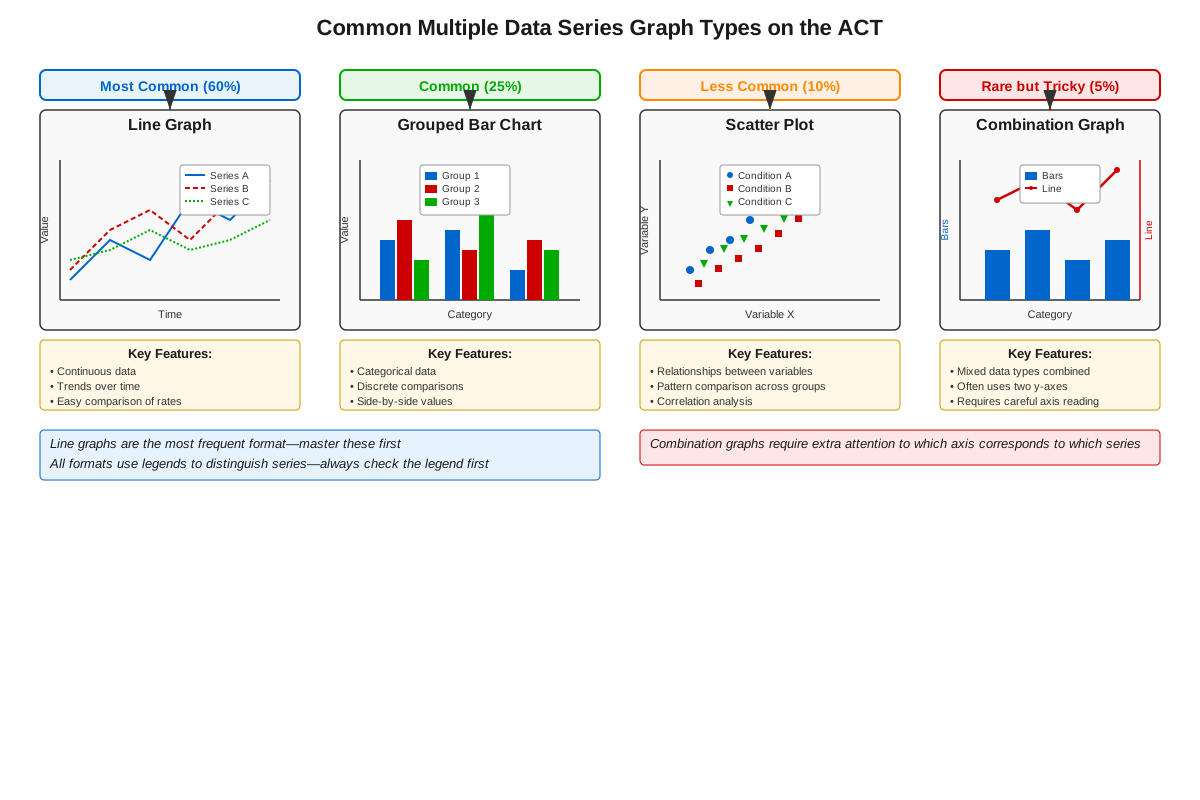
Line graphs are the most common format for displaying multiple data series on the ACT. Each series appears as a separate line, often distinguished by solid versus dashed patterns, different colors (though ACT graphs are typically black and white), or different symbols at data points. Line graphs excel at showing trends over continuous variables like time, temperature, or concentration.
Bar charts present multiple data series through grouped or stacked bars. Grouped bars place bars for different series side-by-side for each category, making direct comparison straightforward. Stacked bars show cumulative values, with each series represented as a segment within a single bar. The ACT typically uses grouped bars because they facilitate easier comparison questions.
Scatter plots with multiple data series show different experimental conditions or groups as distinct sets of points, each marked with unique symbols. These are particularly common when showing correlations or relationships between two continuous variables across different conditions.
Tables organize multiple data series in columns or rows, with clear headers identifying each series. Tables are advantageous when precise numerical values are needed and when data doesn't follow a continuous trend that would benefit from graphical representation.
Reading Legends and Keys
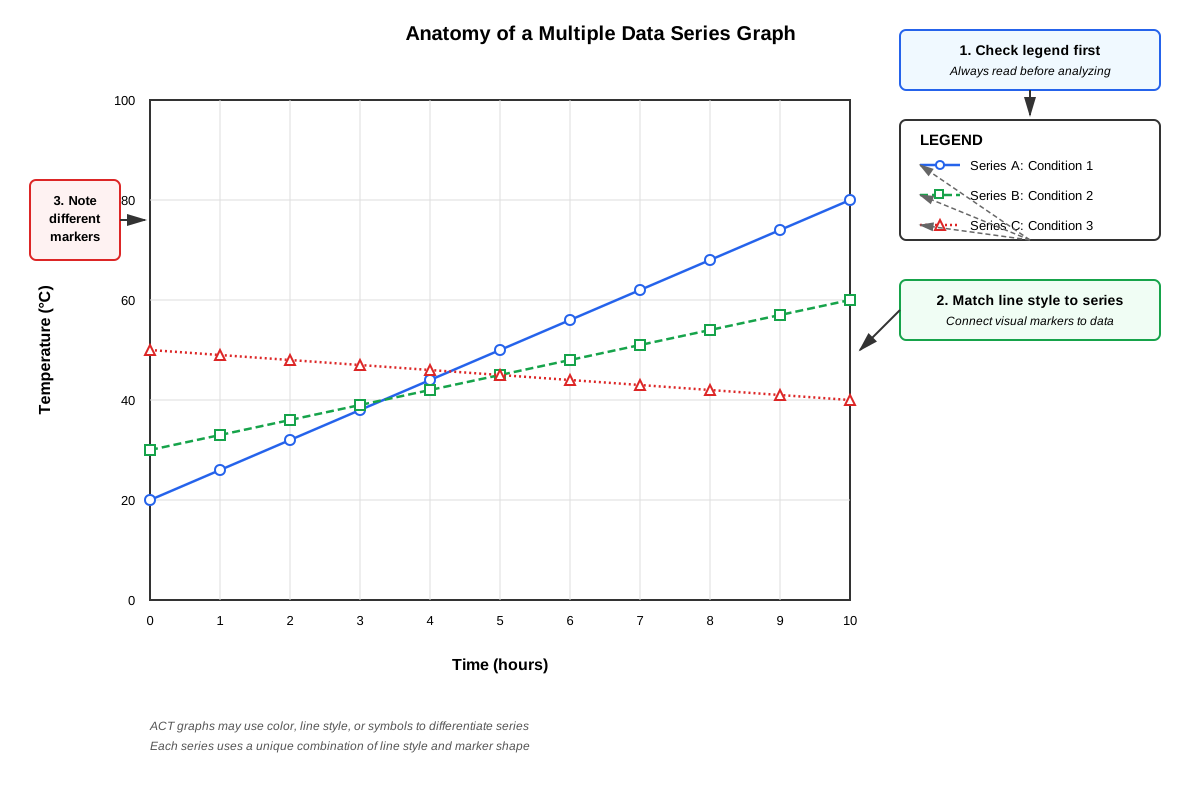
The legend or key is the critical reference tool that identifies what each visual element represents. On the ACT, legends typically appear in a box near the graph, often in the upper right corner or below the figure. Legends use the same visual markers (line styles, symbols, shading patterns) that appear in the graph itself, paired with text descriptions of what each represents.
Effective legend reading requires a systematic approach:
- Locate the legend immediately upon encountering a multi-series graph
- Identify the distinguishing feature (line style, symbol, shading)
- Match the description to the specific experimental condition or variable
- Reference back to the legend for each question to avoid confusion
Extracting Data from Specific Series
When questions ask for values from a particular data series, students must:
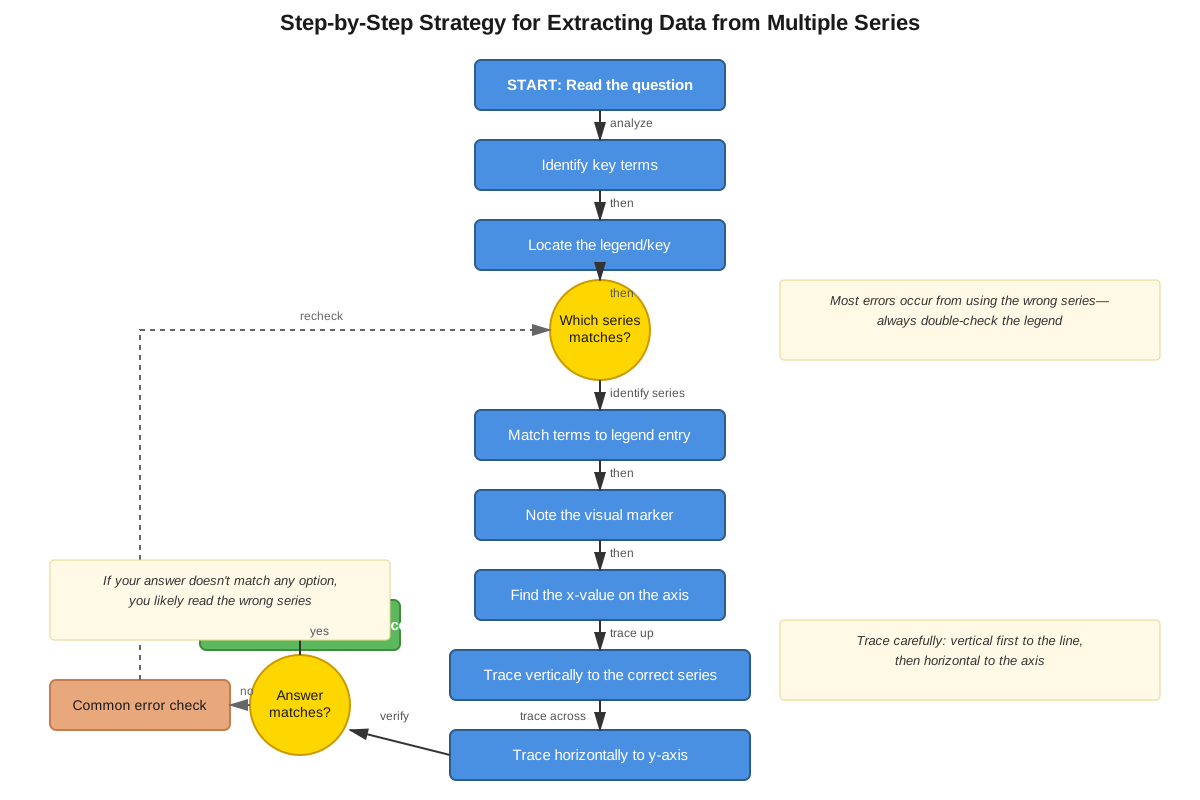
- Identify the target series using the legend and the question's description
- Locate the relevant point on the x-axis (independent variable value)
- Trace vertically to intersect with the correct data series line or point
- Read horizontally to the y-axis to determine the dependent variable value
- Verify by checking that the visual marker matches the legend
Common errors occur when students trace to the wrong series, especially when lines cross or come close together. The solution is to follow the specific line style or symbol pattern carefully, using a straight edge mentally or with a finger if needed during the test.
Comparing Trends Across Series
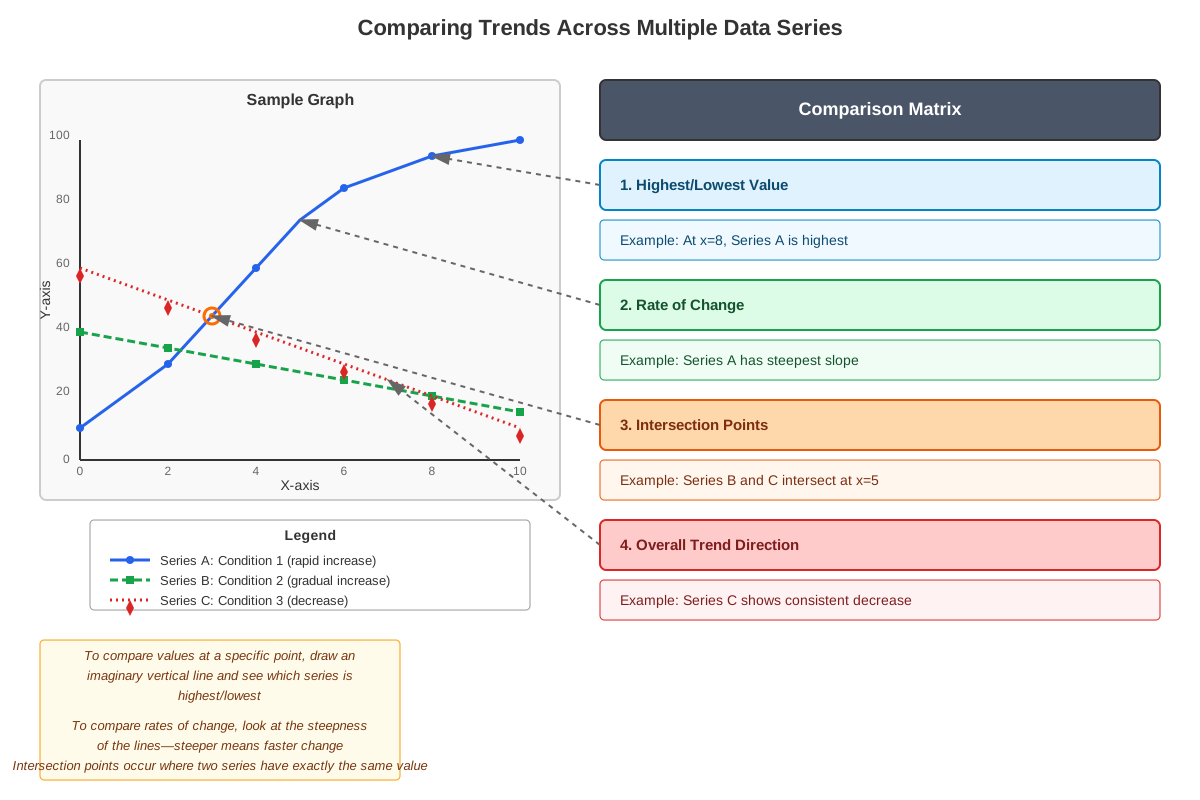
ACT questions frequently ask students to compare patterns, such as "Which series shows the greatest increase?" or "At what point do Series A and B have equal values?" These questions require understanding trend analysis:
- Slope comparison: Steeper lines indicate faster rates of change
- Direction: Positive slopes show increasing relationships; negative slopes show decreasing relationships
- Magnitude: The vertical distance between series indicates the size of differences
- Intersection points: Where series cross indicates equal values at that x-coordinate
Interpolation and Extrapolation
Interpolation involves estimating values between measured data points within the range of collected data. For multiple data series, this means following the trend of a specific series to estimate unmeasured values. Extrapolation extends beyond the measured range, predicting values outside the data collection window. The ACT more commonly tests interpolation because it's more scientifically reliable.
When interpolating from multiple data series:
- Identify which series the question references
- Locate the two data points that bracket the target x-value
- Estimate the y-value by following the line or curve pattern
- Compare your estimate to answer choices, selecting the closest match
Concept Relationships
Multiple data series interpretation builds directly on basic graph reading skills, extending single-dataset analysis to comparative analysis. The relationship flows as follows:
Basic Graph Components (axes, scales, labels) → Single Data Series Reading → Multiple Data Series Interpretation → Comparative Analysis → Experimental Design Understanding
Within the topic itself, concepts are hierarchically connected:
Visual Identification (recognizing that multiple series exist) → Legend Interpretation (determining what each series represents) → Data Extraction (pulling specific values) → Trend Comparison (analyzing patterns across series) → Conclusion Drawing (answering questions about relationships)
The connection to prerequisite topics is essential: without understanding independent and dependent variables, students cannot properly interpret which axis represents which variable across multiple series. Without unit interpretation skills, comparing series with different scales becomes impossible. The topic also connects forward to Research Summaries passages, where multiple experiments or trials generate multiple data series that must be compared to draw scientific conclusions.
Multiple data series questions often integrate with other ACT Science skills such as experimental design (understanding why multiple series exist—different conditions, controls, etc.) and scientific reasoning (using data patterns to support or refute hypotheses). This integration means that mastering multiple data series interpretation enhances performance across all Science passage types.
High-Yield Facts
⭐ Multiple data series graphs always include a legend or key that identifies what each visual element represents
⭐ When lines cross on a graph, the intersection point represents where the two series have equal values for the dependent variable
⭐ The steepest line or curve in a multiple series graph indicates the fastest rate of change
⭐ ACT questions asking "according to Figure X" require identifying the correct data series before extracting any values
⭐ Different line styles (solid, dashed, dotted) or symbols (circles, squares, triangles) distinguish series on black-and-white ACT graphs
- Bar charts with multiple series typically use different shading patterns or place bars side-by-side for comparison
- Tables presenting multiple data series organize each series in separate columns or rows with clear headers
- Scatter plots with multiple series use different symbols to represent different experimental groups or conditions
- The y-axis value at any x-coordinate can differ significantly between series, making series identification critical
- Questions asking for "the difference between" two series require extracting values from both and calculating
- Extrapolation questions (predicting beyond measured data) are less common than interpolation questions on the ACT
- When multiple series show the same general trend (all increasing or all decreasing), questions often focus on magnitude differences
Quick check — test yourself on Multiple data series so far.
Try Flashcards →Common Misconceptions
Misconception: All lines or data points on a single graph represent the same experimental condition or variable.
Correction: Each distinct data series represents a different condition, variable, group, or experimental trial. The legend specifies what each series represents, and treating all data as equivalent leads to incorrect answers.
Misconception: The highest line on a graph always represents the "best" or most desirable outcome.
Correction: The interpretation of "highest" depends entirely on what the dependent variable measures. Higher values might represent worse outcomes (e.g., disease incidence, pollution levels) or better outcomes (e.g., crop yield, efficiency). The question context determines interpretation.
Misconception: When two lines are close together, they can be treated as the same data series.
Correction: Even small separations between data series represent meaningful differences in the dependent variable. ACT questions specifically test the ability to distinguish between similar but distinct series, and treating them as equivalent will lead to wrong answers.
Misconception: The legend only needs to be checked once at the beginning of a passage.
Correction: Each question may reference different data series, requiring repeated reference to the legend. Assuming you remember which line is which without checking leads to series confusion, especially when multiple questions appear in sequence.
Misconception: If a question doesn't explicitly name a data series, any series can be used to answer it.
Correction: Questions always contain clues about which series to use, either through explicit naming ("according to the data for Group A"), contextual description ("for plants receiving full sunlight"), or by referencing specific conditions mentioned in the passage. Identifying the correct series is part of what the question tests.
Misconception: Data points between measured values can be ignored since they weren't actually measured.
Correction: Interpolation between measured points is scientifically valid and frequently tested on the ACT. The trend line or curve connecting measured points represents the best estimate of values between measurements, and questions often ask about these intermediate values.
Worked Examples
Example 1: Line Graph with Three Data Series
Scenario: A graph shows temperature (°C) on the y-axis and time (hours) on the x-axis. Three lines represent different locations: Location A (solid line), Location B (dashed line), and Location C (dotted line). At hour 0, all locations start at 20°C. By hour 4, Location A reaches 32°C, Location B reaches 28°C, and Location C reaches 24°C.
Question: According to the graph, at approximately what time did Location A reach 26°C?
Solution Process:
- Identify the target series: The question asks about Location A, which the legend indicates is the solid line.
- Locate the target value: We need to find when Location A (solid line) reached 26°C on the y-axis.
- Trace horizontally: Starting at 26°C on the y-axis, trace horizontally until intersecting the solid line (Location A).
- Read down to x-axis: From the intersection point, trace vertically down to the x-axis to read the time value.
- Interpolate if necessary: Location A starts at 20°C (hour 0) and reaches 32°C (hour 4). The value 26°C is halfway between 20°C and 32°C. Since the line appears relatively straight, 26°C would occur at approximately hour 2 (halfway through the time period).
- Verify: Check that the intersection point is on the solid line, not the dashed or dotted lines representing other locations.
Answer: Approximately 2 hours
Connection to Learning Objectives: This example demonstrates identifying which data series is being tested (Location A/solid line), applying the strategy of using the legend to distinguish series, and accurately extracting a specific value through interpolation.
Example 2: Bar Chart with Multiple Series
Scenario: A grouped bar chart shows enzyme activity (units/mL) for three enzymes (Enzyme X, Enzyme Y, Enzyme Z) at four different pH levels (5, 6, 7, 8). At pH 7, Enzyme X shows 45 units/mL (white bars), Enzyme Y shows 30 units/mL (gray bars), and Enzyme Z shows 60 units/mL (black bars). At pH 8, Enzyme X shows 20 units/mL, Enzyme Y shows 55 units/mL, and Enzyme Z shows 40 units/mL.
Question: Based on the data, which enzyme shows the greatest decrease in activity when pH increases from 7 to 8?
Solution Process:
- Identify relevant series: All three enzyme series (X, Y, Z) must be examined since the question asks for comparison.
- Extract values at pH 7:
- Enzyme X: 45 units/mL
- Enzyme Y: 30 units/mL
- Enzyme Z: 60 units/mL
- Extract values at pH 8:
- Enzyme X: 20 units/mL
- Enzyme Y: 55 units/mL
- Enzyme Z: 40 units/mL
- Calculate changes:
- Enzyme X: 45 - 20 = 25 units/mL decrease
- Enzyme Y: 55 - 30 = 25 units/mL increase (not a decrease)
- Enzyme Z: 60 - 40 = 20 units/mL decrease
- Compare decreases: Enzyme X shows a 25 unit/mL decrease, Enzyme Z shows a 20 unit/mL decrease, and Enzyme Y actually increases.
- Select answer: Enzyme X shows the greatest decrease.
Answer: Enzyme X
Connection to Learning Objectives: This example demonstrates comparing trends across multiple data series, extracting specific numerical values from individual series, and applying systematic analysis to ACT-style questions. It also shows how bar charts present multiple series through grouped bars with different shading patterns.
Exam Strategy
When approaching ACT Science questions involving multiple data series, implement this systematic process:
Step 1: Immediate Legend Check - Before reading any question, locate and briefly scan the legend to understand how many series exist and what distinguishes them. This 5-second investment prevents confusion throughout all questions for that figure.
Step 2: Question Analysis - Identify trigger words that specify which data series the question references:
- "According to the data for..." (explicit series naming)
- "In Trial 2..." (trial numbers correspond to series)
- "For the group that received..." (condition descriptions)
- "The solid line shows..." (visual element descriptions)
Step 3: Series Isolation - Mentally or physically (with your finger) trace only the relevant data series, ignoring others temporarily. This prevents accidentally reading values from the wrong series.
Step 4: Value Extraction - Use the two-step trace method: horizontal from the y-axis to the series line, then vertical to the x-axis (or vice versa depending on what the question asks).
Step 5: Verification - Before selecting an answer, verify that the visual marker (line style, symbol, shading) matches what the legend indicates for your target series.
Exam Tip: When multiple answer choices are numerically close, the question is testing whether you can distinguish between similar data series. Double-check that you're reading from the correct series.
Time Allocation: Allocate 30-45 seconds per multiple data series question. These are designed to be quick points if approached systematically. If a question takes longer than 60 seconds, mark it and return after completing easier questions.
Process of Elimination:
- Eliminate answers that would require reading from the wrong data series
- Eliminate answers outside the range shown for the specified series
- For comparison questions, eliminate answers that reverse the actual relationship (e.g., if Series A is always higher than Series B, eliminate answers saying B is higher)
Common Trigger Phrases:
- "According to Figure X..." → Check legend immediately
- "Which series shows..." → Comparison across all series required
- "At what value of [x-variable]..." → Interpolation likely needed
- "The difference between..." → Extract values from two specific series and calculate
Memory Techniques
L.I.S.T. Method for approaching multiple data series questions:
- Legend: Locate and read it first
- Identify: Determine which series the question asks about
- Series: Trace only the relevant series line or bars
- Trace: Follow to extract the correct value
"Same Graph, Different Stories" - Visualize each data series as telling its own story within the shared space. Just as multiple people can be in the same room doing different things, multiple data series occupy the same graph showing different patterns.
Symbol Association Mnemonic:
- Solid lines = Standard or control conditions (often)
- Dashed lines = Different experimental conditions
- Dotted lines = Distinct third condition
The "Point-Check-Read" Rhythm:
- Point to the legend entry
- Check the visual marker on the graph
- Read the value from the correct series
This rhythm, practiced during preparation, becomes automatic during the test.
Crossing Lines Rule: "When lines cross, values match" - At intersection points, both series have identical y-values for that x-coordinate. This is frequently tested.
Summary
Multiple data series interpretation is a foundational skill for ACT Science success, appearing in 30-40% of Science questions across Data Representation and Research Summaries passages. The core competency involves distinguishing between two or more related datasets presented simultaneously through visual markers (line styles, symbols, shading patterns) and legends, then accurately extracting values, comparing trends, and drawing conclusions from the specified series. Success requires systematic approaches: immediately locating and referencing legends, carefully identifying which series each question targets, isolating the relevant series while ignoring others, and using precise tracing methods to extract values. Common pitfalls include confusing similar series, reading from the wrong series, and failing to reference the legend for each question. Students who master this topic gain significant advantages in both accuracy and speed, as these questions are designed to be answered quickly once proper techniques are internalized. The ability to handle multiple data series also supports success in more complex passages where experimental comparisons and trend analysis across conditions are essential for answering higher-level reasoning questions.
Key Takeaways
- Multiple data series graphs require immediate legend identification to distinguish between different datasets using visual markers like line styles, symbols, or shading patterns
- Each question targets a specific data series, identified through explicit naming, condition descriptions, or visual element references in the question stem
- Systematic tracing prevents errors: locate the x-value, trace to the correct series line, then read the y-value, always verifying the visual marker matches the legend
- Comparison questions require extracting values from multiple series and calculating differences or identifying which shows greater/lesser values or steeper/shallower trends
- Intersection points indicate equal values between series at that specific x-coordinate, a frequently tested concept
- Time efficiency comes from practiced technique: these questions should take 30-45 seconds each, making them high-yield targets for score improvement
- Legend reference is not optional: checking the legend for each question prevents the most common error—reading from the wrong data series
Related Topics
Single Data Series Interpretation: Mastering multiple data series builds on the foundation of reading single-dataset graphs, extending those skills to comparative analysis across datasets.
Experimental Design and Controls: Understanding why multiple data series exist (different experimental conditions, control versus treatment groups, multiple trials) enhances interpretation and connects data representation to research methodology.
Trend Analysis and Prediction: Multiple data series questions often require identifying patterns, rates of change, and relationships between variables, skills that extend to more complex scientific reasoning questions.
Table Interpretation with Multiple Variables: The same principles of distinguishing between data series apply to complex tables where multiple columns or rows represent different conditions or measurements.
Conflicting Viewpoints Comparison: The skill of comparing multiple data series directly transfers to comparing different scientists' hypotheses or interpretations in Conflicting Viewpoints passages.
Practice CTA
Now that you've mastered the concepts and strategies for interpreting multiple data series, it's time to apply these skills to ACT-style practice questions. The practice questions and flashcards will reinforce your ability to quickly identify data series, extract accurate values, and compare trends under timed conditions. Remember, these questions are designed to be high-yield points on test day—consistent practice with the systematic approaches outlined in this guide will build both speed and accuracy. Challenge yourself to apply the L.I.S.T. method and verify your legend references for each question. Your investment in mastering this foundational skill will pay dividends across all ACT Science passage types!
Sign up free to keep reading
Create a free AnvayaPrep account to finish this ACT guide on Multiple data series — plus flashcards and practice questions.