Overview
Reading graphs is a foundational skill within the ACT Science test's Data Representation category, accounting for approximately 30-40% of all Science questions. This skill involves extracting, interpreting, and analyzing information presented in various graphical formats including line graphs, bar charts, scatter plots, and combination graphs. Success on the ACT Science section depends heavily on the ability to quickly and accurately decode visual data presentations, identify trends, compare values, and draw evidence-based conclusions from graphical information.
The ACT Science test is fundamentally a reading comprehension test disguised as a science assessment. While scientific knowledge helps, the primary challenge lies in rapidly processing complex visual information under strict time constraints—approximately 52 seconds per question. ACT reading graphs questions test whether students can navigate axes, interpret scales, identify relationships between variables, and extract specific data points without making careless errors. These questions appear in nearly every Data Representation passage and frequently within Research Summaries passages as well.
Mastering graph reading connects directly to other critical ACT Science skills including identifying variables, understanding experimental design, recognizing patterns and trends, and making predictions based on data. This topic serves as the gateway skill that enables students to tackle more complex question types involving data synthesis, hypothesis evaluation, and conflicting viewpoints analysis. Without solid graph-reading abilities, students will struggle throughout the entire Science section, making this one of the highest-yield topics for focused preparation.
Learning Objectives
- [ ] Identify when Reading graphs is being tested in ACT Science passages
- [ ] Explain the core rule or strategy behind Reading graphs
- [ ] Apply Reading graphs to ACT-style questions accurately
- [ ] Distinguish between different graph types and their appropriate interpretation methods
- [ ] Extract precise numerical values from graphs with varying scales and units
- [ ] Identify and describe trends, patterns, and relationships shown in graphical data
- [ ] Compare multiple data sets presented within a single graph or across multiple graphs
Prerequisites
- Basic coordinate system understanding: Familiarity with x-axis (horizontal) and y-axis (vertical) orientation is essential for locating data points and understanding how variables relate to each other
- Numerical literacy and estimation skills: The ability to read scales, interpolate between marked values, and perform basic mental math enables quick data extraction without calculation errors
- Scientific notation and unit awareness: Recognizing different measurement units and scientific notation formats prevents misinterpretation of magnitude and scale
- Variable identification: Understanding the difference between independent variables (typically on x-axis) and dependent variables (typically on y-axis) provides context for cause-and-effect relationships
Why This Topic Matters
Graph reading skills extend far beyond standardized testing into virtually every STEM field, social science discipline, business analytics, and data-driven decision-making context. Scientists use graphs to communicate experimental results, engineers rely on graphical data to optimize designs, medical professionals interpret diagnostic charts, and policy makers analyze trend data to guide decisions. The ability to quickly extract meaning from visual data representations is a fundamental 21st-century literacy skill.
On the ACT Science test specifically, graph-reading questions appear with exceptional frequency. Approximately 15-20 of the 40 Science questions directly test graph interpretation skills, making this the single most commonly assessed competency on the exam. Data Representation passages, which constitute roughly 5-6 of the 6-7 total passages, center entirely on graph and table interpretation. Even Research Summaries and Conflicting Viewpoints passages regularly include graphs that students must analyze to answer questions correctly.
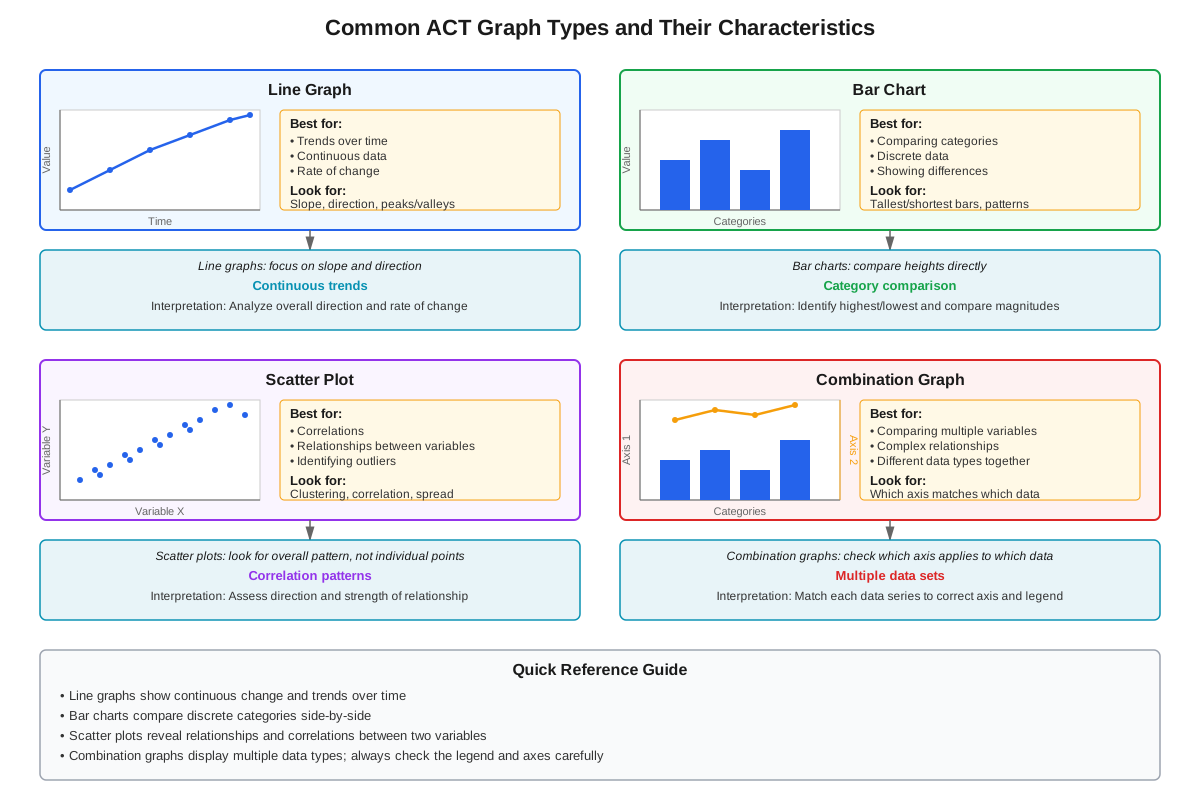
The ACT presents graphs in several characteristic ways: single-variable line graphs showing change over time, multi-variable line graphs comparing different conditions, bar charts comparing categories, scatter plots showing correlations, and combination graphs mixing multiple formats. Questions typically ask students to identify specific values, describe trends (increasing, decreasing, constant), compare data points, extrapolate beyond given data, or identify relationships between variables. The test deliberately includes distractors based on common reading errors—misreading scales, confusing variables, or selecting values from the wrong data series.
Core Concepts
Graph Components and Anatomy
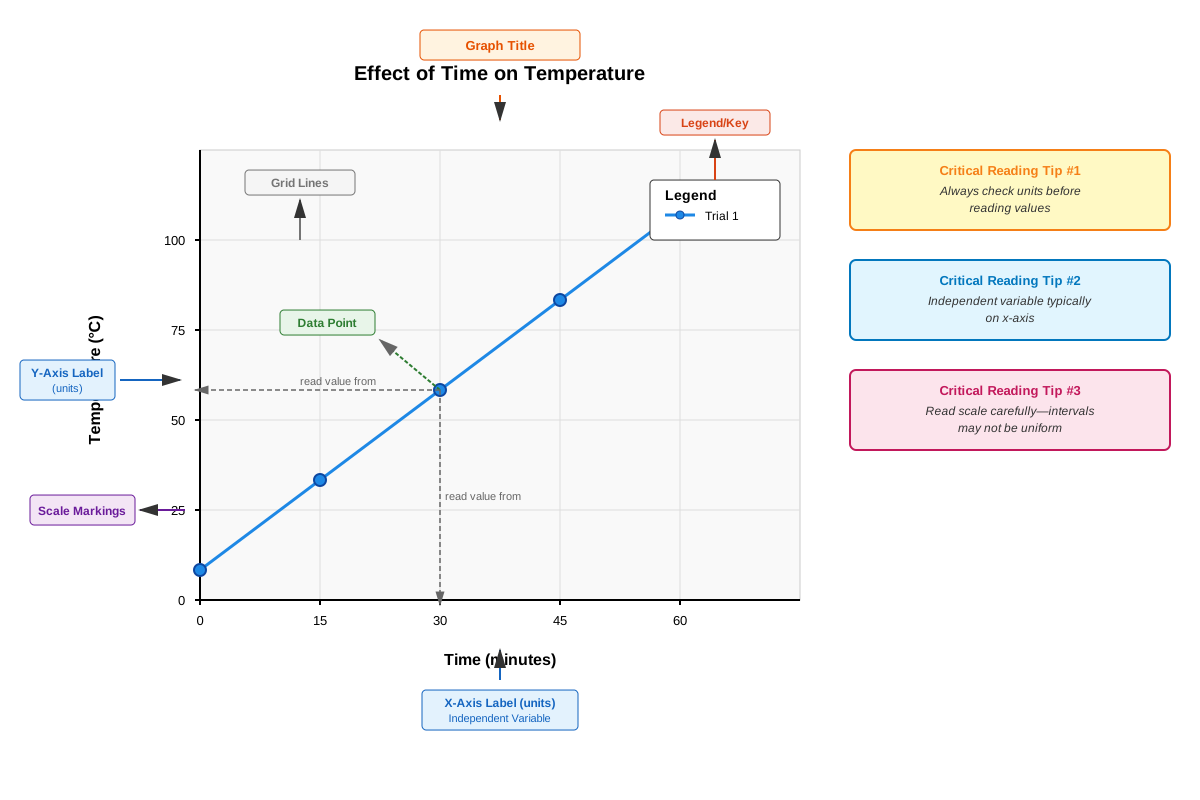
Every graph contains essential structural elements that must be identified before attempting to extract information. The axes form the foundation: the horizontal x-axis typically represents the independent variable (the factor being manipulated or the progression of time), while the vertical y-axis represents the dependent variable (the measured outcome or response). Each axis includes a scale with numerical markings and units that define what is being measured.
The title or caption provides context about what the graph represents, though ACT passages often integrate this information into the surrounding text rather than as a formal graph title. The legend or key identifies different data series when multiple lines, bars, or symbols appear on the same graph. Data points may be represented as dots, crosses, or other symbols, often connected by lines to show continuous relationships or trends.
Understanding scale is critical for accurate data extraction. Scales may be linear (equal intervals) or logarithmic (exponential intervals), though the ACT predominantly uses linear scales. The scale intervals—the numerical distance between marked gridlines—vary widely. A graph might show intervals of 1, 2, 5, 10, 100, or any other value. Students must identify the interval size before attempting to read values between marked lines, a process called interpolation.
Types of Graphs on the ACT
| Graph Type | Primary Purpose | Key Features | Common ACT Uses |
|---|---|---|---|
| Line Graph | Show trends over continuous variables | Connected data points, often time-based | Temperature changes, population growth, reaction rates |
| Bar Chart | Compare discrete categories | Separated rectangular bars | Species counts, categorical comparisons, survey results |
| Scatter Plot | Show correlation between two variables | Individual unconnected points | Relationship strength, outlier identification |
| Combination Graph | Display multiple data types simultaneously | Mixed formats (bars + lines, multiple y-axes) | Complex experimental results with multiple measurements |
Line graphs dominate ACT Science passages because they efficiently display how one variable changes in response to another. The slope of the line indicates the rate of change: steeper slopes mean faster changes, while horizontal lines indicate no change. Positive slopes show direct relationships (both variables increase together), while negative slopes show inverse relationships (one increases as the other decreases).
Bar charts appear when comparing distinct categories rather than continuous variables. The height or length of each bar represents the measured value. ACT questions often ask students to identify which category has the highest or lowest value, or to calculate differences between categories.
Scatter plots show individual data points without connecting lines, useful for displaying correlations and identifying outliers. The overall pattern of points reveals relationship strength: tightly clustered points along a trend line indicate strong correlation, while widely scattered points suggest weak or no correlation.
Reading Values from Graphs
Extracting specific numerical values requires systematic attention to detail. First, identify which variable the question asks about and locate the corresponding axis. Second, find the relevant data point, line, or bar on the graph. Third, trace horizontally or vertically to the appropriate axis. Fourth, read the value by determining where the trace line intersects the axis scale.
When the data point falls between marked scale values, interpolation becomes necessary. If the scale shows marks at 0, 10, 20, 30, and the data point appears halfway between 10 and 20, the value is 15. If it appears one-quarter of the way from 10 toward 20, the value is approximately 12.5. The ACT typically designs answer choices to catch students who misread scales or fail to interpolate correctly.
Extrapolation—estimating values beyond the graphed data range—appears less frequently but requires extending the observed trend. If a line shows consistent increase from x = 0 to x = 10, a question might ask what value would occur at x = 12. Students must continue the established pattern, though the ACT rarely requires complex extrapolation.
Identifying Trends and Patterns
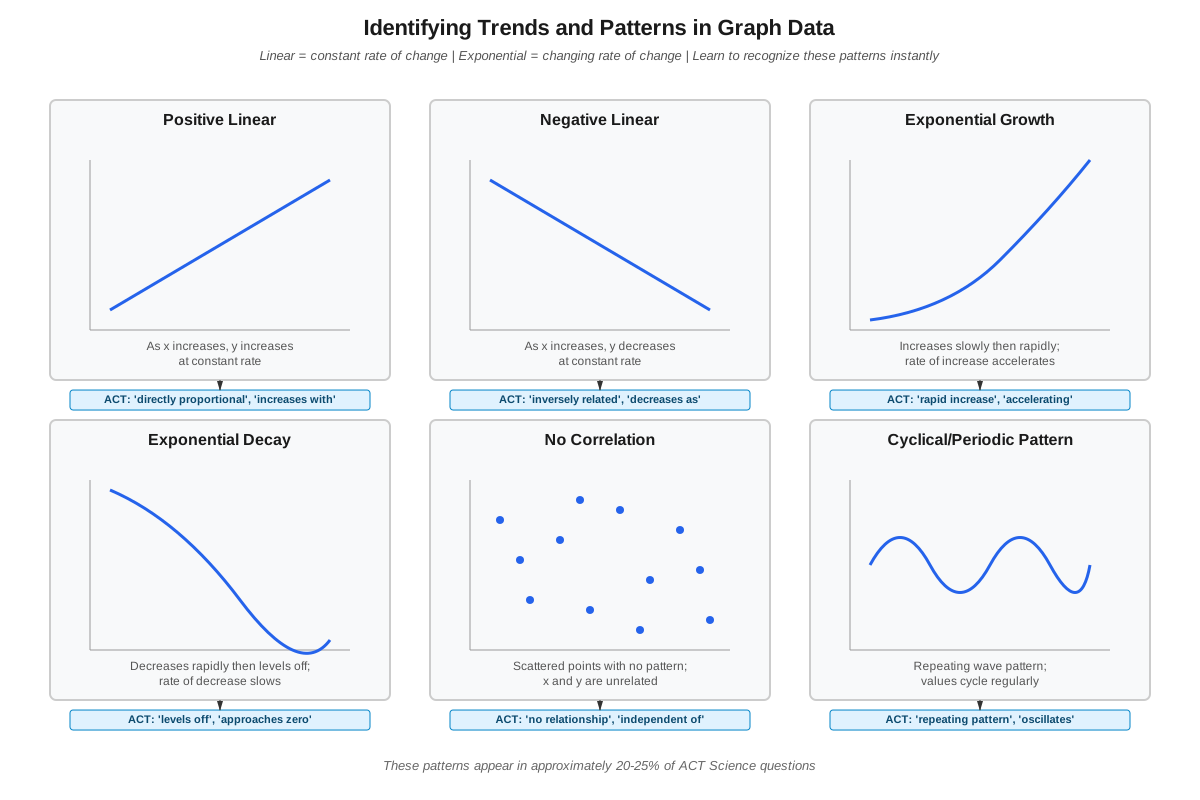
Trend identification questions ask students to describe how variables relate. The fundamental trend types include:
- Increasing (positive trend): The dependent variable rises as the independent variable increases
- Decreasing (negative trend): The dependent variable falls as the independent variable increases
- Constant (no trend): The dependent variable remains unchanged regardless of the independent variable
- Non-linear trends: The relationship changes character, such as exponential growth, logarithmic curves, or cyclical patterns
The ACT frequently asks students to identify which statement correctly describes the relationship shown in a graph. Correct answers precisely match the graphical evidence, while distractors often reverse the relationship, describe the wrong variable, or claim a relationship exists when the data shows none.
Comparing Multiple Data Sets
Many ACT graphs display multiple lines, bars, or data series simultaneously. The legend identifies each series, typically using different colors, line styles (solid, dashed, dotted), or symbols (circles, triangles, squares). Questions may ask which condition produced the highest value at a specific point, where two lines intersect, or how the gap between two data series changes.
When comparing data sets, focus on the specific comparison requested. Questions asking "at what temperature" require reading the x-axis, while questions asking "what was the difference in pressure" require subtracting y-axis values. The ACT deliberately includes answer choices that represent values from the wrong data series or incorrect mathematical operations.
Concept Relationships
Graph reading skills build hierarchically from basic to complex. Axis identification forms the foundation, enabling scale reading, which in turn allows value extraction. These fundamental skills combine to enable trend identification and data comparison. All these skills integrate when answering synthesis questions that require combining information from multiple graphs or connecting graphical data to passage text.
The relationship between graph reading and other ACT Science topics is extensive. Variable identification (distinguishing independent from dependent variables) directly informs which axis to examine. Experimental design understanding explains why certain variables appear together on graphs. Pattern recognition skills developed through graph reading transfer to table interpretation and data synthesis tasks.
Within the Data Representation unit specifically, graph reading connects to table reading (both require extracting specific values), trend analysis (identifying patterns over ranges), and data synthesis (combining information from multiple sources). The progression flows: Basic graph reading → Complex graph interpretation → Multi-graph synthesis → Integration with passage text and scientific reasoning.
High-Yield Facts
⭐ The x-axis typically represents the independent variable (what was changed), while the y-axis represents the dependent variable (what was measured)
⭐ When multiple lines appear on one graph, always check the legend to identify which line represents which condition or variable
⭐ Scale intervals are not always uniform across different graphs; always check the numerical spacing between gridlines before reading values
⭐ Interpolation (estimating between marked values) is required when data points fall between scale markings; estimate proportionally based on position
⭐ Trend questions ask about the overall pattern, not individual data points; focus on the general direction and shape of the line or bars
- Line slope indicates rate of change: steeper slopes mean faster changes, horizontal lines mean no change
- When two lines intersect on a graph, the variables have equal values at that specific point
- Scatter plots with tightly clustered points indicate strong correlations; widely scattered points indicate weak or no correlation
- Units on axes are critical; confusing units (like seconds vs. minutes or grams vs. kilograms) leads to incorrect answers
- The highest point on a line graph or tallest bar on a bar chart represents the maximum value for that variable
- Extrapolation questions ask about values beyond the graphed range; extend the established trend pattern
- Combination graphs may have two different y-axes (one on left, one on right) for different variables with different units
- Negative values appear below the x-axis or to the left of the y-axis; don't overlook negative regions
- Logarithmic scales (rare on ACT) show exponential relationships; each interval represents multiplication rather than addition
- When comparing data sets, ensure you're reading from the correct line or bar series before selecting an answer
Quick check — test yourself on Reading graphs so far.
Try Flashcards →Common Misconceptions
Misconception: The x-axis always represents time → Correction: While time frequently appears on the x-axis, any independent variable can occupy this position. The x-axis might represent temperature, concentration, distance, or any other manipulated variable. Always read the axis label to identify what variable is actually represented.
Misconception: All scale intervals are the same size across different graphs → Correction: Scale intervals vary dramatically between graphs and even between the x and y axes of the same graph. One graph might use intervals of 5, while another uses intervals of 100. Always check the numerical values marked on each axis before attempting to read data points.
Misconception: Data points must fall exactly on gridlines → Correction: Most ACT graphs require interpolation because data points fall between marked scale values. Students must estimate proportional positions between gridlines. A point halfway between 20 and 30 represents a value of 25, not 20 or 30.
Misconception: The steepest line always represents the largest values → Correction: Steepness (slope) indicates rate of change, not magnitude. A steep line shows rapid change, while a gradual line shows slow change. The actual values depend on the y-axis position. A steep line at low y-values may represent smaller absolute values than a gradual line at high y-values.
Misconception: When multiple lines appear, they all use the same y-axis scale → Correction: Combination graphs sometimes include two different y-axes—one on the left side and one on the right side—each with different scales and units. Always verify which axis corresponds to which data series by checking the legend and axis labels carefully.
Misconception: Extrapolating beyond the graph range is always reliable → Correction: Extrapolation assumes the established trend continues unchanged, which may not reflect reality. The ACT typically asks only for simple extrapolations that extend obvious patterns a short distance beyond the graphed range. Be cautious about assuming complex trends continue indefinitely.
Misconception: Bar charts and line graphs can be read identically → Correction: Bar charts represent discrete categories without inherent order or continuity between bars, while line graphs represent continuous relationships where intermediate values exist between plotted points. This distinction affects how trends and comparisons should be interpreted.
Worked Examples
Example 1: Multi-Line Graph with Interpolation
Question: The graph below shows the temperature of three different liquids (A, B, and C) over time. According to the graph, what was the approximate temperature of Liquid B at 15 minutes?
Graph description: X-axis shows time from 0 to 30 minutes with marks every 5 minutes. Y-axis shows temperature from 0°C to 100°C with marks every 10°C. Three lines are plotted: Liquid A (solid line) starts at 20°C and increases steadily to 80°C. Liquid B (dashed line) starts at 60°C and decreases to 30°C. Liquid C (dotted line) remains constant at 40°C. At 15 minutes, Liquid B's line falls between the 40°C and 50°C marks, approximately 3/4 of the way from 40°C toward 50°C.
Step 1: Identify the relevant data series
The question asks about Liquid B, which the legend indicates is the dashed line.
Step 2: Locate the x-axis value
Find 15 minutes on the x-axis. This falls exactly halfway between the 10-minute and 20-minute marks.
Step 3: Trace vertically to the dashed line
From the 15-minute mark, trace upward until intersecting the dashed line (Liquid B).
Step 4: Trace horizontally to the y-axis
From the intersection point, trace horizontally to the y-axis to read the temperature value.
Step 5: Interpolate the y-axis value
The intersection point falls between 40°C and 50°C. The scale interval is 10°C. The point appears approximately 3/4 of the distance from 40°C toward 50°C. Calculate: 40 + (0.75 × 10) = 40 + 7.5 = 47.5°C.
Answer: Approximately 47-48°C (ACT answer choices would likely include 45°C, 47°C, 50°C, and 55°C, with 47°C being correct)
Connection to Learning Objectives: This example demonstrates applying graph reading to ACT-style questions by identifying the correct data series, locating specific x-values, and interpolating between scale markings to extract precise numerical values.
Example 2: Trend Identification and Comparison
Question: Based on the graph showing enzyme activity at different pH levels for Enzymes X and Y, which statement best describes the relationship between pH and enzyme activity?
Graph description: X-axis shows pH from 0 to 14 with marks every 2 units. Y-axis shows enzyme activity from 0 to 100 units with marks every 20 units. Enzyme X (solid line) shows low activity at pH 2, increases to peak activity of 80 units at pH 6, then decreases to low activity by pH 10. Enzyme Y (dashed line) shows low activity at pH 4, increases to peak activity of 90 units at pH 10, then decreases slightly by pH 14.
Step 1: Analyze Enzyme X's trend
Enzyme X activity increases from pH 2 to pH 6, reaches maximum activity around pH 6, then decreases from pH 6 to pH 10. This creates a bell-shaped curve centered at pH 6.
Step 2: Analyze Enzyme Y's trend
Enzyme Y activity increases from pH 4 to pH 10, reaches maximum activity around pH 10, then shows slight decrease toward pH 14. This creates a bell-shaped curve centered at pH 10.
Step 3: Compare the two enzymes
Both enzymes show optimal activity at specific pH values (peak activity), but these optimal pH values differ. Enzyme X peaks in slightly acidic conditions (pH 6), while Enzyme Y peaks in basic conditions (pH 10).
Step 4: Evaluate potential answer choices
- "Both enzymes show maximum activity at the same pH" → Incorrect; peaks occur at different pH values
- "Enzyme activity increases continuously as pH increases" → Incorrect; both show peak-then-decrease patterns
- "Each enzyme has an optimal pH where activity is highest, and activity decreases at pH values above and below this optimum" → Correct; matches the observed bell-curve patterns
- "Enzyme Y is always more active than Enzyme X" → Incorrect; at pH 6, Enzyme X shows higher activity
Answer: Each enzyme has an optimal pH where activity is highest, and activity decreases at pH values above and below this optimum
Connection to Learning Objectives: This example demonstrates identifying trends (bell-curve patterns), comparing multiple data sets (two enzyme lines), and explaining the core strategy of analyzing overall patterns rather than individual data points.
Exam Strategy
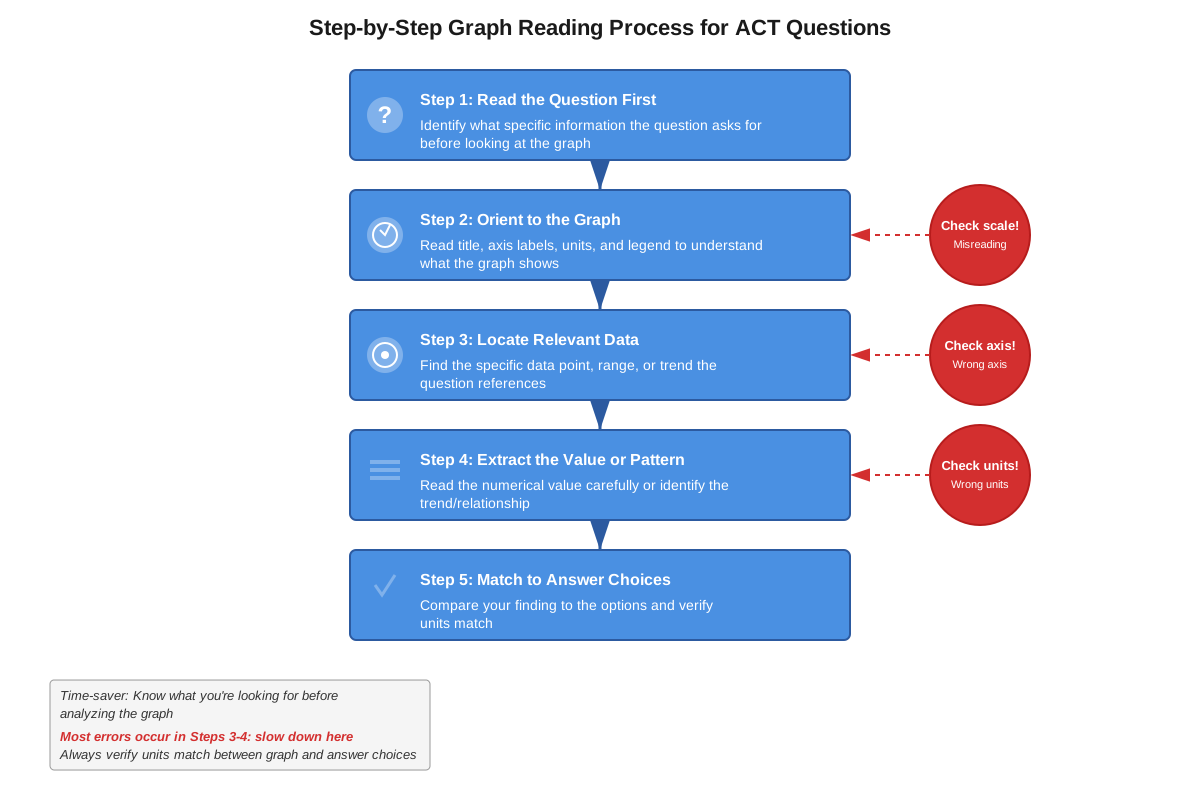
When approaching ACT Science graph questions, implement this systematic process:
1. Read the question first before examining the graph in detail. Identify exactly what information is requested: a specific value, a trend description, a comparison, or a relationship. This focused approach prevents wasting time analyzing irrelevant graph features.
2. Identify trigger words that indicate question type:
- "According to the graph" or "Based on Figure 1" → Direct reading question requiring value extraction
- "As X increases" or "When X decreases" → Trend identification question
- "Compared to" or "difference between" → Comparison question requiring multiple value extraction
- "At what value of X" → Requires reading the x-axis after locating a y-axis value
- "Approximately" or "closest to" → Interpolation required; exact precision not expected
3. Locate and verify axes and scales before attempting to read values. Check:
- What variable each axis represents
- The units of measurement
- The scale intervals (spacing between marked values)
- Whether multiple y-axes exist for different data series
4. Use process of elimination strategically:
- Eliminate answers with wrong units or magnitude (if the graph shows values in hundreds, eliminate answers in thousands)
- Eliminate trend descriptions that contradict the line direction (if the line goes up, eliminate "decreases")
- Eliminate comparisons that reverse the relationship (if Line A is above Line B, eliminate "B is greater than A")
5. Time allocation: Spend approximately 30-40 seconds per graph question. If a question requires complex interpolation or multiple steps, mark it and return if time permits. Prioritize questions asking for direct value reading or obvious trend identification over those requiring calculations or complex synthesis.
6. Common trap patterns to avoid:
- Reading from the wrong data series (always verify the legend)
- Confusing x and y axes (check which variable the question asks about)
- Misreading scale intervals (don't assume intervals are 1 or 10)
- Selecting the maximum value when asked for minimum, or vice versa
- Choosing values from the wrong units (confusing the left and right y-axes on combination graphs)
Exam Tip: When graphs include multiple lines or data series, use your finger or pencil to physically trace from the x-axis value to the correct line, then to the y-axis. This physical tracking reduces errors from visual confusion, especially under time pressure.
Memory Techniques
AXIS mnemonic for systematic graph reading:
- Axes: Identify what each axis represents
- X-value: Locate the x-axis value mentioned in the question
- Intersection: Find where the x-value meets the relevant line/bar
- Scale: Check the y-axis scale and intervals
"Left to Right, Bottom to Top" for reading direction: Always read the x-axis from left to right (increasing values) and y-axis from bottom to top (increasing values). This prevents orientation errors.
"Legend = Line Identity" reminder: Before reading any multi-line graph, check the legend to establish which line represents which variable. Create a mental or physical note matching line styles to variables.
The "Slope Story" visualization: Think of line graphs as telling a story over time or across conditions. Upward slopes mean "things are getting bigger/faster/more," downward slopes mean "things are getting smaller/slower/less," and flat lines mean "nothing is changing." This narrative approach helps with trend questions.
"Scale Trap" awareness: Create a mental checkpoint: "Have I verified the scale intervals?" before reading any value. This habit prevents the most common graph-reading error.
Interpolation finger method: When estimating values between gridlines, visualize or physically mark the distance between gridlines as divided into halves or quarters. A point halfway between 20 and 40 is 30; a point one-quarter of the way is 25.
Summary
Reading graphs constitutes the most frequently tested skill on the ACT Science section, appearing in approximately 15-20 questions per test. Success requires systematic identification of graph components (axes, scales, units, legends), accurate value extraction through interpolation, trend recognition, and multi-dataset comparison. The fundamental strategy involves reading questions first to identify what information is needed, verifying axes and scales before extracting data, and using process of elimination to avoid common traps like wrong data series, misread scales, or reversed relationships. Students must distinguish between graph types—line graphs for continuous trends, bar charts for categorical comparisons, and scatter plots for correlations—and apply appropriate interpretation methods to each. The most critical skills are interpolating values between scale markings, identifying whether variables show increasing, decreasing, or constant relationships, and comparing multiple data series while tracking which legend entry corresponds to which line or bar. Mastering these graph-reading fundamentals enables success not only on direct Data Representation questions but also on the graphical components of Research Summaries and Conflicting Viewpoints passages.
Key Takeaways
- Always verify axes, scales, and units before attempting to read any value from a graph—misreading scale intervals is the most common error
- Check the legend immediately when multiple lines, bars, or data series appear—reading from the wrong data series guarantees an incorrect answer
- Interpolation between marked scale values is required for most ACT graph questions—estimate proportional positions rather than rounding to the nearest marked value
- Trend questions focus on overall patterns (increasing, decreasing, constant), not individual data points—describe the general relationship between variables
- Read the question first to identify exactly what information is needed—this focused approach saves time and prevents analyzing irrelevant graph features
- Use systematic process of elimination based on units, magnitude, and direction—wrong answers often contain values from incorrect data series or reversed relationships
- Practice physical tracking (finger or pencil) from x-value to line to y-value—this reduces visual confusion errors, especially under time pressure
Related Topics
Table Interpretation: While graphs visualize relationships, tables organize data in rows and columns. Mastering graph reading provides the foundation for extracting values from tables, comparing across rows or columns, and identifying patterns in tabular data. Both skills require careful attention to labels, units, and systematic value extraction.
Trend Analysis and Pattern Recognition: Beyond basic graph reading, advanced questions ask students to predict future values, identify cyclical patterns, or recognize exponential versus linear relationships. Strong graph-reading skills enable these higher-order analytical tasks.
Data Synthesis Across Multiple Representations: Research Summaries passages often present the same experimental results in both graphical and tabular formats, or across multiple related graphs. Graph-reading mastery enables students to integrate information from diverse sources to answer complex synthesis questions.
Experimental Design and Variable Relationships: Understanding which variables appear on which axes connects directly to experimental design concepts. The independent variable (what scientists manipulate) typically appears on the x-axis, while the dependent variable (what scientists measure) appears on the y-axis, reflecting the cause-and-effect structure of experiments.
Practice CTA
Now that you understand the systematic approach to reading graphs on the ACT Science section, it's time to apply these strategies to real practice questions. Work through the practice questions associated with this topic, focusing on implementing the AXIS method and avoiding common traps like misread scales and wrong data series. Use the flashcards to reinforce quick recognition of graph types, trend patterns, and key terminology. Remember: graph reading is a skill that improves dramatically with deliberate practice. Each practice question you complete builds the pattern recognition and systematic approach that will enable you to confidently tackle any graph the ACT presents. You've got this!
Sign up free to keep reading
Create a free AnvayaPrep account to finish this ACT guide on Reading graphs — plus flashcards and practice questions.