Overview
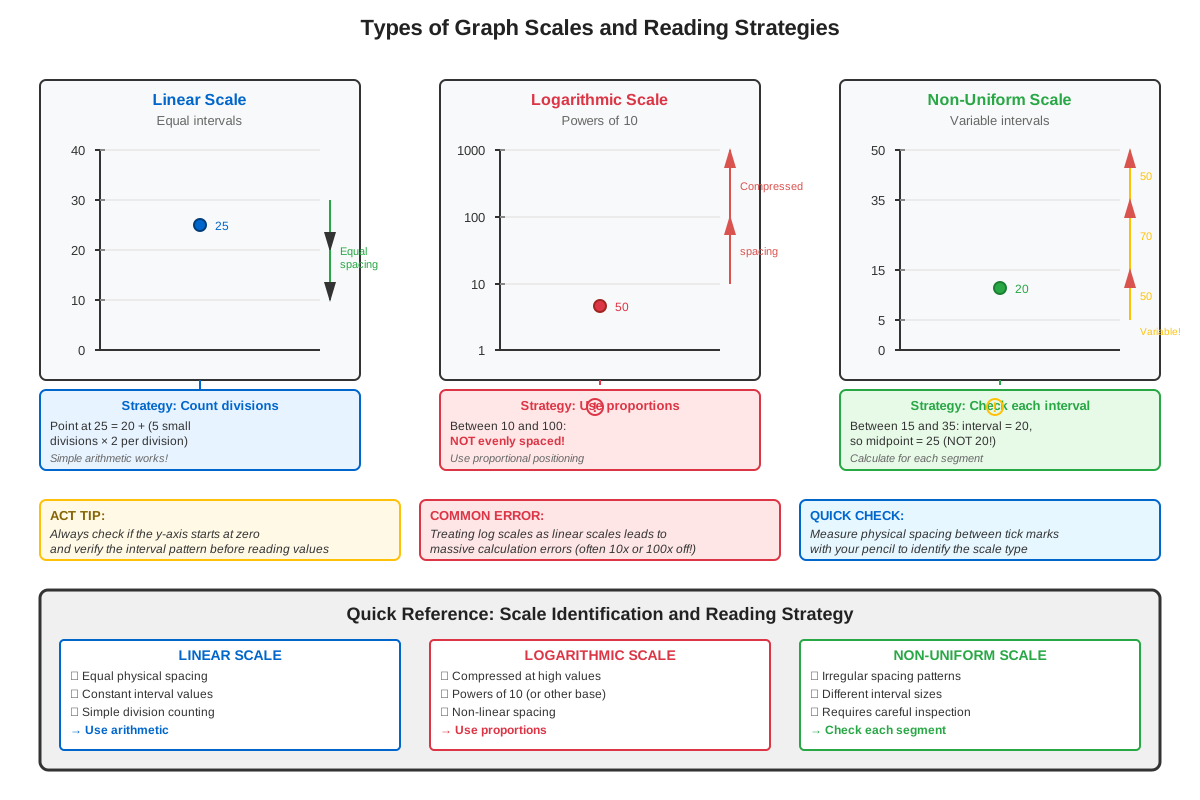
Scale interpretation is a fundamental skill tested extensively throughout the ACT Science section, appearing in approximately 30-40% of all questions. This skill involves accurately reading, understanding, and extracting quantitative information from various types of graphs, charts, tables, and diagrams that use different measurement scales. The ability to correctly interpret scales is not merely about reading numbers—it requires understanding the relationship between visual representations and the actual values they represent, recognizing different scale types (linear, logarithmic, non-uniform), and accurately translating graphical information into meaningful data.
On the ACT Science test, ACT scale interpretation questions assess whether students can navigate the complexity of scientific data presentation. Students must determine exact values from plotted points, understand axis labels and units, recognize scale intervals, and interpolate or extrapolate data points. These questions often appear deceptively simple but contain subtle traps: axes that don't start at zero, scales with irregular intervals, multiple y-axes with different scales, or units that require conversion. Mastering scale interpretation is essential because it serves as the foundation for virtually all data representation questions—students cannot analyze trends, compare data sets, or draw conclusions if they cannot first accurately read the scales.
Scale interpretation connects directly to broader scientific literacy and data analysis skills. It underlies the ability to compare experimental results, identify patterns and trends, calculate rates of change, and evaluate the validity of scientific claims. Within the ACT Science section, scale interpretation integrates with other critical skills including trend analysis, data comparison, and experimental design evaluation. Students who excel at scale interpretation gain a significant advantage because they can quickly and accurately extract information from passages, leaving more time for complex reasoning questions.
Learning Objectives
- [ ] Identify when Scale interpretation is being tested in ACT Science passages
- [ ] Explain the core rule or strategy behind Scale interpretation for different graph and table types
- [ ] Apply Scale interpretation to ACT-style questions accurately and efficiently
- [ ] Distinguish between linear, logarithmic, and non-uniform scales and adjust reading strategies accordingly
- [ ] Accurately interpolate values between marked scale intervals with precision
- [ ] Recognize and avoid common scale interpretation errors that lead to incorrect answers
- [ ] Extract data from graphs with multiple scales or dual y-axes without confusion
Prerequisites
- Basic graph literacy: Understanding that graphs represent relationships between variables using x and y axes—essential because scale interpretation builds upon knowing what graphs communicate
- Fundamental arithmetic skills: Ability to perform addition, subtraction, multiplication, and division—necessary for calculating scale intervals and interpolating values
- Unit awareness: Recognition that measurements have units (meters, seconds, grams, etc.)—important because scale interpretation often requires attention to unit labels
- Number line comprehension: Understanding how numbers are ordered and spaced on a line—foundational for recognizing how scales represent numerical values visually
Why This Topic Matters
Scale interpretation represents one of the most practical and universally applicable skills tested on the ACT. In real-world scientific contexts, researchers, medical professionals, engineers, and data analysts constantly interpret scales when reading instrument displays, analyzing experimental results, monitoring patient vital signs, or evaluating engineering specifications. The ability to accurately read scales prevents costly errors in fields ranging from pharmaceutical dosing to structural engineering calculations. This skill translates directly to college-level science courses where students must interpret laboratory data, understand research papers, and conduct their own experiments.
On the ACT Science test, scale interpretation questions appear with remarkable frequency—students can expect to encounter 8-12 questions per test that directly assess this skill. These questions typically appear in the Data Representation passages (which comprise 3 of the 6 passages) but also feature prominently in Research Summaries passages. The ACT presents scale interpretation challenges through various formats: line graphs, bar graphs, scatter plots, tables with numerical data, diagrams with measurement indicators, and complex multi-panel figures. Questions may ask students to identify specific values, compare data points, determine differences between measurements, or recognize patterns that require accurate scale reading.
Common manifestations of scale interpretation on the ACT include: determining the exact temperature at which a phase change occurs from a graph, reading the population size at a specific year from a bar chart, identifying the pH value corresponding to a particular enzyme activity level, extracting pressure measurements from a table with scientific notation, or comparing growth rates between two organisms using a dual-axis graph. The ACT deliberately includes scale-related challenges such as axes that begin at non-zero values, logarithmic scales that compress large ranges, irregular intervals between tick marks, and scales that require students to calculate the value of unlabeled intervals.
Core Concepts
Understanding Scale Components
Every scale on a graph or chart consists of several critical components that students must identify and understand. The axis itself represents the dimension being measured—typically the independent variable on the x-axis (horizontal) and the dependent variable on the y-axis (vertical). Each axis includes tick marks that indicate specific values, though not every tick mark is necessarily labeled. The scale interval refers to the numerical difference between consecutive tick marks, which may be uniform (constant intervals) or non-uniform (varying intervals). Axis labels identify what variable is being measured, while units specify the measurement system (e.g., meters, kilograms, degrees Celsius).
Understanding these components allows students to systematically approach any graph. The first step in scale interpretation involves identifying the minimum and maximum values shown on each axis, then determining whether the scale is continuous or discrete. Students must calculate the interval value by examining labeled tick marks—if marks at 0, 10, and 20 are labeled, the interval is 10 units. However, if only 0 and 50 are labeled with 5 tick marks between them, students must calculate that each interval represents 10 units (50 ÷ 5 = 10).
Linear Scales
Linear scales represent the most common type encountered on the ACT, where equal distances along the axis correspond to equal numerical differences. On a linear scale, the relationship between position and value is proportional and constant throughout the entire range. For example, if 1 cm on the graph represents 5 units, then 2 cm represents 10 units, 3 cm represents 15 units, and so forth. This proportionality makes linear scales relatively straightforward to interpret once the scale interval is determined.
When working with linear scales, students should employ a systematic approach: First, identify two labeled points on the axis. Second, count the number of intervals between these points. Third, calculate the value of each interval by dividing the numerical difference by the number of intervals. Fourth, use this interval value to determine the value of any point on the scale. For instance, if a scale shows 0 at the bottom and 100 at the top with 10 intervals between them, each interval represents 10 units. A point located at the 7th tick mark would have a value of 70.
Non-Zero Starting Points
A critical challenge in ACT scale interpretation involves axes that do not begin at zero. The ACT frequently uses non-zero starting points to magnify differences in data or to focus on a specific range of values. For example, a temperature scale might range from 20°C to 30°C rather than starting at 0°C. This presentation can visually exaggerate differences between data points, making small variations appear more dramatic than they actually are.
Students must remain vigilant when encountering non-zero scales because the visual impression can be misleading. A graph showing sales increasing from 90 to 100 units might appear to show a doubling if the y-axis starts at 90, when in reality the increase is only about 11%. The key strategy is to always check the minimum value on each axis before interpreting the data. When calculating differences between points, students should subtract the actual values rather than relying on visual estimation.
Logarithmic Scales
Logarithmic scales compress large ranges of data by representing each interval as a multiple (usually 10×) of the previous interval rather than an additive increase. On a logarithmic scale, equal distances represent equal ratios rather than equal differences. A scale might show 1, 10, 100, 1,000, 10,000—each step represents multiplication by 10. These scales appear less frequently on the ACT but are used when data spans several orders of magnitude, such as bacterial population growth, earthquake intensity, or sound levels.
Recognizing logarithmic scales requires attention to the axis labels. If consecutive labeled values increase by multiplication (1, 10, 100) rather than addition (1, 2, 3), the scale is logarithmic. The spacing between tick marks on logarithmic scales is non-uniform—the distance from 1 to 10 is the same as the distance from 10 to 100, even though the numerical difference is vastly different (9 vs. 90). When interpolating values on logarithmic scales, students cannot simply divide the space proportionally; instead, they must consider the multiplicative relationship.
Interpolation and Extrapolation
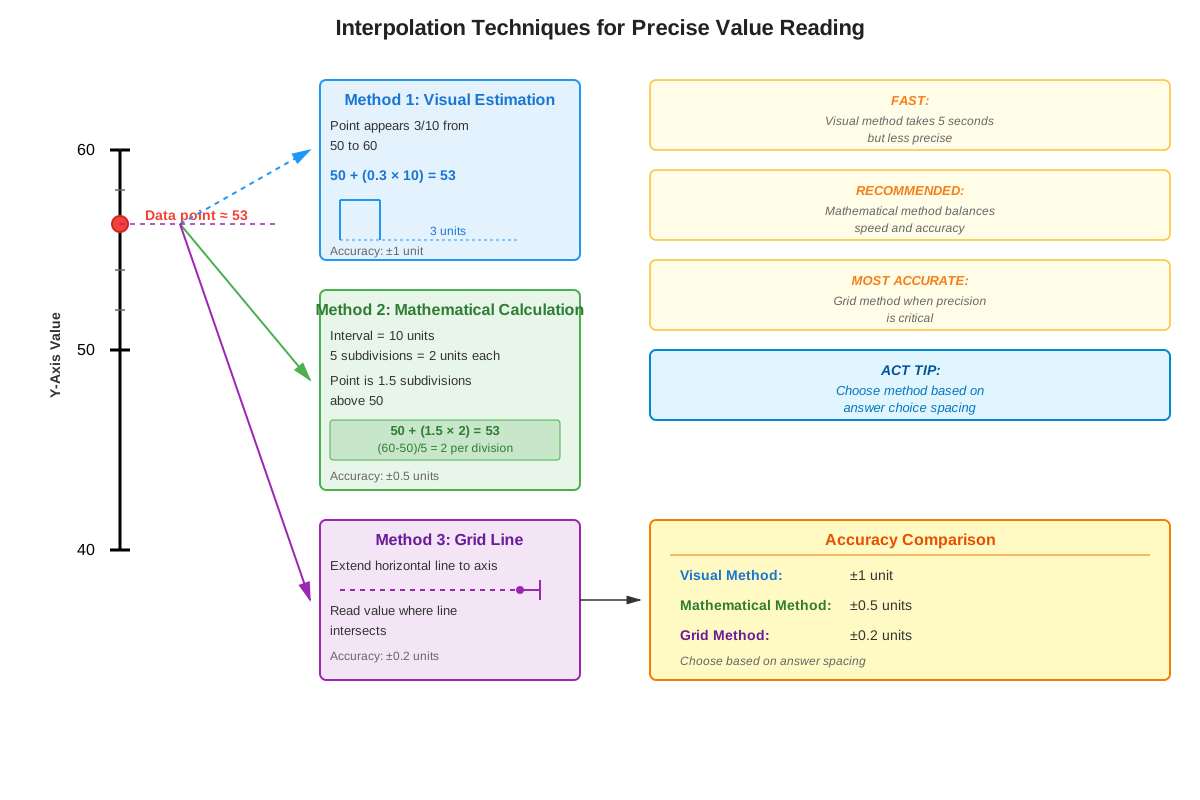
Interpolation involves determining values that fall between marked points on a scale, while extrapolation involves estimating values beyond the range of the data shown. On the ACT, interpolation questions are common and require students to estimate where a data point falls relative to the nearest tick marks. For accurate interpolation on linear scales, students should visualize dividing the interval into equal parts and estimate the position of the point within that interval.
For example, if a point falls approximately halfway between the tick marks for 20 and 30, the value would be approximately 25. If the point appears to be about one-quarter of the way from 20 toward 30, the value would be approximately 22.5 (20 + 0.25 × 10). The ACT typically designs answer choices to test whether students can interpolate accurately—incorrect answers often represent common estimation errors, such as reading the nearest tick mark rather than interpolating, or miscalculating the interval value.
Multiple Scales and Dual Axes
Some ACT graphs present multiple scales or dual y-axes, where two different variables with different units are plotted on the same graph. For instance, a graph might show temperature (°C) on the left y-axis and pressure (kPa) on the right y-axis, both plotted against time on the x-axis. These graphs require careful attention to which data series corresponds to which axis, typically indicated by matching colors, symbols, or line styles.
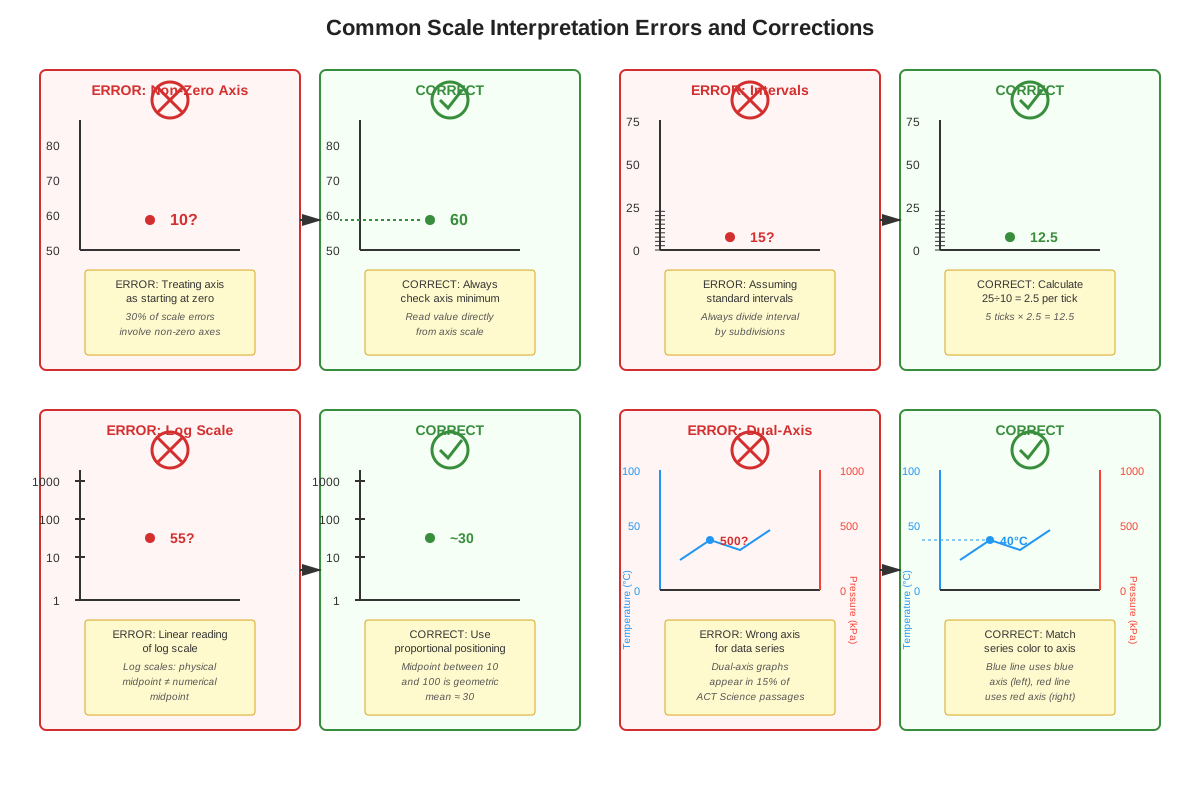
When interpreting dual-axis graphs, students must: (1) identify which data series uses which axis, (2) read values using only the appropriate axis for each series, and (3) avoid comparing the two series directly using visual height, since they use different scales. A common error is reading a value from the wrong axis or attempting to compare two variables that use different scales as if they were directly comparable.
Scale Intervals and Precision
The scale interval determines the precision with which values can be read from a graph. If tick marks are spaced at intervals of 10 units, values can typically be estimated to the nearest 1-2 units through interpolation. However, if intervals are 100 units, precision is necessarily lower. The ACT designs answer choices to match the appropriate level of precision—if the scale allows reading to the nearest 5 units, answer choices will typically differ by at least 5 units.
Students should match their precision to what the scale reasonably allows. Over-precision (claiming to read a value of 23.7 from a scale with intervals of 10) is as problematic as under-precision (reading 20 when the point clearly falls near 25). The answer choices provide guidance—if choices are 20, 25, 30, and 35, the scale supports reading to the nearest 5 units.
Tables and Numerical Scales
While graphs receive significant attention, tables also require scale interpretation skills. Tables present data in rows and columns with numerical values, and students must accurately read values, understand scientific notation, recognize significant figures, and interpret units. Common challenges include: reading values from the correct row and column intersection, understanding when values are expressed in scientific notation (e.g., 3.2 × 10⁴), and recognizing when units change within a table.
When interpreting tables, students should: (1) carefully identify row and column headers, (2) trace from the specified row and column to find the intersection, (3) note the units specified in headers or captions, and (4) recognize patterns in how data is organized. Tables may present data in ascending or descending order, group related measurements together, or use formatting (bold, italics) to highlight specific values.
Concept Relationships
Scale interpretation serves as the foundational skill that enables all higher-order data analysis on the ACT Science test. The relationship flows as follows: Scale Interpretation → enables → Data Extraction → enables → Trend Analysis → enables → Hypothesis Evaluation. Without accurate scale interpretation, students cannot extract correct values, which prevents accurate trend identification, which ultimately prevents proper evaluation of scientific hypotheses.
Within the topic itself, understanding scale components (axes, tick marks, intervals, labels) provides the foundation for recognizing scale types (linear, logarithmic, non-uniform). This recognition then informs the appropriate reading strategy (proportional division for linear scales, multiplicative thinking for logarithmic scales). The ability to perform interpolation depends on understanding both scale intervals and scale types. Multiple scale interpretation integrates all previous concepts while adding the complexity of tracking which data series corresponds to which scale.
Scale interpretation connects to prerequisite knowledge of basic graph literacy by building upon the fundamental understanding that graphs represent relationships between variables. It extends this foundation by adding precision and complexity—moving from "this line goes up" to "this line increases from 23.5 to 47.2 units over this interval." The arithmetic skills prerequisite enables the calculations necessary for determining interval values and interpolating between tick marks.
Looking forward, scale interpretation enables progression to more advanced topics including rate calculation (which requires reading two values and computing their ratio), data comparison across multiple experiments (which requires accurate value extraction from multiple graphs), and error analysis (which requires understanding the precision limitations of scales). Mastery of scale interpretation is non-negotiable for success on the ACT Science section.
Quick check — test yourself on Scale interpretation so far.
Try Flashcards →High-Yield Facts
⭐ The ACT frequently uses axes that do not start at zero to visually exaggerate differences between data points—always check the minimum value on each axis before interpreting data.
⭐ To find the value of each interval on a linear scale: identify two labeled points, count the intervals between them, then divide the numerical difference by the number of intervals.
⭐ When a data point falls between tick marks, estimate its position as a fraction of the interval (e.g., halfway between 20 and 30 = 25).
⭐ On graphs with dual y-axes, each data series corresponds to only one axis—identify which axis matches which data series before reading any values.
⭐ Logarithmic scales show equal distances representing equal ratios (multiplication) rather than equal differences (addition)—consecutive values typically increase by factors of 10.
- Scale interpretation questions appear in approximately 30-40% of ACT Science questions, making it one of the most frequently tested skills.
- Answer choices on scale interpretation questions are deliberately designed to include common reading errors—the wrong answers often represent values at adjacent tick marks or miscalculated intervals.
- Units matter: a value of 5 meters is different from 5 centimeters, and the ACT tests whether students pay attention to unit labels.
- When tick marks are unlabeled, count the total number of intervals between labeled marks and divide the numerical range by that count to find each interval's value.
- Scientific notation in tables requires attention: 3.2 × 10⁴ equals 32,000, not 3.2 or 320.
- The precision of your answer should match the precision of the scale—don't claim to read 23.7 from a scale with intervals of 10 units.
- Bar graphs and histograms require reading the top of the bar to determine the value, not the middle or bottom.
- Time scales may use irregular intervals (e.g., years 1990, 1995, 2005, 2010) rather than uniform spacing—calculate each interval separately.
- Multiple data series on the same graph are typically distinguished by different symbols (circles, squares, triangles) or line styles (solid, dashed, dotted)—the legend identifies which is which.
- When extrapolating beyond the data range, the ACT typically expects students to extend the existing trend linearly unless the question specifies otherwise.
Common Misconceptions
Misconception: All graph axes start at zero, so the bottom of the graph always represents zero. → Correction: Many ACT graphs use non-zero starting points to focus on a specific data range. Always check the minimum value labeled on each axis. A graph showing values from 90 to 100 does not have zero at the bottom—it starts at 90.
Misconception: The visual height or length of bars or lines directly indicates the magnitude of difference between values. → Correction: Visual appearance can be misleading, especially with non-zero axes or different scales. Always read the actual numerical values from the scale rather than relying on visual estimation of relative sizes. A bar that appears twice as tall as another might represent only a 10% increase if the axis starts at 90.
Misconception: On logarithmic scales, a point halfway between 10 and 100 represents a value of 55. → Correction: Logarithmic scales represent multiplicative relationships, not additive ones. The midpoint between 10 and 100 on a logarithmic scale represents approximately 31.6 (the geometric mean: √(10 × 100)), not 55 (the arithmetic mean).
Misconception: When a graph has two y-axes, you can compare the two data series directly by their visual heights. → Correction: Data series using different scales cannot be compared visually because they use different measurement systems. A line reaching "higher" on the graph might actually represent a smaller value if it uses the right y-axis with a different scale than the left y-axis.
Misconception: If tick marks aren't labeled, you can't determine their values. → Correction: Unlabeled tick marks can be calculated by finding the interval value from labeled marks. If 0 and 100 are labeled with 10 intervals between them, each unlabeled tick mark represents 10 units (100 ÷ 10 = 10).
Misconception: All intervals on a scale are equal. → Correction: While most ACT scales use uniform intervals, some use non-uniform spacing, particularly time scales or logarithmic scales. Always verify that intervals are equal by checking multiple labeled points before assuming uniformity.
Misconception: The precision of values read from a graph can be infinite if you estimate carefully enough. → Correction: The precision is limited by the scale interval. A scale with intervals of 10 units typically allows reading to the nearest 1-2 units through interpolation, but claiming precision to 0.1 units would be inappropriate and unsupported by the scale.
Worked Examples
Example 1: Linear Scale with Non-Zero Starting Point
Question: The graph below shows the temperature of a chemical reaction over time. The y-axis shows temperature in °C, with labeled marks at 85°C and 95°C, and 5 unlabeled tick marks between them. A data point is located at the 3rd tick mark above 85°C. What is the temperature at this point?
Solution:
Step 1: Identify the labeled values and count intervals.
- Lower labeled value: 85°C
- Upper labeled value: 95°C
- Number of intervals between them: 5 intervals (creating 6 tick marks total including the endpoints)
Step 2: Calculate the value of each interval.
- Numerical difference: 95°C - 85°C = 10°C
- Value per interval: 10°C ÷ 5 intervals = 2°C per interval
Step 3: Determine the value at the specified location.
- Starting point: 85°C
- Number of intervals to move up: 3 intervals
- Value to add: 3 intervals × 2°C per interval = 6°C
- Final temperature: 85°C + 6°C = 91°C
Step 4: Verify the answer makes sense.
- The point is more than halfway from 85°C to 95°C (3 out of 5 intervals = 60%)
- 91°C is indeed 60% of the way from 85°C to 95°C: 85 + 0.6(10) = 91 ✓
Connection to Learning Objectives: This example demonstrates the core strategy for scale interpretation on linear scales with non-zero starting points, showing the systematic approach of identifying labeled values, calculating intervals, and applying the interval value to find specific data points.
Example 2: Dual-Axis Graph Interpretation
Question: A graph displays two variables over time: Plant Height (cm) on the left y-axis ranging from 0 to 50 cm, and Soil Moisture (%) on the right y-axis ranging from 0 to 100%. The plant height is shown with a solid line, and soil moisture is shown with a dashed line. At Day 10, the solid line reaches the level of the 4th tick mark on the left axis (with 5 intervals between 0 and 50), while the dashed line reaches the level of the 6th tick mark on the right axis (with 10 intervals between 0 and 100). What are the plant height and soil moisture at Day 10?
Solution:
Step 1: Identify which data series uses which axis.
- Solid line (plant height) uses left y-axis (0-50 cm)
- Dashed line (soil moisture) uses right y-axis (0-100%)
Step 2: Calculate the interval value for the left axis (plant height).
- Range: 0 to 50 cm
- Number of intervals: 5
- Value per interval: 50 cm ÷ 5 = 10 cm per interval
- Position: 4th tick mark = 4 intervals above 0
- Plant height: 0 + (4 × 10 cm) = 40 cm
Step 3: Calculate the interval value for the right axis (soil moisture).
- Range: 0 to 100%
- Number of intervals: 10
- Value per interval: 100% ÷ 10 = 10% per interval
- Position: 6th tick mark = 6 intervals above 0
- Soil moisture: 0 + (6 × 10%) = 60%
Step 4: Verify by checking that the values use the correct axes.
- Plant height (40 cm) is read from the left axis ✓
- Soil moisture (60%) is read from the right axis ✓
- The values are not directly comparable because they use different scales and units ✓
Connection to Learning Objectives: This example illustrates the critical skill of identifying and correctly using multiple scales on a single graph, demonstrating how to avoid the common error of reading values from the wrong axis or attempting to compare data series that use different scales.
Exam Strategy
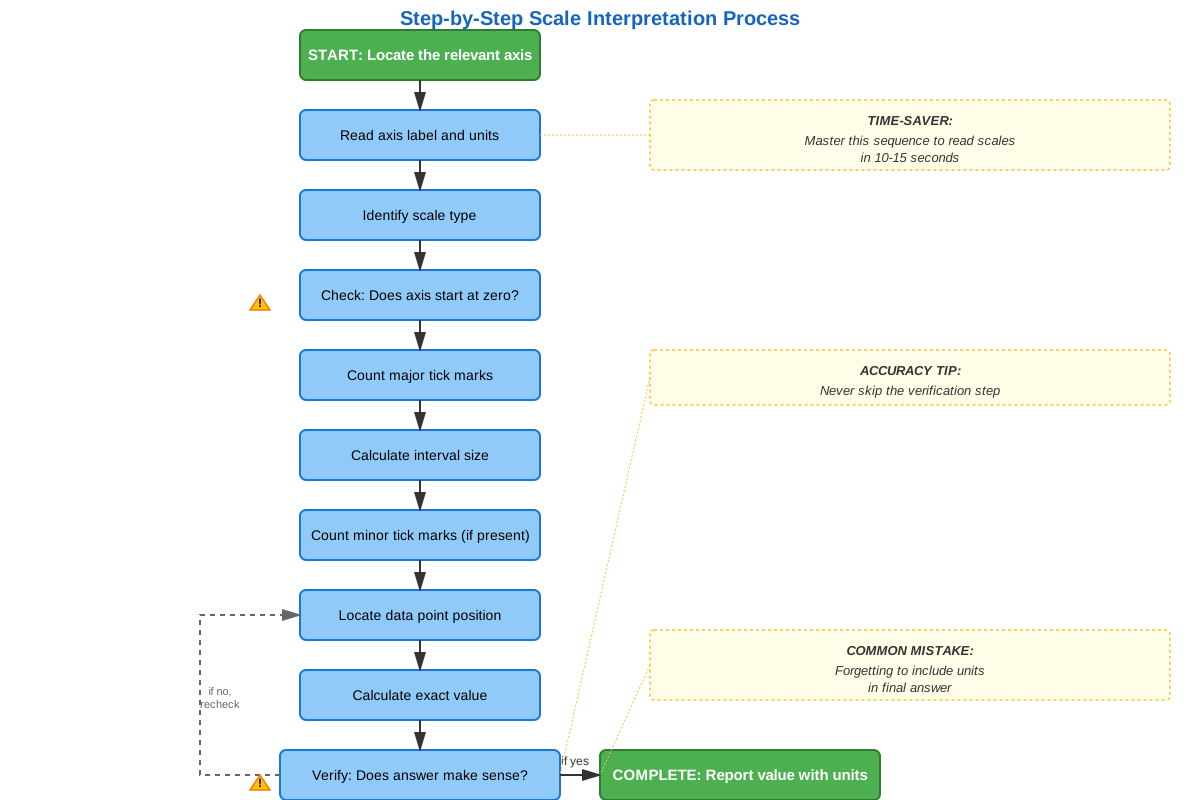
When approaching ACT Science questions that test scale interpretation, employ a systematic strategy to maximize accuracy and efficiency. Begin by quickly scanning the graph or table to identify the type of scale (linear, logarithmic, or non-uniform) and note whether axes start at zero. This initial assessment takes only 2-3 seconds but prevents costly errors. Look for the trigger words in questions that signal scale interpretation: "approximately," "closest to," "at what value," "when X equals," "the value of," or "according to the graph/table."
Before reading any specific values, invest 5-10 seconds in understanding the scale structure. Identify at least two labeled points on each axis and calculate the interval value. This upfront investment pays dividends because you can then quickly read multiple values from the same graph without recalculating. For questions asking about specific data points, use your finger or pencil to trace from the point to the axis, ensuring you read from the correct axis on dual-axis graphs.
Process-of-elimination strategies specific to scale interpretation include: (1) Eliminate answers that fall outside the range shown on the graph—if the y-axis goes from 0 to 100, an answer of 150 is impossible. (2) Eliminate answers that don't match the scale's precision—if the scale has intervals of 10, answers differing by 1-2 units are likely distractors. (3) Check whether wrong answers represent adjacent tick marks or common miscalculations—if you calculated 45 but see 40, 45, 50, and 55 as choices, verify your interval calculation.
For time allocation, straightforward scale interpretation questions should take 20-30 seconds once you understand the scale. If a question requires reading multiple values or comparing data across different graphs, allow 45-60 seconds. Don't spend more than 60 seconds on any single scale interpretation question—if you're stuck, make your best estimate based on visual position and move on. You can return if time permits.
Exam Tip: When interpolating between tick marks, use the answer choices to guide your precision. If choices are 22, 25, 28, and 31, the test expects you to interpolate to the nearest 3 units. If choices are 20, 30, 40, and 50, estimate to the nearest 10 units.
Watch for red flag scenarios that signal potential traps: (1) axes that don't start at zero (check the minimum value), (2) different units on different axes (read the labels carefully), (3) scientific notation in tables (convert correctly), (4) irregular time intervals (calculate each interval separately), and (5) multiple data series with similar symbols (check the legend). When you notice these features, slow down slightly and double-check your reading.
Memory Techniques
SCALE Acronym for systematic graph reading:
- Scan the axes (identify variables, units, and range)
- Calculate intervals (find the value of each tick mark)
- Assess the starting point (check if axes begin at zero)
- Locate the data point (trace to the correct axis)
- Estimate precisely (interpolate based on position between marks)
"Two Labels, Count Between" - A simple phrase to remember the interval calculation process: Find two labeled points, count the intervals between them, divide the difference by the count.
Visualization Strategy for Logarithmic Scales: Picture each interval as a "multiplication step" rather than an "addition step." Visualize climbing stairs where each step multiplies your height by 10 rather than adding a fixed amount. This mental model helps distinguish logarithmic from linear scales.
The "Finger Trace" Technique: Physically trace from a data point to the axis with your finger or pencil, keeping your finger parallel to the grid lines. This kinesthetic approach reduces errors from visual estimation and ensures you read from the correct axis on dual-axis graphs.
"Units Matter" Mantra: Before reading any value, say the unit out loud or in your mind: "I'm reading temperature in degrees Celsius" or "This axis shows time in minutes." This verbal reinforcement prevents unit confusion and keeps attention focused on what the numbers represent.
The "Zero Check": Develop the habit of automatically checking whether each axis starts at zero. Make this your first action when viewing any graph. A quick mental note—"y-axis starts at 20, not zero"—prevents the most common scale interpretation error.
Summary
Scale interpretation is the foundational skill for extracting accurate quantitative information from graphs, charts, and tables on the ACT Science test. Success requires systematic identification of scale components (axes, tick marks, intervals, labels, and units), calculation of interval values by dividing the numerical difference between labeled points by the number of intervals, and careful attention to scale characteristics including non-zero starting points, logarithmic versus linear progression, and multiple axes with different scales. Students must interpolate values between tick marks by estimating position as a fraction of the interval and must match their precision to what the scale reasonably supports. Common pitfalls include assuming axes start at zero, reading from the wrong axis on dual-axis graphs, treating logarithmic scales as linear, and over- or under-estimating precision. The systematic SCALE approach (Scan, Calculate, Assess, Locate, Estimate) provides a reliable framework for approaching any scale interpretation question. With approximately 30-40% of ACT Science questions requiring accurate scale interpretation, mastery of this skill is essential for achieving a high score and provides the foundation for all subsequent data analysis and trend identification tasks.
Key Takeaways
- Always check if axes start at zero—non-zero starting points are common on the ACT and can create misleading visual impressions of data differences.
- Calculate interval values systematically: identify two labeled points, count intervals between them, divide the numerical difference by the interval count.
- Match your precision to the scale—if intervals are 10 units, you can reasonably interpolate to the nearest 1-2 units, but not to 0.1 units.
- On dual-axis graphs, identify which data series uses which axis before reading any values, and never compare series visually when they use different scales.
- Logarithmic scales represent multiplicative relationships—equal distances represent equal ratios (typically 10×), not equal differences.
- Use answer choices as precision guides—the spacing between answer options indicates the level of precision the scale supports.
- Interpolate by estimating position as a fraction of the interval—a point halfway between 20 and 30 equals 25; one-quarter of the way equals 22.5.
Related Topics
Trend Analysis and Pattern Recognition: Building on scale interpretation, this topic involves identifying whether data increases, decreases, remains constant, or shows cyclical patterns. Accurate scale reading enables precise trend description and rate calculation.
Data Comparison Across Experiments: This advanced skill requires extracting values from multiple graphs or tables and comparing them quantitatively. Mastery of scale interpretation is prerequisite because comparison requires accurate value extraction from each data source.
Unit Conversion and Dimensional Analysis: Related to scale interpretation, this topic addresses converting between different measurement systems (e.g., meters to centimeters, hours to seconds). Understanding units on scales prepares students for conversion challenges.
Error Analysis and Uncertainty: This topic examines the precision and reliability of measurements, building on the understanding that scale intervals limit the precision with which values can be read. Scale interpretation provides the foundation for discussing measurement uncertainty.
Rate Calculation and Slope Determination: Calculating rates of change requires reading two values from a scale and computing their ratio. Accurate scale interpretation is essential for correct rate calculations.
Practice CTA
Now that you've mastered the concepts and strategies of scale interpretation, it's time to put your knowledge into action! Access the practice questions to test your ability to read scales accurately, calculate intervals, interpolate values, and avoid common traps. The flashcards will help you memorize key facts and strategies for quick recall during the exam. Remember, scale interpretation appears in 30-40% of ACT Science questions—mastering this skill will significantly boost your score. Each practice question you complete strengthens your pattern recognition and builds the confidence you need to tackle any scale interpretation challenge on test day. You've got this!
Sign up free to keep reading
Create a free AnvayaPrep account to finish this ACT guide on Scale interpretation — plus flashcards and practice questions.