Overview
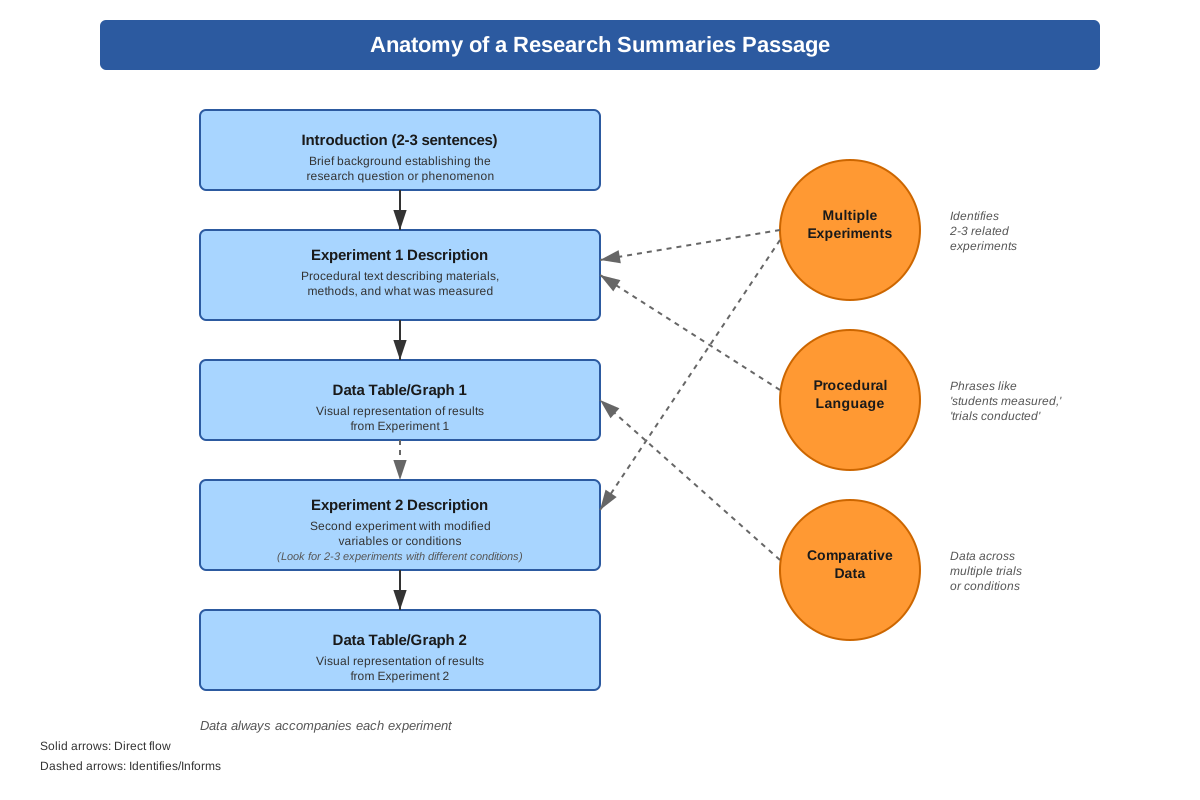
The ACT Science section presents three distinct passage types, and Research Summaries constitute approximately 45-55% of all passages students encounter on test day. These passages describe one or more experiments conducted to investigate a scientific question, presenting data in tables, graphs, or diagrams. Unlike Data Representation passages that focus purely on interpreting presented information, or Conflicting Viewpoints passages that compare competing hypotheses, Research Summaries require students to understand experimental design, identify variables, analyze results across multiple trials, and draw conclusions about cause-and-effect relationships.
Mastering the ACT research summaries strategy is essential because these passages consistently appear in 3 out of the 6-7 total Science passages on every ACT administration. Students who lack a systematic approach often waste precious time re-reading dense experimental descriptions or struggle to locate relevant data when answering questions. The strategic approach transforms what appears to be complex scientific writing into a predictable, manageable format that can be navigated efficiently under timed conditions.
The ACT research summaries strategy connects directly to fundamental scientific reasoning skills that underpin all Science section success. Understanding how to quickly identify independent and dependent variables, recognize experimental controls, and trace how changes in one factor affect outcomes prepares students not only for Research Summaries but also strengthens their ability to evaluate scientific claims in Conflicting Viewpoints passages and interpret complex datasets in Data Representation passages. This topic serves as the cornerstone of ACT Science mastery.
Learning Objectives
- [ ] Identify when ACT research summaries strategy is being tested
- [ ] Explain the core rule or strategy behind ACT research summaries strategy
- [ ] Apply ACT research summaries strategy to ACT-style questions accurately
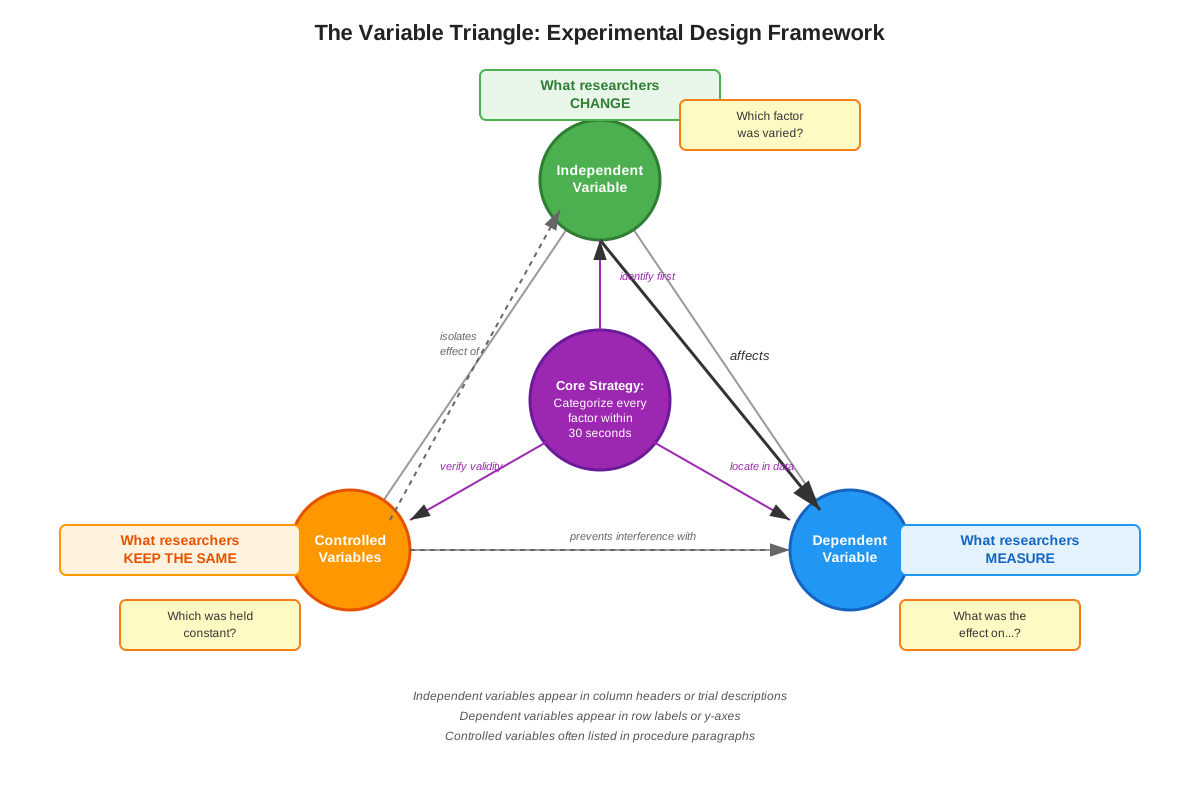
- [ ] Distinguish between independent variables, dependent variables, and controlled variables within 30 seconds of reading an experiment description
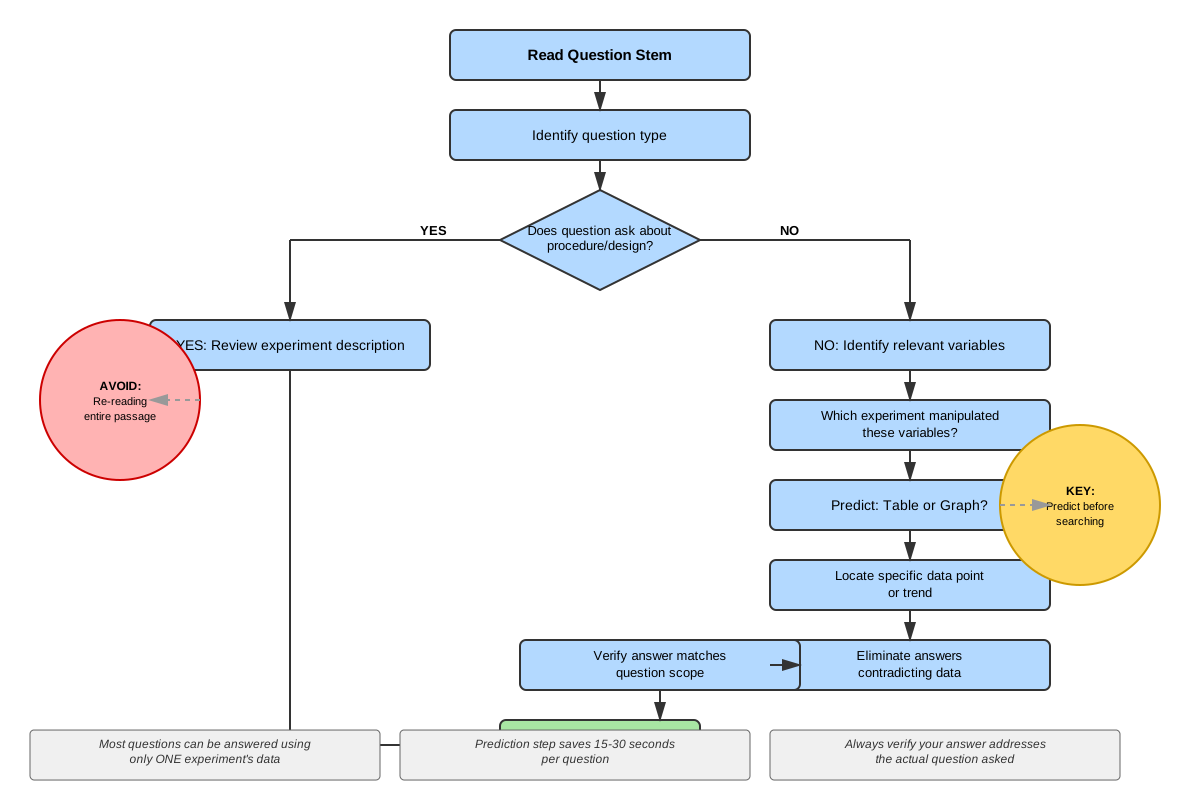
- [ ] Predict which data table or figure contains information needed to answer a specific question without re-reading the entire passage
- [ ] Evaluate whether an experimental design adequately tests a stated hypothesis
Prerequisites
- Basic graph reading skills: Students must interpret line graphs, bar charts, scatter plots, and tables to extract numerical values and identify trends, as Research Summaries present data exclusively through visual formats.
- Understanding of the scientific method: Familiarity with hypothesis formation, experimental design, and conclusion-drawing provides the conceptual framework for understanding why experiments are structured as described in passages.
- Ability to identify patterns and trends: Recognizing whether values increase, decrease, remain constant, or show no clear pattern is fundamental to answering questions about experimental results.
- Basic scientific vocabulary: Terms like "hypothesis," "variable," "control," "trial," and "procedure" appear frequently in Research Summaries passages without definition.
Why This Topic Matters
Research Summaries passages mirror the authentic process of scientific investigation that students encounter in laboratory courses and real-world research settings. The ability to quickly comprehend experimental design, identify what factors are being manipulated, and understand how outcomes are measured translates directly to success in college-level science courses across biology, chemistry, physics, and earth sciences. Beyond academics, evaluating research claims critically has become essential for navigating health information, environmental debates, and technology assessments in daily life.
On the ACT Science section, Research Summaries passages typically generate 6 questions each and appear 3 times per test, accounting for approximately 18 of the 40 total Science questions (45%). These questions test multiple skill levels: approximately 40% require straightforward data extraction, 35% demand comparison across experiments or trials, 15% ask students to predict outcomes under new conditions, and 10% require evaluation of experimental design or methodology. The passages themselves range from 150-250 words with 2-4 accompanying figures or tables.
Research Summaries commonly appear in these formats: multi-experiment passages describing 2-3 related studies investigating the same phenomenon from different angles; single-experiment passages with multiple trials varying one factor at a time; and comparative studies testing the same hypothesis under different conditions. The most frequently tested scientific disciplines include biology (ecology, cellular processes), chemistry (reaction rates, solution properties), physics (motion, energy transfer), and earth science (atmospheric conditions, geological processes).
Core Concepts
The Three-Step Reading Strategy
The most effective approach to Research Summaries passages involves a structured three-step process that maximizes comprehension while minimizing time investment. Step 1: Read the introduction (first 2-3 sentences) to identify the research question and general topic. This provides context for understanding why the experiments were conducted. Step 2: Skim each experiment description to locate the independent variable (what the researchers changed), dependent variable (what they measured), and controlled variables (what they kept constant). Step 3: Examine figures and tables to understand how data is organized, noting axis labels, units, and the range of values presented.
This strategy typically requires 45-60 seconds before attempting any questions, but this investment pays dividends by creating a mental map of where information is located. Students who skip this step and jump directly to questions often spend 2-3 times longer searching randomly through the passage for relevant data.
Identifying Variable Types
Every Research Summaries passage revolves around relationships between variables. The independent variable is the factor that researchers deliberately manipulate or change across trials. Common independent variables include temperature, concentration, time, mass, distance, or the presence/absence of a specific factor. The dependent variable is the outcome that researchers measure in response to changes in the independent variable. This is always the data being collected and recorded in tables or plotted on graphs.
Controlled variables (also called constants) are factors that researchers keep identical across all trials to ensure that observed changes in the dependent variable result solely from changes in the independent variable, not from other factors. For example, if an experiment tests how temperature affects plant growth, the amount of water, light exposure, soil type, and plant species would all be controlled variables.
| Variable Type | Definition | Location in Passage | Example |
|---|---|---|---|
| Independent | Factor deliberately changed | Experiment description; often x-axis | Temperature (10°C, 20°C, 30°C) |
| Dependent | Outcome measured | Table columns; often y-axis | Plant height (cm) |
| Controlled | Factors kept constant | Experiment description | Water amount, light exposure, soil type |
Understanding Experimental Structure
Research Summaries passages typically present experiments in one of three structural formats. Single-factor experiments vary only one independent variable while keeping all other factors constant, allowing researchers to isolate the effect of that single factor. Multi-factor experiments vary two or more independent variables, either one at a time (sequential) or simultaneously (factorial design), to understand how multiple factors interact.
Comparative experiments test the same hypothesis using different subjects, materials, or conditions to determine whether results are consistent across contexts. For example, testing whether a fertilizer increases growth in tomatoes, peppers, and lettuce represents a comparative approach.
Data Organization Patterns
ACT Research Summaries present data in predictable formats that students can learn to navigate efficiently. Tables typically organize data with independent variable values in the leftmost column or top row, with dependent variable measurements filling the remaining cells. Line graphs conventionally place the independent variable on the x-axis and dependent variable on the y-axis, with multiple lines representing different trials or conditions. Bar charts compare discrete categories or conditions, with bar height representing the measured dependent variable.
Understanding these conventions allows students to locate specific data points rapidly. When a question asks about "the effect of increasing temperature on reaction rate," students immediately know to look for temperature values on the x-axis (or left column) and reaction rate on the y-axis (or subsequent columns).
The Relationship Between Experiments
Multi-experiment Research Summaries passages always connect their experiments logically. Experiment 2 typically builds on Experiment 1 by either testing a different independent variable, using a different range of values, or examining the same phenomenon under different conditions. Recognizing these relationships helps students understand why certain questions ask them to compare results across experiments.
Common relationship patterns include: progressive refinement (Experiment 2 narrows the range of values tested in Experiment 1), factor isolation (Experiment 1 tests Factor A while Experiment 2 tests Factor B), and condition variation (Experiment 1 uses Material X while Experiment 2 uses Material Y to test generalizability).
Question Type Recognition
Research Summaries questions fall into five predictable categories, each requiring a specific approach. Data extraction questions ask students to read a specific value from a table or graph (e.g., "According to Experiment 1, what was the pH at 25°C?"). These require only locating the correct cell or point—no calculation or inference needed.
Trend identification questions ask about patterns (e.g., "As temperature increased, pressure..."). Students should look for consistent directional changes: increases, decreases, or remains constant. Comparison questions require students to examine data from multiple trials, experiments, or conditions (e.g., "In which trial was growth rate highest?"). Prediction questions ask what would happen under conditions not explicitly tested, requiring students to extrapolate from observed trends. Design evaluation questions ask about experimental methodology, controls, or whether the design adequately tests the hypothesis.
Concept Relationships
The three-step reading strategy serves as the foundation that enables all other strategic elements. By first identifying the research question, students create a framework for understanding why specific variables were chosen and how experiments relate to each other. This understanding directly facilitates variable identification—students can quickly distinguish what was changed (independent), what was measured (dependent), and what was held constant (controlled).
Variable identification, in turn, enables efficient data organization pattern recognition. Once students know which variable is independent, they immediately know where to look for it in tables (typically leftmost column or top row) and graphs (typically x-axis). This creates a direct pathway: Three-step reading → Variable identification → Data location → Rapid question answering.
Understanding experimental structure connects to recognizing relationships between experiments. When students grasp that Experiment 2 typically builds on Experiment 1 by varying a different factor or testing a different range, they can anticipate comparison questions and understand why certain data patterns emerge. This relationship flows as: Experimental structure understanding → Experiment relationship recognition → Prediction of question types.
Question type recognition represents the culmination of all previous concepts. Students who have completed the three-step reading, identified variables, understood data organization, and recognized experimental relationships can rapidly categorize each question and deploy the appropriate answering strategy. The complete concept flow follows: Reading strategy → Variable identification → Data organization → Experimental relationships → Question categorization → Strategic answering.
Quick check — test yourself on ACT research summaries strategy so far.
Try Flashcards →High-Yield Facts
- ⭐ Research Summaries passages always describe at least one experiment with a clear procedure, variables, and results presented in figures or tables
- ⭐ The independent variable is what researchers change; the dependent variable is what they measure in response
- ⭐ Approximately 40% of Research Summaries questions require only reading a single value from a table or graph without any calculation
- ⭐ When a question asks about "the effect of X on Y," X is the independent variable and Y is the dependent variable
- ⭐ Controlled variables are mentioned in the experiment description but do NOT appear as column headers or axis labels in data presentations
- Multi-experiment passages always connect their experiments logically—Experiment 2 builds on or extends Experiment 1
- Line graphs on the ACT conventionally place independent variables on the x-axis and dependent variables on the y-axis
- Questions asking "According to Experiment 1..." require data only from Experiment 1, not from other experiments in the passage
- When extrapolating beyond tested values, extend the observed trend unless the question provides reason to expect a change
- The passage introduction (first 2-3 sentences) always states the general research question or phenomenon being investigated
Common Misconceptions
Misconception: Students must read and understand every detail of the experimental procedure before attempting questions. → Correction: The three-step strategy requires only skimming procedures to identify variables; detailed procedural steps rarely affect question answers. Most questions can be answered using only the data tables and graphs.
Misconception: Controlled variables appear in data tables alongside independent and dependent variables. → Correction: Controlled variables are mentioned in text descriptions but never appear as column headers or axis labels because they don't change across trials. Only variables that change or are measured appear in data presentations.
Misconception: All Research Summaries questions require complex calculations or scientific knowledge beyond what's presented in the passage. → Correction: Approximately 75% of Research Summaries questions require only reading data directly from figures or identifying simple trends (increases/decreases). No outside scientific knowledge or mathematical calculations are needed.
Misconception: When a passage describes multiple experiments, students must understand how all experiments relate before answering any questions. → Correction: Questions specify which experiment(s) to use (e.g., "According to Experiment 2..."). Students should answer each question using only the referenced experiment(s), not the entire passage.
Misconception: The most complex-looking graph or table contains the most important information. → Correction: All figures and tables are equally important. Questions distribute evenly across all data presentations. Students should give equal attention to each during the initial 45-60 second passage review.
Misconception: Prediction questions require guessing because the conditions weren't tested. → Correction: Prediction questions always ask students to extrapolate from observed trends. If temperature increases from 10°C to 30°C caused pressure to increase from 2 atm to 6 atm, students can confidently predict that 40°C would yield pressure above 6 atm by extending the trend.
Worked Examples
Example 1: Multi-Experiment Variable Identification
Passage Summary: Students conducted two experiments to investigate factors affecting seed germination. In Experiment 1, they placed 50 bean seeds in each of four containers with different amounts of water (10 mL, 20 mL, 30 mL, 40 mL) and counted germinated seeds after 7 days. In Experiment 2, they placed 50 bean seeds in each of four containers with 20 mL of water at different temperatures (10°C, 20°C, 30°C, 40°C) and counted germinated seeds after 7 days.
Question: In Experiment 1, the independent variable was water amount and the dependent variable was:
A. Temperature
B. Number of seeds
C. Number of germinated seeds
D. Time
Solution Process:
Step 1: Identify what researchers changed in Experiment 1. The passage states "different amounts of water (10 mL, 20 mL, 30 mL, 40 mL)"—this is the independent variable.
Step 2: Identify what researchers measured as the outcome. The passage states "counted germinated seeds after 7 days"—this is what they measured in response to changing water amount.
Step 3: Evaluate each answer choice:
- A. Temperature: Not mentioned in Experiment 1; this was the independent variable in Experiment 2
- B. Number of seeds: This was held constant at 50 seeds per container (controlled variable)
- C. Number of germinated seeds: This is what they counted/measured (dependent variable) ✓
- D. Time: This was held constant at 7 days (controlled variable)
Answer: C
Connection to Learning Objectives: This example demonstrates how to identify when Research Summaries strategy is being tested (recognizing a variable identification question) and how to apply the strategy (distinguishing independent, dependent, and controlled variables by asking "What changed?" and "What was measured?").
Example 2: Trend Analysis and Prediction
Passage Summary: Experiment 1 tested how temperature affects enzyme activity. Scientists measured reaction rate (molecules/second) at five temperatures:
| Temperature (°C) | Reaction Rate (molecules/sec) |
|---|---|
| 10 | 15 |
| 20 | 32 |
| 30 | 48 |
| 40 | 51 |
| 50 | 28 |
Question: Based on Experiment 1, if the scientists had tested the enzyme at 35°C, the reaction rate would most likely have been:
A. Less than 15 molecules/sec
B. Between 32 and 48 molecules/sec
C. Between 48 and 51 molecules/sec
D. Greater than 51 molecules/sec
Solution Process:
Step 1: Identify the trend in the data. From 10°C to 40°C, reaction rate increases (15 → 32 → 48 → 51). At 50°C, reaction rate drops to 28, suggesting the enzyme denatures at high temperatures.
Step 2: Locate where 35°C falls in the tested range. 35°C is between 30°C (rate = 48) and 40°C (rate = 51).
Step 3: Apply the trend. Since reaction rate was increasing in this range, 35°C should yield a rate between the values at 30°C and 40°C.
Step 4: Evaluate answer choices:
- A. Less than 15: This contradicts the increasing trend
- B. Between 32 and 48: This would place 35°C below the 30°C value, contradicting the trend
- C. Between 48 and 51: This correctly places 35°C between the surrounding tested values ✓
- D. Greater than 51: The data shows the maximum rate occurred at 40°C, with decline afterward
Answer: C
Connection to Learning Objectives: This example shows how to apply Research Summaries strategy to prediction questions by identifying trends, locating the untested value within the tested range, and extrapolating logically from surrounding data points.
Exam Strategy
When approaching Research Summaries passages, invest 45-60 seconds in the three-step reading process before attempting any questions. This upfront investment prevents the time-wasting cycle of reading questions, searching randomly through the passage, re-reading sections, and still missing key information. Students who skip this step typically spend 6-8 minutes per passage; those who use the strategy complete passages in 4-5 minutes with higher accuracy.
Trigger words that signal specific question types include: "According to Experiment X" (data extraction—go directly to that experiment's figures), "As X increased, Y..." (trend identification—look for consistent directional changes), "compared to" or "higher/lower than" (comparison—examine multiple data points), "would most likely" or "if the scientists had tested" (prediction—extrapolate from trends), and "Which of the following best explains why the scientists..." (design evaluation—consider experimental purpose and controls).
For process-of-elimination, immediately eliminate answer choices that contradict data directly shown in tables or graphs. If a table shows temperature increasing from 10°C to 50°C, eliminate any answer claiming temperature decreased. For trend questions, eliminate choices using absolute terms ("always," "never") unless data shows no exceptions. For prediction questions, eliminate choices that reverse observed trends without justification.
Time allocation should follow this pattern: 45-60 seconds for initial passage reading, 30-40 seconds per data extraction question, 45-60 seconds per trend/comparison question, and 60-75 seconds per prediction/design evaluation question. If a question requires more than 90 seconds, mark it for review and move forward—returning with fresh perspective often reveals the answer immediately.
Exam Tip: When stuck between two answer choices, return to the specific experiment referenced in the question. The correct answer must be supported by data from that experiment alone, not from background knowledge or other experiments unless explicitly stated.
Memory Techniques
IDC Mnemonic for variable types: Independent variable is what I change, Dependent variable is what Data I collect, Controlled variables stay Constant.
"X-Independent, Y-Depends" for graph reading: The X-axis shows the Independent variable (what researchers changed), while the Y-axis shows what Depends on those changes (the dependent variable).
"Read-Skim-Scan" (RSS) for the three-step strategy: Read the introduction for the research question, Skim experiment descriptions for variables, Scan figures for data organization.
"TIDE" for question approach: Type (categorize the question), Identify (locate relevant data), Determine (find the answer), Eliminate (remove wrong choices).
Visualization strategy: Picture experiments as "before and after" scenarios. The independent variable is what changes between "before" and "after," while the dependent variable is what you measure to see the effect of that change. Controlled variables are identical in both pictures.
Summary
The ACT research summaries strategy provides a systematic approach to the most common passage type in the Science section, accounting for 45% of all questions. Success requires mastering the three-step reading process: reading the introduction to identify the research question, skimming experiment descriptions to locate independent, dependent, and controlled variables, and scanning figures to understand data organization. Students must distinguish between variable types by asking "What did researchers change?" (independent), "What did they measure?" (dependent), and "What stayed the same?" (controlled). Understanding that data organization follows predictable patterns—independent variables on x-axes or in leftmost columns, dependent variables on y-axes or in subsequent columns—enables rapid data location. Recognizing the five question types (data extraction, trend identification, comparison, prediction, and design evaluation) allows students to deploy specific answering strategies for each. Multi-experiment passages always connect logically, with later experiments building on earlier ones by testing different variables or conditions. The strategy transforms seemingly complex scientific passages into manageable, predictable formats that can be navigated efficiently under timed conditions.
Key Takeaways
- Research Summaries passages appear 3 times per ACT Science section, generating approximately 18 of 40 questions (45%)
- The three-step reading strategy (read introduction, skim for variables, scan figures) takes 45-60 seconds but saves 2-3 minutes overall
- Independent variables are what researchers change; dependent variables are what they measure; controlled variables stay constant
- Approximately 75% of Research Summaries questions require only reading data directly or identifying simple trends—no outside knowledge needed
- Data organization follows predictable patterns: independent variables on x-axes/left columns, dependent variables on y-axes/subsequent columns
- Questions specify which experiment to use; answer using only that experiment's data unless explicitly told to compare
- Prediction questions always ask students to extrapolate from observed trends, not to guess randomly
Related Topics
Data Representation Strategy: While Research Summaries focus on experimental design and multiple trials, Data Representation passages present observational data without experimental manipulation. Mastering Research Summaries strategy provides the variable identification and graph-reading skills that transfer directly to Data Representation passages, though the latter require stronger pattern recognition across larger datasets.
Conflicting Viewpoints Strategy: Research Summaries build the experimental evaluation skills needed for Conflicting Viewpoints passages. Understanding how experiments test hypotheses prepares students to evaluate whether scientific arguments are supported by evidence, a critical skill for comparing competing theories.
Scientific Reasoning Skills: The variable identification and trend analysis practiced in Research Summaries form the foundation for all scientific reasoning. These skills enable students to evaluate cause-and-effect relationships, distinguish correlation from causation, and assess the validity of scientific claims across all ACT Science passage types.
Advanced Graph Interpretation: Research Summaries introduce students to multi-line graphs, scatter plots with trend lines, and complex data tables. Mastering these formats prepares students for the most challenging Data Representation passages that present data in unconventional formats or require synthesis across multiple figures.
Practice CTA
Now that you understand the comprehensive strategy for tackling Research Summaries passages, it's time to put these skills into action. Complete the practice questions to reinforce variable identification, trend analysis, and strategic question answering. Use the flashcards to memorize key concepts like the three-step reading process and question type triggers. Remember: Research Summaries strategy is the highest-yield topic in ACT Science—mastering it will directly improve your score on nearly half of all Science questions. Approach each practice passage systematically, and you'll build the confidence and speed needed for test day success!
Sign up free to keep reading
Create a free AnvayaPrep account to finish this ACT guide on ACT research summaries strategy — plus flashcards and practice questions.