Overview
Data interpretation is the cornerstone skill tested throughout the ACT Science section, appearing in virtually every passage and accounting for approximately 40-50% of all Science questions. This skill involves extracting, analyzing, and drawing conclusions from scientific information presented in tables, graphs, charts, and experimental results. Unlike content-heavy science exams, the ACT Science test primarily assesses how well students can read and understand data representations rather than recall specific scientific facts.
Mastering ACT data interpretation is essential because it directly determines success on Research Summaries passages, which constitute one-third of the Science section. These passages present experimental designs and their results, requiring students to identify trends, compare data points, interpolate and extrapolate values, and recognize relationships between variables. The ability to quickly and accurately interpret data under time pressure separates high-scoring students from those who struggle with the Science section.
Data interpretation connects to broader scientific literacy by developing critical thinking skills applicable across all scientific disciplines. This topic builds upon basic graph-reading abilities and extends into more complex analytical tasks such as identifying experimental controls, understanding dependent and independent variables, and recognizing patterns across multiple data sets. Strong data interpretation skills also support success in the Conflicting Viewpoints passages and Data Representation passages, making this the most transferable and high-yield topic in ACT Science preparation.
Learning Objectives
- [ ] Identify when Data interpretation is being tested in ACT Science passages
- [ ] Explain the core rule or strategy behind Data interpretation
- [ ] Apply Data interpretation to ACT-style questions accurately
- [ ] Extract specific numerical values from tables and graphs within 10 seconds
- [ ] Recognize and describe trends (increasing, decreasing, constant) in data sets
- [ ] Interpolate values between given data points with reasonable accuracy
- [ ] Extrapolate trends beyond the given data range when appropriate
Prerequisites
- Basic graph literacy: Understanding x-axis, y-axis, and how to locate points on coordinate planes is essential for reading any data representation
- Unit awareness: Recognizing common scientific units (meters, grams, seconds, degrees Celsius) helps interpret what data actually measures
- Comparison skills: The ability to determine which of two numbers is larger or smaller enables trend identification and data comparison
- Variable concepts: Understanding independent variables (what experimenters change) versus dependent variables (what they measure) provides context for data relationships
Why This Topic Matters
Data interpretation skills extend far beyond standardized testing into real-world applications across medicine, engineering, business analytics, and scientific research. Professionals in every field must analyze data to make informed decisions, whether evaluating clinical trial results, interpreting market trends, or assessing environmental measurements. The ACT Science section simulates these real-world scenarios by presenting authentic scientific data that requires careful analysis.
On the ACT Science test, data interpretation questions appear in every single passage, making this the highest-frequency topic tested. Research Summaries passages, which focus heavily on experimental data, comprise 3 of the 6 passages (18 questions total). Within these passages, approximately 60-70% of questions require direct data interpretation skills. Additionally, Data Representation passages (another 2 passages, 12 questions) test these skills almost exclusively. This means roughly 30-35 of the 40 Science questions involve data interpretation to some degree.
Common question formats include: "According to Figure 1, what was the temperature when pressure equaled 5 atm?", "Based on Table 2, as humidity increased, plant growth:", and "Which of the following graphs best represents the relationship between variables X and Y?" These questions test whether students can locate specific values, identify trends, compare data across conditions, and understand relationships between variables—all core data interpretation skills.
Core Concepts
Reading Tables Effectively
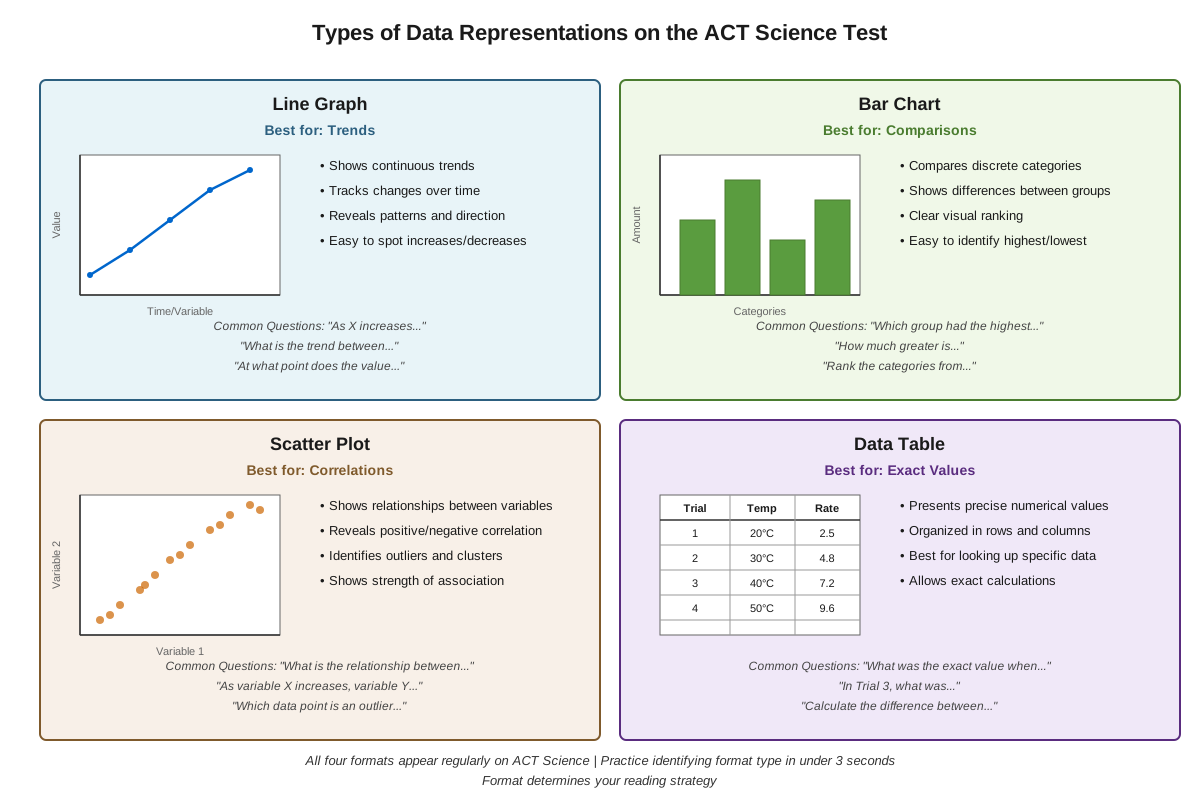
Tables organize data in rows and columns, with headers indicating what each column or row represents. The first row typically contains column headers (independent variable values or condition labels), while the first column often lists the dependent variable or trial numbers. To extract information efficiently, students must first identify what each axis represents, then trace from the row and column intersection to find specific values.
Key table-reading steps:
- Read the table title to understand what data is presented
- Identify units for all measurements (often in parentheses after variable names)
- Locate row and column headers to understand organization
- Trace systematically from header to data point
- Note any footnotes or asterisks that provide additional context
Interpreting Line Graphs
Line graphs display continuous relationships between variables, with the independent variable on the x-axis and dependent variable on the y-axis. The slope of the line indicates the relationship: upward slopes show positive correlations (as x increases, y increases), downward slopes show negative correlations (as x increases, y decreases), and horizontal lines indicate no relationship. Multiple lines on one graph allow comparison between different conditions or experimental groups.
Critical graph elements:
- Axes labels and scales: Always check what each axis measures and the scale intervals
- Data points: Individual measurements plotted on the graph
- Trend lines: Lines connecting data points to show overall patterns
- Legend: Key explaining what different lines or symbols represent
- Title: Describes the relationship being displayed
Understanding Bar Graphs and Histograms
Bar graphs compare discrete categories or groups, with bar height representing the measured value. Unlike line graphs, the x-axis categories have no inherent order (though they may be arranged logically). Histograms appear similar but represent frequency distributions, with bars touching to show continuous data ranges. The tallest bar indicates the highest value or most frequent occurrence.
Analyzing Scatter Plots
Scatter plots show individual data points without connecting lines, useful for displaying raw experimental data and identifying correlations. A tight clustering of points along an imaginary line suggests a strong relationship, while scattered points indicate weak or no correlation. Outliers—points far from the general pattern—are easily visible in scatter plots and may indicate measurement errors or special conditions.
Identifying Trends and Patterns
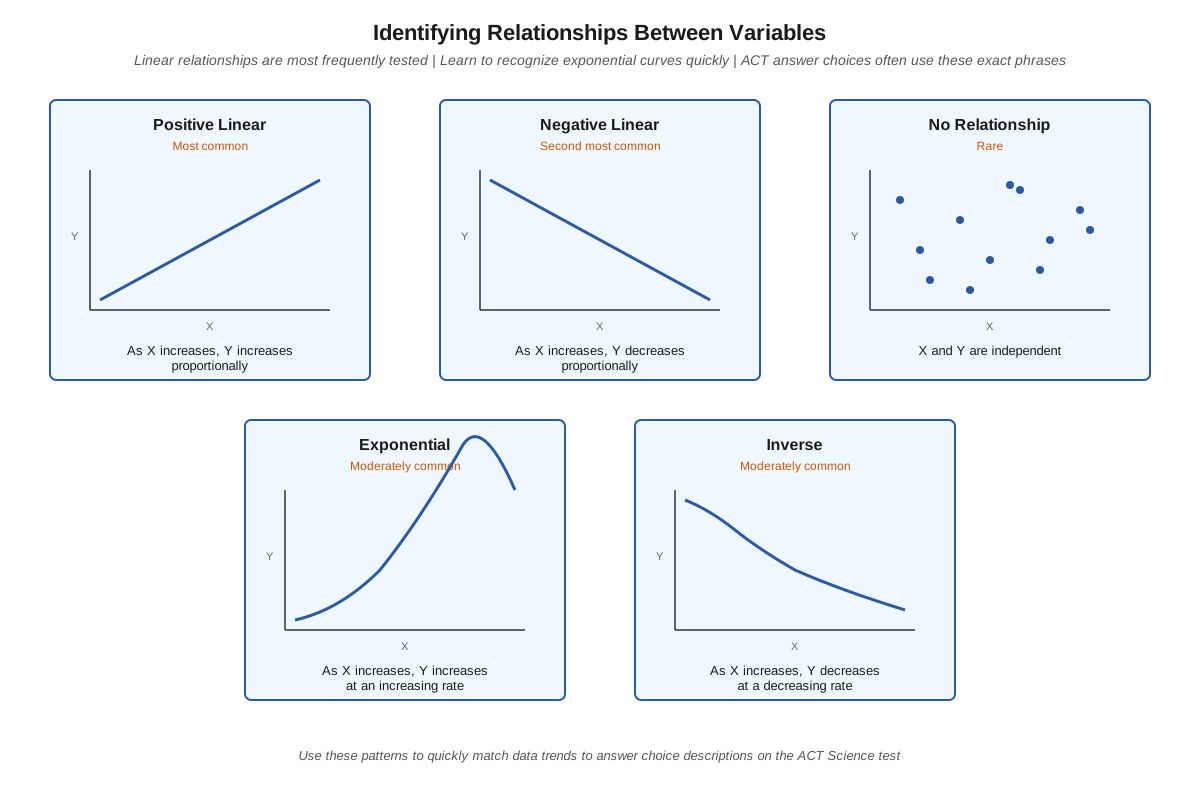
Trend analysis forms the foundation of data interpretation. Trends describe how one variable changes in relation to another:
| Trend Type | Description | Example |
|---|---|---|
| Direct/Positive | Both variables increase together | Temperature increases, gas volume increases |
| Inverse/Negative | One increases while the other decreases | Pressure increases, gas volume decreases |
| No relationship | Changes in one variable don't affect the other | Plant height and day of the week |
| Non-linear | Relationship exists but isn't a straight line | Exponential growth, logarithmic decay |
Interpolation vs. Extrapolation
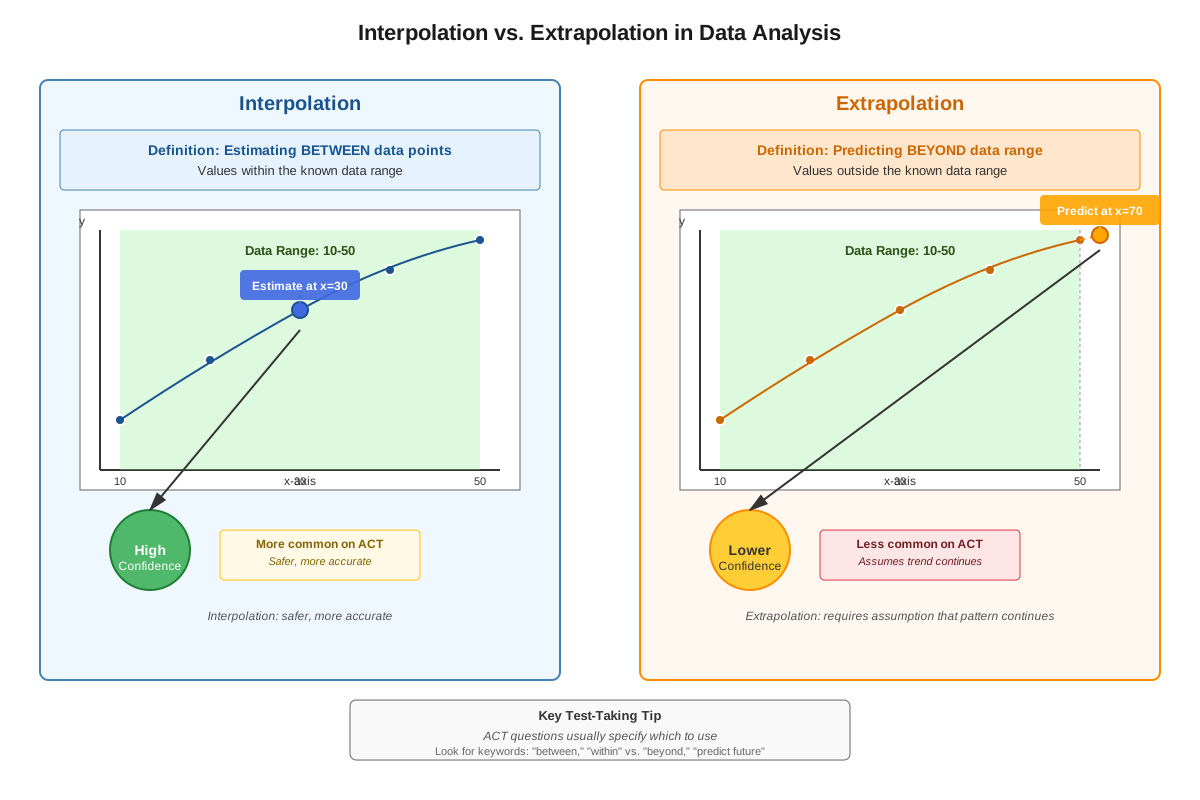
Interpolation involves estimating values between measured data points. If a table shows temperature at 10°C and 20°C, interpolating the value at 15°C means estimating based on the pattern between known points. This is generally reliable because you're working within the measured range.
Extrapolation extends trends beyond the measured data range. If data shows values from 10-20°C, extrapolating to 25°C assumes the trend continues unchanged. This is less reliable because conditions outside the tested range may differ. ACT questions sometimes test whether students recognize when extrapolation is inappropriate.
Comparing Data Across Conditions
Research Summaries passages frequently present multiple experiments or trials with varying conditions. Effective comparison requires:
- Identifying which variable changed between conditions
- Holding other variables constant mentally
- Comparing corresponding data points
- Determining whether the change in conditions caused a change in results
Understanding Scales and Units
Misreading scales causes frequent errors. Always check:
- Scale intervals: Does each line represent 1, 5, or 10 units?
- Scale type: Is it linear (equal intervals) or logarithmic (exponential intervals)?
- Units: Are measurements in meters or centimeters, seconds or minutes?
- Axis breaks: Do axes start at zero or some other value?
Recognizing Data Relationships
The ACT tests understanding of how variables relate:
- Dependent variables: What researchers measure (effect)
- Independent variables: What researchers manipulate (cause)
- Controlled variables: Factors kept constant across trials
- Confounding variables: Uncontrolled factors that might affect results
Concept Relationships
Data interpretation skills build hierarchically, starting with basic value extraction and progressing to complex analysis. Reading individual data points → identifying trends within single data sets → comparing trends across multiple data sets → drawing conclusions about variable relationships → evaluating experimental design based on data patterns.
The connection to prerequisite knowledge is direct: basic graph literacy enables table and graph reading, which enables trend identification, which enables comparison and analysis. Understanding variables (independent, dependent, controlled) provides the framework for interpreting what data actually means in experimental contexts.
Within Research Summaries passages, data interpretation connects intimately with experimental design understanding. The data presented results from specific experimental procedures, so interpreting data requires understanding what was measured, how it was measured, and under what conditions. This creates a feedback loop: experimental design → data collection → data interpretation → conclusions about the hypothesis.
Data interpretation also connects forward to Conflicting Viewpoints passages, where students must evaluate whether data supports or contradicts different scientific hypotheses. The ability to accurately interpret data determines whether students can assess the validity of competing scientific arguments.
High-Yield Facts
⭐ Approximately 40-50% of ACT Science questions directly test data interpretation skills
⭐ The independent variable is almost always on the x-axis; the dependent variable is on the y-axis
⭐ When a question asks about trends "as X increases," look at the data from left to right or top to bottom
⭐ Direct relationships show both variables moving in the same direction (both increase or both decrease)
⭐ Inverse relationships show variables moving in opposite directions (one increases while the other decreases)
- Tables organize data in rows and columns with headers indicating what each represents
- Line graphs show continuous relationships; bar graphs compare discrete categories
- Interpolation (estimating within the data range) is more reliable than extrapolation (estimating beyond the range)
- Always check units and scale intervals before reading values from graphs
- Multiple lines or data sets on one graph enable direct comparison between conditions
⭐ The steeper the slope on a line graph, the stronger the relationship between variables
- Scatter plots reveal correlations and outliers more clearly than line graphs
- Horizontal lines on graphs indicate no relationship between variables
- When comparing data across experiments, identify which variable changed and which stayed constant
- Axis breaks (when axes don't start at zero) can visually exaggerate differences between values
Quick check — test yourself on Data interpretation so far.
Try Flashcards →Common Misconceptions
Misconception: The independent variable can be on either axis depending on the experiment.
Correction: By scientific convention, the independent variable (what experimenters manipulate) is always placed on the x-axis, and the dependent variable (what they measure) is always on the y-axis. This consistency helps readers quickly understand data relationships.
Misconception: If two variables both increase, one must cause the other.
Correction: Correlation does not equal causation. Two variables can show similar trends due to a third factor, coincidence, or indirect relationships. The ACT tests whether students can identify relationships without assuming causation unless the experimental design supports it.
Misconception: Extrapolating trends is just as reliable as interpolating between data points.
Correction: Extrapolation assumes trends continue unchanged beyond the measured range, which may not be true. Physical, chemical, or biological constraints often cause trends to change outside tested conditions. The ACT sometimes includes questions specifically testing whether students recognize extrapolation limitations.
Misconception: All graphs with upward-sloping lines show the same strength of relationship.
Correction: The steepness of the slope indicates relationship strength. A steep slope means small changes in the independent variable cause large changes in the dependent variable (strong relationship), while a gentle slope indicates a weaker relationship.
Misconception: Data points must fall exactly on trend lines to be valid.
Correction: Real experimental data includes natural variation and measurement uncertainty. Points near but not exactly on trend lines are normal. Only points far from the general pattern (outliers) suggest potential problems.
Misconception: The highest point on a graph is always the "best" or most desirable result.
Correction: The meaning of data depends on context. In some experiments, lower values might be preferable (e.g., pollution levels, disease rates). Always consider what the variables represent before making value judgments.
Misconception: Complex-looking graphs with multiple lines are always harder to interpret.
Correction: Multiple data sets on one graph actually facilitate comparison. The key is systematically using the legend to identify each line, then comparing them one aspect at a time rather than trying to process everything simultaneously.
Worked Examples
Example 1: Table Interpretation with Trend Analysis
Passage Context: Students conducted an experiment measuring how temperature affects the solubility of salt in water. They recorded the following data:
| Temperature (°C) | Solubility (g/100mL) |
|---|---|
| 0 | 35.7 |
| 20 | 36.0 |
| 40 | 36.6 |
| 60 | 37.3 |
| 80 | 38.0 |
Question: Based on the table, as temperature increased from 0°C to 80°C, the solubility of salt:
A) decreased only
B) increased only
C) increased, then decreased
D) remained constant
Solution Process:
Step 1: Identify what the question asks. We need to describe the trend in solubility as temperature increases.
Step 2: Locate the relevant data. Temperature is in the left column (independent variable), solubility in the right column (dependent variable).
Step 3: Read the data systematically from top to bottom (low temperature to high temperature):
- At 0°C: 35.7 g/100mL
- At 20°C: 36.0 g/100mL (increased from previous)
- At 40°C: 36.6 g/100mL (increased from previous)
- At 60°C: 37.3 g/100mL (increased from previous)
- At 80°C: 38.0 g/100mL (increased from previous)
Step 4: Identify the pattern. Every value is larger than the previous one—this is a consistent increasing trend.
Step 5: Eliminate wrong answers:
- A) decreased only - No, values increased
- C) increased, then decreased - No, values never decreased
- D) remained constant - No, values changed
Answer: B) increased only
Connection to Learning Objectives: This example demonstrates identifying when data interpretation is tested (trend analysis question), applying the core strategy (systematic reading of data), and accurately answering an ACT-style question.
Example 2: Graph Interpretation with Interpolation
Passage Context: Researchers measured the growth rate of bacteria at different pH levels and displayed results in the following graph:
[Description: Line graph with pH on x-axis (3, 5, 7, 9, 11) and Growth Rate (cells/hour) on y-axis. Points plotted: (3, 20), (5, 45), (7, 80), (9, 50), (11, 15). Line connects all points showing increase from pH 3-7, then decrease from pH 7-11.]
Question: Based on the graph, the growth rate at pH 6 was most likely closest to:
A) 30 cells/hour
B) 50 cells/hour
C) 63 cells/hour
D) 80 cells/hour
Solution Process:
Step 1: Recognize this requires interpolation. pH 6 falls between measured points at pH 5 and pH 7.
Step 2: Locate the relevant data points:
- At pH 5: 45 cells/hour
- At pH 7: 80 cells/hour
Step 3: Estimate the value at pH 6 (halfway between pH 5 and 7). Since pH 6 is exactly halfway between 5 and 7, estimate halfway between the growth rates:
- Difference: 80 - 45 = 35 cells/hour
- Halfway point: 45 + (35/2) = 45 + 17.5 = 62.5 cells/hour
Step 4: Find the closest answer choice. 62.5 is closest to 63.
Step 5: Verify reasonableness. The answer should be between 45 and 80, and closer to the middle since pH 6 is in the middle. 63 fits this criterion.
Answer: C) 63 cells/hour
Connection to Learning Objectives: This demonstrates applying interpolation strategy, a core data interpretation skill, and shows how to estimate values between measured points accurately.
Exam Strategy
Approaching Data Interpretation Questions
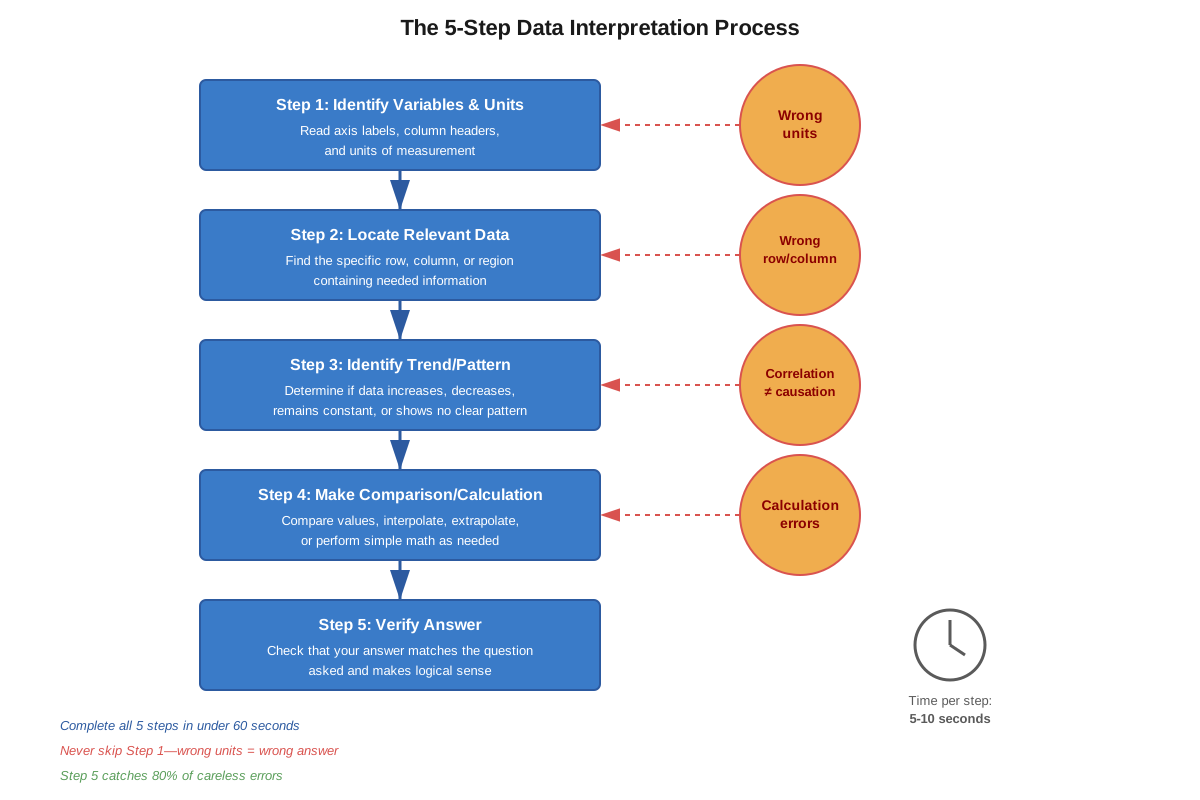
Step 1: Read the question first before examining tables or graphs. This focuses attention on relevant data and prevents wasting time on unnecessary information.
Step 2: Identify the data source mentioned in the question (e.g., "According to Figure 2" or "Based on Table 1"). Go directly to that specific representation.
Step 3: Locate the relevant variables mentioned in the question. Find these on axes, column headers, or row labels.
Step 4: Extract or analyze the data systematically. For specific values, trace carefully from axes to data points. For trends, read data in order from low to high values of the independent variable.
Step 5: Predict an answer before looking at choices when possible. This prevents answer choices from confusing your interpretation.
Trigger Words and Phrases
Watch for these question stems that signal data interpretation:
- "According to Figure/Table X..." (direct value extraction)
- "Based on the data..." (analysis required)
- "As [variable] increased..." (trend identification)
- "At what [independent variable] did [dependent variable] equal..." (specific value location)
- "Which of the following best describes the relationship..." (relationship analysis)
- "The data support the conclusion that..." (inference from data)
Process of Elimination Tips
For trend questions: Eliminate any answer describing the opposite trend first (if data increases, eliminate "decreased only"). Then eliminate answers describing patterns not present in the data (if data consistently increases, eliminate "increased then decreased").
For specific value questions: Eliminate answers outside the possible range first. If the graph shows values between 20 and 80, eliminate any answer below 20 or above 80.
For comparison questions: Eliminate answers that contradict clear data patterns. If Experiment 1 consistently shows higher values than Experiment 2, eliminate any answer stating the opposite.
Time Allocation
Spend no more than 30-40 seconds per data interpretation question. These questions test reading accuracy, not complex reasoning, so they should be among the fastest to answer. If a question requires more than 45 seconds, mark it and return later—you may be overcomplicating the task.
Exam Tip: The ACT Science section provides 35 minutes for 40 questions (52.5 seconds per question average). Data interpretation questions should take less than average time, banking seconds for more complex Conflicting Viewpoints questions.
Memory Techniques
AXIS Mnemonic for graph reading:
- Always check the axes first
- X-axis holds the independent variable
- Identify units and scale intervals
- Systematically trace to data points
TIDE for trend identification:
- Trace the data from left to right or top to bottom
- Identify if values increase, decrease, or stay constant
- Determine if the relationship is direct or inverse
- Eliminate answers that contradict the pattern
TABLE for systematic table reading:
- Title tells you what data represents
- Axes/headers show variable names
- Both row and column must be identified
- Locate the intersection point
- Examine units carefully
Visualization Strategy: Picture yourself as a scientist recording data in real-time. As you read left to right across a graph or down a table, imagine watching the experiment unfold. This creates a mental narrative that makes trends more memorable and intuitive.
Scale Check Acronym - SUIT:
- Start point (does the axis begin at zero?)
- Units (what is being measured?)
- Intervals (what does each line represent?)
- Type (linear or logarithmic scale?)
Summary
Data interpretation represents the most frequently tested skill on the ACT Science section, appearing in virtually every passage and accounting for 40-50% of all questions. Success requires systematic approaches to extracting information from tables, graphs, and charts, identifying trends in data sets, and understanding relationships between variables. The core strategy involves reading questions first to focus attention, locating the relevant data source, identifying the variables in question, and systematically extracting or analyzing the information needed. Students must distinguish between interpolation (estimating within the data range) and extrapolation (extending beyond it), recognize direct versus inverse relationships, and compare data across multiple conditions or experiments. Mastery of data interpretation enables students to answer questions quickly and accurately, banking time for more complex reasoning questions elsewhere in the Science section.
Key Takeaways
- Data interpretation questions appear in every ACT Science passage and represent the highest-frequency question type
- Always read the question first to identify which data source and variables are relevant
- The independent variable appears on the x-axis; the dependent variable appears on the y-axis
- Systematic reading (left to right, top to bottom) prevents errors when identifying trends
- Interpolation within the data range is reliable; extrapolation beyond it is less certain
- Check units, scale intervals, and axis starting points before extracting values
- Direct relationships show variables moving together; inverse relationships show them moving in opposite directions
Related Topics
Experimental Design Analysis: Understanding how experiments are structured helps interpret why data appears as it does and what conclusions are valid. Mastering data interpretation provides the foundation for evaluating whether experimental designs adequately test hypotheses.
Conflicting Viewpoints Evaluation: After mastering data interpretation, students can progress to evaluating whether data supports or contradicts different scientific hypotheses, a key skill in Conflicting Viewpoints passages.
Scientific Reasoning: Data interpretation skills enable higher-level scientific reasoning, including identifying assumptions, evaluating conclusions, and recognizing limitations in experimental data.
Data Representation Passages: These passages focus almost exclusively on data interpretation skills, making this topic essential preparation for one-third of the ACT Science section.
Practice CTA
Now that you understand the core concepts and strategies for data interpretation, it's time to apply these skills to actual ACT-style questions. The practice questions and flashcards will reinforce your ability to quickly and accurately extract information from tables and graphs, identify trends, and analyze relationships between variables. Remember, data interpretation is a skill that improves rapidly with focused practice—each question you work through builds the pattern recognition and systematic approach that leads to confident, accurate performance on test day. Start practicing now to transform these strategies into automatic habits!
Sign up free to keep reading
Create a free AnvayaPrep account to finish this ACT guide on Data interpretation — plus flashcards and practice questions.