Overview
Experimental results represent one of the most frequently tested components of the ACT Science test, appearing in nearly every Research Summaries passage. These passages present data from one or more experiments, and students must interpret tables, graphs, and written descriptions to answer questions about what the experiments showed. Understanding how to read, analyze, and draw conclusions from ACT experimental results is essential for achieving a competitive score on the Science section.
The ability to interpret experimental results goes beyond simply reading numbers from a table or graph. Students must recognize patterns in data, identify relationships between variables, compare results across different experimental conditions, and understand what the data reveals about the hypothesis being tested. This skill bridges the gap between experimental design and scientific conclusions, requiring students to think like scientists who must make sense of raw data. On the ACT, approximately 40-50% of Science questions directly test the ability to understand and interpret experimental results, making this the single most important skill for the Science section.
Experimental results questions connect to broader scientific reasoning skills including data analysis, pattern recognition, and evidence-based conclusions. These questions often integrate with topics like variable identification, experimental design, and hypothesis evaluation. Mastering experimental results interpretation provides the foundation for tackling more complex questions about scientific investigations and prepares students for the analytical thinking required in college-level science courses.
Learning Objectives
- [ ] Identify when Experimental results is being tested
- [ ] Explain the core rule or strategy behind Experimental results
- [ ] Apply Experimental results to ACT-style questions accurately
- [ ] Extract specific numerical values from tables and graphs with 100% accuracy
- [ ] Recognize trends and patterns in experimental data across multiple trials or conditions
- [ ] Compare results between different experimental groups or conditions
- [ ] Determine which experimental condition produced the highest or lowest values for a given variable
Prerequisites
- Basic graph reading skills: Understanding x-axis, y-axis, data points, and trend lines is essential for interpreting visual representations of experimental results
- Table interpretation: Ability to locate specific values in rows and columns enables quick data extraction from tabular results
- Variable identification: Recognizing independent and dependent variables helps students understand what was measured and what was manipulated in experiments
- Units of measurement: Familiarity with common scientific units (meters, grams, seconds, degrees Celsius) prevents confusion when comparing numerical values
- Basic mathematical operations: Simple calculations like finding averages, identifying maximum/minimum values, and recognizing increasing/decreasing patterns are frequently required
Why This Topic Matters
Experimental results interpretation is the cornerstone of scientific literacy. In real-world applications, scientists, medical professionals, engineers, and researchers must constantly analyze experimental data to make informed decisions. Whether evaluating clinical trial results for a new medication, analyzing environmental data to assess pollution levels, or testing materials for engineering applications, the ability to extract meaningful information from experimental results is fundamental to scientific progress.
On the ACT Science test, experimental results questions appear in approximately 18-22 questions out of the 40 total questions, representing 45-55% of the exam. These questions appear primarily in Research Summaries passages (3-4 passages per test), which present data from controlled experiments. The most common question types include: direct data lookup questions (asking for specific values from tables or graphs), trend identification questions (asking whether a variable increased, decreased, or remained constant), comparison questions (asking which condition produced higher or lower values), and interpolation/extrapolation questions (asking what value would be expected at a point not directly measured).
Research Summaries passages typically present 2-4 related experiments with results displayed in multiple formats: data tables with numerical values, line graphs showing relationships between variables, bar graphs comparing different conditions, and scatter plots showing correlations. Students must quickly navigate between these different representations, often using information from multiple sources to answer a single question. The passages cover diverse scientific fields including biology, chemistry, physics, and Earth science, but the data interpretation skills remain consistent across all topics.
Core Concepts
Understanding Data Tables
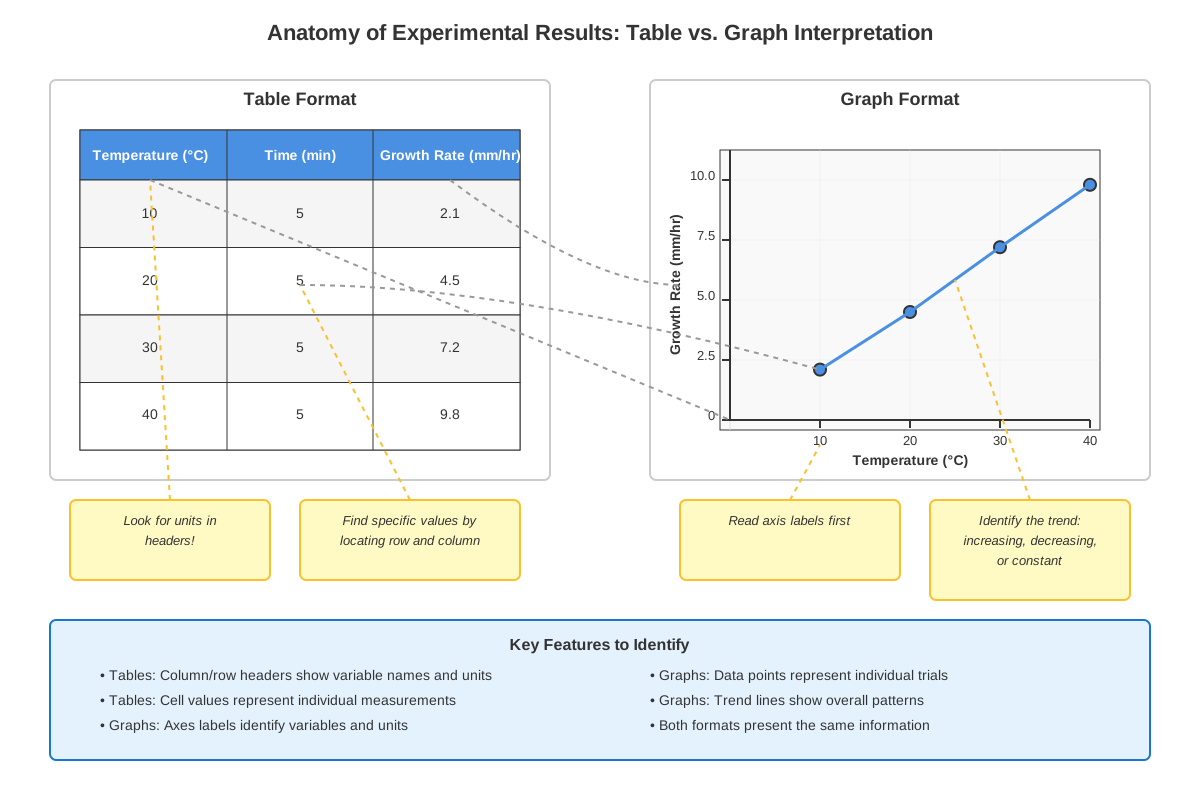
Data tables organize experimental results in rows and columns, with each cell containing a specific measurement or observation. The first row typically contains column headers identifying the variables, while the first column often lists different experimental trials, conditions, or time points. Reading data tables efficiently requires systematic scanning: first identify what each column represents, then locate the specific row that matches the question's conditions, and finally extract the value at the intersection.
Tables may present data in various formats including whole numbers, decimals, percentages, or scientific notation. Pay attention to units, which are usually listed in the column headers or immediately after variable names. When comparing values across rows or columns, ensure all measurements use the same units. Some tables include calculated values like averages, ranges, or percent changes alongside raw data.
Interpreting Line Graphs
Line graphs display the relationship between two continuous variables, with the independent variable on the x-axis and the dependent variable on the y-axis. Each data point represents a specific measurement, and connecting lines help visualize trends. On the ACT, line graphs frequently show how a measured variable changes over time or in response to different levels of an independent variable.
To extract information from line graphs: locate the x-axis value specified in the question, trace vertically to the data line, then trace horizontally to read the y-axis value. For questions about trends, examine whether the line slopes upward (positive relationship), downward (negative relationship), or remains horizontal (no relationship). Multiple lines on the same graph allow comparison between different experimental conditions or groups.
Analyzing Bar Graphs
Bar graphs compare discrete categories or experimental conditions using rectangular bars whose heights represent measured values. Unlike line graphs that show continuous relationships, bar graphs display data for separate, distinct groups. The ACT frequently uses bar graphs to compare results across different experimental trials, treatment groups, or categorical variables.
When reading bar graphs, identify what each bar represents by checking the x-axis labels or legend. The height of each bar corresponds to the measured value on the y-axis. To compare conditions, visually assess which bars are taller or shorter, or read exact values from the y-axis scale. Some bar graphs include error bars extending above and below each bar, indicating variability or uncertainty in measurements.
Recognizing Patterns and Trends
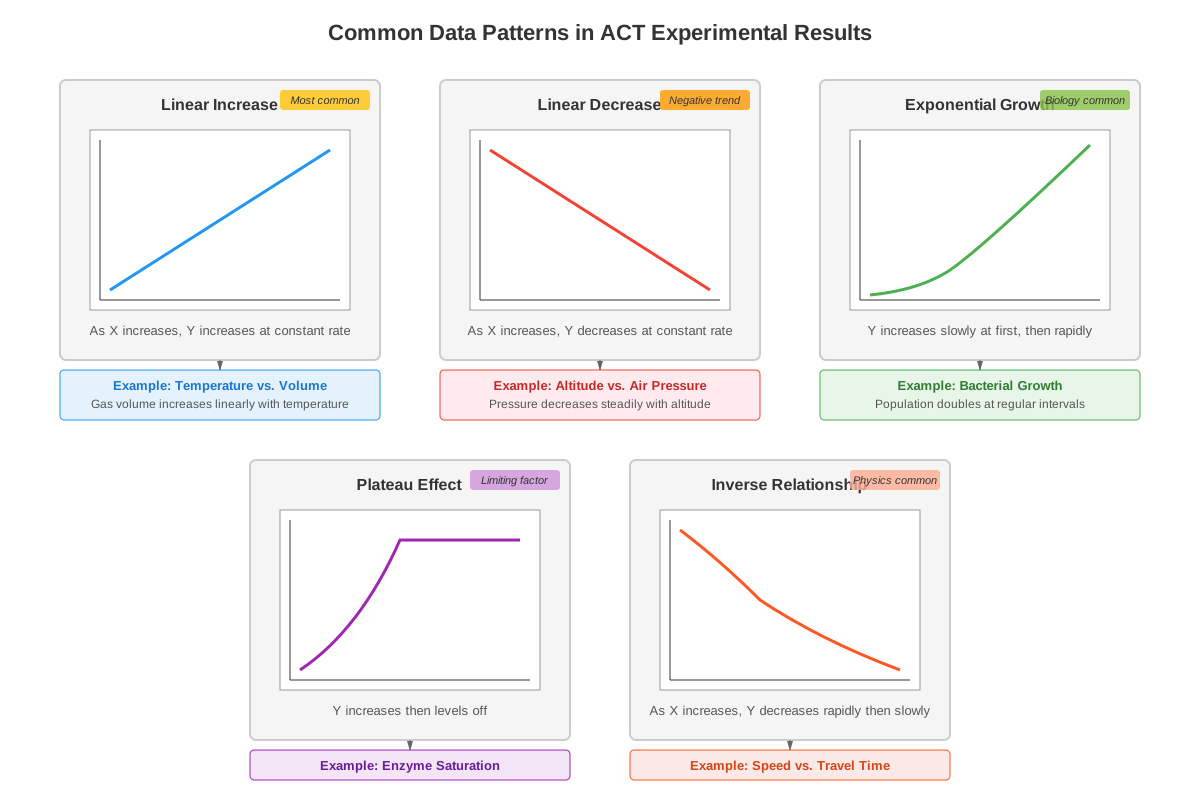
Pattern recognition is crucial for answering questions about how variables relate to each other. Common patterns include:
- Direct relationships: As one variable increases, another increases proportionally
- Inverse relationships: As one variable increases, another decreases
- No relationship: Changes in one variable don't affect another
- Non-linear relationships: Variables relate in curved patterns rather than straight lines
- Threshold effects: A variable shows no change until reaching a critical point, then changes rapidly
Identifying these patterns requires examining data across multiple measurements or conditions. Look for consistency in how values change: do they always increase together, always move in opposite directions, or show no consistent pattern?
Comparing Experimental Conditions
Many ACT questions require comparing results between different experimental groups, trials, or time points. Effective comparison involves identifying the specific conditions being compared, locating the relevant data for each condition, and determining which produced higher, lower, or equal values for the measured variable.
| Comparison Type | What to Look For | Example Question |
|---|---|---|
| Between groups | Different experimental treatments or conditions | Which group had the highest average temperature? |
| Across time | Changes in measurements over sequential time points | At which time point was the concentration greatest? |
| Between variables | Different measured outcomes in the same experiment | Was pH or temperature more affected by the treatment? |
| Within conditions | Variation among trials in the same experimental group | Which trial in Group A showed the lowest value? |
Extracting Specific Values
The most straightforward experimental results questions ask students to find specific numerical values from tables or graphs. These questions test careful reading and attention to detail rather than complex analysis. Success requires: identifying the correct table or graph, locating the appropriate row/column or axis position, and reading the value accurately including units and decimal places.
Common errors include reading from the wrong row or column, misreading axis scales (especially when gridlines don't align with every number), and confusing similar-looking values. Always double-check that the extracted value matches all conditions specified in the question.
Understanding Experimental Controls
Experimental results often include data from control groups or baseline conditions that provide comparison points for evaluating treatment effects. Controls help determine whether observed changes result from the experimental manipulation or from other factors. When analyzing results, identify which condition serves as the control (often labeled "control," "baseline," or "0" for the independent variable) and compare experimental conditions to this reference point.
Interpolation and Extrapolation
Some questions ask about values not directly measured in the experiment. Interpolation estimates values between measured data points, while extrapolation estimates values beyond the measured range. For interpolation on line graphs, follow the trend line between two known points. For extrapolation, extend the established pattern beyond the measured range, though this involves greater uncertainty.
Concept Relationships
The concepts within experimental results interpretation form an interconnected system where each skill builds upon others. Data extraction (reading specific values from tables and graphs) serves as the foundation → enabling pattern recognition (identifying how variables relate) → which supports comparison skills (determining which conditions produced different outcomes) → ultimately leading to evidence-based conclusions about experimental hypotheses.
Experimental results connect directly to prerequisite knowledge of variables: understanding independent and dependent variables helps students know where to look for specific information (independent variables typically appear in leftmost columns or on x-axes, while dependent variables appear in other columns or on y-axes). Graph reading skills from mathematics courses transfer directly to interpreting scientific data visualizations.
This topic also connects forward to more advanced Science skills. Mastering experimental results interpretation enables students to evaluate experimental design (understanding what results would support or refute a hypothesis), assess data quality (recognizing when results show consistency or unexpected variation), and synthesize information across multiple experiments (comparing results from different studies to draw broader conclusions).
The relationship map: Variable Identification → Data Location → Value Extraction → Pattern Recognition → Condition Comparison → Trend Analysis → Conclusion Formation
High-Yield Facts
⭐ Approximately 45-55% of ACT Science questions test experimental results interpretation, making it the most frequently assessed skill
⭐ The independent variable is almost always on the x-axis of graphs or in the leftmost column of tables
⭐ When a question asks "according to the results," the answer must come directly from the data, not from outside knowledge
⭐ Line graphs show continuous relationships; bar graphs show categorical comparisons
⭐ "Increased," "decreased," and "remained constant" are the three most common trend descriptions tested
- Tables organize data in rows and columns with headers identifying variables and units
- Multiple lines on a single graph allow direct comparison between different experimental conditions
- Error bars on graphs indicate variability or uncertainty in measurements
- Control groups provide baseline comparisons for evaluating experimental effects
- Interpolation estimates values between measured points; extrapolation extends beyond measured ranges
- Units must match when comparing numerical values across different conditions
- The highest point on a line graph represents the maximum value; the lowest point represents the minimum
- Positive slopes indicate direct relationships; negative slopes indicate inverse relationships
- Data points that don't follow the general trend may indicate experimental error or important exceptions
- Reading axis scales carefully prevents errors when gridlines don't mark every value
Quick check — test yourself on Experimental results so far.
Try Flashcards →Common Misconceptions
Misconception: Experimental results questions require extensive scientific knowledge about the topic being studied → Correction: ACT experimental results questions test data interpretation skills, not content knowledge. All necessary information appears in the passage, tables, and graphs. Students should focus on reading the data accurately rather than applying outside knowledge about biology, chemistry, or physics concepts.
Misconception: Line graphs always show time on the x-axis → Correction: While time is a common independent variable, line graphs can display any continuous variable on the x-axis. Always read axis labels carefully to identify what variables are actually being graphed. The x-axis might show temperature, concentration, distance, or any other manipulated variable.
Misconception: The tallest bar or highest point on a graph is always the "correct" answer → Correction: Questions may ask for the lowest value, the condition that showed the least change, or the group that most closely matched the control. Read questions carefully to determine whether they ask for maximum, minimum, or some other specific comparison.
Misconception: When data points don't fall exactly on gridlines, students should round to the nearest gridline → Correction: Estimate values between gridlines as accurately as possible. If a data point falls halfway between 20 and 30, the value is approximately 25, not 20 or 30. The ACT often includes answer choices that differ by small amounts to test careful reading.
Misconception: All experiments in a Research Summaries passage test the same hypothesis → Correction: While experiments in a passage are related, they often test different aspects of a phenomenon or use different methods. Each experiment may have different variables, conditions, or measured outcomes. Always verify which experiment a question refers to before answering.
Misconception: Complex-looking graphs with multiple lines or many data points are harder questions → Correction: Visual complexity doesn't necessarily indicate question difficulty. Many questions about complex graphs simply ask for direct data lookup. Focus on the specific information requested rather than being intimidated by the overall appearance.
Misconception: If a pattern holds for most data points, it holds for all data points → Correction: Some questions specifically test whether students notice exceptions to general trends. A single data point that doesn't follow the pattern may be the key to answering correctly, especially for questions asking about inconsistencies or unexpected results.
Worked Examples
Example 1: Data Table Interpretation
Passage Context: Students conducted an experiment measuring plant growth under different light conditions. They measured the height of bean plants after 14 days under four different light intensities.
Data Table:
| Light Intensity (lumens) | Average Plant Height (cm) | Number of Leaves |
|---|---|---|
| 100 | 8.2 | 4 |
| 200 | 12.5 | 6 |
| 300 | 15.8 | 8 |
| 400 | 14.1 | 7 |
Question: According to the results, at which light intensity did the plants achieve the greatest average height?
Solution Process:
- Identify what the question asks: We need to find which light intensity produced the greatest average plant height
- Locate the relevant column: The "Average Plant Height (cm)" column contains the data we need
- Scan for the maximum value: Reading down the column: 8.2, 12.5, 15.8, 14.1
- Identify the maximum: 15.8 cm is the highest value
- Find the corresponding condition: This height occurred at 300 lumens light intensity
- Answer: 300 lumens
Key Strategy: This question tests direct data extraction. The answer requires no calculation or complex analysis—only careful reading of the table to locate the maximum value and its corresponding condition. Notice that the highest light intensity (400 lumens) did NOT produce the greatest height, demonstrating that "more" doesn't always mean "better" in experimental results.
Example 2: Line Graph Trend Analysis
Passage Context: Researchers measured the concentration of dissolved oxygen in a lake at different water temperatures throughout the year.
Graph Description: A line graph shows temperature (°C) on the x-axis from 0 to 30, and dissolved oxygen concentration (mg/L) on the y-axis from 0 to 14. The line starts at approximately 13 mg/L at 0°C, decreases steadily to approximately 7 mg/L at 30°C.
Question: Based on the results, as water temperature increased from 0°C to 30°C, the dissolved oxygen concentration:
A. increased only
B. decreased only
C. increased, then decreased
D. remained constant
Solution Process:
- Identify the variables: Independent variable (x-axis) = temperature; Dependent variable (y-axis) = dissolved oxygen concentration
- Determine the direction of change: Following the line from left to right (increasing temperature), the line slopes downward
- Describe the pattern: A downward slope means the y-variable (oxygen) decreases as the x-variable (temperature) increases
- Check for consistency: The line decreases continuously across the entire range—no increases or plateaus
- Select the answer: The oxygen concentration decreased only
- Answer: B
Key Strategy: This question tests pattern recognition and trend description. Rather than extracting specific numerical values, students must describe the overall relationship between variables. The word "only" in the answer choices is crucial—it indicates the trend must be consistent across the entire range. Always trace the entire line or examine all data points before concluding about trends.
Connection to Learning Objectives: This example demonstrates how to identify when experimental results are being tested (the question asks "based on the results"), apply the core strategy of reading graphs systematically (identify variables, trace the pattern, describe the relationship), and answer ACT-style questions accurately by eliminating answers that don't match the observed pattern.
Exam Strategy
Question Identification
Experimental results questions typically include trigger phrases: "According to the results," "Based on the data," "The results indicate that," "Which trial showed," or "At what temperature did." These phrases signal that the answer must come directly from tables, graphs, or explicitly stated results—not from outside knowledge or theoretical reasoning.
Systematic Approach
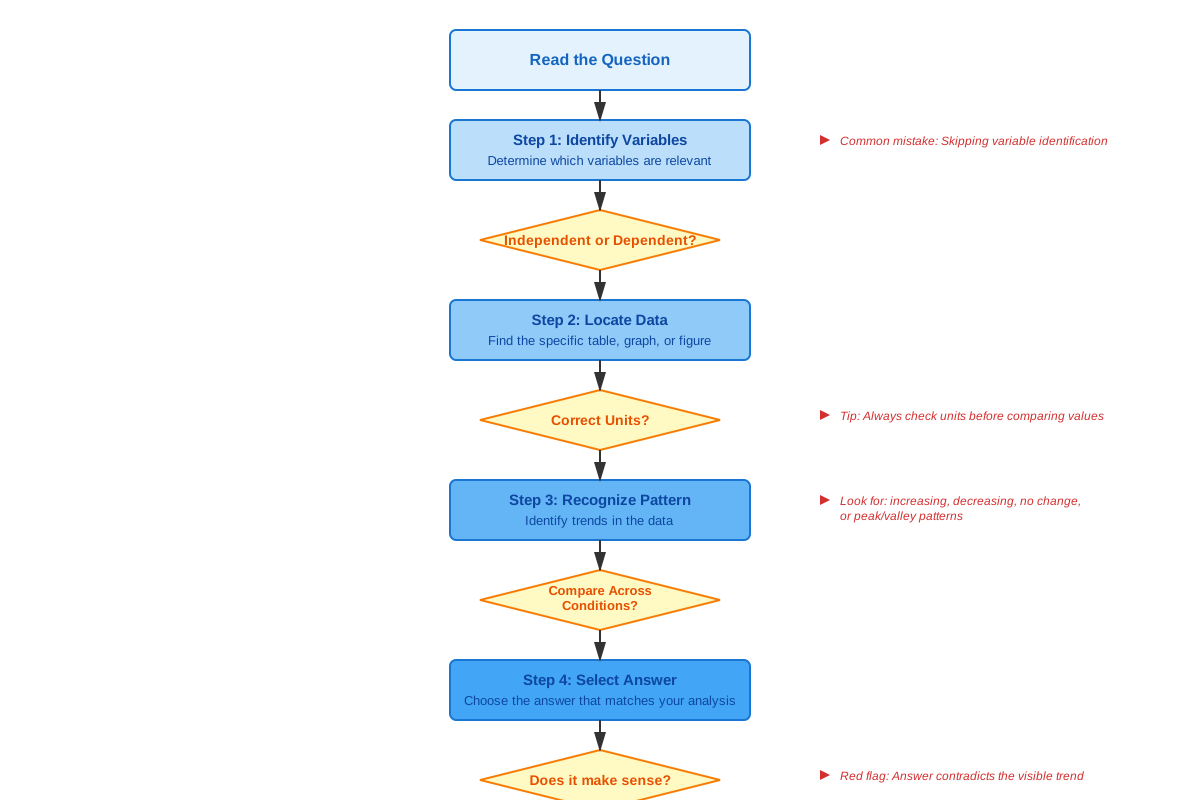
Use this four-step process for every experimental results question:
- Identify the source: Determine which table, graph, or figure contains the relevant data
- Locate the conditions: Find the specific row, column, data point, or line that matches the question's conditions
- Extract or analyze: Read the value, identify the pattern, or make the comparison requested
- Verify units and scale: Ensure the answer matches the units and magnitude shown in the data
Time Management
Experimental results questions should be among the fastest to answer since they require data reading rather than complex reasoning. Allocate approximately 30-40 seconds per straightforward data lookup question, and up to 60 seconds for questions requiring comparison across multiple conditions or interpolation between data points. If a question requires more than 90 seconds, mark it and return later—you may be overcomplicating the analysis.
Process of Elimination
For experimental results questions with numerical answer choices, eliminate options that fall outside the range of measured values (unless the question specifically asks for extrapolation). For trend questions, eliminate any answer that contradicts even a portion of the data. For comparison questions, eliminate answers that reverse the actual relationship shown in the data.
Common Traps
Watch for these frequent ACT tricks:
- Wrong variable: Answer choices may include values from the correct row but wrong column
- Wrong condition: Values from a similar but incorrect experimental condition
- Reversed relationship: Describing an inverse relationship as direct, or vice versa
- Partial trend: Describing only part of the data pattern while ignoring contradictory portions
- Unit confusion: Presenting the correct number but with wrong units
Graph Reading Efficiency
For line graphs, use your answer sheet or pencil as a straight edge to trace from axis values to data points accurately. For bar graphs, compare heights visually first to eliminate obviously wrong answers before reading exact values. For tables, use your finger or pencil to track rows and columns, preventing the common error of reading from an adjacent row.
Memory Techniques
TIDE - Remember the four types of experimental results questions:
- Trend identification (Is it increasing, decreasing, or constant?)
- Identification of specific values (What was the measurement at this condition?)
- Difference comparison (Which condition was higher/lower?)
- Extension beyond data (Interpolation/extrapolation)
"X-INDEPENDENT, Y-DEPENDS" - Remember that the x-axis shows the independent variable (what researchers controlled) and the y-axis shows the dependent variable (what researchers measured). This helps quickly identify what was manipulated versus what was measured.
"TABLE FIRST, GRAPH SECOND" - When a passage includes both tables and graphs showing the same data, check the table first for exact values (faster and more accurate) and use graphs for trend questions (easier to visualize patterns).
UP-DIRECT, DOWN-INVERSE - For line graphs, an upward slope indicates a direct relationship (both variables increase together), while a downward slope indicates an inverse relationship (one increases as the other decreases).
"CONTROL = COMPARISON" - Always identify the control condition first, as it provides the baseline for evaluating all other experimental results.
Summary
Experimental results interpretation is the most heavily tested skill on the ACT Science section, appearing in approximately half of all questions. Success requires systematic data extraction from tables and graphs, pattern recognition across multiple measurements, and accurate comparison between experimental conditions. Students must read axis labels and column headers carefully, locate specific values at the intersection of conditions, identify whether variables increase, decrease, or remain constant, and compare results across different experimental groups. The key to mastering experimental results questions is recognizing that they test data reading skills rather than scientific content knowledge—all necessary information appears in the passage. By practicing systematic approaches to tables and graphs, students can answer these questions quickly and accurately, building a strong foundation for ACT Science success. The most critical skills are careful attention to detail when reading scales and labels, consistent verification of units and conditions, and disciplined focus on what the data actually shows rather than what might be expected based on outside knowledge.
Key Takeaways
- Experimental results questions comprise 45-55% of the ACT Science test, making them the highest-yield topic for focused study
- Always read axis labels, column headers, and units before attempting to extract data from tables or graphs
- Trend questions require examining the entire data range—a relationship must be consistent across all measurements to be described as "increased only" or "decreased only"
- The answer to "according to the results" questions must come directly from the data, never from outside scientific knowledge
- Use systematic approaches: identify the data source, locate the specific conditions, extract or analyze the information, and verify units
- Common errors include reading from wrong rows/columns, misreading axis scales, and confusing similar values—double-check every answer
- Line graphs show continuous relationships between variables; bar graphs compare discrete categories or conditions
Related Topics
Experimental Design: Understanding how experiments are structured helps predict what results will be presented and how they relate to the hypothesis being tested. Mastering experimental results interpretation provides the foundation for evaluating whether experimental designs are appropriate for testing specific hypotheses.
Data Analysis and Patterns: Advanced questions may require calculating rates of change, identifying non-linear relationships, or recognizing complex patterns across multiple experiments. Strong experimental results skills enable progression to these higher-level analytical tasks.
Scientific Reasoning: Interpreting experimental results connects to broader reasoning skills including evaluating evidence, identifying assumptions, and drawing valid conclusions. Students who master results interpretation can more effectively tackle questions about what additional experiments would test or what conclusions are supported by data.
Conflicting Viewpoints: Some ACT Science passages present different scientists' interpretations of the same experimental results. Understanding how to read and analyze results independently enables students to evaluate which viewpoint is better supported by the data.
Practice CTA
Now that you understand the core strategies for interpreting experimental results, it's time to apply these skills to ACT-style questions. Complete the practice questions to reinforce your ability to extract data from tables and graphs, identify trends, and compare experimental conditions. Use the flashcards to memorize key trigger phrases and common question types. Remember: experimental results questions should become your fastest and most reliable points on the ACT Science test—they reward careful reading and systematic approaches rather than complex scientific reasoning. With focused practice, you'll develop the confidence to tackle any data interpretation question the ACT presents!
Sign up free to keep reading
Create a free AnvayaPrep account to finish this ACT guide on Experimental results — plus flashcards and practice questions.