Overview
Identifying conclusions is a critical skill tested extensively in the ACT Science section, particularly within Research Summaries passages. This skill requires students to distinguish between raw data, observations, and the interpretations or inferences that scientists draw from their experimental results. On the ACT, students must recognize what conclusions are supported by presented evidence, differentiate between conclusions and hypotheses, and understand the logical relationship between experimental findings and the claims researchers make based on those findings.
The ability to identify conclusions is fundamental to scientific literacy and represents one of the highest-level cognitive skills tested on the ACT Science exam. Unlike questions that simply ask students to read data from a graph or table, ACT identifying conclusions questions require analytical thinking and the capacity to evaluate whether a statement logically follows from the evidence provided. These questions often appear in 2-4 questions per Research Summaries passage, making them among the most frequently tested question types in the Science section.
This topic connects directly to other essential ACT Science skills, including understanding experimental design, interpreting data representations, and evaluating scientific arguments. Mastering conclusion identification enables students to tackle the most challenging Science questions and serves as a foundation for understanding how scientific knowledge is constructed through the research process. Students who excel at identifying conclusions demonstrate not just reading comprehension, but the ability to think like scientists by recognizing the logical boundaries of what experimental data can and cannot support.
Learning Objectives
- [ ] Identify when Identifying conclusions is being tested in ACT Science passages
- [ ] Explain the core rule or strategy behind Identifying conclusions
- [ ] Apply Identifying conclusions to ACT-style questions accurately
- [ ] Distinguish between conclusions, hypotheses, observations, and predictions in scientific contexts
- [ ] Evaluate whether a given conclusion is supported by the experimental data presented
- [ ] Recognize overgeneralized or unsupported conclusions that extend beyond the experimental evidence
- [ ] Identify the specific data or results that support a particular conclusion
Prerequisites
- Basic graph and table reading skills: Essential for extracting the data upon which conclusions are based
- Understanding of independent and dependent variables: Necessary to recognize cause-and-effect relationships that conclusions often describe
- Familiarity with experimental design terminology: Helps distinguish between different components of research (hypothesis, method, results, conclusion)
- Ability to identify trends in data: Conclusions frequently describe patterns, increases, decreases, or relationships observed in results
Why This Topic Matters
In real-world scientific practice, the ability to identify valid conclusions separates rigorous research from speculation. Scientists must constantly evaluate whether their interpretations are justified by their data, and peer reviewers assess whether published conclusions are warranted. This skill extends beyond laboratory science into everyday critical thinking—evaluating news reports about scientific studies, assessing health claims, and making informed decisions all require the ability to distinguish between what data shows and what people claim it shows.
On the ACT Science exam, conclusion identification questions appear with high frequency, typically comprising 15-20% of all Science questions. These questions most commonly appear in Research Summaries passages (which make up 3 of the 6 Science passages), though they occasionally appear in Data Representation passages as well. The ACT tests this skill because it represents authentic scientific reasoning that students need for college-level coursework across STEM disciplines.
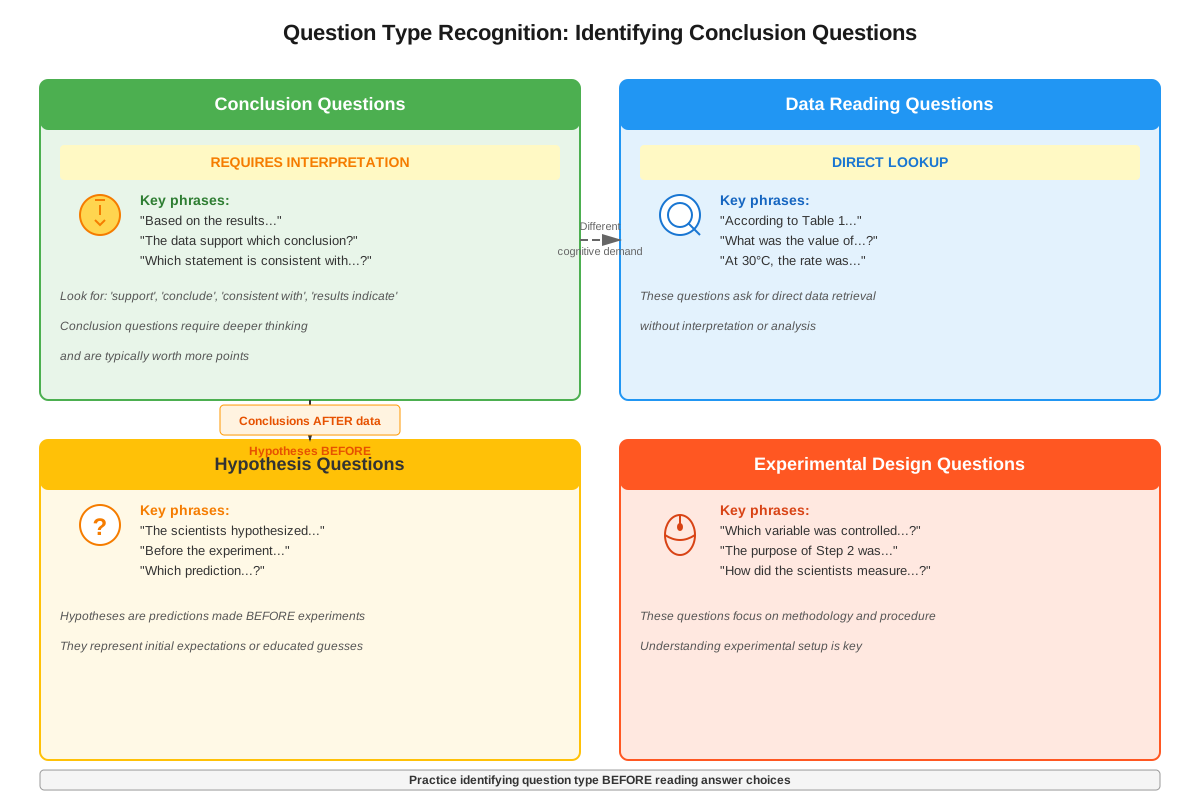
Common question formats include: "Based on the results of Experiment 2, which conclusion is supported?", "The students' data support which of the following conclusions about...?", "Which statement best explains the results shown in Figure 1?", and "Do the results of Study 1 support the hypothesis that...?" These questions require students to move beyond simple data extraction to evaluate logical relationships between evidence and claims.
Core Concepts
What Is a Scientific Conclusion?
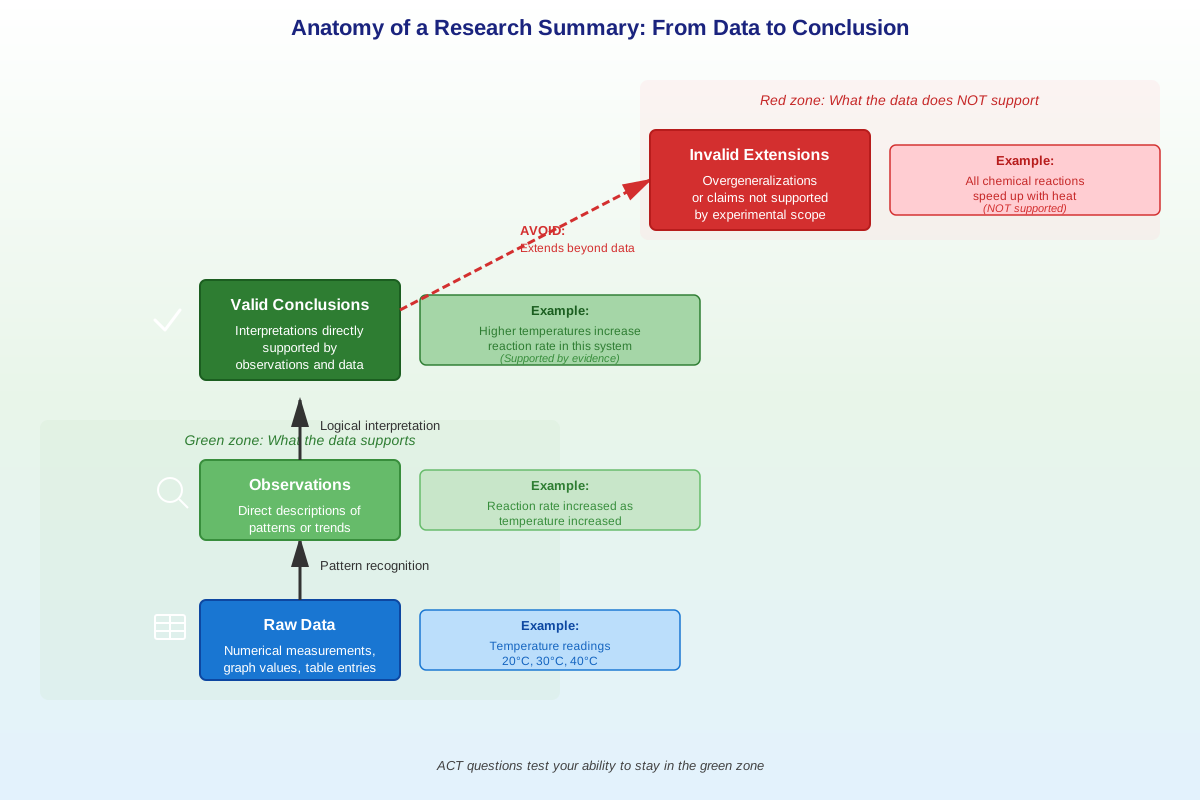
A conclusion in scientific research is an interpretation or inference drawn from experimental results or observations. It represents what the data means or implies, not merely what the data shows. Conclusions answer the research question by explaining patterns, relationships, or effects revealed through the investigation. Critically, valid conclusions must be directly supported by the evidence presented and should not extend beyond what the data can reasonably demonstrate.
The distinction between observation and conclusion is fundamental. An observation is a direct statement of what was measured or seen: "Temperature increased from 20°C to 40°C." A conclusion interprets what this means: "Higher temperatures increased the reaction rate." The conclusion makes a claim about causation or relationship that goes beyond the raw numbers.
Components of Conclusions in ACT Passages
ACT Science passages typically present conclusions in several locations:
- Explicit conclusion statements: Often found in introductory paragraphs or after results descriptions, using phrases like "The results suggest that...", "This indicates...", or "Therefore..."
- Implicit conclusions: Embedded in descriptions of results where interpretation and data are intertwined
- Answer choices: Where students must evaluate which statement represents a valid conclusion
Valid conclusions share several characteristics:
- They are supported by specific data from the experiments or studies presented
- They address the relationship between variables tested in the research
- They remain within the scope of what was actually tested
- They acknowledge limitations when appropriate (though ACT often simplifies this)
Distinguishing Conclusions from Other Scientific Components
| Component | Definition | Example | Timing |
|---|---|---|---|
| Hypothesis | Testable prediction made before experimentation | "If temperature increases, then reaction rate will increase" | Before experiment |
| Observation | Direct measurement or description of what occurred | "At 40°C, the reaction completed in 5 minutes" | During/after experiment |
| Conclusion | Interpretation of what the results mean | "Temperature has a positive effect on reaction rate" | After experiment |
| Prediction | Forecast about what would happen in untested conditions | "At 50°C, the reaction would complete even faster" | After conclusion |
Understanding these distinctions is crucial because ACT questions often include wrong answer choices that confuse these categories. A statement might be a perfectly valid hypothesis but not a conclusion supported by the presented data.
The Evidence-Conclusion Relationship
Every valid conclusion must have a clear evidentiary basis in the experimental results. When evaluating whether a conclusion is supported, students should ask:
- What specific data points or trends support this claim? Can you point to particular numbers, graph features, or table entries?
- Does the conclusion address variables that were actually tested? Conclusions about untested variables are unsupported.
- Is the conclusion appropriately limited? Does it avoid overgeneralizing beyond the experimental conditions?
- Does the conclusion match the direction and magnitude of effects observed? If data shows a small increase, a conclusion claiming a dramatic effect is unsupported.
Scope and Limitations of Conclusions
A critical aspect of identifying conclusions involves recognizing appropriate scope. Valid conclusions are constrained by:
- The specific conditions tested: A study testing pH 4-7 cannot support conclusions about pH 10
- The population or materials studied: Results from one species may not apply to others
- The variables measured: Conclusions can only address what was actually measured
- The experimental design: Correlational studies cannot support causal conclusions as strongly as controlled experiments
ACT questions frequently test whether students recognize when a conclusion oversteps these boundaries. Wrong answer choices often present statements that sound scientific but extend beyond what the data can support.
Identifying Conclusion Questions on the ACT
Certain trigger words and phrases signal that a question is testing conclusion identification:
- "Based on the results..."
- "The data support which conclusion..."
- "Which statement best explains..."
- "The experiment demonstrates that..."
- "According to the findings..."
- "What can be concluded about..."
- "The results indicate..."
These phrases tell students they need to evaluate logical relationships between evidence and claims, not simply extract data from a figure.
Concept Relationships
The skill of identifying conclusions builds directly upon data interpretation abilities. Students must first accurately read and understand experimental results (from graphs, tables, or descriptions) before they can evaluate what conclusions those results support. This creates a hierarchical relationship: Data Extraction → Pattern Recognition → Conclusion Evaluation.
Conclusion identification also connects intimately with understanding experimental design. Recognizing what variables were manipulated and measured helps students determine what conclusions are within scope. The relationship flows: Experimental Design → Results → Valid Conclusions. Questions about conclusions often implicitly test whether students understood the experimental setup.
Furthermore, identifying conclusions relates to evaluating scientific arguments and hypotheses. Students may need to determine whether results support or refute an initial hypothesis, creating the relationship: Hypothesis → Experimental Test → Results → Conclusion (supports/refutes hypothesis). This complete cycle represents authentic scientific reasoning.
The skill also connects forward to more advanced tasks like comparing multiple experiments or synthesizing information across passages. Once students can identify individual conclusions, they can evaluate whether conclusions from different studies agree or conflict, building toward the highest-level ACT Science questions.
High-Yield Facts
⭐ Conclusions are interpretations of data, not the data itself—they explain what results mean, not just what was observed.
⭐ Valid conclusions must be directly supported by specific experimental results presented in the passage—if you cannot point to supporting data, the conclusion is not supported.
⭐ Conclusions can only address variables that were actually tested in the experiments described—statements about untested variables are outside the scope.
⭐ The scope of conclusions is limited by experimental conditions—results from one temperature range, pH level, or species cannot automatically be generalized to others.
⭐ Correlation does not equal causation—unless the experiment used proper controls, conclusions should describe relationships, not definitive cause-and-effect.
- Conclusions typically appear after results are presented, using phrases like "these results suggest," "this indicates," or "therefore."
- Wrong answer choices often confuse conclusions with hypotheses (predictions made before the experiment) or observations (direct descriptions of data).
- Overgeneralized conclusions that extend far beyond the tested conditions are common wrong answers on the ACT.
- Conclusions that contradict the data shown in graphs or tables are always incorrect, even if they sound scientifically plausible.
- Multiple conclusions can be supported by the same data set—the question is whether each specific conclusion is justified by the evidence.
- Quantitative conclusions (describing amounts or magnitudes) require quantitative data support, not just qualitative observations.
- Conclusions about mechanisms (how or why something occurs) require more evidence than conclusions about patterns (what occurs).
Quick check — test yourself on Identifying conclusions so far.
Try Flashcards →Common Misconceptions
Misconception: Any statement that appears after the results section is automatically a valid conclusion.
Correction: Conclusions must be logically supported by the data. A statement can appear in a conclusion section but still be unsupported if it extends beyond what the evidence demonstrates or contradicts the results.
Misconception: If a conclusion sounds scientific and uses technical terminology, it must be correct.
Correction: The validity of a conclusion depends entirely on whether it is supported by the experimental data, not on how sophisticated it sounds. ACT wrong answers often use impressive-sounding language to distract from lack of evidentiary support.
Misconception: Conclusions and hypotheses are the same thing.
Correction: Hypotheses are predictions made before experimentation; conclusions are interpretations drawn after analyzing results. A hypothesis might be proven wrong by the data, while a valid conclusion must align with the results obtained.
Misconception: If one experiment supports a conclusion, that conclusion applies universally to all conditions.
Correction: Conclusions are limited by the scope of the experiments performed. Results from specific conditions (certain temperatures, pH levels, species, etc.) cannot automatically be generalized to all possible conditions without additional testing.
Misconception: Observing that two variables change together means one causes the other.
Correction: Correlation (two things changing together) does not prove causation (one thing causing the other). Valid causal conclusions require controlled experiments where other variables are held constant. Many ACT wrong answers present causal claims based on merely correlational data.
Misconception: Conclusions must be complex and detailed to be correct.
Correction: Valid conclusions can be simple and straightforward. A conclusion that directly states an observed relationship (e.g., "As temperature increased, reaction rate increased") is often more valid than a complex statement that extends beyond the data.
Worked Examples
Example 1: Temperature and Enzyme Activity
Passage Summary: Students conducted an experiment measuring the activity of an enzyme at different temperatures. They measured the rate of product formation at 10°C, 20°C, 30°C, 40°C, and 50°C. Results showed that product formation rate increased from 10°C to 40°C (from 2 mg/min to 18 mg/min), but decreased at 50°C (to 8 mg/min).
Question: Based on the results of the experiment, which conclusion is supported?
A) Enzymes function best at exactly 40°C in all organisms.
B) Temperature has no effect on enzyme activity.
C) Within the range tested, enzyme activity increased as temperature increased from 10°C to 40°C.
D) Enzymes are destroyed at any temperature above 40°C.
Solution Process:
Step 1: Identify what data was actually collected. The experiment measured enzyme activity at five specific temperatures: 10°C, 20°C, 30°C, 40°C, and 50°C.
Step 2: Identify the pattern in the results. Activity increased from 10°C to 40°C, then decreased at 50°C.
Step 3: Evaluate each answer choice against the data:
Choice A: This overgeneralizes. The data shows optimal activity at 40°C in this experiment, but the conclusion extends to "all organisms," which was not tested. The phrase "exactly 40°C" is also too specific—the data doesn't show that 39°C or 41°C would be worse. Unsupported—too broad.
Choice B: This directly contradicts the data, which clearly shows different activity levels at different temperatures. Incorrect—contradicts evidence.
Choice C: This accurately describes the observed pattern without overgeneralizing. It specifies "within the range tested" (acknowledging scope) and describes the increase from 10°C to 40°C, which matches the data exactly. Supported—matches data and appropriate scope.
Choice D: While activity did decrease at 50°C, the data doesn't prove enzymes were "destroyed." They might have been temporarily inactivated, or activity might increase again at higher temperatures (untested). The word "any" also overgeneralizes. Unsupported—extends beyond evidence.
Answer: C
Key Takeaway: The correct conclusion precisely matches the data pattern while acknowledging the scope of what was tested. Wrong answers either contradict the data, overgeneralize beyond tested conditions, or make claims about mechanisms not demonstrated by the evidence.
Example 2: Plant Growth and Light Wavelength
Passage Summary: Researchers grew identical seedlings under different wavelengths of light: red (650 nm), blue (450 nm), green (550 nm), and white (full spectrum). After 4 weeks, they measured plant height and total leaf area. Results showed: red light produced tallest plants (25 cm) with moderate leaf area (40 cm²); blue light produced shorter plants (15 cm) with largest leaf area (55 cm²); green light produced shortest plants (10 cm) with smallest leaf area (20 cm²); white light produced intermediate results (20 cm height, 45 cm² leaf area).
Question: Do the results support the conclusion that blue light is optimal for overall plant growth?
Solution Process:
Step 1: Define what "optimal for overall plant growth" would mean. This phrase is ambiguous—it could refer to height, leaf area, or some combination.
Step 2: Examine what the data shows about blue light. Blue light produced the shortest plants but the largest leaf area.
Step 3: Evaluate the conclusion. Blue light was optimal for one measure (leaf area) but worst for another measure (height). Whether this represents "optimal overall growth" depends on how you define optimal, which the data doesn't specify.
Step 4: Consider alternative interpretations. Red light maximized height; blue light maximized leaf area; white light provided balanced results. Each could be considered "optimal" depending on the goal.
Answer: No, the results do not fully support this conclusion. The data shows blue light maximized leaf area but minimized height. A more accurate conclusion would be: "Blue light produced the greatest leaf area but the shortest plants" or "Different wavelengths optimized different aspects of growth."
Key Takeaway: Conclusions using evaluative terms like "optimal," "best," or "most effective" require clear criteria. When data shows trade-offs (one measure improves while another worsens), conclusions claiming overall superiority are not well-supported. Valid conclusions should acknowledge these complexities or focus on specific measured outcomes.
Exam Strategy
Systematic Approach to Conclusion Questions
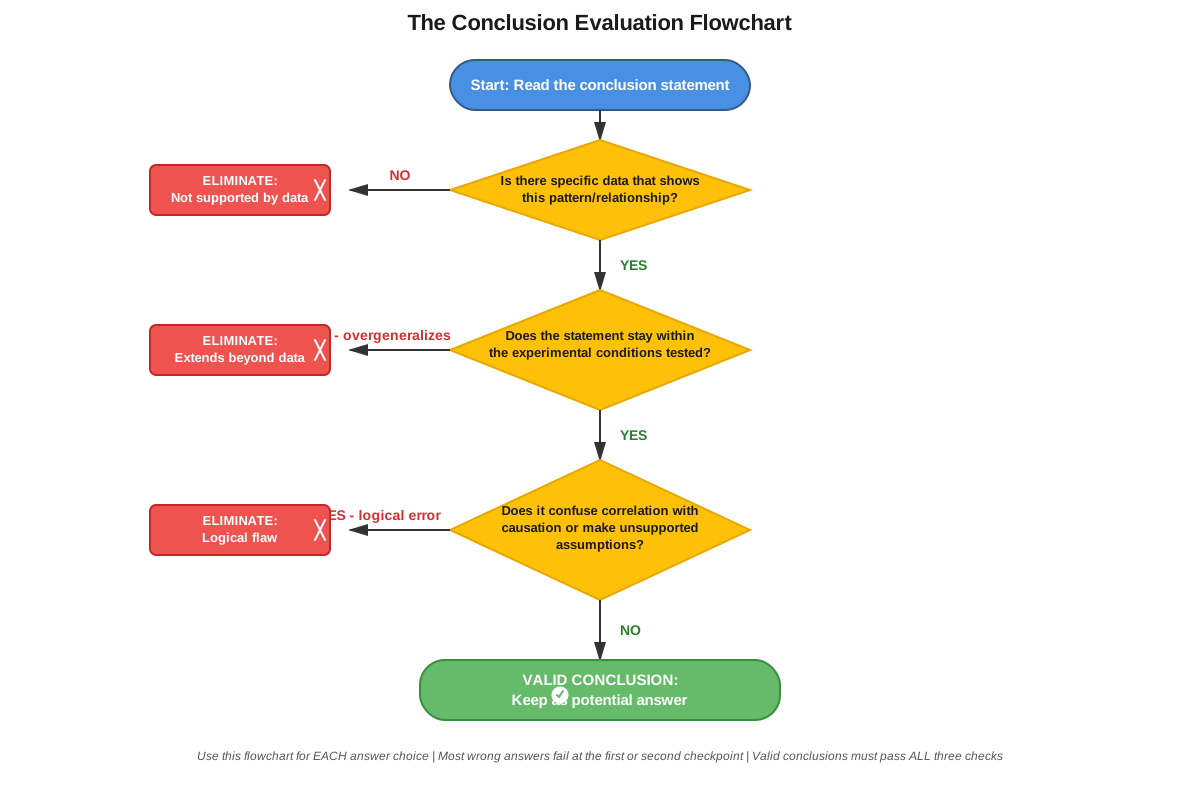
When encountering a question asking about conclusions, follow this process:
- Identify the relevant data: Determine which experiment, figure, or table contains the evidence needed to evaluate the conclusion.
- Extract the pattern or trend: Before looking at answer choices, articulate to yourself what the data actually shows (increases, decreases, relationships, etc.).
- Check each answer choice against the data: For each option, ask "Can I point to specific data that supports this?" and "Does this extend beyond what was tested?"
- Eliminate overgeneralizations first: Answer choices that use absolute terms ("always," "never," "all," "none") or extend to untested conditions are usually wrong.
- Eliminate contradictions: Any choice that contradicts the presented data is incorrect, regardless of how plausible it sounds.
- Choose the most conservative option: When multiple choices seem possible, the one that stays closest to the actual data without adding unsupported interpretation is usually correct.
Trigger Words That Signal Conclusion Questions
Watch for these phrases in question stems:
- "Based on the results..."
- "The data support..."
- "Which conclusion..."
- "The experiment demonstrates..."
- "According to the findings..."
- "What can be concluded..."
- "The results indicate..."
- "Which statement best explains..."
These phrases tell you to evaluate logical relationships between evidence and claims, not just extract data.
Red Flags in Answer Choices
Be suspicious of answer choices that:
- Use absolute language ("always," "never," "all," "only," "must")
- Mention variables or conditions not tested in the experiment
- Describe mechanisms (how/why) when only patterns (what) were measured
- Extend to different organisms, materials, or conditions than those tested
- Contradict any part of the presented data
- Make causal claims from correlational data
Time Management
Conclusion questions typically require 30-45 seconds—slightly longer than simple data extraction questions but less than complex synthesis questions. If you find yourself spending more than one minute, you may be overthinking. Return to the data, identify the basic pattern, and choose the answer that most directly reflects that pattern without adding unsupported interpretation.
Exam Tip: If you're stuck between two answer choices, ask yourself: "Which one requires me to make fewer assumptions beyond what's explicitly shown in the data?" The answer requiring fewer assumptions is usually correct.
Memory Techniques
SCOPE Acronym for Evaluating Conclusions:
- Specific data supports it
- Conditions tested match the claim
- Overgeneralization avoided
- Pattern matches the results
- Evidence directly addresses the variables mentioned
The "Point to It" Rule: If you cannot point to specific data (a number, a trend in a graph, a pattern in a table) that supports a conclusion, that conclusion is not supported. Physically pointing to your screen or paper can help make this concrete.
Conclusion vs. Observation Visualization: Picture observations as photographs (they show exactly what's there) and conclusions as captions (they interpret what the photo means). The caption must accurately describe the photo but adds interpretation.
The Boundary Test: Imagine the conclusion as a fence around the data. If the fence extends into areas where no data exists (untested temperatures, different species, etc.), the conclusion has overstepped its boundaries.
Before/After Distinction:
- Before the experiment = Hypothesis (prediction)
- After the experiment = Conclusion (interpretation)
This temporal distinction helps prevent confusing these concepts.
Summary
Identifying conclusions is a high-yield ACT Science skill that requires students to distinguish between raw data and the interpretations scientists draw from that data. Valid conclusions must be directly supported by specific experimental results, remain within the scope of what was actually tested, and avoid overgeneralizing to untested conditions or populations. The ACT tests this skill by presenting Research Summaries passages and asking students to evaluate whether particular statements are supported by the evidence, often including wrong answers that sound plausible but extend beyond the data, contradict the results, or confuse conclusions with hypotheses or observations. Success requires systematically checking each potential conclusion against the actual data, eliminating overgeneralizations and contradictions, and selecting the most conservative interpretation that directly reflects the experimental findings. This skill represents authentic scientific reasoning essential for college-level STEM coursework and appears in approximately 15-20% of ACT Science questions.
Key Takeaways
- Conclusions are interpretations of data that explain what results mean, not merely descriptions of what was observed
- Every valid conclusion must be supported by specific data points, trends, or patterns from the experiments presented
- The scope of conclusions is limited by experimental conditions—results cannot be generalized to untested variables, conditions, or populations
- Common wrong answers include overgeneralizations, statements about untested variables, contradictions of the data, and confusion between conclusions and hypotheses
- Use the "Point to It" rule: if you cannot point to specific supporting data, the conclusion is not supported
- Trigger phrases like "based on the results" and "the data support" signal conclusion identification questions
- When evaluating answer choices, eliminate overgeneralizations first, then contradictions, then choose the most conservative option that stays closest to the actual data
Related Topics
Evaluating Hypotheses: Building on conclusion identification, this skill involves determining whether experimental results support or refute initial predictions. Mastering conclusions enables students to understand the complete hypothesis-testing cycle.
Comparing Multiple Experiments: Once students can identify conclusions from individual experiments, they can progress to comparing conclusions across different studies to identify agreements, contradictions, or complementary findings.
Experimental Design Analysis: Understanding what makes a valid conclusion requires knowledge of proper experimental controls and design. These topics reinforce each other bidirectionally.
Data Interpretation and Trend Analysis: The foundation for identifying conclusions, as students must first accurately read and understand data patterns before evaluating what conclusions they support.
Scientific Argumentation: Advanced application of conclusion identification, where students evaluate the strength of complete scientific arguments by assessing whether conclusions are warranted by the evidence chain.
Practice CTA
Now that you understand the principles of identifying conclusions, it's time to apply these strategies to actual ACT-style questions. The practice questions and flashcards will help you recognize the patterns of valid versus unsupported conclusions and build the quick evaluation skills needed for test day. Remember: every conclusion question is an opportunity to demonstrate your scientific reasoning abilities. Approach each practice question systematically, use the SCOPE acronym, and trust the "Point to It" rule. With focused practice, identifying conclusions will become one of your strongest ACT Science skills. Start practicing now to transform this knowledge into test-day confidence and points!
Sign up free to keep reading
Create a free AnvayaPrep account to finish this ACT guide on Identifying conclusions — plus flashcards and practice questions.