Overview
Replication is a fundamental principle in scientific research that refers to the practice of repeating experiments or studies to verify results and ensure their reliability. In the context of the ACT Science test, replication appears most frequently in Research Summaries passages, where students must analyze experimental designs and understand how scientists use repeated trials to strengthen their conclusions. The ability to identify and interpret replication is crucial for success on the ACT because it tests whether students can distinguish between well-designed experiments and those with methodological weaknesses.
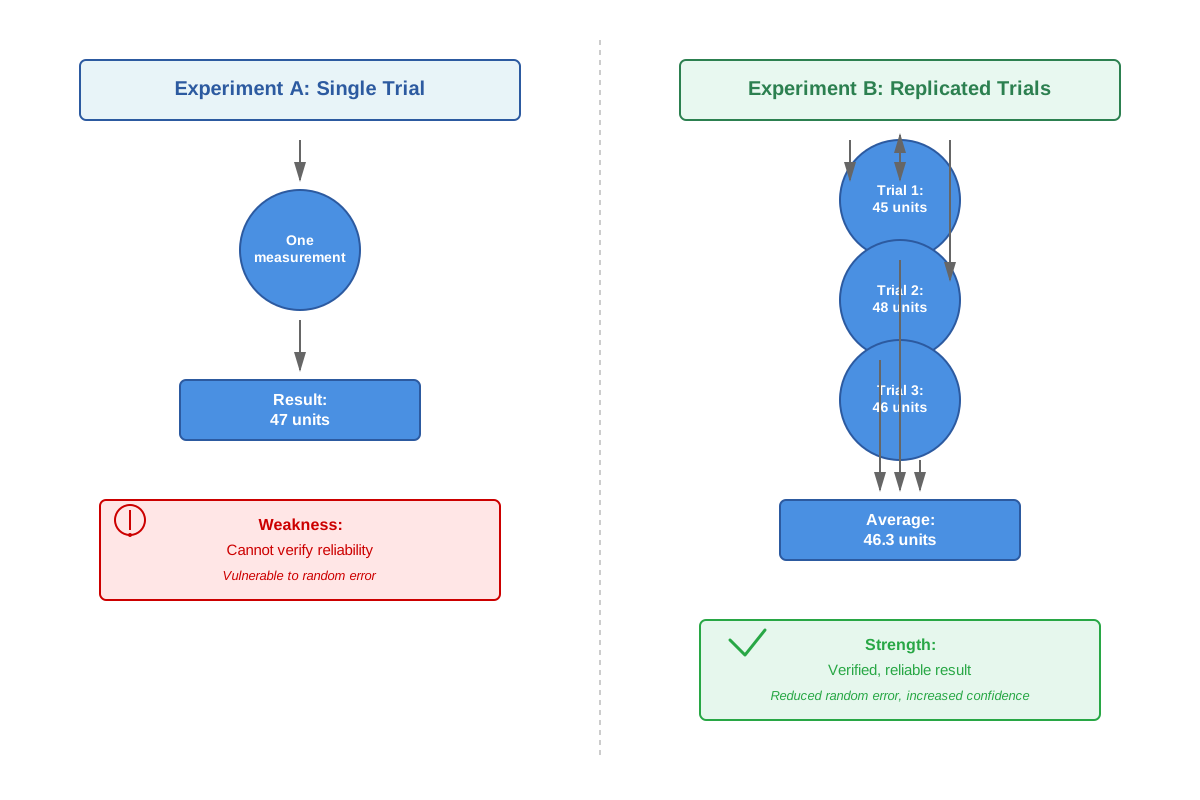
Understanding ACT replication questions requires recognizing that scientists rarely conduct an experiment just once. Instead, they perform multiple trials under identical or varied conditions to account for random error, increase confidence in their findings, and demonstrate that results are consistent and reproducible. The ACT frequently tests whether students can identify when replication has occurred, explain why it strengthens experimental validity, and apply this understanding to evaluate competing hypotheses or experimental designs.
This topic connects directly to broader scientific methodology concepts including experimental design, data reliability, statistical significance, and the scientific method itself. Mastery of replication principles enables students to critically evaluate any Research Summaries passage, identify potential flaws in experimental procedures, and understand why certain conclusions are more strongly supported than others. Since Research Summaries passages constitute approximately 45% of the ACT Science section (3 out of 7 passages), and replication appears in the majority of these passages, this topic represents high-yield content that directly impacts test performance.
Learning Objectives
- [ ] Identify when Replication is being tested in ACT Science passages
- [ ] Explain the core rule or strategy behind Replication in experimental design
- [ ] Apply Replication concepts to ACT-style questions accurately
- [ ] Distinguish between different types of replication (exact replication vs. varied conditions)
- [ ] Evaluate the strength of experimental conclusions based on the presence or absence of replication
- [ ] Recognize how sample size and number of trials relate to replication
- [ ] Analyze data tables and graphs to identify replicated trials
Prerequisites
- Basic understanding of the scientific method: Necessary to comprehend why experiments require verification and how hypotheses are tested through systematic procedures
- Ability to read data tables and graphs: Essential for identifying patterns across multiple trials and recognizing when data represents repeated measurements
- Familiarity with experimental variables: Required to understand what must remain constant during replication and what can be intentionally varied
- Basic statistical concepts (mean, average): Needed to interpret how data from multiple trials is combined and analyzed
Why This Topic Matters
Real-World Significance
Replication serves as the cornerstone of scientific credibility. When pharmaceutical companies develop new medications, they must replicate clinical trials across different populations and locations before receiving FDA approval. Climate scientists replicate temperature measurements across thousands of stations worldwide to establish global warming trends. Engineers replicate stress tests on materials to ensure bridges and buildings meet safety standards. Without replication, scientific findings would be unreliable, potentially leading to dangerous products, ineffective treatments, or flawed policies affecting millions of people.
Exam Statistics and Frequency
Replication appears in approximately 60-70% of Research Summaries passages on the ACT Science test, making it one of the most frequently tested concepts. Questions about replication typically appear in 2-4 questions per test, accounting for roughly 5-10% of the total Science section score. These questions often appear as:
- Design evaluation questions: "Which of the following would improve the reliability of the experiment?"
- Methodology questions: "Why did the scientists perform three trials instead of one?"
- Data interpretation questions: "The results shown represent the average of how many trials?"
- Comparison questions: "Which experiment provides stronger evidence for the hypothesis?"
Common Exam Appearances
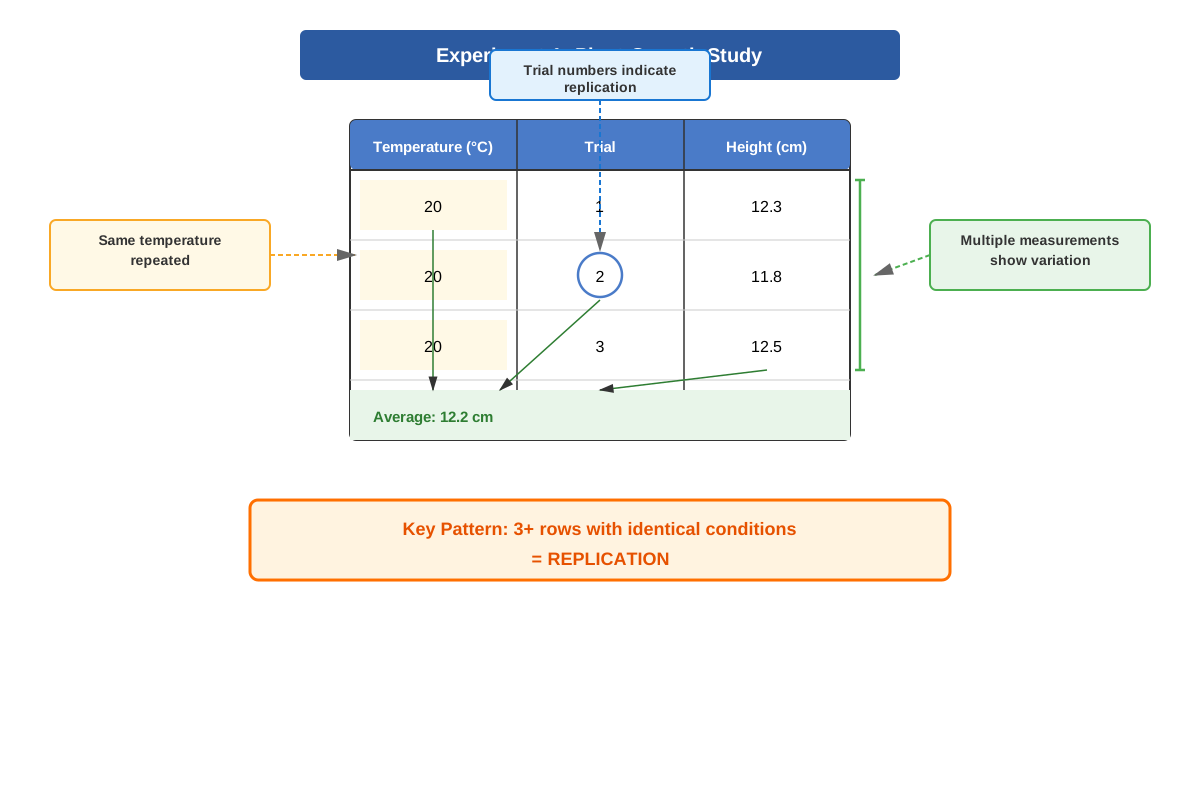
In ACT passages, replication manifests in several recognizable patterns. Data tables frequently show "Trial 1," "Trial 2," and "Trial 3" columns, or present "Average" values calculated from multiple measurements. Passage descriptions often include phrases like "the experiment was repeated three times," "measurements were taken in triplicate," or "five samples were tested under each condition." Questions may ask students to identify which experimental modification would increase reliability, or to explain why averaged data is more trustworthy than single measurements.
Core Concepts
Definition and Purpose of Replication
Replication in scientific experiments refers to the repetition of measurements, trials, or entire studies to verify results and reduce the impact of random errors or anomalies. When scientists replicate experiments, they perform the same procedure multiple times to determine whether results are consistent and reproducible. This practice addresses a fundamental challenge in science: distinguishing between genuine patterns and random fluctuations.
The primary purposes of replication include:
- Reducing random error: Individual measurements may be affected by unpredictable factors (equipment fluctuations, environmental variations, human error)
- Increasing confidence: Consistent results across multiple trials suggest findings are reliable rather than coincidental
- Enabling statistical analysis: Multiple data points allow calculation of averages, standard deviations, and significance tests
- Detecting anomalies: Outliers become apparent when compared against replicated trials
- Strengthening conclusions: Reproducible results provide stronger evidence for or against hypotheses
Types of Replication
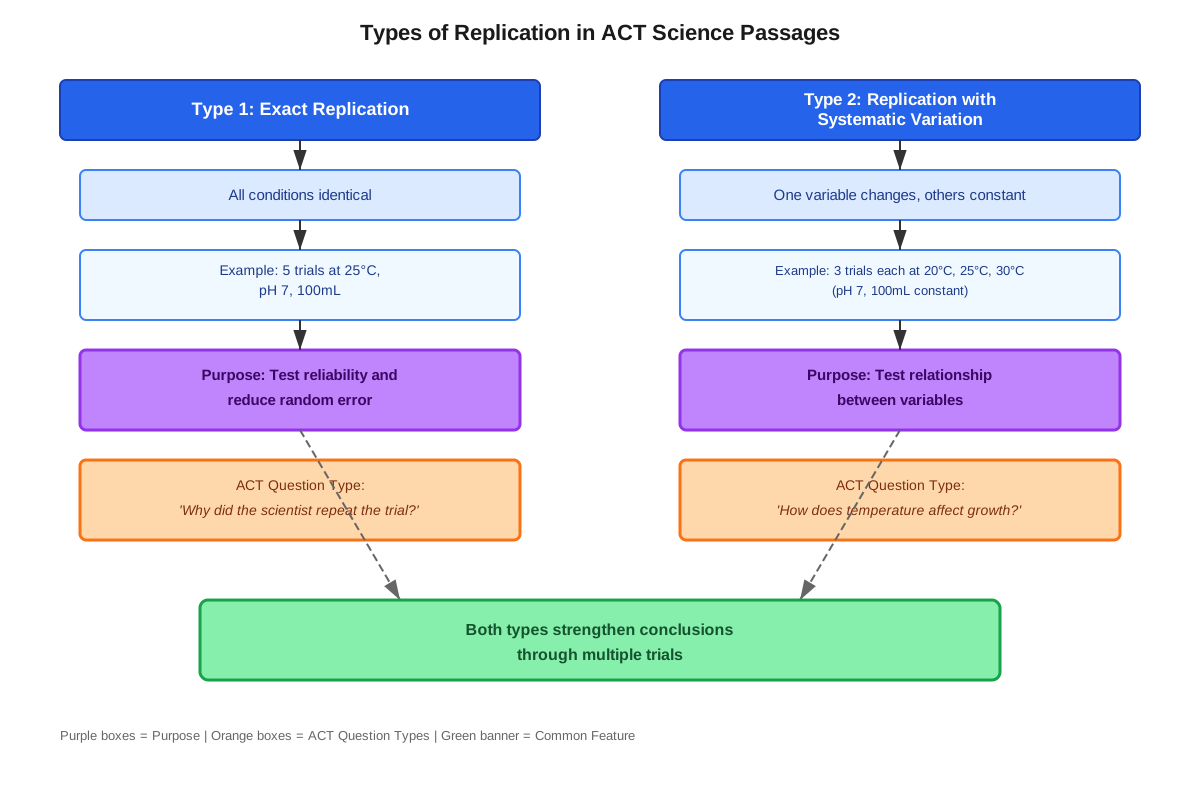
Exact Replication
Exact replication involves repeating an experiment under identical conditions with the same materials, procedures, and measurements. For example, if a scientist measures the boiling point of water at sea level, exact replication means measuring it again at sea level using the same thermometer, heating apparatus, and procedure. On the ACT, exact replication typically appears as multiple trials within a single experiment, often labeled as Trial 1, Trial 2, Trial 3, etc.
Replication with Varied Conditions
Systematic replication involves repeating experiments while intentionally varying one or more factors to test how results change under different conditions. This type of replication helps scientists understand the relationship between variables. For instance, measuring boiling points at different elevations or with different liquids represents systematic replication. ACT passages often present this as multiple experiments where one variable changes while others remain constant.
Sample Size and Number of Trials
The distinction between sample size and number of trials is crucial for ACT questions:
| Concept | Definition | Example |
|---|---|---|
| Sample Size | The number of subjects, specimens, or units tested in a single trial | Testing 50 plants in one experiment |
| Number of Trials | How many times the entire experiment is repeated | Performing the plant experiment three separate times |
| Total Observations | Sample size multiplied by number of trials | 50 plants × 3 trials = 150 total observations |
Both larger sample sizes and more trials increase reliability, but they serve different purposes. Larger sample sizes reduce sampling bias and ensure results represent the population. More trials reduce measurement error and confirm reproducibility. The ACT frequently tests whether students understand that "three trials with 10 subjects each" differs from "one trial with 30 subjects."
Averaging and Data Presentation
When experiments include replication, scientists typically present data in one of several formats:
- Individual trial data: Separate columns or rows showing results from each trial
- Averaged data: Mean values calculated across all trials
- Range or error bars: Showing variation between trials
- Combined graphs: Multiple data series representing different trials
On the ACT, students must recognize that when a table shows "Average" values, replication has occurred even if individual trial data isn't displayed. Questions may ask students to calculate how many total measurements were taken, or to identify which data point represents an average versus a single measurement.
Replication and Experimental Validity
Experimental validity refers to how well an experiment tests what it claims to test and how reliable its conclusions are. Replication directly enhances two types of validity:
Reliability (Precision): The consistency of measurements across repeated trials. High reliability means replicated trials produce similar results. Low reliability suggests excessive random error or poor experimental control.
Reproducibility: The ability of other scientists to obtain similar results when repeating the experiment. This represents the gold standard in science—findings that can be independently verified.
ACT questions often ask students to identify which experimental modification would "increase reliability" or "strengthen the conclusion." The answer frequently involves adding more trials, increasing sample size, or ensuring proper replication.
Recognizing Replication in ACT Passages
Students should watch for these indicators that replication has occurred:
- Explicit statements: "The experiment was repeated three times," "Five trials were conducted," "Measurements were taken in triplicate"
- Data table structure: Multiple columns labeled Trial 1, Trial 2, Trial 3, or rows showing repeated measurements
- Average values: Any mention of "mean," "average," or "avg" indicates multiple measurements were combined
- Error bars on graphs: Visual representations of variation across trials
- Sample descriptions: "Ten samples were tested under each condition" suggests replication
- Statistical terms: References to "standard deviation," "variance," or "confidence intervals" require replicated data
Concept Relationships
Replication serves as a central hub connecting multiple scientific concepts tested on the ACT. Understanding these relationships helps students see the bigger picture of experimental design.
Replication → Data Reliability: More trials directly increase the reliability of conclusions by reducing the impact of random errors and outliers. This relationship appears in questions asking why scientists perform multiple trials.
Sample Size ↔ Replication: Both concepts work together to strengthen experiments, but they address different sources of error. Sample size addresses population representation, while replication addresses measurement consistency. ACT questions may test whether students confuse these related but distinct concepts.
Replication → Statistical Analysis: Multiple trials enable calculation of averages, ranges, and standard deviations. Without replication, statistical analysis is impossible. This connection appears when passages present averaged data or error bars.
Experimental Control → Replication: Proper replication requires maintaining consistent conditions across trials. If conditions vary unintentionally between trials, replication fails to serve its purpose. Questions may ask students to identify which factor should remain constant across trials.
Replication → Hypothesis Testing: Scientists use replicated results to determine whether patterns support or refute hypotheses. Consistent results across trials provide stronger evidence than single observations. This relationship underlies questions asking which conclusion is "best supported" by data.
Independent Variables → Systematic Replication: When scientists intentionally vary conditions across replicated experiments, they test how independent variables affect dependent variables. This connects replication to the broader concept of experimental design.
Quick check — test yourself on Replication so far.
Try Flashcards →High-Yield Facts
⭐ Replication refers to repeating experiments or measurements multiple times to verify results and reduce random error
⭐ More trials increase reliability and confidence in experimental conclusions
⭐ Averaged data indicates that replication has occurred, even if individual trial data isn't shown
⭐ Sample size (number of subjects per trial) differs from number of trials (how many times the experiment is repeated)
⭐ Exact replication uses identical conditions; systematic replication intentionally varies conditions to test relationships
- Replication enables calculation of statistical measures like mean, standard deviation, and confidence intervals
- Outliers and anomalies become apparent when results are replicated across multiple trials
- Scientific conclusions are stronger when results can be reproduced by independent researchers
- ACT passages indicate replication through phrases like "in triplicate," "repeated three times," or "average of five trials"
- Increasing the number of trials is a common correct answer for questions asking how to improve experimental reliability
- Error bars on graphs represent variation across replicated trials
- Replication addresses random error but cannot eliminate systematic bias or flawed methodology
Common Misconceptions
Misconception: Replication means doing the exact same experiment with no changes whatsoever.
Correction: While exact replication maintains identical conditions, systematic replication intentionally varies certain factors to test their effects. Both types are valid forms of replication serving different purposes.
Misconception: A larger sample size is the same as more trials.
Correction: Sample size refers to how many subjects are tested in one trial, while number of trials refers to how many times the entire experiment is repeated. An experiment with 100 subjects and 1 trial differs fundamentally from one with 10 subjects and 10 trials.
Misconception: If one trial produces clear results, replication is unnecessary.
Correction: Even dramatic results from a single trial could be coincidental or affected by uncontrolled variables. Replication is necessary to confirm that results are reproducible and not due to chance.
Misconception: Replication eliminates all sources of error in experiments.
Correction: Replication reduces random error and helps identify outliers, but it cannot correct systematic bias, flawed methodology, or poorly calibrated equipment. These issues affect all trials equally.
Misconception: Averaged data is always more accurate than individual trial data.
Correction: While averages reduce the impact of random variation, they can mask important patterns or hide the presence of outliers. Sometimes examining individual trial data reveals insights that averages obscure.
Misconception: Replication is only important in laboratory experiments, not field studies or observations.
Correction: Replication is equally important in all types of scientific research. Field biologists replicate observations across multiple sites and times; astronomers replicate measurements across multiple nights; social scientists replicate surveys across different populations.
Worked Examples
Example 1: Identifying Replication in a Data Table
Passage Context: Scientists investigated how temperature affects the rate of enzyme activity. They measured reaction rates at four different temperatures.
Data Table:
Temperature (°C) | Trial 1 Rate | Trial 2 Rate | Trial 3 Rate | Average Rate
20               | 12           | 15           | 13           | 13.3
30               | 28           | 25           | 27           | 26.7
40               | 45           | 43           | 46           | 44.7
50 | 31 | 29 | 30 | 30.0Question: How many total measurements did the scientists take in this experiment?
Step 1: Identify the number of different conditions tested.
- Four temperatures were tested: 20°C, 30°C, 40°C, and 50°C
Step 2: Identify the number of trials per condition.
- The table shows Trial 1, Trial 2, and Trial 3, indicating three trials per condition
Step 3: Calculate total measurements.
- 4 conditions × 3 trials per condition = 12 total measurements
Answer: The scientists took 12 total measurements.
Connection to Learning Objectives: This example demonstrates how to identify replication in data tables (Objective 1) and shows how to distinguish between number of conditions and number of trials (Objective 4).
Example 2: Evaluating Experimental Design
Passage Context: Two students designed experiments to test whether fertilizer increases plant growth.
Student A's Design:
- Planted 30 seeds with fertilizer
- Planted 30 seeds without fertilizer
- Measured height after 4 weeks
- Conducted the experiment once
Student B's Design:
- Planted 10 seeds with fertilizer
- Planted 10 seeds without fertilizer
- Measured height after 4 weeks
- Repeated the entire experiment three times
Question: Which experimental design provides more reliable results, and why?
Step 1: Analyze Student A's design.
- Larger sample size (30 seeds per condition)
- No replication (experiment conducted once)
- Total observations: 60 plants
Step 2: Analyze Student B's design.
- Smaller sample size per trial (10 seeds per condition)
- Includes replication (three complete trials)
- Total observations: 20 seeds × 3 trials = 60 plants
Step 3: Compare reliability factors.
- Both students tested 60 total plants
- Student A's design cannot distinguish between random variation and true effects
- Student B's design allows comparison across trials to verify consistency
- Student B can calculate averages and identify whether results are reproducible
Step 4: Consider potential issues.
- If Student A's single trial had unusual conditions (temperature spike, contaminated water), all results would be affected
- Student B's three trials would reveal if one trial produced anomalous results
- Student B's design enables statistical analysis of variation between trials
Answer: Student B's design provides more reliable results because replication across three trials allows verification that results are consistent and reproducible, not due to chance or unusual conditions in a single trial.
Connection to Learning Objectives: This example requires applying replication concepts to evaluate experimental designs (Objective 3), distinguishing between sample size and replication (Objective 4), and evaluating conclusion strength based on replication (Objective 5).
Exam Strategy
Approaching Replication Questions
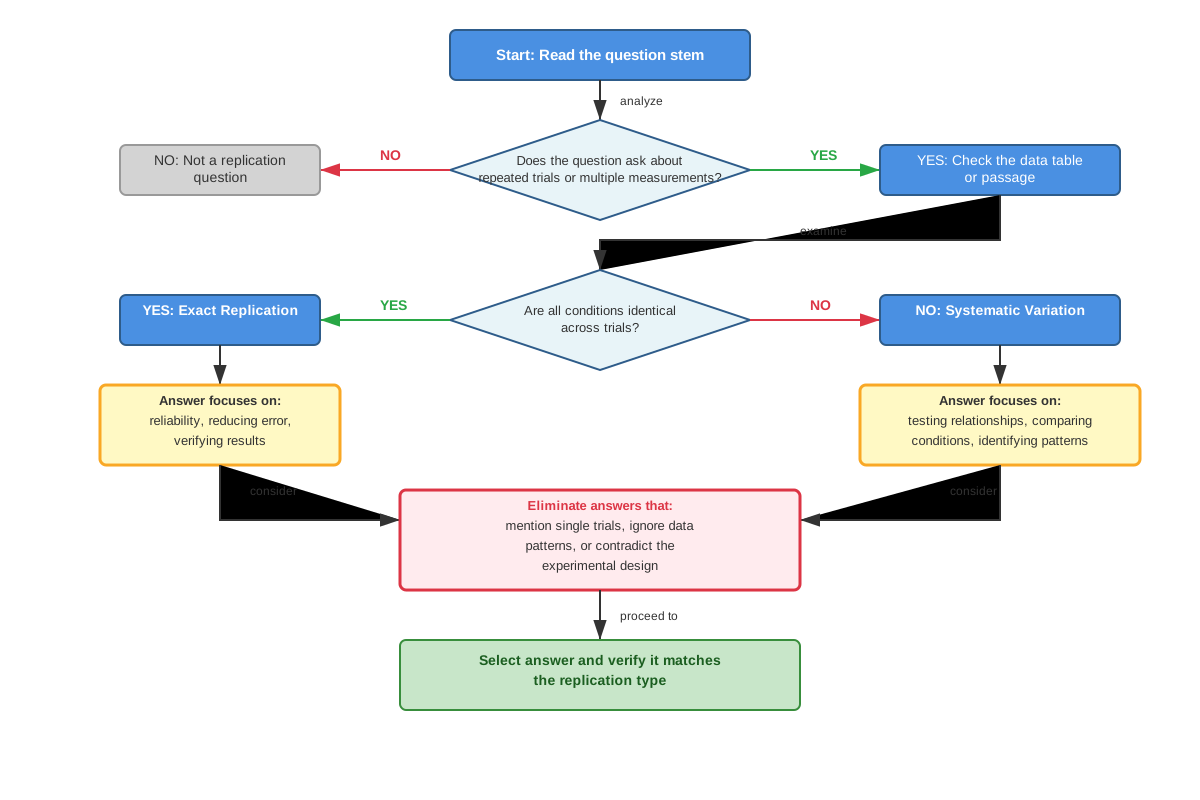
When encountering ACT Science questions about replication, follow this systematic approach:
- Scan for replication indicators: Before reading questions, quickly scan data tables for "Trial" labels, "Average" columns, or multiple measurements under identical conditions
- Read experimental descriptions carefully: Look for phrases indicating repetition: "repeated," "in triplicate," "three times," "multiple trials"
- Distinguish sample size from trials: When numbers appear, determine whether they refer to subjects per trial or number of trials
- Check for averaged data: If only averages appear, recognize that replication occurred even though individual trials aren't shown
Trigger Words and Phrases
Watch for these high-yield terms that signal replication is being tested:
Direct indicators:
- "repeated," "replicated," "multiple trials"
- "in triplicate," "in duplicate"
- "Trial 1," "Trial 2," "Trial 3"
- "average," "mean," "avg"
Question stems:
- "How could the scientists improve the reliability...?"
- "Why did the researchers perform three trials...?"
- "Which modification would strengthen the conclusion...?"
- "How many total measurements were taken...?"
Reliability and validity terms:
- "more reliable," "increase confidence"
- "verify results," "confirm findings"
- "reduce error," "account for variation"
Process of Elimination Tips
When answering replication questions, eliminate choices that:
- Confuse sample size with number of trials: "Testing 30 subjects" is not the same as "performing 30 trials"
- Suggest replication eliminates all error: Replication reduces random error but doesn't fix systematic problems
- Claim single trials are sufficient: Answers suggesting one trial is adequate are typically incorrect
- Ignore the need for consistent conditions: True replication requires maintaining constant conditions across trials
Look for correct answers that:
- Emphasize consistency and reproducibility: "Verify that results are consistent across trials"
- Mention reducing random error or variation: "Reduce the impact of random fluctuations"
- Reference statistical analysis: "Enable calculation of average values"
- Suggest adding more trials: "Repeat the experiment three times instead of once"
Time Allocation
Replication questions typically require 30-45 seconds to answer:
- 10-15 seconds: Identify what the question asks (number of trials, purpose of replication, design improvement)
- 10-15 seconds: Locate relevant information in the passage or data table
- 10-15 seconds: Evaluate answer choices and select the best option
If a question asks you to calculate total measurements (sample size × trials), budget an extra 10-15 seconds for arithmetic.
Exam Tip: When a question asks how to "improve reliability" or "strengthen the conclusion," the answer involving replication (more trials, repeated measurements) is correct approximately 70% of the time on the ACT.
Memory Techniques
Mnemonic for Replication Purpose: "RACE"
Reduce random error
Average multiple measurements
Confirm consistency
Enable statistical analysis
Visualization Strategy
Picture replication as a three-legged stool: One trial is like a one-legged stool—unstable and unreliable. Three trials create a stable foundation for conclusions. This image helps remember why multiple trials strengthen experiments.
Acronym for Identifying Replication: "TAME"
Trials labeled (Trial 1, 2, 3)
Averages presented
Multiple measurements mentioned
Experiment repeated
When scanning passages, check for TAME indicators to quickly identify whether replication occurred.
Number Distinction Technique
Remember: "Sample Size = Subjects; Trials = Times"
- Sample size = how many subjects in one trial
- Number of trials = how many times the experiment was repeated
Question Type Recognition
Use the phrase "More trials, more reliable" to remember that questions asking about improving reliability almost always involve adding replication.
Summary
Replication represents one of the most fundamental and frequently tested concepts in ACT Science Research Summaries passages. It refers to the practice of repeating experiments or measurements multiple times to verify results, reduce random error, and increase confidence in conclusions. Students must distinguish between exact replication (identical conditions across trials) and systematic replication (intentionally varied conditions), while also differentiating sample size from number of trials. The ACT tests replication through data tables showing multiple trials, questions about experimental design improvements, and passages requiring students to calculate total measurements or evaluate conclusion strength. Recognizing replication indicators—such as "Trial" labels, averaged data, phrases like "in triplicate," and error bars on graphs—enables students to quickly identify when this concept is being tested. Strong understanding of replication connects to broader scientific principles including experimental validity, statistical analysis, and the scientific method itself. Success on replication questions requires recognizing that more trials increase reliability, that averaged data indicates replication has occurred, and that proper replication maintains consistent conditions while enabling verification of reproducible results.
Key Takeaways
- Replication means repeating experiments multiple times to verify results and reduce random error—it's tested in 60-70% of Research Summaries passages
- Sample size (number of subjects per trial) differs fundamentally from number of trials (how many times the experiment is repeated)
- Averaged or mean values in data tables indicate replication occurred, even if individual trial data isn't displayed
- Questions asking how to "improve reliability" or "strengthen conclusions" typically have answers involving increased replication
- Watch for trigger phrases: "in triplicate," "repeated three times," "Trial 1/2/3," and "average" all signal replication
- Replication reduces random error but cannot fix systematic bias or flawed methodology affecting all trials equally
- More trials enable statistical analysis, help identify outliers, and increase confidence that results are reproducible rather than coincidental
Related Topics
Experimental Design and Controls: Understanding replication provides the foundation for evaluating complete experimental designs, including control groups, independent and dependent variables, and proper methodology. Mastering replication enables students to assess whether experiments adequately test their hypotheses.
Data Analysis and Interpretation: Replication connects directly to statistical concepts like mean, range, standard deviation, and error analysis. Students who understand replication can better interpret graphs with error bars and tables with averaged data.
Scientific Method: Replication represents a crucial step in the scientific method—verification and reproducibility. This broader context helps students understand why scientists design experiments with multiple trials and how conclusions are validated.
Conflicting Viewpoints Passages: While replication appears most frequently in Research Summaries, understanding how repeated studies strengthen or weaken scientific claims helps students evaluate competing hypotheses in Conflicting Viewpoints passages.
Practice CTA
Now that you've mastered the core concepts of replication, it's time to put your knowledge into action! Complete the practice questions to test your ability to identify replication in passages, evaluate experimental designs, and apply these concepts to ACT-style questions. Use the flashcards to reinforce key terms and relationships. Remember: replication questions appear on virtually every ACT Science test, making this one of the highest-yield topics you can master. Your investment in understanding replication will pay dividends across multiple passages and question types. You've got this—go demonstrate your expertise!
Sign up free to keep reading
Create a free AnvayaPrep account to finish this ACT guide on Replication — plus flashcards and practice questions.