Overview
Acid base data is a critical component of the ACT Science test that appears regularly in data representation and research summaries passages. This topic requires students to interpret experimental data, graphs, and tables that present information about acids, bases, pH levels, and related chemical properties. Unlike traditional chemistry courses that emphasize memorizing acid-base reactions, the ACT acid base data questions focus on scientific reasoning skills: reading graphs, identifying trends, comparing experimental conditions, and drawing logical conclusions from presented information.
Understanding how to approach acid-base data is essential for ACT success because these questions test core scientific literacy skills that apply across all science passages. Students must quickly extract relevant information from complex data presentations, recognize patterns in numerical data, and make predictions based on observed trends. The ACT does not expect students to have advanced chemistry knowledge; instead, it assesses whether students can think like scientists by analyzing unfamiliar data systematically.
This topic connects to broader scientific reasoning concepts including experimental design, variable identification, data interpretation, and hypothesis evaluation. Mastering acid-base data interpretation strengthens overall performance on the ACT Science section because the same analytical skills apply to passages covering biology, physics, Earth science, and other chemistry topics. The ability to navigate tables, graphs, and experimental descriptions efficiently is the foundation of ACT Science success.
Learning Objectives
- [ ] Identify when Acid base data is being tested in ACT Science passages
- [ ] Explain the core rule or strategy behind Acid base data interpretation
- [ ] Apply Acid base data analysis skills to ACT-style questions accurately
- [ ] Extract relevant numerical values from tables and graphs presenting acid-base information
- [ ] Recognize trends and patterns in pH data across different experimental conditions
- [ ] Compare and contrast the properties of acids and bases based on presented data
- [ ] Make predictions about acid-base behavior using data extrapolation techniques
Prerequisites
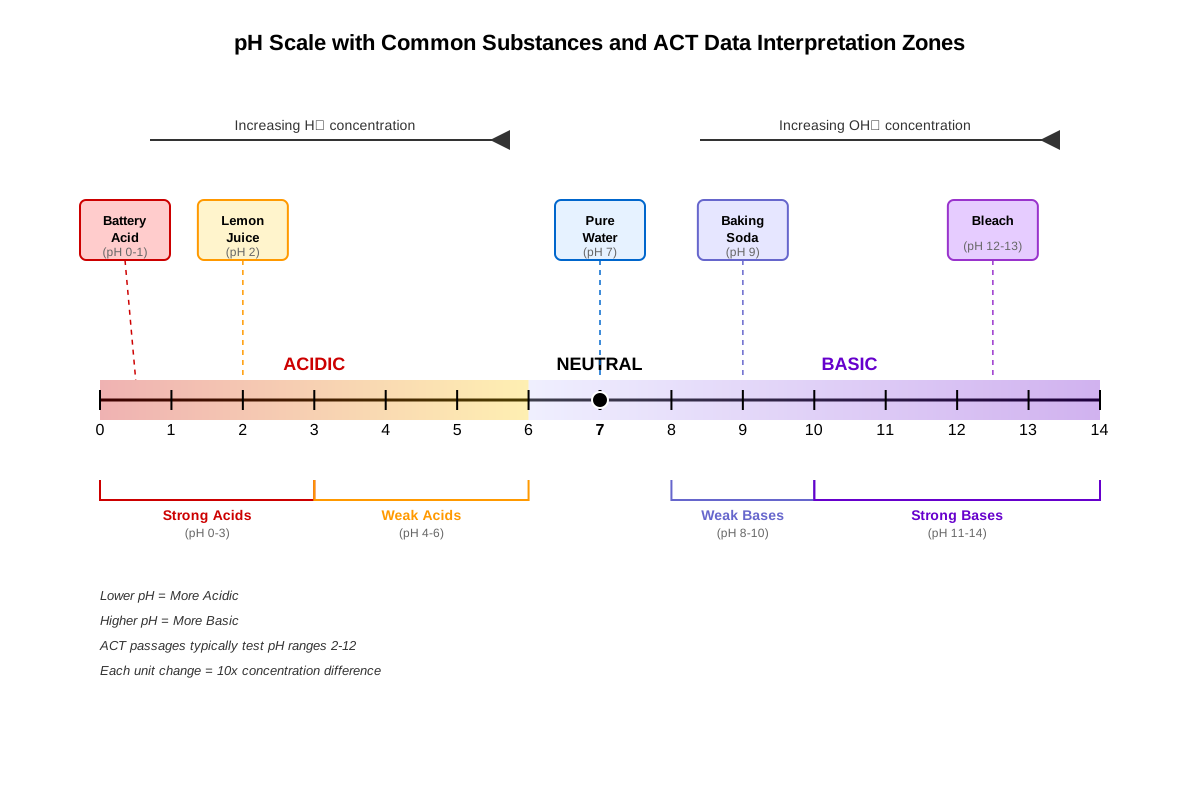
- Basic understanding of the pH scale: The pH scale ranges from 0-14, with lower numbers indicating acids and higher numbers indicating bases; this foundational knowledge helps students orient themselves when interpreting data.
- Graph reading skills: Students should be able to identify axes, read coordinate points, and recognize increasing/decreasing trends; these skills are essential for extracting information from visual data presentations.
- Table interpretation: The ability to locate specific values in rows and columns and compare multiple data points; acid-base passages frequently present data in tabular format.
- Scientific vocabulary fundamentals: Understanding terms like "solution," "concentration," "indicator," and "neutralization" helps students comprehend passage context without getting confused by terminology.
Why This Topic Matters
Acid-base chemistry appears in countless real-world applications that make this topic practically significant. Environmental scientists monitor the pH of lakes and streams to assess ecosystem health. Medical professionals analyze blood pH to diagnose metabolic disorders. Agricultural specialists test soil acidity to optimize crop growth. Food scientists control pH during fermentation and preservation processes. Understanding how to interpret acid-base data prepares students for scientific literacy in everyday life, from understanding product labels to evaluating environmental reports.
On the ACT Science test, acid-base data appears in approximately 10-15% of passages, making it a high-yield topic for focused preparation. These questions typically appear in Data Representation passages (which present 5 questions based on graphs and tables) or Research Summaries passages (which describe experiments with 6 questions). The most common question formats include: identifying pH values from graphs, comparing acidity between solutions, predicting outcomes when conditions change, and determining which experimental setup produced specific results.
Acid-base passages on the ACT commonly feature scenarios such as: titration experiments showing pH changes as solutions are mixed, indicator color changes at different pH levels, the effect of acid rain on various materials, buffer solution behavior, or the relationship between concentration and pH. The passages often include multiple graphs or tables that students must navigate efficiently, making strategic data interpretation skills more important than chemistry knowledge.
Core Concepts
Understanding pH Scale Representation
The pH scale is the most fundamental concept in acid-base data interpretation. On the ACT, pH data appears in various formats: line graphs showing pH changes over time, bar graphs comparing pH across different solutions, or tables listing pH values for multiple substances. The pH scale runs from 0 to 14, where values below 7 indicate acidic solutions, 7 represents neutral solutions, and values above 7 indicate basic (alkaline) solutions. Each unit change in pH represents a tenfold change in hydrogen ion concentration, though the ACT rarely tests this mathematical relationship directly.
When interpreting pH data, students must recognize that lower pH values mean stronger acids and higher pH values mean stronger bases. This inverse relationship sometimes confuses students who expect "higher numbers" to always mean "more acidic." ACT passages exploit this potential confusion by asking questions like "Which solution is most acidic?" when the table shows pH values, requiring students to select the lowest number rather than the highest.
Data Representation Formats
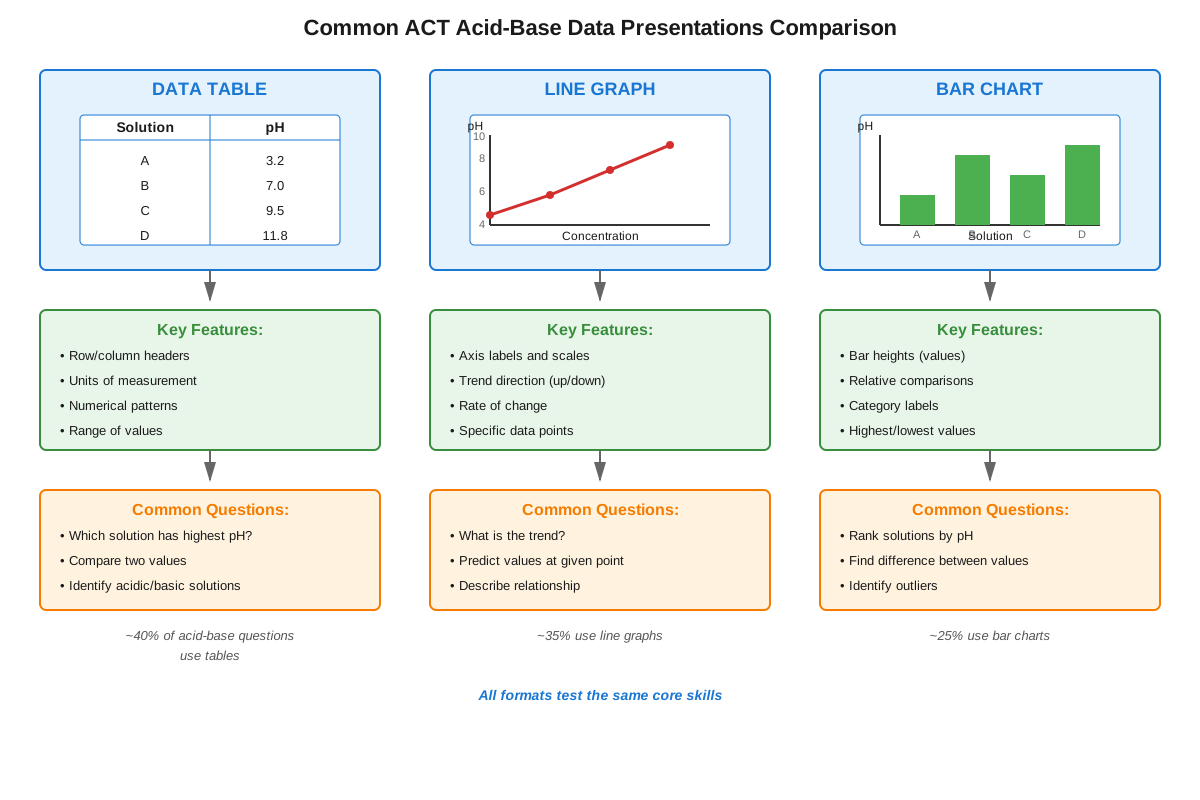
Acid-base data on the ACT appears in several standard formats that students should recognize immediately:
Line graphs typically show pH changes during titration experiments or over time. The x-axis usually represents volume of solution added or time elapsed, while the y-axis shows pH. These graphs often display characteristic curves with steep sections indicating rapid pH changes near the equivalence point. Students must be able to read specific coordinate points and identify trends such as "pH increases as more base is added."
Bar graphs commonly compare pH values across different substances or experimental conditions. Each bar represents a different solution, material, or trial. Questions often ask students to rank solutions by acidity or identify which condition produced the highest/lowest pH.
Tables present organized data in rows and columns, often showing multiple variables simultaneously. A typical acid-base table might list different solutions in one column, their pH values in another, and additional properties (color, temperature, concentration) in subsequent columns. Students must efficiently locate specific values and make comparisons across rows or columns.
Identifying Variables in Acid-Base Experiments
ACT acid-base passages always involve variables that students must identify to answer questions correctly. The independent variable is what the experimenter deliberately changes (such as the type of acid used, concentration of solution, or volume of base added). The dependent variable is what gets measured as a result (typically pH, but sometimes indicator color, conductivity, or reaction rate).
Understanding which variable is independent and which is dependent helps students predict relationships and answer "what would happen if" questions. For example, if a passage shows that pH increases as more sodium hydroxide is added to a solution, students can predict that adding even more sodium hydroxide would continue increasing the pH.
Trend Recognition and Pattern Analysis
The ACT frequently tests whether students can identify trends in acid-base data. Common patterns include:
- Direct relationships: As one variable increases, another increases (e.g., as base is added, pH increases)
- Inverse relationships: As one variable increases, another decreases (e.g., as acid concentration increases, pH decreases)
- Threshold effects: A variable shows little change until reaching a critical point, then changes rapidly (e.g., pH during titration near the equivalence point)
- Plateau effects: A variable changes initially but then levels off despite continued changes in the independent variable (e.g., buffered solutions maintaining stable pH)
Recognizing these patterns allows students to answer questions about data points not explicitly shown in graphs or tables through interpolation (estimating values between data points) or extrapolation (predicting values beyond the data range).
Comparative Analysis Skills
Many ACT acid-base questions require comparing data across different experimental conditions, solutions, or trials. Students must determine which solution is "most acidic," which experiment showed the "greatest pH change," or which condition produced results "most similar to" a reference case. These comparisons require careful attention to numerical values and the ability to perform mental calculations or estimations quickly.
| Comparison Type | What to Look For | Example Question |
|---|---|---|
| Magnitude | Absolute values or differences | "Which solution had the highest pH?" |
| Direction | Increasing vs. decreasing trends | "In which trial did pH decrease?" |
| Rate of change | Steepness of slopes or size of differences | "Where did pH change most rapidly?" |
| Similarity | Matching patterns or close values | "Which trial most closely resembled Trial 1?" |
Indicator Behavior and Color Changes
Some ACT acid-base passages include information about pH indicators—substances that change color at specific pH ranges. Common indicators mentioned include litmus paper (red in acid, blue in base), phenolphthalein (colorless in acid, pink in base), and universal indicator (displays multiple colors across the pH range). Questions might ask students to predict indicator color at a given pH or determine pH based on observed color.
The key strategy for indicator questions is matching the pH value from data to the color range described in the passage. Students should not rely on memorized indicator colors; instead, they must use the information provided in the passage, which often includes a table showing pH ranges and corresponding colors.
Concept Relationships
The concepts within acid-base data interpretation form an interconnected system where each skill builds upon others. pH scale understanding serves as the foundation → enabling data format recognition → which facilitates variable identification → leading to trend recognition → ultimately supporting comparative analysis and prediction skills.
The relationship between independent and dependent variables directly connects to trend recognition: identifying which variable is manipulated helps predict how the measured variable will respond. For example, recognizing that "volume of acid added" is the independent variable immediately suggests looking for how pH (dependent variable) changes in response.
Trend recognition skills connect to comparative analysis because identifying a pattern in one experimental condition allows comparison with patterns in other conditions. If Trial 1 shows pH decreasing linearly while Trial 2 shows pH decreasing exponentially, students can answer questions about which trial showed faster pH change at specific points.
These acid-base data skills connect to prerequisite knowledge of graph reading and table interpretation by applying those general skills to the specific context of pH and acid-base chemistry. The scientific reasoning skills developed through acid-base data analysis transfer directly to other ACT Science topics, including enzyme activity graphs, population ecology tables, and physics experiment data.
Quick check — test yourself on Acid base data so far.
Try Flashcards →High-Yield Facts
⭐ The pH scale ranges from 0-14, with values below 7 indicating acids, 7 indicating neutral, and above 7 indicating bases
⭐ Lower pH numbers mean stronger acids; higher pH numbers mean stronger bases
⭐ The independent variable in acid-base experiments is typically what the experimenter changes (type of solution, volume added, concentration)
⭐ The dependent variable is what gets measured as a result, most commonly pH
⭐ Line graphs showing pH during titration typically display steep curves near the equivalence point
- Bar graphs comparing pH across solutions allow quick visual identification of most acidic (shortest bar) and most basic (tallest bar) substances
- Tables presenting acid-base data often include multiple variables that must be considered simultaneously
- Indicator color changes occur at specific pH ranges described in the passage, not from memorized chemistry knowledge
- Trend extrapolation questions ask students to predict values beyond the data range shown
- Interpolation questions require estimating values between explicitly shown data points
⭐ ACT acid-base questions test data interpretation skills, not memorized chemistry facts
- Passages may include distracting information that is not needed to answer specific questions
- Time-series graphs show how pH changes over time or with sequential additions
- Comparative questions often require identifying "greatest," "least," "most similar," or "most different" conditions
- Buffer solutions maintain relatively stable pH despite additions of acid or base, appearing as flat regions on graphs
Common Misconceptions
Misconception: Higher pH values mean stronger acids → Correction: Higher pH values actually indicate stronger bases. Lower pH values (closer to 0) indicate stronger acids. This inverse relationship is frequently tested on the ACT.
Misconception: Students need to memorize specific acid and base formulas to answer ACT questions → Correction: The ACT Science section tests data interpretation skills, not memorized chemistry knowledge. All necessary information appears in the passage, graphs, or tables.
Misconception: Indicator colors must be memorized from chemistry class → Correction: ACT passages always provide information about indicator colors and their corresponding pH ranges. Students should use only the information given in the passage.
Misconception: Every piece of information in the passage is needed for every question → Correction: ACT passages often include extra information. Successful students identify which data is relevant to each specific question rather than trying to use everything.
Misconception: pH changes linearly with the amount of acid or base added → Correction: pH often changes non-linearly, especially during titrations. Graphs may show slow changes followed by rapid changes, or vice versa. Students must read the actual data rather than assuming linear relationships.
Misconception: Neutral solutions always have exactly pH 7.0 → Correction: While pH 7.0 is neutral at 25°C, the passage may define neutral differently or present data at different temperatures. Students should use the passage's definitions rather than outside assumptions.
Misconception: All acids and bases behave identically at the same concentration → Correction: Different acids and bases have different strengths. The passage data shows actual behavior, which may vary between substances even at identical concentrations.
Worked Examples
Example 1: Interpreting a Titration Graph
Passage Context: A student performed a titration experiment by gradually adding sodium hydroxide (NaOH) solution to hydrochloric acid (HCl) solution while measuring pH. Figure 1 shows pH (y-axis) versus volume of NaOH added in mL (x-axis). The graph shows pH starting at 2.0, remaining relatively flat until about 20 mL, then rising steeply between 20-25 mL, and finally leveling off around pH 12.0 after 30 mL.
Question: According to Figure 1, at approximately what volume of NaOH added did the solution reach pH 7.0?
Solution Process:
- Identify what the question asks: We need to find the volume (x-axis value) corresponding to pH 7.0 (y-axis value)
- Locate pH 7.0 on the y-axis: Find the horizontal line at pH 7.0
- Trace horizontally to the curve: Follow the pH 7.0 line until it intersects the graphed line
- Read down to the x-axis: From the intersection point, trace vertically down to read the volume
- Estimate the value: The intersection occurs at approximately 22-23 mL
Answer: Approximately 22-23 mL of NaOH
Key Reasoning: This question tests basic graph reading skills in an acid-base context. The steep section of the curve contains pH 7.0, which is the equivalence point where the acid has been neutralized. Students must resist the temptation to overthink this question—it simply requires reading coordinates from a graph. The ACT rewards careful, systematic graph reading over chemistry knowledge.
Example 2: Comparing pH Across Experimental Conditions
Passage Context: Table 1 shows the pH of four different household solutions measured at room temperature:
| Solution | pH |
|---|---|
| Lemon juice | 2.3 |
| Tap water | 7.1 |
| Baking soda solution | 8.5 |
| Ammonia cleaner | 11.2 |
Question 1: Based on Table 1, which solution is most acidic?
Solution Process:
- Recall the pH scale relationship: Lower pH values indicate stronger acids
- Scan the pH column for the lowest value: 2.3 is the lowest pH shown
- Identify the corresponding solution: Lemon juice has pH 2.3
Answer: Lemon juice
Question 2: If a fifth solution with pH 9.0 were added to the table, it would be classified as:
Solution Process:
- Determine where pH 9.0 falls on the scale: Above 7.0 means basic
- Compare to existing basic solutions: Baking soda (8.5) and ammonia (11.2) are both basic
- Determine relative strength: pH 9.0 is more basic than baking soda but less basic than ammonia
Answer: A weak base (or basic solution, depending on answer choices)
Key Reasoning: These questions test comparative analysis and pH scale understanding. Students must remember that "most acidic" means "lowest pH" and that values above 7.0 indicate bases. The second question requires both classification (identifying the solution as basic) and comparison (determining its relative strength). These multi-step reasoning processes are typical of ACT Science questions.
Exam Strategy
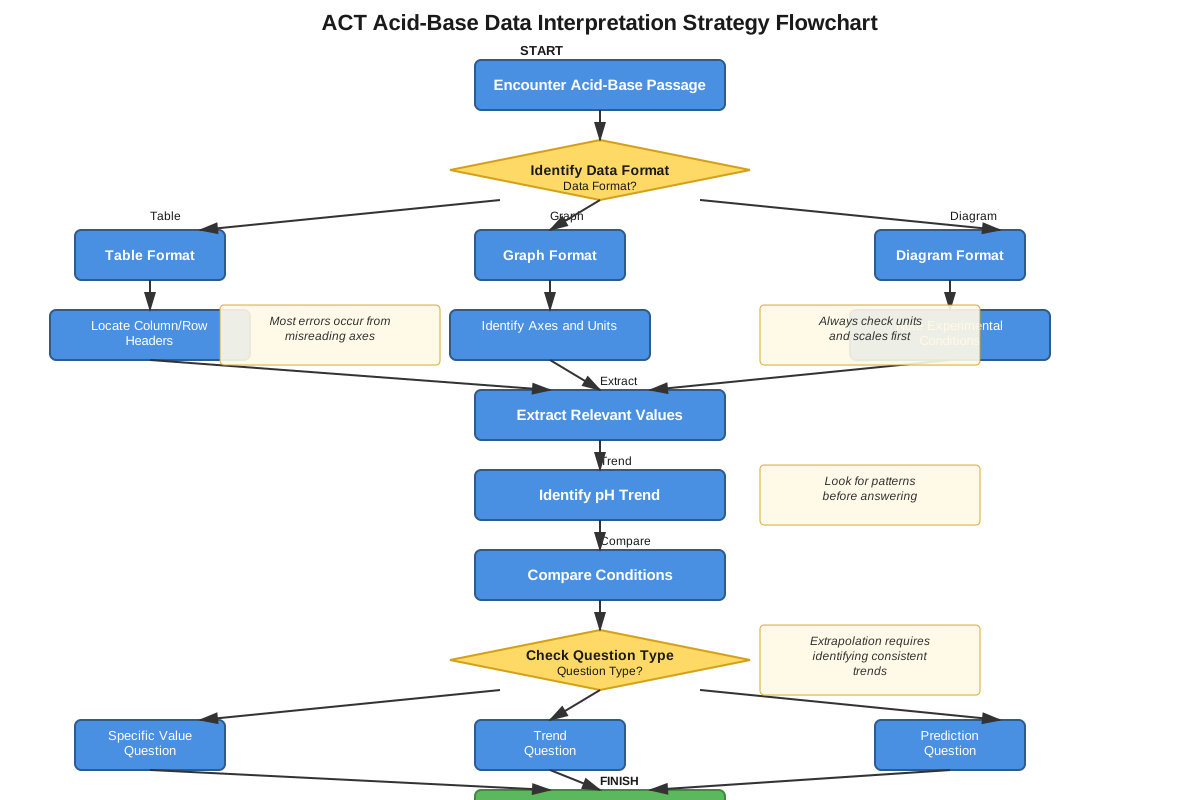
When approaching ACT acid-base data questions, follow this systematic process:
Step 1: Quickly scan the passage structure (15-20 seconds). Identify whether data is presented in graphs, tables, or both. Note how many figures or tables are included and what variables each presents. This preview helps you know where to look when answering specific questions.
Step 2: Read the question stem carefully before diving into data. Identify exactly what information is needed: a specific pH value, a comparison between conditions, a trend description, or a prediction. Many students waste time examining irrelevant data because they didn't clearly understand what the question asked.
Step 3: Locate the relevant data source. Match the question to the appropriate figure or table. Questions usually reference specific figures ("According to Figure 1...") or describe conditions that appear in only one data presentation.
Step 4: Extract the needed information systematically. For graphs, use a finger or pencil to trace from axis to curve to axis, ensuring accurate reading. For tables, use a straight edge (your answer sheet or pencil) to follow rows and columns without losing your place.
Trigger words and phrases that indicate acid-base data questions:
- "According to Figure/Table..." (direct data reading)
- "Which solution is most acidic/basic" (comparison requiring pH knowledge)
- "As [variable] increases..." (trend identification)
- "If the experiment were repeated with..." (prediction/extrapolation)
- "At what [volume/time/concentration] did pH reach..." (coordinate reading)
- "Which trial showed the greatest change in..." (comparative analysis)
Process-of-elimination strategies:
- Eliminate answers that contradict the direction of trends (if pH increases in the data, eliminate answers saying it decreases)
- Eliminate answers with values outside the range shown in data (unless the question explicitly asks for extrapolation)
- Eliminate answers that confuse acids and bases (if the question asks for the most acidic solution, eliminate answers with high pH values)
- For "most/least" questions, eliminate middle-range values first, then compare extremes
Time allocation: Spend no more than 45-60 seconds per question on acid-base passages. If a question requires complex calculations or multiple data comparisons, mark it and return after completing easier questions. The ACT rewards efficient test-takers who maximize points per minute spent.
Memory Techniques
pH Scale Mnemonic: "Low Acids, High Bases" (LAHB) - Lower numbers are Acids, Higher numbers are Bases. Visualize a ladder where you climb LOW to reach ACIDS at the bottom and climb HIGH to reach BASES at the top.
Variable Identification: "I Manipulate, Data Measures" - The Independent variable is what I Manipulate; the Dependent variable is what Data Measures. This helps distinguish between the two variable types quickly.
Graph Reading Acronym: "Axis Curve Axis" (ACA) - When reading graphs, always go Axis → Curve → Axis. Start at one axis, trace to the curve, then trace to the other axis. This prevents reading errors.
Trend Direction: Visualize pH as a thermometer. When you add base, the "temperature" (pH) goes UP. When you add acid, the "temperature" (pH) goes DOWN. This physical visualization helps prevent directional errors.
Comparison Strategy: "Extremes First" (EF) - When comparing multiple values, identify the Extremes First (highest and lowest). Most ACT questions ask about extremes ("most acidic," "greatest change"), so finding these first saves time.
Table Navigation: Use the "Finger Trace" technique - physically trace rows and columns with your finger or pencil to avoid reading the wrong cell. This simple physical action dramatically reduces careless errors on table-based questions.
Summary
Acid-base data interpretation on the ACT Science test focuses on scientific reasoning skills rather than memorized chemistry knowledge. Students must efficiently extract information from graphs and tables presenting pH data, recognize trends and patterns, compare experimental conditions, and make predictions based on observed relationships. The pH scale (0-14, with lower values indicating acids and higher values indicating bases) provides the conceptual framework, but success depends on systematic data analysis strategies. Key skills include identifying independent and dependent variables, reading coordinates accurately from graphs, locating specific values in tables, recognizing direct and inverse relationships, and performing comparative analyses. The ACT rewards students who approach acid-base passages methodically: scanning passage structure, reading questions carefully, locating relevant data sources, and extracting information systematically. With focused practice on these data interpretation skills, students can confidently tackle acid-base questions regardless of the specific chemical context presented.
Key Takeaways
- Acid-base data questions test data interpretation skills, not chemistry memorization—all necessary information appears in the passage
- Lower pH values (0-6) indicate acids; higher pH values (8-14) indicate bases—this inverse relationship is frequently tested
- Systematic graph and table reading prevents careless errors—use the axis-curve-axis technique for graphs and finger-tracing for tables
- Identify independent and dependent variables immediately—this clarifies cause-and-effect relationships and enables prediction
- Trend recognition is more valuable than memorizing specific values—understanding patterns allows answering questions about data points not explicitly shown
- Comparative questions require careful attention to numerical values—"most," "least," "greatest," and "smallest" questions demand precise data reading
- Time efficiency matters—spend 45-60 seconds per question and skip complex questions to return to later
Related Topics
Experimental Design in Chemistry: Understanding how scientists design controlled experiments builds on the variable identification skills developed through acid-base data interpretation. This topic explores hypothesis formation, control groups, and experimental validity.
Concentration and Dilution: Many acid-base passages include concentration data alongside pH measurements. Mastering concentration relationships enhances understanding of why pH changes occur and enables more sophisticated data analysis.
Chemical Reactions and Stoichiometry: While the ACT doesn't require calculations, understanding the conceptual basis of acid-base reactions (neutralization, titration) provides context that makes data interpretation more intuitive.
Data Representation Across Science Disciplines: The graph-reading and table-interpretation skills developed through acid-base data practice transfer directly to biology passages (population graphs), physics passages (motion graphs), and Earth science passages (climate data tables).
Scientific Reasoning and Hypothesis Evaluation: Acid-base data interpretation is one application of broader scientific reasoning skills. Mastering this topic strengthens the ability to evaluate hypotheses, assess experimental support, and identify conflicting viewpoints across all ACT Science passages.
Practice CTA
Now that you've mastered the core concepts and strategies for acid-base data interpretation, it's time to apply these skills to realistic ACT-style questions. Complete the practice questions to reinforce your understanding of pH scale relationships, graph reading techniques, and comparative analysis strategies. Use the flashcards to drill high-yield facts and trigger words until they become automatic. Remember: the ACT rewards systematic, efficient data interpretation more than chemistry knowledge. With focused practice, you'll develop the confidence and speed needed to excel on acid-base passages and boost your overall Science score. Start practicing now—every question you work through strengthens your pattern recognition and builds the test-taking instincts that lead to top scores!
Sign up free to keep reading
Create a free AnvayaPrep account to finish this ACT guide on Acid base data — plus flashcards and practice questions.