Overview
The ACT Science section evaluates students' ability to interpret, analyze, and evaluate scientific information across multiple disciplines. Biology data represents one of the most frequently tested content areas, appearing in approximately 40% of all Science passages. Unlike traditional biology exams that test memorization of facts, the ACT focuses on data interpretation skills using biological contexts—including graphs, tables, experimental designs, and research summaries from fields like ecology, genetics, cellular biology, and physiology.
Understanding how to work with ACT biology data is essential because these passages often contain the most complex visual representations and require students to synthesize information across multiple data sources. Biology passages typically present experimental scenarios involving living organisms, cellular processes, population dynamics, or biochemical pathways. Students must quickly identify variables, recognize patterns in data, and draw evidence-based conclusions without extensive background knowledge in specialized biology topics.
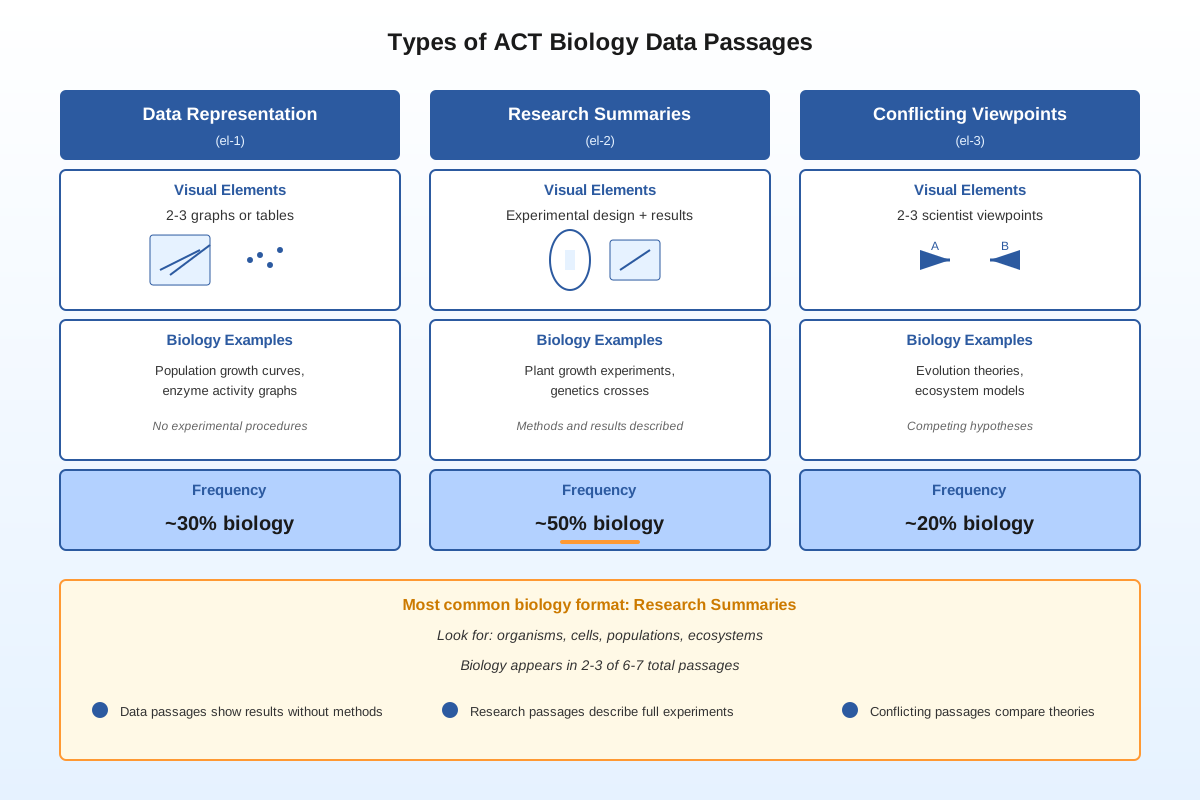
This topic connects directly to the broader Scientific Reasoning framework of the ACT, which emphasizes three core skills: Data Representation (understanding graphs and tables), Research Summaries (analyzing experimental design), and Conflicting Viewpoints (evaluating competing hypotheses). Biology data appears across all three passage types, making it impossible to achieve a high Science score without mastering biological data interpretation. The skills developed here also reinforce graph analysis, experimental design principles, and logical reasoning that apply to chemistry and physics passages.
Learning Objectives
- [ ] Identify when Biology data is being tested in ACT Science passages
- [ ] Explain the core rule or strategy behind Biology data interpretation
- [ ] Apply Biology data analysis to ACT-style questions accurately
- [ ] Distinguish between independent and dependent variables in biological experiments
- [ ] Interpret trends and patterns in biological graphs, tables, and diagrams
- [ ] Evaluate the validity of conclusions based on presented biological data
- [ ] Synthesize information from multiple biological data sources within a single passage
Prerequisites
- Basic graph reading skills: Understanding x-axis, y-axis, scales, and coordinate systems is essential for interpreting biological data visualizations
- Fundamental scientific method knowledge: Recognizing hypotheses, variables, controls, and conclusions helps students navigate experimental biology passages
- Elementary biology vocabulary: Familiarity with terms like organism, cell, population, and ecosystem prevents confusion when reading passage context
- Unit conversion awareness: Converting between metric units (milliliters, grams, meters) appears frequently in biological measurements
Why This Topic Matters
Biology data interpretation extends far beyond standardized testing into real-world applications. Medical professionals analyze patient data trends, environmental scientists track ecosystem changes, and public health officials interpret epidemiological statistics—all requiring the same skills tested on the ACT. Understanding biological data enables informed decision-making about personal health, environmental policy, and scientific literacy in an increasingly data-driven society.
On the ACT Science section, biology-related passages appear in 2-3 out of 6-7 total passages, accounting for approximately 15-18 questions per test. These passages most commonly appear as Research Summaries (describing experiments with living organisms) and Data Representation passages (presenting biological measurements in graphs and tables). Biology passages tend to score among the highest difficulty ratings because they often combine multiple data types—such as a table showing initial conditions, a graph displaying results over time, and a diagram illustrating the experimental setup.
Common biology data presentations include: population growth curves showing exponential or logistic patterns; enzyme activity graphs demonstrating optimal pH or temperature conditions; photosynthesis or respiration rates under varying light intensities; genetic crosses displaying inheritance patterns; ecological succession data tracking species diversity over time; and physiological measurements like heart rate, blood pressure, or hormone levels under different conditions. Recognizing these standard formats allows students to quickly orient themselves within passages and anticipate question types.
Core Concepts
Understanding Biology Data Formats
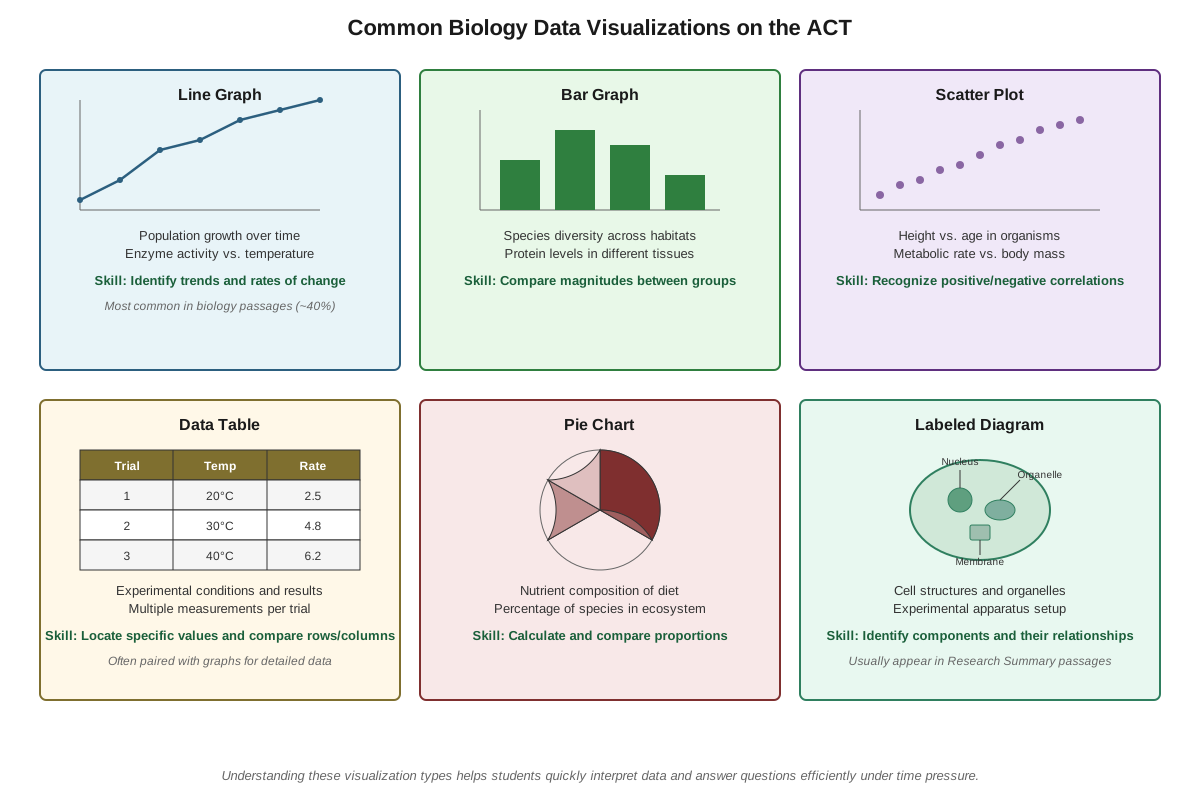
Biology data on the ACT appears in three primary formats: tables, graphs, and diagrams. Tables typically present numerical measurements organized by experimental conditions, such as organism counts at different time points or biochemical concentrations under varying treatments. Students must locate specific values, compare across rows or columns, and identify maximum or minimum values. Graphs visualize relationships between variables, with line graphs showing continuous change over time, bar graphs comparing discrete categories, and scatter plots revealing correlations. Diagrams illustrate experimental setups, anatomical structures, or ecological relationships, requiring spatial reasoning and the ability to trace pathways or processes.
Variables in Biological Experiments
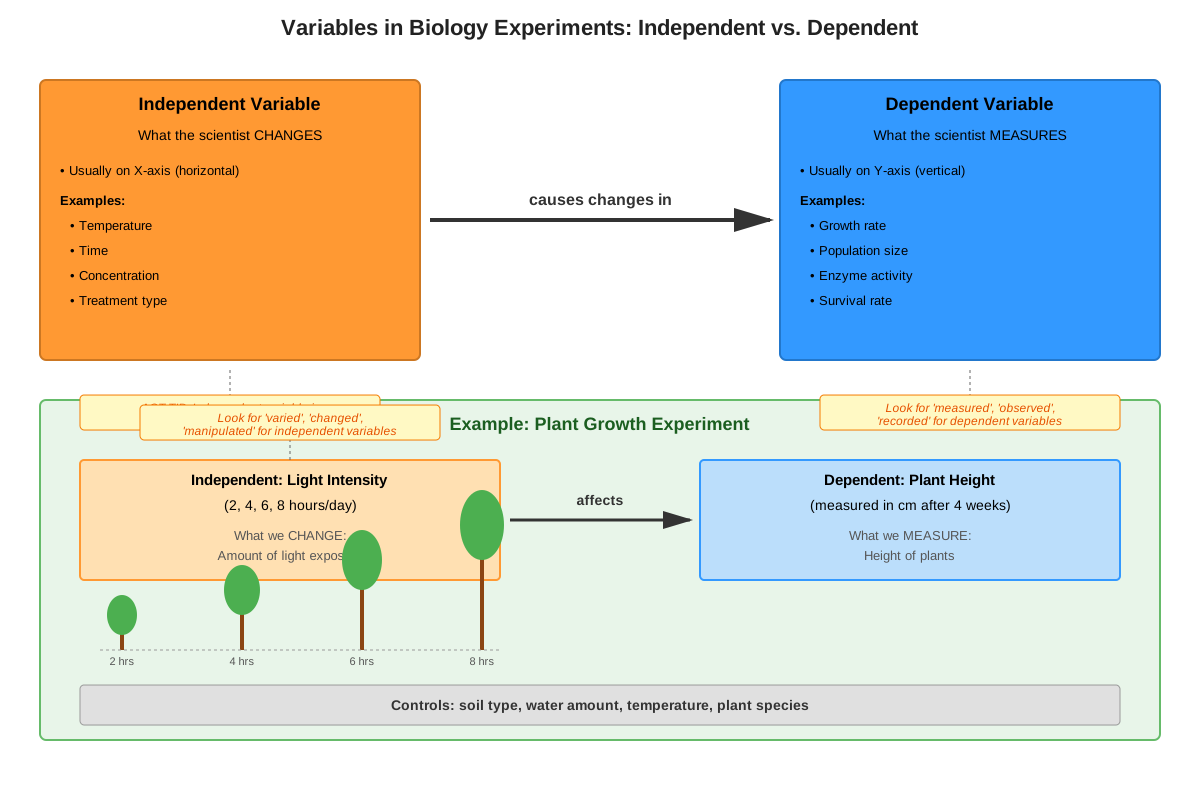
Every biological experiment contains independent variables (factors deliberately manipulated by researchers) and dependent variables (measured outcomes that respond to changes). For example, in a study examining how temperature affects enzyme activity, temperature is the independent variable (controlled by researchers) while enzyme activity rate is the dependent variable (measured as the response). The ACT frequently asks students to identify these variables or predict how changing one variable affects another. Control groups represent baseline conditions without experimental manipulation, allowing researchers to isolate the effect of the independent variable.
Interpreting Biological Trends
Biological data often displays characteristic patterns that students should recognize immediately. Linear relationships show constant rates of change, appearing as straight lines on graphs (e.g., constant population growth under unlimited resources). Exponential growth curves start slowly then accelerate rapidly, typical of bacterial populations in nutrient-rich environments. Logistic growth curves show initial exponential growth that levels off at a carrying capacity, representing realistic population limits due to resource constraints. Inverse relationships demonstrate that as one variable increases, another decreases (e.g., predator-prey cycles). Optimal ranges appear as peaks on graphs, showing maximum activity at specific conditions (e.g., enzyme function at optimal pH).
Data Tables in Biology
| Table Type | Common Content | Key Skills Required |
|---|---|---|
| Time-series | Population counts, growth measurements over days/weeks | Identifying trends, calculating rates of change |
| Comparative | Different species, treatments, or conditions in rows | Comparing values across categories |
| Multi-variable | Multiple measurements for each experimental condition | Tracking multiple relationships simultaneously |
| Summary statistics | Means, ranges, standard deviations | Understanding variability and central tendency |
Experimental Design Elements
ACT biology passages frequently describe experimental procedures that students must understand to answer questions correctly. Sample size affects reliability—larger samples provide more trustworthy results. Replication means repeating trials multiple times to ensure consistency. Randomization prevents bias by randomly assigning subjects to treatment groups. Standardized conditions keep all variables constant except the independent variable being tested. Questions often ask students to identify flaws in experimental design or suggest improvements.
Units and Measurements
Biological data uses specific measurement units that students must recognize and interpret. Concentration appears as molarity (M), percent (%), or parts per million (ppm). Time ranges from seconds (enzyme reactions) to years (ecological succession). Population measures include density (organisms per area), abundance (total count), or biomass (total mass). Rate measurements express change per unit time, such as heartbeats per minute or milliliters of oxygen consumed per hour. The ACT may require students to compare values with different units or recognize when unit conversions affect conclusions.
Biological Relationships and Causation
A critical skill involves distinguishing correlation (two variables change together) from causation (one variable directly causes changes in another). The ACT presents data showing relationships and asks whether conclusions about causation are justified. Strong evidence for causation requires controlled experiments where only the proposed cause varies while other factors remain constant. Observational studies showing correlation cannot prove causation because confounding variables might explain the relationship.
Concept Relationships
The core concepts within biology data interpretation build upon each other hierarchically. Understanding data formats (tables, graphs, diagrams) provides the foundation for identifying variables within those representations. Recognizing variables enables students to interpret trends and patterns in how dependent variables respond to independent variable changes. These patterns connect to experimental design principles that explain why data appears as it does—proper controls, adequate sample sizes, and standardized conditions produce reliable trends. Finally, understanding measurements and units allows accurate quantitative interpretation, while distinguishing correlation from causation represents the highest-level analytical skill.
This topic connects to prerequisite knowledge of basic graph reading by applying those skills specifically to biological contexts with domain-specific vocabulary and concepts. The scientific method prerequisite becomes concrete through analyzing actual experimental designs in biology passages. These biology data interpretation skills transfer directly to chemistry and physics passages, where the same principles of variable identification, trend analysis, and experimental evaluation apply with different content.
Relationship map: Data Format Recognition → Variable Identification → Trend Analysis → Experimental Design Evaluation → Quantitative Measurement Interpretation → Causal Reasoning
High-Yield Facts
- ⭐ Biology passages account for 40% of ACT Science content, making them the most frequently tested science discipline
- ⭐ Independent variables appear on the x-axis of graphs, while dependent variables appear on the y-axis
- ⭐ Control groups provide baseline comparisons that allow researchers to isolate experimental effects
- Exponential growth curves indicate unlimited resources, while logistic curves show resource limitations
- ⭐ Optimal conditions appear as peaks or maximum values on graphs showing biological activity
- Sample size directly affects reliability—larger samples produce more trustworthy conclusions
- Correlation does not prove causation—observational data cannot establish cause-and-effect relationships
- ⭐ Rate measurements express change per unit time and require identifying both the numerator (what changes) and denominator (time unit)
- Carrying capacity represents the maximum population size an environment can sustain indefinitely
- Enzyme activity typically shows optimal ranges for temperature and pH, with decreased activity outside these ranges
- Population density measures organisms per unit area, while abundance measures total organism count
- ⭐ Direct relationships show both variables increasing or decreasing together, while inverse relationships show opposite changes
- Standard deviation indicates data variability—larger values mean more spread in measurements
- Photosynthesis rates typically increase with light intensity until reaching a saturation point
Quick check — test yourself on Biology data so far.
Try Flashcards →Common Misconceptions
Misconception: The x-axis always represents time in biological graphs.
Correction: While time frequently appears on the x-axis, the independent variable (whatever researchers manipulate) determines x-axis content. This could be temperature, pH, concentration, or any other experimental factor.
Misconception: Larger organisms always have higher metabolic rates than smaller organisms.
Correction: Absolute metabolic rate increases with body size, but metabolic rate per unit mass (mass-specific metabolic rate) actually decreases as organisms get larger. The ACT tests whether students can distinguish between these different rate measurements.
Misconception: If two variables show correlation in biological data, one must cause the other.
Correction: Correlation indicates variables change together but doesn't prove causation. A third variable might cause both, or the relationship might be coincidental. Only controlled experiments can establish causation.
Misconception: Control groups receive no treatment whatsoever.
Correction: Control groups receive standard or baseline treatment (like a placebo) to match experimental groups in all ways except the variable being tested. This allows valid comparisons.
Misconception: All biological growth follows exponential patterns indefinitely.
Correction: Real populations show logistic growth that levels off at carrying capacity due to limited resources, space, or other constraints. Exponential growth only occurs temporarily under ideal conditions.
Misconception: The steepest part of a curve always represents the most important data.
Correction: While steep slopes indicate rapid change, the most important data depends on the research question. Maximum values, minimum values, or specific threshold points might be more significant than rate of change.
Misconception: Biology passages require extensive memorized knowledge of biological facts.
Correction: The ACT Science section tests data interpretation skills using biological contexts. All necessary information appears in the passage—students analyze provided data rather than recall memorized content.
Worked Examples
Example 1: Population Growth Analysis
Passage Context: Scientists studied bacterial population growth in two culture dishes. Dish A contained unlimited nutrients, while Dish B contained limited nutrients. They counted bacteria every 2 hours for 12 hours.
Data Table:
| Time (hours) | Dish A (millions) | Dish B (millions) |
|---|---|---|
| 0 | 1.0 | 1.0 |
| 2 | 2.0 | 1.8 |
| 4 | 4.0 | 3.0 |
| 6 | 8.0 | 4.0 |
| 8 | 16.0 | 4.5 |
| 10 | 32.0 | 4.8 |
| 12 | 64.0 | 5.0 |
Question: Based on the data, which statement best describes bacterial growth patterns?
Solution Process:
- Identify variables: Time is the independent variable (x-axis equivalent), bacterial count is the dependent variable
- Analyze Dish A trend: Population doubles every 2 hours (1→2→4→8→16→32→64), indicating exponential growth
- Analyze Dish B trend: Growth rate decreases over time (0.8→1.2→1.0→0.5→0.3→0.2 million per 2-hour interval), indicating logistic growth approaching carrying capacity
- Connect to concepts: Unlimited nutrients (Dish A) support exponential growth; limited nutrients (Dish B) create carrying capacity around 5 million bacteria
- Answer: Dish A shows exponential growth while Dish B shows logistic growth approaching carrying capacity
Key Takeaway: This question tests the ability to recognize growth patterns from numerical data and connect them to experimental conditions (nutrient availability).
Example 2: Enzyme Activity Interpretation
Passage Context: Researchers measured the activity of digestive enzyme pepsin at different pH levels. Activity was measured as milligrams of protein digested per minute.
Graph Description: A line graph shows pH (2-10) on the x-axis and enzyme activity (0-50 mg/min) on the y-axis. The curve peaks at pH 2 (50 mg/min), decreases gradually to pH 4 (30 mg/min), then drops sharply to near zero by pH 6 (5 mg/min), remaining at zero through pH 10.
Question: At which pH would pepsin most effectively digest proteins in a test tube?
Solution Process:
- Identify the dependent variable: Enzyme activity (protein digested per minute) measures effectiveness
- Locate maximum value: The peak occurs at pH 2 with 50 mg/min activity
- Understand biological context: Maximum activity indicates optimal conditions for enzyme function
- Eliminate incorrect answers: Higher pH values show progressively lower activity, making them less effective
- Answer: pH 2, where pepsin shows maximum activity
Follow-up reasoning: This optimal pH makes biological sense because pepsin functions in the stomach, which has highly acidic conditions (pH 1.5-2). The ACT often includes biologically realistic scenarios where data patterns align with natural environments.
Key Takeaway: Optimal conditions appear as maximum or minimum values depending on what's being measured. Always identify what the y-axis represents to determine whether higher or lower values indicate better performance.
Exam Strategy
When approaching ACT biology data passages, follow this systematic process:
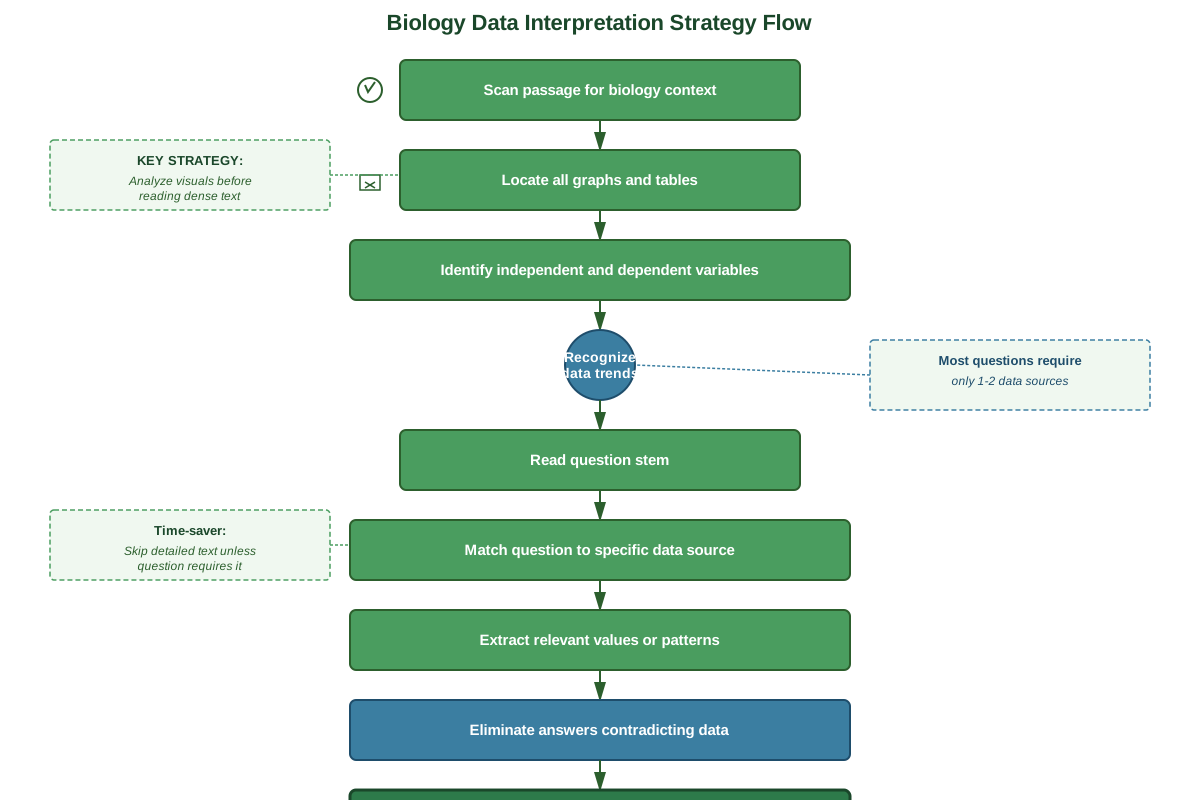
Step 1: Preview questions first (15-20 seconds). Quickly scan question stems to identify what data you'll need—specific table values, graph trends, or experimental design elements. This focuses your passage reading.
Step 2: Identify the passage type (5 seconds). Data Representation passages emphasize graph/table interpretation. Research Summary passages focus on experimental design and results. Conflicting Viewpoints passages present competing hypotheses about biological phenomena.
Step 3: Locate variables immediately (10 seconds). Circle or mentally note independent variables (what researchers changed) and dependent variables (what they measured). This clarifies cause-and-effect relationships.
Step 4: Analyze data systematically (30-40 seconds). For tables, scan for patterns across rows and columns. For graphs, identify overall trends (increasing, decreasing, constant, optimal peak). Note any unusual data points or unexpected patterns.
Exam Tip: The ACT rarely requires complex calculations. If you find yourself doing extensive math, you've likely missed a simpler approach. Most questions require reading values directly from data or identifying general trends.
Trigger words to watch for:
- "According to the data" or "Based on the results" = Find specific information in tables/graphs
- "Most likely" or "Best supported by" = Identify trends and extrapolate logically
- "Compared to" or "Difference between" = Compare specific values or conditions
- "If... then" = Apply patterns to new scenarios or predict outcomes
- "Control group" or "experimental group" = Understand experimental design
Process of elimination strategies:
- Eliminate answers contradicting explicit data (wrong numbers, reversed trends)
- Remove answers requiring outside knowledge not provided in the passage
- Discard extreme answers using words like "always," "never," or "only" unless data strongly supports them
- Choose answers matching the data's scope—don't extrapolate beyond what's shown
Time allocation: Spend 5 minutes per passage (including all questions). For biology passages with complex data, allocate 60-90 seconds for initial passage review, then 30-45 seconds per question. If a question requires extensive searching, mark it and return after completing easier questions.
Memory Techniques
DIVE for analyzing biology data:
- Dependent variable (what's measured—usually y-axis)
- Independent variable (what's changed—usually x-axis)
- Variables controlled (what stays constant)
- Experimental vs. control groups
GRAPH for interpreting biological graphs:
- General trend (increasing, decreasing, constant, optimal)
- Range of values (minimum to maximum)
- Axis labels and units
- Peaks or valleys (optimal conditions)
- How variables relate (direct, inverse, no relationship)
Visualize growth curves: Picture exponential growth as a hockey stick (flat then sharply upward), logistic growth as an S-curve (slow start, rapid middle, leveling plateau). These mental images help quickly identify growth patterns in data.
The "3-C Rule" for experimental design questions:
- Control group present?
- Constant conditions maintained?
- Clear cause-effect relationship?
If all three C's are satisfied, the experiment is well-designed.
Remember optimal conditions with "Peak Performance": Enzymes and organisms show peak performance (maximum activity) at optimal temperature, pH, or other conditions. On graphs, these appear as literal peaks or maximum values.
Summary
Biology data interpretation on the ACT Science section requires systematic analysis of tables, graphs, and experimental designs within biological contexts. Success depends on quickly identifying independent and dependent variables, recognizing characteristic patterns like exponential versus logistic growth, and understanding experimental design principles including controls, sample size, and standardized conditions. Rather than testing memorized biological facts, the ACT evaluates data analysis skills using biological scenarios—students must extract information from provided data, identify trends, compare values across conditions, and draw evidence-based conclusions. The most critical skills include distinguishing correlation from causation, recognizing optimal conditions as peaks or extreme values, and connecting experimental design elements to data reliability. Mastering these strategies enables students to efficiently navigate the 40% of Science passages containing biological content, directly impacting overall Science scores.
Key Takeaways
- Biology data appears in 40% of ACT Science passages, making it the most frequently tested science discipline
- Independent variables (what researchers manipulate) typically appear on the x-axis, while dependent variables (measured outcomes) appear on the y-axis
- Recognize standard biological patterns: exponential growth (unlimited resources), logistic growth (carrying capacity), and optimal ranges (peak enzyme activity)
- Control groups provide essential baseline comparisons that allow isolation of experimental effects
- The ACT tests data interpretation skills, not memorized biology facts—all necessary information appears in the passage
- Correlation between variables does not prove causation; only controlled experiments establish cause-and-effect relationships
- Systematic analysis using the DIVE method (Dependent, Independent, Variables controlled, Experimental vs. control) ensures thorough data interpretation
Related Topics
Chemistry Data Interpretation: Similar data analysis skills apply to chemical reactions, concentration effects, and reaction rates. Mastering biology data interpretation provides transferable skills for chemistry passages, which account for approximately 30% of ACT Science content.
Physics Data Interpretation: Graph analysis, variable identification, and experimental design principles extend to physics contexts involving motion, forces, and energy. The same systematic approach works across all science disciplines.
Research Summaries Across Disciplines: Biology passages frequently appear as Research Summary formats. Understanding experimental design in biological contexts strengthens skills for analyzing experiments in any scientific field.
Statistical Analysis in Science: Advanced understanding of variability, sample size effects, and data reliability builds on basic biology data interpretation, preparing students for college-level scientific research.
Practice CTA
Now that you've mastered the core concepts and strategies for interpreting biology data on the ACT, it's time to apply these skills! Complete the practice questions to reinforce your ability to identify variables, analyze trends, and evaluate experimental designs. Use the flashcards to memorize high-yield facts and trigger words that signal specific question types. Remember, biology data interpretation is a skill that improves with deliberate practice—each passage you analyze strengthens your pattern recognition and speeds up your response time. You've built a solid foundation; now demonstrate your mastery through focused practice!
Sign up free to keep reading
Create a free AnvayaPrep account to finish this ACT guide on Biology data — plus flashcards and practice questions.