Overview
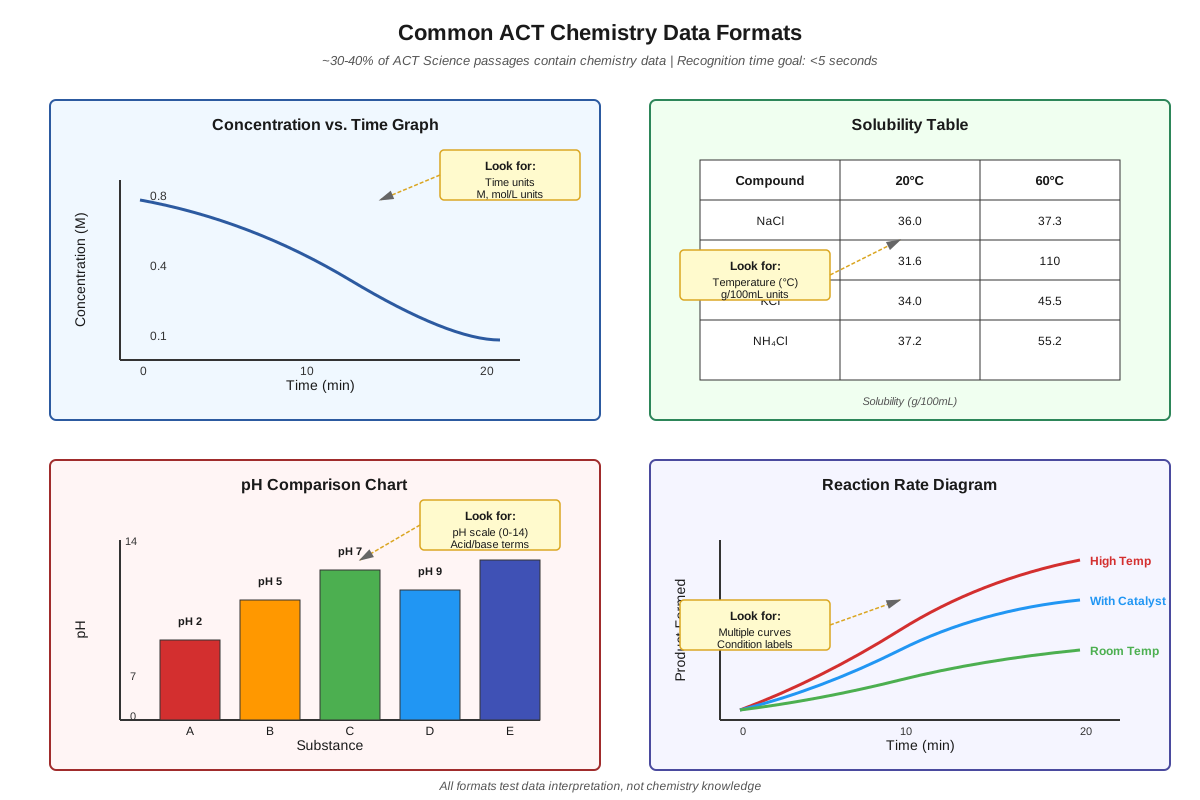
Chemistry data represents one of the most frequently tested components of the ACT Science section, appearing in approximately 30-40% of all science passages. Unlike traditional chemistry exams that require memorization of formulas and equations, ACT chemistry data questions focus on interpreting experimental results, analyzing trends in chemical properties, and drawing conclusions from tables, graphs, and diagrams. Students encounter chemistry data in various formats: solubility tables, pH measurements, reaction rate graphs, concentration changes over time, and periodic table trends.
The ACT Science test does not require extensive chemistry knowledge; instead, it assesses the ability to read and interpret scientific data presented in chemistry contexts. Students must quickly identify relevant information, recognize patterns, compare experimental conditions, and make predictions based on observed trends. Chemistry data questions typically appear within Research Summaries (experiments) or Data Representation passages, where multiple experiments or datasets are presented simultaneously. Success requires strong graph-reading skills, table interpretation abilities, and the capacity to synthesize information across multiple data sources.
Understanding chemistry data is foundational to the broader Scientific Reasoning unit because it develops critical analytical skills applicable across all science disciplines. The strategies learned for interpreting chemical concentration graphs transfer directly to biology population studies, physics motion diagrams, and Earth science atmospheric data. Mastering chemistry data interpretation builds confidence in approaching unfamiliar scientific contexts—a hallmark of ACT Science success—and establishes the pattern recognition skills necessary for efficient test-taking under time pressure.
Learning Objectives
- [ ] Identify when Chemistry data is being tested in ACT Science passages
- [ ] Explain the core rule or strategy behind Chemistry data interpretation
- [ ] Apply Chemistry data analysis to ACT-style questions accurately
- [ ] Extract quantitative information from chemistry-related tables and graphs within 30 seconds
- [ ] Compare multiple experimental conditions and identify controlled versus manipulated variables in chemistry contexts
- [ ] Predict trends and extrapolate data points beyond the given range using established chemical patterns
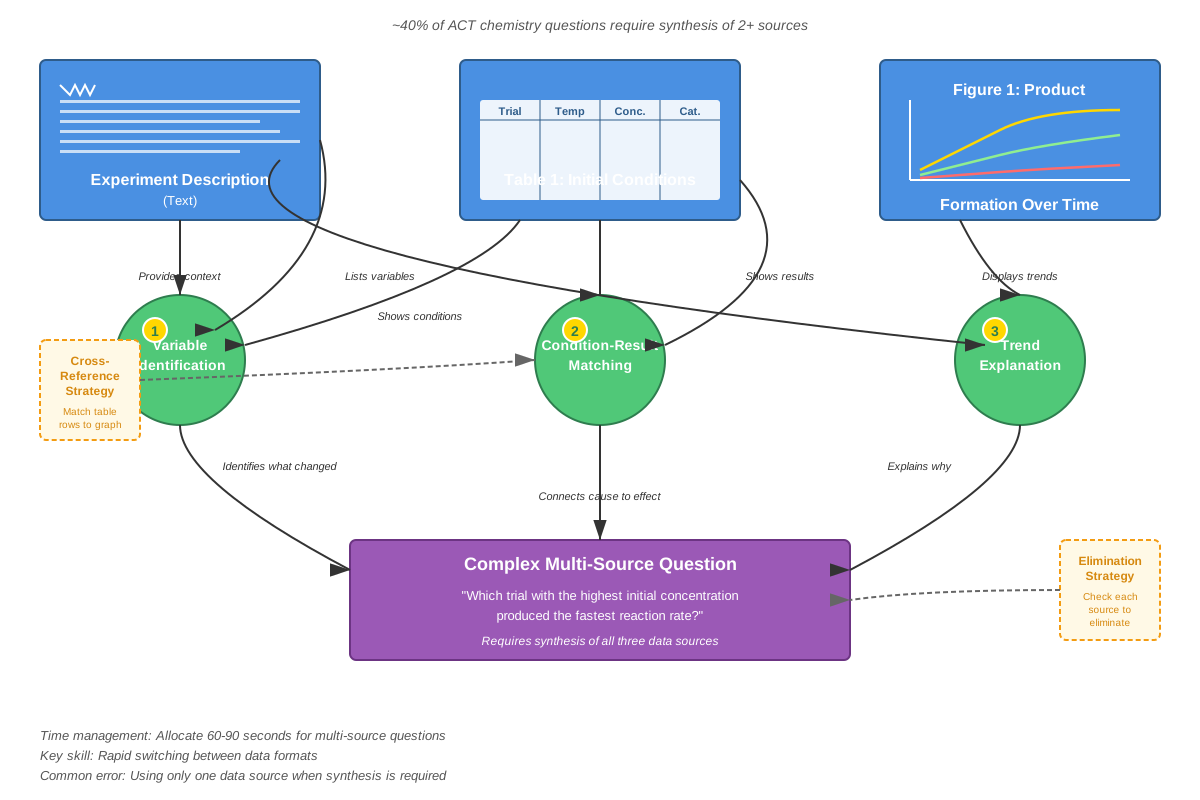
- [ ] Synthesize information from multiple chemistry data sources to answer complex reasoning questions
Prerequisites
- Basic graph reading skills: Understanding x-axis, y-axis, data points, and trend lines is essential for interpreting chemistry graphs showing concentration, temperature, or reaction progress
- Table interpretation: Ability to locate specific values in rows and columns enables quick extraction of chemical properties, experimental conditions, and measurement results
- Unit awareness: Recognizing common scientific units (mL, g, mol, °C, M) prevents misinterpretation of magnitude and scale in chemistry data
- Comparative reasoning: Skill in determining "greater than," "less than," and "equal to" relationships allows for rapid analysis of chemical trends and experimental outcomes
- Basic scientific vocabulary: Familiarity with terms like "experiment," "variable," "control," and "measurement" provides context for understanding chemistry data presentation
Why This Topic Matters
Chemistry data interpretation skills extend far beyond standardized testing into real-world applications across multiple fields. Pharmaceutical researchers analyze concentration-response curves to determine drug efficacy. Environmental scientists interpret pH and pollutant concentration data to assess water quality. Chemical engineers monitor reaction rates and yields to optimize industrial processes. Medical professionals read blood chemistry panels to diagnose conditions. Even everyday consumers interpret nutrition labels and medication dosages—both forms of chemistry data presentation.
On the ACT Science test, chemistry data appears with remarkable consistency. Approximately 2-3 complete passages (out of 6-7 total) feature chemistry-related content, generating 10-15 questions per test. These passages commonly present solubility experiments, acid-base titrations, reaction kinetics studies, phase change diagrams, and periodic trends. The question types include direct data lookup (20% of chemistry questions), trend identification (35%), comparison between conditions (25%), prediction and extrapolation (15%), and experimental design evaluation (5%). Students who master chemistry data interpretation gain a significant strategic advantage because these questions are highly predictable in format and approach.
Chemistry data passages typically appear in three distinct formats on the ACT. Data Representation passages present 2-3 graphs or tables showing chemical properties, measurements, or trends, followed by 5 questions requiring interpretation. Research Summary passages describe 2-4 related experiments with chemistry data in tables and graphs, testing the ability to compare conditions and synthesize results across studies. Conflicting Viewpoints passages occasionally incorporate chemistry data to support different scientific hypotheses, requiring students to evaluate evidence quality and relevance. Recognizing these formats immediately helps students activate appropriate reading and analysis strategies.
Core Concepts
Identifying Chemistry Data Passages
Chemistry data passages contain specific markers that distinguish them from biology, physics, or Earth science content. Key identifiers include chemical terminology (elements, compounds, molecules, reactions, solutions), references to the periodic table, discussion of chemical properties (solubility, reactivity, pH, concentration), and presentation of data involving chemical changes or measurements. Passages may describe mixing substances, measuring reaction products, testing different chemical conditions, or comparing properties across elements or compounds.
Visual cues also signal chemistry content: molecular diagrams, structural formulas, periodic table excerpts, pH scales, concentration units (molarity, ppm, percent composition), and graphs showing chemical quantities changing over time or across conditions. The experimental setup descriptions often mention beakers, test tubes, solutions, heating, mixing, or chemical analysis techniques. Recognizing these markers within the first 10-15 seconds of reading allows students to activate chemistry-specific interpretation strategies.
Core Data Types in ACT Chemistry
The ACT presents chemistry information through several standard formats, each requiring specific reading strategies:
Tables organize chemical data in rows and columns, typically showing how one or more properties change across different conditions, substances, or time points. Common table types include solubility data (grams dissolved per 100 mL at various temperatures), reaction yields under different conditions, physical properties of elements or compounds (melting point, density, boiling point), and concentration measurements at different time intervals. Reading tables efficiently requires identifying the independent variable (usually in the leftmost column or top row) and dependent variables (measured outcomes in other cells).
Line graphs display continuous relationships between chemical variables, most commonly concentration versus time, temperature versus solubility, or pH versus volume added. The x-axis typically represents the manipulated variable (what experimenters changed), while the y-axis shows the responding variable (what was measured). Multiple lines on one graph indicate different experimental conditions or substances being compared. Trend direction (increasing, decreasing, constant) and rate of change (steep versus gradual slopes) provide critical information for answering questions.
Bar graphs compare discrete categories or conditions, such as reaction rates for different catalysts, yields from various reactants, or properties across different elements. The height of each bar represents the measured quantity, enabling quick visual comparison. ACT chemistry bar graphs often compare experimental trials, different chemical substances, or the same substance under varying conditions.
Diagrams and models illustrate molecular structures, experimental apparatus, or chemical processes. While less common than graphs and tables, these visuals may show electron configurations, bonding patterns, phase diagrams, or equipment setups. Questions about diagrams typically ask students to identify components, predict outcomes based on the model, or explain relationships between structure and properties.
Essential Interpretation Strategies
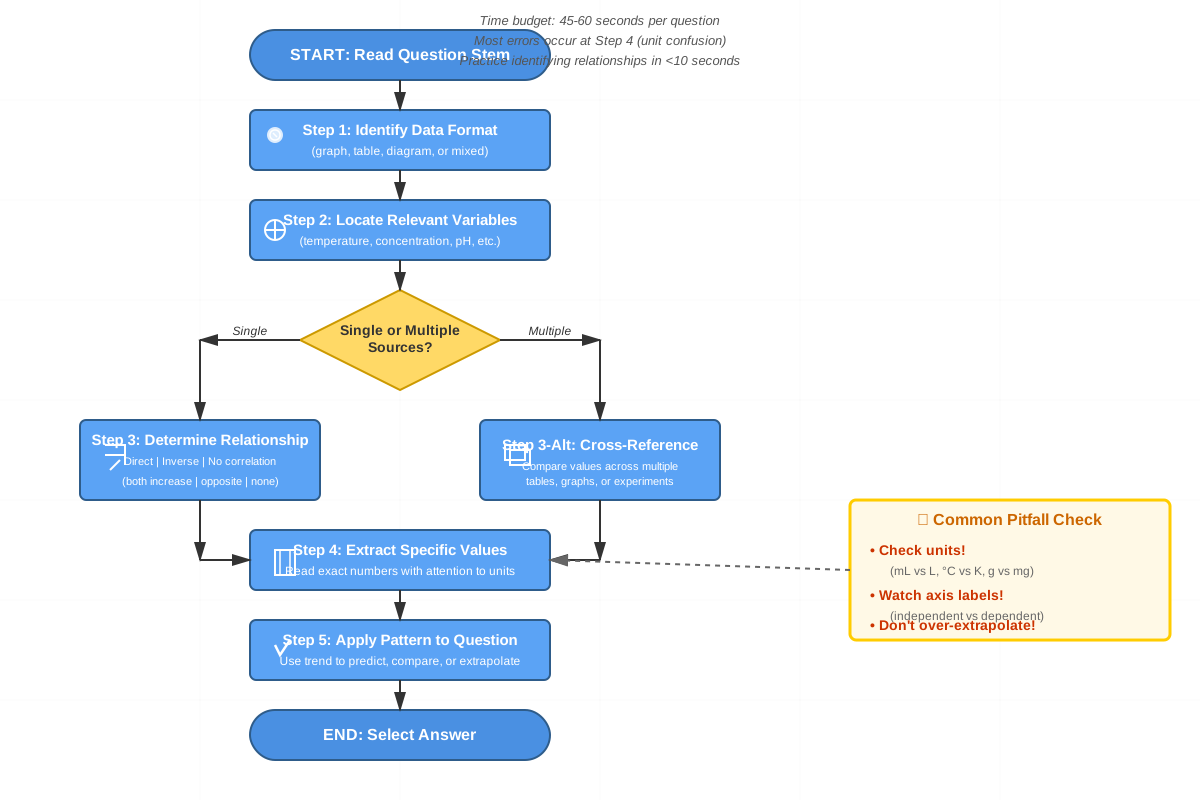
Successful chemistry data interpretation follows a systematic approach applicable to all passage types:
Step 1: Identify variables and units. Before reading any data values, determine what is being measured (dependent variables), what is being changed (independent variables), and what units are used. This orientation prevents confusion and enables accurate interpretation.
Step 2: Recognize patterns and trends. Scan the data for increasing patterns, decreasing patterns, constant values, or more complex relationships (peaks, valleys, plateaus). Most ACT chemistry questions test pattern recognition rather than specific numerical values.
Step 3: Compare across conditions. When multiple experiments, substances, or trials are presented, identify what differs between them and how those differences affect outcomes. Controlled variables (kept constant) versus manipulated variables (intentionally changed) are crucial for understanding experimental design.
Step 4: Note extremes and special points. Maximum values, minimum values, zero points, and inflection points (where trends change direction) frequently appear in questions. Marking these mentally or with quick annotations saves time during question-answering.
Step 5: Consider the chemical context. While the ACT doesn't require extensive chemistry knowledge, basic chemical reasoning helps. Higher temperatures generally increase reaction rates and solubility; acids have low pH values; concentration decreases as substances are consumed in reactions. These general principles guide prediction and extrapolation questions.
Common Chemistry Data Scenarios
Certain experimental setups appear repeatedly on the ACT, making them high-yield study targets:
| Scenario Type | Typical Variables | Common Question Focus |
|---|---|---|
| Solubility experiments | Temperature (x-axis), grams dissolved (y-axis), different solutes (multiple lines) | How solubility changes with temperature; comparing solubility of different substances |
| Reaction rate studies | Time (x-axis), concentration or amount (y-axis), different conditions (multiple lines/trials) | How fast reactions proceed; effect of temperature, catalysts, or concentration on rate |
| Acid-base titrations | Volume added (x-axis), pH (y-axis) | Identifying equivalence points; comparing acid/base strength |
| Phase changes | Temperature (x-axis), state of matter or energy (y-axis) | Identifying melting/boiling points; comparing substances |
| Periodic trends | Atomic number or position (x-axis), property like electronegativity or atomic radius (y-axis) | Recognizing patterns across periods or groups |
Quantitative versus Qualitative Analysis
ACT chemistry data questions divide into two categories requiring different approaches. Quantitative questions ask for specific numerical values, calculations, or precise comparisons. These require locating exact data points in tables or graphs, reading axis values carefully, and sometimes performing simple arithmetic (though complex calculations are rare). Example: "According to Table 1, what was the pH of Solution A at 25°C?"
Qualitative questions focus on trends, patterns, relationships, and general comparisons without requiring exact numbers. These constitute approximately 70% of chemistry data questions and reward pattern recognition over precise reading. Example: "Based on Figure 2, as temperature increased, the solubility of Compound X..." Students should prioritize speed on qualitative questions, using visual pattern recognition rather than reading every data point.
Concept Relationships
Chemistry data interpretation skills build hierarchically, with each concept supporting more complex analysis. Variable identification forms the foundation, enabling all subsequent interpretation. Without knowing what is being measured and what is being changed, students cannot accurately read graphs or tables. This foundational skill leads directly to pattern recognition, where students identify how dependent variables respond to changes in independent variables.
Pattern recognition enables comparison across conditions, the next level of complexity. Once students can identify trends in individual datasets, they can compare how different experimental conditions, substances, or trials produce different patterns. This comparative skill is essential for Research Summary passages with multiple experiments. Comparison ability then supports prediction and extrapolation, where students extend observed patterns beyond the given data range or apply patterns to new situations.
The relationship map flows as follows:
Variable Identification → Unit Recognition → Pattern Recognition (increasing/decreasing/constant trends) → Comparison Across Conditions → Prediction and Extrapolation → Synthesis Across Multiple Data Sources
This progression also connects to prerequisite skills. Basic graph reading (prerequisite) enables variable identification (chemistry data skill), which enables pattern recognition (chemistry data skill), which enables prediction (advanced chemistry data skill). Similarly, table interpretation (prerequisite) supports comparison across conditions (chemistry data skill), which supports synthesis (advanced chemistry data skill).
Chemistry data interpretation also connects laterally to other ACT Science topics. The same pattern recognition skills apply to biology population graphs, physics motion diagrams, and Earth science climate data. The experimental design concepts (controlled variables, manipulated variables, multiple trials) learned through chemistry passages transfer to all Research Summary passages regardless of content area. This makes chemistry data a high-leverage topic—mastering it improves performance across the entire Science test.
High-Yield Facts
⭐ Chemistry data passages appear in 30-40% of ACT Science tests, generating 10-15 questions per exam
⭐ Most chemistry data questions test pattern recognition and trend identification rather than specific numerical values
⭐ The x-axis typically represents the independent (manipulated) variable, while the y-axis shows the dependent (responding) variable
⭐ When multiple lines appear on one graph, they represent different experimental conditions, substances, or trials being compared
⭐ Solubility generally increases with temperature for most solid solutes in water—a common ACT chemistry data pattern
- Tables organize data with independent variables in the leftmost column or top row and dependent variables in other cells
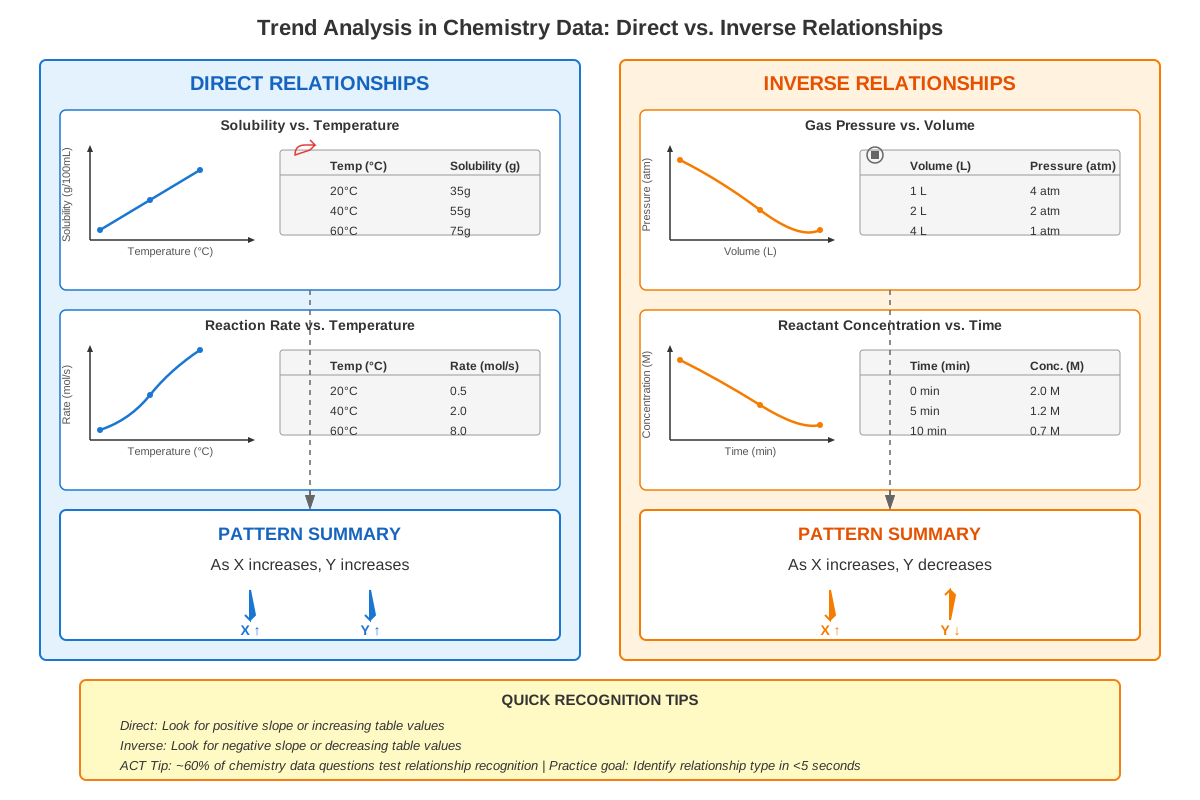
- Increasing trends show positive relationships (as one variable increases, the other increases); decreasing trends show inverse relationships
- Constant horizontal lines on graphs indicate no change in the measured variable despite changes in the independent variable
- Steeper slopes on line graphs indicate faster rates of change; gradual slopes indicate slower rates
- Bar graph height enables quick visual comparison without reading exact numerical values
- Phase change diagrams show flat (constant temperature) regions during melting and boiling
- Periodic trend graphs typically show repeating patterns across periods or consistent increases/decreases down groups
- Concentration versus time graphs for reactions typically show decreasing reactant concentration and increasing product concentration
- pH values below 7 indicate acids, above 7 indicate bases, and exactly 7 indicates neutral solutions
- Catalyst experiments show faster reaction rates (steeper slopes or shorter time to completion) compared to uncatalyzed reactions
Quick check — test yourself on Chemistry data so far.
Try Flashcards →Common Misconceptions
Misconception: Chemistry data questions require memorizing chemical formulas, equations, and extensive chemistry knowledge → Correction: The ACT Science test provides all necessary information within the passage. Questions test data interpretation skills, not chemistry content knowledge. Students should focus on reading graphs and tables accurately rather than recalling chemistry facts.
Misconception: Every data point in a table or graph must be read carefully before answering questions → Correction: Most questions focus on overall trends and patterns rather than specific values. Students should scan for general patterns first, then locate specific data points only when questions require them. This approach saves significant time.
Misconception: Multiple lines on a graph represent multiple dependent variables → Correction: Multiple lines typically represent the same dependent variable measured under different conditions or for different substances. Each line shows how one experimental condition or substance behaves, enabling comparison.
Misconception: Higher values on graphs always indicate "better" or more desirable outcomes → Correction: The y-axis simply represents measured quantities without inherent value judgments. Higher concentration might indicate more product formation (potentially desirable) or more pollutant present (undesirable). Context determines interpretation.
Misconception: Chemistry data passages require performing calculations and mathematical operations → Correction: While occasional questions ask for simple arithmetic (finding differences or averages), complex calculations are extremely rare. The ACT Science test emphasizes interpretation over computation. Students should not waste time on elaborate calculations unless explicitly required.
Misconception: Extrapolation questions can be answered by guessing any reasonable value beyond the data range → Correction: Extrapolation requires extending the established pattern or trend. If concentration decreases linearly over time, extrapolation should continue that linear decrease. Random guessing ignores the pattern evidence provided in the data.
Misconception: All chemistry data follows predictable real-world patterns (like solubility increasing with temperature) → Correction: While real chemistry knowledge occasionally helps, ACT passages sometimes present hypothetical or unusual data specifically to test interpretation skills independent of prior knowledge. Always prioritize what the data shows over what "should" happen based on chemistry principles.
Worked Examples
Example 1: Solubility Data Interpretation
Passage Setup: Table 1 shows the solubility (grams of solute dissolved per 100 mL of water) of three compounds at different temperatures.
| Temperature (°C) | Compound A (g/100mL) | Compound B (g/100mL) | Compound C (g/100mL) |
|---|---|---|---|
| 20 | 35 | 18 | 42 |
| 40 | 52 | 22 | 38 |
| 60 | 71 | 28 | 33 |
| 80 | 93 | 35 | 29 |
Question: Based on Table 1, as temperature increased from 20°C to 80°C, the solubility of Compound C:
A. increased only
B. decreased only
C. increased, then decreased
D. decreased, then increased
Solution Process:
Step 1: Identify the variables. Temperature is the independent variable (left column), and solubility is the dependent variable (data columns). We need to focus on Compound C specifically.
Step 2: Trace Compound C values from top to bottom: 42 → 38 → 33 → 29. Each value is smaller than the previous one.
Step 3: Recognize the pattern. The values consistently decrease as temperature increases. This is a simple decreasing trend with no direction changes.
Step 4: Eliminate incorrect answers. Choice A (increased only) contradicts the decreasing values. Choice C (increased, then decreased) and Choice D (decreased, then increased) both describe direction changes that don't occur in the data.
Answer: B. The solubility decreased only.
Connection to Learning Objectives: This example demonstrates identifying chemistry data (solubility table), applying the core strategy (tracing values to identify trends), and accurately answering an ACT-style question through systematic analysis.
Example 2: Reaction Rate Graph Analysis
Passage Setup: Figure 1 shows the concentration of Product X over time for a chemical reaction performed at three different temperatures.
Description of graph: X-axis shows Time (minutes) from 0 to 60. Y-axis shows Concentration of Product X (mol/L) from 0 to 10. Three lines are shown: Line 1 (50°C) reaches 8 mol/L at 60 minutes with a gradual slope. Line 2 (70°C) reaches 8 mol/L at 40 minutes with a steeper slope. Line 3 (90°C) reaches 8 mol/L at 25 minutes with the steepest slope.
Question 1: According to Figure 1, at which temperature did the reaction produce Product X most rapidly?
Solution Process:
Step 1: Understand what "most rapidly" means. Rapid production means reaching high concentrations in less time, represented by steeper slopes on the graph.
Step 2: Compare the three lines visually. Line 3 (90°C) has the steepest slope, reaching the same final concentration in the shortest time.
Step 3: Confirm by checking specific points. At 20 minutes, the 90°C reaction has produced more Product X than the other temperatures, indicating faster production.
Answer: 90°C produced Product X most rapidly.
Question 2: Based on Figure 1, if the reaction had been performed at 60°C, the concentration of Product X at 50 minutes would most likely have been:
A. less than 6 mol/L
B. between 6 and 7 mol/L
C. between 7 and 8 mol/L
D. greater than 8 mol/L
Solution Process:
Step 1: Recognize this as an interpolation question. We need to predict behavior between two known conditions (50°C and 70°C).
Step 2: Check the known values at 50 minutes. At 50°C, concentration is approximately 6.5 mol/L. At 70°C, concentration is approximately 7.5 mol/L.
Step 3: Apply the pattern. Since 60°C falls between 50°C and 70°C, the concentration should fall between their values at 50 minutes.
Step 4: Estimate the midpoint. 60°C is halfway between 50°C and 70°C, so the concentration should be approximately halfway between 6.5 and 7.5 mol/L, which is about 7 mol/L.
Answer: C. Between 7 and 8 mol/L (with the value likely closer to 7 mol/L).
Connection to Learning Objectives: These examples demonstrate extracting quantitative information from graphs, comparing multiple experimental conditions (different temperatures), and predicting trends through interpolation—all essential ACT chemistry data skills.
Exam Strategy
Approaching Chemistry Data Passages
Effective ACT Science test-takers follow a consistent approach when encountering chemistry data passages. First 15 seconds: Skim the passage introduction to identify the general topic and experimental setup. Look for chemistry-specific terms and note how many figures or tables are presented. Next 30 seconds: Examine each figure and table quickly, identifying variables, units, and general patterns without reading specific values. Note what is being compared (different substances, temperatures, concentrations, time points). Remaining time: Move directly to questions, returning to specific data only when needed.
This approach differs from traditional reading comprehension because ACT Science passages are reference materials, not narratives to be fully understood before answering questions. Students who read passages thoroughly before attempting questions waste valuable time and often forget details anyway. The question-first approach ensures time is spent only on relevant information.
Trigger Words and Phrases
Certain question language signals specific chemistry data skills:
"According to Table/Figure X..." indicates a direct lookup question requiring locating a specific value. Strategy: Go directly to the referenced data source and find the exact information requested.
"As [variable] increased/decreased..." signals a trend identification question. Strategy: Trace values in the specified direction and describe the pattern (increased, decreased, remained constant).
"Compared to [condition A], [condition B]..." indicates a comparison question. Strategy: Locate data for both conditions and determine the relationship (greater than, less than, equal to).
"Based on [data source], if [new condition]..." signals prediction or extrapolation. Strategy: Identify the established pattern and extend it logically to the new condition.
"Which of the following best explains..." often appears with chemistry data and requires connecting patterns to chemical reasoning. Strategy: Eliminate answers contradicting the data, then select the explanation most consistent with observed trends.
"At what [value] did..." asks for a specific point where something occurred (maximum, minimum, intersection, threshold). Strategy: Scan the data for the described event and read the corresponding independent variable value.
Process of Elimination Strategies
Chemistry data questions lend themselves particularly well to elimination strategies:
For trend questions, eliminate any answer describing a pattern opposite to what the data shows. If concentration increases, eliminate "decreased" answers immediately.
For comparison questions, eliminate answers placing values in the wrong order. If the data clearly shows A > B > C, eliminate any answer suggesting B > A or C > B.
For prediction questions, eliminate answers that violate the established pattern. If all data points show a linear increase, eliminate answers suggesting sudden decreases or plateaus unless the question specifically asks about limits.
For quantitative questions, eliminate answers outside the possible range. If all table values fall between 10 and 50, an answer of 75 is likely incorrect unless extrapolation far beyond the data range is explicitly requested.
Time Allocation
Chemistry data passages typically require 5-6 minutes total (including reading and answering all questions). Allocate approximately:
- 45 seconds for initial passage and figure review
- 45-60 seconds per question (5-6 questions per passage)
- 30 seconds for final review if time permits
Questions requiring simple data lookup should take 30-40 seconds. Questions requiring comparison or trend identification should take 50-60 seconds. Questions requiring synthesis across multiple data sources may take 70-80 seconds. If a question exceeds 90 seconds, mark it and move on—returning if time permits at the end.
Exam Tip: Chemistry data questions are among the most predictable on the ACT Science test. Unlike Conflicting Viewpoints passages that require careful reading of arguments, chemistry data questions follow consistent patterns. Invest practice time in recognizing these patterns to build speed and confidence.
Memory Techniques
The VPUT Framework
Remember the essential steps for any chemistry data question with VPUT:
Variables - Identify what's being measured and what's being changed
Pattern - Recognize increasing, decreasing, or constant trends
Units - Check units to avoid magnitude errors
Trend - Trace the specific data relevant to the question
This four-step framework applies to every chemistry data question and prevents common errors like misreading axes or confusing variables.
The "Three C's" of Graph Reading
Conditions - What's different between multiple lines or trials?
Change - How does the dependent variable respond?
Compare - Which condition produces the greatest/least effect?
These three questions guide efficient graph analysis and directly address the most common question types.
Solubility Memory Aid
Most solid solutes follow the pattern: "Heat helps dissolve" (solubility increases with temperature). While exceptions exist, this general principle helps with prediction questions when data shows typical solubility behavior. However, always prioritize what the data shows over this general rule.
Axis Reading Acronym: "X-CHANGE, Y-MEASURE"
X-axis typically shows what experimenters CHANGE (independent variable: time, temperature, concentration)
Y-axis typically shows what experimenters MEASURE (dependent variable: concentration, pH, mass, rate)
This simple reminder prevents the common error of confusing independent and dependent variables.
Visualization Strategy
When encountering complex tables, mentally convert them to simple graphs. Imagine the leftmost column as an x-axis and each data column as a line on a graph. This visualization makes patterns more obvious and enables faster trend identification. For example, if table values in a column increase from top to bottom, visualize an upward-sloping line.
Summary
Chemistry data interpretation forms a cornerstone of ACT Science success, appearing in approximately one-third of all science passages and generating 10-15 questions per test. Unlike traditional chemistry courses emphasizing memorization and calculation, ACT chemistry data questions assess the ability to extract information from tables and graphs, identify patterns and trends, compare experimental conditions, and make predictions based on observed data. Success requires systematic approaches: identifying variables and units first, recognizing overall patterns before reading specific values, comparing across conditions efficiently, and extending trends logically when predicting outcomes. The most common chemistry data scenarios—solubility experiments, reaction rate studies, and periodic trends—follow predictable formats that reward pattern recognition over detailed chemistry knowledge. Students should prioritize speed on qualitative trend questions while maintaining accuracy on quantitative lookup questions, allocating approximately 5-6 minutes per chemistry data passage. Mastering these interpretation skills not only improves Science section scores but also develops analytical abilities applicable across all scientific disciplines tested on the ACT.
Key Takeaways
- Chemistry data passages test interpretation skills, not chemistry content knowledge—all necessary information appears within the passage
- Pattern recognition (identifying increasing, decreasing, or constant trends) is more important than reading every specific data point
- The x-axis typically represents the independent (manipulated) variable, while the y-axis shows the dependent (responding) variable
- Multiple lines on graphs represent different experimental conditions or substances, enabling comparison of how each responds to the same changes
- Systematic approaches (VPUT framework: Variables, Pattern, Units, Trend) prevent common errors and increase speed
- Most chemistry data questions can be answered in 45-60 seconds using efficient scanning and elimination strategies
- Solubility, reaction rate, and periodic trend scenarios appear repeatedly and follow predictable patterns worth memorizing
Related Topics
Data Representation in Biology: The graph and table interpretation skills developed through chemistry data apply directly to biology passages showing population changes, enzyme activity, or ecological relationships. Mastering chemistry data provides a foundation for efficiently analyzing biological datasets.
Physics Data Analysis: Similar to chemistry data, physics passages present motion graphs, force diagrams, and energy relationships. The same variable identification and pattern recognition strategies transfer seamlessly to physics contexts.
Experimental Design and Scientific Investigation: Understanding how chemistry experiments manipulate variables, control conditions, and measure outcomes builds the foundation for evaluating experimental design quality—a skill tested in Research Summary passages across all science disciplines.
Conflicting Viewpoints with Data Support: Some Conflicting Viewpoints passages incorporate chemistry data to support different hypotheses. Mastering chemistry data interpretation enables students to evaluate which viewpoint has stronger data support.
Advanced Graph Analysis: Building on basic chemistry data skills, advanced graph analysis includes interpreting logarithmic scales, understanding error bars, and analyzing complex multi-variable relationships that occasionally appear in challenging ACT Science passages.
Practice CTA
Now that you've mastered the core concepts and strategies for chemistry data interpretation, it's time to apply these skills to authentic ACT-style questions. Complete the practice questions associated with this topic to reinforce pattern recognition, build speed, and identify any remaining areas for improvement. Use the flashcards to memorize high-yield facts and trigger words that will help you quickly identify question types during the actual exam. Remember: chemistry data questions are among the most predictable on the ACT Science test—consistent practice transforms these passages from challenging obstacles into reliable score-boosters. Your investment in mastering this high-yield topic will pay dividends across the entire Science section!
Sign up free to keep reading
Create a free AnvayaPrep account to finish this ACT guide on Chemistry data — plus flashcards and practice questions.