Overview
Physics data represents one of the most frequently tested components of the ACT Science section, appearing in approximately 30-40% of all science passages. Unlike traditional physics courses that emphasize mathematical problem-solving and theoretical understanding, ACT physics data focuses on interpreting experimental results, analyzing graphs and tables, and understanding relationships between physical variables. Students encounter physics data through passages that present experimental setups, data tables, graphs, and scientific explanations related to mechanics, energy, waves, electricity, magnetism, thermodynamics, and optics.
The ACT Science test does not require students to memorize physics formulas or perform complex calculations. Instead, it assesses the ability to read and interpret data presentations, identify trends and patterns, compare experimental conditions, and draw logical conclusions from presented information. Physics data passages typically include multiple representations of the same information—such as a data table accompanied by a graph—requiring students to move fluidly between different data formats and extract relevant information efficiently.
Mastering physics data interpretation is essential because it forms the foundation for success across all ACT Science passage types, including Data Representation, Research Summaries, and Conflicting Viewpoints passages. The skills developed through physics data analysis—pattern recognition, variable identification, trend analysis, and quantitative reasoning—transfer directly to chemistry and biology passages. Furthermore, physics passages often integrate mathematical reasoning with scientific interpretation, making them excellent indicators of overall scientific literacy and critical thinking ability.
Learning Objectives
- [ ] Identify when Physics data is being tested in ACT Science passages
- [ ] Explain the core rule or strategy behind Physics data interpretation
- [ ] Apply Physics data analysis techniques to ACT-style questions accurately
- [ ] Extract quantitative information from graphs, tables, and diagrams efficiently
- [ ] Recognize relationships between independent and dependent variables in physics experiments
- [ ] Predict trends and extrapolate data beyond given ranges using established patterns
- [ ] Compare multiple experimental trials or conditions to identify controlling factors
Prerequisites
- Basic graph reading skills: Understanding x-axis, y-axis, scales, and coordinate systems is essential for interpreting the visual data representations that dominate physics passages
- Fundamental mathematical operations: Addition, subtraction, multiplication, division, and basic proportional reasoning enable quick estimation and comparison of numerical values
- Scientific method awareness: Recognizing experimental design elements (control groups, variables, trials) helps students understand the purpose and structure of physics experiments
- Unit awareness: Familiarity with common measurement units (meters, seconds, kilograms, degrees) allows students to contextualize data and avoid misinterpretation
Why This Topic Matters
Physics data interpretation skills extend far beyond standardized testing into real-world applications across engineering, medicine, technology, and research. Scientists and engineers constantly analyze experimental data to optimize designs, validate theories, and solve practical problems. Medical professionals interpret diagnostic data from imaging equipment and monitoring devices. Technology developers analyze performance metrics to improve products. The ability to extract meaningful insights from complex data presentations represents a fundamental 21st-century literacy skill.
On the ACT Science test, physics data appears in approximately 2-3 passages per exam, accounting for 10-15 questions out of the 40 total science questions. These passages typically present as Data Representation passages (featuring 5 questions each) or Research Summaries passages (featuring 6 questions each). Physics passages frequently test motion and forces (kinematics, Newton's laws), energy transformations (potential, kinetic, thermal), wave properties (frequency, wavelength, amplitude), electricity and magnetism (circuits, fields), and thermodynamics (temperature, heat transfer, phase changes).
Common physics data presentations include position-time graphs, velocity-time graphs, force diagrams, energy bar charts, circuit diagrams with current/voltage measurements, temperature-time curves, wave diagrams showing amplitude and wavelength, and tables comparing experimental conditions with measured outcomes. Questions typically ask students to identify trends, compare values, extrapolate beyond given data ranges, identify variables, determine relationships between quantities, and select statements supported by the data.
Core Concepts
Understanding Physics Data Presentations
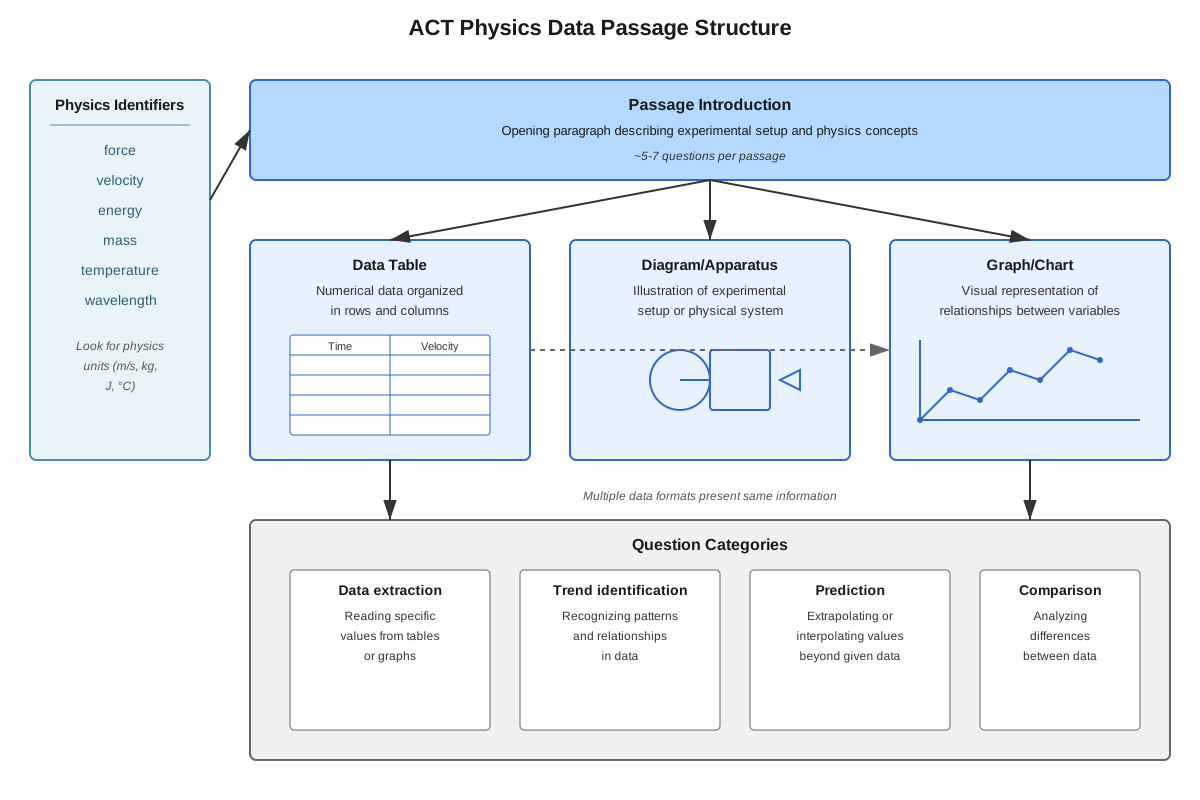
Physics data on the ACT appears in three primary formats: graphs, tables, and diagrams. Each format serves specific purposes and requires distinct interpretation strategies. Graphs excel at showing continuous relationships and trends over time or across conditions. Tables efficiently present precise numerical values for multiple variables across different trials or conditions. Diagrams illustrate experimental setups, force relationships, circuit configurations, or wave properties.
When encountering a physics passage, students should first identify the independent variable (the factor experimentally manipulated) and the dependent variable (the measured outcome). The independent variable typically appears on the x-axis of graphs or in the leftmost column of tables, while dependent variables occupy the y-axis or subsequent table columns. Understanding this relationship immediately clarifies what the experiment tests and what conclusions the data supports.
Graph Interpretation Strategies
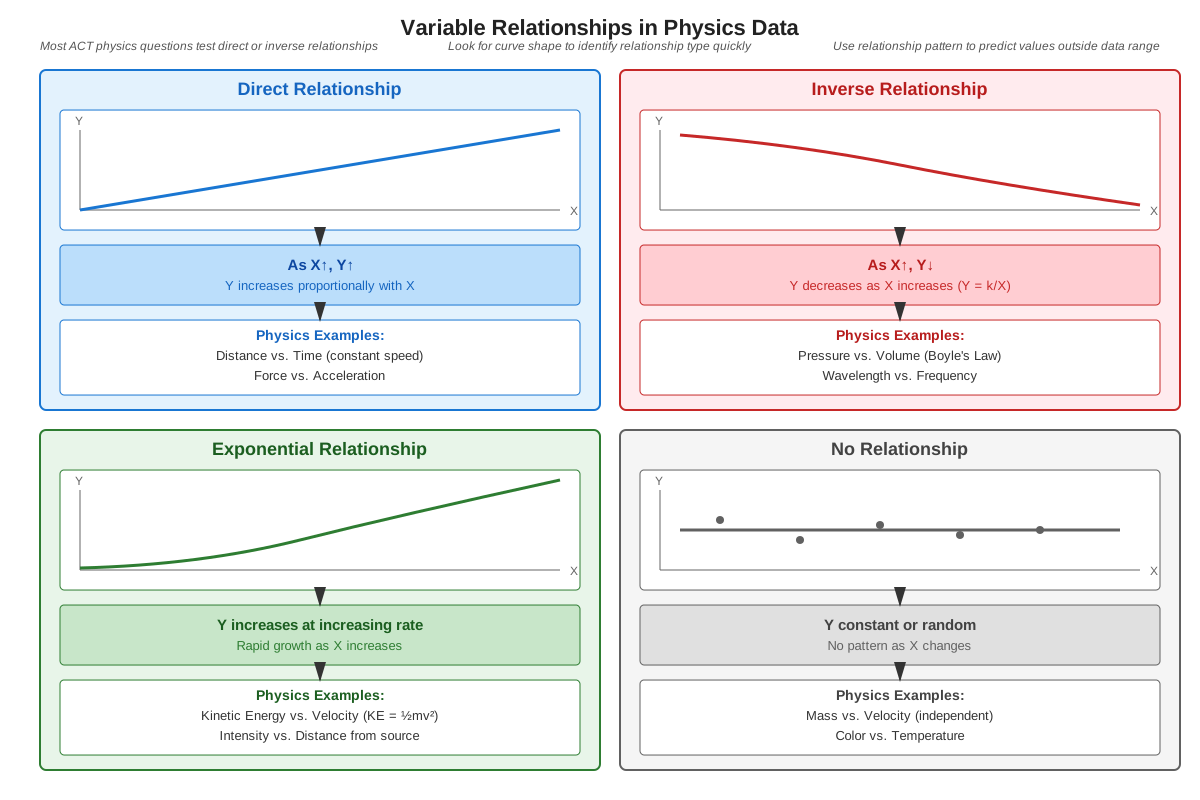
Physics graphs on the ACT follow predictable patterns that students can quickly recognize. Linear relationships appear as straight lines, indicating constant rates of change (such as constant velocity or uniform acceleration). Exponential relationships show curves that increase or decrease at accelerating rates (such as radioactive decay or population growth). Inverse relationships display hyperbolic curves where one variable increases as another decreases (such as pressure-volume relationships in gases).
The slope of a line on a graph carries physical meaning. On a position-time graph, slope represents velocity. On a velocity-time graph, slope represents acceleration. On a force-displacement graph, the area under the curve represents work or energy. Students should practice identifying whether slopes are positive (increasing), negative (decreasing), zero (constant), or undefined (vertical line indicating instantaneous change).
Intercepts also provide valuable information. The y-intercept shows the dependent variable's value when the independent variable equals zero, often representing initial conditions. The x-intercept indicates when the dependent variable reaches zero, which might represent stopping points, equilibrium positions, or threshold values.
Table Analysis Techniques
Physics data tables organize information systematically, allowing precise value comparisons. Effective table analysis requires identifying patterns across rows and columns. Students should look for values that consistently increase, decrease, remain constant, or show more complex patterns. Comparing how multiple dependent variables respond to changes in the independent variable reveals relationships between physical quantities.
When questions ask for specific values, students must carefully match row and column headers to locate correct data points. When questions require comparisons, students should identify the relevant rows or columns and perform mental calculations or estimations rather than precise arithmetic. The ACT rewards efficient approximation over time-consuming exact calculations.
Variable Relationships in Physics
Physics experiments manipulate variables to establish cause-and-effect relationships. Direct relationships occur when both variables increase or decrease together (such as force and acceleration for constant mass). Inverse relationships occur when one variable increases as the other decreases (such as wavelength and frequency for constant wave speed). Independent relationships occur when changing one variable produces no effect on another (such as mass and free-fall acceleration in the absence of air resistance).
Students must distinguish between correlation (variables changing together) and causation (one variable causing changes in another). The ACT frequently tests this distinction by presenting data showing correlated variables and asking whether the data supports causal claims. Proper experimental design with controlled variables enables causal conclusions, while observational data typically supports only correlational claims.
Experimental Design Elements
Physics passages describe experimental procedures that students must understand to interpret data correctly. Control variables remain constant across all trials, ensuring that observed changes result from manipulating the independent variable rather than confounding factors. Multiple trials increase reliability by reducing the impact of random errors or anomalies. Systematic variation of the independent variable across a range of values reveals the full relationship between variables.
Understanding the apparatus and measurement techniques helps students contextualize data. For example, knowing that a motion sensor measures position at regular time intervals explains why position-time data appears as discrete points rather than continuous curves. Recognizing that thermometers have limited precision explains why temperature measurements might round to the nearest degree.
Common Physics Quantities and Units
| Quantity | Symbol | Common Units | Typical Relationships |
|---|---|---|---|
| Position/Distance | d, x, s | meters (m), centimeters (cm) | Changes with velocity and time |
| Time | t | seconds (s), minutes (min) | Independent variable in motion studies |
| Velocity/Speed | v | meters/second (m/s) | Rate of position change |
| Acceleration | a | meters/second² (m/s²) | Rate of velocity change |
| Force | F | newtons (N) | Causes acceleration (F = ma) |
| Mass | m | kilograms (kg), grams (g) | Resistance to acceleration |
| Energy | E | joules (J) | Conserved in isolated systems |
| Power | P | watts (W) | Rate of energy transfer |
| Temperature | T | Celsius (°C), Kelvin (K) | Measure of thermal energy |
| Frequency | f | hertz (Hz) | Wave oscillations per second |
| Wavelength | λ | meters (m), nanometers (nm) | Distance between wave peaks |
Concept Relationships
Physics data interpretation builds upon fundamental graph and table reading skills, extending them to scientific contexts with physical meaning. The ability to identify independent and dependent variables → enables recognition of cause-and-effect relationships → which supports prediction of outcomes under new conditions → ultimately allowing evaluation of hypotheses and theories.
Within physics passages, multiple representations of the same phenomenon reinforce understanding. An experiment might present initial conditions in a diagram → collect measurements in a data table → display trends in a graph → and describe patterns in accompanying text. Students must synthesize information across these representations to answer questions completely.
The relationship between experimental design and data interpretation proves crucial. Understanding why scientists control certain variables → explains why data tables include specific columns → which clarifies what comparisons the data supports → and determines what conclusions remain valid versus speculative.
Physics data skills transfer directly to chemistry and biology passages. The same graph interpretation techniques apply whether analyzing motion, chemical reaction rates, or population growth. The same table analysis strategies work for physics measurements, chemical concentrations, or biological counts. Mastering physics data interpretation therefore accelerates performance across all ACT Science content areas.
High-Yield Facts
- ⭐ Physics passages appear in 2-3 of the 6-7 total ACT Science passages, representing approximately 30-40% of science questions
- ⭐ The ACT never requires memorized physics formulas; all necessary information appears in the passage
- ⭐ Independent variables typically appear on the x-axis of graphs or in the leftmost column of tables
- ⭐ Direct relationships show both variables increasing or decreasing together; inverse relationships show opposite trends
- ⭐ Extrapolation questions ask students to extend established trends beyond the given data range
- On position-time graphs, slope represents velocity; on velocity-time graphs, slope represents acceleration
- Steeper slopes on graphs indicate faster rates of change for the dependent variable
- Horizontal lines on graphs indicate the dependent variable remains constant despite changes in the independent variable
- When multiple lines appear on a single graph, the legend identifies what distinguishes each line (different masses, temperatures, materials, etc.)
- Data points that deviate significantly from established patterns likely represent experimental errors or anomalies
- Questions asking "according to the data" or "based on the results" require answers directly supported by presented information without additional assumptions
- Comparing two experimental conditions requires identifying what variable changed between them and what effect that change produced
- The area under a curve on certain physics graphs represents accumulated quantities (work, displacement, charge)
- Units provide crucial context for interpreting numerical values and comparing quantities
- Control variables remain constant across all trials to isolate the effect of the independent variable
Quick check — test yourself on Physics data so far.
Try Flashcards →Common Misconceptions
Misconception: Physics passages require memorizing and applying complex formulas like F = ma or E = mc².
Correction: The ACT Science test assesses data interpretation, not formula application. All necessary information appears in the passage, and questions focus on reading graphs, comparing values, and identifying trends rather than performing calculations.
Misconception: Every data point must fit perfectly on a trend line or curve for the relationship to be valid.
Correction: Real experimental data includes natural variation and measurement uncertainty. The ACT expects students to recognize overall trends despite minor deviations. A few outlier points do not invalidate a clear general pattern.
Misconception: Correlation between two variables proves that one causes the other.
Correction: Variables can correlate without causal relationships. Proper experimental design with controlled variables and systematic manipulation of the independent variable is necessary to establish causation. The ACT frequently tests this distinction.
Misconception: Extrapolating trends requires complex mathematical calculations.
Correction: ACT extrapolation questions typically require simple pattern recognition. If a variable increases by 5 units for each 1-unit increase in another variable, that pattern continues beyond the given data range. Visual estimation from graph trends usually suffices.
Misconception: Physics passages require extensive background knowledge in mechanics, electricity, thermodynamics, and optics.
Correction: While familiarity with basic physics concepts helps, the ACT provides all necessary context within passages. Students can answer questions correctly by carefully reading the passage and analyzing presented data, even without prior physics coursework.
Misconception: Tables and graphs present different information that must be reconciled.
Correction: Tables and graphs in the same passage typically present the same data in different formats. Students should use whichever format makes answering a specific question easier—tables for precise values, graphs for trends and comparisons.
Misconception: Longer, more complex passages with multiple experiments are inherently more difficult.
Correction: Passage length and complexity do not directly correlate with question difficulty. Longer passages often provide more context and multiple data representations that actually make questions easier to answer. Students should focus on understanding what each experiment tests rather than being intimidated by passage length.
Worked Examples
Example 1: Motion Graph Analysis
Passage Context: Students conducted an experiment to study the motion of a battery-powered toy car on a level track. They used a motion sensor to record the car's position at 1-second intervals for 10 seconds. The graph below shows position (in meters) versus time (in seconds).
[Graph description: The graph shows position on the y-axis (0-20 meters) and time on the x-axis (0-10 seconds). The line starts at the origin and increases linearly to approximately 15 meters at 5 seconds, then remains horizontal at 15 meters from 5 to 10 seconds.]
Question: Based on the graph, during which time interval was the car's velocity greatest?
Solution Process:
- Identify what the question asks: The question asks about velocity, which represents the rate of position change over time.
- Recall the graph interpretation rule: On a position-time graph, velocity equals the slope of the line. Steeper slopes indicate greater velocities.
- Analyze the graph sections:
- From 0 to 5 seconds: The line slopes upward, indicating positive velocity (the car moves forward)
- From 5 to 10 seconds: The line is horizontal (zero slope), indicating zero velocity (the car stopped)
- Compare slopes: The only non-zero slope occurs from 0 to 5 seconds. During this interval, the slope remains constant (straight line), so velocity remains constant.
- Answer: The car's velocity was greatest (and constant) during the interval from 0 to 5 seconds. After 5 seconds, the velocity became zero.
Connection to Learning Objectives: This example demonstrates identifying when physics data is being tested (motion graphs), applying the core strategy (slope equals velocity on position-time graphs), and accurately answering ACT-style questions through systematic analysis.
Example 2: Energy Transformation Table Analysis
Passage Context: Students investigated how the height from which a ball is dropped affects its rebound height. They dropped a rubber ball from various initial heights and measured how high it bounced. The table below shows their results.
| Initial Drop Height (cm) | Rebound Height (cm) | Energy Lost (%) |
|---|---|---|
| 20 | 15 | 25 |
| 40 | 30 | 25 |
| 60 | 45 | 25 |
| 80 | 60 | 25 |
| 100 | 75 | 25 |
Question 1: If the students dropped the ball from 120 cm, what would be the most likely rebound height?
Solution Process:
- Identify the pattern: Looking at the table, rebound height consistently equals 75% of the initial drop height (or equivalently, 25% of energy is lost each time).
- Recognize the relationship type: This is a direct proportional relationship—as initial height increases, rebound height increases proportionally.
- Calculate the pattern: Rebound height = Initial height × 0.75
- Apply to new condition: 120 cm × 0.75 = 90 cm
- Answer: The most likely rebound height would be 90 cm.
Question 2: Based on the data, which statement is best supported?
A) The ball loses the same amount of energy regardless of drop height
B) The ball loses the same percentage of energy regardless of drop height
C) Higher drops result in greater percentage energy loss
D) Lower drops result in greater percentage energy loss
Solution Process:
- Examine the "Energy Lost (%)" column: Every trial shows 25% energy loss.
- Evaluate each option:
- Option A: False—higher drops lose more absolute energy (but the same percentage)
- Option B: True—the percentage remains constant at 25%
- Option C: False—the percentage stays constant, not increasing
- Option D: False—the percentage stays constant, not decreasing
- Answer: B is correct.
Connection to Learning Objectives: This example demonstrates extracting quantitative information from tables, recognizing relationships between variables, predicting trends through extrapolation, and comparing experimental conditions to identify patterns.
Exam Strategy
Approaching Physics Passages Efficiently
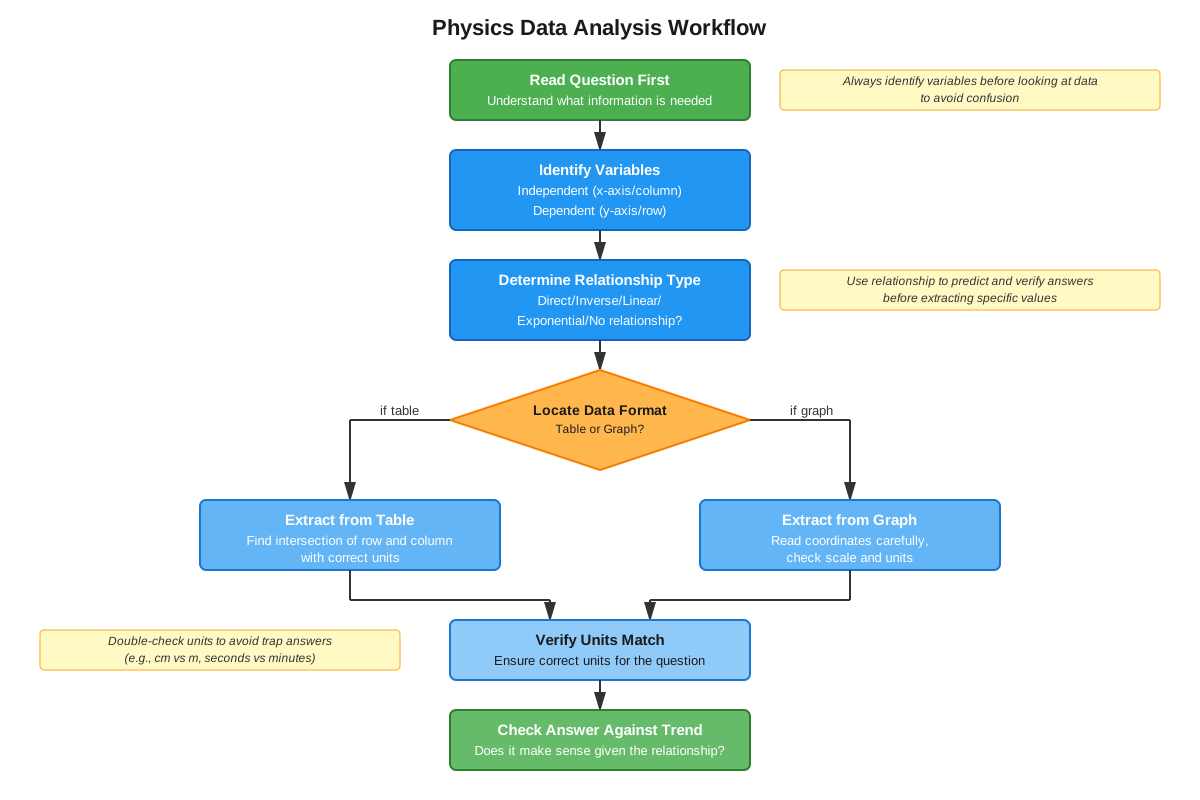
When encountering a physics passage, invest 30-45 seconds in strategic preview before attempting questions. First, read the introductory paragraph to understand the experimental purpose and context. Second, identify all data presentations (graphs, tables, diagrams) and note what variables each displays. Third, scan for any unusual features like multiple experimental conditions, control groups, or repeated trials. This preview creates a mental map that accelerates question answering.
Trigger Words and Phrases
Certain question stems signal specific strategies:
- "According to the graph/table/figure": The answer must come directly from the data presentation without additional reasoning or outside knowledge
- "Based on the results": Synthesize information from multiple data sources within the passage
- "If the experiment were repeated with [new condition]": Extrapolate established patterns to predict outcomes
- "Which variable was controlled": Identify factors held constant across all trials
- "The data supports which conclusion": Eliminate options that contradict presented data or require unsupported assumptions
Process of Elimination Techniques
Physics questions often include options that misread graphs, confuse variables, or reverse relationships. Eliminate options that:
- Claim trends opposite to what graphs or tables show (increasing vs. decreasing)
- Confuse independent and dependent variables
- State relationships not supported by the data (causation when only correlation exists)
- Require information not provided in the passage
- Contradict basic physical principles (energy appearing from nowhere, objects accelerating without forces)
Time Allocation Guidance
Physics passages typically require 5-6 minutes total (including reading and answering all questions). Allocate approximately:
- 45 seconds: Initial passage preview and data presentation identification
- 30-45 seconds per question: Reading, analyzing, and selecting answers
- 15-30 seconds: Final review of marked questions if time permits
Questions asking for specific values from tables or graphs should take less time (20-30 seconds) than questions requiring synthesis across multiple data sources or extrapolation (45-60 seconds). If a question requires more than 60 seconds, mark it and return after completing easier questions.
Efficient Graph Reading
Rather than studying every detail of a graph before reading questions, use a targeted approach: read the question first, identify what information it requires, then locate that specific information on the graph. This prevents wasting time analyzing irrelevant graph features. However, always check axis labels, units, and scales before extracting values to avoid misreading data.
Memory Techniques
The VATS Mnemonic for Graph Analysis
Variables: Identify independent (x-axis) and dependent (y-axis) variables
Axes: Check labels, units, and scales before reading values
Trends: Determine if relationships are increasing, decreasing, constant, or complex
Slope: Remember that slope carries physical meaning (velocity, acceleration, rate)
The TABLE Strategy for Data Tables
Titles: Read column and row headers to understand what each position represents
Alignment: Match question requirements to specific rows and columns
Baseline: Identify control conditions or initial values for comparison
Lookup: Locate specific values by carefully tracing rows and columns
Extrapolate: Extend patterns beyond given data when questions require prediction
Relationship Recognition Rhyme
"When both go up or both go down, a direct relationship is found.
When one goes up and one goes down, an inverse relationship is around.
When one stays flat while the other varies, no relationship the data carries."
The DICE Framework for Experimental Design
Dependent variable: What is measured (the outcome)
Independent variable: What is changed (the manipulation)
Control variables: What stays the same (held constant)
Experimental trials: How many times each condition is tested (repetition)
Summary
Physics data interpretation represents a high-yield ACT Science skill that appears in approximately 30-40% of science passages. Success requires efficiently extracting information from graphs, tables, and diagrams rather than memorizing formulas or performing complex calculations. Students must identify independent and dependent variables, recognize direct and inverse relationships, compare experimental conditions, and extrapolate trends beyond given data ranges. The ACT tests data literacy—the ability to read visual and tabular information, identify patterns, and draw logical conclusions—rather than physics content knowledge. Effective strategies include previewing passages to create mental maps, using trigger words to select appropriate approaches, eliminating options that contradict data or require unsupported assumptions, and allocating time efficiently based on question complexity. Mastering physics data interpretation not only improves ACT Science scores but also develops critical thinking skills applicable across all scientific disciplines and real-world problem-solving contexts.
Key Takeaways
- Physics data passages test interpretation skills, not formula memorization or complex calculations
- Independent variables (manipulated factors) typically appear on x-axes or in leftmost table columns; dependent variables (measured outcomes) appear on y-axes or subsequent columns
- Graph slopes carry physical meaning: on position-time graphs, slope equals velocity; on velocity-time graphs, slope equals acceleration
- Direct relationships show variables changing together in the same direction; inverse relationships show variables changing in opposite directions
- Extrapolation questions require extending established patterns beyond given data ranges using simple pattern recognition
- The ACT provides all necessary information within passages; correct answers come from careful data analysis rather than outside knowledge
- Efficient time management involves previewing passages strategically, targeting specific data for each question, and using estimation rather than precise calculation
Related Topics
Chemistry Data Interpretation: Builds on the same graph and table analysis skills developed through physics data, applying them to chemical reactions, concentration changes, and molecular properties. Mastering physics data interpretation accelerates chemistry passage performance.
Biology Data Analysis: Extends data interpretation to living systems, population studies, and ecological relationships. The pattern recognition and variable identification skills from physics data transfer directly to biological contexts.
Research Summaries Passages: Integrate physics data with experimental design analysis, requiring students to evaluate procedures, identify controls, and assess validity. Physics data mastery provides the foundation for understanding more complex multi-experiment passages.
Conflicting Viewpoints Passages: Occasionally include physics data supporting different scientific hypotheses or theories. The ability to extract relevant information from data presentations helps students evaluate competing claims.
Quantitative Reasoning in Mathematics: The estimation, proportional reasoning, and pattern recognition skills developed through physics data interpretation enhance performance on ACT Math questions involving data analysis and problem-solving.
Practice CTA
Now that you understand the core concepts and strategies for physics data interpretation, it's time to apply these skills to authentic ACT-style questions. The practice questions and flashcards will reinforce your ability to quickly identify variables, recognize relationships, extract information from graphs and tables, and select correct answers efficiently. Each practice attempt strengthens your pattern recognition and builds the confidence needed to approach physics passages systematically on test day. Remember: physics data interpretation is a learnable skill that improves dramatically with focused practice. Your investment in mastering these techniques will pay dividends not only on the ACT Science section but also in developing critical thinking abilities valuable throughout your academic and professional career.
Sign up free to keep reading
Create a free AnvayaPrep account to finish this ACT guide on Physics data — plus flashcards and practice questions.