Overview
Earth science data represents one of the most frequently tested content areas within the ACT Science section, appearing in approximately 20-30% of all science passages. Unlike other standardized tests that may focus heavily on memorized facts, the ACT earth science data questions primarily assess a student's ability to interpret graphs, tables, and experimental results related to geological processes, atmospheric phenomena, oceanography, and environmental systems. Success on these questions depends less on extensive background knowledge and more on the ability to extract, analyze, and synthesize information from visual representations of scientific data.
The ACT Science section presents earth science content through Research Summaries and Data Representation passages that feature real-world scenarios such as climate patterns, rock formation sequences, water cycle dynamics, seismic activity, and planetary comparisons. Students must quickly identify relevant data points, recognize trends across multiple variables, and draw logical conclusions based on presented evidence. This skill set extends beyond earth science itself—the data interpretation strategies learned here apply equally to biology, chemistry, and physics passages, making earth science data literacy a foundational competency for achieving high scores across the entire Science section.
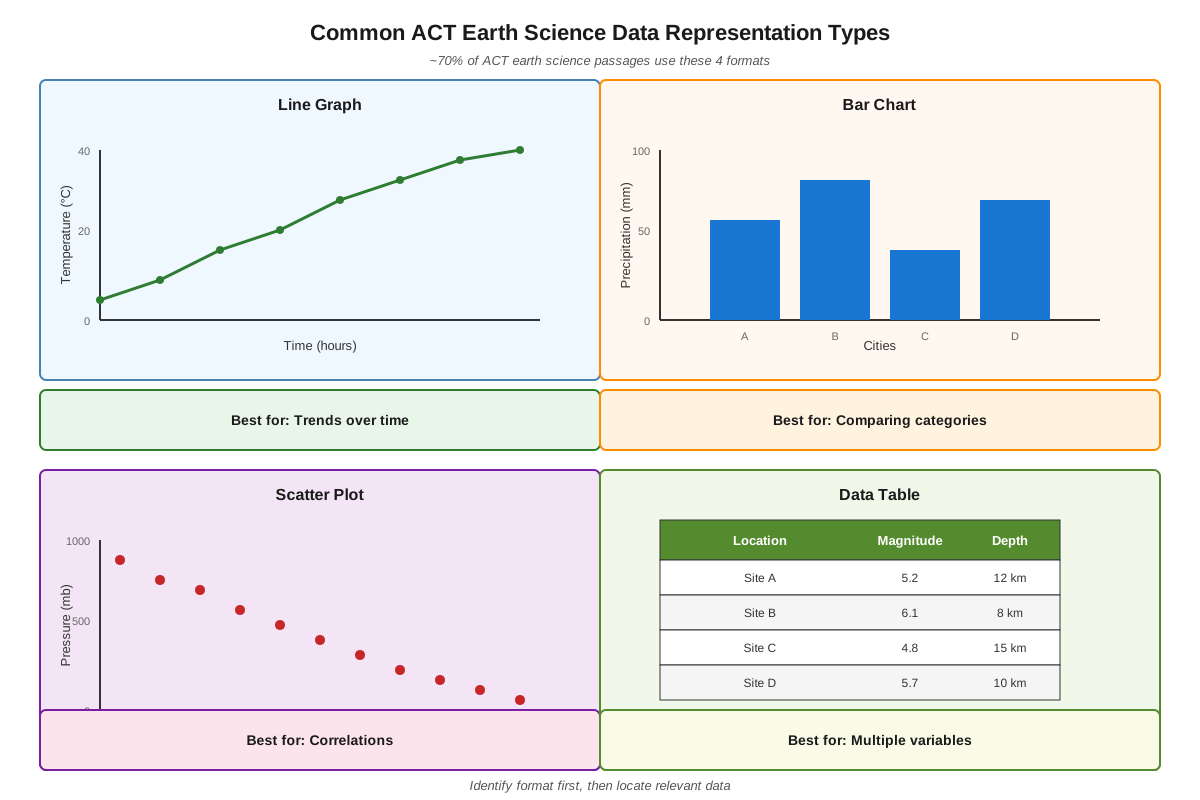
Understanding how to approach earth science data passages strategically transforms them from intimidating walls of information into straightforward point-earning opportunities. The ACT consistently uses specific formats for presenting earth science information: line graphs showing changes over time, bar charts comparing different locations or conditions, scatter plots revealing correlations between variables, and data tables organizing multiple measurements. Recognizing these patterns and developing a systematic approach to extracting information allows students to answer questions efficiently and accurately, often without requiring extensive prior knowledge of earth science concepts.
Learning Objectives
- [ ] Identify when Earth science data is being tested in ACT Science passages
- [ ] Explain the core rule or strategy behind interpreting Earth science data effectively
- [ ] Apply Earth science data interpretation skills to ACT-style questions accurately
- [ ] Distinguish between different types of data representations commonly used in earth science passages (graphs, tables, diagrams)
- [ ] Synthesize information from multiple data sources within a single passage to answer complex questions
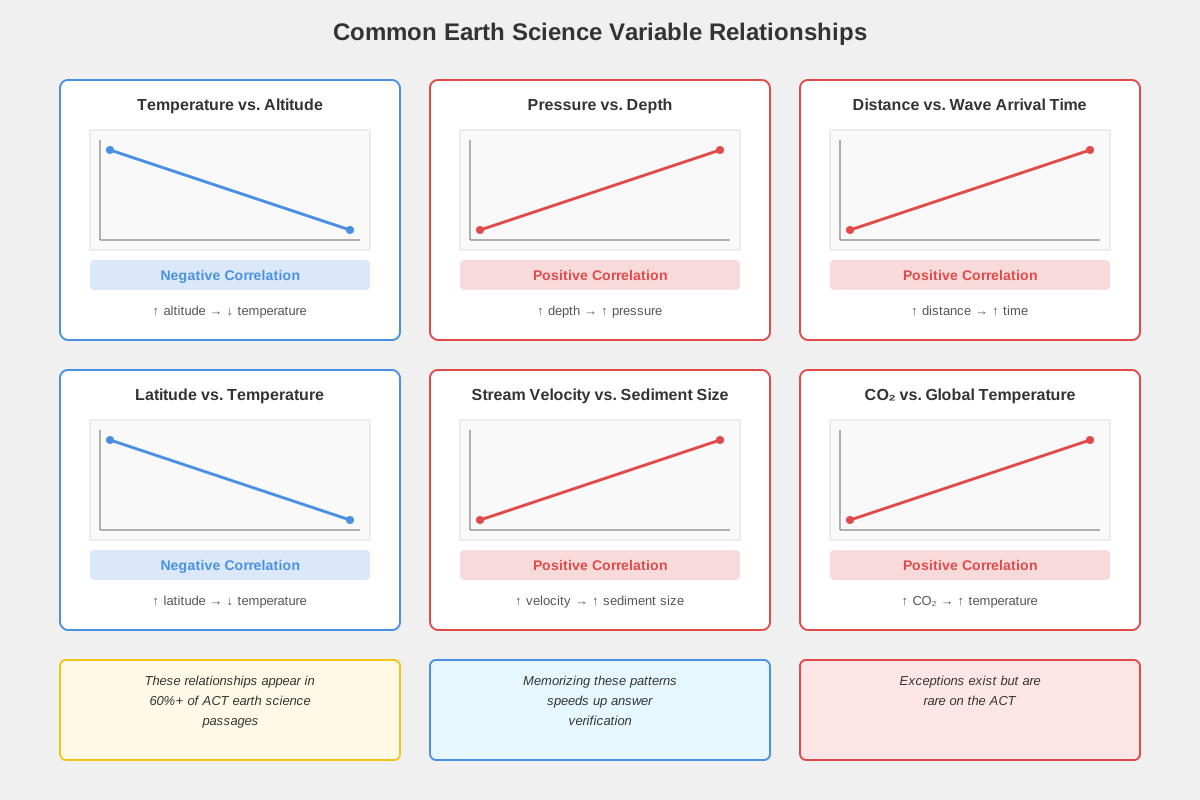
- [ ] Recognize common earth science variables and their typical relationships (temperature vs. altitude, pressure vs. depth, etc.)
- [ ] Evaluate conflicting hypotheses or viewpoints using earth science data as evidence
Prerequisites
- Basic graph reading skills: Understanding x-axis, y-axis, scales, and how to locate specific data points is essential for extracting information from visual representations
- Familiarity with scientific units: Recognizing common measurements (meters, degrees Celsius, millibars, etc.) helps students quickly interpret data without confusion
- Understanding of variables: Distinguishing between independent and dependent variables enables students to identify cause-and-effect relationships in experimental data
- Basic mathematical operations: Simple calculations like finding differences, averages, or rates of change appear frequently in data interpretation questions
- Scientific method fundamentals: Knowing how experiments are structured helps students understand the purpose and design of research summaries
Why This Topic Matters
Earth science data interpretation skills extend far beyond standardized testing into numerous real-world applications. Meteorologists analyze atmospheric data to predict weather patterns and issue severe storm warnings. Geologists examine seismic data to assess earthquake risks and locate natural resources. Environmental scientists track pollution levels, ocean temperatures, and ice sheet measurements to understand climate change impacts. Urban planners use topographic data to design infrastructure, while agricultural specialists interpret soil composition data to optimize crop yields. The ability to extract meaningful insights from complex earth science datasets represents a critical 21st-century literacy skill applicable across scientific, technical, and policy-making careers.
On the ACT specifically, earth science data passages appear with remarkable consistency. Statistical analysis of recent ACT Science sections reveals that approximately 2-3 passages per test feature earth science content, accounting for 10-15 questions out of the 40 total. These passages typically fall into two categories: Data Representation passages (3-5 questions each) that present graphs and tables without extensive experimental procedures, and Research Summaries (6 questions each) that describe studies investigating earth science phenomena. The question types range from straightforward data extraction ("According to Figure 1, what was the temperature at 500 meters depth?") to complex synthesis questions requiring students to combine information from multiple sources or extend trends beyond the given data range.
Common manifestations of earth science data on the ACT include: atmospheric pressure changes with altitude, temperature variations across different latitudes or seasons, rock layer sequences and fossil distributions, ocean current patterns and salinity gradients, solar radiation intensity at various angles, groundwater flow rates through different soil types, volcanic gas compositions, planetary atmosphere comparisons, and erosion rates under different conditions. Recognizing these recurring themes allows students to anticipate the types of relationships they'll encounter and approach passages with greater confidence.
Core Concepts
Types of Earth Science Data Representations
The ACT presents earth science information through several standardized formats, each requiring specific interpretation strategies. Line graphs most commonly display continuous changes over time or distance, such as temperature fluctuations throughout a day or seismic wave velocity at increasing depths. These graphs typically feature time or distance on the x-axis and the measured variable on the y-axis. Students must identify trends (increasing, decreasing, constant), locate specific values, and often extrapolate beyond the given data range.
Bar charts compare discrete categories or locations, such as annual rainfall across different cities or mineral compositions in various rock samples. Unlike line graphs, bar charts represent distinct, separate measurements rather than continuous data. Questions often ask students to rank categories, calculate differences between bars, or identify the category with the highest or lowest value.
Scatter plots reveal relationships between two variables, such as the correlation between elevation and average temperature or the relationship between earthquake magnitude and frequency. The pattern of data points indicates whether variables are positively correlated (both increase together), negatively correlated (one increases as the other decreases), or uncorrelated (no clear pattern). ACT questions frequently ask students to describe these relationships or predict values for new data points.
Data tables organize multiple measurements systematically, often presenting several variables measured under different conditions. Earth science tables might show temperature, pressure, and humidity readings at various altitudes, or chemical compositions of different rock types. Effective table interpretation requires identifying row and column headers, understanding units, and locating specific values efficiently.
Common Earth Science Variables and Relationships
Understanding typical earth science relationships accelerates data interpretation significantly. Temperature and altitude demonstrate an inverse relationship in the troposphere—as altitude increases, temperature generally decreases at approximately 6.5°C per kilometer. However, students must remain flexible, as the ACT may present data showing temperature inversions or stratospheric warming patterns.
Pressure and depth exhibit a direct relationship in both atmospheric and oceanic contexts. Atmospheric pressure decreases with increasing altitude, while water pressure increases with depth. The ACT frequently tests whether students can identify this relationship from graphical data and apply it to answer questions about conditions at different elevations or depths.
Latitude and solar radiation connect through the angle of incoming sunlight. Equatorial regions receive more direct solar radiation than polar regions, resulting in higher temperatures and different climate patterns. Data passages may present graphs showing temperature, precipitation, or vegetation patterns across different latitudes, requiring students to recognize these fundamental relationships.
Time and cyclic patterns appear in data showing daily temperature fluctuations, seasonal changes, tidal patterns, or long-term climate cycles. Students must identify periodic patterns, predict future values based on established cycles, and recognize anomalies that deviate from expected patterns.
Data Extraction Strategies
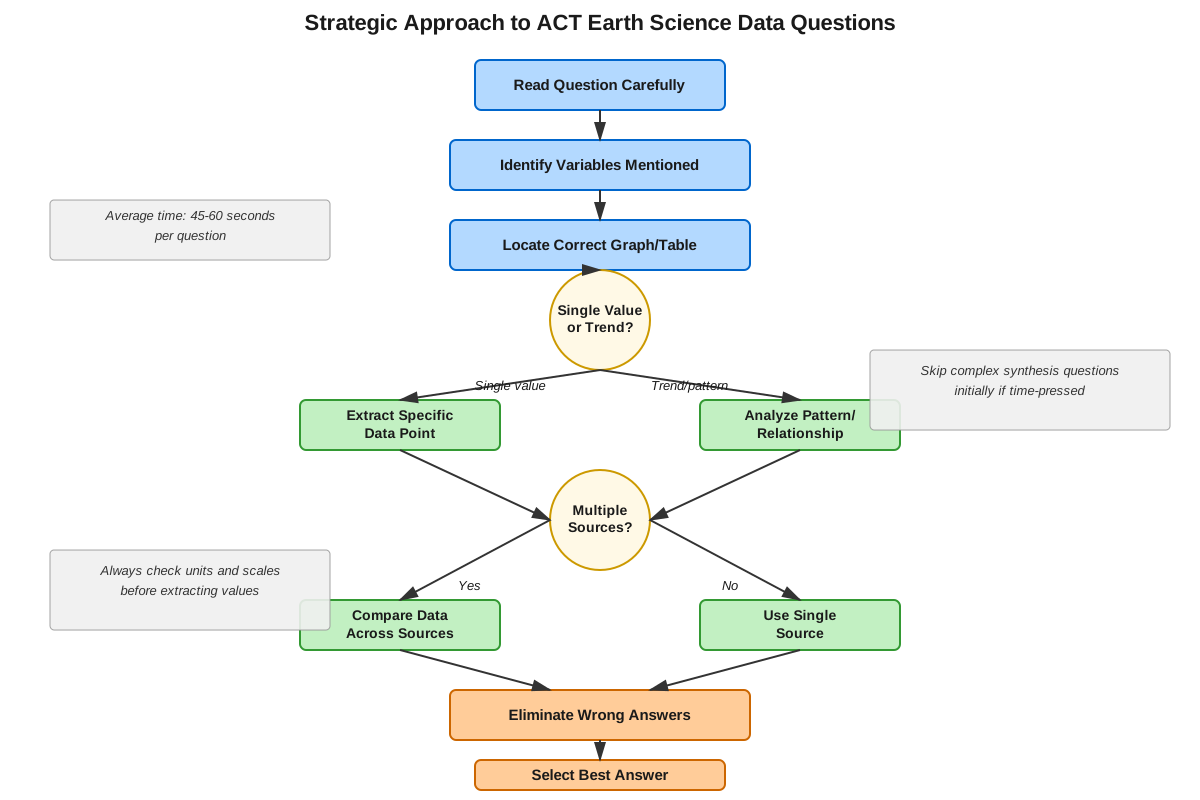
Efficient data extraction begins with understanding what the question asks before examining the data. The ACT deliberately includes extraneous information to test whether students can focus on relevant data. When a question references "Figure 2," students should immediately locate Figure 2, identify the relevant axes or columns, and extract only the necessary information.
Direct reading questions require locating a specific value from a graph or table. The strategy involves: (1) identifying the independent variable value given in the question, (2) locating that value on the appropriate axis or in the table, (3) tracing to find the corresponding dependent variable value, and (4) checking units to ensure the answer matches the question format.
Trend identification questions ask students to describe patterns such as "As X increases, Y..." The approach requires examining the overall pattern rather than individual data points. Students should look at the general direction of a line graph, the progression of bar heights, or the pattern of scatter plot points to determine whether the relationship is positive, negative, constant, or more complex.
Interpolation and extrapolation questions require estimating values between given data points (interpolation) or beyond the data range (extrapolation). For interpolation, students should identify the two surrounding data points and estimate a value between them. For extrapolation, students must extend the established trend, though they should note that extrapolation involves greater uncertainty.
Synthesis and Comparison Skills
Advanced ACT earth science questions require combining information from multiple sources. A passage might present temperature data in Figure 1, precipitation data in Figure 2, and vegetation types in Table 1, then ask which location has specific combined characteristics. The systematic approach involves: (1) identifying all relevant data sources mentioned in the question, (2) extracting information from each source separately, (3) comparing or combining the information according to the question's requirements, and (4) eliminating answer choices that contradict any data source.
Conflicting viewpoints passages present different scientists' hypotheses about earth science phenomena, supported by the same dataset. Students must evaluate which hypothesis the data supports, identify predictions that would differ between hypotheses, or determine what additional data would help distinguish between competing explanations. Success requires carefully reading each viewpoint, identifying the specific claims each scientist makes, and matching those claims against the presented data.
Units and Scale Awareness
Earth science data spans enormous ranges—from nanometers in mineral crystal structures to thousands of kilometers in atmospheric circulation patterns. The ACT tests whether students notice units and scales. A common trap involves presenting graphs with unusual scales (logarithmic scales, reversed axes, or non-zero baselines) to see if students interpret data accurately despite these variations.
Students must develop the habit of checking: (1) axis labels and units, (2) scale increments (is each line 1 unit, 10 units, or 100 units?), (3) whether scales are linear or logarithmic, and (4) whether axes start at zero or another value. Many incorrect answer choices exploit students who extract numbers without considering scale.
Concept Relationships
The core concepts within earth science data interpretation form an interconnected system where mastery of one skill enhances others. Data representation recognition (identifying graph types) → enables → appropriate extraction strategies (knowing how to read each format) → which supports → trend identification (recognizing patterns) → leading to → synthesis skills (combining multiple data sources) → culminating in → hypothesis evaluation (using data as evidence for competing explanations).
Understanding common earth science relationships (temperature-altitude, pressure-depth) connects directly to trend identification skills because recognizing expected patterns helps students quickly interpret unfamiliar graphs. When students know that atmospheric pressure typically decreases with altitude, they can rapidly verify whether a graph shows this expected relationship or presents an anomaly requiring explanation.
Units and scale awareness underlies all other skills—without correctly interpreting scales and units, even perfect graph-reading technique yields incorrect answers. This foundational skill connects to data extraction (ensuring extracted values are accurate) and synthesis (confirming that combined data uses compatible units).
The relationship to prerequisite knowledge flows naturally: basic graph reading skills → provide the foundation for → earth science-specific data interpretation, while understanding variables → enables → recognizing cause-and-effect relationships in earth science contexts. The scientific method fundamentals prerequisite connects to hypothesis evaluation skills, as students apply their understanding of how scientists test ideas to assess competing viewpoints passages.
High-Yield Facts
⭐ Earth science passages appear in 2-3 passages per ACT Science test, accounting for approximately 10-15 questions
⭐ The ACT tests data interpretation skills, not memorized earth science facts—students can answer most questions using only the provided information
⭐ Temperature generally decreases with altitude in the troposphere at approximately 6.5°C per kilometer
⭐ Atmospheric pressure decreases with increasing altitude; water pressure increases with increasing depth
⭐ Direct reading questions (finding specific values) are the most common earth science data question type
- Line graphs typically show continuous changes over time or distance, while bar charts compare discrete categories
- Scatter plots reveal correlations: positive (both variables increase together), negative (inverse relationship), or no correlation
- Interpolation (estimating between data points) is more reliable than extrapolation (extending beyond the data range)
- The ACT frequently uses non-zero baselines on graphs to test whether students notice scale details
- Equatorial regions receive more direct solar radiation than polar regions due to the angle of incoming sunlight
- Synthesis questions requiring information from multiple figures are typically worth more time investment due to higher difficulty
- Conflicting viewpoints passages always provide data that students must use to evaluate competing hypotheses
- Units matter—the ACT includes answer choices with correct numbers but wrong units to catch careless readers
Quick check — test yourself on Earth science data so far.
Try Flashcards →Common Misconceptions
Misconception: Earth science data questions require extensive memorization of geological facts, atmospheric layers, and rock types. → Correction: The ACT Science section tests data interpretation skills, not content knowledge. Nearly all information needed to answer questions appears in the passage, graphs, or tables. While recognizing common relationships (like temperature decreasing with altitude) helps with speed, students can answer questions correctly by carefully extracting information from the provided data.
Misconception: All line graphs show time on the x-axis. → Correction: While many earth science graphs plot changes over time, the x-axis frequently represents distance (depth, altitude, latitude) or other independent variables. Students must read axis labels carefully rather than assuming time is always the independent variable. A graph might show temperature versus depth, pressure versus altitude, or mineral composition versus distance from a volcanic vent.
Misconception: When a question asks about a trend, students should focus on individual data points and their specific values. → Correction: Trend questions require identifying the overall pattern rather than specific values. Students should look at the general direction and shape of the entire line or the progression across all bars, not get distracted by minor fluctuations between adjacent points. The ACT wants students to describe whether variables increase together, move inversely, remain constant, or show more complex relationships.
Misconception: Extrapolating far beyond the given data range is just as reliable as interpolating between data points. → Correction: Extrapolation involves greater uncertainty because trends may change outside the measured range. While the ACT sometimes asks students to extend trends slightly beyond the data, answer choices that require extreme extrapolation are often incorrect. When extrapolating, students should extend the established trend conservatively and be cautious about predictions far outside the measured range.
Misconception: If a passage presents data about an unfamiliar earth science topic, students cannot answer the questions without prior knowledge of that topic. → Correction: The ACT deliberately includes passages on obscure topics (unusual minerals, specific geological formations, or rare atmospheric phenomena) to test pure data interpretation skills. Students should focus on the data relationships shown in graphs and tables rather than worrying about unfamiliar terminology. The passage provides all necessary context, and questions can be answered using only the presented information.
Misconception: All earth science data shows smooth, predictable patterns. → Correction: Real-world data often includes variability, outliers, and complex patterns. The ACT may present data with fluctuations, multiple peaks and valleys, or non-linear relationships. Students should describe the data as presented rather than forcing it into expected patterns. If a graph shows temperature increasing with altitude in a particular layer, students should report that observation even if it contradicts the typical tropospheric pattern.
Worked Examples
Example 1: Multi-Source Data Synthesis
Passage Context: A study examined three locations at different latitudes. Figure 1 shows average annual temperature for each location. Table 1 shows annual precipitation and elevation for each location.
Figure 1: Bar chart showing Location A: 25°C, Location B: 15°C, Location C: 5°C
Table 1:
| Location | Latitude | Elevation (m) | Annual Precipitation (cm) |
|---|---|---|---|
| A | 10°N | 50 | 180 |
| B | 35°N | 200 | 90 |
| C | 55°N | 100 | 60 |
Question: Which location has the highest temperature and the lowest precipitation?
Solution Process:
Step 1: Identify what the question asks—we need to find one location that satisfies TWO conditions: highest temperature AND lowest precipitation.
Step 2: Extract temperature data from Figure 1. Location A has the highest temperature at 25°C.
Step 3: Extract precipitation data from Table 1. Location C has the lowest precipitation at 60 cm.
Step 4: Check if any single location satisfies both conditions. Location A has the highest temperature but not the lowest precipitation (180 cm). Location C has the lowest precipitation but not the highest temperature (5°C).
Step 5: Recognize that no location satisfies both conditions—this is likely a trap. Re-read the question carefully. If the question uses "and," both conditions must be met by the same location. If no location meets both criteria, the answer might be "Cannot be determined" or the question might be asking something slightly different.
Key Learning Point: This example demonstrates why reading questions precisely matters. Many students rush and select Location A (highest temperature) without verifying it also has the lowest precipitation. The ACT frequently includes questions where no option satisfies all stated conditions, testing whether students verify all criteria before selecting an answer.
Example 2: Trend Identification with Extrapolation
Passage Context: Scientists measured atmospheric pressure at various altitudes.
Figure 2: Line graph showing pressure (millibars) on y-axis versus altitude (km) on x-axis. Data points: 0 km = 1000 mb, 2 km = 800 mb, 4 km = 600 mb, 6 km = 450 mb, 8 km = 350 mb.
Question: Based on the trend in Figure 2, the atmospheric pressure at 10 km would most likely be:
A) 500 mb
B) 300 mb
C) 250 mb
D) 100 mb
Solution Process:
Step 1: Identify the question type—this asks for extrapolation beyond the measured range (data goes to 8 km, question asks about 10 km).
Step 2: Examine the overall trend. As altitude increases, pressure decreases. This is a negative correlation.
Step 3: Analyze whether the decrease is linear or non-linear. Calculate the pressure change between intervals:
- 0 to 2 km: decrease of 200 mb
- 2 to 4 km: decrease of 200 mb
- 4 to 6 km: decrease of 150 mb
- 6 to 8 km: decrease of 100 mb
Step 4: Recognize the pattern—the rate of decrease is slowing (200, 200, 150, 100). This is a non-linear, decelerating decrease.
Step 5: Extrapolate conservatively. From 8 to 10 km (another 2 km interval), the decrease should be less than 100 mb (continuing the decelerating pattern). Starting from 350 mb at 8 km and decreasing by approximately 50-100 mb gives a range of 250-300 mb.
Step 6: Evaluate answer choices. Choice C (250 mb) fits the extrapolated trend best. Choice B (300 mb) would represent a decrease of only 50 mb, which is possible but represents the minimum. Choice A (500 mb) would require pressure to increase, contradicting the trend. Choice D (100 mb) requires too large a decrease.
Answer: C) 250 mb
Key Learning Point: This example illustrates the importance of analyzing the rate of change, not just the direction. Students who notice only that "pressure decreases with altitude" might incorrectly extrapolate linearly. Recognizing that the rate of decrease is slowing leads to more accurate extrapolation and demonstrates sophisticated data interpretation skills.
Exam Strategy
Approaching ACT earth science data passages strategically maximizes both accuracy and efficiency. Begin by quickly scanning the passage to identify the number and types of data representations (graphs, tables, diagrams). This 10-15 second preview helps students understand the passage structure before diving into questions. Note whether the passage is a Data Representation (typically 5 questions, more straightforward) or Research Summary (typically 6 questions, may include experimental design questions).
Trigger words signal specific question types and appropriate strategies. When questions include "According to Figure X" or "Based on Table Y," students should go directly to that data source without re-reading the entire passage. Words like "trend," "pattern," or "relationship" indicate the question asks about overall behavior rather than specific values. Phrases such as "most likely" or "probably" suggest extrapolation or inference questions requiring students to extend beyond the given data. "Compared to" or "difference between" signal comparison questions requiring extraction from multiple data points.
Process of elimination proves particularly powerful for earth science data questions. After extracting relevant data, students should eliminate answer choices that directly contradict the data before selecting a final answer. For trend questions, eliminate choices describing the opposite relationship (if temperature increases with depth, eliminate any choice saying it decreases). For numerical questions, eliminate choices with wrong units or values outside the possible range. For synthesis questions, eliminate any choice that contradicts even one of the multiple data sources.
Time allocation should prioritize direct reading questions over complex synthesis questions. A typical earth science passage deserves 5-6 minutes total. Students should aim to answer straightforward data extraction questions in 20-30 seconds each, saving extra time for multi-step synthesis questions that may require 60-90 seconds. If a question requires extensive calculation or complex reasoning, consider marking it for review and returning after completing easier questions in the passage.
Common traps to avoid include: selecting answer choices with correct numbers but wrong units, failing to notice non-zero baselines on graphs, confusing correlation with causation, extrapolating too far beyond the data range, and selecting answers based on outside knowledge that contradicts the passage data. The ACT deliberately includes these trap answers to test whether students carefully interpret the provided information.
Exam Tip: When stuck between two answer choices, return to the specific data source and verify which choice the data actually supports. Students often eliminate the correct answer based on assumptions rather than the presented data.
Memory Techniques
GRAPH mnemonic for systematic graph interpretation:
- Glance at axes and labels first
- Recognize the graph type (line, bar, scatter)
- Analyze the overall trend or pattern
- Pinpoint specific values the question asks about
- Heed units and scale carefully
TABLES acronym for efficient table reading:
- Title tells you what data is presented
- Axes (rows and columns) organize the information
- Baseline—check if values start at zero
- Locate the specific cell needed
- Examine units for each column
- Scan for patterns across rows or columns
Pressure-Altitude relationship: Remember "UP = pressure goes DOWN" (as you go UP in altitude, pressure goes DOWN). Visualize climbing a mountain—the air gets thinner (lower pressure) as you ascend.
Temperature-Latitude relationship: "Equator = Hotter" (closer to the equator, higher temperatures). Visualize the sun directly overhead at the equator versus at an angle near the poles.
Data extraction sequence: "Question → Figure → Extract → Verify" (Q-FEV). Always read the question first to know what to look for, then go to the specific figure, extract only relevant data, and verify your answer matches what the question asks.
For conflicting viewpoints passages, use "SHED":
- Scientist 1's main claim
- Hypothesis of Scientist 2
- Evidence each uses
- Differences in their predictions
Summary
Earth science data interpretation represents a high-yield, learnable skill set that appears consistently on the ACT Science section. Success requires recognizing common data representation formats (line graphs, bar charts, scatter plots, and tables), extracting information accurately by attending to axes, units, and scales, and identifying trends rather than memorizing earth science content. The ACT tests whether students can analyze relationships between variables such as temperature and altitude, pressure and depth, or latitude and solar radiation using only the information provided in passages. Strategic approaches include reading questions before examining data, using process of elimination to remove choices that contradict the data, and allocating time efficiently by answering direct reading questions quickly while investing more time in complex synthesis questions. Students should focus on what the data actually shows rather than relying on outside knowledge or assumptions, verify that answer choices match both the numerical value and units requested, and practice systematic approaches to multi-source questions that require combining information from multiple graphs or tables. Mastering these interpretation skills not only improves ACT Science scores but also develops critical thinking abilities applicable across scientific disciplines and real-world data analysis situations.
Key Takeaways
- Earth science data questions test interpretation skills, not memorized facts—nearly all answers can be found in the provided graphs, tables, and passages
- Always check axes labels, units, and scales before extracting data; many wrong answers exploit students who ignore these details
- Trend questions require identifying overall patterns (increasing, decreasing, constant, or complex relationships) rather than focusing on individual data points
- Direct reading questions (finding specific values) should take 20-30 seconds; synthesis questions requiring multiple data sources may need 60-90 seconds
- Process of elimination is powerful—systematically eliminate choices that contradict the data before selecting a final answer
- Common earth science relationships (temperature decreases with altitude, pressure decreases with altitude, equatorial regions are warmer) help with quick interpretation but should never override what the actual data shows
- When extrapolating beyond the data range, extend the established trend conservatively and recognize that extreme extrapolation involves greater uncertainty
Related Topics
Data Representation in Other Sciences: The graph and table interpretation skills developed through earth science data passages apply directly to biology (population graphs, enzyme activity curves), chemistry (reaction rates, solubility curves), and physics (motion graphs, energy diagrams) passages on the ACT. Mastering earth science data interpretation provides transferable skills for the entire Science section.
Research Summaries and Experimental Design: While this guide focuses on data interpretation, many earth science passages appear as Research Summaries that include experimental procedures. Understanding how scientists design studies to test hypotheses about geological processes, atmospheric phenomena, or environmental changes deepens comprehension of why specific data was collected and how to interpret it.
Conflicting Viewpoints Passages: Earth science topics frequently appear in passages presenting competing scientific hypotheses (theories about climate change, explanations for geological formations, or debates about planetary evolution). The data interpretation skills from this guide enable students to evaluate which hypothesis the evidence supports.
Scientific Reasoning Across Disciplines: Earth science data interpretation exemplifies the broader scientific reasoning skills the ACT assesses—identifying variables, recognizing patterns, drawing evidence-based conclusions, and distinguishing between correlation and causation. These reasoning skills form the foundation for success across all ACT Science passage types.
Practice CTA
Now that you've mastered the core concepts and strategies for interpreting earth science data on the ACT, it's time to apply these skills to realistic practice questions. The practice questions and flashcards accompanying this guide will reinforce your ability to quickly identify data representation types, extract information accurately, recognize trends, and synthesize information from multiple sources. Each practice question you complete strengthens your pattern recognition and builds the confidence needed to approach earth science passages efficiently on test day. Remember: earth science data questions are highly learnable—consistent practice with strategic approaches transforms them from challenging obstacles into reliable point-earning opportunities. Start practicing now to solidify these high-yield skills!
Sign up free to keep reading
Create a free AnvayaPrep account to finish this ACT guide on Earth science data — plus flashcards and practice questions.