Overview
Energy data represents one of the most frequently tested concepts in the ACT Science section, appearing in approximately 15-20% of all science passages. This topic requires students to interpret, analyze, and draw conclusions from various forms of energy-related information presented in graphs, tables, diagrams, and experimental descriptions. Unlike content-heavy science exams, the ACT Science test emphasizes data interpretation skills, making energy data questions a critical component of achieving a competitive score.
The ACT energy data questions assess a student's ability to understand energy transformations, energy conservation principles, and quantitative relationships between different forms of energy. These questions typically appear within Research Summaries and Data Representation passages, where students must extract information from complex visual representations and apply scientific reasoning to answer questions about energy systems, efficiency calculations, and energy transfer mechanisms.
Mastering energy data interpretation connects directly to broader scientific reasoning skills tested throughout the ACT Science section. This topic integrates mathematical analysis, graph interpretation, and conceptual understanding of physical systems—skills that appear across multiple passage types. Success with energy data questions builds confidence in handling quantitative scientific information and strengthens the analytical thinking required for conflicting viewpoints passages and experimental design questions.
Learning Objectives
- [ ] Identify when Energy data is being tested in ACT Science passages
- [ ] Explain the core rule or strategy behind Energy data interpretation
- [ ] Apply Energy data analysis to ACT-style questions accurately
- [ ] Extract quantitative information from energy-related graphs and tables
- [ ] Calculate energy efficiency and energy transformations using provided data
- [ ] Compare multiple energy systems based on data presentation
- [ ] Predict trends in energy data based on established patterns
Prerequisites
- Basic algebra skills: Required for calculating ratios, percentages, and solving for unknown variables in energy equations
- Graph reading fundamentals: Essential for extracting data points, identifying trends, and understanding axis labels in energy diagrams
- Scientific notation: Necessary for working with very large or very small energy values commonly presented in ACT passages
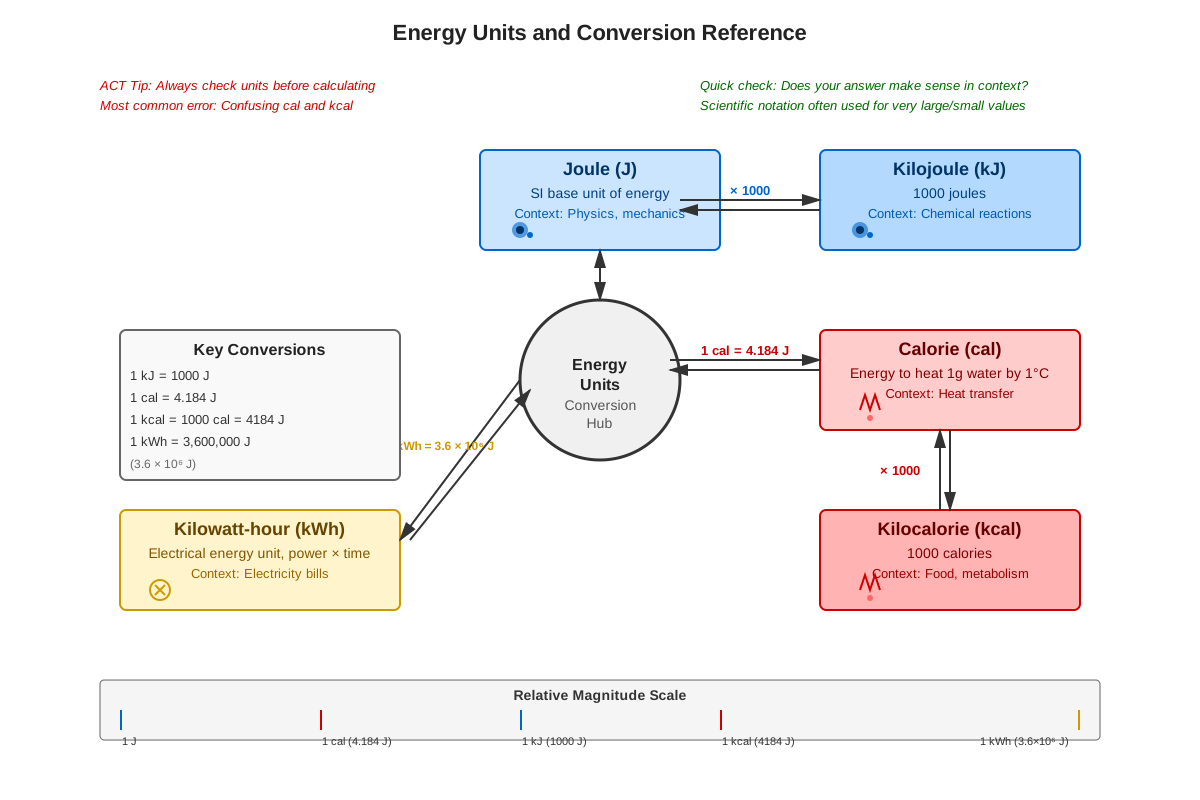
- Unit awareness: Critical for recognizing different energy units (joules, calories, kilowatt-hours) and understanding their relationships
- Basic physics concepts: Foundational understanding of force, work, and power helps contextualize energy data presentations
Why This Topic Matters
Energy data interpretation skills extend far beyond standardized testing into real-world applications across multiple disciplines. Engineers analyze energy efficiency data to design sustainable buildings, environmental scientists track energy consumption patterns to address climate change, and medical professionals interpret metabolic energy data to diagnose health conditions. Understanding how to read, interpret, and draw conclusions from energy data represents a fundamental scientific literacy skill applicable to informed citizenship and professional success.
On the ACT Science exam, energy data questions appear with remarkable consistency. Statistical analysis of recent ACT exams reveals that 2-4 questions per test directly assess energy data interpretation skills, with additional questions incorporating energy concepts within broader scientific contexts. These questions typically appear in Research Summaries passages (40% frequency), Data Representation passages (35% frequency), and occasionally within Conflicting Viewpoints passages (25% frequency) when scientists debate energy-related phenomena.
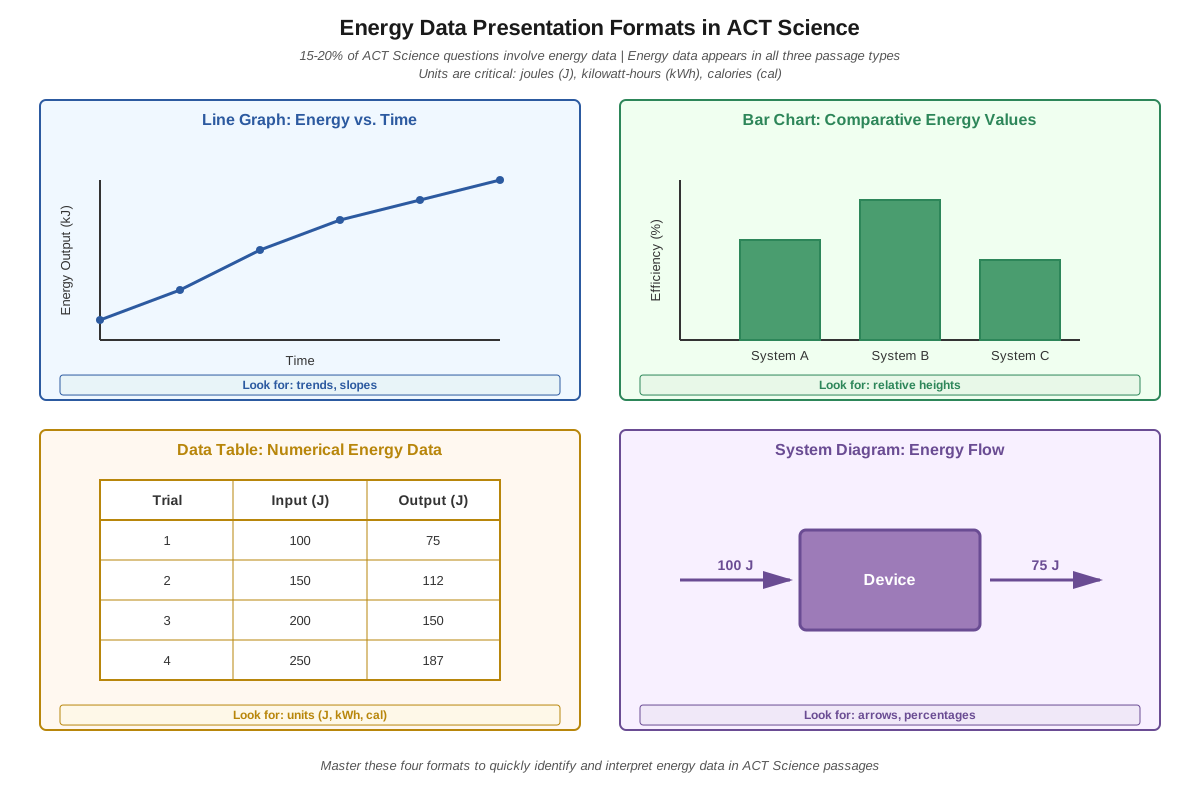
Common presentation formats include line graphs showing energy output versus time, bar charts comparing energy efficiency across different systems, tables displaying energy input and output values, diagrams illustrating energy transformations in mechanical or biological systems, and scatter plots correlating energy consumption with other variables. The ACT frequently tests students' ability to identify the most efficient system, calculate percentage changes in energy, extrapolate trends beyond provided data ranges, and recognize inverse or direct relationships between energy variables.
Core Concepts
Understanding Energy Data Presentation
Energy data on the ACT appears in multiple formats, each requiring specific interpretation strategies. Energy data refers to quantitative information about energy storage, transfer, transformation, or consumption presented through visual or tabular means. The most common presentation formats include:
Line graphs typically show energy changes over time, such as power output from a solar panel throughout the day or temperature changes (thermal energy) during a chemical reaction. When analyzing these graphs, identify the independent variable (usually time or distance on the x-axis) and the dependent variable (energy measurement on the y-axis). Pay careful attention to units—energy might be expressed in joules (J), kilojoules (kJ), calories (cal), kilocalories (kcal), or kilowatt-hours (kWh).
Bar charts frequently compare energy values across different conditions, systems, or time periods. These visualizations excel at showing discrete comparisons, such as energy efficiency of different fuel types or energy consumption across various appliances. When interpreting bar charts, note whether the bars represent absolute values or percentages, and check for any error bars indicating measurement uncertainty.
Tables present precise numerical values that may require calculation or comparison. Energy data tables often include multiple columns showing input energy, output energy, energy lost, and efficiency percentages. Students must extract relevant values and perform calculations to answer questions about energy transformations or system performance.
Energy Transformation and Conservation
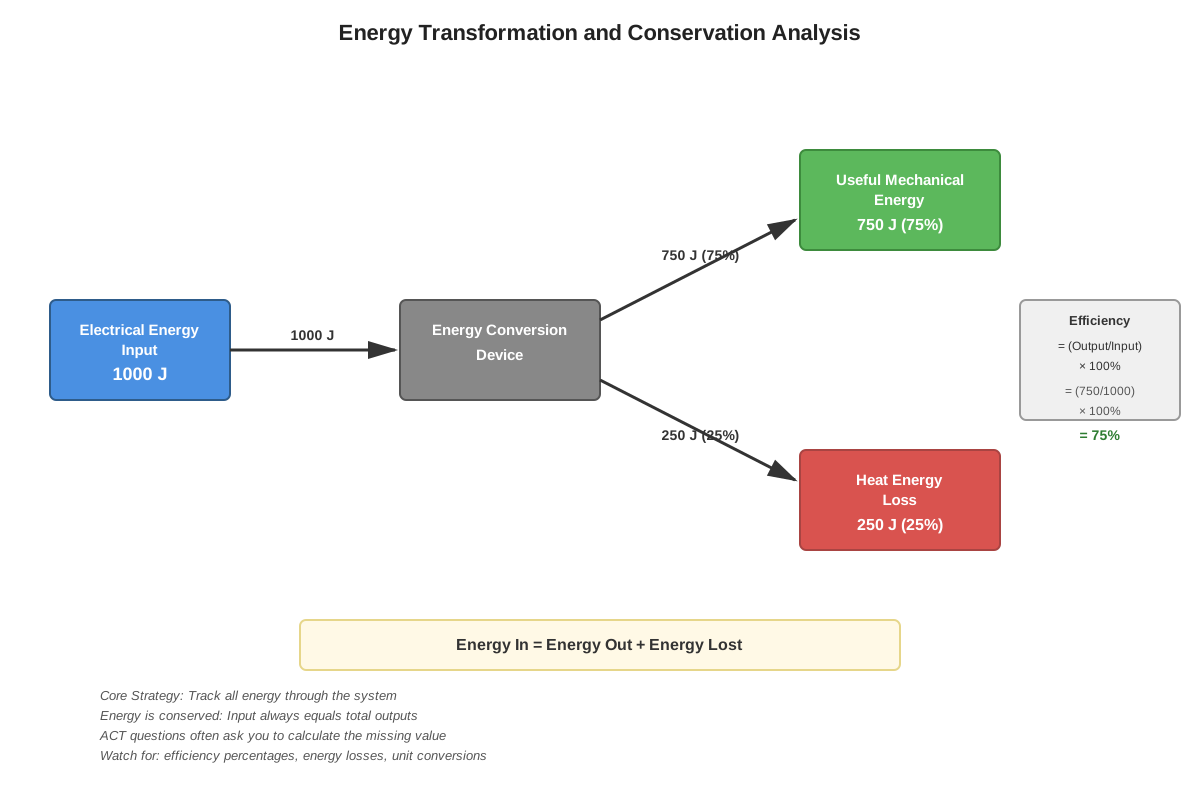
The law of energy conservation states that energy cannot be created or destroyed, only transformed from one form to another. This principle underlies virtually all energy data questions on the ACT. When analyzing energy data, students should recognize that:
Energy Input = Energy Output + Energy Lost (as heat, sound, etc.)Energy transformations occur in predictable patterns. Common transformations tested on the ACT include:
- Chemical energy → Thermal energy (combustion reactions)
- Electrical energy → Light energy + Thermal energy (light bulbs)
- Kinetic energy → Potential energy (objects moving upward)
- Solar energy → Chemical energy (photosynthesis)
- Mechanical energy → Electrical energy (generators)
When examining energy data, identify which transformation is occurring and recognize that some energy always dissipates as thermal energy due to inefficiency. This explains why no real-world system achieves 100% efficiency.
Energy Efficiency Calculations
Energy efficiency represents the ratio of useful energy output to total energy input, typically expressed as a percentage. This concept appears frequently in ACT energy data questions:
Efficiency (%) = (Useful Energy Output / Total Energy Input) × 100For example, if a motor receives 1000 J of electrical energy and produces 750 J of mechanical work, its efficiency equals (750/1000) × 100 = 75%. The remaining 25% (250 J) dissipates as thermal energy and sound.
ACT questions may present efficiency data in various ways:
- Direct efficiency percentages in tables
- Input and output values requiring calculation
- Graphs showing efficiency changes under different conditions
- Comparative data requiring identification of the most efficient system
Quantitative Relationships in Energy Data
Energy data often reveals mathematical relationships between variables. Recognizing these patterns enables accurate prediction and extrapolation:
| Relationship Type | Description | Example |
|---|---|---|
| Direct proportion | As one variable increases, another increases proportionally | Doubling time doubles energy consumption at constant power |
| Inverse proportion | As one variable increases, another decreases proportionally | Increasing efficiency decreases energy waste |
| Linear relationship | Variables change at a constant rate | Constant power output over time |
| Exponential relationship | Variables change at an accelerating rate | Radioactive decay energy release |
| Threshold effect | No change until a critical value is reached | Activation energy in chemical reactions |
When analyzing energy data graphs, determine whether the relationship is linear (straight line), exponential (curved line with increasing slope), or logarithmic (curved line with decreasing slope). This identification helps predict values beyond the data range and understand the underlying physical principles.
Power and Energy Relationships
Power represents the rate of energy transfer or consumption, measured in watts (W) or kilowatts (kW). The relationship between power, energy, and time is fundamental:
Power = Energy / Time
Energy = Power × Time
ACT passages may present power data and require students to calculate total energy consumption, or vice versa. For example, a 100-watt light bulb operating for 10 hours consumes 1000 watt-hours (1 kWh) of energy. Understanding this relationship enables students to convert between power ratings and total energy consumption.
Interpreting Energy Data Trends
Successful ACT test-takers quickly identify trends in energy data:
Increasing trends indicate growing energy values over time or across conditions. These might represent energy accumulation, increasing power output, or rising consumption rates.
Decreasing trends show declining energy values, such as energy dissipation, decreasing efficiency, or reduced power output.
Cyclical patterns reveal repeating energy fluctuations, common in renewable energy sources like solar and wind power that vary with time of day or weather conditions.
Plateau effects indicate maximum capacity or equilibrium states where energy values stabilize despite changing conditions.
Concept Relationships
Energy data interpretation builds upon fundamental graph reading skills and mathematical reasoning, creating a hierarchical knowledge structure. At the foundation level, students must understand coordinate systems and axis interpretation → this enables reading individual data points from graphs and tables → which allows comparison between multiple data points → leading to trend identification → ultimately enabling prediction and extrapolation beyond provided data.
The relationship between energy conservation principles and efficiency calculations is particularly important: understanding that total energy remains constant (conservation) → recognizing that energy transforms between forms → observing that some energy always dissipates as heat → calculating the ratio of useful output to total input (efficiency) → comparing efficiency across different systems.
Power and energy concepts connect through temporal relationships: recognizing power as a rate → understanding energy as accumulated power over time → applying the Energy = Power × Time relationship → solving for unknown variables when two of three values are provided → interpreting real-world scenarios involving both instantaneous power and total energy consumption.
Within the broader ACT Science curriculum, energy data interpretation connects to experimental design (understanding controlled and manipulated variables in energy experiments), data representation (applying graph interpretation skills to energy-specific contexts), and scientific reasoning (drawing logical conclusions from energy data patterns). Mastering energy data analysis strengthens overall scientific literacy and quantitative reasoning skills applicable across all ACT Science passage types.
Quick check — test yourself on Energy data so far.
Try Flashcards →High-Yield Facts
⭐ Energy efficiency always equals (useful energy output / total energy input) × 100%, and no real system achieves 100% efficiency due to thermal energy loss
⭐ When comparing energy systems in tables or graphs, the most efficient system produces the highest useful output from the same input or requires the lowest input for the same output
⭐ Power (watts) multiplied by time (hours) equals energy (watt-hours), enabling conversion between instantaneous power ratings and total energy consumption
⭐ In energy transformation diagrams, the sum of all output energies must equal the input energy due to conservation of energy
⭐ Linear relationships on energy graphs indicate constant rates of change, while curved lines indicate accelerating or decelerating rates
- Energy data questions frequently require extracting two values from different parts of a graph or table and performing a single calculation
- When graphs show multiple lines representing different systems, the question typically asks for comparison or identification of the best-performing system
- Units matter critically—mixing joules and calories or watts and kilowatts without conversion leads to incorrect answers
- Percentage change calculations appear frequently: [(final value - initial value) / initial value] × 100%
- Energy data passages often include one "direct reading" question requiring simple extraction of a value from a graph or table without calculation
Common Misconceptions
Misconception: Energy efficiency can exceed 100% if a system is particularly well-designed → Correction: Energy efficiency cannot exceed 100% because this would violate the law of energy conservation. All real systems lose some energy to heat, sound, or other non-useful forms, making maximum theoretical efficiency 100% and practical efficiency always lower.
Misconception: Power and energy are interchangeable terms representing the same concept → Correction: Power represents the rate of energy transfer (energy per unit time), while energy represents the total amount of work or heat. A 100-watt bulb uses power at a rate of 100 joules per second, but total energy consumption depends on how long it operates.
Misconception: When an energy graph shows a horizontal line, no energy is being used → Correction: A horizontal line indicates constant energy level or constant rate of energy use, not zero energy. For example, a flat line on a power consumption graph means steady power use at that level, not absence of energy consumption.
Misconception: The steepest line on an energy graph always represents the best or most efficient system → Correction: Steepness indicates rate of change, not efficiency. A steep line might represent rapid energy consumption (inefficient) or rapid energy production (potentially efficient). Context and axis labels determine whether steepness is desirable.
Misconception: All energy lost in a system is wasted and serves no purpose → Correction: While lost energy (usually as heat) reduces efficiency for the intended purpose, it may serve secondary functions. For example, incandescent bulbs are inefficient light sources because most energy becomes heat, but that heat might contribute to warming a room. The ACT tests understanding of efficiency relative to the primary intended function.
Misconception: Energy data tables always present values in the same units throughout → Correction: ACT passages sometimes mix units intentionally to test unit awareness. A table might show input energy in kilojoules and output energy in joules, requiring conversion before calculation. Always check units carefully before performing calculations.
Worked Examples
Example 1: Energy Efficiency Comparison
Passage Context: A study compared four different light bulbs by measuring the electrical energy input and light energy output over one hour of operation. The results are shown in the table below:
| Bulb Type | Electrical Energy Input (J) | Light Energy Output (J) |
|---|---|---|
| Incandescent | 360,000 | 18,000 |
| CFL | 60,000 | 12,000 |
| LED | 36,000 | 10,800 |
| Halogen | 216,000 | 21,600 |
Question: Which bulb type has the highest energy efficiency for producing light?
Solution Process:
Step 1: Recognize this is an efficiency comparison question requiring calculation for each bulb type.
Step 2: Apply the efficiency formula: Efficiency = (Output / Input) × 100%
Step 3: Calculate efficiency for each bulb:
- Incandescent: (18,000 / 360,000) × 100% = 5%
- CFL: (12,000 / 60,000) × 100% = 20%
- LED: (10,800 / 36,000) × 100% = 30%
- Halogen: (21,600 / 216,000) × 100% = 10%
Step 4: Compare results and identify the highest efficiency.
Answer: LED bulbs have the highest energy efficiency at 30%.
Key Insight: The most efficient system isn't necessarily the one with the highest output (Halogen produced the most light) or lowest input (LED used the least electricity). Efficiency specifically measures the ratio of useful output to total input. This example demonstrates why calculating efficiency for all options is essential rather than making assumptions based on a single variable.
Example 2: Power and Energy Relationship
Passage Context: A solar panel system's power output was measured throughout a sunny day. The graph shows power output (in watts) on the y-axis and time (in hours after sunrise) on the x-axis. At hour 4, the power output reaches 800 watts and remains constant until hour 8.
Question: How much total energy, in kilowatt-hours (kWh), did the solar panel produce during the 4-hour period from hour 4 to hour 8?
Solution Process:
Step 1: Identify the given information:
- Power output: 800 watts (constant)
- Time period: 4 hours
- Required answer unit: kilowatt-hours (kWh)
Step 2: Recognize the relationship: Energy = Power × Time
Step 3: Perform the calculation:
- Energy = 800 watts × 4 hours = 3,200 watt-hours
Step 4: Convert to the requested unit:
- 3,200 watt-hours ÷ 1,000 = 3.2 kilowatt-hours
Answer: The solar panel produced 3.2 kWh of energy during this period.
Key Insight: This problem tests multiple skills: recognizing the power-energy relationship, extracting information from a graph description, performing unit conversion, and understanding that constant power output over time produces calculable total energy. The ACT frequently presents scenarios where students must identify which formula applies before performing calculations. Additionally, attention to requested units (kWh rather than watt-hours) is critical for selecting the correct answer choice.
Exam Strategy
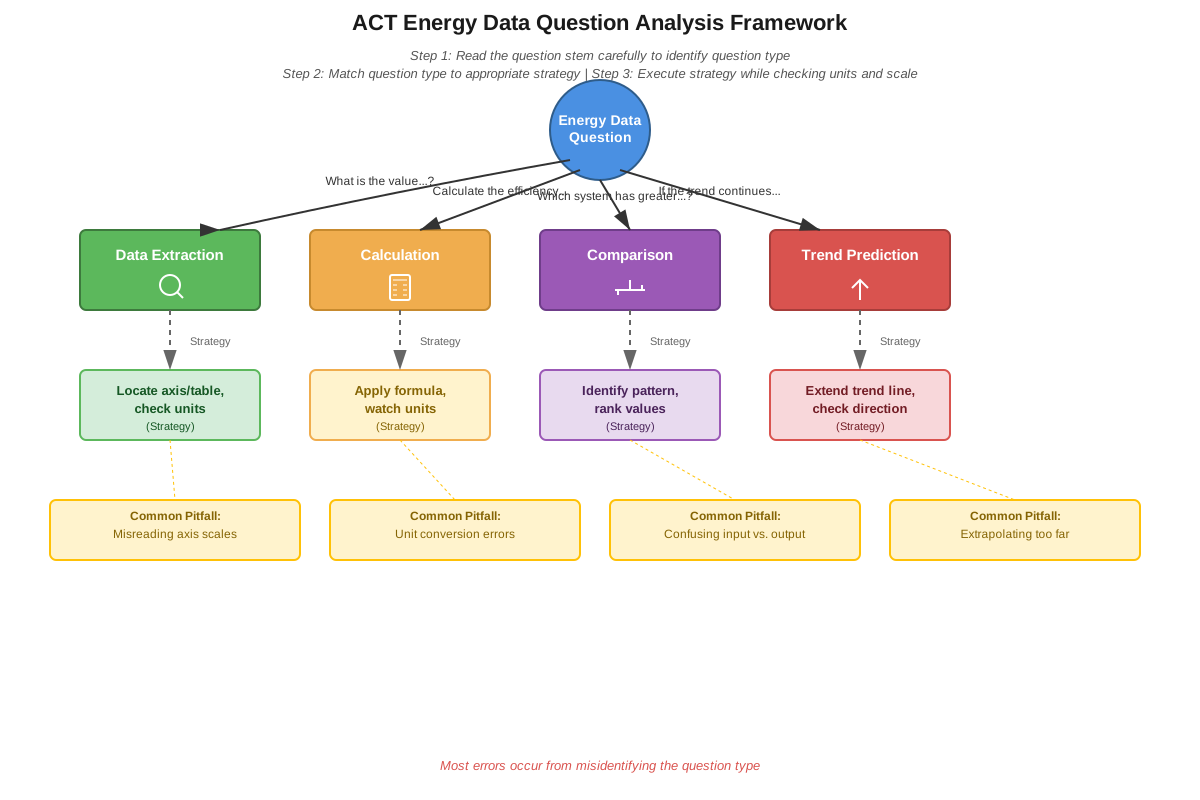
When approaching ACT energy data questions, implement a systematic strategy that maximizes accuracy while managing time effectively. Begin by identifying the question type: Does it ask for direct data extraction, calculation, comparison, or prediction? This classification determines your approach.
Trigger words and phrases that signal energy data questions include:
- "According to the graph/table/figure..."
- "Based on the data..."
- "Which system is most efficient..."
- "How much energy..."
- "What is the relationship between..."
- "As [variable] increases, [energy] ..."
- "At what time/temperature/condition..."
Exam Tip: Spend 5-10 seconds scanning the entire data presentation before reading questions. Note axis labels, units, legends, and the general trend. This preview prevents misreading data under time pressure.
For calculation questions, write down the formula before plugging in numbers. This prevents arithmetic errors and helps identify if unit conversion is necessary. Common formulas include efficiency calculations, percentage change, and power-energy relationships. Always check that your calculated answer appears among the answer choices—if not, review your unit conversion.
Process-of-elimination strategies specific to energy data:
- Eliminate answers with incorrect units (if the question asks for joules, eliminate kilowatt-hour answers)
- Eliminate answers that violate energy conservation (efficiency > 100%, output > input without external energy source)
- Eliminate answers that contradict clear trends (if the graph shows increasing energy, eliminate answers suggesting decrease)
- For comparison questions, eliminate options that don't align with the data (if System A clearly has higher output than System B, eliminate answers claiming the opposite)
Time allocation: Energy data questions typically require 30-45 seconds each. Direct reading questions (extracting a single value) should take 20-30 seconds. Calculation questions may require 45-60 seconds. If a question requires multiple calculations or complex analysis, mark it for review and return after completing faster questions in the passage.
When graphs show multiple lines or bars, create a quick mental ranking of the systems from highest to lowest for the relevant variable. This ranking helps answer comparison questions quickly without recalculating for each answer choice.
Memory Techniques
POWER mnemonic for energy data analysis approach:
- Presentation: Identify the data format (graph, table, diagram)
- Output: Determine what the question asks for
- What's given: Extract relevant values from the data
- Equation: Select the appropriate formula or relationship
- Result: Calculate and verify the answer makes sense
"Input Over Output Equals Efficiency" - Remember that efficiency calculations always place output in the numerator and input in the denominator, then multiply by 100 for percentage. Visualize a fraction with "OUT" on top and "IN" on bottom.
Unit conversion visualization: Picture a "kilo-ladder" where each step up multiplies by 1,000:
- Watts → Kilowatts (÷1,000)
- Joules → Kilojoules (÷1,000)
- Watt-hours → Kilowatt-hours (÷1,000)
The "No Free Energy" rule: Whenever you see efficiency or energy transformation data, remember that some energy always disappears as heat. If calculations suggest 100% or greater efficiency, recheck your work—you've made an error.
Graph trend memory: Use the phrase "Line Up, Value Up" for direct relationships and "Line Up, Value Down" for inverse relationships. This helps quickly identify whether variables increase together or oppositely.
Summary
Energy data interpretation represents a high-yield ACT Science topic requiring integration of graph reading skills, mathematical calculation ability, and conceptual understanding of energy principles. Success depends on recognizing energy data presentation formats (graphs, tables, diagrams), applying the energy conservation principle that input equals output plus losses, calculating energy efficiency as the ratio of useful output to total input, and understanding the power-energy-time relationship. Students must extract quantitative information accurately, perform unit conversions when necessary, identify trends and patterns in energy data, and compare multiple systems to determine optimal performance. The most common question types involve efficiency calculations, direct data extraction, trend identification, and system comparison. Mastering these skills requires practice with diverse data presentations and systematic application of formulas while maintaining awareness of units and physical constraints like the impossibility of exceeding 100% efficiency.
Key Takeaways
- Energy data questions appear in 15-20% of ACT Science passages, making this a high-priority topic for score improvement
- Efficiency always equals (useful output / total input) × 100%, and real systems never achieve 100% due to energy losses
- The relationship Energy = Power × Time enables conversion between instantaneous power ratings and total energy consumption
- Systematic data extraction (identify axes, units, and trends before answering questions) prevents careless errors under time pressure
- Energy conservation principle (input = output + losses) provides a check for calculation accuracy
- Unit awareness is critical—always verify that values use consistent units before performing calculations
- Comparison questions require evaluating all systems using the same metric (efficiency, total output, or input requirements) rather than making assumptions based on partial information
Related Topics
Graphical Analysis and Data Interpretation: Builds upon energy data skills by extending graph reading to other scientific contexts including population dynamics, chemical concentrations, and geological time scales. Mastering energy data provides a foundation for interpreting any quantitative scientific information presented visually.
Experimental Design and Variables: Understanding controlled experiments helps contextualize why energy data is collected in specific ways. Students who master energy data interpretation can better evaluate experimental methodology and identify potential sources of error in energy measurements.
Chemical Reactions and Thermodynamics: Energy data frequently appears in chemistry contexts involving exothermic and endothermic reactions. The skills developed through energy data analysis directly apply to interpreting enthalpy diagrams and reaction energy profiles.
Environmental Science and Sustainability: Energy efficiency calculations and renewable energy data interpretation connect to broader environmental passages on the ACT. Understanding energy data enables analysis of carbon footprint data, renewable energy adoption rates, and climate change information.
Practice CTA
Now that you've mastered the core concepts of energy data interpretation, it's time to solidify your understanding through active practice. Attempt the practice questions designed specifically for this topic, focusing on applying the systematic approach outlined in the exam strategy section. Use the flashcards to reinforce key formulas, relationships, and common question patterns. Remember that energy data questions reward careful attention to detail and methodical problem-solving—skills that improve dramatically with deliberate practice. Each practice question you complete builds the pattern recognition and calculation speed necessary for ACT success. Challenge yourself to explain why wrong answers are incorrect, not just why the right answer is correct. This deeper engagement transforms passive review into active mastery.
Sign up free to keep reading
Create a free AnvayaPrep account to finish this ACT guide on Energy data — plus flashcards and practice questions.