Overview
Genetics data represents one of the most frequently tested scientific reasoning topics on the ACT Science section. This topic requires students to interpret experimental results, pedigree charts, Punnett squares, and data tables related to inheritance patterns, gene expression, and population genetics. Unlike pure memorization of genetic principles, ACT genetics data questions emphasize the ability to analyze presented information, identify patterns in inheritance, and draw logical conclusions from experimental evidence.
The ACT Science test does not expect students to have extensive prior knowledge of genetics terminology or complex molecular mechanisms. Instead, it assesses the ability to read and interpret genetics-related data presentations, understand relationships between variables in genetic experiments, and apply basic reasoning skills to novel scenarios. Questions typically present data through graphs, tables, pedigree diagrams, or experimental descriptions, then ask students to identify trends, make predictions, or evaluate hypotheses based solely on the information provided.
Understanding how to approach genetics data connects directly to broader scientific reasoning skills tested throughout the ACT Science section. The analytical strategies used for genetics passages—identifying independent and dependent variables, recognizing patterns, comparing experimental groups, and evaluating evidence—apply equally to passages covering chemistry, physics, Earth science, and biology. Mastering genetics data interpretation strengthens overall data analysis competency, which accounts for approximately 40% of all ACT Science questions across various content areas.
Learning Objectives
- [ ] Identify when genetics data is being tested in ACT Science passages
- [ ] Explain the core rule or strategy behind interpreting genetics data presentations
- [ ] Apply genetics data analysis to ACT-style questions accurately
- [ ] Distinguish between different types of genetic data presentations (pedigrees, Punnett squares, frequency tables, experimental results)
- [ ] Predict offspring ratios and inheritance patterns from provided genetic crosses
- [ ] Evaluate competing hypotheses about inheritance mechanisms using experimental data
- [ ] Extract quantitative information from genetics tables and graphs to answer specific questions
Prerequisites
- Basic understanding of dominant and recessive traits: Necessary to interpret inheritance patterns and predict outcomes in genetic crosses
- Ability to read tables and graphs: Essential foundation for extracting information from any data presentation format
- Understanding of experimental design basics: Required to identify control groups, variables, and valid conclusions from genetics experiments
- Familiarity with ratios and percentages: Needed to calculate and compare genetic frequencies and probabilities
- Recognition of parent-offspring relationships: Fundamental to understanding pedigree charts and inheritance tracking
Why This Topic Matters
Genetics data interpretation appears in approximately 15-20% of ACT Science passages, making it one of the highest-yield topics for focused preparation. These passages typically appear as either Research Summaries (describing genetic experiments and their results) or Data Representation passages (presenting pedigrees, population data, or inheritance patterns). Students who master genetics data interpretation gain a significant strategic advantage, as these questions often follow predictable patterns and can be answered quickly with the right approach.
In real-world applications, genetics data analysis forms the foundation of modern medicine, agriculture, and evolutionary biology. Medical professionals use pedigree analysis to counsel families about inherited disease risks. Agricultural scientists interpret genetic data to develop crop varieties with desired traits. Conservation biologists analyze population genetics data to preserve endangered species. The ACT tests these skills in simplified form, preparing students for college-level biology courses and scientific literacy in everyday life.
Common ACT genetics data presentations include: pedigree charts showing trait inheritance across multiple generations (appearing in 40% of genetics passages), tables comparing offspring phenotypes from controlled crosses (35% of passages), graphs showing allele frequencies in populations over time (15% of passages), and experimental descriptions with quantitative results about gene expression or mutation rates (10% of passages). Recognizing these formats immediately helps students activate the appropriate analytical strategies.
Core Concepts
Types of Genetics Data Presentations
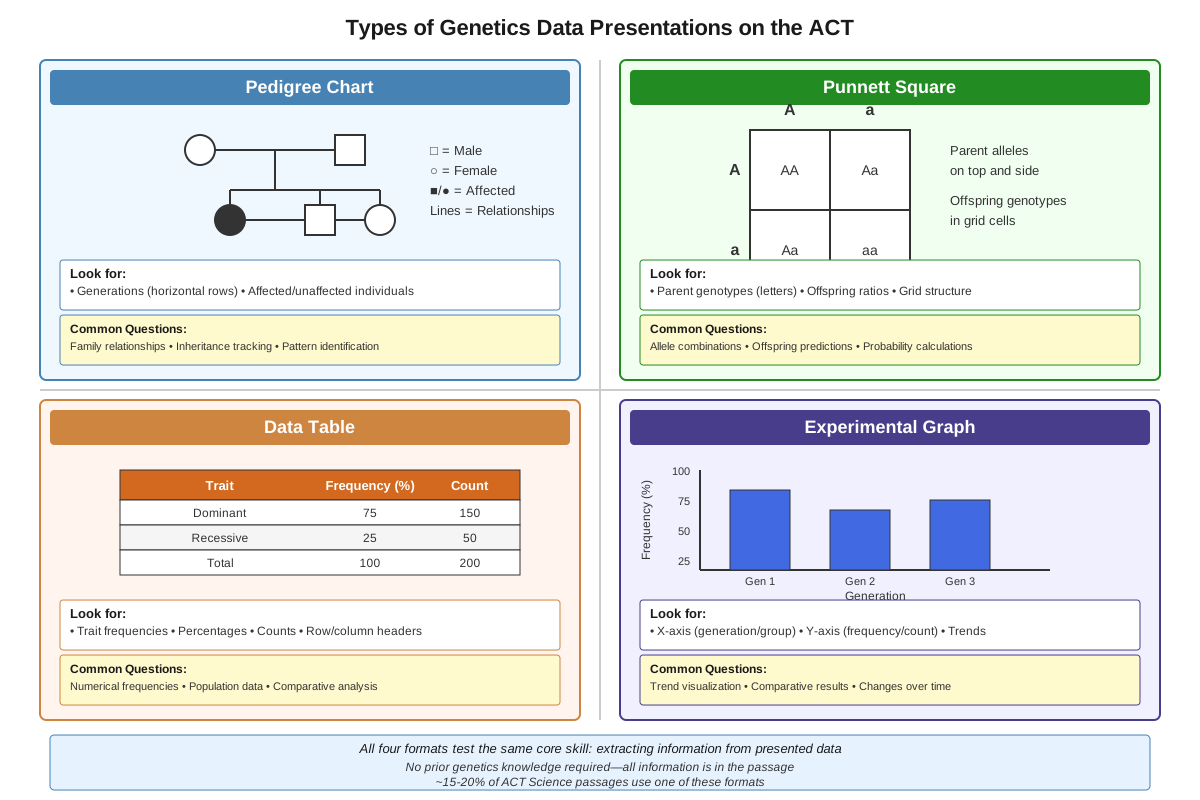
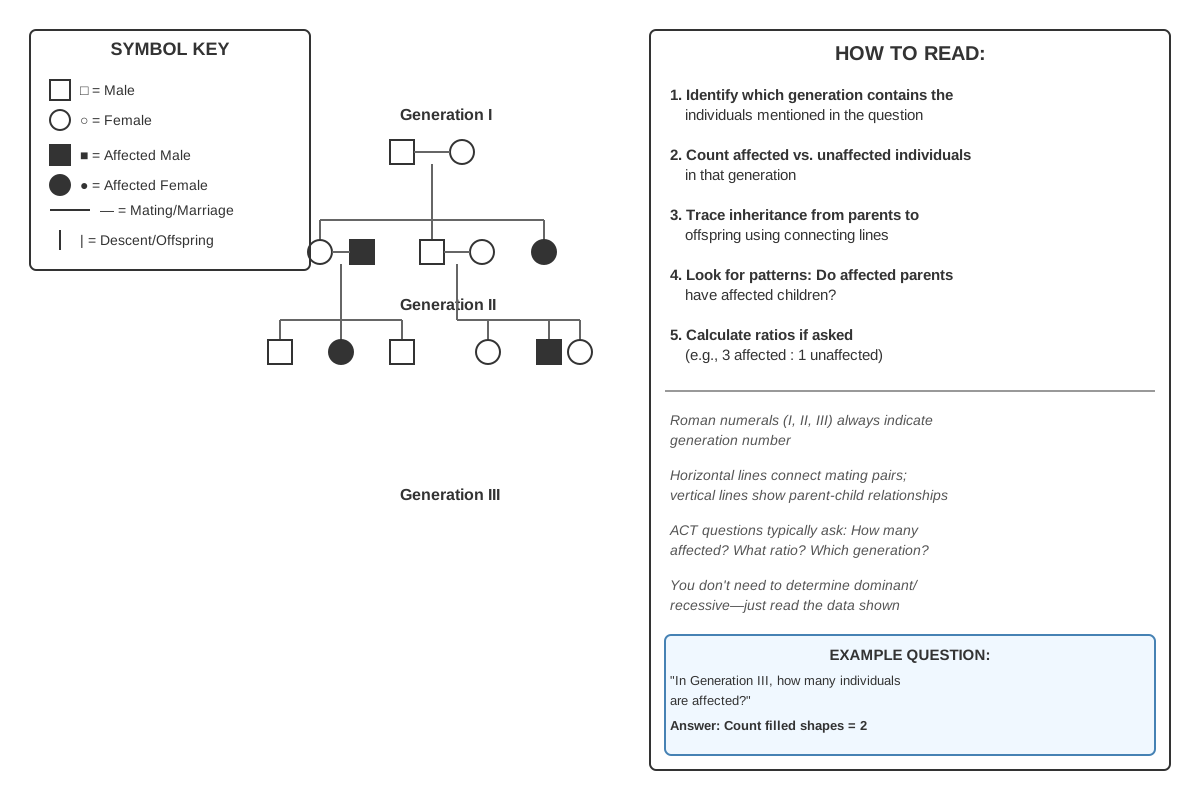
The ACT presents genetics information through several standardized formats, each requiring specific interpretation strategies. Pedigree charts use symbols (typically squares for males, circles for females) connected by lines to show family relationships across generations. Shaded symbols indicate individuals expressing a particular trait, while unshaded symbols represent those without the trait. Horizontal lines connect mating pairs, and vertical lines descend to their offspring. Students must trace trait inheritance patterns through generations to determine whether traits are dominant, recessive, sex-linked, or follow other inheritance patterns.
Punnett squares appear less frequently as complete diagrams but often underlie the data presented in tables. These grids show all possible genetic combinations from a cross between two parents. The ACT typically presents the results of crosses rather than asking students to construct Punnett squares from scratch. Understanding that a 3:1 ratio suggests a heterozygous cross for a dominant trait, while a 1:1 ratio indicates a cross between a heterozygous and homozygous recessive individual, allows rapid interpretation of offspring data.
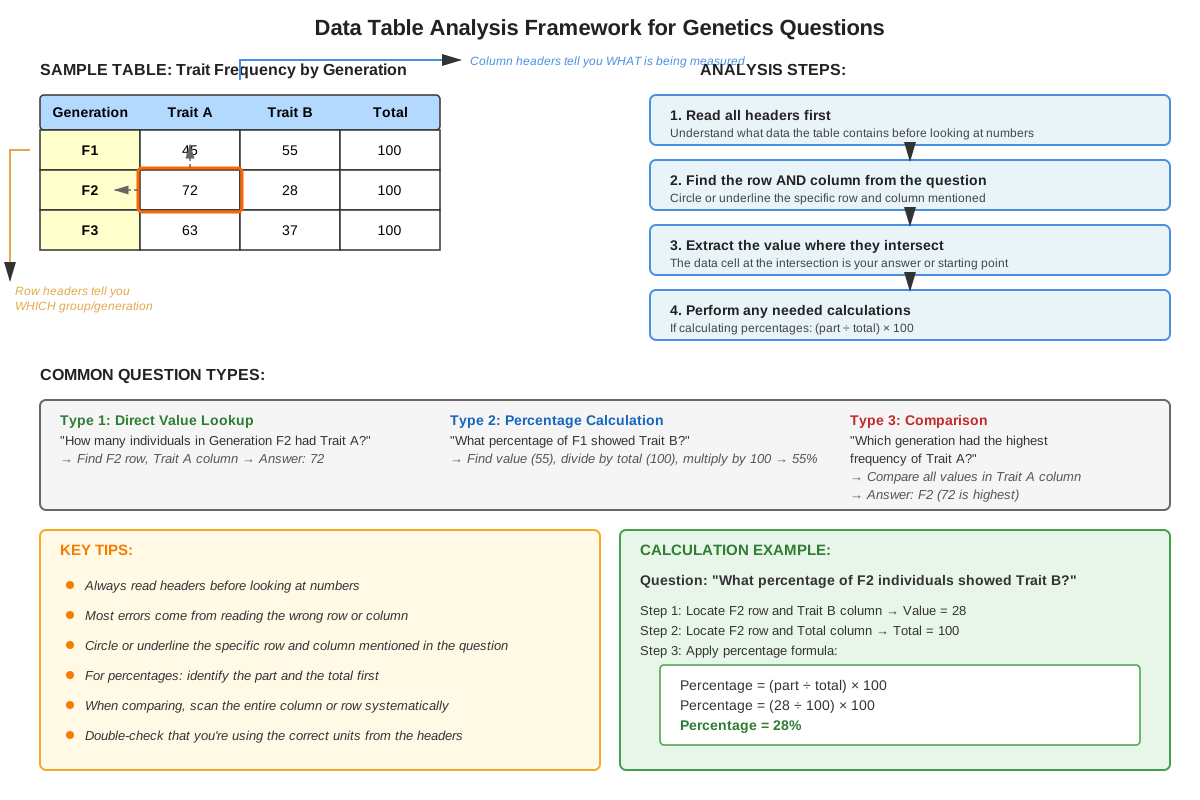
Data tables in genetics passages commonly display offspring counts or percentages organized by phenotype, genotype, or generation. These tables may compare results from multiple experimental crosses, show how trait frequencies change over time, or present data from different populations. The key skill involves identifying which variables are being compared and recognizing patterns in the numerical data.
Graphs depicting genetics data most often show frequency changes over time (line graphs), compare trait distributions across groups (bar graphs), or display correlations between genetic and environmental factors (scatter plots). Unlike tables, graphs emphasize visual trends and require students to extract approximate values from axes rather than reading precise numbers.
Inheritance Pattern Recognition
Recognizing inheritance patterns from data represents the most frequently tested skill in ACT genetics passages. Dominant traits appear in every generation of a pedigree when present, can be passed from affected parents to offspring, and typically show a 3:1 ratio in offspring when two heterozygous parents mate. Recessive traits may skip generations, require two copies of the allele for expression, and can appear in offspring of two unaffected carrier parents.
Sex-linked traits show distinctive patterns: they predominantly affect one sex (usually males for X-linked recessive traits), affected males have unaffected parents but may have affected grandfathers through carrier mothers, and carrier females typically remain unaffected. The ACT often presents pedigrees where recognizing sex-linkage is crucial to answering questions about inheritance probability or pattern identification.
Codominance and incomplete dominance produce intermediate or blended phenotypes rather than simple dominant-recessive patterns. Data tables showing three distinct phenotypes in a 1:2:1 ratio indicate incomplete dominance, while tables showing both parental phenotypes plus a combined phenotype suggest codominance. The ACT tests whether students can distinguish these patterns from standard Mendelian inheritance.
Quantitative Genetics Data Analysis
Many ACT genetics questions require calculating or comparing numerical values from data. Phenotypic ratios express the relative numbers of offspring with different observable traits. A cross producing 75 tall plants and 25 short plants yields a 3:1 ratio, suggesting simple dominant inheritance. Students must recognize equivalent ratios presented in different forms (percentages, decimals, or whole numbers).
Allele frequencies in population genetics describe what proportion of all gene copies in a population represent each variant. If a population of 100 individuals includes 60 homozygous dominant (AA), 30 heterozygous (Aa), and 10 homozygous recessive (aa), the frequency of the dominant allele (A) is calculated from the total number of A alleles (60×2 + 30×1 = 150) divided by total alleles (200), yielding 0.75 or 75%. While the ACT rarely requires complex calculations, recognizing how frequencies relate to genotype distributions is essential.
Probability calculations in genetics follow basic multiplication and addition rules. The probability of independent events occurring together equals the product of their individual probabilities (if each offspring has a 1/4 chance of being homozygous recessive, two offspring both being homozygous recessive has probability 1/4 × 1/4 = 1/16). The probability of either of two mutually exclusive events occurring equals the sum of their probabilities.
Experimental Genetics Data Interpretation
Research Summary passages present genetics experiments with specific procedures and results. Students must identify the experimental question (what the researchers wanted to learn), the independent variable (what the researchers manipulated, such as which parents were crossed), the dependent variable (what was measured, such as offspring phenotypes), and controlled variables (factors kept constant across experimental groups).
Control groups in genetics experiments might include wild-type organisms compared to mutants, or crosses expected to produce known ratios for comparison. Recognizing the purpose of controls helps students evaluate whether experimental conclusions are justified by the data.
Sample size affects data reliability. Genetics experiments with larger numbers of offspring produce ratios closer to theoretical predictions. The ACT may present data from crosses with different sample sizes and ask which provides more reliable evidence for a hypothesis. Understanding that random variation affects small samples more than large ones guides these judgments.
Data Trends and Pattern Recognition
Identifying trends in genetics data requires comparing values across rows, columns, or time points. Increasing trends might show allele frequencies rising over generations due to selection, mutation rates increasing with environmental exposure, or trait expression correlating with gene dosage. Decreasing trends could indicate alleles being eliminated from populations, trait frequencies declining over time, or reduced expression under certain conditions.
Constant values across conditions suggest that a variable does not affect the outcome. If offspring ratios remain 3:1 regardless of temperature, temperature does not influence inheritance of that trait. Recognizing when data shows no relationship is as important as identifying correlations.
Cyclical or fluctuating patterns occasionally appear in population genetics data, showing allele frequencies oscillating over time or varying with environmental cycles. These patterns indicate dynamic equilibria or frequency-dependent selection rather than directional change.
Concept Relationships
The core concepts in genetics data interpretation build upon each other in a logical progression. Data presentation formats (pedigrees, tables, graphs) serve as the foundation, providing the raw information from which all other analysis flows. Understanding these formats enables inheritance pattern recognition, which identifies whether traits follow dominant, recessive, sex-linked, or other inheritance modes. Pattern recognition, in turn, supports quantitative analysis, allowing students to calculate ratios, frequencies, and probabilities that confirm or refute inheritance hypotheses.
Experimental genetics interpretation integrates all previous concepts: students must extract data from presentations, recognize patterns in results, and perform quantitative comparisons across experimental groups. Finally, trend identification represents the highest-level skill, requiring synthesis of multiple data points to describe how genetic variables change across conditions, generations, or populations.
This hierarchy connects to prerequisite knowledge through several pathways: basic graph and table reading skills → genetics data presentation formats → pattern recognition; understanding of ratios and percentages → quantitative genetics calculations → trend analysis; experimental design principles → genetics experiment interpretation → hypothesis evaluation. Each connection reinforces scientific reasoning skills applicable beyond genetics to all ACT Science passages.
High-Yield Facts
⭐ Pedigree charts use squares for males and circles for females; shaded symbols indicate individuals expressing the trait being tracked
⭐ A 3:1 phenotypic ratio in offspring typically indicates a cross between two heterozygous parents for a dominant trait
⭐ Traits that skip generations in pedigrees are usually recessive, requiring two copies of the allele for expression
⭐ Sex-linked recessive traits predominantly affect males and can pass from carrier mothers to affected sons
⭐ The ACT provides all necessary information within the passage; no outside genetics knowledge is required to answer questions
- Incomplete dominance produces intermediate phenotypes and 1:2:1 ratios in heterozygous crosses
- Codominance shows both parental phenotypes simultaneously in heterozygous individuals
- Larger sample sizes in genetics experiments produce more reliable data closer to theoretical ratios
- Control groups in genetics experiments provide baseline comparisons for evaluating experimental results
- Allele frequencies in populations can change over time due to selection, mutation, migration, or genetic drift
- Probability of independent genetic events occurring together equals the product of individual probabilities
- Horizontal lines in pedigrees connect mating pairs; vertical lines connect parents to offspring
- A 1:1 phenotypic ratio suggests a cross between heterozygous and homozygous recessive individuals
- Multiple generations showing a trait in every affected family line indicates dominant inheritance
- Carrier individuals possess one copy of a recessive allele but do not express the trait phenotypically
Quick check — test yourself on Genetics data so far.
Try Flashcards →Common Misconceptions
Misconception: Pedigree charts always show genetic diseases or disorders → Correction: Pedigrees can track any heritable trait, including neutral characteristics like eye color, height, or flower color in plants. The ACT uses pedigrees for various traits, not exclusively medical conditions.
Misconception: All genetics questions require memorizing specific genes, alleles, or genetic terminology → Correction: ACT genetics passages provide all necessary definitions and information within the passage itself. Success depends on data interpretation skills, not prior memorization of genetic facts.
Misconception: A 3:1 ratio always means dominant inheritance → Correction: While 3:1 ratios typically indicate heterozygous crosses for dominant traits, context matters. The ratio must be interpreted alongside other information like whether traits skip generations or show sex-linkage patterns.
Misconception: If parents don't have a trait, their children cannot have it → Correction: Recessive traits can appear in children of two unaffected carrier parents. Each carrier parent contributes one recessive allele, and offspring inheriting both copies express the trait.
Misconception: Genetics data questions require complex calculations and mathematical formulas → Correction: ACT genetics questions involve basic arithmetic—simple ratios, percentages, and occasionally multiplication for probability. Calculator-level mathematics is never required, and most questions involve pattern recognition rather than calculation.
Misconception: Sex-linked traits only affect males → Correction: While X-linked recessive traits predominantly affect males (who need only one copy), females can be affected if they inherit two copies of the recessive allele. Additionally, X-linked dominant traits affect both sexes, though often more severely in males.
Misconception: All offspring from the same parents will have identical genotypes → Correction: Genetic crosses produce probability distributions, not guaranteed outcomes. Each offspring independently inherits alleles according to Mendelian probabilities, so siblings can have different genotypes and phenotypes.
Misconception: Larger numbers in data tables always indicate dominant traits → Correction: The meaning of numerical values depends on context. In some experiments, larger numbers might represent recessive phenotypes if the experimental design specifically selected for them or if population frequencies favor the recessive allele.
Worked Examples
Example 1: Pedigree Analysis
Passage Context: A pedigree chart shows three generations of a family. Generation I includes an unaffected male (square, unshaded) and an unaffected female (circle, unshaded). Generation II shows four offspring: two unaffected males, one unaffected female, and one affected female (shaded circle). Generation III shows offspring from the affected female in Generation II mated with an unaffected male, producing two unaffected males, one affected male, and one affected female.
Question: Based on the pedigree, which inheritance pattern best explains the trait?
Solution Process:
Step 1: Identify key observations from the pedigree
- The trait appears in Generation II despite both Generation I parents being unaffected (trait skips from grandparents to grandchildren through Generation II)
- Both males and females can be affected (seen in Generation II and III)
- An affected female (Generation II) with an unaffected male produced both affected and unaffected offspring
Step 2: Evaluate dominant vs. recessive inheritance
- If the trait were dominant, at least one Generation I parent would need to be affected to pass it to Generation II
- Since both Generation I parents are unaffected but have an affected daughter, the trait must be recessive
- Both Generation I parents must be carriers (heterozygous)
Step 3: Evaluate sex-linked vs. autosomal inheritance
- Sex-linked recessive traits rarely affect females (requires two copies)
- The affected female in Generation II indicates this is likely autosomal recessive
- If it were X-linked recessive, the Generation I father would need to be affected to produce an affected daughter
Step 4: Verify with Generation III data
- Affected female (homozygous recessive) × unaffected male (could be homozygous dominant or heterozygous)
- Producing both affected and unaffected offspring indicates the unaffected male is heterozygous
- This pattern confirms autosomal recessive inheritance
Answer: The trait follows autosomal recessive inheritance. This conclusion is supported by the trait skipping generations, appearing in both sexes, and the specific offspring ratios observed.
Connection to Learning Objectives: This example demonstrates identifying genetics data (pedigree chart), applying the core strategy of systematic pattern analysis, and accurately interpreting ACT-style genetics information.
Example 2: Experimental Cross Data Analysis
Passage Context: Researchers crossed two pea plants and recorded offspring phenotypes. The data table shows:
| Offspring Phenotype | Number Observed |
|---|---|
| Tall, Purple flowers | 315 |
| Tall, White flowers | 108 |
| Short, Purple flowers | 101 |
| Short, White flowers | 32 |
| Total | 556 |
The passage states that tall is dominant to short, and purple is dominant to white.
Question: What are the most likely genotypes of the parent plants?
Solution Process:
Step 1: Calculate phenotypic ratios
- Tall, Purple: 315/556 ≈ 0.57 (approximately 9/16)
- Tall, White: 108/556 ≈ 0.19 (approximately 3/16)
- Short, Purple: 101/556 ≈ 0.18 (approximately 3/16)
- Short, White: 32/556 ≈ 0.06 (approximately 1/16)
Step 2: Recognize the ratio pattern
- The ratio approximates 9:3:3:1
- This is the classic dihybrid cross ratio for two independently assorting genes
- Occurs when both parents are heterozygous for both traits
Step 3: Determine parent genotypes
- Let T = tall allele, t = short allele
- Let P = purple allele, p = white allele
- A 9:3:3:1 ratio results from TtPp × TtPp cross
- Both parents must be heterozygous for both height and flower color
Step 4: Verify the conclusion
- TtPp × TtPp produces:
- 9/16 T_P_ (tall, purple) ✓
- 3/16 T_pp (tall, white) ✓
- 3/16 ttP_ (short, purple) ✓
- 1/16 ttpp (short, white) ✓
- The observed data matches this prediction within expected random variation
Answer: Both parent plants have genotype TtPp (heterozygous for both height and flower color). The 9:3:3:1 ratio in offspring confirms this dihybrid cross.
Connection to Learning Objectives: This example shows identifying genetics data in table format, explaining the core strategy of ratio recognition, and applying quantitative analysis to determine parental genotypes from offspring data—all essential ACT genetics skills.
Exam Strategy
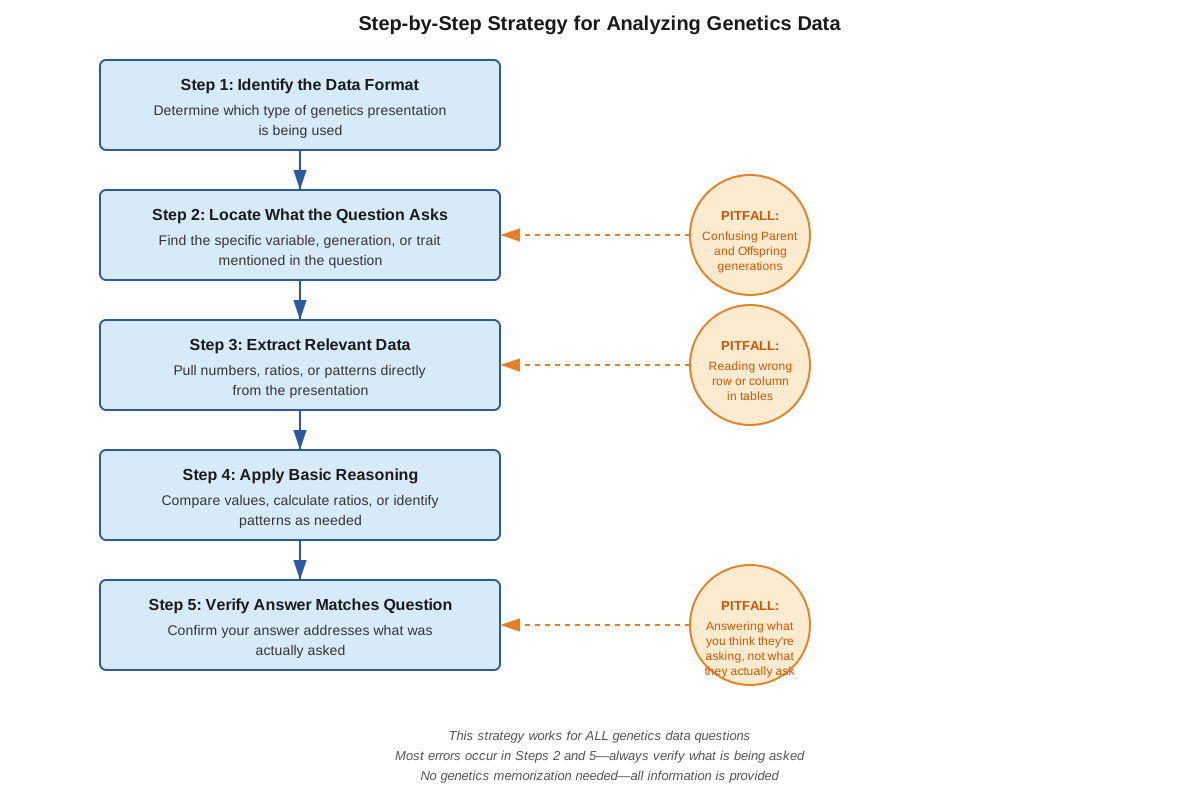
When approaching ACT genetics data questions, begin by identifying the data presentation format within the first 10 seconds. Pedigrees, tables, and graphs each require different initial strategies. For pedigrees, immediately locate affected individuals and trace their relationships to parents and offspring. For tables, scan column and row headers to understand what variables are being compared. For graphs, identify axes labels and overall trends before reading individual data points.
Trigger words that signal genetics data questions include: "inheritance pattern," "offspring ratio," "genotype," "phenotype," "dominant," "recessive," "carrier," "generation," "cross," "allele frequency," and "pedigree." When these terms appear in questions, activate genetics-specific reasoning rather than general data interpretation strategies.
The most efficient approach follows a three-step process: (1) Extract relevant data from the presentation, (2) Identify the pattern or relationship being tested, (3) Eliminate answer choices that contradict the data. For questions asking about inheritance patterns, eliminate options that conflict with observable facts (e.g., eliminate "dominant" if the trait skips generations). For quantitative questions, eliminate answers that fall outside the possible range before calculating exact values.
Time allocation for genetics passages should follow the standard ACT Science pacing: 5 minutes per passage including all questions. Spend approximately 45-60 seconds initially reviewing the data presentation and passage introduction, then 30-45 seconds per question. Genetics questions often allow faster answering than physics or chemistry calculations, so use saved time to double-check answers or return to difficult questions from earlier passages.
Process of elimination works particularly well for genetics questions because wrong answers often contain absolute statements that conflict with data. If a question asks "Which statement is supported by the pedigree?" eliminate any choice that contradicts even one observation from the chart. Similarly, for questions about possible genotypes, eliminate options that could not produce the observed offspring ratios.
Exam Tip: The ACT never requires outside genetics knowledge beyond basic vocabulary defined in the passage. If a question seems to require memorized genetic facts, reread the passage—the answer is always derivable from provided information.
Memory Techniques
PEDIGREE acronym for analyzing inheritance patterns:
- Parents: Identify the parental generation
- Expression: Note which individuals express the trait
- Dominant or recessive: Determine if trait skips generations
- Independence: Check if trait shows sex-linkage
- Generations: Count how many generations show the trait
- Ratios: Calculate approximate offspring ratios
- Eliminate: Rule out impossible inheritance patterns
- Evaluate: Choose the pattern matching all observations
3-1-1 Rule for quick ratio recognition:
- 3:1 ratio → heterozygous × heterozygous for dominant trait
- 1:1 ratio → heterozygous × homozygous recessive
- 1:2:1 ratio → incomplete dominance or codominance
Visualization strategy for pedigrees: Mentally color-code generations (Generation I = red, Generation II = blue, Generation III = green) to track inheritance flow. This prevents confusion when tracing complex family relationships across multiple generations.
Sex-linkage memory aid: "X marks the spot" - X-linked traits show a distinctive X-shaped pattern in pedigrees, passing from affected grandfather through carrier daughter to affected grandson, creating a diagonal skip pattern.
Table reading technique: "CROW" - Columns first, Rows second, Observe patterns, Write brief notes. Always identify what columns and rows represent before attempting to interpret data values.
Summary
Genetics data interpretation on the ACT Science test requires systematic analysis of pedigrees, tables, graphs, and experimental results rather than memorization of genetic facts. Success depends on recognizing data presentation formats, identifying inheritance patterns through ratio analysis and pedigree tracing, and applying logical reasoning to extract conclusions from provided information. The most critical skills include distinguishing dominant from recessive inheritance by observing whether traits skip generations, recognizing sex-linked patterns through male-predominant expression, calculating and interpreting phenotypic ratios to determine parental genotypes, and evaluating experimental genetics data by identifying variables and controls. All necessary information appears within passages, making data interpretation skills more valuable than prior genetics knowledge. Students who master the systematic approaches outlined in this guide—particularly pedigree analysis, ratio recognition, and experimental design evaluation—will confidently handle the 15-20% of ACT Science questions involving genetics data, significantly improving overall Science section scores.
Key Takeaways
- Genetics data appears in 15-20% of ACT Science passages through pedigrees, tables, graphs, and experimental descriptions
- All information needed to answer genetics questions is provided within the passage; no outside memorization is required
- Pedigrees showing traits in every generation indicate dominant inheritance; traits skipping generations suggest recessive inheritance
- A 3:1 offspring ratio typically indicates a heterozygous cross for a dominant trait; 1:1 ratios suggest heterozygous × homozygous recessive crosses
- Sex-linked recessive traits predominantly affect males and pass from carrier mothers to affected sons
- Systematic analysis following consistent steps (identify format → recognize pattern → eliminate contradictions → select answer) maximizes accuracy and speed
- Larger sample sizes in genetics experiments produce more reliable data closer to theoretical predictions
Related Topics
Population Genetics and Hardy-Weinberg Equilibrium: Builds on allele frequency concepts to analyze how populations evolve over time. Mastering basic genetics data interpretation provides the foundation for understanding population-level genetic changes.
Molecular Genetics and Gene Expression: Extends genetics data analysis to include DNA structure, protein synthesis, and gene regulation. The data interpretation skills developed with inheritance patterns apply directly to analyzing gene expression experiments.
Evolutionary Biology Data: Connects genetics data to natural selection, adaptation, and speciation. Understanding how traits are inherited enables analysis of how populations change through evolutionary processes.
Experimental Design in Biology: Applies the experimental analysis skills from genetics passages to broader biological research. Recognizing variables, controls, and valid conclusions transfers across all ACT Science biological passages.
Statistical Analysis in Science: Develops the quantitative reasoning used in genetics ratio calculations into more sophisticated statistical interpretation. Probability concepts from genetics provide entry points to understanding statistical significance and data reliability.
Practice CTA
Now that you have mastered the core concepts and strategies for interpreting genetics data on the ACT Science test, reinforce your learning by attempting the practice questions and reviewing the flashcards. These resources provide targeted practice with the specific question types, data formats, and reasoning patterns you will encounter on test day. Consistent practice with ACT-style genetics questions builds the pattern recognition speed and analytical confidence needed to maximize your Science section score. Remember: genetics data questions follow predictable formats and reward systematic analysis—skills that improve rapidly with focused practice. Start your practice now to transform these strategies into automatic responses that will serve you throughout the exam!
Sign up free to keep reading
Create a free AnvayaPrep account to finish this ACT guide on Genetics data — plus flashcards and practice questions.