Overview
Interpreting equations is a critical skill tested throughout the ACT Science section, appearing in approximately 15-20% of all science questions. This skill requires students to extract meaningful information from mathematical relationships, understand how variables interact, and predict outcomes based on equation structure. Unlike pure mathematics, the ACT Science test evaluates whether students can read equations as scientific statements—understanding what increases or decreases together, identifying proportional versus inverse relationships, and recognizing how changing one variable affects others.
The ability to interpret equations bridges multiple scientific disciplines on the ACT. Whether analyzing chemical reaction rates, physical motion formulas, biological population models, or geological time calculations, students must quickly decode mathematical relationships without necessarily solving complex calculations. This skill is particularly high-yield because it appears across all passage types: Data Representation, Research Summaries, and Conflicting Viewpoints. Questions may ask students to predict trends, identify relationships between variables, or determine which factor has the greatest impact on an outcome.
Mastering equation interpretation connects directly to broader scientific reasoning competencies. It supports data analysis skills by helping students understand the mathematical models underlying experimental results. It enhances graph interpretation abilities since equations and graphs represent the same relationships in different formats. Most importantly, it develops scientific literacy—the capacity to understand how scientists communicate quantitative relationships and make predictions about natural phenomena.
Learning Objectives
- [ ] Identify when Interpreting equations is being tested in ACT Science passages
- [ ] Explain the core rule or strategy behind Interpreting equations
- [ ] Apply Interpreting equations to ACT-style questions accurately
- [ ] Determine whether relationships between variables are direct or inverse from equation structure
- [ ] Predict how changes in one variable affect another variable without performing calculations
- [ ] Recognize common equation patterns across different scientific disciplines
- [ ] Translate between equation representations and verbal descriptions of relationships
Prerequisites
- Basic algebraic manipulation: Understanding variables, constants, and basic operations is essential for recognizing how equation components relate to each other
- Proportional reasoning: Recognizing direct and inverse proportions helps students quickly identify relationship types without detailed calculations
- Scientific notation: Many ACT equations include exponential terms that require comfort with powers of ten
- Unit awareness: Understanding that variables represent measurable quantities helps contextualize what equations actually describe
- Graph reading fundamentals: Equations and graphs represent identical relationships, so connecting these representations strengthens interpretation skills
Why This Topic Matters
In real-world science, equations serve as compact descriptions of natural laws and experimental relationships. Scientists use equations to make predictions, design experiments, and communicate findings efficiently. A single equation can summarize thousands of observations and enable predictions about untested conditions. From calculating medication dosages to predicting climate patterns, equation interpretation underpins practical scientific applications.
On the ACT Science test, ACT interpreting equations questions appear in 3-5 questions per test, making this a high-frequency, high-impact skill. These questions typically appear in Research Summaries passages (50% of occurrences) and Data Representation passages (40%), with occasional appearances in Conflicting Viewpoints passages (10%). The questions rarely require actual calculation; instead, they test conceptual understanding of relationships.
Common question formats include: "According to the equation, as Variable X increases, Variable Y..." or "Based on the equation, which factor has the greatest effect on..." or "The equation indicates that the relationship between A and B is best described as..." Students who can quickly decode equation structure gain significant time advantages, often answering these questions in 20-30 seconds compared to 60+ seconds for those attempting unnecessary calculations.
Core Concepts
Understanding Direct Relationships
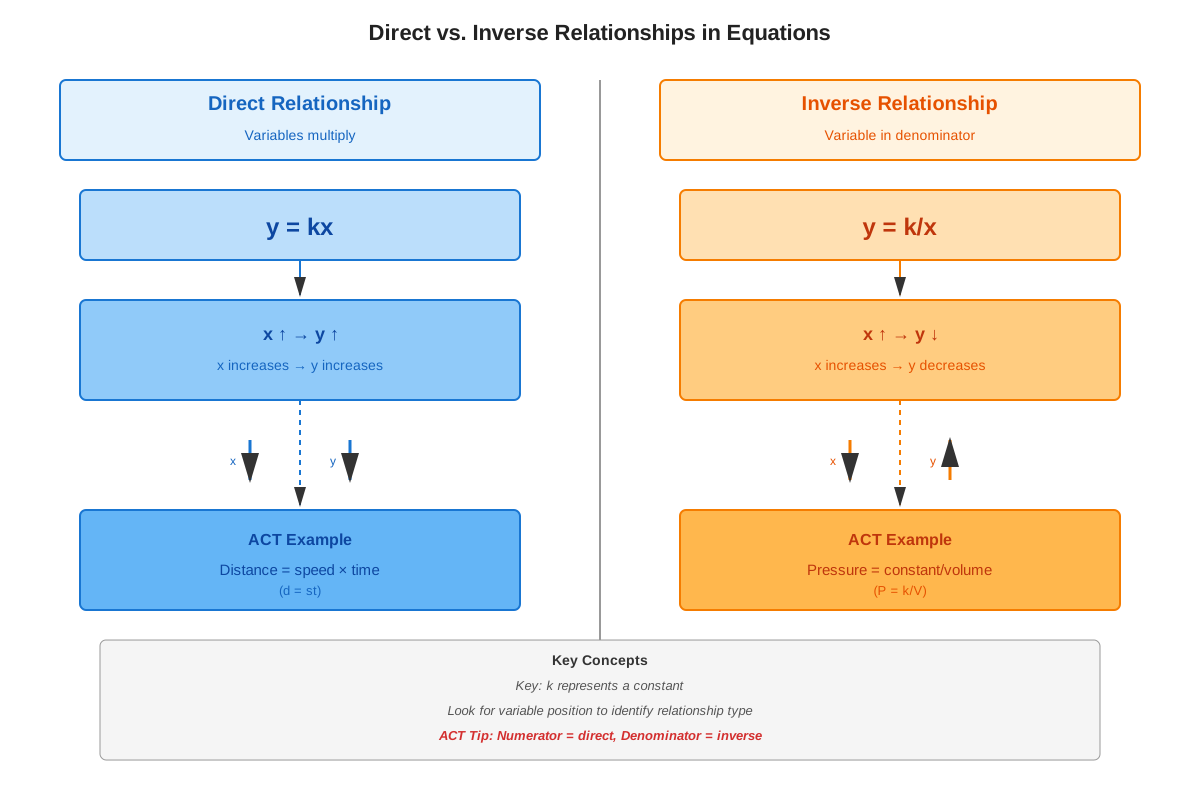
A direct relationship (also called positive correlation) occurs when two variables change in the same direction. In equation form, this appears when variables are multiplied together or when one variable appears in the numerator with a positive coefficient. For example, in the equation F = ma (force equals mass times acceleration), force has a direct relationship with both mass and acceleration. If mass doubles while acceleration stays constant, force doubles. If acceleration triples while mass stays constant, force triples.
Key indicators of direct relationships:
- Variables multiplied together (xy, abc)
- Variable in the numerator with positive sign (+x, +2y)
- Variable with positive exponent in numerator (x², y³)
- Addition of a variable term (+kx)
Understanding Inverse Relationships
An inverse relationship (also called negative correlation) occurs when variables change in opposite directions. In equations, this appears when one variable is in the denominator or has a negative exponent. The classic example is d = v/t (distance equals velocity divided by time, rearranged as t = d/v). When distance is constant, as velocity increases, time decreases. If velocity doubles, time is cut in half.
Key indicators of inverse relationships:
- Variable in denominator (1/x, a/b)
- Negative exponent (x⁻¹, y⁻²)
- Subtraction of a variable term (-kx)
- Division by a variable expression
Identifying Proportionality Strength
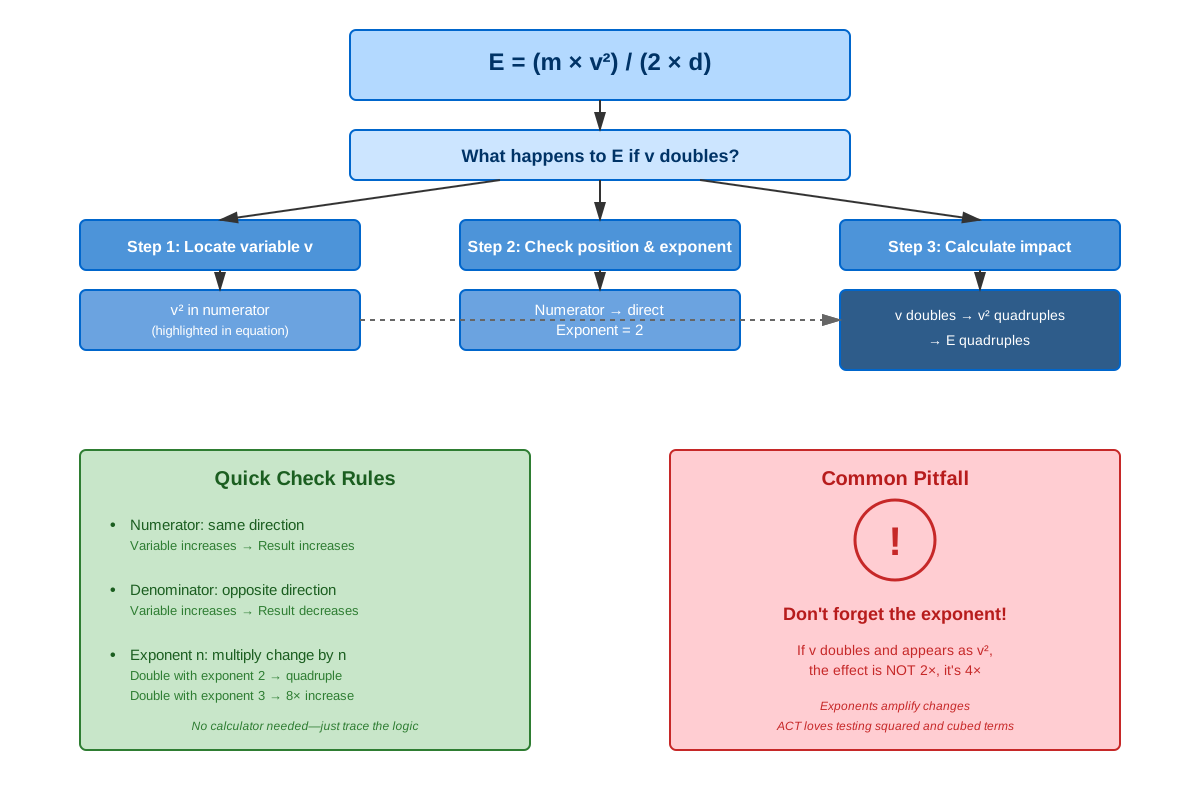
Not all relationships have equal impact. The proportionality strength depends on exponents and coefficients. In the equation E = ½mv², energy depends on both mass and velocity, but velocity has a squared relationship while mass has a linear relationship. This means velocity changes have dramatically larger effects on energy than equivalent mass changes. If velocity doubles, energy quadruples (2² = 4). If mass doubles, energy only doubles.
| Relationship Type | Equation Form | Effect of Doubling Variable |
|---|---|---|
| Linear (direct) | y = kx | y doubles |
| Quadratic | y = kx² | y quadruples |
| Cubic | y = kx³ | y increases 8-fold |
| Square root | y = k√x | y increases by √2 (≈1.4×) |
| Inverse linear | y = k/x | y halves |
| Inverse square | y = k/x² | y becomes ¼ original |
Reading Equation Structure
Successful interpreting equations requires systematic analysis of equation components:
- Identify the dependent variable: Usually isolated on the left side (y = ...), this is what you're calculating or predicting
- Locate independent variables: These appear on the right side and represent factors you can control or measure
- Note constants: Letters like k, c, or specific numbers that don't change
- Examine mathematical operations: Multiplication, division, addition, subtraction, exponents, and roots all convey different relationships
- Consider units: Variables with units (meters, seconds, grams) represent measurable quantities
For example, in P = ρgh (pressure equals density times gravitational acceleration times height):
- P (pressure) is the dependent variable
- ρ (density), g (gravity), and h (height) are independent variables
- All three independent variables have direct relationships with pressure
- No constants appear explicitly (though g is often treated as constant)
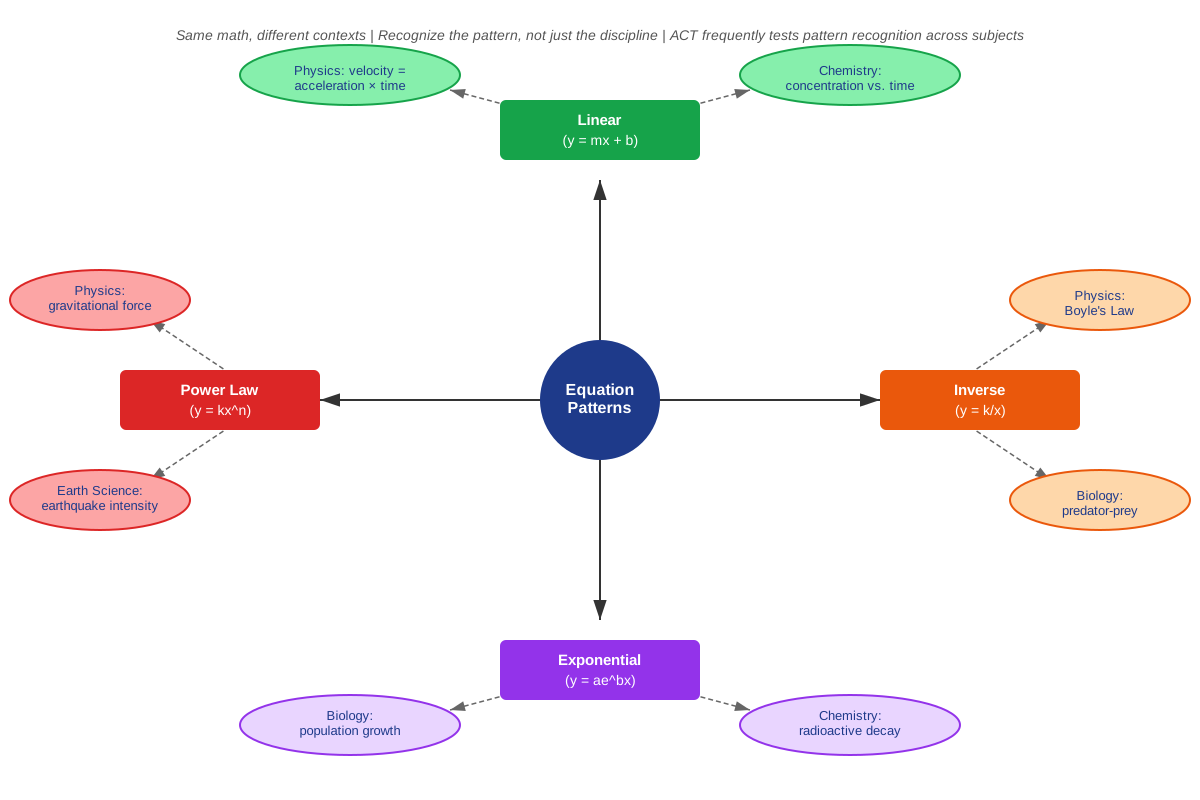
Recognizing Common Equation Patterns
Certain equation structures appear repeatedly across ACT Science passages:
Rate equations: Rate = k[A]ⁿ[B]ᵐ where brackets indicate concentration and exponents show reaction order. Higher exponents mean that variable has greater influence.
Exponential growth/decay: N = N₀e^(kt) where N changes exponentially over time t. The sign of k determines growth (positive) or decay (negative).
Power laws: y = Axⁿ where the exponent n determines relationship strength. Common in physics (gravity, electromagnetism) and biology (metabolic scaling).
Rational functions: y = (ax + b)/(cx + d) where relationships are more complex, often showing asymptotic behavior.
Translating Equations to Predictions
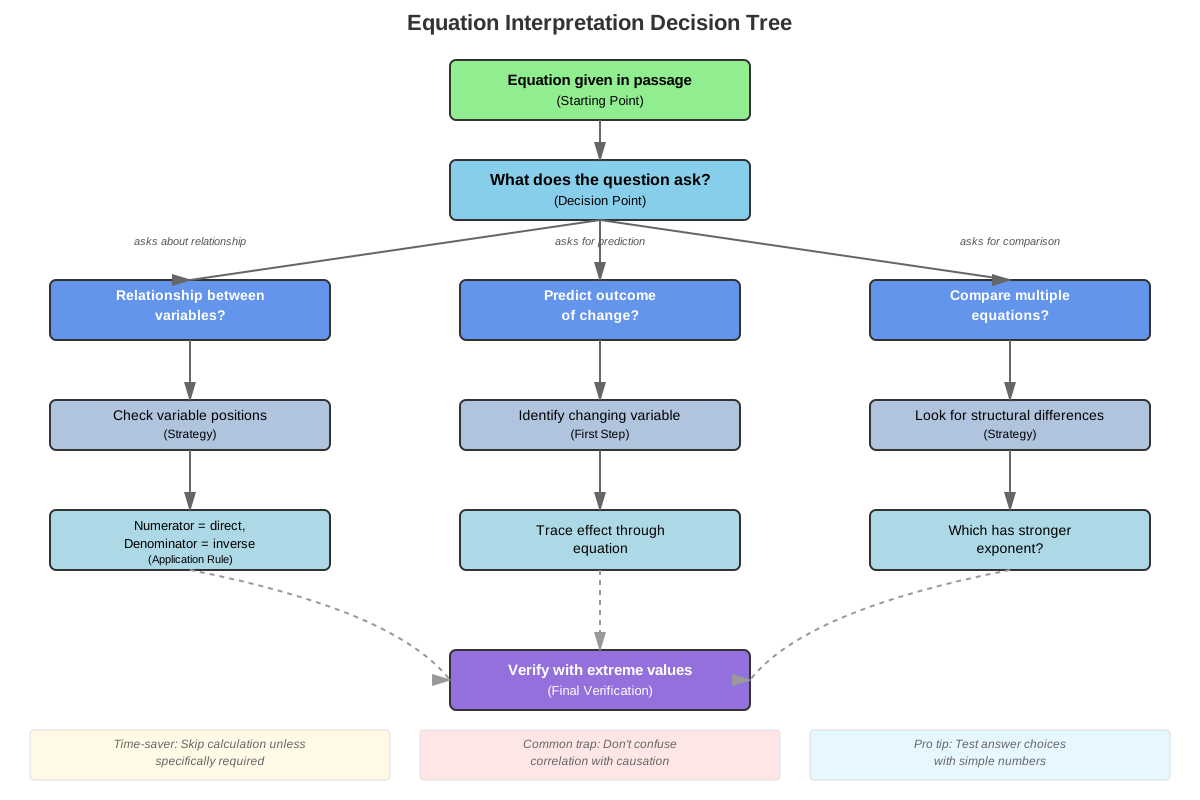
The ultimate goal of equation interpretation is making predictions without calculation. When a question asks "What happens to Y when X increases?", follow this process:
- Locate X in the equation
- Determine if X is in numerator (direct) or denominator (inverse)
- Check for exponents that modify the relationship strength
- Consider whether other variables are held constant
- State the prediction: "Y increases/decreases/stays the same"
For complex equations with multiple variables, focus on the specific variable mentioned in the question and temporarily treat others as constants.
Concept Relationships
The concepts within equation interpretation form a hierarchical structure. Understanding direct and inverse relationships serves as the foundation—students must master this before progressing. These basic relationships → lead to → proportionality strength analysis, where exponents and coefficients modify simple relationships. Both foundational concepts → support → equation structure reading, which provides a systematic approach to unfamiliar equations. All three concepts → enable → recognizing common patterns, allowing rapid identification of equation types. Finally, all previous concepts → culminate in → making predictions, the ultimate test skill.
Connections to prerequisite knowledge include: Basic algebra → enables → identifying variables and operations; Proportional reasoning → supports → understanding direct/inverse relationships; Graph reading → parallels → equation interpretation (both represent identical relationships in different formats).
Connections to related ACT Science topics: Equation interpretation → enhances → Data analysis (equations model data patterns); Equation interpretation → supports → Experimental design understanding (equations represent hypotheses being tested); Equation interpretation → connects to → Graph analysis (equations are mathematical versions of graph relationships).
Quick check — test yourself on Interpreting equations so far.
Try Flashcards →High-Yield Facts
⭐ Direct relationships occur when variables are multiplied together or appear in the numerator; as one increases, the other increases proportionally.
⭐ Inverse relationships occur when a variable appears in the denominator or has a negative exponent; as one increases, the other decreases.
⭐ Exponents indicate relationship strength: squared relationships (x²) have four times the effect of linear relationships when the variable doubles.
⭐ Variables in the numerator with positive signs have direct relationships with the dependent variable.
⭐ Variables in the denominator have inverse relationships with the dependent variable.
- Constants (k, c, or specific numbers) do not change and can be ignored when determining relationship direction.
- When multiple variables appear in an equation, the one with the highest exponent has the greatest proportional effect.
- Addition and subtraction in equations indicate offsetting effects or baseline values, not proportional relationships.
- Exponential functions (e^x) show accelerating change, while logarithmic functions (log x) show decelerating change.
- Square root relationships (√x) are weaker than linear relationships; doubling x only increases √x by about 1.4 times.
- Negative signs in front of variables indicate inverse relationships, just like denominators do.
- When comparing effects of different variables, focus on exponents first, then coefficients.
Common Misconceptions
Misconception: All variables in an equation have equal importance and equal effects on the outcome.
→ Correction: Variables with higher exponents have disproportionately larger effects. In E = ½mv², velocity affects energy much more than mass does because of the squared relationship.
Misconception: If a variable appears in an equation, increasing it always increases the result.
→ Correction: Variables in denominators or with negative exponents have inverse relationships. In t = d/v, increasing velocity (v) decreases time (t).
Misconception: Constants like k or c are variables that need to be considered when predicting relationships.
→ Correction: Constants remain fixed in a given scenario. They affect the magnitude of results but not the direction of relationships between variables.
Misconception: Addition in equations creates the same type of relationship as multiplication.
→ Correction: Multiplication creates proportional relationships (doubling x doubles y in y = kx), while addition creates offset relationships (doubling x in y = x + 5 doesn't double y).
Misconception: You need to calculate numerical answers to interpret equation relationships correctly.
→ Correction: ACT equation interpretation questions test conceptual understanding of relationships, not calculation ability. Recognizing whether relationships are direct or inverse is sufficient for most questions.
Misconception: Negative exponents mean the relationship is negative or decreasing.
→ Correction: Negative exponents (x⁻¹ = 1/x) indicate inverse relationships, not negative values. As x increases, y decreases, but both can remain positive.
Misconception: Complex equations with many terms are impossible to interpret quickly.
→ Correction: Focus only on the specific variable mentioned in the question and treat all others as constants. This simplifies even complex equations dramatically.
Worked Examples
Example 1: Gravitational Force Equation
Question: The gravitational force between two objects is given by the equation:
F = G(m₁m₂)/r²where F is force, G is the gravitational constant, m₁ and m₂ are the masses of the two objects, and r is the distance between them. If the distance between two objects is doubled while their masses remain constant, what happens to the gravitational force?
Solution Process:
Step 1: Identify what's changing and what's constant.
- Changing: r (distance) is doubling
- Constant: G, m₁, and m₂ remain the same
Step 2: Locate r in the equation.
- r appears in the denominator with an exponent of 2 (r²)
Step 3: Determine the relationship type.
- Denominator placement = inverse relationship
- Exponent of 2 = inverse square relationship
Step 4: Apply the change.
- If r doubles, r² quadruples (2² = 4)
- Since r² is in the denominator, F becomes 1/4 of its original value
Answer: The gravitational force decreases to one-quarter of its original value.
Connection to Learning Objectives: This example demonstrates identifying inverse relationships (denominator placement) and understanding proportionality strength (squared exponent), allowing prediction without calculation.
Example 2: Chemical Reaction Rate
Question: A chemical reaction rate is described by the equation:
Rate = k[A]²[B]where k is the rate constant, [A] is the concentration of reactant A, and [B] is the concentration of reactant B. A scientist wants to maximize the reaction rate. Which change would have the greater effect: doubling [A] or doubling [B]?
Solution Process:
Step 1: Identify the relationships.
- Both [A] and [B] are in the numerator = both have direct relationships with Rate
- [A] has an exponent of 2
- [B] has an implied exponent of 1
Step 2: Compare proportionality strengths.
- Doubling [A]: Since [A]² appears, doubling [A] means (2[A])² = 4[A]²
- Rate increases by a factor of 4
- Doubling [B]: Since [B]¹ appears, doubling [B] means 2[B]
- Rate increases by a factor of 2
Step 3: Compare effects.
- Doubling [A] → Rate quadruples (4×)
- Doubling [B] → Rate doubles (2×)
Answer: Doubling [A] would have the greater effect because it has a squared relationship with the rate, while [B] has only a linear relationship.
Connection to Learning Objectives: This example shows how to compare the effects of different variables by examining exponents, a common ACT question type that tests understanding of proportionality strength.
Exam Strategy
Trigger Words: Watch for phrases like "according to the equation," "based on the formula," "the relationship between," "as X increases," "which factor has the greatest effect," and "if X doubles." These signal equation interpretation questions.
Approach Strategy:
- Don't calculate unless explicitly asked: 90% of equation interpretation questions require only qualitative analysis, not numerical answers. Save time by recognizing this.
- Use the "cover-up" technique: Mentally cover all variables except the one mentioned in the question. This simplifies complex equations dramatically.
- Check numerator vs. denominator first: This single distinction (direct vs. inverse) eliminates 50% of answer choices in most questions.
- Look for exponents second: After determining relationship direction, exponents tell you relationship strength, often distinguishing between remaining answer choices.
- Eliminate impossible answers: If a variable is in the numerator, any answer saying "as X increases, Y decreases" is automatically wrong.
Process of Elimination Tips:
- If the question asks about increasing a variable in the numerator, eliminate all answers suggesting the result decreases
- If comparing effects of multiple variables, eliminate any answer that ignores exponents
- If an equation contains only multiplication and division (no addition/subtraction), eliminate answers suggesting "no effect" or "constant"
- For "greatest effect" questions, immediately focus on the variable with the highest exponent
Time Allocation:
Spend 20-30 seconds on straightforward equation interpretation questions (single variable, clear relationship). Allocate up to 45 seconds for complex comparison questions involving multiple variables. If you find yourself attempting calculations, stop and reconsider—you're likely overthinking the question.
Memory Techniques
NUDI Mnemonic for relationship types:
- Numerator = Up together (direct relationship)
- Denominator = Inverse relationship
"Power Doubles" Rule: Remember the effect of doubling a variable:
- Power of 1: doubles (2¹ = 2)
- Power of 2: quadruples (2² = 4)
- Power of 3: octuples (2³ = 8)
- Power of -1: halves (2⁻¹ = 1/2)
- Power of -2: quarters (2⁻² = 1/4)
Visualization Strategy: Picture a seesaw for inverse relationships. When one side (numerator) goes up, the other side (denominator) makes the result go down. For direct relationships, picture two people walking together—when one speeds up, the other speeds up too.
"EXPONENT = EXTREME": Variables with higher exponents have more extreme (larger) effects on the outcome. The bigger the exponent, the bigger the impact.
Fraction Flip: For variables in denominators, mentally flip the relationship. "As x increases" becomes "as 1/x decreases," helping you see the inverse relationship clearly.
Summary
Interpreting equations on the ACT Science test requires understanding mathematical relationships without performing detailed calculations. The core skill involves recognizing whether variables have direct relationships (numerator placement, multiplication, positive exponents) or inverse relationships (denominator placement, division, negative exponents). Proportionality strength depends on exponents—squared relationships have four times the impact of linear relationships when variables double. Successful students systematically analyze equation structure by identifying dependent and independent variables, noting mathematical operations, and focusing only on the specific variable mentioned in questions while treating others as constants. Common equation patterns include rate equations, exponential functions, and power laws. The key to ACT success is qualitative analysis of relationships rather than quantitative calculation, allowing students to answer questions in 20-30 seconds by recognizing relationship types and comparing exponents.
Key Takeaways
- Numerator variables have direct relationships; denominator variables have inverse relationships with the dependent variable
- Exponents determine relationship strength: squared relationships (x²) produce four times the effect of linear relationships when variables double
- Focus on the specific variable mentioned in the question and treat all others as constants to simplify complex equations
- ACT equation questions test conceptual understanding, not calculation ability—avoid unnecessary math
- Higher exponents mean greater proportional effects when comparing multiple variables' impacts
- Trigger phrases like "according to the equation" and "as X increases" signal equation interpretation questions
- Systematic analysis (identify dependent variable → locate independent variables → examine operations → determine relationships) ensures accurate interpretation
Related Topics
Graph Interpretation: Equations and graphs represent identical relationships in different formats. Mastering equation interpretation enhances graph analysis skills since slope indicates direct relationships and hyperbolic curves indicate inverse relationships.
Data Analysis and Trends: Equations often model experimental data patterns. Understanding equations helps predict data trends and identify outliers that don't fit mathematical models.
Experimental Design: Scientists design experiments to test relationships expressed in equations. Recognizing equation structure helps understand why experimenters manipulate certain variables.
Unit Analysis: Advanced equation interpretation involves understanding how units combine (meters/second, grams/mole), which helps verify relationship correctness and detect errors.
Logarithmic and Exponential Functions: These special equation types appear frequently in chemistry (pH, half-life) and biology (population growth), requiring specialized interpretation strategies.
Practice CTA
Now that you understand the core strategies for interpreting equations on the ACT Science test, it's time to apply these skills! Work through the practice questions to reinforce your ability to identify relationship types, compare proportionality strengths, and make predictions without unnecessary calculations. The flashcards will help you memorize key patterns and trigger words. Remember: equation interpretation is one of the highest-yield skills on the ACT Science test—mastering it will significantly boost your score. You've got this!
Sign up free to keep reading
Create a free AnvayaPrep account to finish this ACT guide on Interpreting equations — plus flashcards and practice questions.