Overview
Science passage mapping is a strategic approach to reading and organizing information from ACT Science passages before attempting to answer questions. Rather than reading passages linearly from start to finish or jumping directly to questions, passage mapping involves quickly scanning the passage structure, identifying key components, and creating a mental or physical "map" of where different types of information are located. This technique transforms what appears to be dense scientific content into an organized reference system that students can navigate efficiently during the exam.
The ACT Science section presents a unique challenge: students must process seven passages containing graphs, tables, experimental descriptions, and conflicting viewpoints within 35 minutes—averaging just five minutes per passage. Without a systematic approach, students often waste precious time rereading passages, searching for specific data points, or becoming overwhelmed by technical terminology. ACT Science passage mapping addresses these challenges by helping students understand the passage's organization before diving into questions, enabling them to locate answers quickly and avoid common traps.
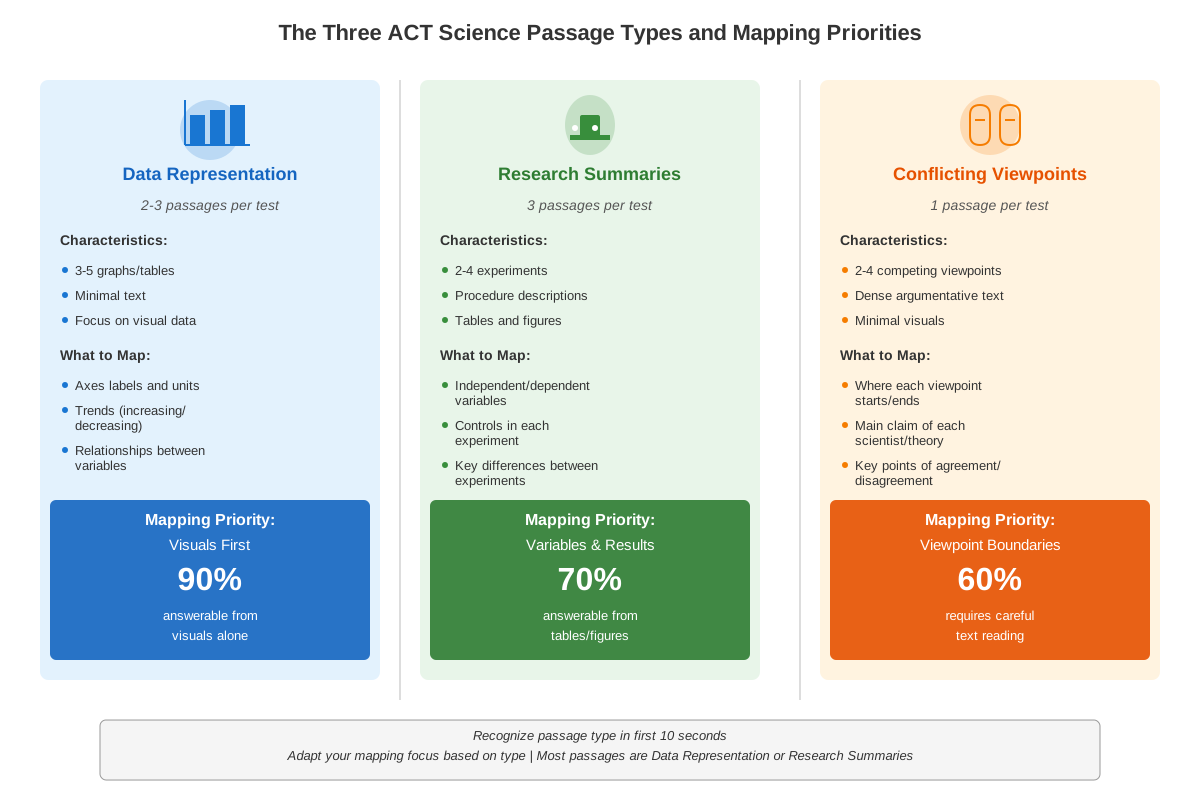
This skill is foundational to success across all three ACT Science passage types: Data Representation (graphs and tables), Research Summaries (experimental procedures and results), and Conflicting Viewpoints (competing scientific hypotheses). Passage mapping integrates with other critical Science skills such as graph interpretation, experimental design analysis, and hypothesis evaluation. By mastering this technique, students develop the metacognitive awareness needed to approach any scientific text strategically, making it one of the highest-yield skills for score improvement in the Science section.
Learning Objectives
- [ ] Identify when Science passage mapping is being tested
- [ ] Explain the core rule or strategy behind Science passage mapping
- [ ] Apply Science passage mapping to ACT-style questions accurately
- [ ] Distinguish between the three main ACT Science passage types and adapt mapping strategies accordingly
- [ ] Create an effective passage map in under 60 seconds that facilitates rapid information retrieval
- [ ] Recognize which passage elements require detailed attention versus superficial scanning
- [ ] Evaluate when to reference the passage versus when to work directly from visual representations
Prerequisites
- Basic graph reading skills: Understanding axes, scales, trends, and data points is essential because passage mapping requires quickly assessing what information graphs contain without detailed analysis.
- Familiarity with scientific terminology: Recognizing common scientific terms (independent/dependent variables, control groups, hypotheses) enables faster passage scanning and categorization.
- Reading comprehension fundamentals: The ability to identify main ideas, supporting details, and text structure helps students recognize passage organization patterns.
- Time management awareness: Understanding the time constraints of the ACT Science section (5 minutes per passage) provides context for why efficient passage mapping is necessary.
Why This Topic Matters
In real-world scientific practice, researchers constantly navigate complex studies, datasets, and literature by first understanding the structure and organization of information before diving into details. Scientists don't read every word of a research paper linearly; they scan abstracts, examine figures, review methods, and strategically read sections relevant to their questions. Science passage mapping teaches this authentic scientific literacy skill while simultaneously optimizing exam performance.
On the ACT Science section, passage mapping appears in every single passage—making it universally applicable across all 40 questions. Approximately 85-90% of ACT Science questions can be answered by locating specific information within passages rather than requiring outside scientific knowledge. Students who effectively map passages typically complete questions 30-40% faster than those who don't, creating time for double-checking answers and tackling more challenging items. The College Board's research indicates that students who employ systematic passage analysis strategies score an average of 3-4 points higher on the Science section compared to those who read passages linearly.
This topic appears in multiple question formats: questions asking students to locate specific data points, compare experimental conditions, identify variables, synthesize information across multiple figures, and evaluate hypotheses. Without passage mapping, students often fall into time traps—rereading entire passages, confusing similar experimental trials, or missing the organizational logic that makes complex passages manageable. The skill becomes particularly critical in Research Summaries passages with multiple experiments and Conflicting Viewpoints passages where distinguishing between different scientists' perspectives is essential.
Core Concepts
The Three-Phase Mapping Process
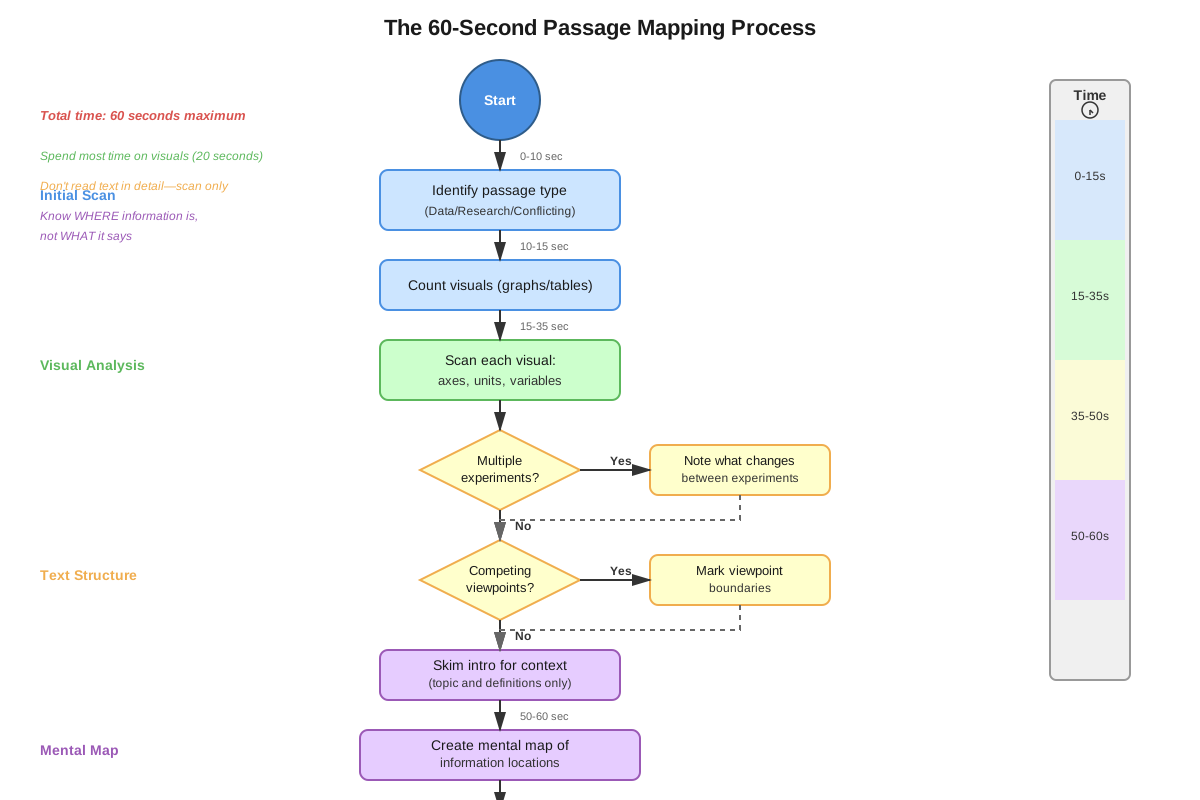
The science passage mapping technique consists of three distinct phases that should be completed in approximately 45-60 seconds before attempting any questions. This systematic approach prevents the common mistake of diving into questions unprepared.
Phase 1: Passage Type Identification (10-15 seconds)
Immediately determine which of the three ACT Science passage types you're encountering:
- Data Representation: Primarily graphs, tables, and charts with minimal text
- Research Summaries: Descriptions of experiments with accompanying data
- Conflicting Viewpoints: Extended text presenting two or more competing scientific perspectives
Identifying the passage type activates the appropriate mental framework and expectations for information organization.
Phase 2: Structural Scanning (20-30 seconds)
Quickly scan the passage to identify and mentally note:
- Number and types of visual representations (graphs, tables, diagrams)
- Number of experiments or trials (if applicable)
- Key variables being studied
- General topic and scientific context
- Location of different information types
Phase 3: Reference Point Marking (15-20 seconds)
Create mental or physical markers for:
- Where each distinct experiment or dataset begins
- Which figures correspond to which experimental conditions
- Where definitions or key concepts are explained
- Boundaries between different scientists' viewpoints (in Conflicting Viewpoints passages)
Key Elements to Map
| Element | What to Identify | Why It Matters |
|---|---|---|
| Variables | Independent (manipulated) and dependent (measured) variables | Most questions ask about relationships between variables |
| Units | Measurement units for all data | Prevents confusion between similar-looking numbers |
| Trends | General patterns (increasing, decreasing, constant) | Many questions test pattern recognition rather than specific values |
| Experimental Structure | Number of trials, conditions, or groups | Helps distinguish between similar experiments |
| Visual Organization | Which graph shows what information | Enables rapid location of relevant data |
| Viewpoint Boundaries | Where Scientist 1's view ends and Scientist 2's begins | Critical for Conflicting Viewpoints passages |
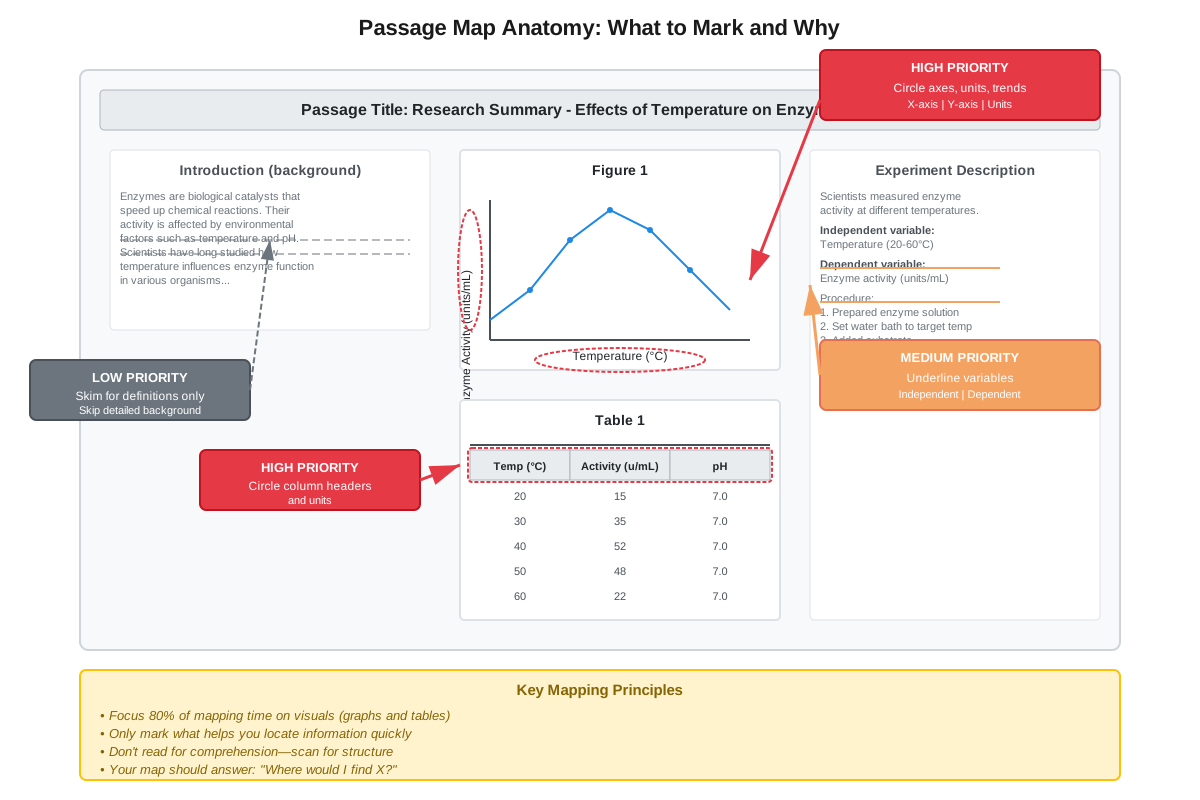
The "Skim-Don't-Read" Principle
A fundamental concept in ACT Science passage mapping is distinguishing between information that requires reading versus scanning. Most students waste time reading detailed descriptions of experimental procedures or background information that rarely appears in questions.
Information to SKIM (not read carefully):
- Detailed procedural descriptions ("The solution was heated to 75°C for 30 minutes...")
- Background context paragraphs
- Technical terminology definitions (unless needed for understanding)
- Lengthy explanations of scientific principles
Information to NOTE (pay attention to):
- What was measured (dependent variables)
- What was changed (independent variables)
- How many experiments or trials occurred
- General purpose of each experiment
- Differences between experimental conditions
Passage-Specific Mapping Strategies
Data Representation Passages:
These passages contain 5-6 questions and focus heavily on graph and table interpretation. The mapping strategy emphasizes:
- Identifying what each axis represents
- Noting the range and scale of data
- Recognizing overall trends
- Locating any anomalies or special conditions
- Understanding relationships between multiple figures
Research Summaries Passages:
These passages describe 2-4 related experiments with 6 questions. The mapping strategy focuses on:
- Numbering each experiment mentally (Experiment 1, 2, 3)
- Identifying what changed between experiments
- Noting which figures correspond to which experiments
- Understanding the overall research question
- Recognizing control conditions
Conflicting Viewpoints Passages:
These passages present competing scientific explanations with 7 questions. The mapping strategy prioritizes:
- Drawing a mental line between viewpoints
- Identifying the central disagreement
- Noting unique claims of each scientist
- Recognizing areas of agreement
- Understanding the underlying question being debated
The "Question-First" Decision
An advanced aspect of passage mapping involves deciding whether to map the entire passage first or to use a "question-first" approach for certain passage types. For Data Representation passages with straightforward graphs, some students benefit from reading questions first, then mapping only the relevant portions. However, for Research Summaries and Conflicting Viewpoints passages, comprehensive mapping before questions typically proves more efficient because questions often require synthesizing information across the entire passage.
Active Annotation Techniques
While the ACT doesn't allow writing in test booklets, students can use active reading strategies during passage mapping:
- Mentally labeling experiments ("Exp 1," "Exp 2")
- Noting variable relationships ("temp up → pressure up")
- Identifying key transition words ("however," "in contrast," "similarly")
- Recognizing question-worthy information (comparisons, extremes, patterns)
Concept Relationships
Science passage mapping serves as the foundational skill that enables all other ACT Science competencies. The relationship flows as follows:
Passage Mapping → Graph Interpretation: Effective mapping identifies which graphs contain which information, making graph interpretation questions answerable in seconds rather than minutes. Without mapping, students waste time searching through multiple figures.
Passage Mapping → Experimental Design Analysis: By mapping the structure of experiments during the initial scan, students can quickly answer questions about controls, variables, and experimental modifications without rereading procedural descriptions.
Passage Mapping → Hypothesis Evaluation: In Conflicting Viewpoints passages, mapping creates clear boundaries between different scientists' perspectives, enabling rapid comparison and evaluation of competing claims.
Passage Mapping → Data Synthesis: Questions requiring information from multiple experiments or figures become manageable when students have mapped where each piece of information resides.
The skill also connects to prerequisite knowledge: basic graph reading enables quick visual scanning during mapping, while scientific terminology familiarity allows rapid categorization of passage elements without getting bogged down in unfamiliar words.
Within the passage mapping process itself, concepts are hierarchical: passage type identification must occur first because it determines which structural elements to prioritize during scanning. Structural scanning must precede reference point marking because you can't mark important locations until you understand the overall organization. This sequential relationship means students must master each phase before the complete mapping process becomes automatic.
High-Yield Facts
⭐ The ACT Science section tests reading comprehension and data interpretation, not scientific knowledge—passage mapping is the primary skill that enables both.
⭐ Approximately 90% of ACT Science questions can be answered by locating information in the passage; effective mapping makes this location process 2-3 times faster.
⭐ The three passage types (Data Representation, Research Summaries, Conflicting Viewpoints) appear in predictable quantities: typically 3 Data Representation, 3 Research Summaries, and 1 Conflicting Viewpoints passage per test.
⭐ Students should spend 45-60 seconds mapping each passage before attempting questions; this upfront investment saves 2-3 minutes per passage overall.
⭐ The most commonly tested information in passages includes: trends in data, comparisons between experimental conditions, identification of variables, and relationships between variables.
- Data Representation passages contain the fewest questions (5-6) but often the most straightforward data location tasks when properly mapped.
- Research Summaries passages typically present experiments in chronological order, with each subsequent experiment building on or modifying previous ones.
- Conflicting Viewpoints passages always present exactly two, three, or four distinct perspectives, never an ambiguous number.
- Questions appear in order of difficulty within each passage, not in the order information appears in the passage—mapping prevents time-wasting searches.
- The introduction paragraph of Research Summaries passages often contains background information that never appears in questions and can be skimmed rapidly.
- Graphs with multiple lines or data series are high-yield mapping targets because they generate multiple questions about comparisons and relationships.
- When passages contain both tables and graphs showing the same data, questions typically reference the visual format that makes the answer most obvious.
Quick check — test yourself on Science passage mapping so far.
Try Flashcards →Common Misconceptions
Misconception: Students must read every word of ACT Science passages carefully to answer questions correctly.
Correction: The ACT Science section primarily tests data interpretation and passage navigation skills, not reading comprehension of scientific prose. Most detailed procedural descriptions and background paragraphs can be skimmed or skipped entirely. Effective passage mapping identifies which small portions of text actually matter for questions.
Misconception: Passage mapping wastes valuable time that should be spent answering questions.
Correction: While mapping takes 45-60 seconds upfront, it saves 2-3 minutes per passage by eliminating repeated searching, rereading, and confusion about passage organization. Students who skip mapping typically spend more total time per passage and make more errors due to locating incorrect information.
Misconception: All three passage types should be mapped using the same strategy.
Correction: Each passage type has distinct organizational patterns that require adapted mapping approaches. Data Representation passages emphasize visual element identification, Research Summaries require tracking multiple experiments, and Conflicting Viewpoints demand clear separation of different scientists' claims. Using a one-size-fits-all approach misses type-specific efficiency opportunities.
Misconception: Passage mapping means creating detailed written notes or outlines.
Correction: Effective passage mapping is primarily a mental process of understanding passage organization and creating reference points. Since students cannot write in ACT test booklets, mapping involves visual scanning, mental categorization, and strategic attention allocation rather than note-taking. Physical marking (when allowed on answer documents) should be minimal and symbolic.
Misconception: Students should always map the entire passage before looking at any questions.
Correction: While comprehensive mapping works best for Research Summaries and Conflicting Viewpoints passages, some students benefit from a modified approach for Data Representation passages: quickly scanning the visuals, reading the first question, then mapping relevant portions. The optimal sequence depends on passage complexity and individual student preferences developed through practice.
Misconception: Passage mapping requires memorizing all the data and information in the passage.
Correction: The goal of mapping is not memorization but organization—knowing where to find information quickly when questions require it. Students should understand the passage structure and general trends but should reference specific data points from the passage when answering questions rather than relying on memory.
Worked Examples
Example 1: Research Summaries Passage Mapping
Passage Setup: A passage describes three experiments investigating how temperature and pH affect enzyme activity. Experiment 1 tests enzyme activity at different temperatures (20°C, 30°C, 40°C, 50°C) at pH 7. Experiment 2 tests enzyme activity at different pH levels (5, 6, 7, 8, 9) at 30°C. Experiment 3 tests enzyme activity at combinations of temperature and pH. Results are shown in Table 1 (Experiment 1), Figure 1 (Experiment 2), and Table 2 (Experiment 3).
Mapping Process:
Phase 1 - Passage Type Identification (10 seconds):
This is clearly a Research Summaries passage because it describes multiple related experiments with accompanying data tables and figures. Expect 6 questions that will likely ask about comparing experiments, identifying variables, and interpreting trends.
Phase 2 - Structural Scanning (25 seconds):
- Three distinct experiments, each testing different conditions
- Two variables being studied: temperature and pH
- Dependent variable: enzyme activity (likely measured in some unit)
- Experiment 1: temperature varied, pH constant
- Experiment 2: pH varied, temperature constant
- Experiment 3: both variables tested together
- Three visual elements: Table 1 (Exp 1), Figure 1 (Exp 2), Table 2 (Exp 3)
Phase 3 - Reference Point Marking (20 seconds):
- Mental note: "Exp 1 = Table 1 = temp changes"
- Mental note: "Exp 2 = Figure 1 = pH changes"
- Mental note: "Exp 3 = Table 2 = both change"
- Key insight: Experiments 1 and 2 isolate single variables (good experimental design)
- Experiment 3 likely tests optimal combinations
Application to Sample Question:
Question: "In Experiment 2, as pH increased from 5 to 9, enzyme activity:"
Using the map: Immediately know to reference Figure 1 (Experiment 2 data). No need to reread the experimental description or search through other figures. Scan Figure 1 for the pH 5 to 9 range and identify the trend. Answer in 15-20 seconds.
Learning Objective Connection: This example demonstrates applying passage mapping to ACT-style questions accurately by showing how a 55-second mapping investment enables rapid question answering.
Example 2: Conflicting Viewpoints Passage Mapping
Passage Setup: A passage presents two scientists debating whether a newly discovered fossil represents a transitional species. The passage contains an introductory paragraph describing the fossil, followed by "Scientist 1" (arguing it IS transitional) and "Scientist 2" (arguing it is NOT transitional). Each scientist's viewpoint spans approximately 8-10 lines of text.
Mapping Process:
Phase 1 - Passage Type Identification (10 seconds):
This is a Conflicting Viewpoints passage, identifiable by the "Scientist 1" and "Scientist 2" labels and the debate structure. Expect 7 questions asking about each scientist's claims, areas of agreement/disagreement, and which evidence supports which viewpoint.
Phase 2 - Structural Scanning (30 seconds):
- Introduction: describes the fossil discovery and basic characteristics
- Central question: Is this fossil a transitional species?
- Scientist 1's position: YES, it's transitional
- Scientist 2's position: NO, it's not transitional
- Each scientist provides 3-4 pieces of evidence/reasoning
- No graphs or tables—all text-based
Phase 3 - Reference Point Marking (25 seconds):
- Draw mental line: Introduction ends → Scientist 1 begins (note approximate location)
- Draw mental line: Scientist 1 ends → Scientist 2 begins (note approximate location)
- Scientist 1's main evidence: (quickly note 2-3 key claims without reading in detail)
- Fossil shows intermediate bone structure
- Dating places it in correct time period
- Geographic location supports transition theory
- Scientist 2's main evidence: (quickly note 2-3 key claims)
- Bone structure fully matches modern species
- Similar fossils found in wrong time periods
- Alternative explanation for geographic location
Application to Sample Question:
Question: "Which of the following statements about the fossil's bone structure would be consistent with Scientist 1's viewpoint?"
Using the map: Immediately know to reference Scientist 1's section (approximately the first half of the viewpoints). Recall from mapping that Scientist 1 emphasized "intermediate bone structure." Scan that section for specific claims about bones. Eliminate answer choices that contradict the "intermediate" concept. Answer in 20-25 seconds.
Learning Objective Connection: This example demonstrates identifying when passage mapping is being tested (recognizing that Conflicting Viewpoints questions require clear separation of viewpoints) and explaining the core strategy (creating mental boundaries between scientists' positions to enable rapid reference).
Exam Strategy
Question Approach Sequence
When encountering any ACT Science passage, follow this strategic sequence:
- Identify passage type (5 seconds): Scan for visual elements, experiment descriptions, or "Scientist" labels
- Complete passage mapping (45-60 seconds): Use the three-phase process appropriate for the passage type
- Read questions strategically (5-10 seconds per question): Identify what information is needed and where it's located
- Reference passage efficiently (10-20 seconds per question): Go directly to the mapped location
- Eliminate wrong answers (5-10 seconds): Use passage information to eliminate 2-3 choices quickly
- Select best answer (5 seconds): Choose from remaining options with confidence
Trigger Words and Phrases
Recognize these question stems that directly test passage mapping skills:
- "According to Figure 2..." → Immediately reference Figure 2; no need to read surrounding text
- "In Experiment 3..." → Go directly to Experiment 3 description and data; ignore other experiments
- "Based on Scientist 1's viewpoint..." → Reference only Scientist 1's section; Scientist 2 is irrelevant
- "Which of the following is a difference between Experiment 1 and Experiment 2?" → Compare the two experiments using your mental map of their structures
- "According to the passage..." → This vague stem requires knowing where different types of information are located
Process of Elimination Tips
Use passage mapping to eliminate answers efficiently:
- Eliminate answers referencing wrong data sources: If a question asks about Experiment 2, immediately eliminate any answer choice that cites data from Experiment 1 or 3
- Eliminate answers contradicting mapped trends: If you noted during mapping that temperature increased throughout an experiment, eliminate any answer suggesting temperature decreased
- Eliminate answers mixing up scientists' viewpoints: In Conflicting Viewpoints passages, eliminate answers that attribute Scientist 1's claims to Scientist 2 or vice versa
- Eliminate answers requiring unmapped information: If an answer choice references a variable or condition not mentioned in your passage map, it's likely incorrect or requires closer passage inspection
Time Allocation Advice
Optimal Time Distribution: Spend 45-60 seconds mapping, then average 40-50 seconds per question. This creates a 5-minute-per-passage pace with buffer time.
Time-Saving Strategies:
- If a passage seems exceptionally complex during mapping, mark it and return after completing easier passages
- For Data Representation passages with very simple graphs, reduce mapping time to 30-40 seconds
- If you find yourself rereading the passage while answering questions, your initial mapping was insufficient—invest more time in mapping on subsequent passages
- Budget extra time (6-7 minutes) for the Conflicting Viewpoints passage, which typically contains more questions and requires careful reading
Red Flags Indicating Poor Mapping:
- Searching through multiple figures to find relevant data
- Rereading experimental descriptions for each question
- Confusing which experiment tested which variable
- Mixing up different scientists' viewpoints
- Spending more than 60 seconds on a single question
Memory Techniques
The "DIVE" Mnemonic for Passage Mapping
Determine passage type
Identify variables and visuals
Verify experiment structure
Establish reference points
This four-step acronym ensures students complete all essential mapping phases before attempting questions.
The "3-2-1" Rule for Research Summaries
When mapping Research Summaries passages, remember:
- 3 pieces of information to identify: independent variable(s), dependent variable(s), and number of experiments
- 2 questions to answer mentally: "What changed between experiments?" and "Which figures show which experiments?"
- 1 key insight: Experiments usually build on each other, testing increasingly complex conditions
Visualization Strategy: The Mental Highlighter
Imagine a mental highlighter that marks three colors while scanning passages:
- Yellow: Variables and what's being measured (most important)
- Green: Experiment boundaries and transitions ("Experiment 2 began...")
- Blue: Unusual conditions or exceptions ("except for Trial 3...")
This visualization technique helps students prioritize attention during the scanning phase without physical marking.
The "Scientist Shorthand" System
For Conflicting Viewpoints passages, create mental shorthand for each scientist:
- Scientist 1 = "Pro" (supporting the main hypothesis)
- Scientist 2 = "Con" (opposing the main hypothesis)
- Or use "S1" and "S2" with quick mental notes about their positions
This shorthand prevents confusion when questions ask about specific scientists' viewpoints.
The "Graph GPS" Technique
Think of passage mapping as creating a GPS system for the passage:
- Destination: The answer to each question
- Map: Your mental organization of passage structure
- Route: The fastest path from question to relevant passage section
- Landmarks: Key figures, experiments, or viewpoint boundaries
This metaphor helps students understand that mapping isn't about memorization—it's about navigation.
Summary
Science passage mapping is the foundational strategy for ACT Science success, transforming seemingly complex passages into organized, navigable information systems. The technique involves a systematic three-phase process: identifying passage type (Data Representation, Research Summaries, or Conflicting Viewpoints), structurally scanning to understand organization and locate key elements, and establishing mental reference points for rapid information retrieval. Effective mapping takes 45-60 seconds per passage but saves 2-3 minutes overall by eliminating repeated searching and confusion. The core principle is "skim-don't-read"—understanding passage structure and variable relationships matters far more than reading every word. Students must adapt their mapping strategy to passage type: Data Representation emphasizes visual element identification, Research Summaries requires tracking multiple experiments and their relationships, and Conflicting Viewpoints demands clear separation of competing perspectives. Mastering this skill enables students to answer approximately 90% of ACT Science questions through efficient information location rather than scientific knowledge, making it the highest-yield strategy for score improvement.
Key Takeaways
- Science passage mapping is a 45-60 second investment that saves 2-3 minutes per passage by creating an organized mental reference system before attempting questions
- The three passage types (Data Representation, Research Summaries, Conflicting Viewpoints) require adapted mapping strategies that prioritize different structural elements
- Effective mapping focuses on organization and navigation, not memorization—knowing where information is located matters more than remembering specific data points
- The "skim-don't-read" principle is essential: detailed procedural descriptions and background information rarely appear in questions and should be scanned rather than carefully read
- Approximately 90% of ACT Science questions test information location and data interpretation, making passage mapping the most universally applicable skill in the Science section
- Students should identify variables, experiment boundaries, visual elements, and viewpoint separations during mapping as these elements generate the majority of questions
- Poor mapping manifests as repeated passage searching, confusion between experiments, and excessive time per question—these red flags indicate the need for more thorough initial mapping
Related Topics
Graph and Table Interpretation: After mapping identifies which visuals contain which information, students must extract specific data points, identify trends, and make comparisons. Mastering passage mapping makes graph interpretation questions 2-3 times faster.
Experimental Design Analysis: Understanding controls, variables, and experimental modifications builds directly on passage mapping skills. Students who effectively map experiment structures can quickly answer design-focused questions.
Conflicting Viewpoints Analysis: This advanced skill requires comparing and contrasting scientific perspectives, identifying areas of agreement and disagreement, and evaluating evidence. Passage mapping creates the organizational framework that makes these comparisons manageable.
Data Synthesis Across Multiple Sources: Some ACT Science questions require combining information from multiple experiments, figures, or viewpoints. Passage mapping enables this synthesis by clarifying where each piece of information resides.
Scientific Reasoning Under Time Pressure: Mastering passage mapping develops the metacognitive awareness and strategic thinking necessary for all timed standardized tests, creating transferable skills for the ACT Reading section and college-level assessments.
Practice CTA
Now that you understand the comprehensive strategy behind science passage mapping, it's time to apply these techniques to real ACT-style passages. Complete the practice questions and flashcards to reinforce your mapping skills and build the automaticity needed for test day. Remember: passage mapping feels slow at first but becomes faster with each practice passage. Students who commit to mapping every practice passage typically see 3-4 point score improvements within 2-3 weeks. Your investment in mastering this foundational skill will pay dividends across every ACT Science passage you encounter—start practicing today!
Sign up free to keep reading
Create a free AnvayaPrep account to finish this ACT guide on Science passage mapping — plus flashcards and practice questions.