Overview
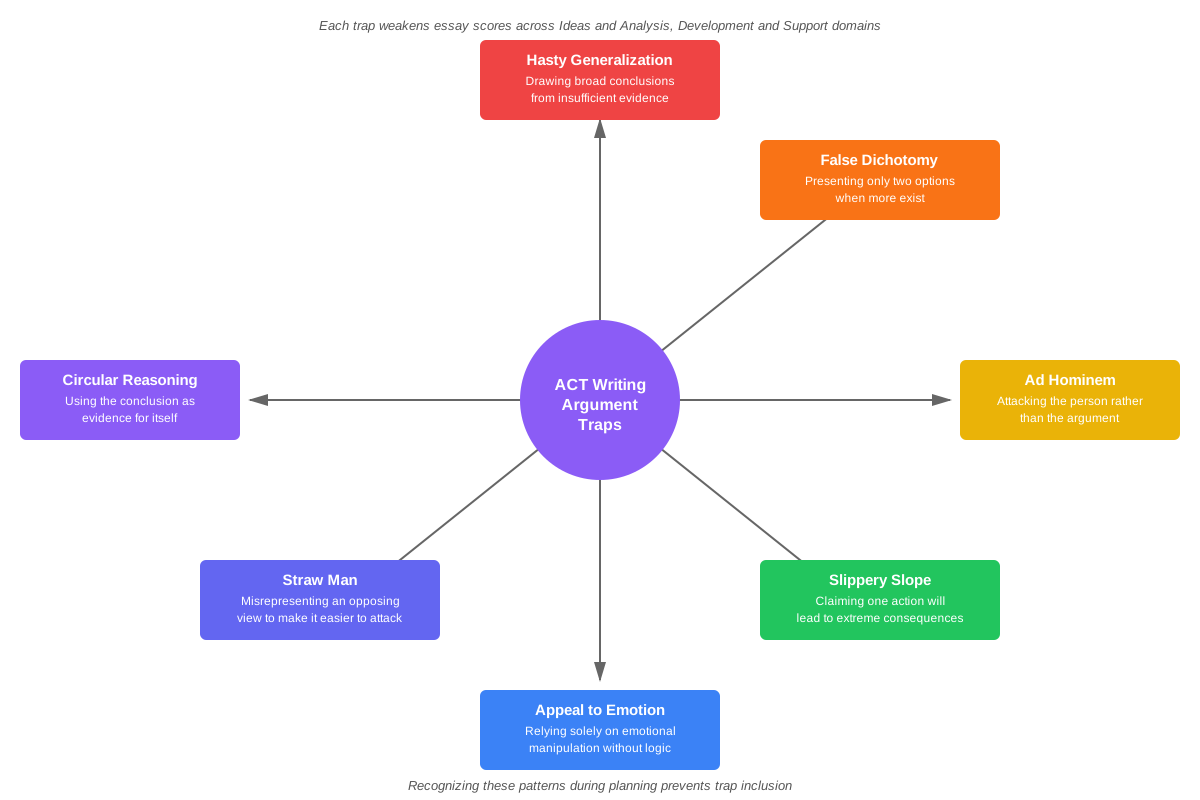
The ACT Writing test challenges students not only to construct a compelling argument but also to avoid subtle logical pitfalls that can undermine even the most eloquent essay. ACT writing argument traps are common reasoning errors, logical fallacies, and structural weaknesses that appear when students rush to develop their position without carefully considering the strength of their evidence and the validity of their reasoning. These traps can transform a potentially high-scoring essay into one that receives mediocre marks, regardless of grammar or vocabulary quality.
Understanding and avoiding these argument traps is essential for achieving a top score on the ACT Writing test. The essay graders specifically evaluate how well students develop and support their ideas with logical reasoning and relevant examples. When students fall into argument traps—such as making hasty generalizations, relying on emotional appeals without logic, or failing to address counterarguments—their essays demonstrate weak critical thinking skills that directly impact their scores across multiple rubric dimensions: Ideas and Analysis, Development and Support, and Organization.
This topic connects directly to broader Writing concepts including thesis development, evidence selection, counterargument integration, and logical progression of ideas. Mastering ACT writing argument traps enables students to construct more sophisticated, persuasive essays that demonstrate the analytical maturity evaluators seek. By recognizing these traps during the planning and drafting stages, students can preemptively strengthen their arguments and produce essays that stand out for their logical coherence and intellectual rigor.
Learning Objectives
- [ ] Identify when ACT writing argument traps is being tested
- [ ] Explain the core rule or strategy behind ACT writing argument traps
- [ ] Apply ACT writing argument traps to ACT-style questions accurately
- [ ] Recognize at least seven distinct types of argument traps in sample essay prompts and responses
- [ ] Evaluate sample paragraphs to determine which contain logical fallacies or weak reasoning
- [ ] Construct counterarguments that avoid common traps while strengthening overall essay quality
- [ ] Revise weak arguments by replacing trap-prone reasoning with sound logical support
Prerequisites
- Basic essay structure: Understanding of introduction, body paragraphs, and conclusion format is necessary because argument traps often occur within specific structural components
- Thesis statement construction: Ability to formulate a clear position statement is essential because many argument traps stem from unclear or overly broad thesis claims
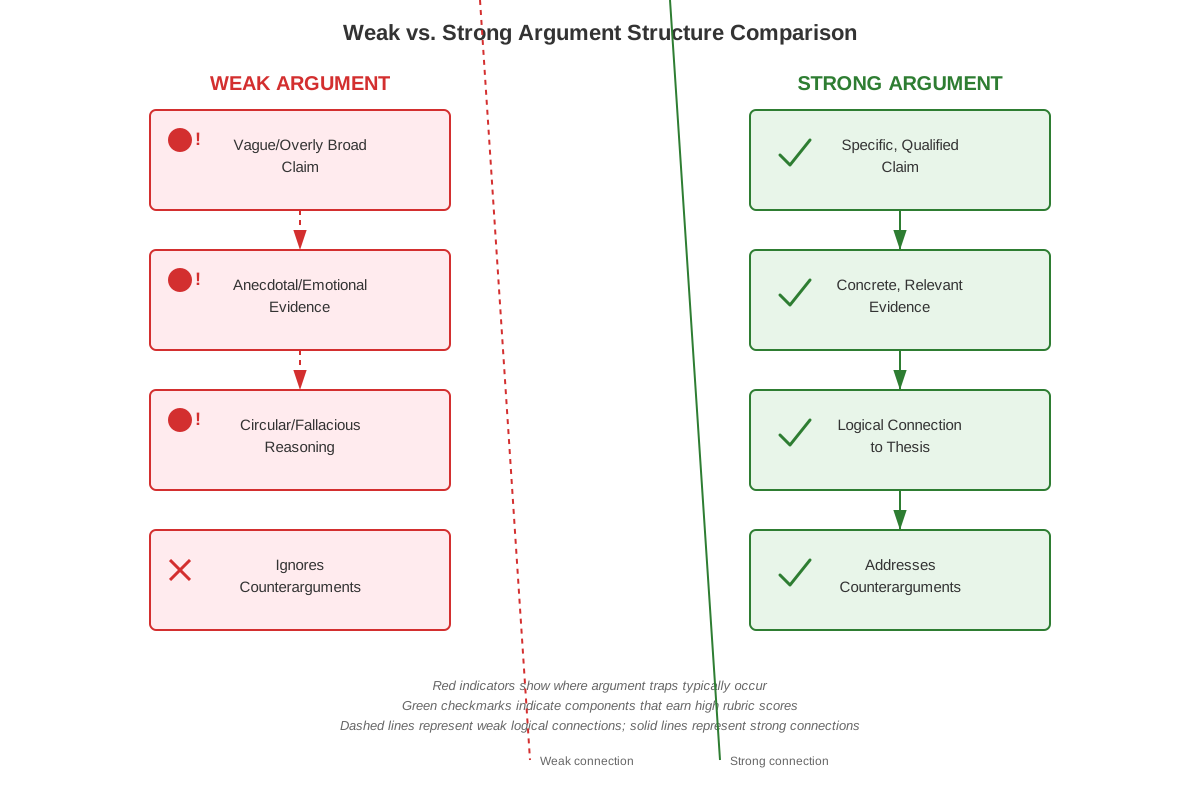
- Evidence types: Familiarity with examples, statistics, and reasoning as support forms is required because distinguishing strong from weak evidence helps identify traps
- Counterargument awareness: Basic understanding that essays should address opposing viewpoints is needed because failure to engage counterarguments represents a major trap category
Why This Topic Matters
In real-world contexts, the ability to construct sound arguments and recognize logical fallacies is fundamental to academic writing, professional communication, and informed citizenship. College coursework across disciplines requires students to evaluate claims critically, construct evidence-based arguments, and identify weaknesses in reasoning. The skills developed through mastering argument traps transfer directly to research papers, debate preparation, legal reasoning, and persuasive business communications.
On the ACT Writing test, argument quality directly determines scores across three of the four rubric domains. Statistical analysis of ACT essays reveals that high-scoring essays (10-12 range) consistently demonstrate sophisticated reasoning that avoids logical fallacies, while mid-range essays (6-8) frequently contain one or more argument traps that undermine their persuasiveness. Approximately 40-50% of the total essay score depends on the strength of reasoning and development—areas where argument traps most commonly appear.
The ACT Writing prompt typically presents a complex issue with multiple perspectives, requiring students to evaluate these perspectives, develop their own position, and explain relationships between their perspective and others. Argument traps most commonly appear when students: rush to support their thesis without considering evidence quality, oversimplify complex issues, ignore valid counterarguments, rely on emotional appeals without logical support, or make unsupported causal claims. Recognizing these patterns during the planning phase allows students to construct stronger arguments from the outset.
Core Concepts
Hasty Generalization Trap
A hasty generalization occurs when students draw broad conclusions from insufficient evidence or limited examples. This trap is particularly common in ACT essays because students often rely on personal anecdotes or single examples to support sweeping claims about society, education, or policy. For instance, arguing that "technology always improves education" based solely on one positive experience with educational apps represents a hasty generalization.
To avoid this trap, students should use qualifying language ("often," "in many cases," "frequently") rather than absolute terms ("always," "never," "all"). Additionally, supporting claims with multiple types of evidence—combining personal examples with broader observations or logical reasoning—strengthens arguments against this criticism.
False Dichotomy Trap
The false dichotomy trap emerges when students present an issue as having only two possible positions when multiple perspectives actually exist. ACT prompts deliberately present three perspectives to discourage binary thinking, yet students often fall into "either-or" reasoning patterns. For example, framing a technology debate as "either we embrace all technology or we reject it completely" ignores moderate positions about selective technology adoption.
Sophisticated essays acknowledge the spectrum of positions on complex issues. Students should explicitly recognize that multiple valid perspectives exist and explain why their position represents the most compelling option among several possibilities, not the only alternative to a single opposing view.
Circular Reasoning Trap
Circular reasoning occurs when the conclusion simply restates the premise without providing actual support. This trap appears when students essentially say "X is true because X is true" without offering independent evidence. For example: "Schools should prioritize creativity because creative thinking is the most important skill schools should teach" merely rephrases the claim without explaining why creativity deserves priority.
Breaking this cycle requires students to provide external justification—explaining consequences, citing benefits, or demonstrating logical connections between claims and outcomes. Strong arguments answer "why" questions with reasoning that extends beyond restatement.
Appeal to Emotion Without Logic
While emotional appeals can enhance persuasive writing, the appeal to emotion trap occurs when students rely exclusively on emotional language without providing logical reasoning or evidence. ACT graders specifically look for balanced arguments that combine emotional resonance with intellectual substance. An essay that argues for environmental protection solely through fear-inducing language about catastrophe, without explaining mechanisms or proposing solutions, falls into this trap.
Effective essays acknowledge emotional dimensions of issues while grounding arguments in logical analysis. Students should ask themselves: "If I removed the emotional language, would my argument still stand on its reasoning and evidence?"
Straw Man Fallacy
The straw man fallacy involves misrepresenting opposing viewpoints to make them easier to refute. Students fall into this trap when they oversimplify or distort counterarguments rather than engaging with their strongest forms. For instance, characterizing those who support traditional education as "wanting students to memorize useless facts" misrepresents legitimate concerns about foundational knowledge.
High-scoring essays demonstrate intellectual honesty by presenting counterarguments fairly before explaining why the student's position remains more compelling. This approach actually strengthens the essay by showing the writer can engage with sophisticated opposition.
Post Hoc Fallacy (False Causation)
The post hoc fallacy assumes that because one event followed another, the first caused the second. This trap appears frequently when students discuss historical trends or policy outcomes. For example: "After schools adopted technology, test scores declined; therefore, technology caused the decline" ignores numerous other factors that might explain score changes.
Avoiding this trap requires students to acknowledge complexity and avoid oversimplified causal claims. Using language like "contributed to" or "correlated with" rather than "caused" demonstrates more sophisticated reasoning. When making causal arguments, students should explain the mechanism connecting cause and effect.
Ignoring Counterarguments
Perhaps the most damaging trap is ignoring counterarguments entirely. ACT prompts present multiple perspectives specifically to test whether students can engage with complexity. Essays that present only supporting evidence without acknowledging opposing views appear one-dimensional and intellectually immature.
Strong essays dedicate at least one paragraph to counterargument engagement, explaining why alternative perspectives have merit but ultimately fall short compared to the student's position. This demonstrates critical thinking and strengthens the overall argument through contrast.
Weak or Irrelevant Evidence
The weak evidence trap occurs when students support claims with examples that don't actually prove their point or rely on vague, unverifiable assertions. Statements like "studies show" or "experts agree" without specifics, or personal anecdotes that don't connect clearly to broader claims, weaken argumentative force.
Students should evaluate each piece of evidence by asking: "Does this example actually demonstrate my claim? Is this evidence specific enough to be convincing? Does this connect logically to my thesis?" Quality matters more than quantity in evidence selection.
Concept Relationships
The various argument traps interconnect in ways that compound their negative effects on essay quality. Hasty generalization often leads to false dichotomy thinking, as students who oversimplify evidence tend to oversimplify positions as well. Both of these traps make students more vulnerable to circular reasoning because they haven't developed sufficient evidence to support claims independently.
Ignoring counterarguments frequently combines with straw man fallacy—when students do acknowledge opposing views, they may misrepresent them to make refutation easier. This connects to appeal to emotion without logic because students who avoid engaging with counterarguments intellectually often resort to emotional appeals instead.
The post hoc fallacy represents a specific type of weak evidence, demonstrating how evidence quality issues manifest in particular reasoning patterns. All these traps ultimately stem from insufficient critical analysis during the planning phase, creating a relationship map:
Rushed Planning → Insufficient Evidence Gathering → Hasty Generalization + Weak Evidence → False Dichotomy + Circular Reasoning → Straw Man Fallacy + Ignoring Counterarguments → Appeal to Emotion Without Logic → Low Essay Score
Understanding these relationships helps students recognize that avoiding argument traps requires systematic planning and evidence evaluation before drafting begins. Strengthening one area (such as evidence quality) naturally reduces vulnerability to multiple trap types.
High-Yield Facts
⭐ The ACT Writing rubric explicitly evaluates "reasoning and illustration" as a primary scoring criterion, making argument quality directly impact scores
⭐ High-scoring essays (10-12) consistently address counterarguments substantively rather than ignoring or dismissing them
⭐ Using absolute language ("always," "never," "all," "none") without qualification signals potential hasty generalization to graders
⭐ The three-perspective prompt structure specifically tests whether students can avoid false dichotomy thinking
⭐ Circular reasoning most commonly appears in thesis statements and topic sentences, making these critical revision points
- Personal anecdotes alone constitute insufficient evidence for broad claims about society or policy
- Emotional language should complement, not replace, logical reasoning and evidence
- Causal claims require explanation of mechanisms, not just temporal sequence
- Acknowledging complexity and nuance demonstrates intellectual maturity that graders reward
- Each body paragraph should contain both evidence and explanation of how that evidence supports the claim
- Qualifying language ("often," "typically," "in many cases") demonstrates more sophisticated reasoning than absolute claims
Quick check — test yourself on ACT writing argument traps so far.
Try Flashcards →Common Misconceptions
Misconception: Strong arguments require absolute certainty and unqualified claims to appear confident. → Correction: Sophisticated arguments acknowledge complexity and use qualifying language appropriately. Statements like "in most cases" or "generally" demonstrate intellectual maturity rather than weakness, as they show awareness that complex issues rarely have simple, universal answers.
Misconception: Addressing counterarguments weakens the essay by giving credibility to opposing views. → Correction: Engaging counterarguments actually strengthens essays by demonstrating critical thinking and making the student's position more persuasive through contrast. Graders specifically look for counterargument engagement as evidence of sophisticated analysis.
Misconception: Personal examples are always weak evidence that should be avoided. → Correction: Personal examples can effectively support arguments when they clearly illustrate broader principles and connect explicitly to the thesis. The weakness occurs when students rely exclusively on personal anecdotes or fail to explain how individual experiences relate to general claims.
Misconception: Emotional appeals are inappropriate in ACT essays and should be eliminated entirely. → Correction: Emotional resonance enhances persuasive writing when combined with logical reasoning and evidence. The trap occurs when students use emotion as a substitute for logic, not when they incorporate emotional dimensions alongside intellectual substance.
Misconception: Longer essays with more examples automatically score higher, regardless of argument quality. → Correction: While essay length correlates with scores, the relationship depends on content quality. Adding weak examples or falling into argument traps while expanding length actually decreases scores. Quality of reasoning matters more than quantity of words.
Worked Examples
Example 1: Identifying and Correcting Hasty Generalization
Prompt Context: Should schools require students to learn coding?
Weak Paragraph (Contains Trap):
"Schools should definitely require all students to learn coding. My friend learned to code and now has a great job at a tech company making lots of money. This proves that coding skills lead to career success. Every student needs these skills to succeed in the modern economy. Without coding knowledge, students will be left behind in the job market."
Analysis of Traps:
This paragraph contains multiple argument traps. First, it commits hasty generalization by drawing a broad conclusion ("every student needs these skills") from a single example (one friend's experience). Second, it uses absolute language ("definitely," "every," "will be") without qualification. Third, it demonstrates weak evidence by relying solely on one anecdote. Fourth, it commits a subtle post hoc fallacy by assuming the friend's success resulted from coding rather than other factors.
Revised Paragraph (Trap-Free):
"Schools should consider incorporating coding education into their curricula because programming skills increasingly benefit students across multiple career paths. While not every profession requires coding expertise, understanding basic programming concepts helps students develop logical thinking and problem-solving abilities applicable to diverse fields. For example, coding education teaches systematic approaches to complex problems—breaking them into manageable components and testing solutions iteratively. These transferable skills prove valuable whether students pursue technology careers or apply computational thinking to fields like business, science, or creative arts. However, schools should balance coding instruction with other essential skills rather than requiring extensive programming coursework for all students, recognizing that different students have different strengths and career interests."
Why This Works: The revised paragraph avoids hasty generalization by using qualifying language ("increasingly," "should consider") and acknowledging that coding isn't universally necessary. It provides reasoning beyond a single example, explaining the mechanism by which coding develops transferable skills. It avoids absolute claims and acknowledges counterarguments (different student interests) while maintaining a clear position.
Example 2: Addressing Counterarguments Without Straw Man Fallacy
Prompt Context: Should schools prioritize standardized test preparation?
Weak Paragraph (Contains Trap):
"Some people think schools shouldn't prepare students for standardized tests because they just want students to have fun all day without any accountability. These critics don't understand that tests measure important skills and colleges need some way to compare students. Obviously, we can't just let students do whatever they want without any assessment."
Analysis of Traps:
This paragraph commits the straw man fallacy by misrepresenting the counterargument. Critics of test preparation don't advocate for "fun all day without accountability"—they typically argue for alternative assessment methods or concerns about teaching to the test. The paragraph also creates a false dichotomy between test preparation and "doing whatever they want," ignoring middle-ground positions.
Revised Paragraph (Trap-Free):
"Critics of standardized test preparation raise legitimate concerns about narrowing curriculum and teaching to the test rather than fostering deep learning. They argue that excessive test focus can reduce time for creative projects, critical thinking development, and exploration of subjects not covered by standardized assessments. These concerns have merit—schools that devote months exclusively to test preparation may indeed sacrifice educational breadth. However, reasonable test preparation need not eliminate these valuable experiences. Strategic test preparation that teaches general skills like time management, careful reading, and systematic problem-solving actually complements broader educational goals. The key lies in balanced implementation: incorporating test-taking strategies within regular instruction rather than replacing substantive learning with drill-and-practice sessions. This approach addresses legitimate concerns about curriculum narrowing while acknowledging that standardized assessments, despite their limitations, provide useful data points for college admissions and educational accountability."
Why This Works: The revised paragraph presents counterarguments fairly and specifically, acknowledging their validity before explaining why the student's position remains more compelling. It avoids false dichotomy by presenting a middle-ground solution. The reasoning demonstrates intellectual honesty and sophistication that graders reward.
Exam Strategy
When approaching ACT Writing prompts, students should implement a systematic planning process that prevents argument traps before drafting begins. Spend 8-10 minutes of the 40-minute time limit on planning, using this time to evaluate evidence quality and identify potential logical weaknesses.
Trigger words that signal potential argument traps in student writing include: "always," "never," "everyone," "no one," "proves," "obviously," "clearly," and "must." During revision, circle these words and verify that claims using absolute language have sufficient support. If not, add qualifying language or strengthen evidence.
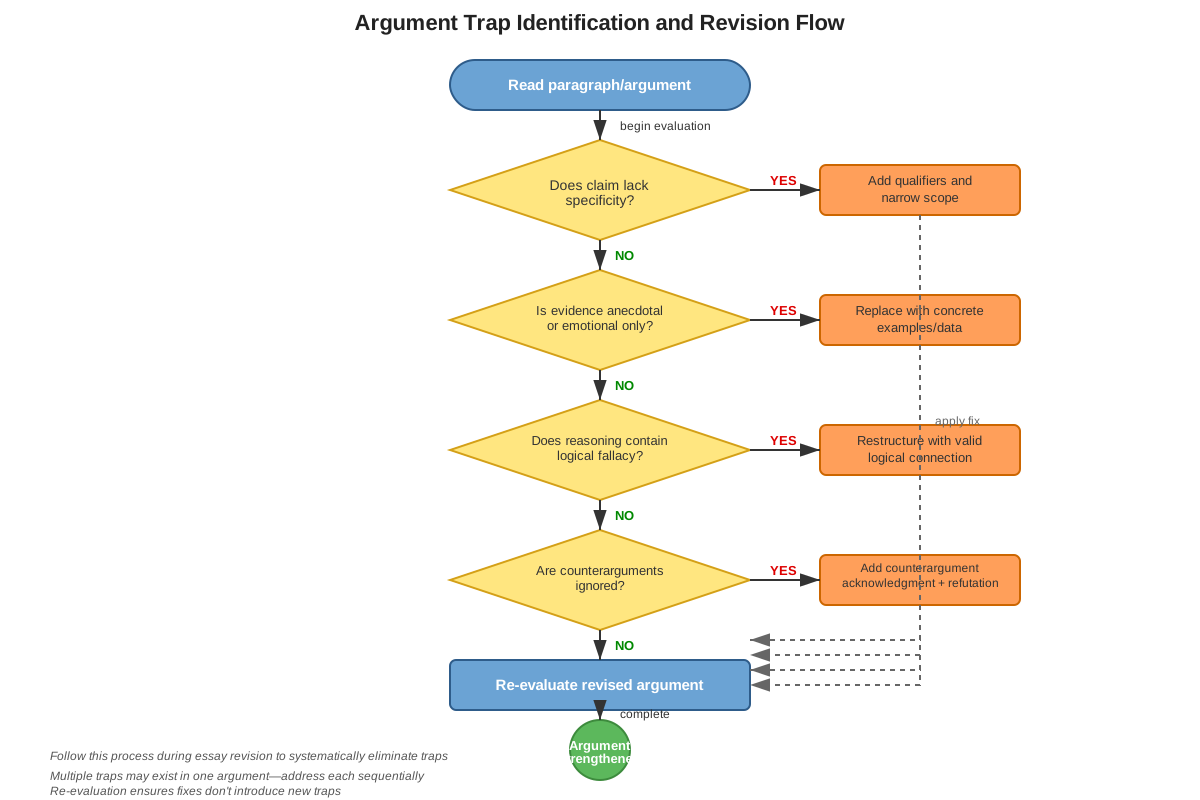
Process-of-elimination for self-evaluation: After drafting each body paragraph, ask three questions: (1) Does this evidence actually prove my claim, or am I assuming a connection? (2) Have I explained the reasoning connecting evidence to thesis, or am I expecting readers to infer it? (3) Would someone who disagrees with me find this paragraph persuasive, or have I only convinced people who already agree? If any answer reveals weakness, revise before continuing.
Time allocation strategy: Reserve 5 minutes at the end for targeted revision focused specifically on argument traps. Quickly scan for absolute language, verify that counterarguments appear, and check that each body paragraph contains both evidence and explanation. This focused revision catches traps that emerge during rushed drafting.
Planning technique: Create a two-column chart during planning—one column for supporting evidence, one for potential counterarguments. This visual organization ensures balanced consideration and prevents the trap of ignoring opposition. For each piece of supporting evidence, ask "What would critics say about this?" to preemptively strengthen arguments.
Memory Techniques
HASTY acronym for avoiding weak reasoning:
- Hasty generalizations need qualifying language
- Absolute claims require exceptional evidence
- Straw man fallacies misrepresent opposition
- Temporal sequence doesn't prove causation
- Your evidence must connect explicitly to claims
The Three E's for strong body paragraphs:
- Evidence (specific examples or reasoning)
- Explanation (how evidence supports the claim)
- Engagement (with complexity or counterarguments)
Visualization strategy: Picture argument traps as literal holes in a bridge connecting thesis to conclusion. Each trap weakens structural integrity. During planning, visualize building a solid bridge by placing strong evidence "planks" and avoiding gaps (weak reasoning). This mental image helps students recognize when arguments lack sufficient support.
COUNTER acronym for engaging opposing views:
- Concede valid points in counterarguments
- Outline the opposing perspective fairly
- Understand why others hold this view
- Nevertheless, explain your position's advantages
- Transition back to supporting your thesis
- Emphasize why your view remains more compelling
- Refine your argument through this contrast
Summary
Mastering ACT writing argument traps requires recognizing common logical fallacies and reasoning weaknesses that undermine essay quality, then implementing systematic strategies to avoid them. The most critical traps include hasty generalization (drawing broad conclusions from insufficient evidence), false dichotomy (presenting issues as binary when multiple perspectives exist), circular reasoning (restating claims without independent support), excessive emotional appeals without logic, straw man fallacy (misrepresenting counterarguments), post hoc fallacy (assuming causation from temporal sequence), ignoring counterarguments entirely, and relying on weak or irrelevant evidence. These traps interconnect, often compounding their negative effects when multiple appear in a single essay. Avoiding them requires careful planning, evidence evaluation, and revision focused specifically on reasoning quality. Students who systematically check for absolute language, verify evidence-claim connections, engage counterarguments fairly, and explain causal mechanisms produce essays that demonstrate the sophisticated critical thinking ACT graders reward with top scores.
Key Takeaways
- Argument quality directly determines ACT Writing scores across multiple rubric dimensions, making trap avoidance essential for high performance
- Hasty generalization and absolute claims without qualification represent the most common traps in student essays
- Engaging counterarguments fairly strengthens rather than weakens essays by demonstrating intellectual sophistication
- Evidence must connect explicitly to claims through explanation—never assume readers will infer the relationship
- Qualifying language ("often," "typically," "in many cases") demonstrates more sophisticated reasoning than absolute statements
- Systematic planning and targeted revision specifically focused on logical reasoning prevent most argument traps
- The three-perspective prompt structure specifically tests ability to avoid false dichotomy and engage with complexity
Related Topics
Thesis Development and Positioning: Understanding how to construct nuanced thesis statements that avoid overgeneralization connects directly to argument trap avoidance, as many traps originate in overly broad or absolute thesis claims.
Evidence Selection and Integration: Mastering the distinction between strong and weak evidence builds on trap recognition, helping students choose examples that genuinely support their claims rather than merely relating to the topic.
Counterargument Integration Techniques: Advanced strategies for incorporating and refuting opposing views extend the foundation of avoiding the "ignoring counterarguments" trap into sophisticated rhetorical techniques.
Logical Reasoning Patterns: Studying formal logic structures and valid argument forms deepens understanding of why certain reasoning patterns constitute traps while others demonstrate sound thinking.
Revision and Self-Editing Strategies: Developing systematic revision processes that target specific weaknesses builds on the self-evaluation techniques introduced in trap avoidance.
Practice CTA
Now that you understand the common argument traps that undermine ACT Writing essays and the strategies to avoid them, apply this knowledge through targeted practice. Complete the practice questions to test your ability to identify traps in sample paragraphs and revise weak arguments. Use the flashcards to reinforce recognition of specific trap types and their corrections. Remember that recognizing these patterns becomes automatic with practice—each essay you write with trap awareness strengthens your ability to construct logically sound arguments under time pressure. Your investment in mastering this skill will pay dividends not only on test day but throughout your academic career. Start practicing now to transform your understanding into consistent high-scoring performance!
Sign up free to keep reading
Create a free AnvayaPrep account to finish this ACT guide on ACT writing argument traps — plus flashcards and practice questions.