Overview
Argument depth is one of the most critical dimensions of effective essay writing on the ACT Writing test. While many students focus on simply stating their position and providing basic support, the ACT scoring rubric specifically rewards essays that demonstrate sophisticated, nuanced thinking through deep analysis rather than surface-level observations. Understanding and applying ACT argument depth separates essays that score in the 7-9 range from those that plateau at 4-6.
Argument depth refers to the extent to which a writer explores the complexities, implications, and nuances of their position and supporting evidence. Rather than merely listing reasons or examples, deep arguments examine why those reasons matter, explore counterarguments thoughtfully, consider context and limitations, and connect ideas to broader principles or consequences. On the ACT, evaluators specifically look for essays that move beyond obvious observations to demonstrate critical thinking and intellectual engagement with the prompt's complexity.
This topic sits at the heart of the Argument Development unit because depth transforms basic argumentation into persuasive, sophisticated writing. While related concepts like thesis development, evidence selection, and organization provide the structural framework for an essay, argument depth determines the quality of thinking within that framework. Mastering this skill not only improves ACT Writing scores but also develops the analytical thinking essential for college-level academic writing across all disciplines.
Learning Objectives
- [ ] Identify when Argument depth is being tested in ACT Writing prompts and scoring criteria
- [ ] Explain the core rule or strategy behind Argument depth and how it differs from surface-level argumentation
- [ ] Apply Argument depth to ACT-style questions accurately by developing sophisticated, nuanced responses
- [ ] Distinguish between shallow and deep analysis in sample essay passages
- [ ] Generate multiple layers of analysis for a single piece of evidence or claim
- [ ] Evaluate the effectiveness of counterargument engagement as a depth-building strategy
- [ ] Construct arguments that explore implications, consequences, and broader contexts
Prerequisites
- Basic essay structure: Understanding of introduction, body paragraphs, and conclusion organization is necessary because argument depth must be integrated within a coherent essay framework
- Thesis statement construction: Ability to craft a clear position statement provides the foundation upon which deeper analysis builds
- Evidence identification: Recognizing relevant examples and reasons is essential before one can analyze them deeply
- Paragraph development: Basic skills in expanding ideas within paragraphs enable the space needed for deeper exploration
- Perspective analysis: Understanding different viewpoints on an issue allows for the comparative thinking that creates depth
Why This Topic Matters
Argument depth directly impacts ACT Writing scores across multiple dimensions of the scoring rubric. The ACT evaluates essays on four domains—Ideas and Analysis, Development and Support, Organization, and Language Use—and argument depth primarily influences the first two domains, which together constitute half of the total score. Essays demonstrating sophisticated depth typically score 4-6 in Ideas and Analysis (out of 6), while those lacking depth rarely exceed a 3.
On the ACT Writing test, approximately 60-70% of the scoring weight relates directly or indirectly to how deeply students engage with the prompt's complexity. The Ideas and Analysis domain explicitly rewards "nuanced understanding of multiple perspectives" and "critical examination of ideas," both hallmarks of argument depth. The Development and Support domain values "skillful reasoning and illustration" over mere listing of examples.
In actual ACT prompts, argument depth appears in several consistent ways. Students encounter prompts presenting three perspectives on a complex issue (such as automation's impact on society, the value of intelligent machines, or public health policy). Shallow responses simply agree or disagree with one perspective and provide basic reasons. Deep responses explore why certain perspectives hold appeal in specific contexts, acknowledge legitimate concerns from opposing views, examine unstated assumptions, consider long-term versus short-term implications, and recognize that complex issues rarely have simple solutions. The difference between a score of 6 and a score of 10 often comes down entirely to argument depth rather than writing mechanics or organization.
Core Concepts
Defining Argument Depth
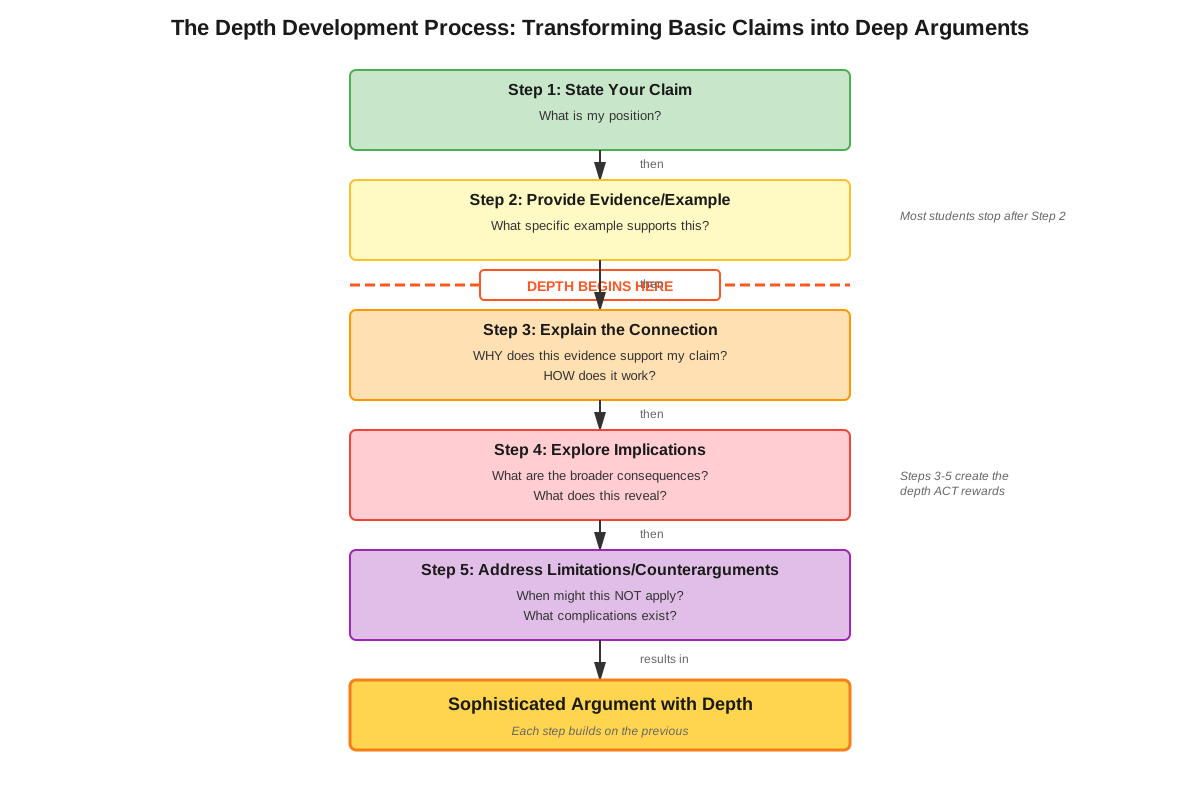
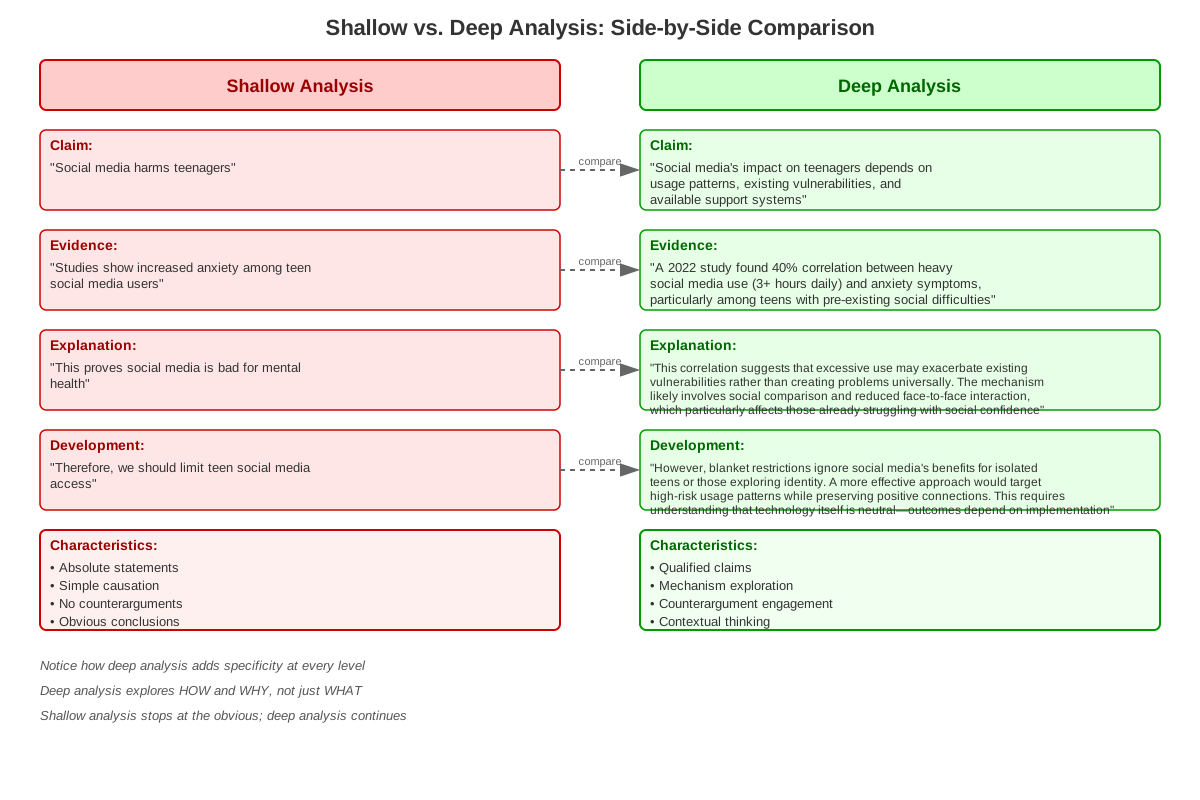
Argument depth represents the degree to which a writer explores the layers of meaning, implication, and complexity within their position and evidence. Rather than stopping at the first level of "what" (what is my position, what are my reasons), deep arguments pursue "why" (why does this reason matter, why might someone disagree, why are the implications significant) and "how" (how does this connect to broader principles, how do different contexts change the analysis, how do various factors interact).
The concept operates on multiple levels simultaneously. At the evidence level, depth means explaining not just what an example shows but why it matters, what it reveals about underlying principles, and how it connects to the broader argument. At the reasoning level, depth involves tracing logical connections through multiple steps rather than making single-step inferences. At the perspective level, depth requires genuinely engaging with opposing viewpoints rather than dismissing them superficially.
The Depth Spectrum
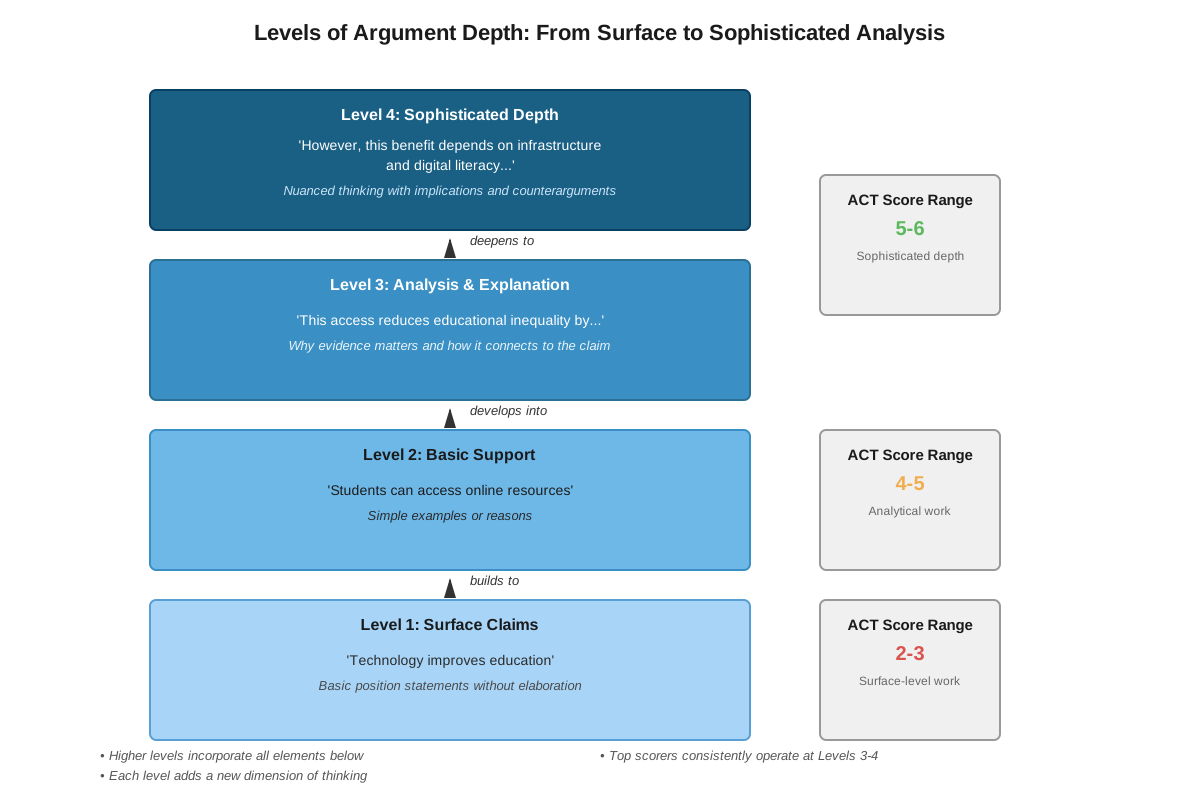
Arguments exist on a spectrum from shallow to deep, and recognizing where analysis falls on this spectrum helps writers improve systematically:
| Depth Level | Characteristics | Example |
|---|---|---|
| Surface | States position, lists basic reasons, provides examples without analysis | "Technology is good because it makes life easier. For example, smartphones help us communicate." |
| Developing | Explains reasons briefly, connects examples to claims, acknowledges one counterpoint | "Technology improves efficiency by reducing time spent on routine tasks, allowing people to focus on creative work. However, some worry about job displacement." |
| Proficient | Analyzes why reasons matter, explores implications, engages counterarguments substantively | "While technology's efficiency gains are valuable, we must consider whether 'easier' always means 'better.' The time saved on routine tasks could enable creativity, but it might also lead to constant connectivity that prevents the downtime necessary for deep thinking." |
| Advanced | Examines multiple dimensions, considers context-dependent factors, explores tensions between competing values, qualifies claims appropriately | "Technology's impact on ease depends critically on which populations and contexts we examine. For knowledge workers with digital access, smartphones enable flexibility and productivity. However, for workers in automated industries or communities with limited digital infrastructure, the same technologies may increase economic precarity. This suggests that 'technology's value' is not a single question but rather a set of context-specific questions about distribution, access, and social priorities." |
Analytical Moves That Create Depth
Several specific analytical moves consistently generate argument depth on the ACT:
Implication exploration involves tracing the consequences of a claim or position beyond the immediate effect. Instead of stopping at "this policy would reduce costs," deep analysis asks "what would those cost savings enable, who would benefit most, and what trade-offs might emerge?" This move demonstrates forward-thinking and systems-level understanding.
Assumption examination requires identifying and questioning the unstated premises underlying an argument. When a perspective claims "innovation requires competition," deep analysis asks "does all innovation require competition, or might some forms of innovation emerge from collaboration? What definition of innovation is being assumed?" This move reveals critical thinking about the foundations of arguments.
Context consideration recognizes that the strength of arguments often depends on circumstances. Deep analysis acknowledges that "while this approach works well in X context, it may face challenges in Y context because..." This move demonstrates nuanced understanding rather than absolutist thinking.
Tension acknowledgment involves recognizing when legitimate values or goals conflict, rather than pretending conflicts don't exist. For example: "Both individual privacy and public safety are important values, and policies in this area inevitably prioritize one over the other to some degree. The question becomes which priority better serves our broader social goals." This move shows intellectual maturity.
Counterargument engagement means genuinely grappling with opposing views rather than dismissing them. Deep engagement identifies the strongest version of an opposing argument, acknowledges its legitimate concerns, and then explains why one's own position remains preferable despite those concerns. This move demonstrates fairness and thorough thinking.
The "So What?" Test
A practical tool for developing argument depth is the "So What?" test. After making any claim or providing any evidence, writers should ask "So what? Why does this matter?" If the answer isn't already in the essay, that's where deeper analysis belongs. This test can be applied multiple times in succession:
- Claim: "Social media increases connectivity."
- So what? "People can maintain relationships across distances."
- So what? "This might reduce feelings of isolation."
- So what? "However, if online connections replace face-to-face interaction, we might see different types of isolation emerge—people surrounded by digital connections but lacking deep, in-person relationships."
Each iteration of "So what?" pushes the analysis deeper, moving from observation to implication to nuanced consideration of complexity.
Depth Versus Breadth
An important distinction exists between argument depth (exploring fewer points thoroughly) and argument breadth (covering many points superficially). On the ACT, depth consistently outperforms breadth. An essay that thoroughly analyzes two well-chosen reasons, exploring their implications and limitations, will score higher than an essay that lists five reasons with minimal explanation. This principle reflects the ACT's emphasis on quality of thinking over quantity of content.
The time constraints of the ACT Writing test (40 minutes) make depth versus breadth a strategic choice. Students who attempt to address too many points inevitably treat each superficially. Successful test-takers select 2-3 strong points and develop each with genuine depth, demonstrating sophisticated thinking within a manageable scope.
Concept Relationships
The concepts within argument depth form an interconnected system where each element reinforces the others. Analytical moves (implication exploration, assumption examination, context consideration, tension acknowledgment, and counterargument engagement) serve as the practical techniques that generate depth along the depth spectrum. The "So What?" test functions as a diagnostic tool that reveals where additional analytical moves would strengthen an argument.
These internal relationships connect to prerequisite knowledge in specific ways. Thesis statement construction provides the central claim that depth-building techniques then support and nuance. Evidence identification supplies the raw material that analytical moves transform into meaningful support. Paragraph development creates the structural space within which deep analysis unfolds—each body paragraph becomes a venue for applying multiple analytical moves to a single main point.
Argument depth also connects forward to related topics in the Argument Development unit. Counterargument integration represents one specific application of depth-building techniques, particularly counterargument engagement and tension acknowledgment. Evidence analysis focuses specifically on the analytical moves applied to examples and data. Logical reasoning provides the underlying validity that makes deep analysis persuasive rather than merely complicated.
The relationship map flows as follows: Basic essay structure → enables → Organized presentation of ideas → which provides space for → Argument depth → which is achieved through → Analytical moves → which are guided by → "So What?" test → resulting in → Movement up the depth spectrum → which improves → Ideas and Analysis scores → contributing to → Overall ACT Writing performance.
High-Yield Facts
- ⭐ Argument depth primarily affects the Ideas and Analysis and Development and Support domains of the ACT Writing rubric, which together constitute 50% of the total score
- ⭐ Essays scoring 9-12 consistently demonstrate nuanced understanding and critical examination of complexity, while essays scoring 5-8 typically present simpler, more straightforward analysis
- ⭐ The ACT rewards depth over breadth—thoroughly analyzing 2-3 points outperforms superficially listing 5+ points
- ⭐ Genuine engagement with counterarguments (acknowledging their strengths before explaining why your position remains preferable) is one of the most reliable depth-building techniques
- ⭐ The "So What?" test can be applied iteratively to any claim or evidence to generate deeper layers of analysis
- Shallow arguments stop at "what" (what is my position, what are my examples), while deep arguments pursue "why" and "how"
- Context consideration—acknowledging that argument strength varies by circumstance—demonstrates nuanced thinking valued by ACT evaluators
- Examining unstated assumptions underlying perspectives shows critical thinking that elevates Ideas and Analysis scores
- Exploring implications and consequences of positions demonstrates forward-thinking analysis
- Acknowledging tensions between competing values (rather than pretending conflicts don't exist) shows intellectual maturity
- Deep analysis often involves qualifying claims appropriately rather than making absolute statements
- The depth spectrum ranges from surface (stating positions) through developing (brief explanation) to proficient (analyzing significance) to advanced (examining multiple dimensions and context-dependent factors)
- Time management on the ACT Writing test should allocate more time to developing depth in 2-3 points than to planning many shallow points
- Effective depth-building often involves asking "under what conditions might this not be true?" or "who might be affected differently?"
Quick check — test yourself on Argument depth so far.
Try Flashcards →Common Misconceptions
Misconception: Argument depth means making arguments longer by adding more words or repetitive explanations.
Correction: Depth comes from exploring new layers of meaning, implication, and complexity, not from verbosity. A single sentence that examines an assumption or explores a consequence adds more depth than a paragraph that restates the same point in different words.
Misconception: Acknowledging counterarguments weakens your position and should be avoided or dismissed quickly.
Correction: Genuine counterargument engagement—identifying legitimate concerns in opposing views before explaining why your position remains preferable—is one of the strongest depth-building techniques. It demonstrates fairness, thorough thinking, and confidence in your position.
Misconception: Deep analysis requires specialized knowledge or sophisticated vocabulary beyond what most students possess.
Correction: Argument depth comes from thinking carefully about the implications and complexities of common ideas, not from using impressive-sounding words or referencing obscure information. The analytical moves that create depth (asking "why does this matter?" or "under what conditions might this not apply?") are accessible to all students.
Misconception: The ACT wants you to take a strong, absolute position without any qualifications or acknowledgment of complexity.
Correction: The ACT specifically rewards nuanced understanding that recognizes complexity. Appropriately qualified claims (acknowledging context-dependent factors or legitimate competing concerns) demonstrate sophisticated thinking, while absolute claims often appear simplistic.
Misconception: Providing more examples automatically creates deeper arguments.
Correction: Depth comes from analyzing examples thoroughly, not from accumulating many examples. One example explored for its implications, assumptions, and context creates more depth than three examples merely stated without analysis.
Misconception: Argument depth is only about the content of ideas, not about how they're expressed.
Correction: While depth primarily concerns the quality of thinking, how ideas are expressed matters significantly. Transitional phrases like "this suggests that," "the implications include," "however, we must consider," and "this depends on" signal analytical moves that create depth and help evaluators recognize sophisticated thinking.
Worked Examples
Example 1: Developing Depth in Evidence Analysis
Prompt Context: Should schools replace traditional textbooks with digital devices?
Shallow Version:
"Schools should use digital devices instead of textbooks because devices are more modern. For example, tablets can hold many books at once. This shows that digital devices are better."
Analysis of Shallow Version: This response states a position and provides an example but stops at the surface level. It doesn't explain why holding many books matters, doesn't consider any complications, and doesn't engage with the complexity of the issue.
Deep Version:
"While the storage capacity of digital devices offers practical advantages—a single tablet can indeed hold an entire library—we must examine whether this convenience translates into better learning outcomes. The ability to access many texts simultaneously could enable valuable cross-referencing and research skills. However, this assumes students have the self-regulation to use devices for academic purposes rather than entertainment, and it assumes all students have reliable home internet access to download materials. In contexts where these conditions hold, digital devices may enhance learning. In contexts where they don't—such as schools serving economically disadvantaged communities with limited home connectivity—the same devices might exacerbate educational inequities. This suggests that the textbook-versus-device question cannot be answered universally but rather depends on the specific resources and support systems available to students."
Analysis of Deep Version: This response demonstrates multiple depth-building techniques:
- Implication exploration: Moves from "holds many books" to "enables cross-referencing and research skills"
- Assumption examination: Identifies unstated assumptions about student self-regulation and internet access
- Context consideration: Recognizes that effectiveness varies by circumstance
- Tension acknowledgment: Addresses the conflict between convenience and equity
- Appropriate qualification: Concludes that the answer is context-dependent rather than absolute
Learning Objective Connection: This example demonstrates how to apply argument depth to ACT-style questions by transforming surface-level observations into nuanced analysis through specific analytical moves.
Example 2: Deepening Counterargument Engagement
Prompt Context: Should communities prioritize economic development or environmental preservation?
Shallow Version:
"Some people think environmental preservation is more important, but they are wrong because we need jobs. Economic development creates employment opportunities, so it should be the priority."
Analysis of Shallow Version: This response acknowledges an opposing view but dismisses it immediately without genuine engagement. It presents a false dichotomy (either/or) and doesn't explore the complexity of balancing competing values.
Deep Version:
"Environmental advocates raise a legitimate concern: economic development without environmental safeguards can degrade the natural resources that sustain both current and future prosperity. Their position recognizes that short-term economic gains might come at the cost of long-term sustainability—polluted water sources, depleted fisheries, or climate impacts that ultimately harm economic productivity. This perspective deserves serious consideration. However, communities facing immediate economic hardship cannot afford to treat environmental preservation as an abstract future concern when families struggle to meet basic needs today. The most effective approach likely involves integrated planning that pursues economic development through environmentally sustainable means—such as green technology industries or ecotourism—rather than treating these goals as mutually exclusive. This strategy acknowledges the validity of both concerns while seeking solutions that serve both values simultaneously, even if imperfectly."
Analysis of Deep Version: This response demonstrates sophisticated counterargument engagement:
- Identifies the strongest version of the opposing view (long-term sustainability concerns)
- Acknowledges its legitimate merits rather than dismissing it
- Tension acknowledgment: Recognizes the real conflict between immediate economic needs and long-term environmental concerns
- Moves beyond false dichotomy: Proposes integrated approaches rather than either/or thinking
- Appropriate qualification: Acknowledges that solutions may be imperfect while still being preferable
Learning Objective Connection: This example shows how to identify when argument depth is being tested (the prompt presents competing values) and how to apply depth-building strategies (genuine counterargument engagement and tension acknowledgment) to create sophisticated analysis.
Exam Strategy
Recognizing Depth Opportunities
ACT Writing prompts consistently present complex issues with multiple legitimate perspectives, which signals that depth is being tested. Watch for prompts that ask you to "evaluate and analyze" perspectives rather than simply "state your opinion." The presence of three provided perspectives indicates the test expects you to engage with complexity rather than present simple agreement or disagreement.
Trigger phrases in prompts that signal depth opportunities include:
- "Consider the implications..."
- "Evaluate multiple perspectives..."
- "Analyze the relationship between..."
- "Examine the complexities..."
When you see these phrases, the ACT is explicitly inviting deep analysis rather than surface-level response.
Time Allocation Strategy
Within the 40-minute ACT Writing test, allocate time to maximize depth:
- Planning (8-10 minutes): Identify 2-3 strong points you can develop deeply rather than listing many points you'll treat superficially
- Writing (25-28 minutes): Spend approximately 8-10 minutes per body paragraph, allowing time to apply multiple analytical moves to each main point
- Revision (2-4 minutes): Check that each body paragraph includes depth-building elements (implications, context, or counterargument engagement)
Exam Tip: If you find yourself listing a fourth or fifth main point during planning, stop. You won't have time to develop that many points deeply. Instead, invest that mental energy in identifying how to deepen your analysis of 2-3 strong points.
The Depth-Building Checklist
For each body paragraph, ensure you've included at least two of these depth-building elements:
- Explanation of why this point matters (implication exploration)
- Acknowledgment of when/where this point applies most strongly (context consideration)
- Recognition of a complicating factor or limitation (tension acknowledgment)
- Engagement with how an opposing perspective might respond (counterargument engagement)
- Examination of an assumption underlying the claim (assumption examination)
This checklist provides a concrete way to verify you're building depth rather than staying at the surface level.
Process of Elimination for Depth
When revising under time pressure, you can quickly identify shallow passages that need deepening by looking for these warning signs:
- Sentences that only state facts or examples without explaining their significance
- Paragraphs that list multiple points without developing any thoroughly
- Counterarguments mentioned but immediately dismissed without genuine engagement
- Absolute claims without any qualification or acknowledgment of context
- Examples provided but not analyzed for what they reveal or imply
If you spot these patterns, add one sentence that applies an analytical move: "This suggests that..." or "However, this depends on..." or "The implications include..." These additions transform shallow passages into deeper analysis.
Signaling Depth to Evaluators
Use transitional phrases that explicitly signal analytical moves, helping evaluators recognize your sophisticated thinking:
- For implication exploration: "This suggests that...", "The consequences include...", "This reveals..."
- For assumption examination: "This assumes that...", "Underlying this view is...", "This depends on the premise that..."
- For context consideration: "In contexts where...", "This applies particularly when...", "However, circumstances differ when..."
- For tension acknowledgment: "While both X and Y are valuable...", "This creates tension between...", "We must balance..."
- For counterargument engagement: "Opponents reasonably argue that...", "This concern has merit because...", "While this perspective raises valid points..."
These phrases serve as depth markers that guide evaluators to your most sophisticated thinking.
Memory Techniques
The DEPTH Acronym
Remember the five key analytical moves with DEPTH:
- Develop implications (ask "so what?")
- Examine assumptions (identify unstated premises)
- Perspectives engage (address counterarguments genuinely)
- Tensions acknowledge (recognize competing values)
- How context matters (consider when/where claims apply)
The Depth Ladder Visualization
Visualize argument development as climbing a ladder where each rung represents a deeper level of analysis:
- Ground level: State your position
- Rung 1: Provide a reason or example
- Rung 2: Explain why that reason matters
- Rung 3: Explore implications or consequences
- Rung 4: Consider limitations or context
- Rung 5: Acknowledge complexity or tensions
Aim to reach at least Rung 3 for each main point in your essay. High-scoring essays consistently reach Rungs 4-5.
The "Yes, But" Technique
For counterargument engagement, remember the "Yes, But" structure:
- Yes: Acknowledge the legitimate concern in the opposing view
- But: Explain why your position remains preferable despite that concern
This simple structure ensures genuine engagement rather than dismissive treatment of opposing perspectives.
The Three-Question Depth Generator
After writing any claim or example, ask these three questions in sequence:
- Why does this matter? (generates implication exploration)
- When might this not apply? (generates context consideration)
- What am I assuming? (generates assumption examination)
Answering even one of these questions adds a layer of depth to your analysis.
Summary
Argument depth represents the extent to which writers explore complexity, implications, and nuances rather than staying at surface-level observations. On the ACT Writing test, depth primarily determines scores in the Ideas and Analysis and Development and Support domains, making it responsible for approximately half of the total score. Deep arguments move beyond "what" to explore "why" and "how," applying specific analytical moves including implication exploration, assumption examination, context consideration, tension acknowledgment, and counterargument engagement. The depth spectrum ranges from surface-level statements through developing explanations to proficient analysis and finally to advanced examination of multiple dimensions and context-dependent factors. Successful ACT test-takers prioritize depth over breadth, thoroughly developing 2-3 strong points rather than superficially listing many points. The "So What?" test provides a practical tool for generating deeper analysis by iteratively questioning the significance of claims and evidence. Genuine counterargument engagement—acknowledging legitimate concerns in opposing views before explaining why one's position remains preferable—consistently distinguishes high-scoring essays. Ultimately, argument depth demonstrates the sophisticated, nuanced thinking that the ACT Writing test specifically rewards and that college-level academic work requires.
Key Takeaways
- Argument depth determines the difference between mid-range scores (5-8) and high scores (9-12) on the ACT Writing test by demonstrating sophisticated thinking
- Five analytical moves create depth: implication exploration, assumption examination, context consideration, tension acknowledgment, and counterargument engagement
- The "So What?" test applied iteratively to any claim or evidence generates deeper layers of analysis
- Depth beats breadth—thoroughly analyzing 2-3 points outperforms superficially listing 5+ points within the 40-minute time limit
- Genuine counterargument engagement (acknowledging strengths of opposing views before explaining why your position remains preferable) is one of the most reliable depth-building techniques
- Context consideration and appropriate qualification of claims demonstrate nuanced understanding rather than simplistic thinking
- Transitional phrases like "this suggests that," "however, this depends on," and "the implications include" signal analytical moves and help evaluators recognize sophisticated thinking
Related Topics
Counterargument Integration: Building on argument depth skills, this topic focuses specifically on strategies for incorporating and responding to opposing viewpoints effectively. Mastering argument depth provides the analytical foundation for sophisticated counterargument work.
Evidence Analysis: This topic applies depth-building techniques specifically to examples, data, and supporting material. The analytical moves learned in argument depth transfer directly to evidence analysis.
Thesis Complexity: Advanced thesis statements reflect the nuanced thinking developed through argument depth practice. Understanding depth enables crafting thesis statements that acknowledge complexity rather than presenting oversimplified positions.
Logical Reasoning: This topic examines the validity of argument structures and the strength of logical connections. Argument depth provides the content that logical reasoning organizes into persuasive structures.
Perspective Analysis: This topic focuses on understanding and evaluating multiple viewpoints on complex issues. The context consideration and counterargument engagement skills from argument depth directly support sophisticated perspective analysis.
Practice CTA
Now that you understand the principles and techniques of argument depth, it's time to apply these concepts to actual ACT-style prompts. The practice questions and flashcards will help you internalize the analytical moves that create depth and develop the ability to recognize depth opportunities quickly during the exam. Remember: depth is a skill that improves with deliberate practice. Each time you apply the "So What?" test or engage genuinely with a counterargument, you're building the sophisticated thinking patterns that lead to top ACT Writing scores. Start practicing now to make these techniques automatic by test day!
Sign up free to keep reading
Create a free AnvayaPrep account to finish this ACT guide on Argument depth — plus flashcards and practice questions.