Overview
Claim development is one of the most critical skills tested in the ACT Writing section, forming the foundation of effective argumentative writing. At its core, claim development refers to the process of establishing, supporting, and elaborating on a central argument or thesis statement through logical reasoning, relevant evidence, and thoughtful analysis. The ACT evaluates how well students can construct and maintain a coherent position on a given issue while addressing multiple perspectives and demonstrating sophisticated thinking.
On the ACT Writing test, students must respond to a prompt that presents a complex issue along with three different perspectives. Success requires not only stating a clear claim but also developing that claim throughout the essay with specific examples, logical connections, and nuanced consideration of counterarguments. The scoring rubric explicitly rewards essays that demonstrate strong claim development, with the highest-scoring essays showing "skillful development of ideas" and "effective support and development of ideas." Essays that merely state a position without adequate development typically receive lower scores, regardless of grammar or organization quality.
Understanding claim development connects directly to other essential Writing concepts including thesis construction, evidence selection, counterargument integration, and paragraph organization. While a thesis statement establishes what the writer believes, claim development is the sustained effort throughout the essay to prove why that belief is valid and persuasive. This topic serves as the bridge between initial planning and final execution, transforming a simple opinion into a compelling, well-reasoned argument that demonstrates college-level critical thinking.
Learning Objectives
- [ ] Identify when Claim development is being tested in ACT Writing prompts and scoring criteria
- [ ] Explain the core rule or strategy behind Claim development in argumentative essays
- [ ] Apply Claim development to ACT-style questions accurately by constructing well-supported arguments
- [ ] Distinguish between adequately developed claims and underdeveloped assertions
- [ ] Evaluate the effectiveness of different types of evidence in supporting a central claim
- [ ] Synthesize multiple perspectives while maintaining consistent claim development throughout an essay
- [ ] Construct topic sentences that advance claim development in each body paragraph
Prerequisites
- Basic essay structure: Understanding introduction, body paragraphs, and conclusion organization is essential because claim development occurs systematically throughout these components
- Thesis statement construction: Knowing how to craft a clear, arguable thesis provides the foundation that claim development builds upon
- Evidence types: Familiarity with examples, statistics, expert opinions, and logical reasoning enables effective support for claims
- Paragraph unity: Understanding how sentences within a paragraph should relate to a single main idea ensures focused claim development
- Perspective analysis: Ability to understand and evaluate different viewpoints on an issue allows for sophisticated claim development that addresses complexity
Why This Topic Matters
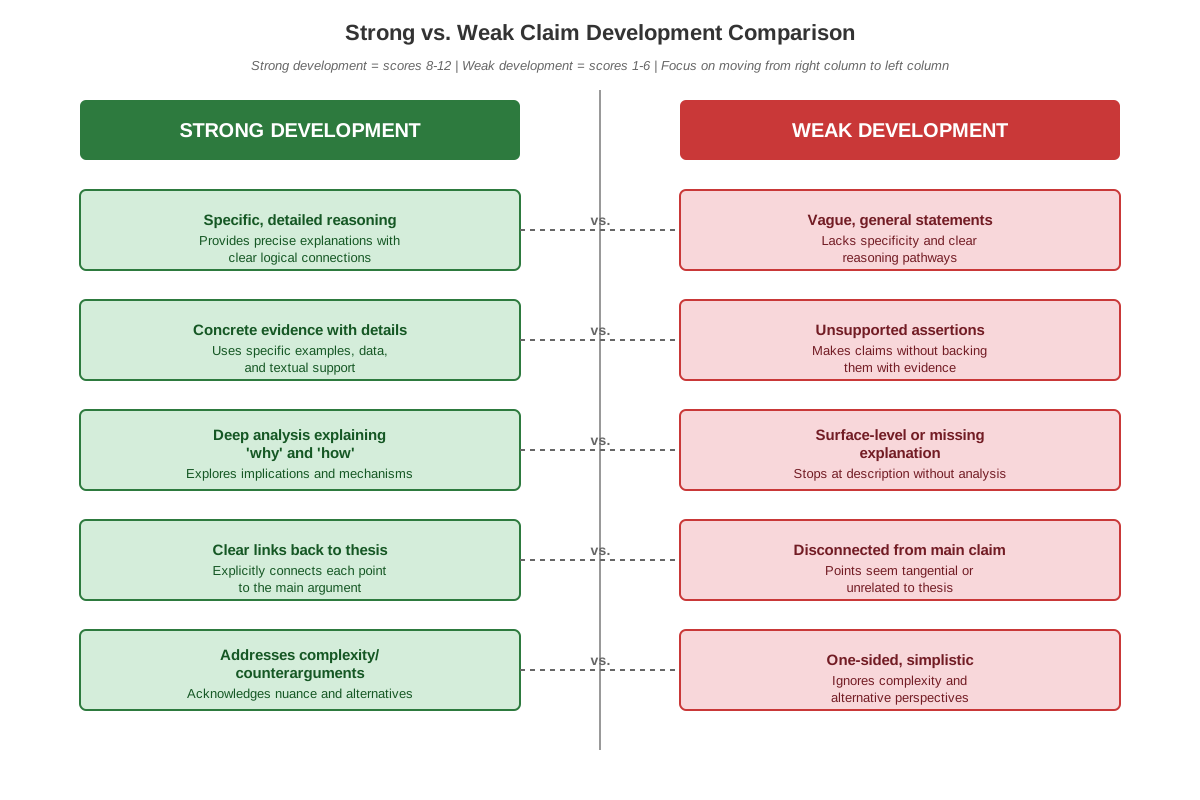
ACT claim development appears in every single Writing test and directly determines a significant portion of the essay score. The ACT Writing rubric allocates substantial weight to "Development and Support" (one of four scoring domains), making this topic account for approximately 25% of the total Writing score. Students who master claim development consistently score in the 8-12 range (out of 12), while those who struggle with it rarely exceed a 6, regardless of their grammar proficiency.
In real-world contexts, claim development represents the fundamental skill of persuasive communication used in college papers, professional proposals, legal arguments, and policy debates. The ability to take a position and systematically support it with evidence and reasoning is perhaps the most transferable academic skill students develop. Employers consistently rank "ability to construct and defend arguments" among the top desired competencies for college graduates.
On the ACT specifically, claim development appears in several distinct ways. The prompt itself asks students to "evaluate and analyze" the given perspectives while developing their own perspective on the issue. The scoring rubric explicitly evaluates whether the essay "develops a perspective on the issue," whether ideas are "developed with clarity and purpose," and whether the writer provides "effective support" for claims. Graders look for essays that go beyond surface-level statements to explore the implications, applications, and nuances of the writer's position. Essays that simply restate the prompt or list examples without connecting them to the central claim receive significantly lower scores.
Core Concepts
What Constitutes Claim Development
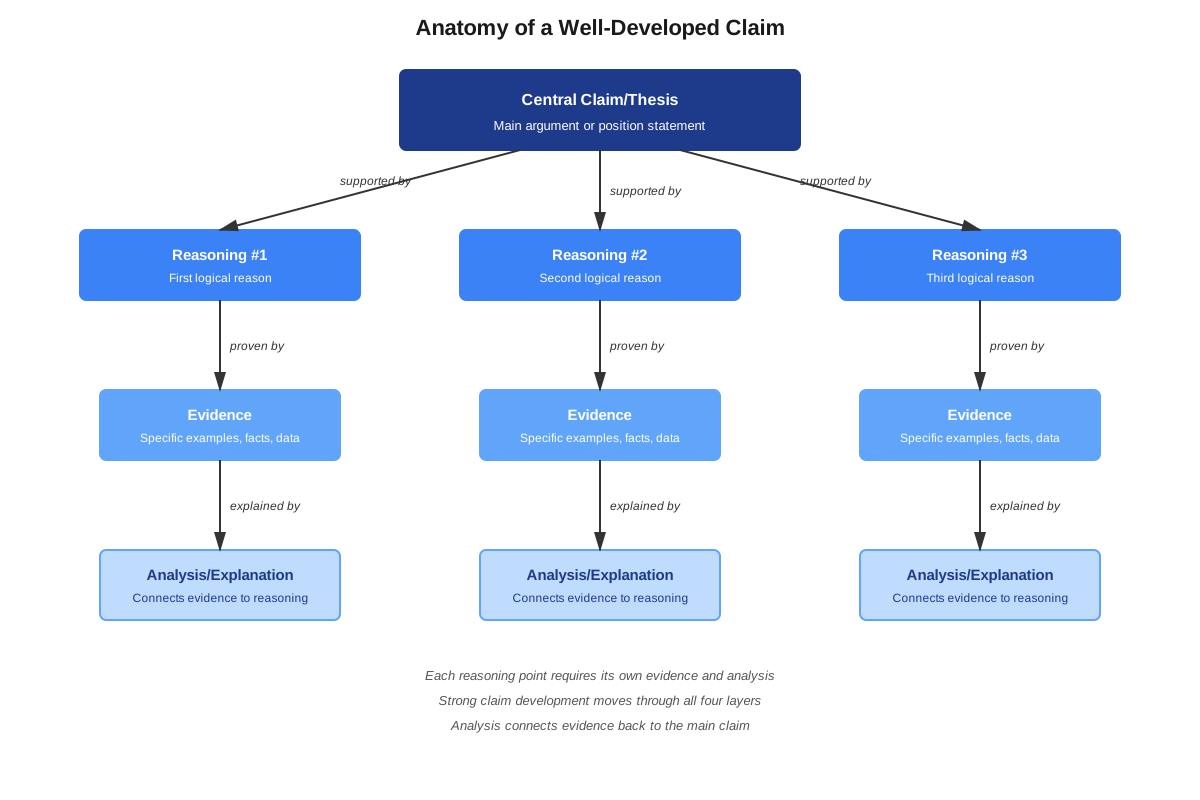
Claim development is the comprehensive process of building, supporting, and elaborating on an argumentative position throughout an essay. It involves three essential components: establishing a clear central claim (thesis), providing relevant and specific evidence to support that claim, and explaining how the evidence connects to and strengthens the argument. Strong claim development transforms a simple statement of opinion into a persuasive, well-reasoned argument that demonstrates critical thinking.
The development process requires depth rather than breadth. A well-developed claim explores one or two key reasons thoroughly rather than listing five superficial points. Each piece of evidence must be unpacked—the writer must explain not just what the evidence is, but why it matters and how it proves the claim. This explanatory component, often called "analysis" or "commentary," distinguishes high-scoring essays from mediocre ones.
The Three Layers of Effective Claim Development
Successful claim development operates on three distinct levels that work together to create a compelling argument:
Layer 1: Assertion - The claim itself must be clear, specific, and arguable. Rather than stating "Technology is important," a developed claim might assert "Digital literacy programs in elementary schools are essential for preparing students to navigate an increasingly automated workforce." The specificity provides direction for development.
Layer 2: Evidence - Supporting material must be concrete, relevant, and sufficient. This includes specific examples (historical events, current events, personal observations), logical reasoning (cause-effect relationships, comparisons), and hypothetical scenarios that illustrate the claim's validity. The ACT rewards essays that use varied evidence types rather than relying solely on one approach.
Layer 3: Analysis - The writer must explicitly connect evidence to the claim through explanation. This involves answering "so what?" and "why does this matter?" Analysis demonstrates the logical relationship between support and conclusion, showing rather than assuming the connection. High-scoring essays spend more words on analysis than on evidence presentation.
Development Strategies for ACT Essays
| Strategy | Description | Example Application |
|---|---|---|
| Elaboration | Expanding on a point with additional details, explanations, or implications | After stating that automation threatens jobs, explain which sectors face greatest risk and why |
| Exemplification | Providing specific, concrete examples that illustrate the claim | Reference the decline of manufacturing jobs in specific regions due to robotics |
| Cause-Effect Analysis | Explaining how one factor leads to another, demonstrating logical relationships | Show how reduced manufacturing jobs lead to economic decline, which affects education funding |
| Comparison/Contrast | Examining similarities and differences to clarify the claim | Compare regions that invested in retraining programs versus those that didn't |
| Qualification | Acknowledging limitations or conditions of the claim to show nuanced thinking | Recognize that some automation creates new job categories while eliminating others |
The Role of Perspective Integration
The ACT Writing prompt provides three perspectives on the issue, and effective claim development requires engaging with these perspectives meaningfully. This doesn't mean agreeing with all perspectives or giving them equal weight. Instead, strong development involves acknowledging relevant perspectives, explaining their strengths or weaknesses, and showing how the writer's own claim accounts for or responds to these alternative viewpoints.
Integration of perspectives serves claim development by demonstrating that the writer has considered the issue's complexity. A well-developed essay might adopt one perspective fully, synthesize elements from multiple perspectives, or propose an entirely new perspective—but in all cases, the development must show engagement with the provided viewpoints. This engagement itself becomes evidence of sophisticated thinking, which strengthens the overall claim.
Paragraph-Level Development
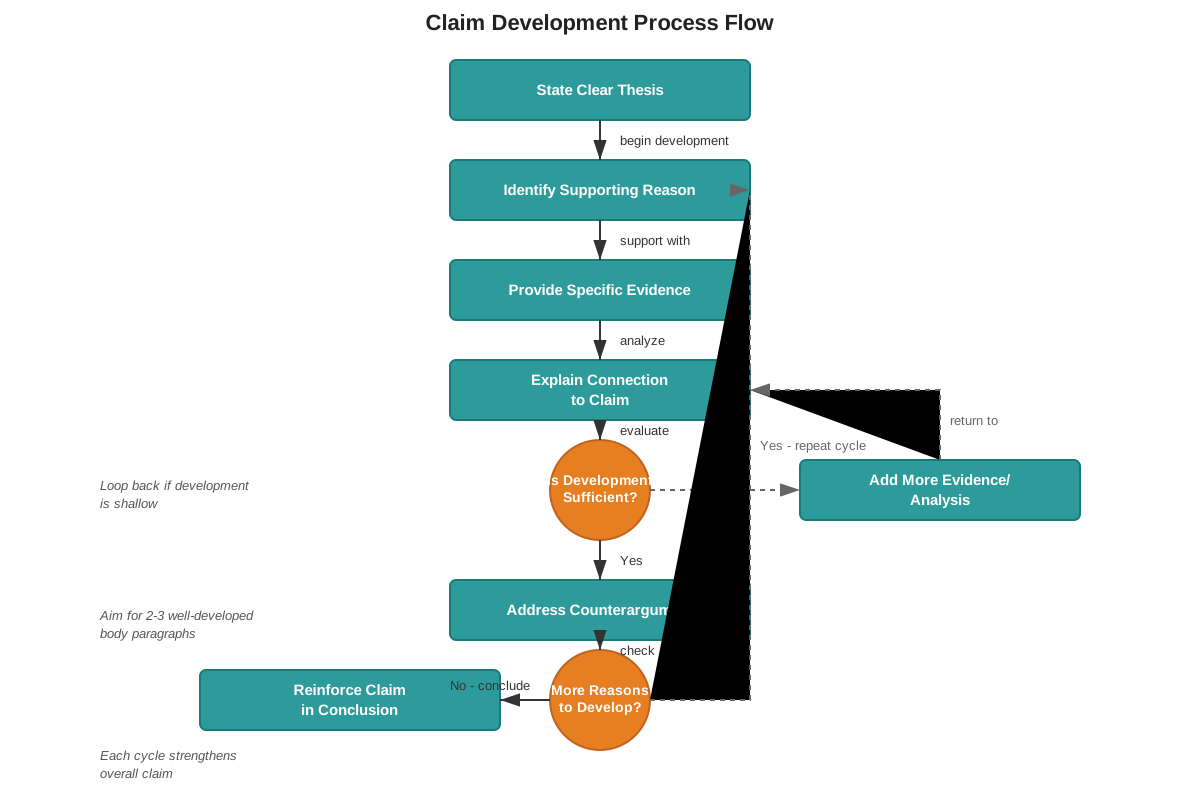
Each body paragraph should advance the overall claim through focused development of a single supporting reason. The paragraph's topic sentence states the specific aspect of the claim being developed, followed by evidence and analysis that elaborate on that point. Effective paragraphs follow a pattern: claim → evidence → explanation → connection back to thesis.
Within paragraphs, development requires sufficient length and depth. A paragraph that states a point and provides one brief example without explanation demonstrates weak development. Strong development might include multiple sentences explaining the example's significance, exploring its implications, or connecting it to broader patterns. The ACT rewards paragraphs that feel complete and thorough rather than rushed or superficial.
Maintaining Development Throughout the Essay
Claim development isn't confined to body paragraphs—it must be sustained from introduction through conclusion. The introduction should establish the claim clearly and preview the development approach. Body paragraphs execute the development through evidence and analysis. The conclusion should synthesize the development, showing how the accumulated evidence and reasoning support the claim without merely repeating earlier points.
Transitions between paragraphs play a crucial role in maintaining development by showing logical progression. Rather than simply moving to a new point, effective transitions demonstrate how each paragraph builds on previous development, creating a cumulative argument that grows stronger as the essay progresses.
Concept Relationships
Claim development serves as the central hub connecting multiple writing skills. The relationship begins with thesis construction → which establishes the claim that requires development → leading to evidence selection → which provides the raw material for development → necessitating analysis and explanation → which transforms evidence into persuasive support → while perspective integration → enriches development by showing awareness of complexity → and paragraph organization → structures the development for maximum clarity and impact.
The connection to prerequisite knowledge is direct: understanding basic essay structure provides the framework within which claim development occurs, while familiarity with evidence types determines what materials are available for development. The relationship flows bidirectionally—strong claim development reinforces clear organization, while clear organization facilitates effective development.
Within the topic itself, the three layers of claim development (assertion, evidence, analysis) form a hierarchical relationship where each layer depends on the previous one. Without a clear assertion, evidence lacks direction. Without evidence, analysis has nothing to work with. Without analysis, evidence remains disconnected from the claim. This interdependence means that weakness in any layer compromises overall development.
Claim development also connects forward to advanced writing skills like rhetorical strategy and stylistic sophistication. Once students master basic development, they can focus on how to develop claims more persuasively through strategic word choice, varied sentence structure, and audience awareness. The progression moves from "Can I develop my claim?" to "How can I develop my claim most effectively?"
High-Yield Facts
⭐ The ACT Writing rubric allocates 25% of the score specifically to "Development and Support," making claim development one of the four equally-weighted scoring domains
⭐ Essays that score 10-12 demonstrate "skillful development" with "effective support and development of ideas," while essays scoring 7-9 show "adequate development" and essays scoring 4-6 show "weak or uneven development"
⭐ Effective claim development requires analysis (explanation of why evidence matters) to be longer than the evidence presentation itself—typically a 2:1 ratio of analysis to evidence
⭐ The highest-scoring essays engage meaningfully with at least two of the three provided perspectives while developing their own perspective, showing sophisticated thinking
⭐ Topic sentences in body paragraphs must advance the central claim by stating a specific reason or aspect, not merely announcing a topic
- Claim development should occur in every paragraph, including the introduction and conclusion, not just body paragraphs
- Specific examples (naming actual events, people, places, or situations) demonstrate stronger development than generic or hypothetical examples
- The "so what?" test is essential: if the reader must guess why evidence matters, development is insufficient
- Counterargument acknowledgment and refutation strengthens claim development by showing the writer has considered alternatives
- Development depth (thorough exploration of fewer points) consistently scores higher than development breadth (superficial coverage of many points)
- Effective development includes exploring implications and consequences of the claim, not just stating reasons for believing it
- The conclusion should synthesize development by showing how evidence accumulates to support the claim, not merely restate the thesis
Quick check — test yourself on Claim development so far.
Try Flashcards →Common Misconceptions
Misconception: Claim development means including as many examples as possible in the essay.
Correction: Quality trumps quantity in claim development. The ACT rewards thorough exploration of one or two well-chosen examples with detailed analysis over superficial listing of multiple examples. A single example developed across four sentences with explanation of its significance demonstrates stronger development than three examples mentioned in one sentence each.
Misconception: Stating the claim clearly in the thesis is sufficient development for the introduction.
Correction: While the thesis establishes the claim, the introduction should also preview how the claim will be developed and provide context for why the issue matters. Strong introductions establish not just what the writer believes but also the framework for proving that belief.
Misconception: Evidence speaks for itself and doesn't require explanation.
Correction: The connection between evidence and claim must be explicitly stated through analysis. Even if the connection seems obvious to the writer, the ACT rewards essays that explain why evidence supports the claim. Graders look specifically for sentences that begin with phrases like "This demonstrates that..." or "This example shows how..." to indicate analytical thinking.
Misconception: Addressing the three provided perspectives means devoting equal space to each one.
Correction: Effective perspective integration involves engaging meaningfully with perspectives relevant to the writer's claim, not mechanically discussing all three equally. An essay might thoroughly analyze one perspective that directly opposes the writer's claim while briefly acknowledging another, demonstrating strategic rather than formulaic development.
Misconception: Longer essays automatically demonstrate better claim development.
Correction: While length often correlates with higher scores, the relationship is not causal. Essays earn high scores through substantive development—depth of analysis, specificity of examples, and clear explanation—not through padding or repetition. A focused 3-page essay with strong development will outscore a rambling 4-page essay with weak development.
Misconception: Personal examples are less effective than historical or current events for claim development.
Correction: The source of evidence matters less than how it's developed. A personal observation developed with specific details and thorough analysis can be just as effective as a historical example. The key is specificity and explanation, not the type of evidence chosen.
Worked Examples
Example 1: Developing a Claim About Educational Technology
Prompt Context: Should schools prioritize technology integration in classrooms?
Weak Development:
"Schools should use more technology because it helps students learn. Technology is important in today's world. Students need to know how to use computers. Many jobs require technology skills."
Analysis of Weakness: This passage states a claim but fails to develop it. The sentences are vague ("helps students learn" without explaining how), repetitive (multiple sentences making the same basic point), and lack specific evidence or analysis. No examples are provided, and no explanation connects the general statements to a coherent argument.
Strong Development:
"Schools should prioritize technology integration because digital literacy has become as fundamental as traditional literacy for economic participation. Consider the transformation of the retail sector: according to the Bureau of Labor Statistics, online retail employment grew 74% between 2015 and 2020, while traditional retail employment declined 8%. This shift means that students entering the workforce will encounter digital interfaces in virtually every career path, from healthcare workers navigating electronic medical records to construction managers using project management software. By integrating technology throughout the curriculum rather than isolating it in computer classes, schools prepare students to view digital tools as natural extensions of learning and problem-solving. This preparation proves especially critical for students from lower-income households who may lack home access to technology; without school-based integration, these students face a compounding disadvantage in both academic achievement and career readiness."
Analysis of Strength: This passage demonstrates multiple development strategies. It provides a specific, arguable claim with clear direction. The Bureau of Labor Statistics reference offers concrete evidence with specific numbers. The analysis explains why this evidence matters by connecting employment trends to student needs. The passage explores implications (what this means for different career paths) and addresses equity considerations (students without home access). The development moves from evidence to explanation to broader significance, creating a complete argument within a single paragraph.
Example 2: Integrating Perspectives While Developing a Claim
Prompt Context: Is automation primarily beneficial or harmful to society?
Weak Development:
"Perspective One says automation is good because it increases efficiency. Perspective Two says automation is bad because it eliminates jobs. Perspective Three says we need to balance automation with human needs. I agree with Perspective Three because balance is important."
Analysis of Weakness: This passage summarizes perspectives without developing any claim. It demonstrates no original thinking, provides no evidence, and offers no analysis. The agreement with Perspective Three is stated but not explained or supported. This represents the most common error in ACT essays: treating perspective integration as a checklist rather than as part of claim development.
Strong Development:
"While Perspective One correctly identifies automation's efficiency gains, this view overlooks the distribution of those gains—a critical factor in determining automation's net social impact. The efficiency benefits of automated manufacturing, for instance, have accrued primarily to shareholders and executives rather than workers or consumers. When General Motors automated its Lordstown, Ohio plant in 2017, production efficiency increased 23%, but the company eliminated 1,500 positions while average vehicle prices rose rather than fell. This pattern reveals the limitation in Perspective One's reasoning: efficiency alone doesn't guarantee social benefit if the gains concentrate among those who already possess capital. Perspective Two's concern about job elimination is therefore valid but incomplete; the issue isn't automation itself but rather the absence of policies that distribute automation's benefits more broadly. A more nuanced position recognizes that automation's social value depends on accompanying policies—such as retraining programs, progressive taxation of automation gains, or reduced work weeks that spread remaining employment—that ensure efficiency gains translate into widespread prosperity rather than increased inequality."
Analysis of Strength: This passage uses perspective integration as a vehicle for claim development. It engages critically with Perspective One by acknowledging its validity while identifying its limitation. The General Motors example provides specific, concrete evidence with numbers. The analysis explains why this evidence matters and what it reveals about the perspective's reasoning. The passage then connects to Perspective Two, showing how the writer's claim synthesizes insights from multiple perspectives while moving beyond them. The development demonstrates sophisticated thinking by identifying the underlying issue (distribution of gains) that explains why perspectives differ.
Exam Strategy
When approaching ACT Writing prompts, begin by spending 3-4 minutes planning claim development before writing. Identify your central claim, then list 2-3 specific examples or reasons that could support it. For each example, jot down 1-2 sentences explaining why it matters—this planning ensures you have material for analysis, not just evidence.
Trigger phrases in the prompt that signal claim development is being tested include: "develop a perspective," "evaluate and analyze," "support your ideas," and "explain the relationship between your perspective and those given." When you see these phrases, recognize that the test is explicitly asking for development, not just position-stating.
Process of elimination doesn't apply directly to the Writing section since it's an essay rather than multiple choice, but you can use a similar strategy during planning: eliminate perspectives or examples that you cannot develop thoroughly. If you can only think of one sentence about an example, it's not worth including. Choose examples and perspectives you can explore in depth.
Time allocation for claim development should follow this pattern: spend 40% of body paragraph time on evidence presentation and 60% on analysis and explanation. If you're writing a 4-paragraph essay (intro, 2 body, conclusion) in 40 minutes, allocate approximately 8 minutes per body paragraph, with 3 minutes for evidence and 5 minutes for analysis. This ensures sufficient development depth.
Exam Tip: If you find yourself writing "This shows that..." or "This proves that..." followed by a restatement of your claim, you're not developing—you're repeating. Instead, explain the mechanism: "This demonstrates that [claim] because [explanation of how evidence creates this result], which suggests [implication or broader significance]."
Watch for development opportunities in the prompt itself. The three perspectives often contain assumptions or logical gaps that you can explore to develop your claim. Identifying what a perspective assumes or overlooks provides rich material for analysis.
Red flags that indicate insufficient development: paragraphs shorter than 5-6 sentences, multiple examples in a single paragraph without explanation, topic sentences that merely announce topics rather than making claims, and conclusions that only restate the thesis without synthesizing development.
Memory Techniques
E.E.A. Development Cycle: Remember that every major point needs Evidence → Explanation → Application. Evidence provides the support, Explanation shows why it matters, Application connects it back to the claim. Visualize this as a three-step staircase that you must climb completely for each point.
The "So What?" Chain: After presenting evidence, ask yourself "So what?" three times, answering each time. This ensures sufficient depth. Example: "Automation eliminated 1,500 jobs." → So what? → "Workers lost income." → So what? → "Local economy declined." → So what? → "This shows automation's benefits aren't automatic without supporting policies." Each "so what?" adds a layer of development.
D.E.P.T.H. Acronym for paragraph development:
- Detail: Include specific, concrete information
- Evidence: Provide support for claims
- Purpose: Explain why this point matters
- Thesis connection: Link back to central claim
- How: Explain the mechanism or process
The 2:1 Visualization: Picture a seesaw with evidence on one side and analysis on the other. The analysis side should be twice as heavy (twice as many words) to keep the seesaw balanced toward development rather than just information-dumping.
Perspective Integration Mnemonic - A.R.E.: When discussing perspectives:
- Acknowledge: State what the perspective claims
- Respond: Explain its strengths or limitations
- Extend: Show how your claim accounts for or moves beyond it
Summary
Claim development represents the core skill that distinguishes high-scoring ACT Writing essays from mediocre ones, requiring students to not merely state positions but to build comprehensive arguments through evidence, analysis, and perspective integration. Effective development operates on three essential layers—assertion, evidence, and analysis—with the analytical component being most critical and most often neglected. The ACT explicitly evaluates development through its scoring rubric, allocating 25% of the Writing score to this domain and distinguishing between skillful, adequate, and weak development based on depth, specificity, and explanatory thoroughness. Students must understand that development occurs throughout the essay, from introduction through conclusion, with each paragraph advancing the central claim through focused exploration of supporting reasons. The key to strong development lies in the 2:1 ratio of analysis to evidence, ensuring that writers explain not just what their evidence is but why it matters and how it proves their claim. Perspective integration enriches development by demonstrating sophisticated thinking, but only when perspectives are engaged critically rather than merely summarized. Mastery of claim development requires practice in elaboration, exemplification, and explanation—transforming simple opinions into compelling, well-reasoned arguments that demonstrate college-level critical thinking.
Key Takeaways
- Claim development accounts for 25% of the ACT Writing score and is explicitly evaluated through the "Development and Support" domain of the rubric
- Analysis must outweigh evidence in well-developed essays, typically following a 2:1 ratio of explanation to evidence presentation
- Depth beats breadth: thorough exploration of one or two examples with detailed explanation scores higher than superficial coverage of many examples
- Every claim requires three layers: assertion (what you believe), evidence (support for that belief), and analysis (explanation of why the evidence proves the claim)
- Perspective integration strengthens development when perspectives are engaged critically to show sophisticated thinking, not merely summarized mechanically
- Development occurs in every paragraph, including introduction and conclusion, not just body paragraphs
- The "so what?" test is essential: if readers must infer why evidence matters, development is insufficient and must be made explicit
Related Topics
Evidence Selection and Integration: Building on claim development, this topic explores how to choose the most effective types of evidence for different claims and how to integrate sources smoothly into argumentative writing. Mastering claim development provides the foundation for understanding what makes evidence relevant and sufficient.
Counterargument and Refutation: Advanced claim development includes anticipating and addressing opposing viewpoints. This topic extends development skills by showing how acknowledging and refuting counterarguments actually strengthens the central claim.
Rhetorical Analysis: Understanding how authors develop claims in published arguments helps students recognize effective development strategies and apply them to their own writing. This topic builds on claim development by adding awareness of audience and purpose.
Thesis Refinement and Positioning: While claim development focuses on supporting a thesis, this related topic examines how to craft thesis statements that are optimally positioned for development—specific enough to support thoroughly but broad enough to matter.
Paragraph Unity and Coherence: This topic explores how to maintain focus within paragraphs while developing claims, ensuring that every sentence advances the argument rather than digressing or repeating.
Practice CTA
Now that you understand the principles and strategies of claim development, it's time to apply these concepts to actual ACT-style prompts. The practice questions and flashcards will help you identify development opportunities, distinguish between strong and weak development, and build the analytical skills that transform good essays into great ones. Remember that claim development is a skill that improves with deliberate practice—each essay you write is an opportunity to deepen your ability to support arguments thoroughly and persuasively. Approach the practice materials with the goal of not just completing them but of consciously applying the E.E.A. cycle and the 2:1 analysis ratio. Your investment in mastering claim development will pay dividends not only on test day but throughout your academic and professional career.
Sign up free to keep reading
Create a free AnvayaPrep account to finish this ACT guide on Claim development — plus flashcards and practice questions.