Overview
Connecting evidence to thesis is one of the most critical skills tested in the ACT Writing section. This skill involves demonstrating a clear, logical relationship between the supporting details, examples, and reasoning presented in an essay and the central claim or argument being advanced. On the ACT, evaluators assess whether students can not only present a thesis and provide evidence, but also explicitly show how that evidence supports, develops, or proves the thesis statement.
The ACT Writing test requires students to analyze multiple perspectives on a complex issue and develop their own perspective while engaging with others. Success depends heavily on the ability to weave evidence seamlessly into the argument, making explicit connections that leave no doubt about how each piece of support strengthens the overall position. Without clear connections, even the most compelling evidence appears irrelevant or disconnected, significantly lowering the essay's score in the Ideas and Analysis and Development and Support domains.
This topic sits at the intersection of critical thinking, analytical writing, and persuasive communication. It builds upon fundamental skills like thesis construction and evidence selection, while serving as the foundation for more sophisticated techniques like counterargument integration and nuanced perspective analysis. Mastering ACT connecting evidence to thesis transforms a collection of disconnected ideas into a cohesive, persuasive argument that demonstrates the sophisticated thinking ACT evaluators seek in top-scoring essays.
Learning Objectives
- [ ] Identify when Connecting evidence to thesis is being tested
- [ ] Explain the core rule or strategy behind Connecting evidence to thesis
- [ ] Apply Connecting evidence to thesis to ACT-style questions accurately
- [ ] Analyze sample essay passages to distinguish between connected and disconnected evidence
- [ ] Construct transitional phrases and explanatory sentences that explicitly link evidence to claims
- [ ] Evaluate the strength of evidence-to-thesis connections in peer or sample essays
- [ ] Synthesize multiple pieces of evidence into a unified argument that consistently reinforces the thesis
Prerequisites
- Thesis statement construction: Understanding how to craft a clear, arguable central claim is essential because evidence can only be connected to a well-defined position
- Evidence identification and selection: Recognizing what constitutes valid support (examples, facts, reasoning, expert opinions) enables appropriate choices for thesis support
- Basic paragraph structure: Familiarity with topic sentences, supporting details, and concluding sentences provides the framework within which evidence-thesis connections occur
- Perspective analysis: The ability to understand and articulate different viewpoints on an issue is necessary for selecting relevant evidence that addresses the prompt's complexity
Why This Topic Matters
In real-world contexts, the ability to connect evidence to claims is fundamental to persuasive writing across disciplines. Legal briefs, scientific papers, business proposals, and policy arguments all require explicit demonstration of how supporting information validates conclusions. This skill reflects critical thinking ability and intellectual maturity—qualities valued in college coursework and professional communication.
On the ACT Writing test, connecting evidence to thesis appears in approximately 100% of prompts, as it is integral to two of the four scoring domains: Ideas and Analysis (which evaluates the quality of reasoning and engagement with perspectives) and Development and Support (which assesses how effectively ideas are elaborated and supported). Essays that score in the 4-6 range (out of 6) consistently demonstrate explicit, sophisticated connections between evidence and thesis, while essays scoring 1-3 typically present evidence without clear explanation of its relevance.
This topic manifests in ACT passages through several patterns: prompts that require analyzing multiple perspectives demand that students show how evidence supports their own perspective while addressing others; the 40-minute time constraint means students must efficiently integrate evidence without lengthy tangents; and the holistic scoring rubric rewards essays where every paragraph clearly advances the central argument. Evaluators specifically look for phrases and sentences that make the "so what?" explicit—showing not just what the evidence is, but why it matters to the thesis.
Core Concepts
The Bridge Between Evidence and Claim
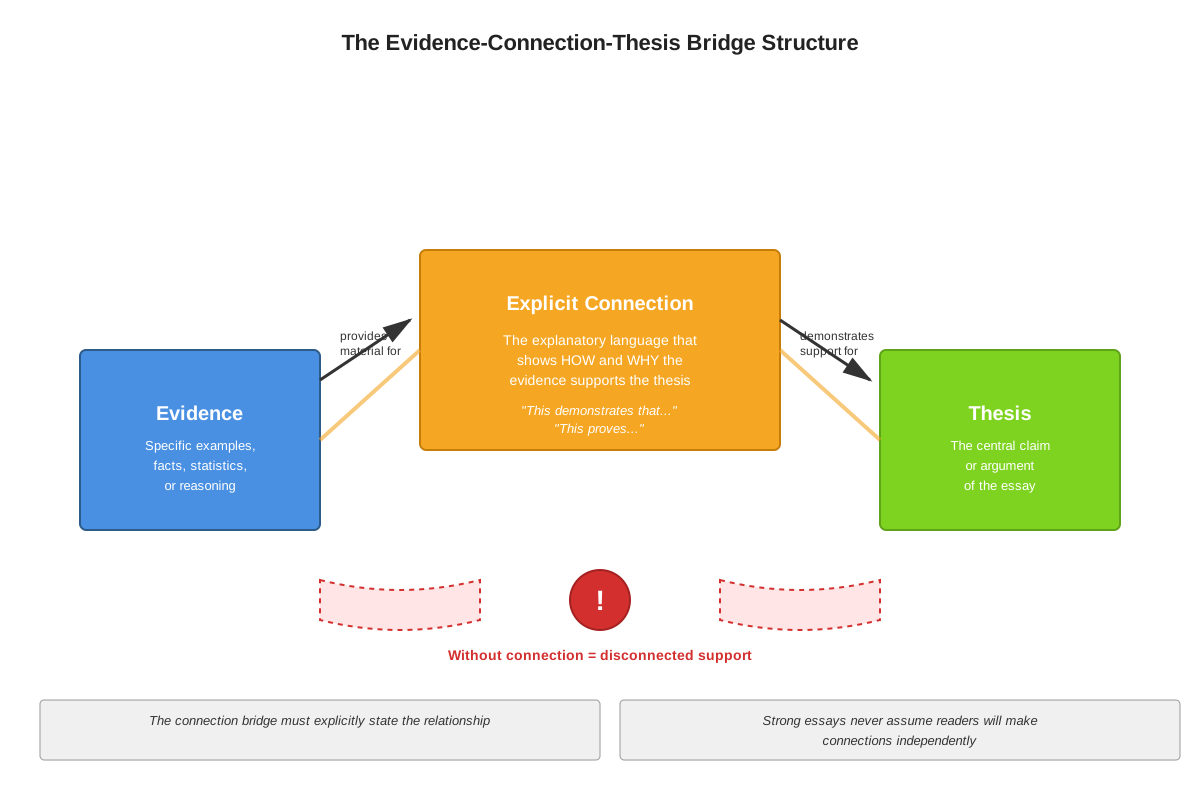
The fundamental principle of connecting evidence to thesis involves creating explicit logical bridges between supporting information and the central argument. Evidence alone—no matter how compelling—does not automatically support a thesis. The writer must articulate the reasoning that links the two. This bridge typically consists of explanatory sentences that follow evidence presentation and answer the implicit question: "How does this example/fact/reasoning prove or support my main point?"
The connection process follows a three-part structure:
- Present the evidence: Introduce the example, fact, statistic, or reasoning
- Explain the evidence: Clarify what the evidence means or demonstrates
- Link to thesis: Explicitly state how this evidence supports, proves, or develops the thesis
Without step three, readers must infer the connection themselves—a risk that often results in misinterpretation or the perception of irrelevance.
Types of Evidence-Thesis Connections
Different types of evidence require different connection strategies:
| Evidence Type | Connection Strategy | Example Transition |
|---|---|---|
| Concrete example | Show how the specific case illustrates the general principle in the thesis | "This example demonstrates that..." |
| Statistical data | Explain what the numbers reveal about the thesis claim | "These figures confirm that..." |
| Expert opinion | Establish the authority's relevance and how their view supports the position | "This expert perspective validates..." |
| Hypothetical scenario | Clarify how the imagined situation proves the thesis would hold true | "This scenario reveals that..." |
| Personal anecdote | Connect the individual experience to the broader argument | "This experience exemplifies..." |
| Logical reasoning | Make the inferential steps explicit | "Therefore, it follows that..." |
Explicit vs. Implicit Connections
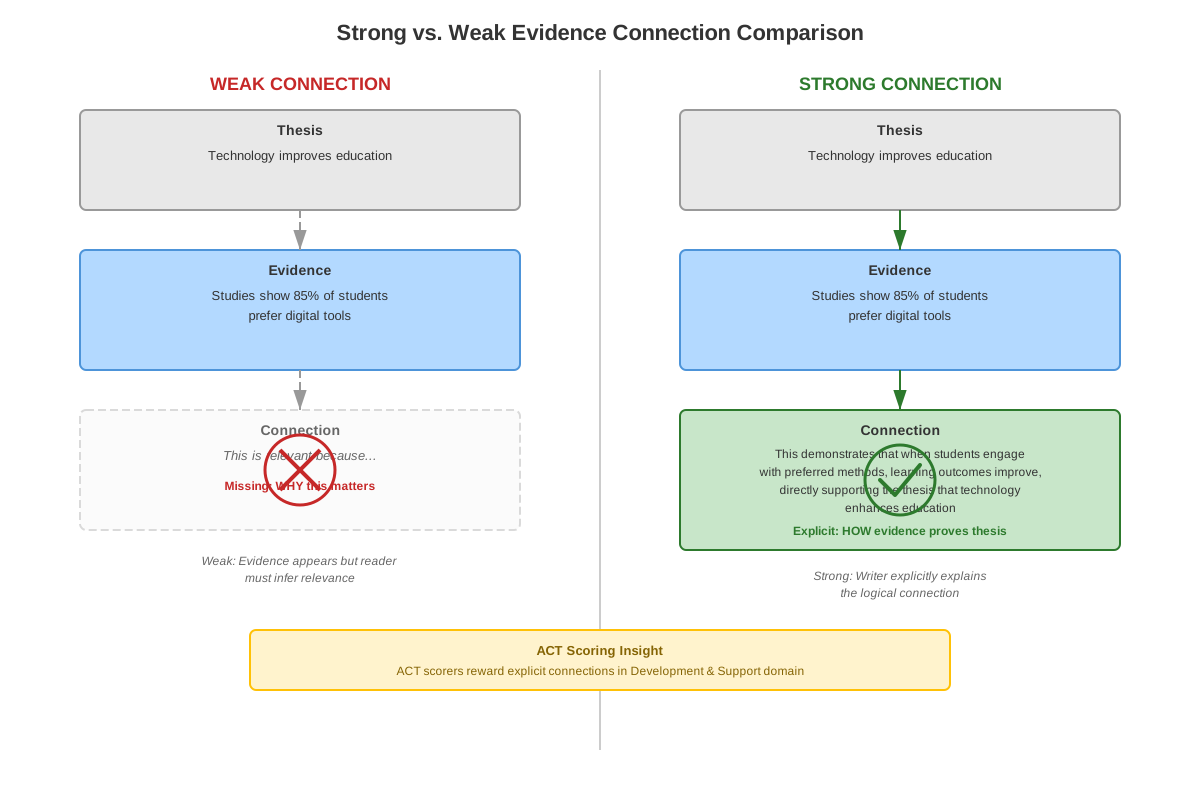
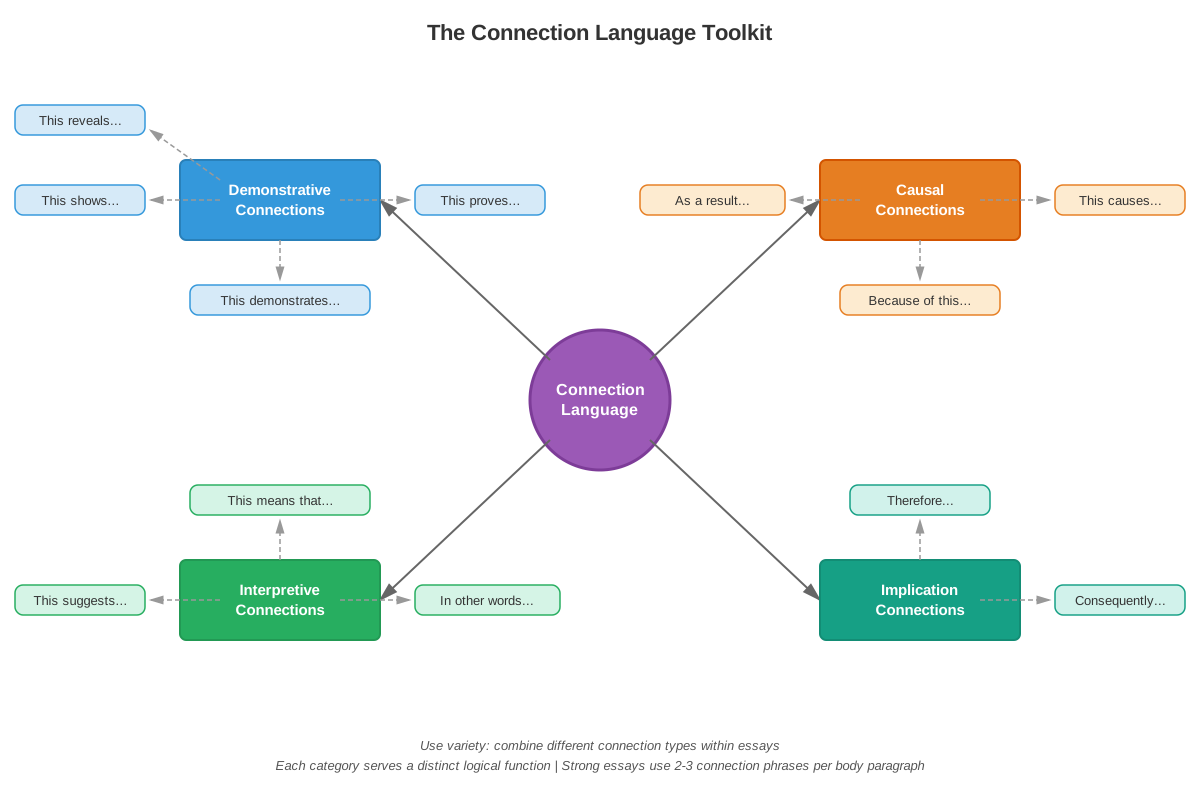
Explicit connections use clear, direct language to state the relationship between evidence and thesis. These connections leave no ambiguity about the writer's reasoning. Phrases like "This proves that," "As a result," "This demonstrates," and "Therefore" signal explicit connections.
Implicit connections rely on the reader to infer the relationship. While sophisticated readers might follow implicit connections, ACT evaluators score essays based on what is actually written, not what could be inferred. Essays that rely primarily on implicit connections typically score lower because they appear to lack analytical depth or clear reasoning.
The "So What?" Principle
The most powerful tool for connecting evidence to thesis is consistently asking "So what?" after presenting evidence. This question forces the writer to articulate significance:
- Evidence: "Studies show that students who participate in extracurricular activities have higher GPAs."
- So what?: "This correlation suggests that structured activities develop time management skills that transfer to academic performance."
- Connection to thesis: "Therefore, schools should expand extracurricular offerings to support academic achievement, as my thesis argues."
Layered Connections in Complex Arguments
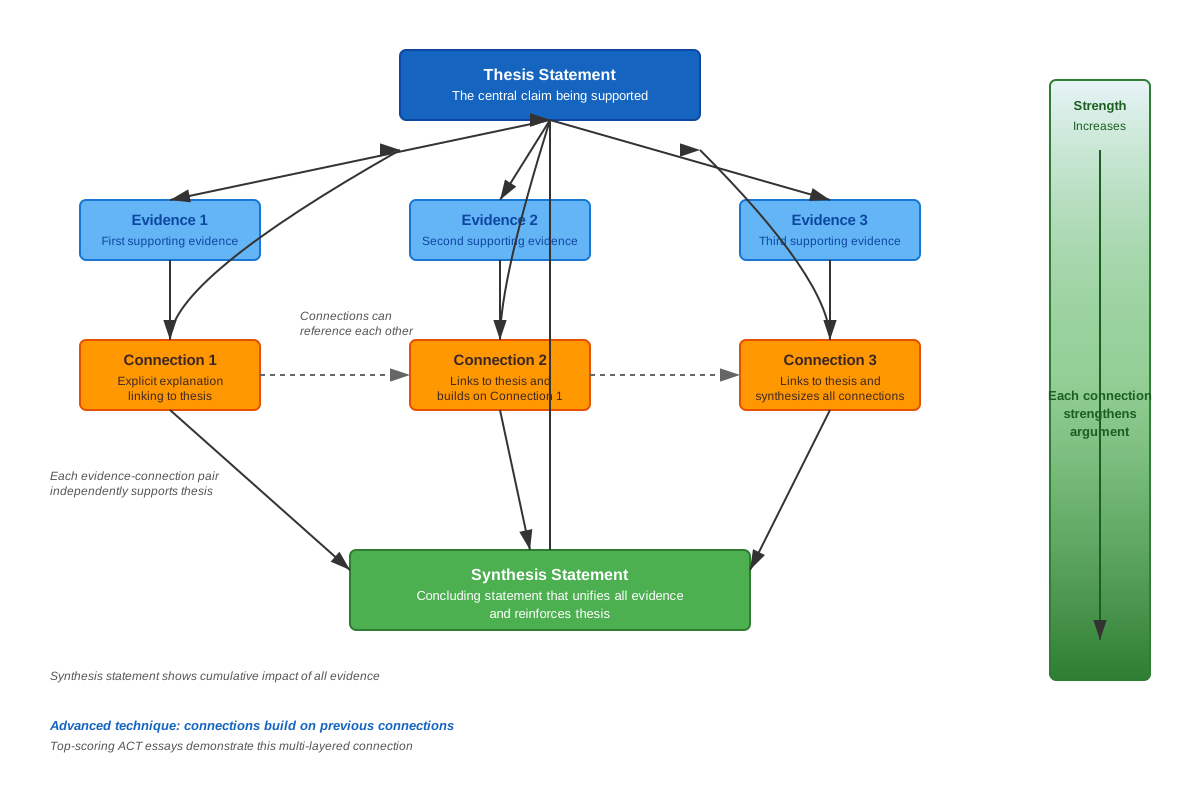
Advanced ACT essays demonstrate layered connections where evidence connects not only to the thesis but also to counterarguments, alternative perspectives, and nuanced qualifications. This creates a web of logical relationships:
- Primary connection: Evidence → Thesis
- Secondary connection: Evidence → Counterargument acknowledgment → Thesis reinforcement
- Tertiary connection: Evidence → Perspective comparison → Thesis nuance
For example: "While opponents might cite this statistic to argue against my position, closer examination reveals that the data actually supports my thesis when we consider the underlying factors."
Transitional Architecture
Effective evidence-thesis connections rely on transitional architecture—the strategic use of transitional words, phrases, and sentences that guide readers through the logical progression. Key transitional categories include:
- Causation: because, since, as a result, consequently, therefore
- Illustration: for example, specifically, in particular, namely
- Emphasis: indeed, in fact, certainly, undoubtedly
- Contrast: however, nevertheless, despite this, on the other hand
- Addition: furthermore, moreover, additionally, likewise
The Explanatory Sentence
The explanatory sentence is the most critical component of evidence-thesis connection. This sentence, which typically follows evidence presentation, performs three functions:
- Interprets what the evidence means
- Explains why it matters
- Links it explicitly to the thesis
Strong explanatory sentences often begin with phrases like:
- "This example illustrates..."
- "This evidence demonstrates..."
- "From this, we can conclude..."
- "This supports the argument that..."
- "This reveals the importance of..."
Concept Relationships
The concepts within connecting evidence to thesis form a hierarchical relationship. At the foundation lies the bridge principle—the understanding that connections must be explicit. This principle supports the "So What?" technique, which generates the content for connections. The "So What?" technique produces explanatory sentences, which are enhanced by transitional architecture. All of these elements work together to create both explicit connections and layered connections in sophisticated arguments.
This topic directly builds upon prerequisite knowledge: thesis construction provides the destination to which evidence must connect; evidence selection provides the material that needs connecting; paragraph structure provides the organizational framework within which connections occur; and perspective analysis provides the complexity that demands nuanced connections.
Connecting evidence to thesis enables progression to advanced topics like counterargument integration (where connections must address opposing views), synthesis across perspectives (where multiple pieces of evidence connect to a complex thesis), and rhetorical sophistication (where connection quality distinguishes exceptional essays).
Relationship Map:
Thesis Construction → Evidence Selection → Bridge Creation (Connecting Evidence to Thesis) → Explanatory Sentences → Transitional Architecture → Explicit Connections → Layered Connections → Sophisticated Argument → High ACT Score
High-Yield Facts
- ⭐ Every piece of evidence in an ACT essay must have at least one sentence explicitly connecting it to the thesis
- ⭐ The explanatory sentence that follows evidence is more important than the evidence itself for scoring purposes
- ⭐ ACT evaluators specifically look for the words and phrases that make connections explicit, not just the presence of evidence
- ⭐ Essays that score 5-6 in Development and Support consistently use transitional phrases to signal evidence-thesis relationships
- ⭐ The "So What?" question should be asked and answered after every major piece of evidence
- Implicit connections are insufficient for top ACT Writing scores; connections must be stated directly
- Strong evidence-thesis connections typically require 1-2 sentences of explanation per piece of evidence
- The phrase "This shows that" or equivalent should appear multiple times throughout a high-scoring essay
- Evidence without connection appears irrelevant to evaluators, even if the connection seems obvious to the writer
- Layered connections that address multiple perspectives simultaneously demonstrate the sophisticated thinking required for scores of 5-6
- Transitional architecture should be varied; repetitive transitions suggest mechanical rather than thoughtful writing
- The strongest connections explain both what the evidence means and why it matters to the specific thesis
- Generic connections ("This is important because...") score lower than specific connections that reference thesis language
- Evidence-thesis connections should appear in every body paragraph, typically 2-3 times per paragraph
- The conclusion should include connections that synthesize multiple pieces of evidence rather than introducing new connections
Quick check — test yourself on Connecting evidence to thesis so far.
Try Flashcards →Common Misconceptions
Misconception: Evidence that seems obviously related to the thesis doesn't need explicit connection.
Correction: ACT evaluators score what is written, not what seems obvious. Even when the relationship appears clear to the writer, explicit connection sentences are required to demonstrate analytical thinking and earn high scores in the Development and Support domain.
Misconception: Simply placing evidence in a paragraph about the thesis creates sufficient connection.
Correction: Proximity does not equal connection. Evidence must be followed by explanatory sentences that articulate the specific logical relationship to the thesis. Physical placement in a relevant paragraph is necessary but insufficient.
Misconception: Longer, more detailed evidence automatically strengthens the thesis connection.
Correction: Evidence length is less important than connection quality. A brief example with strong explanatory connection outscores lengthy evidence with weak or missing connection. The explanation of relevance matters more than the amount of supporting detail.
Misconception: Using transition words like "furthermore" or "additionally" adequately connects evidence to thesis.
Correction: Transitional words show relationships between sentences but don't replace explanatory content. A sentence like "Furthermore, many students participate in sports" adds information but doesn't explain how sports participation supports the thesis. True connection requires substantive explanation, not just transitional signals.
Misconception: The thesis statement itself creates connections, so evidence naturally relates to it.
Correction: The thesis establishes what needs to be proven, but each piece of evidence requires individual connection. The thesis doesn't retroactively connect evidence; each supporting point needs its own explicit link through explanatory sentences.
Misconception: Sophisticated vocabulary in evidence presentation demonstrates strong connection.
Correction: Vocabulary sophistication and connection quality are separate skills. An essay can use advanced vocabulary while failing to connect evidence to thesis, or use simple language while making crystal-clear connections. Evaluators prioritize logical clarity over lexical complexity.
Misconception: Connecting evidence to topic sentences is the same as connecting to the thesis.
Correction: While evidence should relate to paragraph topic sentences, it must ultimately connect to the essay's central thesis. Topic sentences are intermediate steps; the strongest essays show how paragraph-level ideas support the overarching argument, creating a chain: evidence → topic sentence → thesis.
Worked Examples
Example 1: Weak vs. Strong Connection
Prompt Context: Should schools require students to participate in community service?
Thesis: Schools should require community service because it develops civic responsibility, practical skills, and college readiness.
Weak Evidence-Thesis Connection:
"Many successful people have participated in community service. Bill Gates has donated billions to charity. Community service teaches important lessons. Students benefit from helping others."
Analysis of Weakness: This passage presents evidence (Bill Gates's charity) but fails to connect it to the thesis. The reader must infer how Gates's adult philanthropy relates to required student community service, civic responsibility, practical skills, or college readiness. The generic statements ("teaches important lessons," "students benefit") don't specify what lessons or benefits, nor do they link to the thesis's specific claims.
Strong Evidence-Thesis Connection:
"Many successful people attribute their achievements to early community service experiences. Bill Gates, for example, has stated that his teenage volunteer work at a local community center shaped his understanding of social inequality and inspired his later philanthropic focus. This example demonstrates that community service during formative years develops the civic responsibility my thesis advocates—specifically, the awareness of social issues and the commitment to addressing them. By requiring such experiences, schools ensure all students, not just those from service-oriented families, develop this crucial civic consciousness. Furthermore, Gates's trajectory from teenage volunteer to global philanthropist illustrates how early service experiences can evolve into lifelong civic engagement, supporting my argument that required community service cultivates lasting civic responsibility."
Analysis of Strength: This revision makes multiple explicit connections. The phrase "This example demonstrates" signals the connection. The passage explains what the evidence means ("awareness of social issues and commitment to addressing them") and directly links it to thesis language ("civic responsibility my thesis advocates"). The phrase "supporting my argument" creates another explicit connection. The explanation shows how the evidence proves the thesis claim rather than leaving the relationship implicit.
Example 2: Layered Connection with Perspective Integration
Prompt Context: Should schools replace traditional textbooks with digital devices?
Thesis: While digital devices offer certain advantages, schools should maintain traditional textbooks as the primary learning resource because they promote deeper reading comprehension, reduce distractions, and ensure educational equity.
Evidence with Layered Connection:
"A 2019 study by the National Reading Council found that students reading printed texts scored 23% higher on comprehension assessments than students reading identical content on screens. Proponents of digital devices might argue that this gap simply reflects students' lack of familiarity with digital reading, suggesting the difference would disappear with practice. However, this evidence actually strengthens my thesis in two ways. First, the comprehension advantage of print directly supports my claim that traditional textbooks promote deeper reading comprehension—the 23% improvement is substantial and educationally significant. Second, even if we accept the familiarity argument, it reinforces my position: if students currently comprehend printed text better, schools should prioritize the format that works now rather than gambling on a hypothetical future where digital reading might become equally effective. This evidence thus demonstrates that traditional textbooks serve students' immediate educational needs more effectively than digital alternatives, validating my thesis that textbooks should remain the primary resource."
Analysis: This example demonstrates sophisticated connection through multiple layers. It presents evidence, acknowledges a counterargument, then shows how the evidence supports the thesis even when viewed through the counterargument lens. The phrases "directly supports my claim," "reinforces my position," and "demonstrates that" create explicit connections. The passage explains both what the evidence means (substantial comprehension advantage) and why it matters (serves immediate needs), connecting to specific thesis language ("deeper reading comprehension," "primary resource"). This layered approach shows the analytical sophistication ACT evaluators seek in top-scoring essays.
Exam Strategy
When approaching ACT Writing prompts, implement this systematic strategy for connecting evidence to thesis:
Pre-Writing Phase: As you plan your essay, create a simple two-column chart. In the left column, list potential evidence; in the right column, write one sentence explaining how each piece of evidence supports your thesis. This ensures you can articulate connections before you begin writing. If you cannot write a clear connection sentence during planning, the evidence probably isn't relevant enough to include.
Trigger Words to Watch For: ACT prompts often include phrases that signal the need for strong evidence-thesis connections: "support your position," "explain your perspective," "develop your ideas," and "analyze the relationship." These phrases tell you that presenting evidence alone is insufficient—you must explain relationships and demonstrate reasoning.
The Two-Sentence Rule: After presenting any piece of evidence, write at least two sentences: one that explains what the evidence means or demonstrates, and one that explicitly connects it to your thesis using thesis-specific language. This rule ensures you move beyond evidence presentation to evidence analysis.
Connection Checklist: As you write each body paragraph, mentally check:
- Have I stated my evidence clearly?
- Have I explained what this evidence means?
- Have I used a phrase like "This shows/demonstrates/proves/illustrates that..."?
- Have I referenced specific language from my thesis?
- Would a reader who disagrees with me understand my reasoning?
Process of Elimination for Revision: If time permits, reread your essay and highlight every sentence that connects evidence to thesis. If any paragraph lacks highlighted sentences, it needs revision. This visual check quickly identifies weak connections.
Time Allocation: Reserve 5 minutes of your 40-minute writing time for strengthening connections. During this revision period, add explanatory sentences after evidence and insert transitional phrases that make logical relationships explicit. These additions significantly improve scores in the Development and Support domain.
Perspective Integration Strategy: When addressing the prompt's multiple perspectives, use evidence to connect your thesis to each perspective. Structure: "Perspective X argues [summary]. Evidence Y shows [fact]. This evidence supports my thesis rather than Perspective X because [explicit connection]." This approach demonstrates sophisticated engagement with complexity.
Memory Techniques
The BRIDGE Acronym for evidence-thesis connection:
- Bring in the evidence (present your example, fact, or reasoning)
- Reveal what it means (explain or interpret the evidence)
- Identify the link (state the connection explicitly)
- Demonstrate relevance (show why it matters to your argument)
- Ground in thesis language (use specific words from your thesis)
- Explain the "so what" (answer why this evidence proves your point)
The "This Shows That" Mantra: Memorize this simple formula and use it multiple times per essay: "This [evidence] shows that [thesis claim] because [explanation]." This structure automatically creates explicit connections.
The Three-Layer Visualization: Picture your essay as a three-layer cake:
- Bottom layer: Evidence (examples, facts, reasoning)
- Middle layer: Explanatory sentences (the connections)
- Top layer: Thesis (your main argument)
The middle layer is the most important—it holds the structure together. Without it, the bottom and top layers don't connect, and the cake collapses.
The "So What?" Sticky Note: Mentally place a sticky note after every piece of evidence with "SO WHAT?" written on it. This reminds you to answer the significance question before moving to the next point.
The Reporter's Follow-Up: Imagine you're a reporter who just stated a fact. Your editor asks, "Why does this matter to our story?" Your answer is the connection sentence. This role-play helps generate explanatory content.
Summary
Connecting evidence to thesis is the critical skill that transforms a collection of ideas into a coherent, persuasive ACT essay. This skill requires writers to explicitly articulate the logical relationships between supporting information and central claims through explanatory sentences, transitional architecture, and consistent application of the "So What?" principle. The ACT evaluates this skill primarily through the Development and Support and Ideas and Analysis domains, making it essential for achieving scores of 4 or higher. Successful connection involves a three-step process: presenting evidence, explaining what it means, and explicitly linking it to thesis-specific language. The most common weakness in ACT essays is implicit connection—assuming readers will infer relationships that should be stated directly. Strong essays use varied transitional phrases, employ the two-sentence rule after evidence, and create layered connections that address multiple perspectives simultaneously. Mastery requires understanding that evidence quality matters less than connection quality; even compelling evidence appears irrelevant without explicit explanation of its significance to the thesis.
Key Takeaways
- Every piece of evidence requires at least one explanatory sentence that explicitly connects it to the thesis using thesis-specific language
- The "So What?" question is the most powerful tool for generating connection content—ask it after every major piece of evidence
- ACT evaluators score what is written, not what seems obvious; implicit connections are insufficient for top scores
- The explanatory sentence following evidence is more important for scoring than the evidence itself
- Strong connections use transitional phrases ("This demonstrates," "This proves," "Therefore") combined with substantive explanation of relevance
- The two-sentence rule (one explanation sentence + one connection sentence after evidence) ensures adequate connection depth
- Layered connections that address counterarguments and multiple perspectives demonstrate the sophisticated thinking required for scores of 5-6
Related Topics
Thesis Construction and Refinement: Mastering evidence-thesis connection naturally leads to stronger thesis statements, as understanding what needs to be proven clarifies how to state the central claim effectively.
Counterargument Integration: Once evidence-thesis connections are strong, the next level involves connecting evidence to counterarguments, then showing how that evidence ultimately supports the thesis despite apparent opposition.
Synthesis Across Perspectives: Advanced ACT essays synthesize multiple perspectives using evidence that connects to several viewpoints simultaneously, demonstrating nuanced understanding of complex issues.
Rhetorical Analysis: Understanding how evidence connects to claims enables analysis of how other writers construct arguments, a skill tested in ACT Reading and useful for college-level writing.
Paragraph Unity and Coherence: Strong evidence-thesis connections naturally improve paragraph unity, as every sentence clearly relates to the central argument, creating coherent essay structure.
Practice CTA
Now that you understand the principles and strategies for connecting evidence to thesis, it's time to apply this knowledge. Complete the practice questions to test your ability to identify weak connections, strengthen explanatory sentences, and construct explicit evidence-thesis links. Use the flashcards to reinforce key concepts like the BRIDGE acronym, the "So What?" principle, and the two-sentence rule. Remember: this skill improves dramatically with practice. Each time you write a practice essay, focus specifically on making your connections explicit and varied. The investment you make in mastering this skill will pay dividends not only on the ACT but throughout your academic career. You've got this!
Sign up free to keep reading
Create a free AnvayaPrep account to finish this ACT guide on Connecting evidence to thesis — plus flashcards and practice questions.