Overview
Relevant examples form the backbone of persuasive writing on the ACT Writing test. When constructing an argument, students must support their claims with concrete, specific evidence that directly relates to the thesis and perspective being defended. The ability to select and deploy ACT relevant examples separates mediocre essays from high-scoring responses that demonstrate sophisticated reasoning and analytical depth.
On the ACT Writing test, graders evaluate essays across four domains: Ideas and Analysis, Development and Support, Organization, and Language Use. Relevant examples primarily impact the Development and Support domain, where scorers assess how well students elaborate on ideas and substantiate claims with appropriate evidence. Essays that earn top scores (5-6 on the 6-point scale) consistently demonstrate "skillful" or "effective" development through well-chosen, detailed examples that illuminate the writer's reasoning. Conversely, essays lacking relevant examples or relying on vague generalizations typically score in the lower ranges (1-3), as they fail to provide the concrete support necessary for persuasive argumentation.
Understanding relevant examples connects directly to broader argument development skills within ACT Writing. This topic intersects with thesis construction, perspective analysis, counterargument acknowledgment, and logical reasoning. Strong examples don't exist in isolation—they must be carefully integrated into a coherent argumentative structure, explained thoroughly, and explicitly connected back to the central claim. Mastering relevant examples enables students to transform abstract ideas into compelling, evidence-based arguments that demonstrate critical thinking and real-world awareness.
Learning Objectives
- [ ] Identify when Relevant examples is being tested
- [ ] Explain the core rule or strategy behind Relevant examples
- [ ] Apply Relevant examples to ACT-style questions accurately
- [ ] Distinguish between relevant and irrelevant examples in argumentative contexts
- [ ] Generate multiple types of examples (personal, historical, current events, hypothetical) appropriate for different prompts
- [ ] Analyze the effectiveness of examples based on specificity, connection to thesis, and explanatory depth
- [ ] Integrate examples seamlessly into essay paragraphs with proper context and analysis
Prerequisites
- Basic essay structure: Understanding of introduction, body paragraphs, and conclusion organization is essential because relevant examples must be positioned within a coherent argumentative framework
- Thesis statement construction: Ability to craft a clear central claim is necessary because examples must directly support and illuminate the thesis
- Paragraph development: Knowledge of topic sentences and supporting details provides the foundation for integrating examples effectively
- Perspective analysis: Familiarity with evaluating multiple viewpoints enables selection of examples that address different perspectives on an issue
Why This Topic Matters
In real-world contexts, the ability to support claims with relevant evidence is fundamental to persuasive communication across professional, academic, and civic domains. Whether writing a business proposal, crafting a research paper, or participating in public discourse, effective communicators must substantiate their arguments with concrete examples that resonate with their audience. This skill demonstrates critical thinking, research competence, and the capacity to connect abstract principles to tangible realities.
On the ACT Writing test, relevant examples appear in virtually every high-scoring essay. Statistical analysis of ACT scoring patterns reveals that essays receiving scores of 5-6 in the Development and Support domain consistently feature 2-4 well-developed examples per essay, with each example receiving 2-4 sentences of explanation and analysis. The ACT explicitly states in its scoring rubric that effective essays "develop ideas with specific reasons and illustrative examples." Approximately 40% of the Development and Support score depends directly on the quality, relevance, and integration of examples.
Common manifestations of this topic on the ACT include prompts asking students to evaluate perspectives on education policy, technology's impact on society, community involvement, individual versus collective responsibility, and balancing competing values. Regardless of the specific prompt, graders consistently look for examples that are specific (not vague generalizations), relevant (directly connected to the argument), varied (drawing from different domains of knowledge), and thoroughly explained (not merely mentioned but analyzed for significance).
Core Concepts
What Makes an Example "Relevant"
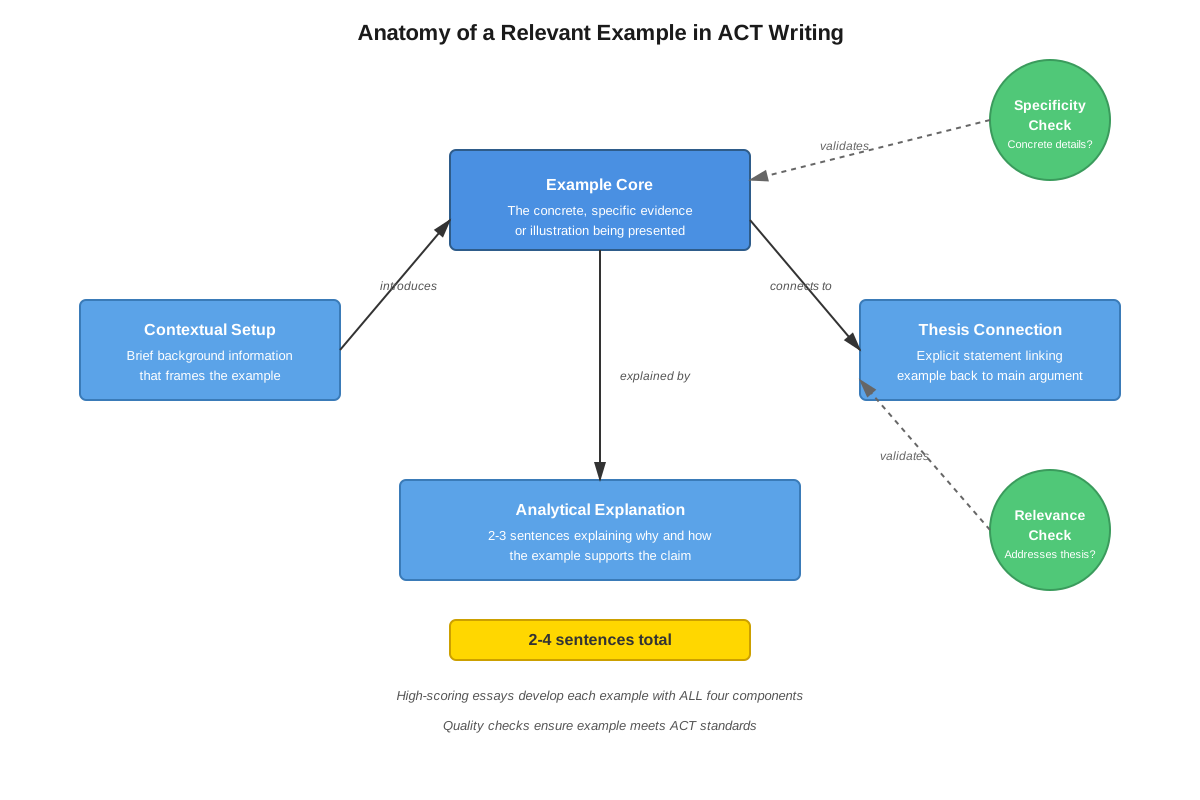
A relevant example is a specific instance, case study, scenario, or piece of evidence that directly supports a claim and illuminates the reasoning behind an argument. Relevance requires three essential qualities: specificity (concrete details rather than vague generalizations), connection (clear relationship to the thesis and point being made), and significance (meaningful contribution to the argument's persuasive power).
Specificity distinguishes strong examples from weak ones. Rather than writing "many people benefit from technology," a relevant example would state: "When my grandmother suffered a stroke last year, telemedicine allowed her rural clinic to consult with specialists 200 miles away, enabling immediate treatment that doctors said saved her life." The specific details—stroke, telemedicine, rural clinic, 200 miles, immediate treatment—create a vivid, credible example that readers can visualize and understand.
Connection requires explicit linkage between the example and the argument. After presenting an example, writers must explain its relevance through analysis. This typically involves 1-2 sentences that interpret the example's significance and tie it back to the thesis. For instance: "This experience demonstrates how technology bridges geographic barriers to healthcare access, supporting the perspective that technological advancement improves quality of life for underserved populations."
Types of Examples for ACT Writing
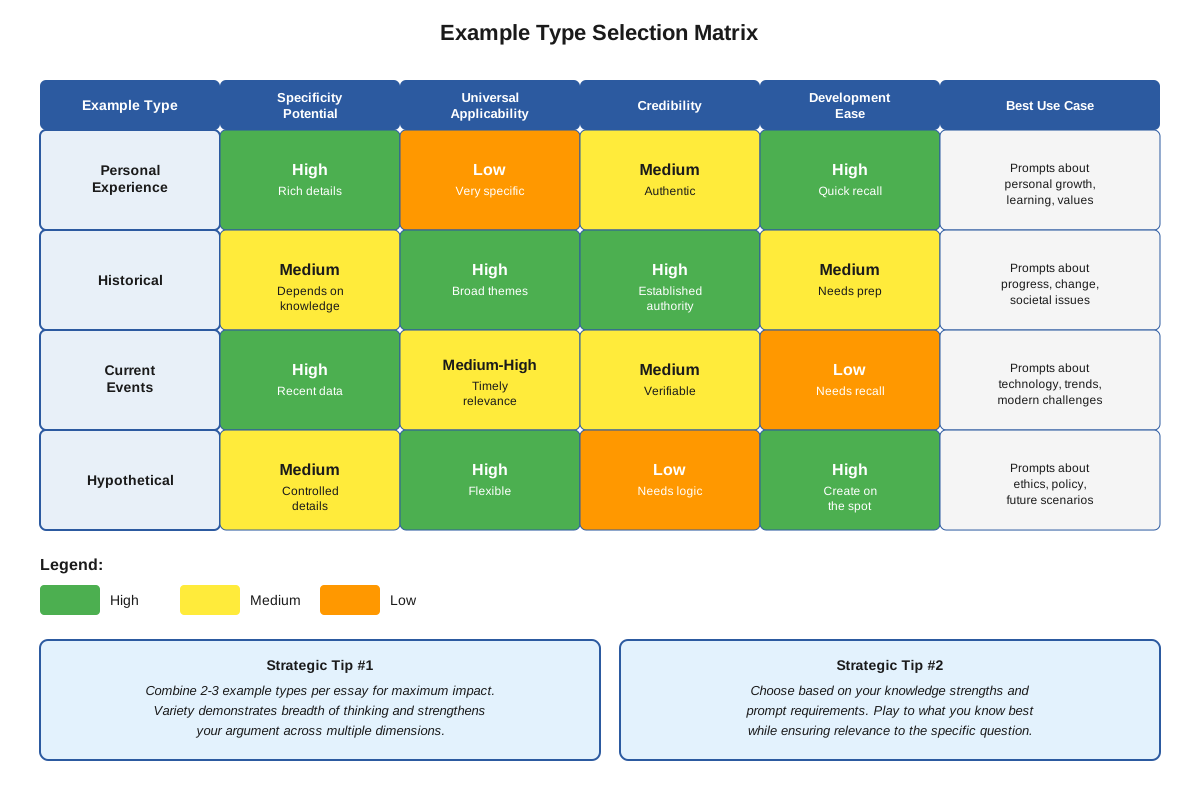
| Example Type | Description | Strengths | Considerations |
|---|---|---|---|
| Personal Experience | Events from the writer's own life or observations | Authentic, detailed, emotionally resonant | Must be relevant to broader argument, not just anecdotal |
| Historical Events | Documented occurrences from the past | Demonstrates knowledge, provides perspective | Requires accurate details; avoid oversimplification |
| Current Events | Recent news, trends, or developments | Shows awareness of contemporary issues | Must be widely known or briefly explained |
| Literary/Cultural References | Books, films, art, or cultural phenomena | Demonstrates cultural literacy | Should be recognizable to general audience |
| Hypothetical Scenarios | Plausible "what if" situations | Useful when personal/historical examples are limited | Must be realistic and thoroughly developed |
| Statistical/Research Data | Studies, surveys, or quantitative evidence | Adds empirical credibility | Use sparingly; ACT doesn't require citations |
The STAR Method for Example Development
The STAR method provides a systematic approach to developing relevant examples with sufficient depth:
- Situation: Establish the context and background (1 sentence)
- Task/Topic: Identify the challenge, question, or issue at stake (1 sentence)
- Action: Describe what happened or what was done (1-2 sentences)
- Result/Relevance: Explain the outcome and connect it explicitly to your argument (1-2 sentences)
This structure ensures examples receive adequate development—typically 4-6 sentences—rather than being mentioned briefly and abandoned. For instance, when arguing that community service should be required for high school graduation:
Situation: "At Lincoln High School in Seattle, administrators implemented a 40-hour community service requirement in 2018." Task: "The goal was to increase civic engagement among students who had shown declining participation in local issues." Action: "Students worked with food banks, tutored elementary children, and assisted at senior centers, documenting their experiences in reflective journals." Result: "Post-graduation surveys revealed that 67% of participants continued volunteering, and local organizations reported sustained youth involvement—demonstrating that structured service requirements can cultivate lasting civic commitment."
Integrating Examples into Argumentative Structure
Relevant examples must be woven into the essay's argumentative fabric, not simply listed. Effective integration follows this pattern:
- Topic sentence stating the paragraph's main point
- Transition introducing the example ("For instance," "Consider," "This principle is evident in")
- Example presentation using STAR or similar development
- Analysis explaining the example's significance
- Connection linking back to thesis
This integration ensures examples serve the argument rather than distracting from it. The analysis component is particularly crucial—it's where writers demonstrate critical thinking by interpreting evidence rather than merely presenting it.
Balancing Multiple Examples
High-scoring ACT essays typically include 2-4 well-developed examples rather than numerous superficial ones. Quality trumps quantity. A single paragraph might contain one thoroughly developed example (5-6 sentences) or two briefer examples (3-4 sentences each) that complement each other.
When using multiple examples, vary the types to demonstrate breadth of knowledge. For instance, combine a personal experience with a historical event, or pair a current event with a hypothetical scenario. This variety shows sophisticated thinking and prevents the essay from seeming narrow or limited in perspective.
Avoiding Irrelevant Examples
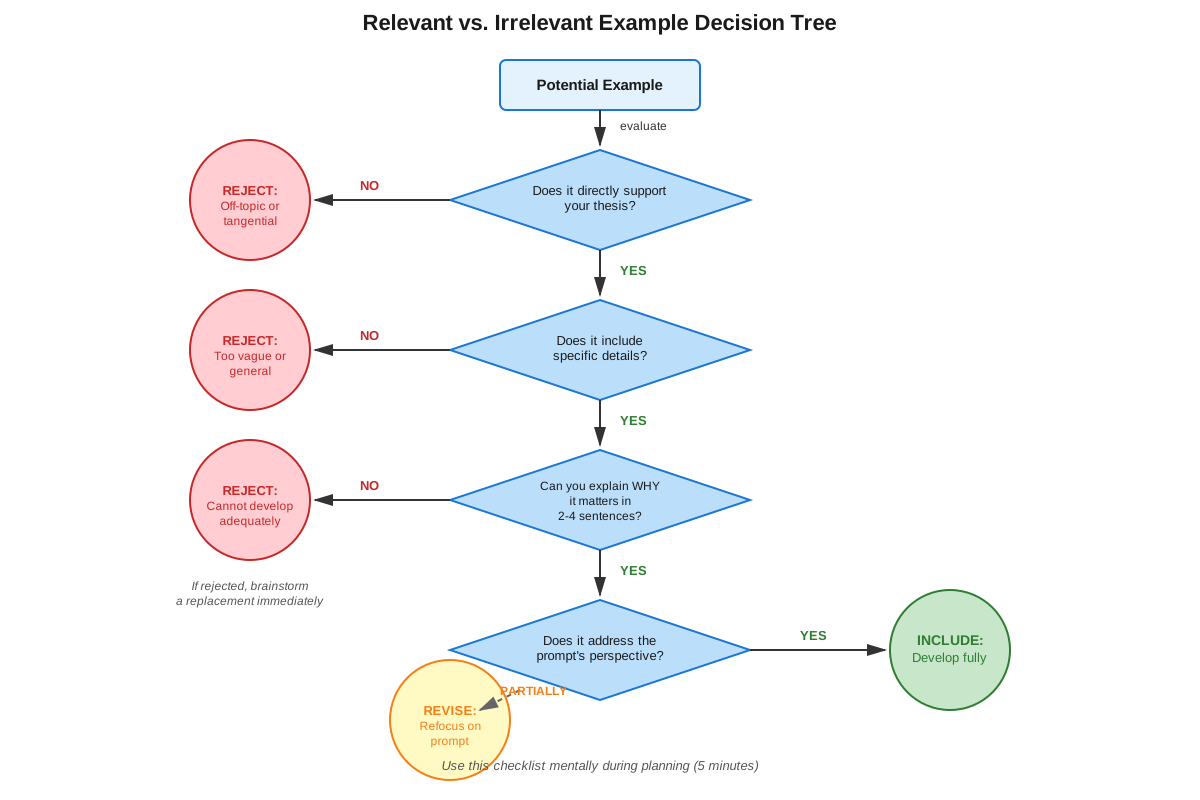
Irrelevance occurs when examples fail to support the specific argument being made, even if they relate to the general topic. For a prompt about whether schools should eliminate letter grades, an example about a student who struggled with test anxiety might seem relevant but becomes irrelevant if the essay argues that grades motivate achievement—the example actually contradicts rather than supports the thesis.
Red flags for irrelevant examples include: examples that require extensive explanation to connect to the argument, examples that address a different aspect of the topic than the thesis focuses on, examples that are so vague they could apply to almost any argument, and examples that contradict the position being defended without being framed as counterarguments to be refuted.
Concept Relationships
The concepts within relevant examples form an interconnected system. Specificity serves as the foundation, enabling connection and significance—vague examples cannot be meaningfully connected to arguments. The types of examples (personal, historical, current events, etc.) represent different tools for achieving specificity, each with distinct strengths. The STAR method provides a procedural framework for developing any example type with sufficient depth. Integration techniques ensure examples support rather than distract from the argument, while balancing strategies optimize the number and variety of examples. Finally, understanding irrelevance helps writers avoid common pitfalls by recognizing what not to include.
This topic connects to prerequisite knowledge in several ways: thesis construction → determines which examples are relevant; paragraph development → provides the structure within which examples are integrated; perspective analysis → guides selection of examples that address multiple viewpoints. Looking forward, mastering relevant examples enables progression to advanced skills like counterargument refutation (using examples to disprove opposing views), synthesis (connecting multiple examples to reveal patterns), and rhetorical sophistication (strategically selecting examples for maximum persuasive impact).
The relationship map: Thesis Statement → Determines Relevance Criteria → Guides Example Selection → Requires Specific Details → Enables Meaningful Connection → Strengthens Argument → Improves Development and Support Score.
High-Yield Facts
⭐ ACT essays scoring 5-6 in Development and Support typically include 2-4 well-developed examples with 4-6 sentences of explanation each
⭐ Relevant examples must be explicitly connected to the thesis through 1-2 sentences of analysis explaining their significance
⭐ Specificity is the most important quality of relevant examples—concrete details are essential for credibility and impact
⭐ Personal experience examples are acceptable and often effective on the ACT, provided they support the broader argument
⭐ The Development and Support domain accounts for 25% of the total ACT Writing score, and examples are the primary evidence graders evaluate
- Examples should vary in type (personal, historical, current events) to demonstrate breadth of knowledge and sophisticated thinking
- Hypothetical scenarios are acceptable when developed realistically and thoroughly, though concrete examples are generally stronger
- Each body paragraph should contain at least one well-developed example; paragraphs without examples typically score poorly
- Examples from widely known sources (major historical events, famous literature) are safer than obscure references that may confuse readers
- The connection between example and argument matters more than the example's inherent interest—relevance trumps novelty
- Graders do not fact-check specific details in examples, but implausible or obviously false claims damage credibility
- Examples should be distributed throughout the essay, not concentrated in a single paragraph
- Brief examples (2-3 sentences) can be effective when paired with more developed examples, providing variety in pacing
- Examples addressing counterarguments demonstrate sophisticated thinking and strengthen the overall argument
- The most common weakness in ACT essays is presenting examples without explaining their relevance to the thesis
Quick check — test yourself on Relevant examples so far.
Try Flashcards →Common Misconceptions
Misconception: Any example related to the general topic is automatically relevant to the argument.
Correction: Relevance requires direct connection to the specific thesis and point being made. An example about education might be irrelevant to an argument about educational technology if it doesn't address technology's role. Writers must explicitly demonstrate how each example supports their particular position.
Misconception: More examples always lead to higher scores.
Correction: Quality and development matter far more than quantity. An essay with six superficial examples will score lower than one with two thoroughly developed, well-analyzed examples. ACT graders specifically look for depth of development, which requires spending 4-6 sentences on each example.
Misconception: Personal examples are less sophisticated or credible than historical or current event examples.
Correction: Personal examples are fully acceptable on the ACT and often demonstrate authentic voice and specific detail. The key is ensuring personal examples support the broader argument rather than remaining purely anecdotal. A personal example that illustrates a general principle can be just as effective as a historical reference.
Misconception: Simply mentioning an example is sufficient; extensive explanation is unnecessary.
Correction: Presenting an example without analysis is one of the most common weaknesses in ACT essays. Graders expect writers to explain the significance of each example and explicitly connect it to the argument. The analysis (explaining "why this example matters") is often more important than the example itself.
Misconception: Examples must be 100% factually accurate with precise dates, names, and statistics.
Correction: While accuracy is important for credibility, ACT graders do not fact-check specific details. Minor inaccuracies in dates or statistics won't significantly impact scores as long as the example is plausible and the overall argument is sound. However, obviously false or implausible claims will damage credibility.
Misconception: Hypothetical examples are weaker than real examples and should be avoided.
Correction: Hypothetical scenarios can be effective when developed thoroughly and realistically. They're particularly useful for exploring potential consequences or testing principles. The key is making them plausible and detailed enough to be convincing, then analyzing them as thoroughly as real examples.
Misconception: Examples should only support the writer's position, never acknowledge opposing viewpoints.
Correction: Sophisticated essays often include examples that initially seem to support opposing perspectives, then analyze why those examples actually support the writer's thesis or explain their limitations. This demonstrates nuanced thinking and strengthens the overall argument by addressing potential objections.
Worked Examples
Worked Example 1: Developing a Personal Experience Example
Prompt Context: Should high schools require students to take a personal finance course before graduation?
Thesis: High schools should require personal finance courses because financial literacy is essential for adult success and is not adequately taught elsewhere.
Weak Example (Insufficient Development):
"I took a personal finance class in high school and it was helpful. I learned about budgeting and saving money. This shows that finance classes are important."
Analysis of Weakness: This example lacks specificity (what exactly was learned? how was it helpful?), provides minimal detail, and offers only superficial connection to the argument. It's approximately 25 words when effective examples need 60-100 words.
Strong Example (Proper Development):
"During my junior year, I enrolled in an optional personal finance course that transformed my understanding of money management. The course covered practical skills like creating monthly budgets, understanding credit scores, and comparing loan terms—topics my parents had never discussed with me. When I received my first paycheck from a part-time job, I applied the 50/30/20 budgeting rule we'd learned: 50% for necessities, 30% for discretionary spending, and 20% for savings. Within six months, I had saved $800 for college expenses, while friends who lacked this training spent their entire paychecks on immediate wants. This experience demonstrates that structured financial education provides concrete skills that students immediately apply, supporting the argument that such courses should be required rather than optional, ensuring all students—not just those who happen to choose the elective—gain essential life skills."
Analysis of Strength: This example uses the STAR method effectively. Situation: enrolled in optional finance course. Task: learning money management. Action: learned specific skills (budgeting, credit scores, loan terms) and applied 50/30/20 rule. Result: saved $800 while friends without training didn't. The example includes specific details (50/30/20 rule, $800 saved, six months), contrasts outcomes (writer vs. friends), and explicitly connects to the thesis in the final sentence. Total length: approximately 130 words, providing substantial development.
Worked Example 2: Integrating a Historical Example with Analysis
Prompt Context: Is it more important for communities to preserve historical buildings or to make way for new development?
Thesis: Communities should prioritize preserving historical buildings because they provide cultural continuity, educational value, and economic benefits that new development cannot replicate.
Example with Full Integration:
"Historical preservation often generates greater long-term economic value than demolition and redevelopment. Consider the transformation of Boston's Faneuil Hall Marketplace in the 1970s. Originally built in 1742, this historic market building had fallen into severe disrepair by the 1960s, and developers proposed demolishing it to construct a modern shopping complex. Instead, the city chose preservation, investing in careful restoration that maintained the building's colonial architecture while adapting interior spaces for contemporary retail use. Today, Faneuil Hall attracts over 18 million visitors annually, generating substantial revenue for local businesses and serving as Boston's second-most-visited tourist destination. The marketplace has sparked economic revitalization throughout the surrounding neighborhood, with property values increasing significantly since the restoration. This outcome illustrates a crucial principle: historic buildings possess unique character and cultural significance that new construction cannot replicate, making them irreplaceable economic and cultural assets. While new development might provide short-term construction jobs, preserved historic sites generate sustained tourism, community identity, and economic activity for decades. The Faneuil Hall example demonstrates that preservation and economic prosperity are not opposing goals but complementary ones, supporting the argument that communities should prioritize maintaining their architectural heritage."
Analysis of Integration: This example demonstrates sophisticated integration through several techniques:
- Topic sentence establishes the paragraph's focus on economic value
- Transition ("Consider") introduces the example smoothly
- Specific details (1742, 1960s, 18 million visitors, second-most-visited) provide credibility
- Context explains the situation and decision point
- Outcome describes results with concrete evidence
- Analysis (sentences beginning with "This outcome illustrates" and "While new development") explains significance
- Connection explicitly ties back to thesis in final sentence
The example addresses a potential counterargument (economic benefits of new development) and refutes it, demonstrating nuanced thinking. The writer doesn't just present the Faneuil Hall case but interprets its broader implications for the preservation debate.
Exam Strategy
When approaching ACT Writing prompts, implement this systematic strategy for generating and deploying relevant examples:
Pre-Writing Phase (3-4 minutes):
- Read the prompt and all three perspectives carefully
- Choose your position and draft a working thesis
- Brainstorm 4-6 potential examples across different categories (personal, historical, current events)
- Select the 2-3 strongest examples that most directly support your thesis
- For each selected example, jot down 2-3 specific details you'll include
Trigger Words in Prompts: Watch for phrases that signal the need for examples: "support your argument," "develop your ideas," "provide reasons," "illustrate your position," "use specific examples." These phrases explicitly tell you that examples are required for a high score.
Process of Elimination for Example Selection:
- Eliminate examples you can't develop with specific details
- Eliminate examples that require extensive background explanation
- Eliminate examples that only tangentially relate to your thesis
- Eliminate examples that all come from the same domain (all personal or all historical)
- Keep examples that you can explain in 4-6 sentences with concrete details
Time Allocation: In a 40-minute ACT Writing test, allocate approximately:
- 8-10 minutes: Planning (including example selection)
- 25-28 minutes: Writing (spend 6-8 minutes per body paragraph, ensuring each example receives 4-6 sentences)
- 3-5 minutes: Revision (check that each example is explicitly connected to thesis)
Red Flags During Writing: If you find yourself writing phrases like "there are many examples," "throughout history," "it is well known," or "everyone knows"—stop. These vague generalizations signal that you're not providing specific examples. Replace them with concrete details.
Quick Development Check: After writing each example, ask: "Could this example support a different thesis?" If yes, you haven't connected it specifically enough to your argument. Add 1-2 sentences of analysis explaining its particular relevance to your position.
Exam Tip: If you're running short on time, it's better to fully develop one strong example per body paragraph than to mention multiple examples superficially. Depth of development matters more than breadth of coverage.
Memory Techniques
STAR Acronym for Example Development:
- Situation: Set the scene
- Task: Identify the challenge
- Action: Describe what happened
- Result: Explain the outcome and Relevance to your argument
The "3S Rule" for Example Quality:
- Specific (concrete details, not vague generalizations)
- Supporting (directly relates to thesis)
- Substantial (4-6 sentences of development)
TYPES Mnemonic for Example Variety:
- Technology/Current events
- Your personal experience
- Past/Historical events
- Education/School-related
- Society/Cultural references
Visualization Strategy: Picture your example as a movie scene. If you can visualize specific details (what people wore, what the building looked like, what was said), you have enough specificity. If your mental image is blurry or generic, you need more concrete details.
The "So What?" Test: After presenting each example, imagine a skeptical reader asking "So what? Why does this matter?" Your answer becomes the analysis that connects the example to your argument. Practice adding "This demonstrates that..." or "This illustrates..." sentences after each example.
Summary
Relevant examples constitute the essential evidence that transforms abstract arguments into persuasive, credible essays on the ACT Writing test. A relevant example must be specific (containing concrete details rather than vague generalizations), connected (explicitly linked to the thesis through analysis), and substantial (developed across 4-6 sentences using frameworks like the STAR method). High-scoring essays typically include 2-4 well-developed examples drawn from varied sources—personal experience, historical events, current affairs, or realistic hypothetical scenarios. The key to effective example use lies not merely in presenting evidence but in analyzing its significance and explicitly demonstrating its relevance to the argument. Writers must integrate examples seamlessly into their argumentative structure, ensuring each example receives adequate development and clear connection to the thesis. Quality trumps quantity: two thoroughly developed, well-analyzed examples will always outscore four superficial mentions. Understanding what makes examples relevant—and what renders them irrelevant—enables students to select and deploy evidence strategically, directly improving their Development and Support scores and overall essay performance.
Key Takeaways
- Relevant examples must be specific, connected to the thesis, and substantially developed (4-6 sentences each) to earn high scores in the Development and Support domain
- The STAR method (Situation, Task, Action, Result/Relevance) provides a reliable framework for developing examples with sufficient depth and explicit connection to arguments
- Quality matters more than quantity—2-3 thoroughly developed examples outperform numerous superficial mentions
- Every example requires analysis (1-2 sentences explaining "why this matters") to demonstrate critical thinking and connect evidence to claims
- Varying example types (personal, historical, current events) demonstrates breadth of knowledge and sophisticated thinking
- Personal experience examples are fully acceptable and often effective when they illustrate broader principles rather than remaining purely anecdotal
- The most common weakness in ACT essays is presenting examples without explaining their relevance—always include explicit connection to your thesis
Related Topics
Counterargument and Refutation: After mastering relevant examples, students can advance to using examples to acknowledge and refute opposing viewpoints, demonstrating sophisticated argumentation that addresses multiple perspectives—a key component of Ideas and Analysis scores.
Thesis Development and Refinement: Understanding relevant examples enables more strategic thesis construction, as writers learn to craft claims they can support with available evidence, creating a reciprocal relationship between thesis and examples.
Paragraph Organization and Coherence: Mastering example integration naturally leads to stronger paragraph structure, as students learn to balance topic sentences, evidence, analysis, and transitions—skills that improve Organization domain scores.
Rhetorical Analysis: The ability to evaluate example relevance and effectiveness transfers to analyzing how other writers use evidence, a critical skill for reading comprehension and rhetorical analysis tasks.
Practice CTA
Now that you understand the principles of relevant examples, it's time to apply this knowledge through deliberate practice. Complete the practice questions to test your ability to identify relevant examples, distinguish them from irrelevant ones, and generate effective examples for various prompts. Use the flashcards to reinforce key concepts like the STAR method and the 3S Rule. Remember: example development is a skill that improves with practice. Each essay you write is an opportunity to refine your ability to select, develop, and integrate evidence that strengthens your arguments. Your investment in mastering relevant examples will directly translate to higher Development and Support scores and more persuasive, credible writing across all contexts. Start practicing now—your ACT Writing score depends on it!
Sign up free to keep reading
Create a free AnvayaPrep account to finish this ACT guide on Relevant examples — plus flashcards and practice questions.