Overview
Supporting reasons form the backbone of effective argumentation in ACT Writing. When the ACT evaluates a student's ability to construct and analyze arguments, it places significant emphasis on how well claims are justified through logical, relevant, and well-developed reasons. Understanding supporting reasons means recognizing that every assertion in an essay or passage requires substantiation—evidence, explanation, or logical connection that demonstrates why a claim should be accepted as valid.
On the ACT Writing test, ACT supporting reasons appear in two critical contexts: first, in the essay portion where students must develop their own arguments with clear, logical support; and second, in the multiple-choice English section where students evaluate whether existing supporting reasons effectively strengthen an argument or whether they're irrelevant, weak, or poorly connected to the main claim. The ability to identify strong versus weak supporting reasons directly impacts scores across multiple dimensions of the ACT Writing rubric, including Ideas and Analysis, Development and Support, and Organization.
This topic connects intimately with broader argument development skills, including thesis construction, evidence selection, counterargument acknowledgment, and logical reasoning. Supporting reasons serve as the bridge between a writer's central claim and the evidence or examples used to prove that claim. Without well-constructed supporting reasons, even the most compelling evidence becomes disconnected and unconvincing. Mastering this concept enables students to both write more persuasive essays and critically evaluate the logical structure of arguments they encounter in test passages.
Learning Objectives
- [ ] Identify when Supporting reasons is being tested in ACT Writing questions
- [ ] Explain the core rule or strategy behind Supporting reasons in argument construction
- [ ] Apply Supporting reasons to ACT-style questions accurately
- [ ] Distinguish between strong and weak supporting reasons in sample passages
- [ ] Generate multiple relevant supporting reasons for a given thesis statement
- [ ] Evaluate whether a supporting reason logically connects to its main claim
- [ ] Revise weak supporting reasons to strengthen argument coherence
Prerequisites
- Basic argument structure: Understanding that arguments consist of claims, reasons, and evidence is essential because supporting reasons function as the middle layer connecting these elements
- Thesis statement construction: Knowing how to identify and write clear thesis statements matters because supporting reasons must directly relate to and advance the thesis
- Logical reasoning fundamentals: Recognizing cause-and-effect relationships and basic logical connections helps students evaluate whether reasons actually support their intended claims
- Evidence vs. reasoning distinction: Understanding the difference between concrete evidence (facts, statistics, examples) and reasoning (explanation of why evidence matters) enables proper development of supporting reasons
Why This Topic Matters
Supporting reasons represent one of the most frequently tested concepts in ACT Writing, appearing in approximately 15-20% of all writing-related questions across both the essay and multiple-choice sections. The ACT specifically evaluates whether students can develop ideas with "purposeful reasoning" and whether their arguments demonstrate "logical progression." These assessment criteria directly measure a student's command of supporting reasons.
In real-world applications, the ability to construct and evaluate supporting reasons proves essential for academic writing across all disciplines, professional communication, critical thinking in daily decision-making, and persuasive speaking. College professors consistently cite weak reasoning and unsupported claims as the most common flaws in student writing. Students who master supporting reasons gain a transferable skill that enhances performance not just on the ACT but throughout their academic and professional careers.
On the ACT, supporting reasons appear in several distinct question formats: sentence addition questions that ask whether a new sentence strengthens an argument; revision questions that require selecting the most logically connected supporting detail; organization questions about whether supporting reasons appear in logical sequence; and essay prompts that explicitly require students to "develop and support" their perspective with "reasoning and examples." The essay rubric's highest scores (5-6 range) specifically require "skillful reasoning" and ideas that are "critically examined," both of which depend on strong supporting reasons.
Core Concepts
Definition and Function of Supporting Reasons
A supporting reason is a logical statement that explains why a claim should be accepted as true or valid. Unlike evidence (which provides concrete facts, statistics, or examples), supporting reasons articulate the logical connection between a claim and its evidence. They answer the implicit question "Why does this matter?" or "Why should the reader accept this claim?"
Supporting reasons perform three critical functions in argument development:
- Bridge-building: They connect abstract claims to concrete evidence
- Explanation: They clarify the logical relationship between different parts of an argument
- Persuasion: They provide the reasoning that convinces readers to accept a position
Consider this structure:
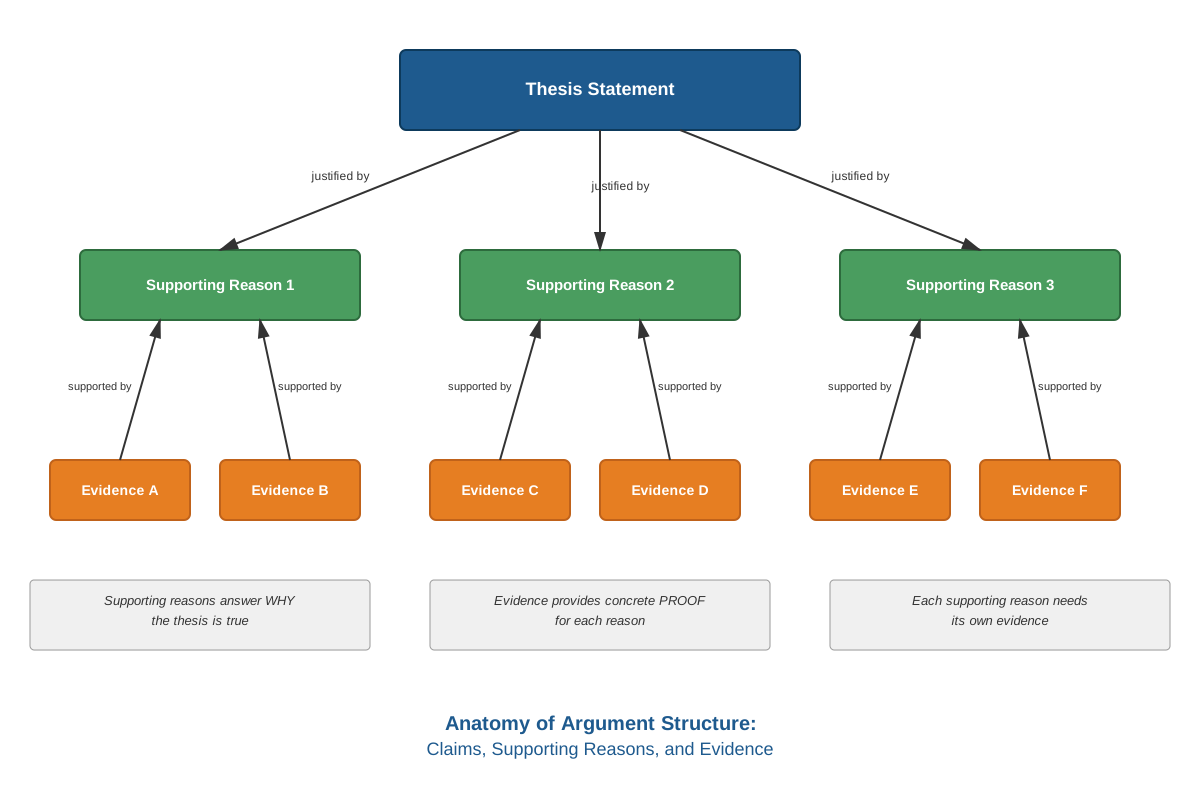
- Claim: Schools should start later in the morning
- Supporting Reason: Adolescent biology requires more sleep for optimal cognitive function
- Evidence: Studies show teenagers naturally fall asleep later and need 8-10 hours of sleep
The supporting reason explains why the evidence matters to the claim—it's not just that teenagers need sleep, but that their biological needs create a mismatch with early start times.
Characteristics of Strong Supporting Reasons
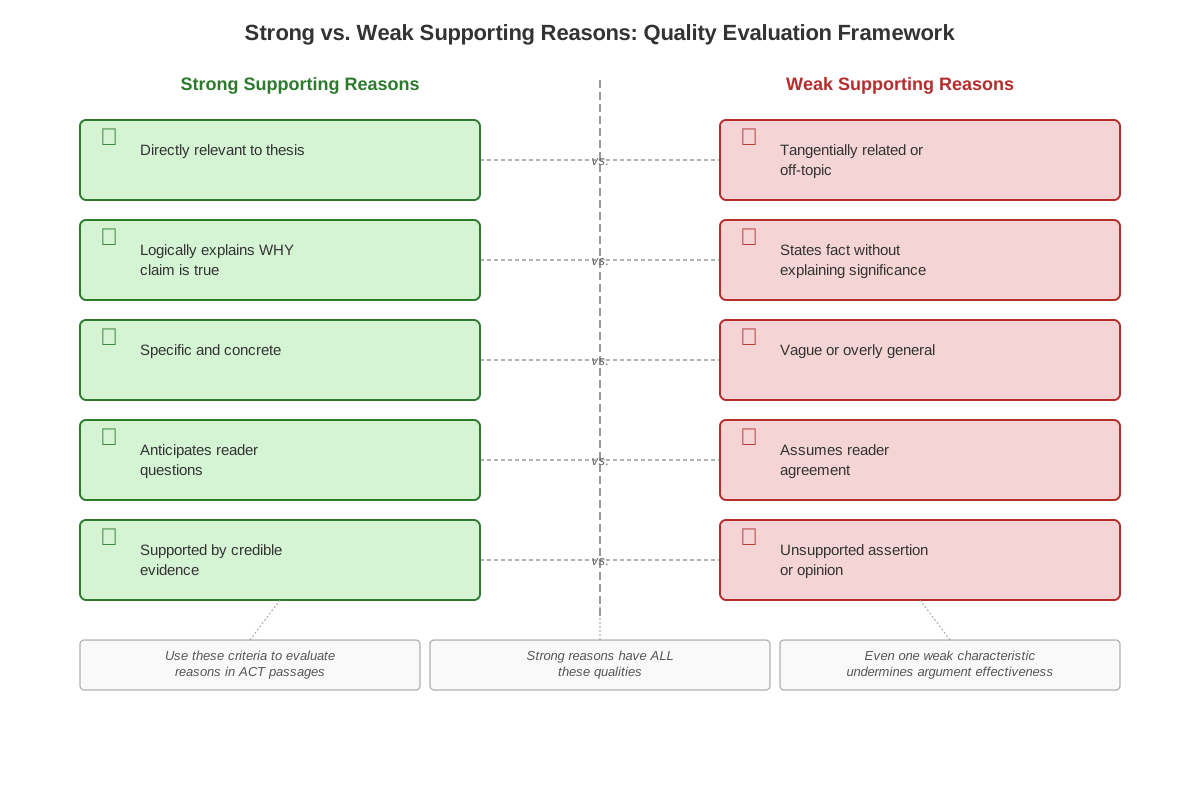
Effective supporting reasons share several key qualities that the ACT consistently rewards:
| Characteristic | Description | Example |
|---|---|---|
| Relevance | Directly relates to the main claim | For a claim about reducing plastic waste, a reason about ocean ecosystem health is relevant; a reason about plastic manufacturing costs is less so |
| Specificity | Provides concrete, detailed reasoning rather than vague generalities | "Reduces carbon emissions by eliminating daily commutes" vs. "Is better for the environment" |
| Logical Connection | Creates a clear cause-effect or if-then relationship | "Because X is true, Y follows" rather than two unrelated statements |
| Sufficiency | Provides adequate weight to support the claim's scope | A major claim requires substantial reasoning; minor points need less development |
| Credibility | Based on sound logic or verifiable premises | Avoids logical fallacies and unsupported assumptions |
Types of Supporting Reasons
The ACT recognizes several categories of supporting reasons, each serving different argumentative purposes:
Causal Reasoning: Explains how one thing leads to another
- "Increasing minimum wage would stimulate local economies because workers would have more disposable income to spend at local businesses"
Comparative Reasoning: Shows how one option is superior to alternatives
- "Online learning offers greater flexibility than traditional classrooms because students can access materials at times that fit their individual schedules"
Definitional Reasoning: Clarifies what something is or means to support a claim
- "This policy constitutes censorship because it restricts access to information based on content rather than age-appropriateness"
Practical Reasoning: Focuses on real-world feasibility or consequences
- "Universal healthcare would reduce administrative costs because a single-payer system eliminates redundant billing processes"
Ethical/Value-Based Reasoning: Appeals to principles or values
- "Privacy protections should extend to digital communications because individuals have a fundamental right to confidential correspondence"
The Reasoning Chain
Strong arguments develop reasoning chains where supporting reasons build upon each other in logical sequence. The ACT rewards essays that demonstrate this progressive development:
- Primary Supporting Reason: The main logical justification for the thesis
- Secondary Supporting Reason: Explains or extends the primary reason
- Tertiary Supporting Reason: Addresses implications or responds to potential objections
Example chain:
- Thesis: Cities should invest in public transportation infrastructure
- Primary Reason: Public transit reduces traffic congestion
- Secondary Reason: Reduced congestion decreases commute times and improves productivity
- Tertiary Reason: Improved productivity benefits the entire regional economy, creating a return on the initial investment
Common Weaknesses in Supporting Reasons
The ACT frequently tests students' ability to identify flawed reasoning:
Circular Reasoning: The reason simply restates the claim without adding logical support
- Weak: "Schools should ban junk food because unhealthy food shouldn't be in schools"
Non Sequitur: The reason doesn't logically connect to the claim
- Weak: "We should increase arts funding because many famous artists struggled financially" (their past struggles don't explain why current funding should increase)
Overgeneralization: The reason makes sweeping claims without adequate support
- Weak: "Everyone benefits from exercise, so gym class should be mandatory" (ignores students with physical limitations)
Irrelevant Reasoning: The reason addresses a different issue than the claim
- Weak: For a claim about educational quality, reasoning about school building aesthetics
Concept Relationships
Supporting reasons exist within a hierarchical argument structure: Thesis Statement → generates → Supporting Reasons → require → Evidence/Examples → need → Analysis/Explanation. Each supporting reason must trace back to the thesis while simultaneously connecting forward to specific evidence.
The relationship between supporting reasons and evidence is particularly crucial: evidence provides the "what" (facts, data, examples) while supporting reasons provide the "why" (logical explanation of significance). Neither functions effectively without the other. A supporting reason without evidence appears unsubstantiated; evidence without a supporting reason seems disconnected or irrelevant.
Supporting reasons also connect laterally to each other through logical progression. The ACT rewards essays where each supporting reason builds upon or complements previous reasons rather than simply listing unrelated points. This creates argument coherence—the sense that all parts of an argument work together toward a unified purpose.
The concept also relates to counterargument acknowledgment: strong supporting reasons often anticipate and address potential objections, demonstrating sophisticated thinking. When a writer acknowledges a counterpoint and then provides a supporting reason for why their position remains stronger, they demonstrate the critical thinking the ACT's highest scores require.
High-Yield Facts
⭐ Supporting reasons explain WHY a claim should be accepted, not just WHAT the claim is—they provide logical justification rather than restatement
⭐ The ACT essay rubric explicitly rewards "reasoning and illustration" in the Development and Support dimension—essays scoring 5-6 must demonstrate "skillful reasoning"
⭐ Strong supporting reasons create clear logical connections between claims and evidence—they function as bridges in argument structure
⭐ Relevance is the most important quality of a supporting reason—even well-developed reasoning fails if it doesn't directly relate to the main claim
⭐ Multiple supporting reasons are stronger than a single reason—the ACT rewards essays that develop arguments from multiple angles
- Supporting reasons should be specific rather than vague—concrete reasoning is more persuasive and easier to develop with evidence
- Effective supporting reasons often address "so what?" or "why does this matter?"—they explain significance
- The ACT frequently tests whether added sentences provide relevant support or introduce irrelevant information
- Supporting reasons can be causal, comparative, practical, ethical, or definitional—different types serve different argumentative purposes
- Weak supporting reasons include circular reasoning, non sequiturs, overgeneralizations, and irrelevant connections
- Supporting reasons should progress logically—each reason should build upon or complement previous reasoning
- The strongest arguments acknowledge counterarguments and provide supporting reasons for why the main position remains superior
Quick check — test yourself on Supporting reasons so far.
Try Flashcards →Common Misconceptions
Misconception: Supporting reasons and evidence are the same thing → Correction: Supporting reasons provide logical explanation (the "why"), while evidence provides concrete facts or examples (the "what"). A statistic is evidence; the explanation of why that statistic matters to your argument is the supporting reason.
Misconception: More supporting reasons always make a stronger argument → Correction: Quality matters more than quantity. Three well-developed, relevant supporting reasons with clear logical connections are far more effective than five superficial or tangentially related reasons. The ACT rewards depth of reasoning over breadth.
Misconception: Supporting reasons should always come before evidence → Correction: While this is a common and effective structure, strong arguments can also present evidence first and then provide the reasoning that explains its significance. What matters is that the logical connection is clear, not the specific order.
Misconception: Personal opinions count as supporting reasons → Correction: Simply stating "I believe" or "I think" doesn't constitute reasoning. Supporting reasons must provide logical justification that would be persuasive regardless of who presents it. Personal experience can serve as evidence, but the reasoning explaining why that experience supports the claim must be logical and generalizable.
Misconception: If a supporting reason is true, it automatically strengthens the argument → Correction: A supporting reason must be both true AND relevant to strengthen an argument. Many true statements have no logical connection to a particular claim. The ACT frequently includes answer choices that are factually accurate but logically irrelevant to the argument at hand.
Misconception: Supporting reasons only matter in the essay portion → Correction: The ACT English multiple-choice section frequently tests supporting reasons through questions about sentence addition, relevance, and logical connection. Understanding supporting reasons is essential for both the essay and multiple-choice sections.
Worked Examples
Example 1: Evaluating Supporting Reasons in a Multiple-Choice Context
Passage excerpt: "Community gardens provide numerous benefits to urban neighborhoods. [1] They create green spaces in concrete-dominated environments. [2] Many vegetables are rich in vitamins and minerals. [3] Gardens foster social connections among neighbors who work together. [4] They can reduce local food costs by providing fresh produce."
Question: The writer is considering deleting sentence [2]. Should the sentence be kept or deleted?
Analysis Process:
Step 1: Identify the main claim—community gardens provide benefits to urban neighborhoods
Step 2: Evaluate whether sentence [2] provides a supporting reason for this claim
Step 3: Examine the logical connection—does the nutritional content of vegetables explain why community gardens benefit neighborhoods?
Step 4: Recognize the disconnect—sentence [2] provides general information about vegetables but doesn't explain how this relates to community gardens' benefits to neighborhoods. The nutritional value would be the same whether vegetables came from community gardens, grocery stores, or home gardens.
Step 5: Compare to other sentences—sentences [1], [3], and [4] all provide specific reasons why community gardens benefit neighborhoods (green space creation, social connection, cost reduction)
Answer: Delete sentence [2] because it doesn't provide a relevant supporting reason for the claim about community gardens' benefits to neighborhoods. While factually true, it lacks logical connection to the specific argument being made.
Connection to Learning Objectives: This example demonstrates how to identify when supporting reasons are being tested (sentence addition/deletion questions) and how to evaluate whether a statement functions as an effective supporting reason (relevance and logical connection).
Example 2: Developing Supporting Reasons for an Essay
Prompt: "Some educators believe that students learn better through hands-on, project-based learning, while others argue that traditional lecture-based instruction is more effective. In your opinion, which approach better serves students' educational needs?"
Thesis: Project-based learning better serves students' educational needs than traditional lecture-based instruction.
Developing Supporting Reasons:
Supporting Reason 1: Project-based learning promotes deeper understanding through active engagement with material rather than passive reception of information.
- Why this works: Creates a clear causal connection (active engagement → deeper understanding) and explains WHY project-based learning is superior
- Evidence to pair with this: Studies showing retention rates for active vs. passive learning; examples of students explaining concepts they've worked with hands-on
- Further development: This deeper understanding translates to better long-term retention and ability to apply knowledge in new contexts
Supporting Reason 2: Real-world projects develop practical skills that lectures cannot address, including collaboration, problem-solving, and time management.
- Why this works: Identifies specific advantages (practical skills) and explains what makes project-based learning unique
- Evidence to pair with this: Examples of skills employers value; student testimonials about project experiences
- Further development: These skills prove essential for college and career success, making project-based learning more aligned with students' future needs
Supporting Reason 3: Project-based learning accommodates diverse learning styles more effectively than one-size-fits-all lectures.
- Why this works: Provides comparative reasoning showing why one approach is superior to the other
- Evidence to pair with this: Research on learning style diversity; examples of students who struggle with lectures but excel with projects
- Further development: By reaching more students effectively, project-based learning promotes educational equity
Weak Supporting Reason to Avoid: "Many students find projects more interesting than lectures."
- Why this fails: Relies on subjective preference rather than logical reasoning about educational effectiveness; doesn't explain WHY interest matters to learning outcomes; could be countered by students who prefer lectures
Connection to Learning Objectives: This example demonstrates how to generate multiple relevant supporting reasons for a thesis, distinguish between strong and weak reasoning, and understand how supporting reasons connect to evidence and further development.
Exam Strategy
Identifying Supporting Reasons Questions
The ACT signals supporting reasons questions through specific trigger phrases:
- "Which choice most effectively supports the claim made in the previous sentence?"
- "Should the writer add this sentence here?"
- "Which choice provides the most relevant detail?"
- "The writer wants to support the main argument of the paragraph"
- "Which choice best maintains the focus of the passage?"
Exam Tip: When you see "support," "relevant," "strengthen," or "maintain focus," you're dealing with a supporting reasons question. These require evaluating logical connections, not just grammatical correctness.
The Three-Question Approach
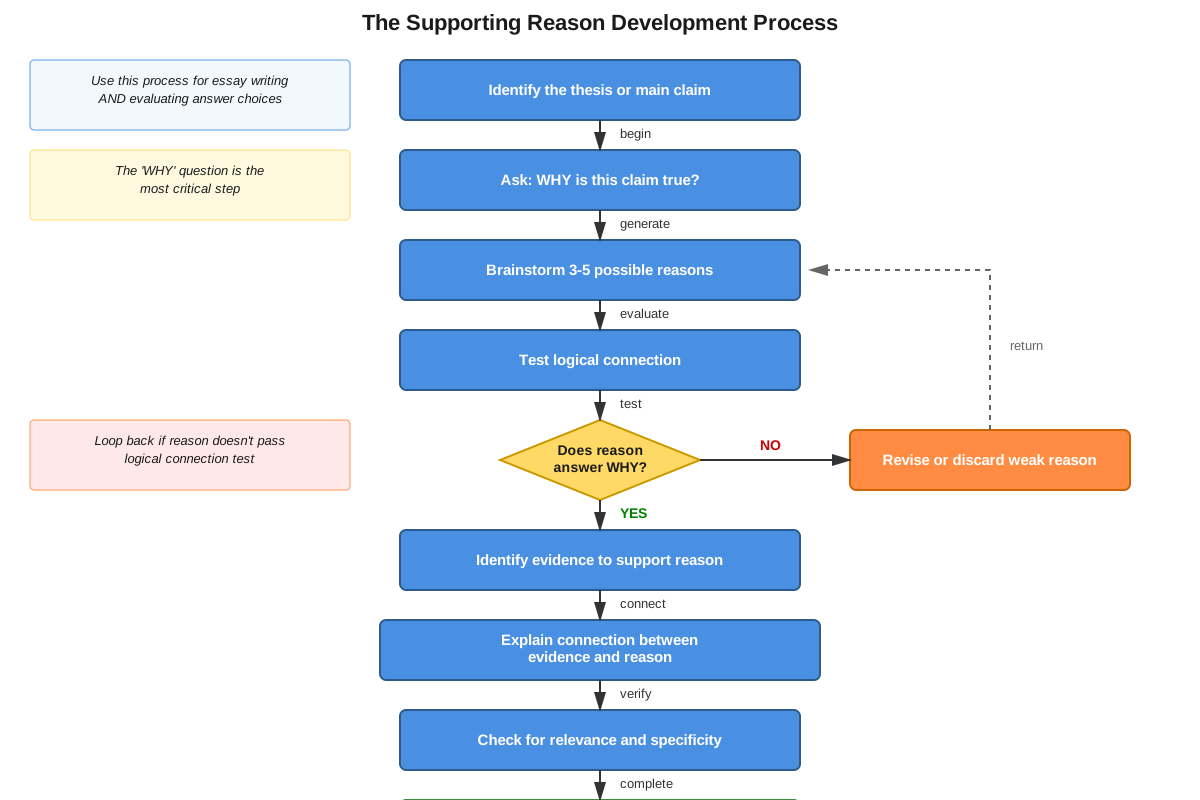
For any supporting reasons question, systematically ask:
- What is the main claim or thesis? (Identify what needs support)
- Does this statement logically connect to that claim? (Evaluate relevance)
- Does it explain WHY or HOW, not just WHAT? (Distinguish reasoning from mere information)
Process of Elimination Strategy
When evaluating answer choices:
Eliminate first: Choices that are factually true but logically irrelevant—these are the most common wrong answers on supporting reasons questions
Eliminate second: Choices that provide evidence or examples without explaining their significance—remember, supporting reasons explain the "why"
Eliminate third: Choices that are too vague or general to provide meaningful support
Select: The choice that creates the clearest logical bridge between claim and evidence
Time Allocation
Supporting reasons questions typically require 30-45 seconds—slightly longer than pure grammar questions because they demand logical analysis. Don't rush these questions; the extra 10-15 seconds spent ensuring you understand the logical connection pays off in accuracy.
For the essay, allocate 2-3 minutes during planning to develop 2-3 strong supporting reasons before you begin writing. This upfront investment prevents the common problem of essays that list examples without explaining their significance.
Red Flags
Watch for these warning signs of weak supporting reasons:
- Circular language: If the "reason" uses the same words as the claim, it's probably just restatement
- "Obviously" or "clearly": These words often mask weak reasoning—if something were truly obvious, it wouldn't need to be stated
- Topic shifts: If the sentence introduces a new subject rather than developing the existing claim, it's likely irrelevant
- Emotional appeals without logic: Feelings aren't supporting reasons unless connected to logical consequences
Memory Techniques
The BRIDGE Acronym
Remember that supporting reasons BRIDGE claims to evidence:
- Builds logical connection
- Relevant to main claim
- Illustrates why evidence matters
- Demonstrates cause-effect or comparison
- Goes beyond mere restatement
- Explains significance
The "So What?" Test
Visualize a skeptical reader asking "So what?" after every claim. Your supporting reason should answer that question. If you can't articulate why something matters to your argument, it's not a strong supporting reason.
The Three-Layer Sandwich
Remember argument structure as a sandwich:
- Top bread: Claim/thesis
- Filling: Supporting reasons (the substance that holds everything together)
- Bottom bread: Evidence/examples
Just as a sandwich needs filling to be satisfying, an argument needs supporting reasons to be convincing. This visual helps remember that supporting reasons are the essential middle layer.
The "Because" Technique
When drafting supporting reasons, use the word "because" to force yourself to provide logical explanation:
"[Claim] because [supporting reason]"
If the sentence doesn't make logical sense with "because" connecting the parts, you don't have a true supporting reason.
Summary
Supporting reasons form the logical foundation of effective argumentation on the ACT Writing test, serving as the essential bridge between claims and evidence. These reasons explain why a claim should be accepted as valid, moving beyond mere restatement or evidence presentation to provide the logical justification that makes arguments persuasive. The ACT evaluates supporting reasons both in the essay portion, where students must develop their own arguments with clear reasoning, and in multiple-choice questions that test whether students can identify relevant support and evaluate logical connections. Strong supporting reasons share key characteristics: relevance to the main claim, specificity rather than vagueness, clear logical connections, and adequate development. Common weaknesses include circular reasoning, non sequiturs, overgeneralizations, and irrelevant connections. Success on ACT supporting reasons questions requires systematically identifying the main claim, evaluating whether statements logically connect to that claim, and distinguishing between reasoning (which explains why) and evidence (which provides what). Students who master supporting reasons gain not only higher ACT scores but also transferable critical thinking and writing skills essential for academic and professional success.
Key Takeaways
- Supporting reasons explain WHY claims should be accepted, providing logical justification rather than restatement or evidence alone
- Relevance is paramount—even well-developed reasoning fails if it doesn't directly connect to the main claim being supported
- The ACT tests supporting reasons in both essay and multiple-choice formats, requiring students to both generate and evaluate logical connections
- Strong supporting reasons create clear bridges between abstract claims and concrete evidence, answering the implicit "So what?" question
- Multiple types of reasoning exist (causal, comparative, practical, ethical, definitional), and effective arguments often employ several types
- Common pitfalls include circular reasoning, non sequiturs, and confusing factual truth with logical relevance—a statement can be true but still fail to support a particular claim
- The systematic three-question approach (What's the claim? Does this connect? Does it explain why?) provides a reliable method for evaluating supporting reasons under time pressure
Related Topics
Evidence Selection and Integration: After mastering supporting reasons, students should study how to select and incorporate specific evidence that pairs effectively with their reasoning. This topic builds directly on supporting reasons by focusing on the concrete examples and data that substantiate logical explanations.
Counterargument and Rebuttal: Understanding supporting reasons enables progression to more sophisticated argument techniques, including acknowledging opposing viewpoints and providing reasons why the main position remains stronger despite valid counterpoints.
Logical Fallacies: Deeper study of common reasoning errors helps students avoid weak supporting reasons and identify flawed logic in test passages. This topic extends the concept of evaluating reasoning quality.
Paragraph Development and Organization: Supporting reasons must be organized effectively within paragraphs and across entire essays. This topic applies supporting reasons knowledge to larger structural contexts.
Thesis Statement Refinement: As students master supporting reasons, they can work backward to craft more sophisticated thesis statements that anticipate the reasoning that will follow, creating tighter argument coherence.
Practice CTA
Now that you understand the essential role supporting reasons play in ACT Writing, it's time to apply this knowledge through targeted practice. Work through the practice questions to test your ability to identify, evaluate, and generate effective supporting reasons under test-like conditions. Use the flashcards to reinforce key concepts and characteristics of strong reasoning. Remember: supporting reasons are tested frequently on the ACT, and mastering this concept will improve your performance across multiple question types in both the essay and multiple-choice sections. Each practice question you complete strengthens your ability to think critically about logical connections—a skill that extends far beyond test day. You've got this!
Sign up free to keep reading
Create a free AnvayaPrep account to finish this ACT guide on Supporting reasons — plus flashcards and practice questions.