Overview
The ACT writing revision strategy is a critical skill set that directly impacts performance on the ACT English Test, which comprises 75 questions to be answered in 45 minutes. Unlike the optional ACT Writing Test (the essay), the English Test focuses heavily on identifying and correcting errors in grammar, punctuation, sentence structure, and rhetorical skills. Revision strategy questions specifically test a student's ability to improve existing text by recognizing when sentences, phrases, or entire paragraphs need to be added, deleted, revised, or reordered to enhance clarity, coherence, and effectiveness.
These questions represent approximately 35% of the ACT English Test and fall under the "Production of Writing" and "Knowledge of Language" reporting categories. Students must quickly evaluate whether proposed revisions improve the passage, maintain its purpose and tone, and enhance logical flow. The ACT writing revision strategy encompasses systematic approaches to analyzing revision choices, including understanding the author's intent, evaluating relevance and specificity, assessing transitions and organization, and recognizing redundancy or wordiness.
Mastery of revision strategy connects directly to broader writing concepts including essay organization, style consistency, audience awareness, and effective communication. Students who excel at revision questions demonstrate not only grammatical knowledge but also higher-order thinking skills such as evaluating effectiveness, analyzing purpose, and synthesizing information across multiple sentences or paragraphs. This topic serves as the bridge between mechanical correctness and sophisticated rhetorical awareness.
Learning Objectives
- [ ] Identify when ACT writing revision strategy is being tested
- [ ] Explain the core rule or strategy behind ACT writing revision strategy
- [ ] Apply ACT writing revision strategy to ACT-style questions accurately
- [ ] Evaluate whether proposed additions or deletions strengthen or weaken a passage
- [ ] Determine the most effective placement for sentences within paragraphs
- [ ] Distinguish between relevant and irrelevant information based on passage purpose
- [ ] Recognize and eliminate redundant or wordy constructions in favor of concise alternatives
Prerequisites
- Basic grammar and punctuation rules: Understanding fundamental sentence structure enables recognition of grammatically correct revision options
- Reading comprehension skills: The ability to understand main ideas and supporting details is essential for evaluating relevance and coherence
- Paragraph structure knowledge: Familiarity with topic sentences, supporting evidence, and concluding statements helps assess organizational effectiveness
- Transition word functions: Knowing how transitions signal relationships between ideas aids in evaluating logical flow
Why This Topic Matters
Revision strategy questions appear in every ACT English Test passage, typically comprising 25-30 questions per test. These questions assess real-world writing skills that extend far beyond standardized testing—the ability to revise and improve written communication is fundamental to academic success, professional correspondence, and effective information sharing. College-level writing demands constant revision, and employers consistently rank clear written communication among the most valued skills.
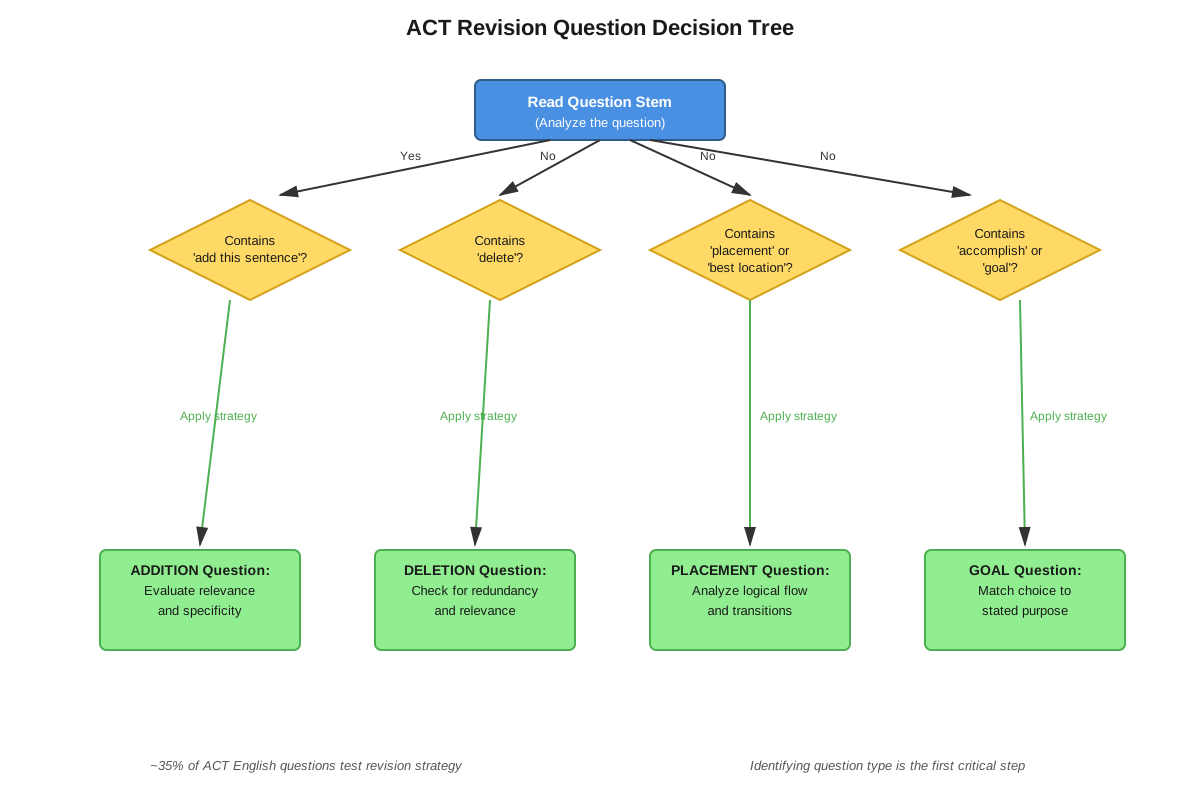
On the ACT, revision questions appear in several distinct formats: "Should the writer add this sentence?", "Should the writer delete the underlined portion?", "The best placement for this sentence would be...", and "Which choice most effectively accomplishes the writer's goal?" These questions often carry more weight than simple grammar corrections because they require synthesizing information across multiple sentences or entire paragraphs, demonstrating higher-order analytical skills.
Common manifestations include questions about adding specific details to support claims, removing tangential information that disrupts focus, reordering sentences to improve logical progression, and selecting the most appropriate concluding statement. Unlike grammar questions with single correct answers based on rules, revision questions demand understanding of context, purpose, and rhetorical effectiveness—skills that directly translate to improved writing performance across all academic disciplines.
Core Concepts
The Four Pillars of Revision Strategy
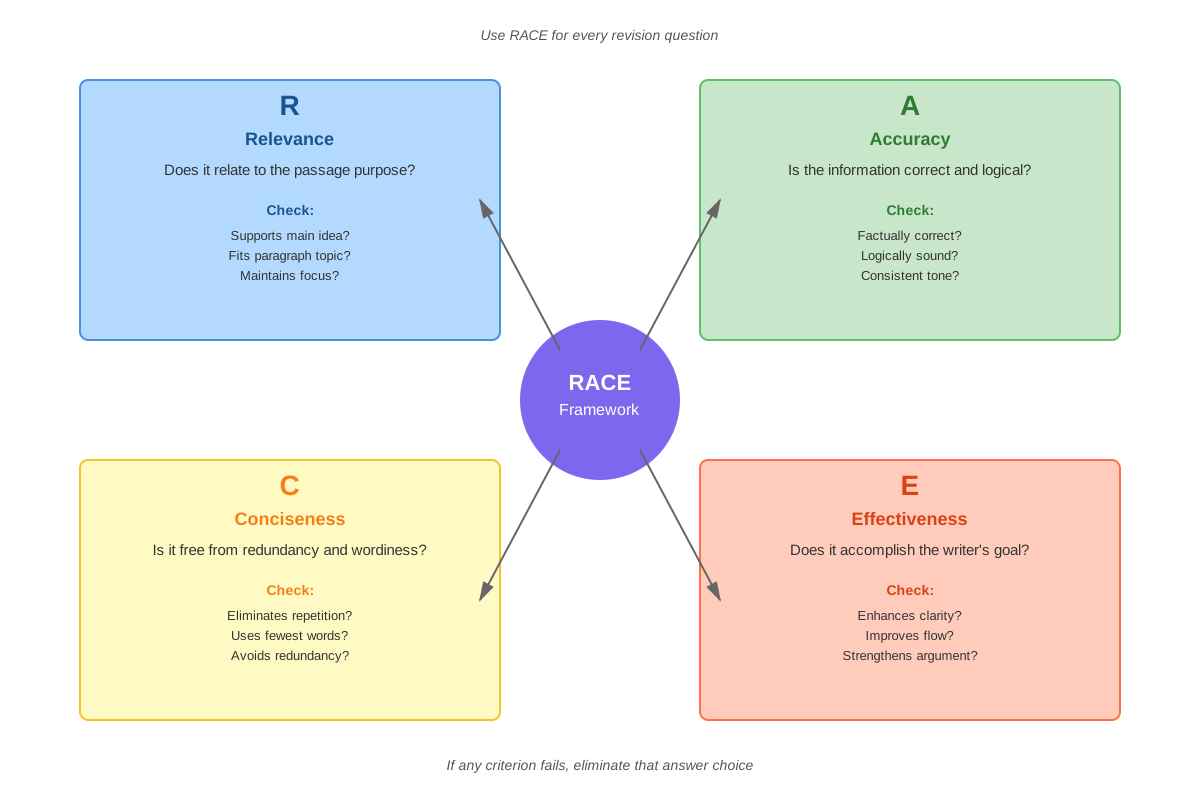
The ACT writing revision strategy rests on four fundamental evaluation criteria that students must internalize and apply systematically to every revision question.
Relevance determines whether information directly supports the passage's main purpose and focus. Every sentence should contribute meaningfully to the central idea. When evaluating additions, ask: "Does this information advance the author's argument or provide necessary context?" When considering deletions, ask: "Would removing this create a gap in understanding or weaken the argument?" Irrelevant information, no matter how interesting or well-written, detracts from passage coherence and should be eliminated.
Specificity assesses whether details are concrete and meaningful rather than vague or generic. The ACT consistently rewards specific, vivid language over abstract generalizations. For example, "The scientist conducted groundbreaking research on cellular regeneration in amphibians" is superior to "The scientist did important work." Revision questions frequently test whether students recognize that adding specific examples, data, or descriptions strengthens writing.
Conciseness requires eliminating redundancy and wordiness without sacrificing meaning. The ACT penalizes repetitive phrasing and unnecessarily complex constructions. Students must identify when information is stated multiple times in different words or when simpler phrasing conveys the same meaning more effectively. The principle: use the fewest words necessary to communicate clearly.
Coherence evaluates logical flow and organizational structure. Sentences should follow a clear progression of ideas, with appropriate transitions signaling relationships. Paragraphs should maintain unified focus, and information should appear in the most logical sequence. Revision questions testing coherence often ask about sentence placement or whether transitions effectively connect ideas.
Question Type Recognition
Understanding the specific formats of revision questions enables rapid identification and appropriate strategic response.
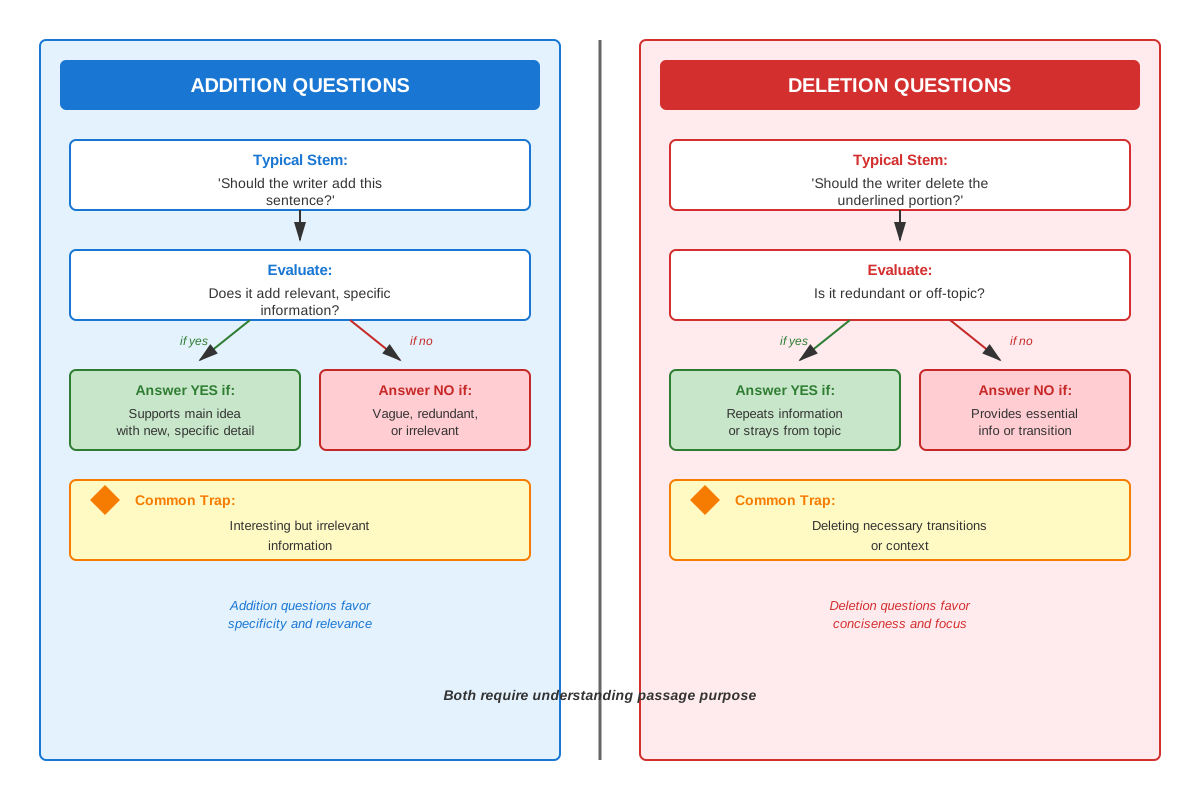
Addition Questions present a proposed sentence or phrase and ask whether it should be added, typically followed by a justification. The format: "Should the writer make this addition here?" with answer choices like "Yes, because it provides specific evidence supporting the claim" or "No, because it introduces information irrelevant to the paragraph's focus." The correct answer depends on whether the addition enhances relevance, specificity, or coherence without creating redundancy.
Deletion Questions ask whether underlined text should be removed, again requiring justification. Format: "Should the writer delete the underlined portion?" with choices explaining why deletion would improve or harm the passage. Students must evaluate whether the information is redundant, irrelevant, or essential to understanding.
Placement Questions provide a numbered sentence and ask where it best fits within a paragraph. These test organizational logic and coherence. Students must read the entire paragraph, understand the progression of ideas, and identify where the sentence logically belongs based on content and transitions.
Goal-Oriented Questions specify what the writer aims to accomplish and ask which choice best achieves that goal. Format: "Which choice most effectively introduces the paragraph's main idea?" or "Which choice provides the most specific support for the claim in the previous sentence?" These require understanding both the stated goal and the passage context.
The Systematic Evaluation Process
Successful revision strategy application follows a consistent analytical sequence:
- Read the surrounding context: Never evaluate a revision in isolation. Read at least 2-3 sentences before and after the question to understand the paragraph's focus and flow.
- Identify the passage purpose: Determine whether the passage is informative, persuasive, narrative, or descriptive. This guides evaluation of what information is relevant.
- Analyze each answer choice: For questions with justifications, the reasoning is as important as the yes/no decision. Eliminate choices with faulty reasoning even if the yes/no seems correct.
- Apply the four pillars: Systematically check whether the revision enhances or diminishes relevance, specificity, conciseness, and coherence.
- Trust the passage over personal knowledge: Base decisions solely on what the passage states and implies, not on outside knowledge or personal opinions about the topic.
Transition and Flow Analysis
Effective revision strategy requires understanding how transitions and sentence relationships create coherence. The ACT tests whether students recognize appropriate transitional language and logical progression.
| Transition Type | Function | Examples |
|---|---|---|
| Addition | Introduces supporting information | furthermore, additionally, moreover, also |
| Contrast | Signals opposing ideas | however, nevertheless, conversely, yet |
| Cause-Effect | Shows relationships | therefore, consequently, thus, as a result |
| Example | Introduces illustration | for instance, specifically, namely, such as |
| Sequence | Indicates order | first, subsequently, finally, meanwhile |
| Emphasis | Highlights importance | indeed, in fact, certainly, undoubtedly |
When evaluating sentence placement, identify the transition words in both the sentence being moved and surrounding sentences. These signal where the sentence logically fits. A sentence beginning with "However" must follow a statement it contrasts with. A sentence starting with "This discovery" must follow the discovery being referenced.
Redundancy Recognition
The ACT frequently tests whether students can identify and eliminate redundant expressions. Common redundancy patterns include:
- Circular definitions: "The annual event that happens every year"
- Implied meanings: "Completely eliminate" (eliminate already means complete removal)
- Repetitive phrasing: Stating the same idea in consecutive sentences using different words
- Unnecessary intensifiers: "Very unique" (unique is absolute)
- Redundant pairs: "Each and every," "first and foremost," "various and sundry"
Revision questions may ask whether to delete redundant portions or choose between options where one is more concise without losing meaning.
Concept Relationships
The core concepts of revision strategy form an interconnected system where each element reinforces the others. Relevance serves as the foundation—before evaluating any other quality, information must relate to the passage purpose. Once relevance is established, specificity determines the quality and effectiveness of that relevant information. Conciseness then refines expression by eliminating unnecessary words while preserving specific, relevant content. Finally, coherence ensures that all relevant, specific, concise elements are arranged in logical order with appropriate transitions.
This hierarchy flows as: Relevance → Specificity → Conciseness → Coherence
The systematic evaluation process applies these concepts sequentially. Reading context enables relevance assessment. Identifying passage purpose guides specificity evaluation. Analyzing answer choices requires checking for conciseness. Applying transition analysis ensures coherence.
Question type recognition connects to evaluation strategy—addition questions primarily test relevance and specificity, deletion questions focus on redundancy and relevance, placement questions assess coherence, and goal-oriented questions integrate all four pillars based on the stated objective.
These revision concepts build upon prerequisite knowledge: grammar rules ensure mechanically correct options, reading comprehension enables purpose identification, paragraph structure knowledge supports coherence evaluation, and transition understanding facilitates flow analysis. Mastery of revision strategy subsequently enables advanced skills in essay organization, style consistency, and rhetorical effectiveness.
High-Yield Facts
⭐ Approximately 35% of ACT English Test questions assess revision and editing skills, making this the highest-weighted question category.
⭐ When a question asks "Should the writer add/delete this?", the justification in the answer choice must accurately reflect the passage content—even if the yes/no decision seems correct, wrong reasoning makes the answer incorrect.
⭐ Information can be factually accurate and well-written but still be incorrect to add if it doesn't directly support the paragraph's specific focus.
⭐ The ACT consistently rewards the most concise option that preserves full meaning—if two choices are grammatically correct, choose the shorter one.
⭐ Sentence placement questions require reading the entire paragraph; the correct position is determined by logical flow, transition words, and pronoun references.
- Addition questions that include phrases like "provides specific evidence" or "offers relevant detail" are correct only if the addition genuinely adds new, pertinent information.
- Deletion justifications stating "it repeats information already provided" are correct only when the passage explicitly states the same idea elsewhere.
- Transitional phrases at the beginning of sentences are crucial clues for placement questions—match the transition type to the logical relationship needed.
- Goal-oriented questions always specify what the writer aims to accomplish; ignore answer choices that don't address the stated goal, even if they're otherwise good writing.
- When evaluating relevance, consider the paragraph's focus, not just the passage's general topic—information can relate to the broad subject but be irrelevant to the specific paragraph purpose.
- Redundancy can occur across sentences, not just within them—check whether consecutive sentences essentially repeat the same point.
- The phrase "most effectively" in questions signals that multiple options may be acceptable, but one best achieves the stated purpose through superior specificity, clarity, or relevance.
- Pronouns and demonstrative adjectives (this, that, these, those) in a sentence indicate it must follow the noun being referenced, helping determine correct placement.
- Concluding sentences should synthesize or reflect on the paragraph's content without introducing entirely new information.
- The ACT never rewards flowery or overly complex language—clear, direct expression is always preferred.
Quick check — test yourself on ACT writing revision strategy so far.
Try Flashcards →Common Misconceptions
Misconception: If information is interesting or factually correct, it should be added to the passage.
Correction: Information must be both accurate AND relevant to the specific paragraph's focus. The ACT frequently includes true, interesting facts as incorrect addition options because they don't support the immediate context or advance the author's purpose.
Misconception: Longer, more detailed answer choices are better because they provide more information.
Correction: The ACT rewards conciseness—the best answer uses the fewest words necessary to convey complete meaning. Wordiness and redundancy are penalized even when grammatically correct. If two options convey the same meaning, choose the shorter one.
Misconception: Deletion questions are asking whether the information is true or well-written.
Correction: Deletion questions assess whether information is necessary for understanding, relevant to the focus, or redundant. Beautifully written, accurate sentences should be deleted if they're tangential to the paragraph's purpose or repeat information already stated.
Misconception: Personal opinion about what makes good writing determines the correct answer.
Correction: Revision decisions must be based solely on the passage's established purpose, tone, and content. What seems interesting or important personally is irrelevant—only what serves the passage's specific goals matters.
Misconception: Sentence placement is determined by where it "sounds best" or "feels right."
Correction: Correct placement is determined by logical progression of ideas, transition words, pronoun references, and content relationships. There are specific, identifiable reasons why a sentence belongs in one position rather than another.
Misconception: If the justification in an answer choice is partially correct, the answer is acceptable.
Correction: The justification must be entirely accurate. If an answer says "Yes, because it provides specific evidence" but the addition actually offers general commentary rather than specific evidence, the answer is wrong even if adding the sentence might improve the passage for other reasons.
Misconception: Transition words can be used interchangeably as long as they connect sentences.
Correction: Each transition type signals a specific logical relationship. Using "however" when the relationship is actually cause-and-effect ("therefore") creates incoherence even though both are transitions.
Worked Examples
Example 1: Addition Question
Passage Context:
"The monarch butterfly's annual migration covers up to 3,000 miles, one of the longest insect migrations known. [1] These butterflies travel from Canada and the northern United States to specific forests in central Mexico. [2] The journey requires multiple generations, as no single butterfly completes the entire round trip."
Question:
At this point, the writer is considering adding the following sentence:
"Many people enjoy watching butterflies in their gardens during summer months."
Should the writer make this addition here?
A) Yes, because it provides relevant information about human interaction with butterflies.
B) Yes, because it connects the scientific information to readers' personal experiences.
C) No, because it shifts focus from the monarch's migration to general butterfly observation.
D) No, because it contradicts information presented earlier in the passage.
Analysis:
Step 1: Identify the paragraph's focus—the monarch butterfly's specific migration pattern and characteristics.
Step 2: Evaluate the proposed addition's relevance—the sentence discusses general butterfly watching, not monarch migration.
Step 3: Assess specificity—the addition is vague ("many people," "summer months") and doesn't advance understanding of the migration.
Step 4: Check for coherence—the addition would interrupt the logical flow from migration distance to migration route to generational aspect.
Step 5: Eliminate answers—Choice A is incorrect because "relevant" is inaccurate; the information doesn't relate to migration. Choice B is incorrect because connecting to personal experience isn't the paragraph's purpose. Choice D is incorrect because there's no contradiction, just irrelevance.
Correct Answer: C
The sentence should not be added because it shifts focus from the specific topic (monarch migration) to an unrelated general topic (butterfly watching). Even though the sentence is about butterflies, it doesn't support the paragraph's specific purpose.
Example 2: Placement Question
Passage:
[1] The development of the printing press revolutionized information dissemination in 15th-century Europe. [2] Johannes Gutenberg's innovation allowed for mass production of texts that previously required months of manual copying. [3] This accessibility transformed education, religion, and politics across the continent. [4] Books became affordable for middle-class citizens, not just wealthy elites.
Question:
For the sake of logic and coherence, Sentence 4 should be placed:
A) where it is now.
B) after Sentence 1.
C) after Sentence 2.
D) before Sentence 1.
Analysis:
Step 1: Identify what Sentence 4 discusses—the affordability and accessibility of books to a broader population.
Step 2: Examine transition and content relationships:
- Sentence 1: Introduces the printing press's revolutionary impact
- Sentence 2: Explains Gutenberg's specific innovation and its efficiency
- Sentence 3: Describes broad consequences (education, religion, politics)
- Sentence 4: Provides specific detail about affordability
Step 3: Determine logical flow—Sentence 4 provides a specific example of how books became accessible (through affordability), which supports the general statement in Sentence 3 about transformation. However, it's more directly connected to Sentence 2's point about mass production enabling what was previously impossible.
Step 4: Check pronoun and transition clues—"This accessibility" in Sentence 3 refers to the accessibility described in Sentence 4 (books becoming affordable). Therefore, Sentence 4 should precede Sentence 3.
Step 5: Test placement after Sentence 2—The flow would be: innovation allowed mass production → books became affordable → this accessibility transformed society. This creates clear cause-and-effect progression.
Correct Answer: C
Sentence 4 should be placed after Sentence 2 because it provides the specific mechanism (affordability) by which mass production led to broader accessibility, which then enables Sentence 3's "This accessibility" reference to make logical sense.
Exam Strategy
When approaching revision strategy questions on the ACT, implement this systematic process to maximize accuracy and efficiency:
Immediate Identification: Recognize revision questions by their distinctive formats—"Should the writer add/delete," "best placement," "most effectively accomplishes," or "which choice provides." These signal that you're evaluating effectiveness rather than grammatical correctness.
Context Reading Protocol: Always read at least two sentences before and after the question location. Many students lose points by evaluating revisions in isolation. Understanding the paragraph's direction and focus is essential for accurate assessment. Budget 15-20 seconds for this context reading—it prevents costly errors.
Trigger Phrase Recognition: Watch for these high-yield phrases in answer choices:
- "Provides specific evidence/detail" → Verify the addition actually includes concrete, particular information
- "Repeats information already provided" → Confirm the passage explicitly states the same idea elsewhere
- "Irrelevant to the paragraph's focus" → Check whether the information relates to the immediate paragraph purpose, not just the general passage topic
- "Introduces the main idea" → Ensure the choice presents the central concept, not a supporting detail
- "Maintains the formal tone" → Evaluate whether the choice matches the passage's established style level
Elimination Strategy for Addition/Deletion Questions: First, determine your yes/no decision based on the four pillars (relevance, specificity, conciseness, coherence). Then, eliminate the two choices with the opposite decision. Finally, carefully evaluate the justifications in the remaining two choices—the reasoning must accurately reflect the passage content. A common trap is correct yes/no with incorrect reasoning.
Placement Question Approach: Number the positions between sentences (before 1, between 1-2, between 2-3, after 3). Read the sentence to be placed and identify key transition words, pronouns, or content clues. Systematically test each position by reading the flow with the sentence inserted. The correct position creates smooth logical progression without gaps or redundancy.
Time Management: Allocate approximately 45 seconds per revision question—slightly more than grammar questions because they require more context reading. If a question requires reading an entire paragraph, it's worth the investment. Don't rush these questions; they're often worth the same points as simpler grammar corrections but require more careful analysis.
Goal-Oriented Question Strategy: When questions specify what the writer aims to accomplish, immediately eliminate any choice that doesn't address the stated goal, regardless of writing quality. If the goal is "provide specific evidence for the claim," eliminate vague or general statements even if they're well-written.
Memory Techniques
RSCC Mnemonic for the Four Pillars: Relevance, Specificity, Conciseness, Coherence—"Revision Success Comes from Checking" these four elements in every question.
The "ADDS" Framework for Addition Questions:
- Assess relevance to paragraph focus
- Determine if it provides new information
- Decide if it enhances specificity
- Scrutinize the justification accuracy
The "DELETE" Process for Deletion Questions:
- Does it repeat information?
- Evaluate relevance to focus
- Look for tangential content
- Examine if removal creates gaps
- Test the justification
- Eliminate based on passage needs
Placement Visualization: Imagine the paragraph as a train with each sentence as a car. The sentence to be placed must connect smoothly to the car before it (matching content/transitions) and lead logically to the car after it. A misplaced car derails the train's progression.
Transition Type Acronym—"ACES":
- Addition (furthermore, moreover)
- Contrast (however, nevertheless)
- Example (for instance, specifically)
- Sequence (first, then, finally)
Conciseness Rule of Thumb: "When in doubt, cut it out"—if two options convey the same complete meaning, the shorter one is correct. Visualize trimming excess words like pruning a plant to promote healthy growth.
Summary
The ACT writing revision strategy encompasses systematic approaches to evaluating whether proposed changes to passages improve clarity, coherence, and effectiveness. Success requires mastering four fundamental pillars: relevance (does information support the specific paragraph focus?), specificity (are details concrete and meaningful?), conciseness (is expression efficient without wordiness?), and coherence (do ideas flow logically with appropriate transitions?). Students must recognize distinct question types—addition, deletion, placement, and goal-oriented—and apply targeted evaluation strategies to each. The systematic process involves reading surrounding context, identifying passage purpose, analyzing answer choices including justifications, and applying the four pillars. Approximately 35% of ACT English questions test revision skills, making this the highest-weighted category. Common pitfalls include evaluating information based on personal interest rather than passage relevance, assuming longer answers are better, and accepting partially correct justifications. Mastery requires understanding that the ACT rewards clear, direct, purposeful writing where every element serves the passage's specific goals.
Key Takeaways
- Revision questions comprise 35% of the ACT English Test and require evaluating effectiveness, not just grammatical correctness
- The four pillars—Relevance, Specificity, Conciseness, Coherence—provide a systematic framework for evaluating all revision decisions
- Always read 2-3 sentences before and after the question to understand paragraph focus and logical flow
- For addition/deletion questions, the justification must accurately reflect passage content; correct yes/no with wrong reasoning is incorrect
- Sentence placement depends on logical progression, transition words, and pronoun references—not subjective preference
- Information can be factually accurate and well-written but still be wrong to add if it doesn't support the specific paragraph purpose
- The ACT consistently rewards the most concise option that preserves complete meaning—eliminate wordiness and redundancy
Related Topics
Essay Organization and Structure: Building on revision strategy skills, this topic explores how to construct well-organized essays with clear thesis statements, logical paragraph progression, and effective transitions. Mastering revision strategy provides the analytical foundation for recognizing strong organizational patterns.
Rhetorical Skills and Audience Awareness: This advanced topic examines how writers adapt tone, style, and content to specific audiences and purposes. Revision strategy skills in evaluating relevance and effectiveness directly support understanding rhetorical choices.
Transition Words and Logical Connectors: A deeper exploration of how different transition types signal specific relationships between ideas. Strong revision strategy skills enable more sophisticated analysis of when and how transitions enhance coherence.
Concision and Wordiness Elimination: This focused topic provides extensive practice identifying and correcting redundant expressions, unnecessary qualifiers, and verbose constructions—building on the conciseness pillar of revision strategy.
Paragraph Unity and Focus: Advanced study of maintaining consistent focus within paragraphs, developing topic sentences, and ensuring all supporting details relate to the central idea. Revision strategy skills in evaluating relevance form the foundation for this topic.
Practice CTA
Now that you've mastered the core concepts of ACT writing revision strategy, it's time to apply these skills to authentic practice questions. The systematic approach you've learned—reading context, applying the four pillars, and carefully evaluating justifications—becomes more automatic with deliberate practice. Challenge yourself with the accompanying practice questions, focusing not just on selecting correct answers but on articulating why each choice is right or wrong. Use the flashcards to reinforce key concepts, trigger phrases, and common question patterns. Remember: revision strategy questions reward careful analysis and systematic thinking. Every practice question you complete strengthens your ability to quickly recognize question types, evaluate effectiveness, and select the best answer with confidence. Your investment in mastering this high-yield topic will pay dividends across the entire ACT English Test!
Sign up free to keep reading
Create a free AnvayaPrep account to finish this ACT guide on ACT writing revision strategy — plus flashcards and practice questions.