Overview
Logical order is one of the most frequently tested concepts in the ACT English section, appearing in questions that ask students to arrange sentences, paragraphs, or ideas in the most coherent and effective sequence. These questions assess a student's ability to recognize natural progression of ideas, maintain narrative flow, and ensure that information builds upon itself in a way that makes sense to readers. Unlike grammar questions that focus on sentence-level correctness, logical order questions require students to think about the broader structure and organization of a passage.
Understanding ACT logical order is essential because these questions typically appear 3-5 times per test and can significantly impact your score. They require you to step back from individual sentences and consider how ideas connect across multiple sentences or even entire paragraphs. The ACT tests logical order through various question types: asking where a sentence should be placed within a paragraph, determining the best sequence for paragraphs, or identifying whether a sentence should be added or deleted based on its relevance to the surrounding context.
Mastering logical order connects directly to other critical Writing concepts including topic sentences, transitions, coherence, and essay organization. When you understand how ideas should flow logically, you'll also improve your ability to identify effective transitions, recognize paragraph unity, and evaluate whether supporting details are arranged effectively. This skill extends beyond the ACT English section—it's fundamental to the ACT Writing test (essay) where organizing your argument logically is crucial for achieving a high score.
Learning Objectives
- [ ] Identify when Logical order is being tested in ACT English questions
- [ ] Explain the core rule or strategy behind Logical order
- [ ] Apply Logical order to ACT-style questions accurately
- [ ] Analyze the relationship between sentences to determine optimal placement
- [ ] Evaluate paragraph sequences to identify the most coherent arrangement
- [ ] Recognize transition words and phrases that signal logical connections
- [ ] Distinguish between chronological, spatial, and conceptual ordering patterns
Prerequisites
- Basic paragraph structure: Understanding topic sentences, supporting details, and concluding sentences is essential because logical order questions require recognizing how sentences function within paragraphs
- Transition words and phrases: Familiarity with transitional expressions helps identify logical connections between ideas and signals about proper sentence placement
- Reading comprehension: The ability to understand main ideas and supporting details is necessary to determine which arrangement makes the most sense
- Pronoun reference: Understanding how pronouns refer to antecedents helps determine whether a sentence can logically follow another
Why This Topic Matters
Logical order questions appear consistently on every ACT English test, typically comprising 10-15% of the total questions in the section. These questions are considered "medium" difficulty because they require more than mechanical grammar knowledge—they demand critical thinking about how ideas relate to one another. Students who master logical order often see significant score improvements because these questions, while challenging, follow predictable patterns once you understand the underlying principles.
In real-world applications, the ability to organize information logically is fundamental to effective communication. Whether writing emails, reports, presentations, or academic papers, arranging ideas in a coherent sequence ensures that readers can follow your thinking and understand your message. Employers consistently rank clear communication and organizational skills among the most valuable competencies, making this a practical skill that extends far beyond test day.
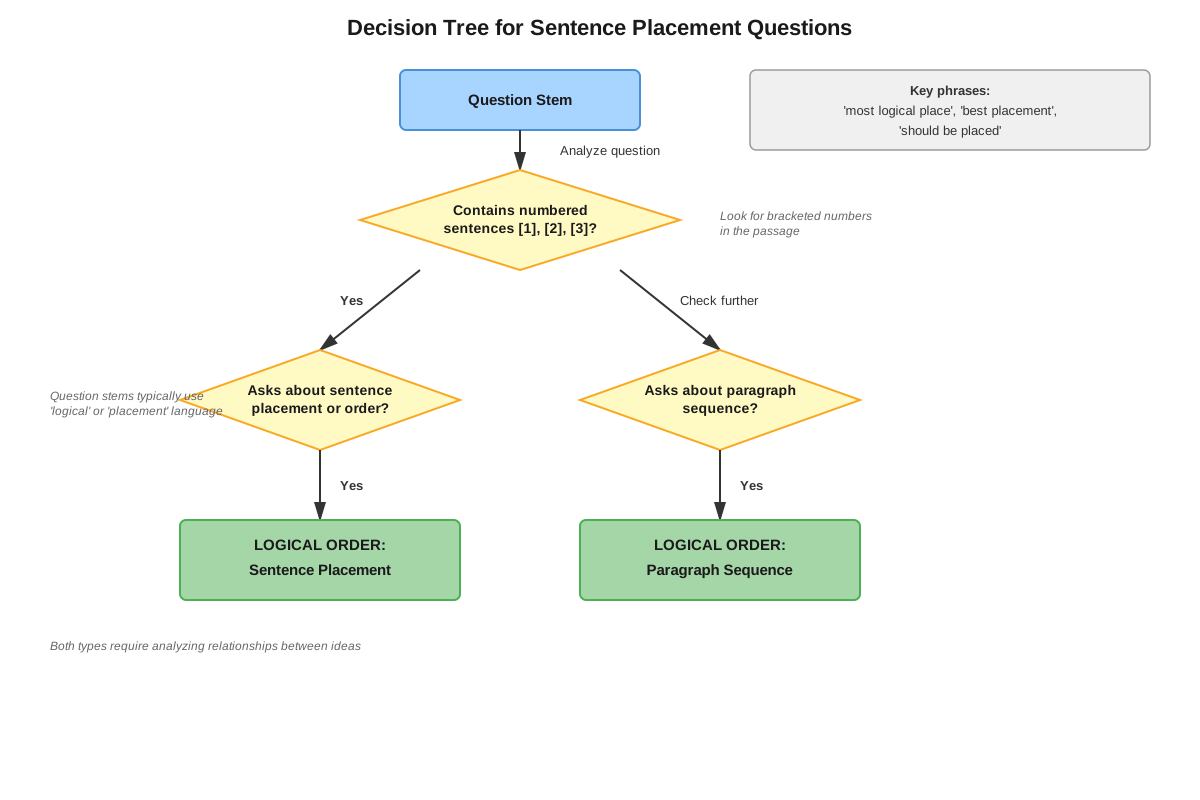
On the ACT, logical order appears in several distinct question formats. The most common type presents a sentence enclosed in a box and asks where it should be placed within a paragraph (offering options like "where it is now" or after specific sentence numbers). Another format asks students to arrange entire paragraphs in the most logical sequence. Less frequently, questions may ask whether a sentence should be added or deleted based on its logical fit with surrounding content. These questions often appear toward the end of a passage, requiring students to have read and understood substantial portions of the text.
Core Concepts
Understanding Logical Progression
Logical order refers to the arrangement of sentences, ideas, or paragraphs in a sequence that makes sense to readers and effectively communicates the intended message. The fundamental principle is that each sentence should build upon what came before and prepare readers for what comes next. Information should flow naturally, with clear connections between ideas that help readers follow the writer's train of thought without confusion.
Three primary ordering patterns appear on the ACT:
- Chronological order: Events or steps arranged by time sequence (first, then, next, finally)
- Spatial order: Descriptions arranged by physical location or direction (near to far, top to bottom, left to right)
- Conceptual order: Ideas arranged by logical relationship (general to specific, cause to effect, problem to solution, least to most important)
Identifying Logical Order Questions
ACT logical order questions have distinctive characteristics that make them recognizable. The most obvious signal is when a sentence appears in a box with numbers [1], [2], [3], [4] marking different positions in the paragraph. The question will ask: "For the sake of the logic and coherence of this paragraph, Sentence X should be placed:" followed by answer choices indicating different positions.
Another format presents numbered paragraphs and asks: "For the sake of the logic and coherence of this essay, Paragraph 3 should be placed:" with options showing different paragraph sequences. These questions require understanding how each paragraph's main idea relates to others and identifying the most logical progression of topics throughout the essay.
Key phrases that signal logical order questions include:
- "For the sake of logic and coherence"
- "The best placement for this sentence would be"
- "Which sequence of paragraphs makes this essay most logical?"
- "At this point, the writer is considering adding the following sentence"
Analyzing Sentence Relationships
To determine correct placement, examine how sentences connect through several types of relationships:
Pronoun references: A sentence containing pronouns (he, she, it, they, this, that, these, those) must follow a sentence that clearly establishes what the pronoun refers to. If a sentence begins with "This discovery," it must follow a sentence that describes a specific discovery.
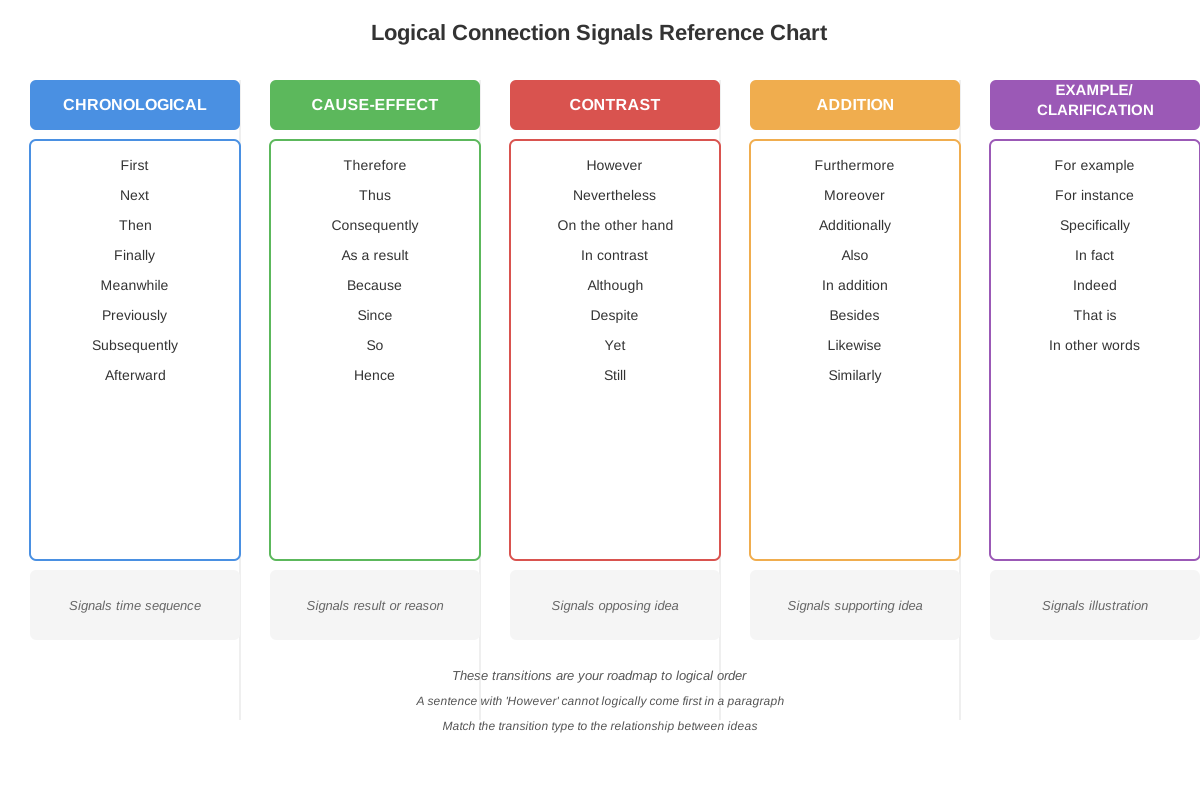
Transitional logic: Transition words reveal relationships between ideas. "However" or "On the other hand" signals contrast, so the sentence must follow something it contradicts. "Furthermore" or "Additionally" indicates the sentence adds to a previous point. "Therefore" or "As a result" shows the sentence presents a consequence of what came before.
Chronological markers: Words like "first," "then," "next," "finally," "before," "after," or specific dates/times indicate temporal sequence. A sentence about what happened "the next day" must follow a sentence establishing the initial day.
Specificity progression: General statements typically precede specific examples or details. A sentence introducing a broad concept should come before sentences that provide particular instances or elaborate on aspects of that concept.
Paragraph-Level Organization
When questions ask about paragraph order, focus on how each paragraph's main idea relates to the essay's overall structure. Effective essays typically follow these patterns:
| Position | Function | Characteristics |
|---|---|---|
| Opening paragraph | Introduces topic and thesis | Broad context, background information, main argument |
| Body paragraphs | Develop supporting points | Each focuses on one main idea supporting the thesis |
| Transitional paragraphs | Connect major sections | Bridge between different aspects of the topic |
| Concluding paragraph | Synthesizes and closes | Restates main points, provides final perspective |
Look for topic sentences that reference ideas from previous paragraphs or set up ideas for subsequent paragraphs. Phrases like "Another reason," "In addition to these benefits," or "Despite these advantages" signal that a paragraph builds upon or contrasts with previous content.
Coherence Markers
Coherence means that all parts of a passage connect logically and flow smoothly. Several elements create coherence:
Repeated key terms: Words or concepts that appear across multiple sentences create thematic unity and help readers track the main subject.
Parallel structure: When discussing multiple items or ideas, maintaining consistent grammatical structure helps readers recognize the relationship between elements.
Logical connectors: Explicit transition words and phrases (however, therefore, for example, in contrast) make relationships between ideas clear.
Consistent point of view: Maintaining the same perspective (first person, third person) and verb tense throughout related sentences creates smoother flow.
Concept Relationships
Logical order serves as a foundational concept that connects to virtually every other aspect of effective writing tested on the ACT. Understanding sentence relationships (the core of logical order) directly enables you to evaluate transition effectiveness—you cannot choose appropriate transitions without first understanding how ideas should connect. This relationship flows both ways: recognizing transition words helps you determine logical order, while understanding logical order helps you select appropriate transitions.
The relationship map for logical order concepts:
Paragraph structure → provides framework for → Logical order → determines effectiveness of → Transitions → creates → Coherence
Pronoun reference → constrains → Sentence placement → contributes to → Logical order
Chronological/spatial/conceptual patterns → guide → Organizational decisions → result in → Logical order
Within the topic itself, understanding sentence-level logical order is prerequisite to evaluating paragraph-level organization. You must first grasp how individual sentences connect before you can determine how entire paragraphs should be sequenced. Similarly, recognizing different ordering patterns (chronological, spatial, conceptual) enables you to identify which pattern a passage follows and arrange elements accordingly.
Logical order also connects to the ACT Writing essay, where organizing your argument effectively is crucial. The same principles that help you identify correct sentence placement in the English section apply when you're structuring your own essay: ideas should progress logically, each paragraph should build upon previous ones, and transitions should guide readers through your reasoning.
High-Yield Facts
⭐ Logical order questions typically appear 3-5 times per ACT English test, making them high-yield for score improvement
⭐ Sentences with pronouns (this, that, these, those, he, she, it, they) must follow sentences that clearly establish their antecedents
⭐ Transition words are the strongest clues for determining logical relationships: "however" signals contrast, "therefore" signals consequence, "for example" signals illustration
⭐ General statements typically precede specific examples or details in well-organized writing
⭐ Chronological markers (first, then, next, finally, dates, times) indicate temporal sequence that must be maintained
- Topic sentences usually appear at the beginning of paragraphs and introduce the main idea that following sentences develop
- Concluding sentences often appear at the end of paragraphs and synthesize or transition to the next idea
- When a sentence introduces a new person, place, or concept, it must come before sentences that refer to that element with pronouns or shortened references
- Cause must precede effect in logical writing—sentences describing results or consequences follow sentences describing the actions or events that caused them
- Introductory or background information should precede detailed discussion or analysis of a topic
- Sentences that reference "this problem," "these benefits," or "that approach" must follow sentences that identify the specific problem, benefits, or approach
- Paragraph order questions often test whether students recognize that background/context paragraphs precede analytical paragraphs
Quick check — test yourself on Logical order so far.
Try Flashcards →Common Misconceptions
Misconception: Logical order questions are just about grammar and can be answered by checking for errors in individual sentences.
Correction: Logical order questions test organization and coherence, not grammar. All answer choices are typically grammatically correct; you must determine which arrangement makes the most sense based on how ideas connect and flow.
Misconception: The sentence should be placed wherever it "sounds best" based on intuition alone.
Correction: While reading fluency matters, logical order questions require analyzing specific relationships: pronoun references, transition words, chronological markers, and progression from general to specific. Use concrete evidence from the text rather than relying solely on intuition.
Misconception: Transition words like "however" and "therefore" can appear anywhere in a passage without affecting meaning.
Correction: Transition words create specific logical relationships between sentences. "However" must follow something it contrasts with; "therefore" must follow a premise that leads to the conclusion. Placing these transitions incorrectly creates logical errors.
Misconception: When rearranging paragraphs, the current order is usually wrong and needs to be changed.
Correction: "Where it is now" or the current paragraph order is often correct. The ACT includes this option to test whether students can recognize when the existing arrangement is already logical. Don't assume change is always necessary.
Misconception: Longer, more complex sentences should come before shorter, simpler ones.
Correction: Sentence length and complexity don't determine logical order. A short, simple sentence can effectively introduce a topic that longer sentences then elaborate on. Focus on idea relationships, not sentence structure.
Worked Examples
Example 1: Sentence Placement Within a Paragraph
Passage excerpt:
[1] The monarch butterfly's annual migration is one of nature's most remarkable phenomena. [2] These delicate insects travel up to 3,000 miles from Canada and the northern United States to specific forests in Mexico. [3] Scientists have discovered that monarchs use a combination of the sun's position and an internal magnetic compass to navigate. [4] This journey takes multiple generations to complete, with no single butterfly making the entire round trip.
Question: For the sake of logic and coherence, Sentence 3 should be placed:
A. where it is now
B. after Sentence 1
C. after Sentence 4
D. before Sentence 1
Solution:
Step 1: Identify what Sentence 3 discusses—how monarchs navigate during migration.
Step 2: Examine what precedes and follows the current position. Currently, Sentence 3 follows information about the distance traveled and precedes information about the multi-generational nature of the journey.
Step 3: Analyze logical flow. The paragraph progresses: introduces migration (S1) → describes the journey's scope (S2) → explains navigation method (S3) → adds detail about generational aspect (S4). This follows a logical pattern from general introduction to increasingly specific details.
Step 4: Test other options. Placing S3 after S1 would interrupt the flow from introducing migration to describing its scope. Placing it after S4 would separate the navigation detail from the journey description. Placing it before S1 would discuss navigation before establishing that migration occurs.
Step 5: Evaluate transition logic. Sentence 3 begins with "Scientists have discovered," which works well after establishing what monarchs do (migrate long distances). The discovery about navigation logically follows the description of the journey.
Answer: A (where it is now)
The current placement maintains logical progression: introduction → scope of journey → method of navigation → additional detail about duration. Each sentence builds upon the previous one, creating coherent flow.
Example 2: Paragraph Sequence
Passage with numbered paragraphs:
[1] Today, the Grand Canyon attracts millions of visitors annually who come to witness its breathtaking vistas and geological wonders.
[2] The Grand Canyon's formation began approximately six million years ago when the Colorado River started carving through layers of rock.
[3] Over millennia, erosion exposed rock layers representing nearly two billion years of Earth's geological history, creating the colorful striations visible today.
[4] Native American tribes inhabited the canyon region for thousands of years before European explorers arrived in the 16th century.
Question: For the sake of logic and coherence of this essay, Paragraph 2 should be placed:
A. where it is now
B. after Paragraph 3
C. after Paragraph 4
D. before Paragraph 1
Solution:
Step 1: Identify each paragraph's main idea:
- Paragraph 1: Current status (tourism today)
- Paragraph 2: Geological formation beginning
- Paragraph 3: Continued geological process and results
- Paragraph 4: Human history
Step 2: Determine logical organizational pattern. The passage discusses the Grand Canyon, so it could follow chronological order (oldest to newest) or reverse chronological (present to past).
Step 3: Analyze current sequence. The passage currently goes: present day (P1) → geological beginning (P2) → geological continuation (P3) → human history (P4). This mixes timeframes awkwardly.
Step 4: Consider alternative arrangements. If we place P2 before P1, the sequence becomes: geological beginning → geological continuation → human history → present day. This creates clear chronological progression from ancient geological formation through human history to modern tourism.
Step 5: Check coherence. Paragraphs 2 and 3 discuss connected geological processes (P2 introduces formation, P3 continues with erosion effects), so they should remain adjacent. Starting with geological formation provides context for why the canyon exists before discussing who has lived there and who visits today.
Answer: D (before Paragraph 1)
The most logical sequence is: geological formation (P2) → erosion and rock layers (P3) → human history (P4) → modern tourism (P1). This creates chronological flow from the canyon's creation to present day, with each paragraph building upon previous information.
Exam Strategy
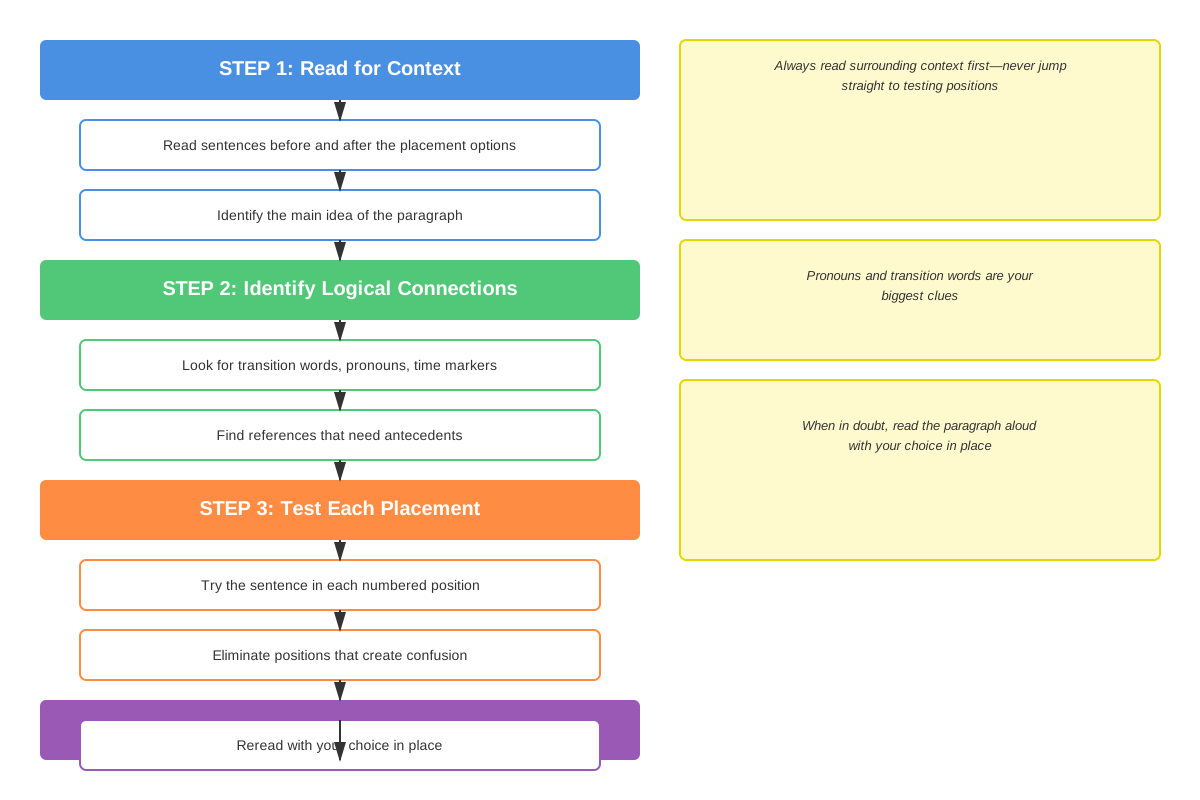
When approaching logical order questions on the ACT, follow this systematic process:
Step 1: Identify the question type. Recognize whether you're placing a sentence within a paragraph or arranging entire paragraphs. This determines your scope of analysis.
Step 2: Read the surrounding context carefully. For sentence placement, read the entire paragraph. For paragraph arrangement, read all paragraphs completely. Don't try to answer based on partial information.
Step 3: Look for concrete clues:
- Pronouns and references: What does "this," "that," "these," "they," or "it" refer to? The antecedent must appear before the pronoun.
- Transition words: What relationship does "however," "therefore," "for example," or "additionally" create?
- Chronological markers: Do dates, times, or sequence words (first, then, next) indicate temporal order?
- Specificity: Does the sentence provide a general statement or specific example?
Step 4: Test the current placement first. Since "where it is now" is often correct, verify whether the existing arrangement already makes sense before considering alternatives. This saves time and prevents unnecessary changes.
Step 5: Eliminate illogical options. Cross out choices that would:
- Place a pronoun before its antecedent
- Put a transition word that contradicts the logical relationship
- Violate chronological sequence
- Separate closely related ideas
Step 6: Read the passage with your chosen placement. Mentally insert the sentence or rearrange paragraphs according to your answer and verify that the flow makes sense.
Exam Tip: Logical order questions often appear in positions 60-75 of the English section. Budget approximately 45-60 seconds per question, as they require more reading than grammar questions but shouldn't consume excessive time.
Trigger phrases to watch for:
- "For the sake of logic and coherence"
- "The best placement"
- "Should be placed"
- "Most logical sequence"
- "At this point, the writer is considering"
Time management strategy: If you're running short on time, prioritize logical order questions over some grammar questions because they often have more obvious correct answers once you identify the key clue (pronoun reference, transition, chronological marker). However, don't spend more than 90 seconds on any single question—if you're stuck, make your best guess and move on.
Memory Techniques
PRONTO - Remember the key clues for determining logical order:
- Pronouns must follow their antecedents
- References to "this" or "that" need prior context
- Order matters for chronological sequences
- New concepts should be introduced before elaboration
- Transitions signal specific relationships
- Organization flows from general to specific
The "Before and After" Visualization: When analyzing sentence placement, visualize a timeline or flowchart. Draw mental arrows showing what must come before what. If Sentence A mentions "this discovery," draw an arrow pointing back to where the discovery must be mentioned. If Sentence B says "however," draw an arrow to what it contrasts with.
The "Pronoun Hunt" Technique: Circle or mentally note every pronoun in the sentence being placed. Then scan the surrounding sentences to find what each pronoun refers to. The sentence must come after all its antecedents are established.
G.T.S. - General to Specific: Remember that effective writing typically moves from General statements to specific examples, then may Synthesize. When unsure about order, ask: "Which sentence is more general?" That one likely comes first.
Transition Categories Acronym - CATE:
- Contrast: however, nevertheless, on the other hand
- Addition: furthermore, moreover, additionally
- Time: then, next, finally, subsequently
- Example: for instance, specifically, such as
Knowing these categories helps you quickly identify what relationship a transition creates and what must come before it.
Summary
Logical order is a high-yield ACT English concept that tests your ability to arrange sentences and paragraphs in coherent, effective sequences. Success requires analyzing specific textual clues rather than relying on intuition: pronouns must follow their antecedents, transition words create specific relationships that constrain placement, chronological markers indicate temporal sequence, and ideas typically progress from general to specific. These questions appear 3-5 times per test and are recognizable by phrases like "for the sake of logic and coherence" and numbered sentence or paragraph options. The key strategy involves reading surrounding context carefully, identifying concrete clues (pronouns, transitions, chronological markers, specificity), testing whether the current placement already works, and eliminating options that create logical errors. Understanding logical order not only improves your ACT English score but also enhances your ability to organize ideas effectively in the Writing section and in real-world communication.
Key Takeaways
- Logical order questions test organization and coherence, not grammar—all options are typically grammatically correct
- Pronouns and references (this, that, these, those) are the strongest clues; they must follow sentences that establish their antecedents
- Transition words create specific relationships: contrast (however), consequence (therefore), addition (furthermore), or example (for instance)
- General statements typically precede specific examples or details in well-organized writing
- "Where it is now" is often correct—test the current placement before assuming change is necessary
- Chronological markers (dates, times, first/then/next) indicate temporal sequence that must be maintained
- Budget 45-60 seconds per logical order question and prioritize identifying concrete textual clues over intuition
Related Topics
Transitions and Transitional Phrases: Understanding how transition words create logical connections between sentences directly supports logical order skills. Mastering transitions helps you both identify correct sentence placement and improve your own writing organization.
Paragraph Unity and Coherence: This topic expands on logical order by examining how all sentences within a paragraph should relate to a single main idea. Strong logical order skills make recognizing paragraph unity much easier.
Essay Organization and Structure: The ACT Writing test requires organizing an entire essay logically. The principles you learn for sentence and paragraph placement in the English section apply directly to structuring your argument effectively.
Topic Sentences and Supporting Details: Understanding how topic sentences introduce main ideas and supporting sentences develop them helps you determine logical order, as sentences typically flow from topic introduction to supporting elaboration.
Rhetorical Skills Questions: Logical order is one category within the broader set of rhetorical skills tested on the ACT, which also includes strategy, organization, and style questions. Mastering logical order builds skills applicable to all rhetorical questions.
Practice CTA
Now that you understand the principles of logical order, it's time to apply these strategies to actual ACT-style questions. The practice questions and flashcards will help you recognize the patterns, identify key clues quickly, and build the confidence needed to answer these questions accurately under timed conditions. Remember: logical order questions are highly learnable—once you know what to look for (pronouns, transitions, chronological markers, general-to-specific progression), you'll find that the correct answer often becomes obvious. Consistent practice will transform these medium-difficulty questions into reliable score-boosters. You've got this!
Sign up free to keep reading
Create a free AnvayaPrep account to finish this ACT guide on Logical order — plus flashcards and practice questions.