Overview
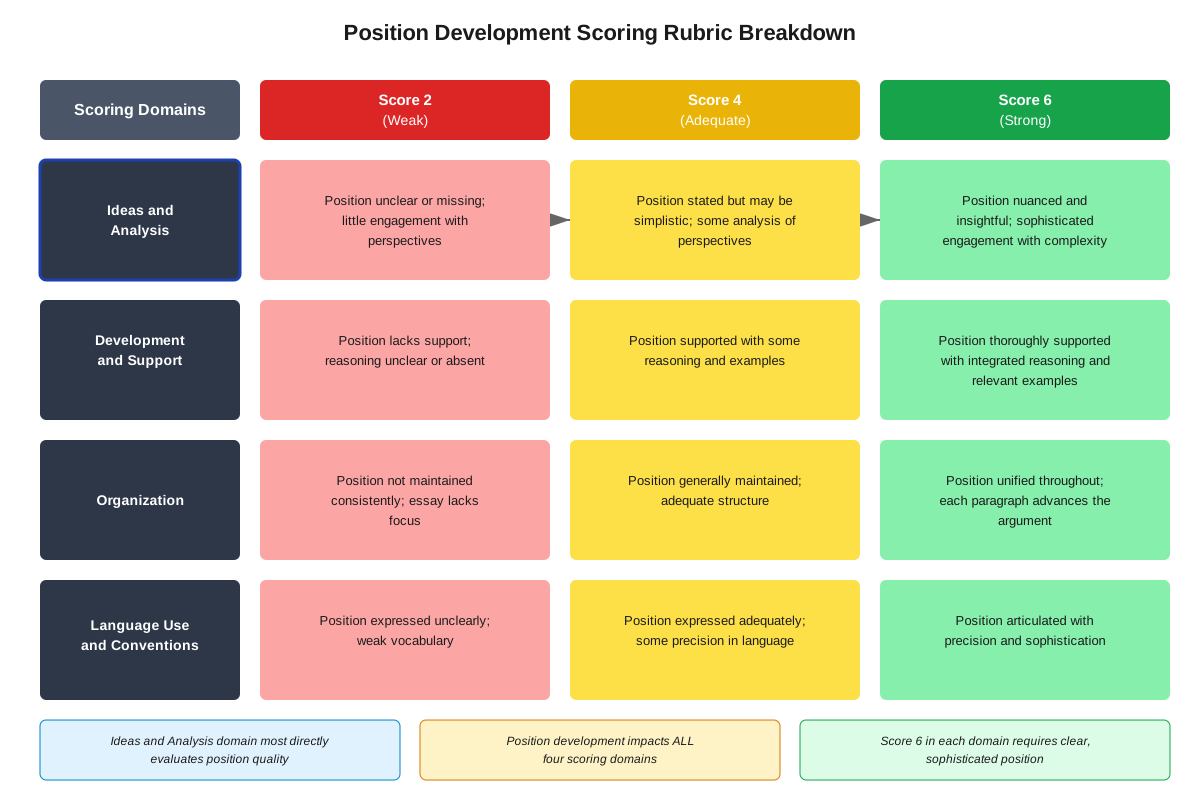
Developing a position is the foundational skill that determines the success of every ACT Writing essay. This critical competency involves crafting a clear, defensible stance on a complex issue and maintaining that perspective throughout the entire essay. On the ACT Writing test, students receive a prompt presenting multiple perspectives on a contemporary issue, and they must analyze these perspectives while developing and defending their own position. The ability to establish and articulate a coherent viewpoint separates high-scoring essays (scores of 10-12) from mediocre ones (scores of 6-8).
The ACT Writing section evaluates how effectively students can engage with complex ideas, analyze multiple viewpoints, and construct a logical argument. ACT developing a position requires more than simply choosing a side—it demands thoughtful consideration of the issue's nuances, acknowledgment of counterarguments, and strategic use of reasoning and examples to support claims. This skill directly impacts all four scoring domains: Ideas and Analysis, Development and Support, Organization, and Language Use and Conventions.
Understanding position development connects intimately with other essential Writing concepts, including thesis construction, evidence selection, counterargument integration, and logical progression. A well-developed position serves as the essay's backbone, guiding every paragraph's purpose and ensuring coherent flow from introduction to conclusion. Without mastering this skill, students struggle to achieve the focused, purposeful writing that ACT graders reward with top scores.
Learning Objectives
- [ ] Identify when Developing a position is being tested
- [ ] Explain the core rule or strategy behind Developing a position
- [ ] Apply Developing a position to ACT-style questions accurately
- [ ] Evaluate the strength and defensibility of different positions on a given issue
- [ ] Synthesize multiple perspectives into a nuanced, original position
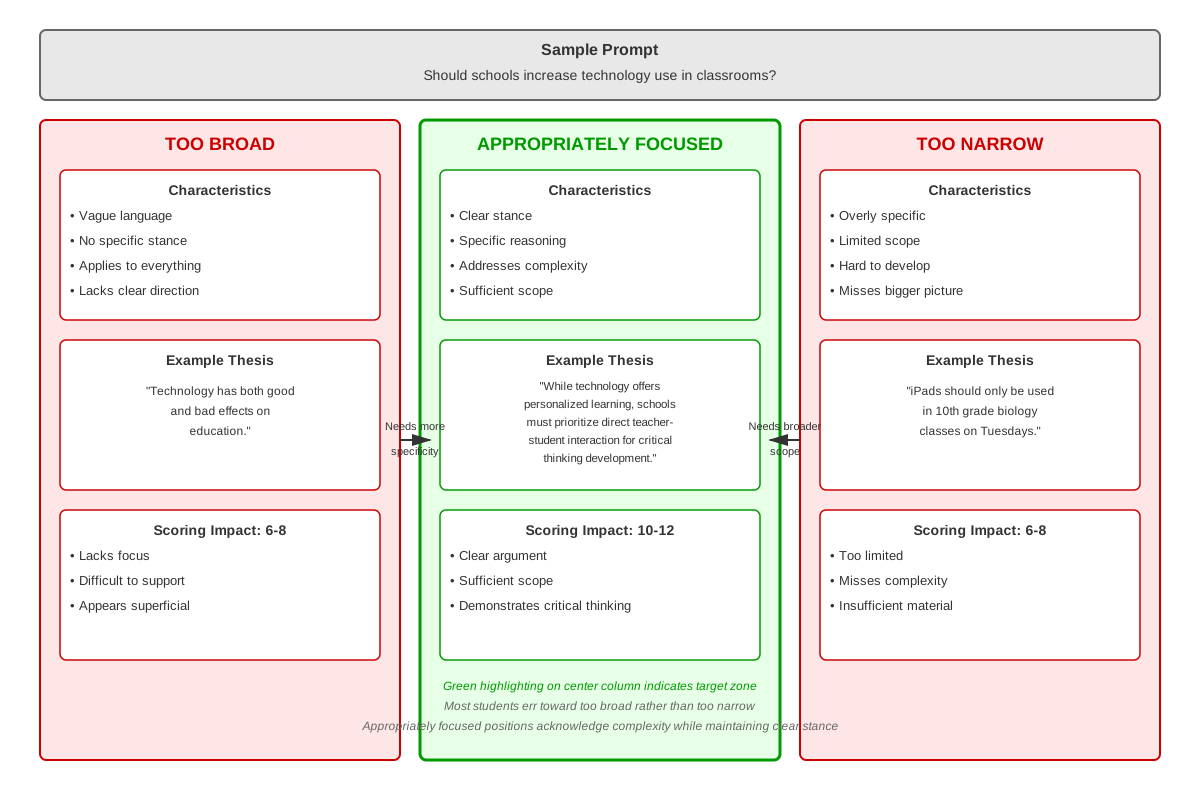
- [ ] Distinguish between positions that are too broad, too narrow, or appropriately focused
- [ ] Construct a position statement that directly addresses the prompt's central question
Prerequisites
- Basic essay structure: Understanding introductions, body paragraphs, and conclusions is essential because position development occurs within this framework
- Thesis statement construction: Knowing how to craft a clear main claim provides the foundation for articulating a position
- Reading comprehension: The ability to understand complex prompts and analyze given perspectives is necessary before developing an original position
- Argumentation basics: Familiarity with claims, evidence, and reasoning helps students support their positions effectively
Why This Topic Matters
In real-world contexts, developing a position mirrors critical thinking skills used in academic discourse, professional decision-making, and civic engagement. Whether writing college papers, participating in workplace discussions, or engaging in community debates, the ability to formulate and defend a thoughtful position is invaluable. This skill demonstrates intellectual maturity and analytical capability that extends far beyond standardized testing.
On the ACT Writing test, position development appears in 100% of essay prompts—it is not optional or occasional but absolutely central to the task. The Ideas and Analysis domain, which accounts for 25% of the Writing score, directly evaluates how well students establish and maintain their position. Graders specifically assess whether the position is clear, whether it engages with the issue's complexity, and whether it demonstrates critical thinking beyond surface-level responses.
Common manifestations in ACT prompts include issues about education policy, technology's role in society, environmental responsibility, individual versus collective rights, and cultural values. The prompt always presents three distinct perspectives, requiring students to analyze these viewpoints while developing their own position—which may align with one perspective, synthesize multiple perspectives, or present an entirely different viewpoint. High-scoring essays demonstrate sophisticated position development by acknowledging the issue's complexity while maintaining a clear, consistent stance throughout.
Core Concepts
Understanding What a Position Is
A position in ACT Writing represents a student's informed stance on the issue presented in the prompt. Unlike a simple opinion ("I think technology is good"), a well-developed position articulates a specific, defensible claim about a complex issue ("While technology offers unprecedented access to information, its most valuable contribution to education lies in fostering collaborative learning experiences that prepare students for interconnected workplaces"). The position must be:
- Specific: Focused enough to be thoroughly defended in 40 minutes
- Arguable: Reasonable people could disagree with it
- Relevant: Directly addresses the prompt's central question
- Sustainable: Can be maintained consistently throughout the essay
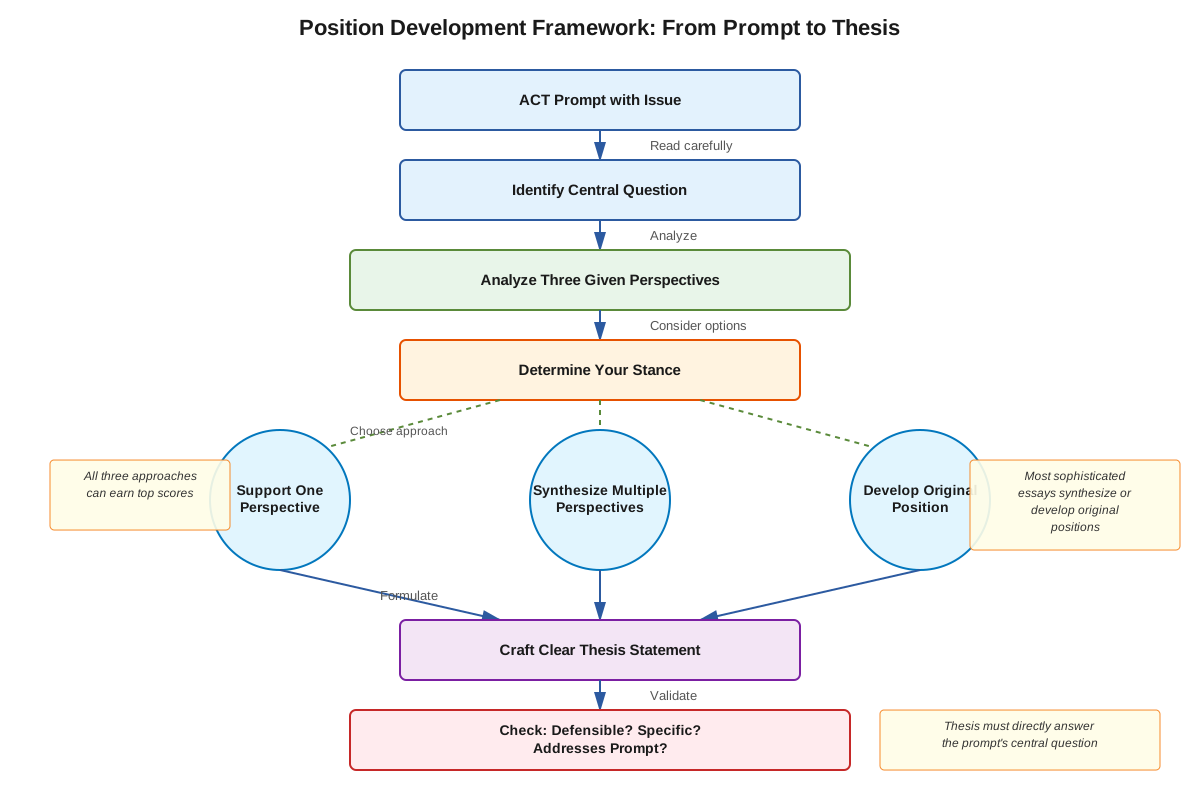
The Position Development Process
Developing a strong position follows a systematic approach:
- Analyze the prompt carefully: Identify the central issue and understand what question is being asked
- Examine all three perspectives: Note the reasoning behind each viewpoint and identify strengths and limitations
- Consider your own knowledge and experiences: Think about relevant examples, observations, or insights
- Identify areas of agreement and disagreement: Determine which perspectives align with your thinking and where you diverge
- Formulate your position: Craft a clear statement that represents your stance
- Test your position: Ensure you can generate multiple supporting points and address potential counterarguments
Types of Positions
Students can develop several types of positions, each with distinct characteristics:
| Position Type | Description | Example Approach | Complexity Level |
|---|---|---|---|
| Aligned | Agrees with one given perspective | "Perspective One correctly identifies..." | Moderate |
| Synthesized | Combines elements from multiple perspectives | "While Perspective Two raises valid concerns, Perspective One's emphasis on..." | High |
| Qualified | Agrees with a perspective but adds conditions | "Perspective Three is correct, but only when..." | High |
| Alternative | Presents a viewpoint different from all three perspectives | "Rather than focusing on X or Y, the real issue is..." | Very High |
Position Clarity and Specificity
The most common weakness in ACT essays is vague or unclear positions. Consider these examples:
Weak Position: "Technology has both good and bad effects on education."
- Problem: Too general, doesn't take a clear stance, merely acknowledges complexity
Stronger Position: "Technology's primary educational value lies in providing personalized learning experiences that adapt to individual student needs."
- Strength: Specific claim, clear focus, defendable with concrete examples
Strongest Position: "While technology enables personalized learning, its greatest educational impact emerges when it facilitates authentic collaboration on real-world problems, preparing students for the interconnected challenges they will face in their careers."
- Strength: Nuanced, acknowledges complexity, makes a specific prioritization, suggests broader implications
Maintaining Position Consistency
Once established, the position must remain consistent throughout the essay. This doesn't mean ignoring counterarguments—in fact, addressing opposing views strengthens the position—but the core stance should not shift. Each body paragraph should advance the position through:
- Direct support: Evidence and reasoning that directly proves the position
- Counterargument engagement: Acknowledging and refuting opposing views
- Implication exploration: Showing the consequences or applications of the position
Position Depth and Nuance
High-scoring essays demonstrate intellectual depth by acknowledging the issue's complexity while maintaining a clear position. This involves:
- Recognizing valid points in opposing perspectives
- Identifying contexts where different approaches might apply
- Exploring underlying assumptions and values
- Considering short-term versus long-term implications
- Acknowledging limitations of one's own position
For example, a nuanced position on technology in education might acknowledge that while digital tools enhance learning, they work best when integrated thoughtfully with traditional pedagogical approaches, and their effectiveness depends on factors like teacher training, student access, and curriculum design.
Concept Relationships
The process of developing a position begins with prompt analysis, which reveals the central issue and question. This analysis leads to perspective evaluation, where students assess the three given viewpoints. Perspective evaluation informs position formulation, the creation of the student's own stance. Once formulated, the position guides thesis construction, which articulates the position in the essay's introduction.
The position then determines evidence selection—what examples, reasoning, and support will be most relevant. It also shapes organizational structure, as each body paragraph must advance the position. Throughout the essay, counterargument integration strengthens the position by demonstrating awareness of opposing views. Finally, conclusion synthesis reinforces the position while exploring its broader implications.
This topic connects to prerequisite knowledge of thesis statements (the position is expressed through the thesis) and basic argumentation (the position is defended through claims and evidence). It enables progression to more advanced topics like sophisticated counterargument techniques, evidence analysis, and rhetorical strategy.
Relationship Map:
Prompt Analysis → Perspective Evaluation → Position Formulation → Thesis Construction → Evidence Selection → Paragraph Development → Counterargument Integration → Conclusion Synthesis
High-Yield Facts
⭐ The ACT Writing prompt always presents three distinct perspectives that students must analyze while developing their own position
⭐ A strong position is specific, arguable, relevant to the prompt, and sustainable throughout the essay
⭐ Students can agree with one perspective, synthesize multiple perspectives, qualify a perspective, or present an alternative viewpoint
⭐ Position clarity directly impacts the Ideas and Analysis score, which accounts for 25% of the Writing score
⭐ High-scoring essays (10-12) demonstrate nuanced positions that acknowledge complexity while maintaining a clear stance
- The position should be established clearly in the introduction and reinforced in the conclusion
- Each body paragraph must advance or support the position in some way
- Acknowledging counterarguments and opposing perspectives strengthens rather than weakens a position
- Vague or shifting positions are among the most common reasons for low scores
- The position need not be "correct" or match the grader's views—it must be well-reasoned and well-supported
- Time spent planning the position (3-5 minutes) significantly improves essay quality
- A position that's too broad cannot be adequately defended in 40 minutes
- Effective positions often identify priorities, make distinctions, or propose balanced approaches
- The position should address the "so what?" question—why does this issue matter?
Quick check — test yourself on Developing a position so far.
Try Flashcards →Common Misconceptions
Misconception: Students must agree with one of the three given perspectives.
Correction: While agreeing with a perspective is one valid approach, students can synthesize multiple perspectives, qualify a perspective with conditions, or present an entirely different viewpoint. The key is developing a clear, defensible position regardless of its relationship to the given perspectives.
Misconception: A strong position means taking an extreme or absolute stance.
Correction: Nuanced positions that acknowledge complexity typically score higher than extreme positions. Statements like "Technology is completely ruining education" are harder to defend than "While technology offers benefits, its educational value depends on thoughtful implementation and teacher training."
Misconception: Acknowledging counterarguments weakens the position.
Correction: Addressing opposing views actually strengthens the position by demonstrating critical thinking and intellectual maturity. High-scoring essays engage with counterarguments and explain why the position remains valid despite these concerns.
Misconception: The position must be stated in the first sentence of the essay.
Correction: While the position should appear clearly in the introduction, it often works best after providing context about the issue. The thesis statement, which articulates the position, typically appears at or near the end of the introductory paragraph.
Misconception: Once stated, the position should simply be repeated in each paragraph.
Correction: The position should be developed and advanced through different angles, evidence, and reasoning in each paragraph. Mere repetition without development results in a shallow, unconvincing essay.
Misconception: Personal opinions are sufficient for developing a position.
Correction: While personal perspective matters, strong positions are supported by logical reasoning, relevant examples, and engagement with the issue's complexity. "I think" or "I believe" statements without substantiation are insufficient.
Misconception: The position must address every aspect of the issue.
Correction: Given time constraints, effective positions focus on the most important aspects of the issue. Attempting to address everything results in superficial treatment. Strategic focus demonstrates better judgment than comprehensive but shallow coverage.
Worked Examples
Example 1: Technology in Education Prompt
Prompt Summary: Should schools prioritize technology integration in classrooms?
Perspective One: Technology provides essential 21st-century skills and should be central to education.
Perspective Two: Traditional teaching methods have proven effective for centuries and shouldn't be abandoned for trendy technology.
Perspective Three: Technology should supplement but not replace human interaction and hands-on learning.
Student's Position Development Process:
- Analyze the prompt: The central question asks about the appropriate role and priority of technology in education.
- Evaluate perspectives:
- Perspective One: Strength—recognizes changing world; Limitation—assumes all technology integration is beneficial
- Perspective Two: Strength—values proven methods; Limitation—may resist beneficial innovation
- Perspective Three: Strength—seeks balance; Limitation—doesn't specify how to achieve this balance
- Consider personal knowledge: Student recalls experiences with both effective technology use (collaborative projects) and ineffective use (passive video watching), plus knowledge of research on active learning.
- Formulate position: "While technology offers valuable educational tools, its effectiveness depends entirely on whether it facilitates active, collaborative learning rather than passive consumption of information."
- Test the position: Can generate examples (collaborative platforms vs. lecture videos), can address counterarguments (technology access issues, teacher training needs), can maintain consistency across multiple paragraphs.
Resulting Thesis: "Rather than debating whether to embrace or resist educational technology, schools should focus on the critical distinction between technology that promotes active, collaborative learning and technology that merely digitizes passive instruction. This approach acknowledges Perspective Three's call for balance while providing the specific criterion that Perspective One lacks: technology's value lies not in its presence but in its capacity to transform students from passive recipients to active participants in their education."
Why This Works: The position is specific (focuses on active vs. passive learning), nuanced (acknowledges valid points in multiple perspectives), arguable (someone could reasonably disagree), and sustainable (can be developed across multiple paragraphs with different examples and reasoning).
Example 2: Community Service Requirements Prompt
Prompt Summary: Should high schools require students to complete community service hours for graduation?
Perspective One: Required service teaches civic responsibility and helps communities.
Perspective Two: Forced service contradicts the spirit of volunteerism and may breed resentment.
Perspective Three: Students should focus on academics rather than mandatory non-academic requirements.
Student's Position Development Process:
- Analyze the prompt: The issue centers on whether mandatory service requirements are beneficial or counterproductive.
- Evaluate perspectives:
- Perspective One: Strength—recognizes civic education value; Limitation—doesn't address the "forced" nature
- Perspective Two: Strength—identifies potential psychological resistance; Limitation—may underestimate educational value
- Perspective Three: Strength—prioritizes academic mission; Limitation—narrowly defines education
- Consider personal knowledge: Student thinks about research on intrinsic vs. extrinsic motivation, personal experiences with required vs. voluntary activities, and the broader purpose of education.
- Formulate position: "Mandatory community service requirements can achieve Perspective One's civic education goals while addressing Perspective Two's concerns about authenticity, but only when schools provide meaningful choice in service options and integrate reflection activities that help students connect service to personal values."
- Test the position: Can explain how choice preserves some volunteerism spirit, can provide examples of effective vs. ineffective programs, can address the academic concern by showing how service develops critical thinking and real-world application skills.
Resulting Thesis: "The debate over mandatory community service reveals a false dichotomy between requirement and authenticity. Well-designed service programs that offer students genuine choice in their service activities and incorporate structured reflection can cultivate civic responsibility without breeding the resentment that Perspective Two fears. This approach transforms service from a mere graduation checkbox into an educational experience that complements rather than competes with academic learning."
Why This Works: The position takes a qualified stance (supports requirements with specific conditions), synthesizes concerns from multiple perspectives, provides clear criteria for success (choice and reflection), and can be developed with concrete examples of program design.
Exam Strategy
Approaching Position Development Questions
When the ACT Writing prompt appears, follow this strategic sequence:
- Spend 5-7 minutes planning (this is not wasted time—it prevents mid-essay confusion)
- Read the prompt twice: First for general understanding, second for specific details
- Annotate the three perspectives: Note one strength and one limitation of each
- Brainstorm quickly: Jot down 2-3 relevant examples or ideas that come to mind
- Draft your position statement: Write it out fully before beginning the essay
- Check your position: Ask "Can I defend this for 3-4 paragraphs?" and "Is this specific enough?"
Trigger Words and Phrases
Watch for these prompt elements that signal position development is being tested:
- "Develop your own perspective on the issue"
- "Evaluate and analyze" the given perspectives
- "State and develop your own perspective"
- "Explain the relationship between your perspective and those given"
- Questions asking about priorities, values, or trade-offs
These phrases indicate that simply summarizing the perspectives is insufficient—you must develop and defend your own position.
Process-of-Elimination Tips
When evaluating your drafted position, eliminate positions that:
- Can be summarized as "it depends" without specifying what it depends on
- Simply restate one perspective without adding insight
- Try to agree with all perspectives equally (this lacks a clear stance)
- Are so extreme that you struggle to find supporting evidence
- Don't actually address the prompt's central question
- Shift or contradict themselves when you try to develop them
Exam Tip: If you find yourself writing "On one hand... on the other hand..." repeatedly without reaching a conclusion, your position lacks clarity. Acknowledging complexity is good; failing to take a stance is problematic.
Time Allocation Advice
In a 40-minute essay:
- Minutes 0-5: Read prompt, analyze perspectives, develop position
- Minutes 5-8: Outline essay structure based on position
- Minutes 8-35: Write essay (introduction, 3-4 body paragraphs, conclusion)
- Minutes 35-40: Review and revise for clarity and consistency
The planning phase is crucial for position development. Students who skip planning often produce essays with unclear or shifting positions, while those who plan strategically write more focused, coherent essays even if they write fewer total words.
Memory Techniques
The CLEAR Position Mnemonic
Remember that strong positions are CLEAR:
- Clear: Unambiguous and easy to identify
- Logical: Based on sound reasoning
- Engaged: Interacts with the issue's complexity
- Arguable: Reasonable people could disagree
- Relevant: Directly addresses the prompt
The Three-Question Test
Before committing to a position, ask:
- "So what?" (Does this position matter? Does it have implications?)
- "Says who?" (Can I support this with reasoning and examples?)
- "What about...?" (Can I address obvious counterarguments?)
If you can answer all three questions confidently, your position is likely strong enough.
Visualization Strategy
Picture your position as a tree trunk: it must be strong enough to support multiple branches (body paragraphs) and deep enough to withstand opposing winds (counterarguments). If your position feels like a thin twig, it needs more specificity and depth.
The "Because" Test
State your position and add "because" three times:
- Position: "Technology's value in education depends on promoting active learning"
- Because: "Passive technology use doesn't improve outcomes"
- Because: "Active learning engages critical thinking"
- Because: "Critical thinking is education's primary goal"
If you can complete this chain, your position has sufficient depth.
Summary
Developing a position for the ACT Writing test requires students to analyze a complex issue, evaluate multiple perspectives, and formulate a clear, defensible stance that can be maintained throughout a 40-minute essay. A strong position is specific rather than vague, arguable rather than obvious, and nuanced rather than extreme. Students can align with one given perspective, synthesize multiple perspectives, qualify a perspective with conditions, or present an alternative viewpoint—the key is clarity and consistency. The position development process involves careful prompt analysis, perspective evaluation, consideration of relevant knowledge and examples, position formulation, and testing the position's sustainability. High-scoring essays demonstrate intellectual depth by acknowledging complexity while maintaining a clear stance, engaging with counterarguments to strengthen rather than weaken the position, and connecting the position to broader implications. The position serves as the essay's backbone, guiding evidence selection, organizational structure, and paragraph development from introduction through conclusion.
Key Takeaways
- Developing a position is the foundational skill for ACT Writing success, directly impacting the Ideas and Analysis score
- Strong positions are specific, arguable, relevant, and sustainable—they can be defended thoroughly within time constraints
- Students have flexibility in how their position relates to the three given perspectives (align, synthesize, qualify, or present alternative)
- Position clarity must be established in the introduction and maintained consistently throughout the essay
- Acknowledging complexity and engaging with counterarguments demonstrates sophistication and strengthens the position
- Spending 5-7 minutes planning the position before writing prevents mid-essay confusion and improves overall coherence
- The most common weakness is vague or shifting positions—specificity and consistency are essential for high scores
Related Topics
Thesis Statement Construction: Building on position development, this topic explores how to articulate the position effectively in a clear, compelling thesis statement that guides the entire essay.
Evidence Selection and Integration: Once a position is developed, students must choose relevant examples, reasoning, and support that effectively defend the position and demonstrate its validity.
Counterargument Techniques: Advanced position development includes anticipating and addressing opposing views, which requires understanding how to acknowledge, refute, or qualify counterarguments strategically.
Perspective Analysis: Before developing a position, students must thoroughly analyze the three given perspectives, identifying their underlying assumptions, strengths, and limitations.
Essay Organization: The position determines the essay's structure, as each paragraph must advance the position through different angles, evidence, or reasoning.
Practice CTA
Now that you understand the principles of developing a position for ACT Writing, it's time to apply these concepts! Work through the practice questions to test your ability to identify strong versus weak positions, formulate your own positions on various prompts, and evaluate position clarity and specificity. Use the flashcards to reinforce key concepts like the CLEAR mnemonic and the characteristics of effective positions. Remember: position development is a skill that improves with practice. Each prompt you analyze and each position you formulate strengthens your ability to think critically and write persuasively under time pressure. You're building a skill that will serve you not just on test day, but throughout your academic and professional career!
Sign up free to keep reading
Create a free AnvayaPrep account to finish this ACT guide on Developing a position — plus flashcards and practice questions.