Overview
Data Sufficiency questions represent approximately one-third of the GMAT Data Insights section, making them a critical component of exam success. Unlike traditional problem-solving questions that require calculating a specific answer, Data Sufficiency questions test whether the information provided is adequate to answer a question—without necessarily solving it completely. This unique format creates numerous opportunities for test-makers to design sophisticated traps that exploit common reasoning errors, time pressure, and mathematical misconceptions.
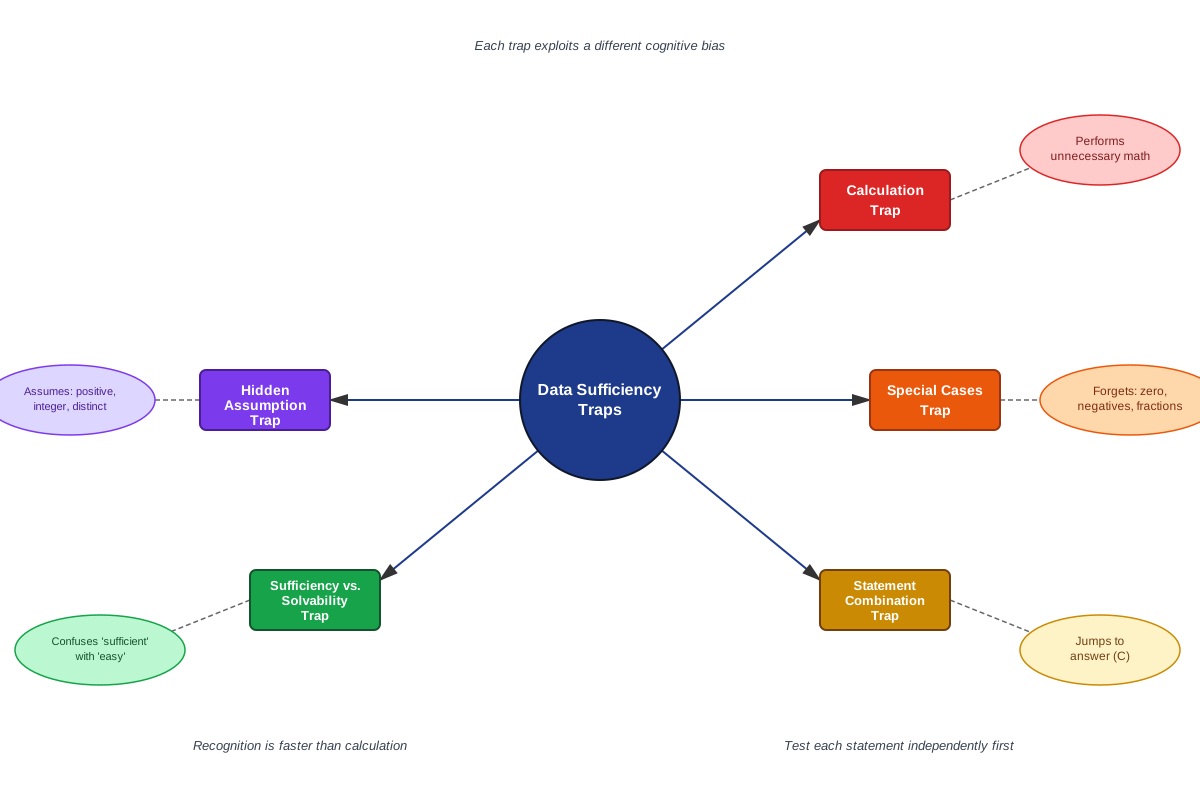
Data sufficiency traps are systematic patterns of misdirection embedded within Data Sufficiency questions that cause even well-prepared test-takers to select incorrect answers. These traps exploit predictable cognitive biases: the tendency to perform unnecessary calculations, the failure to consider negative numbers or zero, the assumption that statements must be used together, and the confusion between "sufficient" and "easy to calculate." Understanding these traps transforms Data Sufficiency from a frustrating puzzle into a strategic game where recognizing patterns becomes as important as mathematical skill.
Mastering GMAT data sufficiency traps is essential because these questions reward strategic thinking over computational ability. The GMAT deliberately designs traps to separate test-takers who understand sufficiency conceptually from those who rely solely on calculation. This topic connects directly to fundamental Data Insights skills including algebraic manipulation, number properties, inequality reasoning, and logical analysis. By learning to identify and avoid these traps, students not only improve their Data Sufficiency performance but also develop the critical reasoning skills that underpin success across all quantitative GMAT sections.
Learning Objectives
- [ ] Identify Data sufficiency traps in GMAT questions
- [ ] Explain Data sufficiency traps and the reasoning errors they exploit
- [ ] Apply Data sufficiency traps knowledge to GMAT questions
- [ ] Distinguish between insufficient information and information that appears insufficient
- [ ] Recognize when calculations are unnecessary for determining sufficiency
- [ ] Evaluate statements independently before considering them together
- [ ] Identify hidden assumptions that lead to trap answers
Prerequisites
- Basic algebra and equation solving: Essential for manipulating statements and determining what information would be needed to solve for unknowns
- Number properties (integers, positives/negatives, zero): Critical because many traps exploit forgotten cases like negative numbers or zero
- Understanding of the Data Sufficiency answer format: Must know what (A), (B), (C), (D), and (E) represent to avoid selecting trap answers
- Inequality manipulation: Many traps involve statements that constrain but don't determine values
- Logical reasoning fundamentals: Needed to distinguish between "sufficient to answer" and "sufficient to calculate easily"
Why This Topic Matters
Data Sufficiency traps appear in virtually every GMAT exam, often in 8-12 of the Data Insights questions. The GMAT uses these traps as a primary mechanism to differentiate between score bands—test-takers scoring below 155 typically fall for multiple traps per exam, while those scoring above 165 consistently avoid them. Understanding these patterns is not merely helpful; it's essential for achieving a competitive score.
In real-world business and analytical contexts, the skill of determining what information is truly necessary mirrors critical decision-making abilities. Executives and consultants must constantly evaluate whether they have sufficient data to make informed decisions or whether additional research is required. The GMAT tests this practical skill through Data Sufficiency questions, making trap awareness valuable beyond test day.
These traps most commonly appear in questions involving: algebraic equations with multiple variables, geometry problems with seemingly insufficient constraints, word problems with extraneous information, questions about number properties (especially divisibility and sign), and statistics problems involving means, medians, and ranges. The test-makers strategically place trap answers that correspond to common reasoning errors, ensuring that hasty or incomplete analysis leads to predictable wrong answers.
Core Concepts
The Fundamental Nature of Sufficiency Traps
Data sufficiency traps are deliberately constructed answer choices that appear correct when test-takers make predictable errors in reasoning. Unlike content-based errors where a student simply doesn't know a formula, trap answers exploit systematic flaws in the decision-making process. The GMAT creates these traps by understanding how test-takers think under time pressure: they calculate when they should reason conceptually, they forget edge cases, they assume statements must work together, and they confuse "can answer" with "can easily calculate."
The architecture of every Data Sufficiency trap follows a pattern: it presents information that seems insufficient (but is actually sufficient) or seems sufficient (but is actually insufficient). The trap succeeds because it aligns with an intuitive but incorrect first impression. Recognizing this architecture allows test-takers to pause and verify their reasoning before selecting an answer.
Trap Type 1: The Unnecessary Calculation Trap
This trap exploits the instinct to solve completely rather than determine sufficiency. Test-takers see a statement, begin calculating, encounter difficulty or complexity, and conclude the statement is insufficient—when in fact, the difficulty of calculation is irrelevant to sufficiency.
Example scenario: "Is x > 0?" with Statement 1: "x² + 5x + 6 = 0"
Many test-takers think: "I'd need to factor this and find x's value, which seems complicated, so this might be insufficient." However, factoring yields x = -2 or x = -3, both negative, definitively answering "No, x is not greater than 0." The statement is sufficient despite requiring work. The trap answer (B), (C), or (E) catches those who confuse "hard to calculate" with "insufficient."
Key principle: Sufficiency means you could answer definitively, not that the answer is easy to find.
Trap Type 2: The Forgotten Case Trap
This category includes several related traps that exploit incomplete case analysis:
The Zero Trap: Statements involving variables that could equal zero, where test-takers forget to check this case. Example: "Is x/y > 1?" with Statement 1: "x > y." Test-takers might think this is sufficient, forgetting that if y = 0, division is undefined, or if y is negative, the inequality reverses.
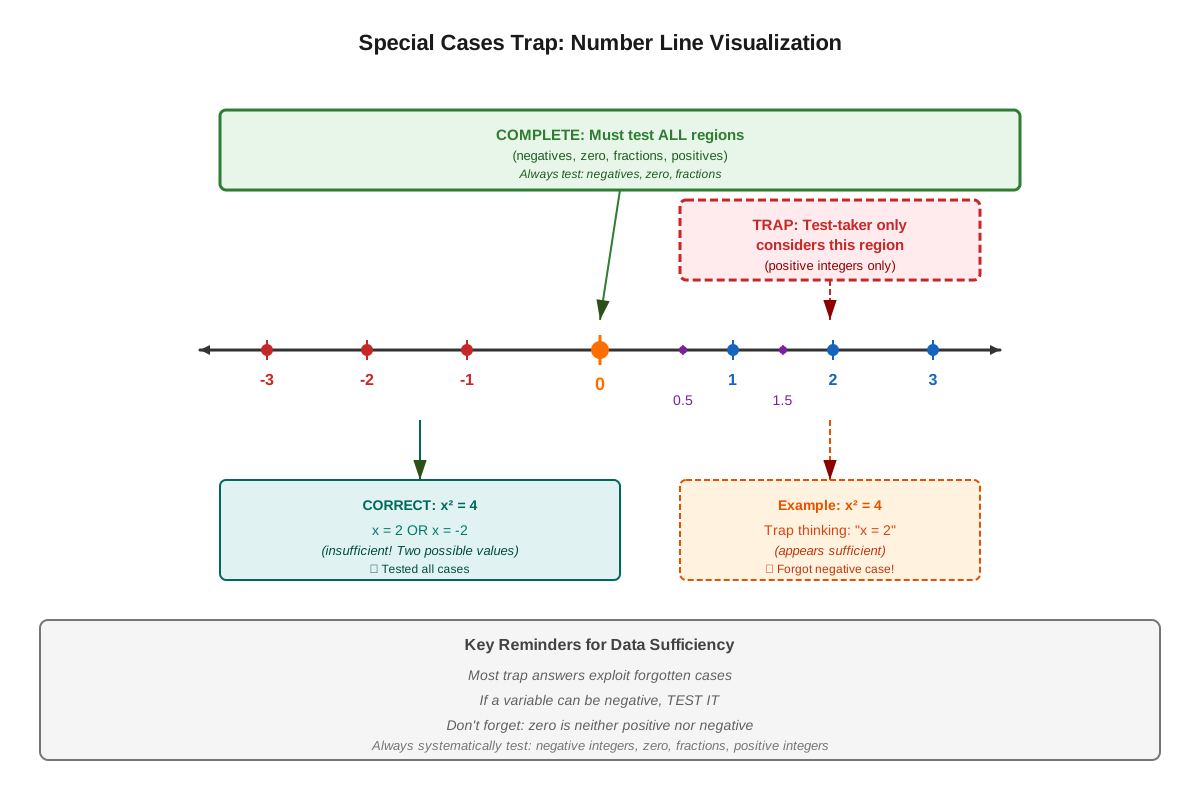
The Negative Number Trap: Questions about absolute values, squares, or inequalities where test-takers assume variables are positive. Example: "What is x?" with Statement 1: "x² = 16." The trap answer is (A), forgetting that x could be -4 or 4.
The Non-Integer Trap: Questions where test-takers assume integer values when none are specified. Example: "Is x > 2?" with Statement 1: "x > 1.5." Test-takers might think this is insufficient, but if the question stem establishes x is an integer, this is sufficient (x must be at least 2).
Trap Type 3: The Statement Combination Trap
This trap has two variants:
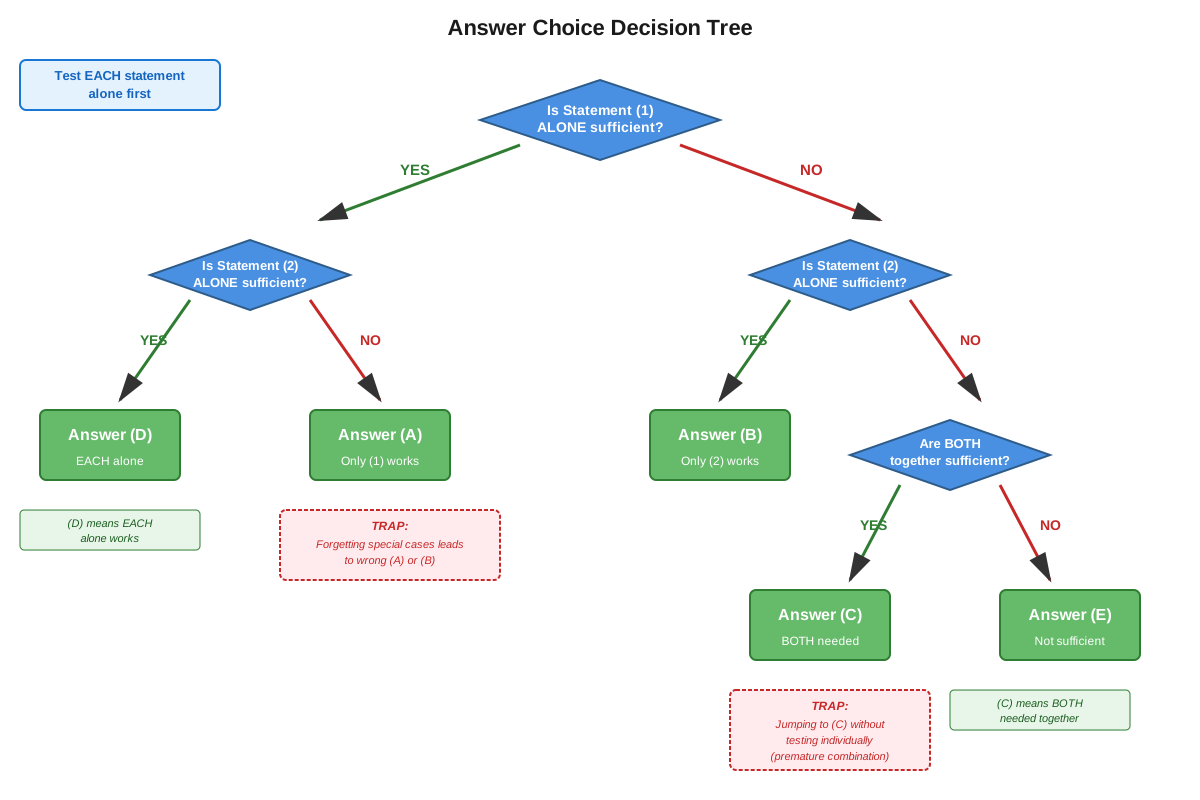
Variant A—Assuming statements must be combined: Test-takers immediately jump to evaluating both statements together without fully analyzing each independently. They select (C) when the answer is actually (A) or (B). This is perhaps the most common trap, exploiting time pressure and the desire to "use all the information."
Variant B—Failing to recognize when combination is necessary: Test-takers conclude each statement alone is insufficient but fail to recognize that together they provide sufficiency. They select (E) when the answer is (C).
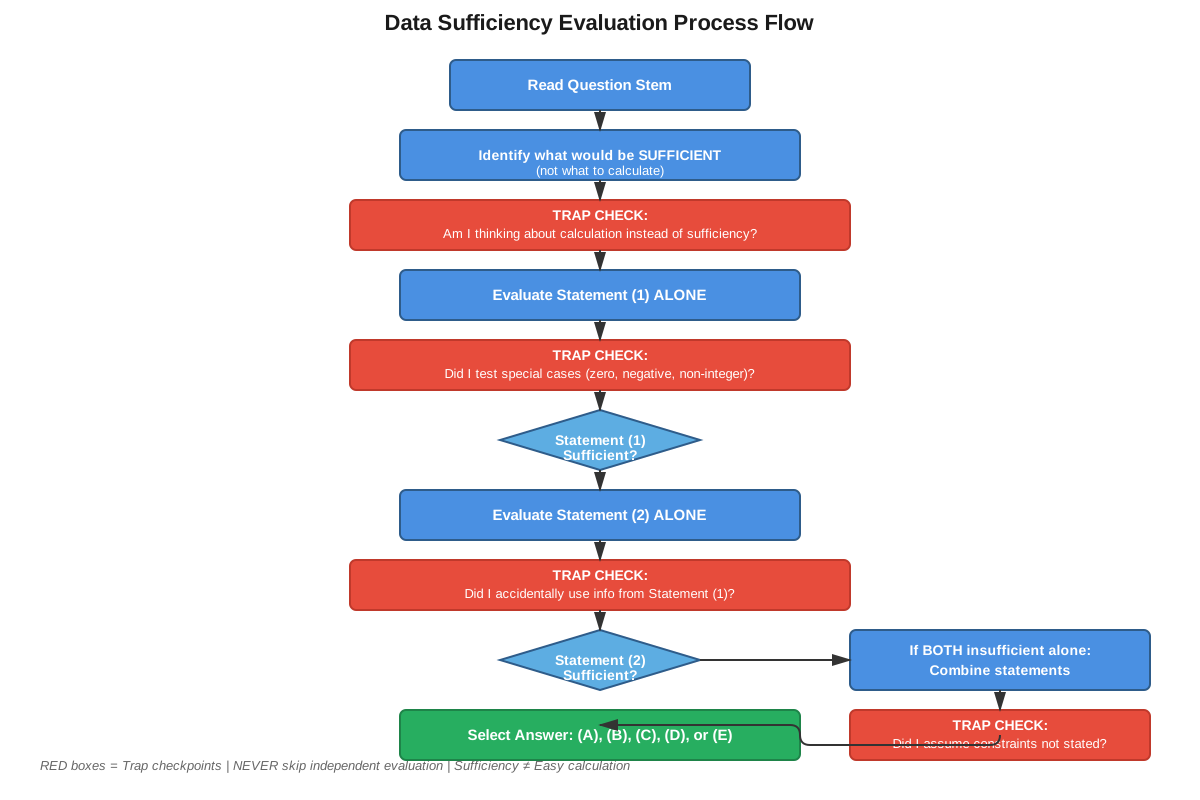
The systematic approach to avoid this trap: Always evaluate Statement 1 alone completely, then Statement 2 alone completely, and only then consider them together if both were insufficient individually.
Trap Type 4: The Extraneous Information Trap
This trap includes irrelevant data that test-takers incorporate into their reasoning, leading them to believe they have more (or less) information than they actually do. The GMAT includes numbers, variables, or conditions that seem relevant but don't affect sufficiency.
Example: "What is the value of x + y?" with Statement 1: "x = 3 and x + y + z = 10." Test-takers might think this is insufficient because z is unknown. However, the question only asks for x + y, and if we know x = 3 and x + y + z = 10, we get y + z = 7, but we still can't determine x + y specifically without knowing z. The trap works both ways—sometimes extraneous information makes things seem insufficient when they're sufficient, and vice versa.
Trap Type 5: The Rephrasing Trap
Test-takers fail to recognize that a statement provides the same information as the question stem in disguised form, or that two statements are actually equivalent. This leads to incorrect evaluation of sufficiency.
Example: "Is x² > x?" with Statement 1: "x > 1 or x < 0." Test-takers might not recognize that x² > x is equivalent to x(x-1) > 0, which occurs exactly when x > 1 or x < 0. Statement 1 directly answers the question, making it sufficient.
Trap Type 6: The "Yes/No" Question Trap
For questions asking "Is [condition] true?", test-takers forget that a definitive "No" is just as sufficient as a definitive "Yes." They select insufficient when a statement proves the condition is definitely false.
Example: "Is x even?" with Statement 1: "x = 2k + 1 where k is an integer." This definitively answers "No, x is odd," making it sufficient. The trap answer treats this as insufficient because it doesn't give a "Yes" answer.
Comparison Table: Sufficient vs. Insufficient
| Scenario | Sufficient | Insufficient |
|---|---|---|
| Can determine exact value | ✓ | - |
| Can determine definitive Yes | ✓ | - |
| Can determine definitive No | ✓ | - |
| Can narrow to two possible values | - | ✓ |
| Can establish range but not specific answer | - | ✓ |
| Different answers possible depending on unstated conditions | - | ✓ |
| Calculation is complex but answer is determinable | ✓ | - |
Concept Relationships
The six trap types interconnect in sophisticated ways. The Unnecessary Calculation Trap often combines with the Forgotten Case Trap—test-takers begin calculating, realize they'd need to check multiple cases, and incorrectly conclude insufficiency rather than systematically checking each case. Similarly, the Statement Combination Trap frequently appears alongside the Rephrasing Trap: test-takers fail to recognize that Statement 2 is actually a rephrasing of Statement 1, leading them to incorrectly select (D) when the answer is (A) or (B).
The Extraneous Information Trap serves as a meta-trap that can appear within any other trap type. When combined with the "Yes/No" Question Trap, it creates particularly difficult questions where irrelevant information distracts from recognizing that a definitive negative answer has been provided.
All trap types connect to the fundamental prerequisite of understanding number properties. The Forgotten Case Trap directly tests whether students remember that variables can be zero, negative, or non-integer. The Rephrasing Trap requires algebraic manipulation skills to recognize equivalent expressions. The Statement Combination Trap demands logical reasoning to evaluate independence of statements.
Relationship flow: Question stem analysis → Individual statement evaluation (avoiding Unnecessary Calculation, Forgotten Case, and Rephrasing traps) → Independence check (avoiding Statement Combination trap) → Sufficiency determination (avoiding Yes/No trap) → Answer selection (avoiding Extraneous Information trap)
High-Yield Facts
⭐ Sufficiency means you CAN answer definitively, not that the calculation is easy or quick—if you could theoretically determine the answer with enough time, the statement is sufficient.
⭐ Always check if zero, negative numbers, or non-integers are possible—these forgotten cases account for approximately 30% of trap answers on Data Sufficiency questions.
⭐ A definitive "No" answer is just as sufficient as a definitive "Yes" answer for questions asking "Is [condition] true?"
⭐ Evaluate Statement 1 completely before looking at Statement 2—jumping between statements is the primary cause of Statement Combination Trap errors.
⭐ If each statement alone is insufficient, they might still be insufficient together—don't assume combination always provides sufficiency; answer choice (E) exists for a reason.
- When a statement gives you an equation with the same number of unknowns, it's typically sufficient to solve (one equation, one unknown = sufficient; two equations, two unknowns = sufficient).
- Statements that appear to give "partial information" may actually be sufficient if the question only requires a Yes/No answer rather than a specific value.
- If you find yourself doing extensive calculations, pause and ask whether you're determining sufficiency or actually solving—you may be falling into the Unnecessary Calculation Trap.
- Geometric figures marked "not drawn to scale" often contain Forgotten Case Traps where multiple configurations are possible.
- When statements seem to provide the same type of information, check if they're actually equivalent (Rephrasing Trap) or if they provide independent constraints.
- Questions with absolute values, squares, or even exponents are high-probability locations for Negative Number Traps.
- Time pressure increases trap susceptibility—if you're rushing, you're more likely to assume statements must be combined or forget to check edge cases.
Quick check — test yourself on Data sufficiency traps so far.
Try Flashcards →Common Misconceptions
Misconception: If I can't easily calculate the answer, the statement must be insufficient.
Correction: Sufficiency is about whether an answer exists and is determinable, not whether you can quickly find it. A statement requiring complex factoring, system solving, or case analysis can still be sufficient if it leads to a definitive answer.
Misconception: For "What is the value of x?" questions, I need to find the exact numerical value.
Correction: You need to determine whether the statement would allow you to find a unique value. You don't need to actually calculate it. If a statement gives you "x² - 5x + 6 = 0," you know x has specific values (2 or 3), but you'd need additional information to determine which one—this is insufficient. However, if the statement gives you enough to determine x uniquely, it's sufficient even if solving is tedious.
Misconception: If Statement 1 is insufficient and Statement 2 is insufficient, I should automatically select (C).
Correction: This is the Statement Combination Trap. Even together, the statements might not provide sufficiency. Always evaluate whether the combination actually provides enough information before selecting (C). Answer choice (E) exists specifically for cases where even both statements together are insufficient.
Misconception: Variables in GMAT questions represent positive numbers unless otherwise stated.
Correction: Unless explicitly stated (e.g., "where x is a positive integer"), variables can be negative, zero, fractions, or irrational numbers. Always consider these cases, especially in questions involving inequalities, absolute values, or division.
Misconception: If a statement gives me a "No" answer to an "Is x > 5?" type question, it's insufficient because it doesn't confirm the condition.
Correction: For Yes/No questions, a definitive "No" is exactly as sufficient as a definitive "Yes." If Statement 1 proves x ≤ 5 in all cases, it has sufficiently answered the question "Is x > 5?" with "No."
Misconception: More information is always better, so if both statements provide information, I should use both.
Correction: Data Sufficiency rewards recognizing when you have enough information, not using all available information. If Statement 1 alone is sufficient, the answer is (A) regardless of what Statement 2 says. Using unnecessary information wastes time and increases error risk.
Misconception: Geometric problems always require knowing all side lengths and angles to be sufficient.
Correction: Many geometric relationships allow determination of values with partial information. For example, knowing two angles of a triangle determines the third; knowing the area and base of a triangle determines the height. Don't assume insufficiency without checking geometric relationships.
Worked Examples
Example 1: Multiple Trap Types Combined
Question: Is x² > x?
Statement 1: x > 1
Statement 2: x < 0
Step 1—Rephrase the question:
Is x² > x? can be rewritten as x² - x > 0, which factors to x(x - 1) > 0.
This inequality is true when both factors are positive OR both factors are negative:
- Both positive: x > 0 AND x - 1 > 0, meaning x > 1
- Both negative: x < 0 AND x - 1 < 0, meaning x < 0
So the question is really asking: "Is x > 1 or x < 0?"
Step 2—Evaluate Statement 1 alone:
Statement 1 tells us x > 1. This directly satisfies one of our conditions (x > 1 or x < 0), so we can definitively answer "Yes, x² > x." Statement 1 is SUFFICIENT.
Trap alert: Some test-takers might think "but what if x is between 0 and 1?" However, Statement 1 excludes this possibility by stating x > 1.
Step 3—Evaluate Statement 2 alone:
Statement 2 tells us x < 0. This directly satisfies the other condition (x > 1 or x < 0), so we can definitively answer "Yes, x² > x." Statement 2 is SUFFICIENT.
Trap alert: The Forgotten Case Trap might cause test-takers to forget that negative numbers squared become positive, making x² > x true for all negative x.
Step 4—Conclusion:
Each statement alone is sufficient. Answer: (D)
Trap answer (E): Test-takers who don't rephrase the question might think neither statement alone tells them enough about the relationship between x² and x.
Trap answer (C): Test-takers might think they need both statements to "cover all cases," falling into the Statement Combination Trap.
Learning objective connection: This example demonstrates identifying traps (Forgotten Case, Statement Combination), explaining why they're traps (failure to rephrase, incomplete case analysis), and applying trap knowledge to select the correct answer.
Example 2: The Unnecessary Calculation Trap
Question: If a and b are integers, is a/b an integer?
Statement 1: b is a factor of 12
Statement 2: a = 24
Step 1—Understand what's being asked:
For a/b to be an integer, b must divide evenly into a (i.e., a must be a multiple of b).
Step 2—Evaluate Statement 1 alone:
Statement 1 tells us b is a factor of 12, meaning b could be ±1, ±2, ±3, ±4, ±6, or ±12. However, we know nothing about a.
If a = 24 and b = 2, then a/b = 12 (integer).
If a = 25 and b = 2, then a/b = 12.5 (not an integer).
Statement 1 alone is INSUFFICIENT.
Step 3—Evaluate Statement 2 alone:
Statement 2 tells us a = 24, but we know nothing about b.
If b = 2, then a/b = 12 (integer).
If b = 5, then a/b = 4.8 (not an integer).
Statement 2 alone is INSUFFICIENT.
Step 4—Evaluate both statements together:
Now we know a = 24 and b is a factor of 12. The factors of 12 are ±1, ±2, ±3, ±4, ±6, ±12.
Here's where the Unnecessary Calculation Trap appears. Test-takers might think: "I need to check each possible value of b to see if 24/b is an integer. That's a lot of work, so maybe it's insufficient?"
Trap alert: The difficulty of checking multiple cases doesn't make the information insufficient. Let's think conceptually instead:
Since b is a factor of 12, and 24 = 12 × 2, we know that 24 is divisible by every factor of 12. Therefore, a/b will ALWAYS be an integer regardless of which factor of 12 that b represents.
We don't need to calculate each case; we can reason that sufficiency exists.
Together, the statements are SUFFICIENT. Answer: (C)
Trap answer (E): Test-takers who begin calculating individual cases, feel overwhelmed, and conclude the information is insufficient fall into the Unnecessary Calculation Trap.
Learning objective connection: This example shows how to identify the Unnecessary Calculation Trap (feeling that complex calculation means insufficiency), explain why it's a trap (sufficiency is about determinability, not ease), and apply this knowledge by reasoning conceptually rather than calculating exhaustively.
Exam Strategy
The Two-Pass Approach: On your first read of each statement, focus solely on understanding what information it provides—don't immediately try to determine sufficiency. On the second pass, evaluate sufficiency systematically. This prevents premature conclusions and reduces trap susceptibility.
Trigger phrases for traps:
- "If x is an integer..." or similar constraints buried in the question stem—these often prevent Forgotten Case Traps
- Questions with absolute values, squares, or even exponents—high probability of Negative Number Traps
- Statements that seem to provide "similar" information—check for Rephrasing Traps
- Complex expressions that would be tedious to calculate—potential Unnecessary Calculation Traps
The Sufficiency Checklist (use mentally for each statement):
- Does this give me a definitive answer (Yes, No, or specific value)?
- Have I checked zero, negatives, and non-integers if applicable?
- Am I confusing "hard to calculate" with "insufficient"?
- For Yes/No questions, is a definitive "No" sufficient?
Process of elimination strategy:
- If Statement 1 is sufficient, eliminate (B), (C), and (E) immediately—only (A) or (D) remain
- If Statement 1 is insufficient, eliminate (A) and (D) immediately—only (B), (C), or (E) remain
- This systematic elimination prevents accidentally selecting impossible answer combinations
Time allocation: Spend 15-20 seconds rephrasing the question stem before evaluating statements. This upfront investment prevents trap answers and often makes statement evaluation faster. Allocate approximately 45 seconds per statement evaluation, and 30 seconds for combined evaluation if needed. Total target: 2 minutes per Data Sufficiency question.
The "Could I solve this?" test: For each statement, ask "If I had unlimited time and paper, could I definitively answer the question?" If yes, it's sufficient—don't actually solve it. This prevents the Unnecessary Calculation Trap while ensuring you're not declaring something sufficient when it's actually insufficient.
Memory Techniques
ZINC Mnemonic for forgotten cases:
- Zero: Could the variable equal zero?
- Integers: Are variables required to be integers, or could they be fractions?
- Negatives: Could the variable be negative?
- Combination: Do I need to combine statements, or is one alone sufficient?
The "EACH" Protocol for statement evaluation:
- Evaluate Statement 1 completely alone
- Analyze Statement 2 completely alone
- Combine only if both were insufficient
- Halt and select answer
Visualization for Yes/No sufficiency: Picture a light switch. Sufficient means the switch is definitely ON (Yes) or definitely OFF (No). Insufficient means the switch could be either position—you can't tell which. This mental image reinforces that both definitive answers represent sufficiency.
The "STOP" reminder when you feel rushed:
- Statements must be evaluated independently first
- Traps increase when you hurry
- One sufficient statement means (A), (B), or (D)—never (C) or (E)
- Pause before selecting to verify your logic
Acronym for trap types: "UNFREY"
- Unnecessary calculation
- Negative numbers forgotten
- Forgotten zero case
- Rephrasing not recognized
- Extraneous information
- Yes/No confusion
Summary
Data sufficiency traps represent systematic patterns of misdirection that exploit predictable reasoning errors under time pressure. The six primary trap types—Unnecessary Calculation, Forgotten Cases (zero, negatives, non-integers), Statement Combination, Extraneous Information, Rephrasing, and Yes/No confusion—account for the majority of incorrect answers on GMAT Data Sufficiency questions. Mastery requires understanding that sufficiency means determinability rather than ease of calculation, that definitive "No" answers are sufficient for Yes/No questions, and that statements must be evaluated independently before considering combination. The key to avoiding traps is systematic analysis: rephrase the question, evaluate each statement completely and independently, check edge cases (especially zero and negatives), and resist the urge to calculate when conceptual reasoning suffices. Success on Data Sufficiency questions correlates strongly with trap recognition—students who can identify these patterns consistently outperform those with equivalent mathematical knowledge but less strategic awareness.
Key Takeaways
- Sufficiency is about determinability, not calculation ease—if you could theoretically find a definitive answer, the statement is sufficient regardless of computational complexity
- Always check zero, negative numbers, and non-integers unless explicitly excluded—these forgotten cases create approximately 30% of trap answers
- Evaluate statements independently first—the Statement Combination Trap is the most common error, caused by immediately considering both statements together
- A definitive "No" is sufficient for Yes/No questions—don't fall into the trap of thinking only "Yes" answers demonstrate sufficiency
- Rephrase the question before evaluating statements—this upfront investment prevents multiple trap types and often makes sufficiency obvious
- Use systematic elimination—if Statement 1 is sufficient, only (A) or (D) are possible; if insufficient, only (B), (C), or (E) remain
- Time pressure increases trap susceptibility—when rushed, slow down on Data Sufficiency questions rather than speeding up, as traps punish hasty analysis
Related Topics
Inequality Manipulation and Number Lines: Understanding how to work with inequalities is essential for avoiding Forgotten Case Traps, particularly when dealing with negative numbers and zero. Mastering this topic enables more sophisticated analysis of statements that constrain rather than determine values.
Algebraic Equation Systems: Many Data Sufficiency questions involve determining whether systems of equations can be solved. Understanding when n equations with n unknowns are sufficient (and when they're not due to dependency) builds on trap awareness.
Number Properties (Divisibility, Primes, Factors): These properties frequently appear in Data Sufficiency questions and create opportunities for Rephrasing Traps where statements provide equivalent information in disguised form.
Absolute Value and Quadratic Equations: These topics are high-yield sources of Negative Number Traps and require careful case analysis that builds directly on trap awareness skills.
Geometric Relationships and Theorems: Geometry Data Sufficiency questions often contain Unnecessary Calculation Traps where test-takers attempt to find all measurements when conceptual relationships alone determine sufficiency.
Practice CTA
Now that you understand the systematic patterns behind data sufficiency traps, it's time to put this knowledge into action. Attempt the practice questions designed specifically to test your trap recognition skills—each question has been carefully constructed to include common traps, allowing you to practice the identification and avoidance strategies you've learned. Use the flashcards to reinforce the six trap types and the ZINC mnemonic for edge cases. Remember: recognizing these patterns is a skill that improves with deliberate practice. Every trap you identify in practice is one you'll avoid on test day, directly translating to score improvement. You've invested the time to understand the theory—now build the pattern recognition that separates good scores from great ones.
Sign up free to keep reading
Create a free AnvayaPrep account to finish this GMAT guide on Data sufficiency traps — plus flashcards and practice questions.