Overview
Absolute value is one of the most frequently tested concepts in GMAT Quantitative Reasoning, appearing in approximately 10-15% of all quantitative questions. This fundamental mathematical concept measures the distance of a number from zero on the number line, regardless of direction. While the basic definition appears straightforward, GMAT absolute value questions often combine this concept with equations, inequalities, coordinate geometry, and algebraic manipulation to create challenging multi-step problems that test both conceptual understanding and computational accuracy.
Mastering absolute value is essential for GMAT success because it serves as a building block for more complex mathematical reasoning. Questions involving absolute value frequently appear in Problem Solving and Data Sufficiency formats, often requiring students to consider multiple cases or scenarios. The GMAT tests not just mechanical computation but the ability to visualize absolute value geometrically, translate between algebraic and graphical representations, and recognize when absolute value creates multiple solution paths.
Within the broader Quantitative Reasoning framework, absolute value connects directly to number properties, inequalities, coordinate geometry, and algebraic equations. Understanding absolute value enables students to solve distance problems, analyze piecewise functions, work with complex inequalities, and interpret data sufficiency statements that involve ranges and constraints. This topic's versatility makes it a high-yield area for focused study, as improvements in absolute value proficiency directly translate to improved performance across multiple question types.
Learning Objectives
- [ ] Identify absolute value expressions and their properties in GMAT questions
- [ ] Explain the geometric and algebraic interpretations of absolute value
- [ ] Apply absolute value concepts to solve equations and inequalities in GMAT questions
- [ ] Analyze absolute value expressions involving multiple variables and complex algebraic forms
- [ ] Evaluate Data Sufficiency statements that incorporate absolute value constraints
- [ ] Synthesize absolute value concepts with coordinate geometry and distance formulas
- [ ] Distinguish between cases when solving absolute value equations and inequalities
Prerequisites
- Basic algebra: Understanding variables, expressions, and equation-solving techniques is essential because absolute value problems require algebraic manipulation and case analysis
- Number line concepts: Familiarity with plotting numbers and understanding distance on a number line provides the geometric foundation for absolute value interpretation
- Inequality notation: Knowledge of inequality symbols and solution sets is necessary because absolute value inequalities generate compound inequality statements
- Integer properties: Understanding positive and negative numbers enables quick evaluation of absolute value expressions and recognition of sign changes
Why This Topic Matters
Absolute value appears throughout real-world applications including engineering tolerances, statistical analysis (measuring deviation from means), computer science (calculating differences), and physics (representing magnitude without direction). In financial contexts, absolute value represents the magnitude of gains or losses regardless of direction, making it essential for risk analysis and portfolio management.
On the GMAT, absolute value questions appear in multiple formats with varying difficulty levels. Approximately 2-3 questions per exam directly test absolute value, while many additional questions incorporate absolute value as part of more complex problems. The GMAT particularly favors questions that combine absolute value with:
- Algebraic equations requiring case analysis (40% of absolute value questions)
- Inequalities that generate compound conditions (30%)
- Data Sufficiency problems testing understanding of multiple solutions (20%)
- Coordinate geometry and distance calculations (10%)
The GMAT uses absolute value to assess critical reasoning skills including the ability to consider multiple scenarios simultaneously, recognize when problems require case-by-case analysis, and understand the relationship between algebraic and geometric representations. Students who master absolute value demonstrate the analytical flexibility that business schools value, as these problems mirror real-world decision-making where multiple scenarios must be evaluated.
Core Concepts
Definition and Basic Properties
The absolute value of a number x, denoted |x|, represents the distance between x and zero on the number line. Distance is always non-negative, so absolute value always produces a non-negative result. Formally:
|x| = x if x ≥ 0
|x| = -x if x < 0
This piecewise definition is crucial for solving absolute value equations and inequalities. The expression |-5| = 5 because -5 is located 5 units from zero. Similarly, |5| = 5 because 5 is also 5 units from zero.
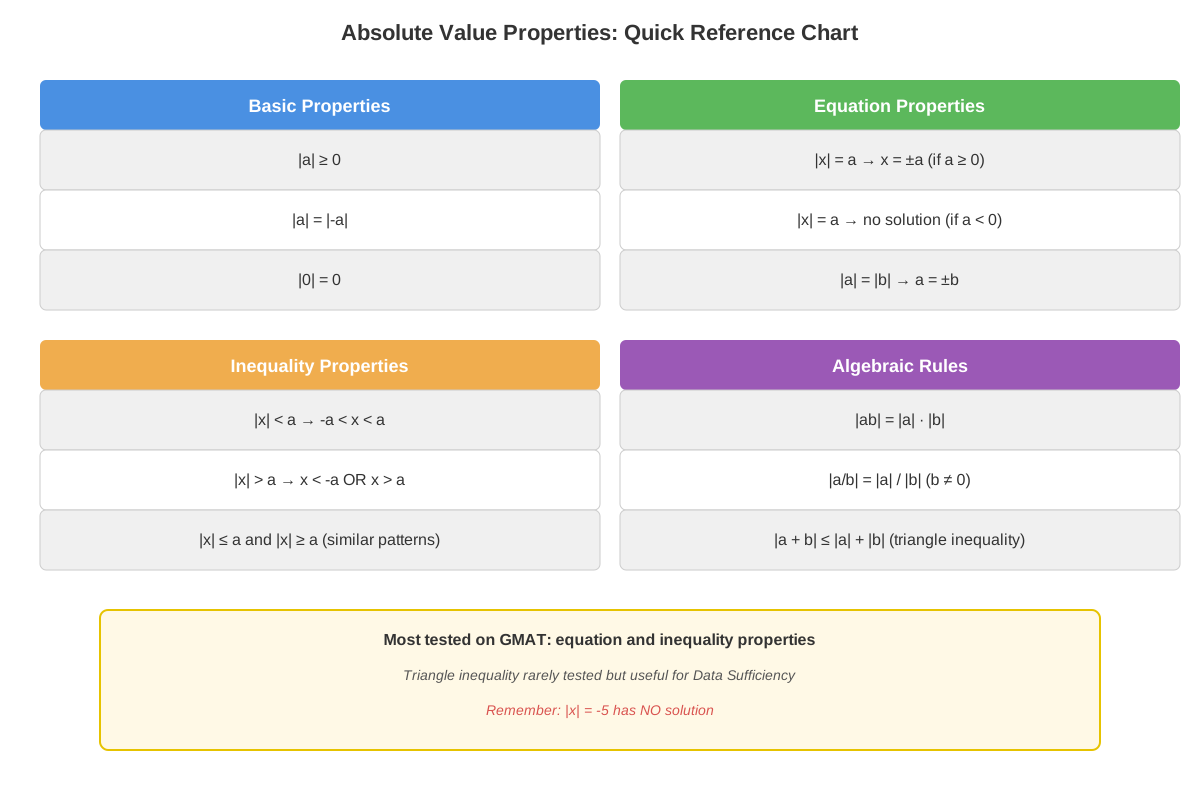
Key properties of absolute value include:
- |x| ≥ 0 for all real numbers x
- |x| = 0 if and only if x = 0
- |x| = |-x| (symmetry property)
- |xy| = |x| · |y| (multiplicative property)
- |x/y| = |x|/|y| when y ≠ 0 (division property)
Geometric Interpretation
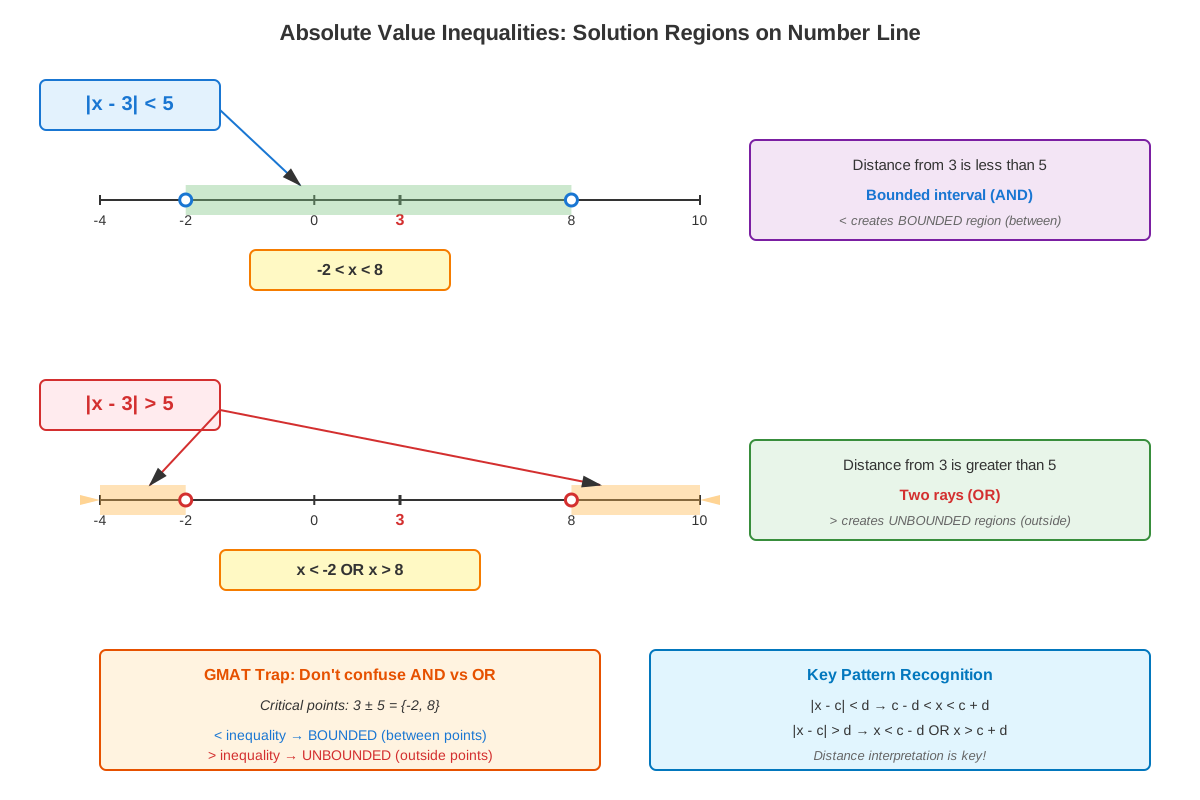
The geometric interpretation provides powerful problem-solving insights. The expression |x - a| represents the distance between x and a on the number line. For example, |x - 3| represents how far x is from 3. This interpretation transforms abstract algebraic expressions into visual, intuitive concepts.
The equation |x - 3| = 5 asks: "What values of x are exactly 5 units away from 3?" The answer includes both x = 8 (five units to the right) and x = -2 (five units to the left). This geometric perspective immediately reveals why absolute value equations typically have two solutions.
Solving Absolute Value Equations
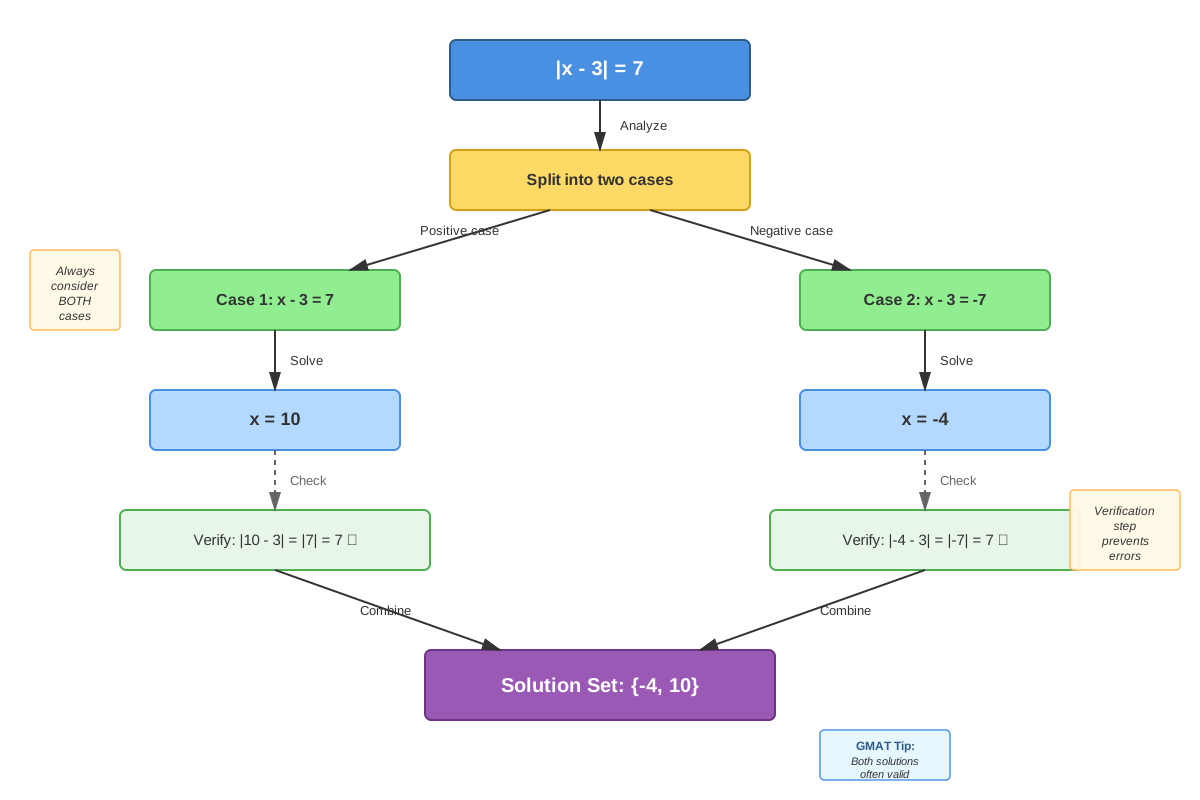
When solving equations like |x + 2| = 7, the case-based approach is essential:
Case 1: The expression inside is non-negative
- x + 2 = 7
- x = 5
Case 2: The expression inside is negative
- -(x + 2) = 7
- x + 2 = -7
- x = -9
Both solutions must be verified in the original equation. This two-case method applies to all absolute value equations of the form |expression| = positive number.
For equations with absolute values on both sides, such as |x - 3| = |2x + 1|, consider that two quantities have equal absolute values when they are either equal or opposites:
- Case 1: x - 3 = 2x + 1 → x = -4
- Case 2: x - 3 = -(2x + 1) → x = 2/3
Solving Absolute Value Inequalities
Absolute value inequalities require careful attention to the inequality direction:
Type 1: |x| < a (where a > 0)
This means x is within distance a from zero, generating the compound inequality:
-a < x < a
Example: |x - 5| < 3 means -3 < x - 5 < 3, which simplifies to 2 < x < 8
Type 2: |x| > a (where a > 0)
This means x is more than distance a from zero, generating the disjunction:
x < -a OR x > a
Example: |x + 2| > 4 means x + 2 < -4 OR x + 2 > 4, giving x < -6 OR x > 2
| Inequality Type | Algebraic Form | Geometric Meaning | Solution Structure | ||
|---|---|---|---|---|---|
| x | < a | -a < x < a | Within distance a from 0 | Single interval | |
| x | ≤ a | -a ≤ x ≤ a | At most distance a from 0 | Single interval (closed) | |
| x | > a | x < -a or x > a | Beyond distance a from 0 | Two separate intervals | |
| x | ≥ a | x ≤ -a or x ≥ a | At least distance a from 0 | Two separate intervals |
Complex Absolute Value Expressions
GMAT questions often feature nested or multiple absolute value expressions. For |x| + |y| = 10, the solution requires considering the signs of both x and y, creating four cases:
- x ≥ 0, y ≥ 0: x + y = 10
- x ≥ 0, y < 0: x - y = 10
- x < 0, y ≥ 0: -x + y = 10
- x < 0, y < 0: -x - y = 10
Each case generates a different linear equation, and the complete solution set combines all valid solutions from each case.
Absolute Value in Data Sufficiency
Data Sufficiency questions frequently test whether students recognize that absolute value creates multiple scenarios. A statement like "|x| = 5" provides less information than "x = 5" because it allows two possibilities. Understanding this distinction is critical for evaluating sufficiency.
When evaluating statements involving absolute value:
- Always consider both positive and negative cases
- Check whether the question asks for a specific value or a property
- Recognize that absolute value constraints often create symmetric solutions
Concept Relationships
The core concepts within absolute value form a hierarchical structure: Basic definition → Geometric interpretation → Equation solving → Inequality solving → Complex multi-variable problems. Each level builds upon the previous, with geometric interpretation serving as the bridge between abstract definition and practical problem-solving.
Absolute value connects to prerequisite topics through its foundation in number line concepts and integer properties. The distance interpretation directly extends number line understanding, while the piecewise definition relies on distinguishing positive from negative numbers. These connections make absolute value a natural progression in mathematical reasoning.
Looking forward, absolute value enables more advanced topics including:
- Distance formula in coordinate geometry: The expression √[(x₂-x₁)² + (y₂-y₁)²] incorporates absolute value concepts through the squaring operation
- Optimization problems: Minimizing |f(x)| requires understanding absolute value properties
- Piecewise functions: Absolute value serves as the prototypical piecewise function
- Modular arithmetic: The relationship between absolute value and remainders appears in number theory problems
The relationship map: Number properties → Absolute value definition → Geometric visualization → Case-based solving → Inequalities → Coordinate geometry applications → Complex algebraic problems
High-Yield Facts
⭐ The equation |x| = a has two solutions (x = a and x = -a) when a > 0, one solution (x = 0) when a = 0, and no solutions when a < 0
⭐ The inequality |x| < a (where a > 0) translates to -a < x < a, creating a single continuous interval
⭐ The inequality |x| > a (where a > 0) translates to x < -a OR x > a, creating two separate intervals
⭐ |x - a| represents the distance between x and a on the number line, providing geometric insight for all absolute value problems
⭐ When solving |expression₁| = |expression₂|, set expression₁ = expression₂ AND expression₁ = -expression₂ to find all solutions
- The absolute value of a product equals the product of absolute values: |ab| = |a| · |b|
- For any real number x: |x|² = x² (squaring eliminates absolute value)
- The triangle inequality states: |a + b| ≤ |a| + |b| for all real numbers a and b
- |x| = x when x ≥ 0, and |x| = -x when x < 0 (the piecewise definition is fundamental)
- Absolute value expressions are always non-negative: |x| ≥ 0 for all x
- In Data Sufficiency, a statement giving |x| = k provides less specific information than x = k because it allows two values
- When absolute value appears in denominators, ensure the denominator cannot equal zero
- The expression |x - a| + |x - b| represents the sum of distances from x to points a and b
Quick check — test yourself on Absolute value so far.
Try Flashcards →Common Misconceptions
Misconception: |x + y| = |x| + |y| for all values
Correction: This equality only holds when x and y have the same sign. The correct relationship is the triangle inequality: |x + y| ≤ |x| + |y|. For example, |3 + (-5)| = |-2| = 2, but |3| + |-5| = 3 + 5 = 8.
Misconception: The equation |x| = -5 has solutions x = 5 and x = -5
Correction: Absolute value always produces non-negative results, so |x| = -5 has no solutions. An absolute value can never equal a negative number.
Misconception: To solve |x - 3| > 5, simply write x - 3 > 5, giving x > 8
Correction: The inequality |x - 3| > 5 means x - 3 > 5 OR x - 3 < -5, yielding x > 8 OR x < -2. The "greater than" absolute value inequality creates two separate regions, not one.
Misconception: When solving |2x + 1| = 7, dividing both sides by 2 gives |x + 0.5| = 3.5
Correction: You cannot distribute division across absolute value. Instead, solve by cases: 2x + 1 = 7 (giving x = 3) or 2x + 1 = -7 (giving x = -4).
Misconception: If |x| < |y|, then x < y
Correction: Absolute value compares distances from zero, not the numbers themselves. For example, |-10| = 10 and |3| = 3, so |-10| > |3|, but -10 < 3. The relationship |x| < |y| means x is closer to zero than y, not that x is less than y.
Misconception: The solution to |x| + 3 = 10 is x = 7 and x = -7
Correction: First isolate the absolute value: |x| = 7, then solve to get x = 7 or x = -7. Students often forget to isolate the absolute value expression before applying the two-case method.
Misconception: In Data Sufficiency, knowing |x - 5| = 3 is sufficient to determine x
Correction: This equation has two solutions (x = 8 and x = 2), so it does not uniquely determine x. This is insufficient unless the question asks for a property that both solutions share (like "Is x positive?").
Worked Examples
Example 1: Absolute Value Equation with Algebraic Manipulation
Problem: Solve for all values of x: |2x - 6| = |x + 3|
Solution:
When two absolute values are equal, the expressions inside are either equal or opposites.
Case 1: The expressions are equal
2x - 6 = x + 3
2x - x = 3 + 6
x = 9
Verification: |2(9) - 6| = |18 - 6| = |12| = 12, and |9 + 3| = |12| = 12 ✓
Case 2: The expressions are opposites
2x - 6 = -(x + 3)
2x - 6 = -x - 3
2x + x = -3 + 6
3x = 3
x = 1
Verification: |2(1) - 6| = |-4| = 4, and |1 + 3| = |4| = 4 ✓
Answer: x = 9 or x = 1
Connection to Learning Objectives: This example demonstrates applying absolute value to solve equations (Objective 3) and analyzing expressions with algebraic forms (Objective 4). The case-based approach illustrates the fundamental principle that absolute value equations require considering multiple scenarios.
Example 2: Absolute Value Inequality in Data Sufficiency Format
Problem: Is |x - 5| < 3?
Statement (1): 2 < x < 8
Statement (2): x² < 64
Solution:
First, understand what the question asks. The inequality |x - 5| < 3 means:
-3 < x - 5 < 3
2 < x < 8
So the question asks: "Is 2 < x < 8?"
Analyzing Statement (1): 2 < x < 8
This directly states the condition we need. Statement (1) alone is SUFFICIENT.
Analyzing Statement (2): x² < 64
Taking square roots: |x| < 8, which means -8 < x < 8
This is a wider range than 2 < x < 8. For example:
- If x = 3, then |3 - 5| = 2 < 3 (YES)
- If x = 0, then |0 - 5| = 5 > 3 (NO)
Statement (2) allows values both inside and outside the required range, so it is INSUFFICIENT.
Answer: Statement (1) alone is sufficient, but Statement (2) alone is not sufficient. (Answer choice A)
Connection to Learning Objectives: This example demonstrates evaluating Data Sufficiency statements with absolute value constraints (Objective 5), applying absolute value to GMAT questions (Objective 3), and explaining the geometric interpretation of absolute value as distance (Objective 2). The problem requires translating the absolute value inequality into a standard inequality and recognizing that broader constraints don't guarantee narrower conditions.
Exam Strategy
When approaching GMAT absolute value questions, follow this systematic process:
Step 1: Identify the absolute value structure (5-10 seconds)
- Count how many absolute value expressions appear
- Note whether the problem involves equations, inequalities, or Data Sufficiency
- Recognize trigger phrases like "distance from," "how far," or "magnitude"
Step 2: Choose your solution method (5 seconds)
- For simple equations: use the two-case method
- For inequalities: apply the standard transformations (< creates AND, > creates OR)
- For geometric problems: visualize on a number line
- For Data Sufficiency: consider whether absolute value creates multiple scenarios
Step 3: Execute systematically (60-90 seconds)
- Write out all cases explicitly
- Verify solutions in the original equation
- Check boundary values for inequalities
- For Data Sufficiency, test extreme values within the given constraints
Exam Tip: When you see absolute value in Data Sufficiency, immediately ask: "Does this create multiple possibilities?" Absolute value often makes statements insufficient that would otherwise be sufficient.
Trigger words and phrases to watch for:
- "Distance between" → translate to |x - a|
- "At least" or "at most" → inequality with ≥ or ≤
- "Within" → less than inequality (|x - a| < b)
- "Outside" or "beyond" → greater than inequality (|x - a| > b)
- "How many values" → count solutions from case analysis
Process-of-elimination tips:
- Eliminate answer choices that give negative values for absolute value expressions
- For inequality questions, test the boundary values in answer choices
- If an answer choice gives only one solution to an absolute value equation, it's likely incomplete
- In Data Sufficiency, if a statement provides |x| = k, it rarely determines x uniquely
Time allocation:
- Simple absolute value equations: 60-90 seconds
- Absolute value inequalities: 90-120 seconds
- Complex multi-variable problems: 120-150 seconds
- Data Sufficiency with absolute value: 90-120 seconds
If a problem requires more than three cases, look for a geometric interpretation or algebraic simplification to reduce complexity.
Memory Techniques
Mnemonic for inequality transformations: "Less than AND, Greater than OR"
- |x| < a means -a < x < a (connected by AND)
- |x| > a means x < -a OR x > a (separated by OR)
Visualization strategy: The "Number Line Distance" technique
Always sketch a quick number line when solving absolute value problems. Mark the reference point (the number being subtracted inside the absolute value) and visualize the distance. This transforms abstract algebra into concrete geometry.
Acronym for solving equations: "EPIC"
- Eliminate the absolute value by considering cases
- Perform algebraic operations for each case
- Isolate the variable
- Check solutions in the original equation
Memory aid for properties: "Absolute value is ALWAYS NON-NEGATIVE"
Whenever you see an equation like |x| = -7, immediately recognize it has no solution. This simple rule eliminates wrong answers quickly.
Pattern recognition: The "Two-Solution Template"
For any equation |expression| = positive number, mentally template:
- Solution 1: expression = positive number
- Solution 2: expression = negative of that number
This template becomes automatic with practice, speeding up problem-solving significantly.
Summary
Absolute value represents the distance of a number from zero, always producing non-negative results. This fundamental concept appears throughout GMAT Quantitative Reasoning in equations, inequalities, and Data Sufficiency questions. The key to mastering absolute value lies in understanding both its algebraic definition (the piecewise function that equals x when x ≥ 0 and -x when x < 0) and its geometric interpretation (distance on the number line). Solving absolute value equations requires case-based analysis, typically generating two solutions, while absolute value inequalities transform into compound inequalities following predictable patterns: "less than" creates a single interval (AND condition), while "greater than" creates two separate intervals (OR condition). GMAT questions test not just mechanical computation but conceptual understanding, particularly the recognition that absolute value creates multiple scenarios that must be considered separately. Success requires systematic problem-solving approaches, careful verification of solutions, and awareness of common pitfalls like forgetting to consider both cases or misapplying inequality transformations. The geometric perspective provides powerful intuition, transforming complex algebraic expressions into visual distance relationships that clarify solution strategies.
Key Takeaways
- Absolute value measures distance from zero and always produces non-negative results; |x| = a has two solutions when a > 0, one when a = 0, and none when a < 0
- The geometric interpretation |x - a| = distance between x and a provides intuitive problem-solving insight and should be visualized on a number line
- Absolute value equations require case-based analysis: solve both expression = value and expression = -value, then verify all solutions
- Inequality transformations follow consistent patterns: |x| < a becomes -a < x < a (single interval), while |x| > a becomes x < -a OR x > a (two intervals)
- In Data Sufficiency questions, absolute value typically creates multiple scenarios, making statements less informative than they initially appear
- Always isolate the absolute value expression before applying case-based solving methods
- Verification is essential: substitute solutions back into the original equation to catch errors from invalid cases
Related Topics
Quadratic Equations: Absolute value equations often transform into quadratic equations when both sides are squared. Mastering absolute value provides foundation for understanding why quadratic equations have two solutions and how to verify which solutions are valid.
Coordinate Geometry and Distance Formula: The distance formula √[(x₂-x₁)² + (y₂-y₁)²] extends absolute value concepts to two dimensions. Understanding |x - a| as one-dimensional distance prepares students for calculating distances between points in the coordinate plane.
Inequalities and Number Line Graphing: Absolute value inequalities generate compound inequalities that must be graphed and interpreted. Proficiency with absolute value strengthens general inequality-solving skills and number line visualization.
Piecewise Functions: Absolute value serves as the fundamental example of piecewise-defined functions. This topic extends to more complex piecewise scenarios common in advanced GMAT problems.
Optimization Problems: Many GMAT optimization questions involve minimizing or maximizing expressions containing absolute values, requiring understanding of how absolute value functions behave and where they achieve extreme values.
Practice CTA
Now that you've mastered the core concepts of absolute value, it's time to solidify your understanding through active practice. Attempt the practice questions to apply these concepts in realistic GMAT scenarios, and use the flashcards to reinforce high-yield facts and formulas. Remember that absolute value appears in approximately 10-15% of GMAT quantitative questions, making this one of the highest-yield topics for focused practice. Each problem you solve strengthens your pattern recognition and builds the automaticity needed for test-day success. Approach practice systematically, reviewing both correct and incorrect answers to understand the reasoning behind each solution. Your investment in mastering absolute value will pay dividends across multiple question types and difficulty levels!
Sign up free to keep reading
Create a free AnvayaPrep account to finish this GMAT guide on Absolute value — plus flashcards and practice questions.