Overview
Sufficiency logic is the foundational reasoning framework that underpins Data Sufficiency questions on the GMAT. Unlike traditional problem-solving questions that require calculating a specific answer, Data Sufficiency questions test the ability to determine whether given information is adequate to answer a question—without necessarily solving for the answer itself. This unique question type demands a different cognitive approach: students must evaluate the completeness and relevance of information rather than perform exhaustive calculations. Mastering GMAT sufficiency logic means developing the discipline to stop calculating once sufficiency is established and the analytical skill to recognize when information is insufficient, redundant, or contradictory.
Data Sufficiency questions constitute approximately 30-40% of the Quantitative and Data Insights sections on the GMAT, making sufficiency logic one of the highest-yield topics for score improvement. These questions assess logical reasoning, critical thinking, and the ability to work efficiently under time pressure—skills that business schools value highly. The format is deceptively simple: a question stem followed by two statements, with five standardized answer choices indicating various combinations of sufficiency. However, the underlying logic requires systematic analysis and a clear understanding of what constitutes "sufficient" information in mathematical and logical contexts.
Within the broader Data Insights framework, sufficiency logic serves as the analytical engine that powers efficient decision-making. It connects directly to quantitative reasoning, algebraic manipulation, and statistical inference, but elevates these skills by requiring meta-cognitive awareness—thinking about what you need to know rather than simply what you know. This topic integrates seamlessly with other Data Insights concepts such as table analysis, graphics interpretation, and multi-source reasoning, where determining sufficiency of data is often the critical first step before any analysis can proceed.
Learning Objectives
- [ ] Identify sufficiency logic in GMAT Data Sufficiency questions
- [ ] Explain sufficiency logic principles and the reasoning behind sufficiency determinations
- [ ] Apply sufficiency logic to GMAT questions systematically and efficiently
- [ ] Distinguish between sufficient, insufficient, and redundant information in mathematical contexts
- [ ] Evaluate combined sufficiency when individual statements are insufficient alone
- [ ] Recognize common sufficiency traps and avoid premature conclusions
- [ ] Execute the systematic AD/BCE approach to Data Sufficiency questions
Prerequisites
- Basic algebra and equation solving: Essential for determining whether statements provide enough information to solve for unknown variables
- Understanding of mathematical definitions: Necessary to recognize when a statement fully defines a mathematical concept (e.g., what information defines a unique triangle)
- Logical reasoning fundamentals: Required to evaluate whether conclusions follow necessarily from given premises
- Number properties: Important for recognizing when statements constrain values sufficiently (e.g., "x is a positive integer" vs. "x is a number")
Why This Topic Matters
Data Sufficiency questions represent a unique challenge that distinguishes the GMAT from other standardized tests. In real-world business contexts, executives and analysts must constantly determine whether they have sufficient information to make decisions, whether additional data collection is necessary, and whether multiple data sources provide redundant or complementary information. The ability to assess information sufficiency efficiently prevents wasted resources on unnecessary analysis and helps prioritize data gathering efforts.
On the GMAT specifically, Data Sufficiency questions appear in approximately 15 of the 45 Quantitative questions and constitute a significant portion of the Data Insights section. These questions typically carry the same weight as Problem Solving questions but can be answered more quickly when approached with proper sufficiency logic—creating a strategic time advantage. Test-makers specifically design these questions to reward logical analysis over computational effort, meaning students who master sufficiency logic can achieve higher accuracy with less calculation.
Common manifestations of sufficiency logic on the GMAT include: determining whether geometric information defines a unique figure, evaluating whether algebraic statements allow solving for a specific variable, assessing whether statistical data permits calculating a required measure, and judging whether constraints on variables narrow possibilities to a single value. Questions frequently test the distinction between "knowing the value" and "knowing enough to determine the value," a subtle but critical difference that separates high scorers from average performers.
Core Concepts
The Fundamental Principle of Sufficiency
Sufficiency logic refers to the analytical framework for determining whether given information is adequate to answer a specific question with certainty. Information is "sufficient" if and only if it enables determining a definite answer to the question posed—not necessarily calculating that answer, but establishing that exactly one answer exists. This principle requires distinguishing between three states: sufficient (the information definitively answers the question), insufficient (multiple answers remain possible), and contradictory (the information leads to logical impossibility, though this is rare on the GMAT).
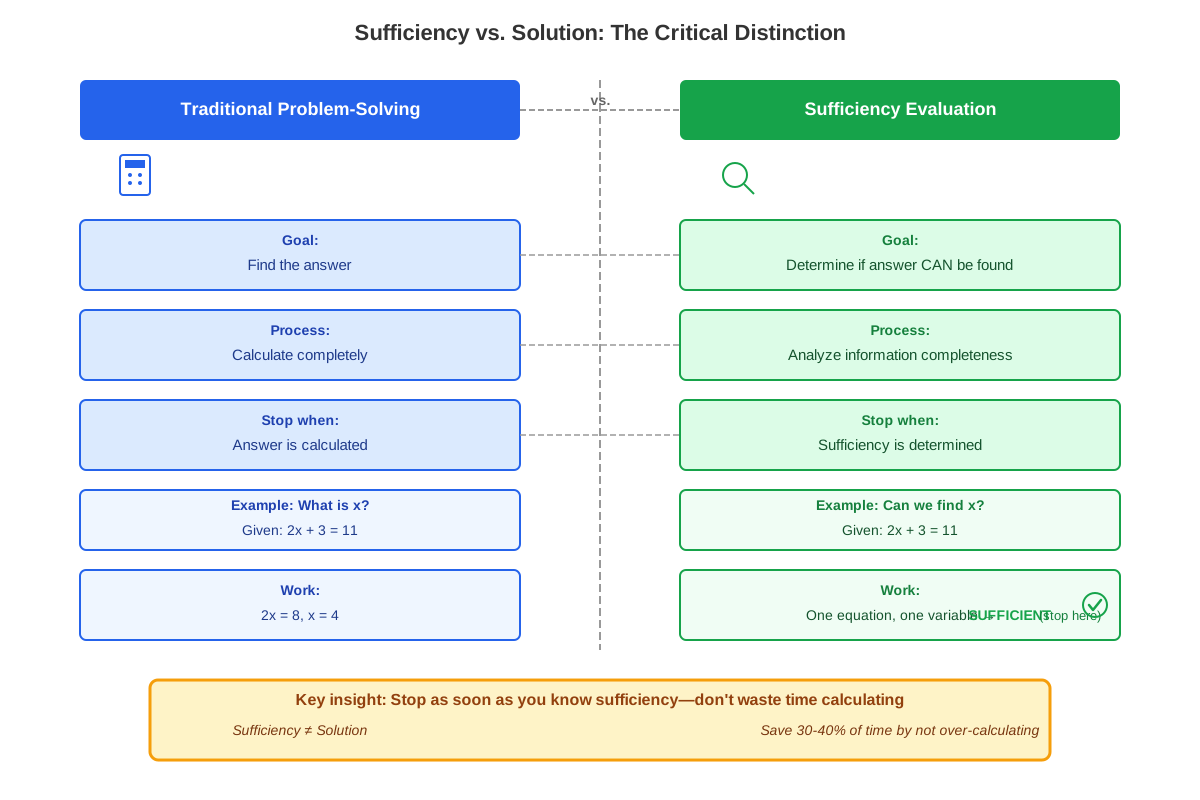
The key insight is that sufficiency does not require actual computation. If you can establish with certainty that a unique answer exists, the information is sufficient, even if calculating that answer would take several minutes. Conversely, if you calculate extensively but multiple answers remain possible, the information is insufficient. This distinction makes Data Sufficiency questions fundamentally different from traditional problem-solving: they test logical analysis rather than computational skill.
The Standard Data Sufficiency Format
Every GMAT Data Sufficiency question follows an identical structure:
- Question stem: Poses a specific question, often asking for the value of a variable or whether a certain condition holds
- Statement (1): Provides one piece of information
- Statement (2): Provides a second, independent piece of information
- Five answer choices: Always presented in the same order
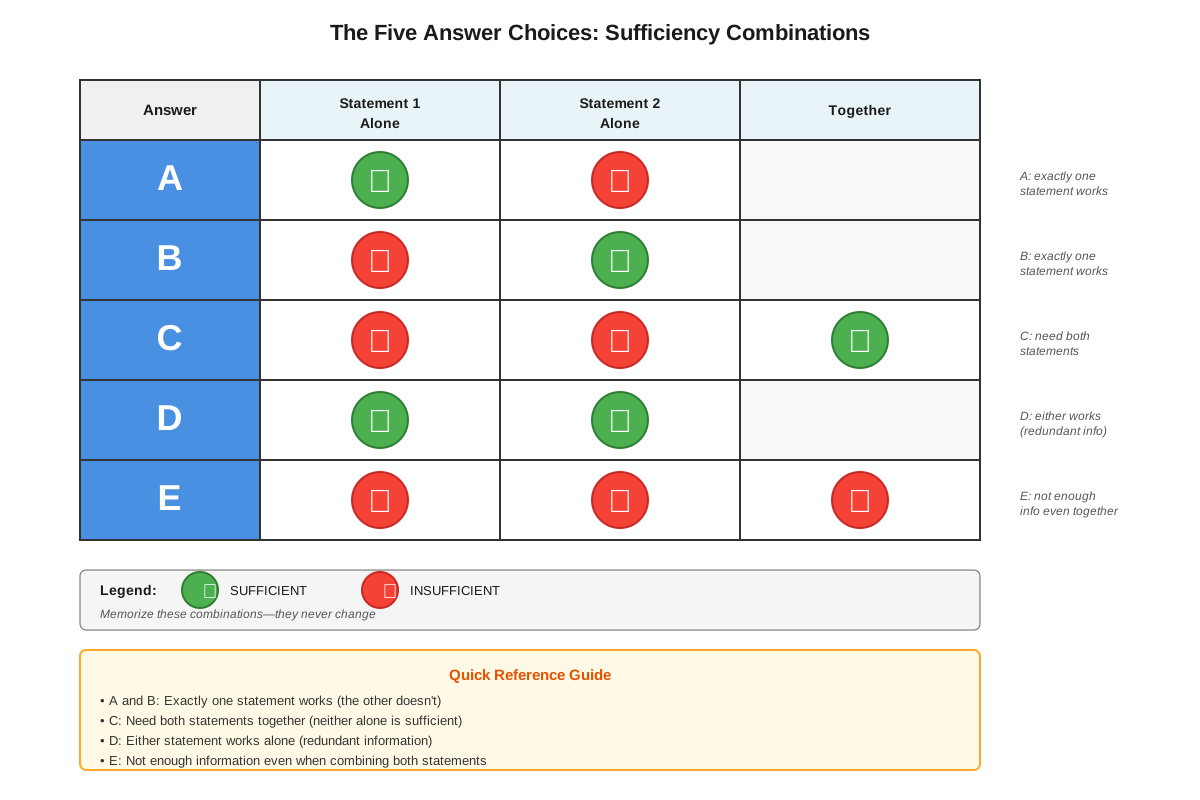
The five answer choices are standardized across all Data Sufficiency questions:
| Answer Choice | Meaning |
|---|---|
| (A) | Statement (1) ALONE is sufficient, but statement (2) alone is not sufficient |
| (B) | Statement (2) ALONE is sufficient, but statement (1) alone is not sufficient |
| (C) | BOTH statements TOGETHER are sufficient, but NEITHER statement ALONE is sufficient |
| (D) | EACH statement ALONE is sufficient |
| (E) | Statements (1) and (2) TOGETHER are NOT sufficient |
Understanding this structure is crucial because it allows for a systematic evaluation process. The answer choices are mutually exclusive and exhaustive—exactly one must be correct for every question.
The AD/BCE Decision Tree
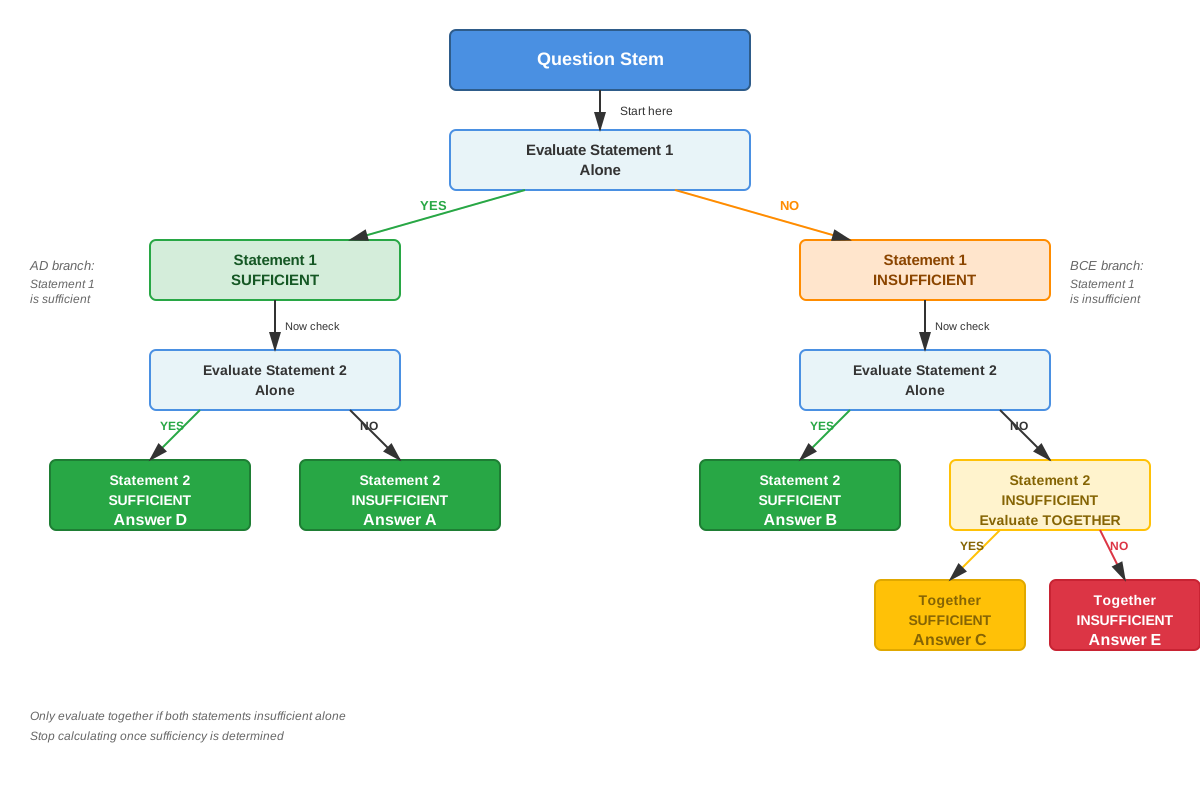
The most efficient approach to Data Sufficiency questions follows a systematic decision tree known as the AD/BCE method:
Step 1: Evaluate Statement (1) alone (ignoring Statement 2 completely)
- If sufficient → Possible answers are A or D
- If insufficient → Possible answers are B, C, or E
Step 2: Evaluate Statement (2) alone (ignoring Statement 1 completely)
- If you're in the AD group:
- If Statement (2) is also sufficient → Answer is D
- If Statement (2) is insufficient → Answer is A
- If you're in the BCE group:
- If Statement (2) is sufficient → Answer is B
- If Statement (2) is insufficient → Must evaluate both together
Step 3: If necessary, evaluate both statements together
- Only reached if both statements individually were insufficient
- If sufficient together → Answer is C
- If insufficient together → Answer is E
This systematic approach prevents the common error of considering statements together prematurely and ensures efficient evaluation without redundant analysis.
Types of Sufficiency
Understanding different categories of sufficiency helps recognize patterns quickly:
Value Sufficiency: The question asks for a specific numerical value. Information is sufficient only if it determines exactly one value. For example, "What is x?" requires pinning down x to a single number, not a range.
Yes/No Sufficiency: The question asks whether a condition holds (e.g., "Is x > 5?"). Information is sufficient if it definitively answers "yes" or definitively answers "no." Crucially, a definite "no" is just as sufficient as a definite "yes"—many students mistakenly think they need a "yes" answer.
Relationship Sufficiency: The question asks about a relationship between variables. Information is sufficient if it establishes the relationship definitively, even if individual values remain unknown.
Combining Information: The Together Case
When evaluating statements together (the potential C answer), students must consider all information from both statements simultaneously. Key principles include:
- No contradiction assumption: The GMAT guarantees that the two statements never contradict each other, so any apparent contradiction indicates an error in reasoning
- Complete information: Use everything from both statements; don't accidentally drop information
- No new assumptions: Don't introduce information not present in either statement
- Redundancy recognition: Sometimes statements provide overlapping information that doesn't add sufficiency
The combined case often involves solving systems of equations, applying multiple constraints simultaneously, or using one statement to narrow possibilities and the other to select among them.
Sufficiency vs. Solving
A critical distinction that separates efficient test-takers from those who struggle with time management is recognizing when to stop analyzing. Once sufficiency is established, further calculation wastes time. For example:
- Question: What is the value of x?
- Statement: 3x + 7 = 22
The moment you recognize this is a linear equation with one variable, you know it's sufficient—you don't need to solve for x = 5. This discipline saves 15-30 seconds per question, accumulating to several minutes over the section.
Conversely, extensive calculation that doesn't establish sufficiency is wasted effort. If after manipulation you still have "x could be 2 or 3," the statement is insufficient regardless of how much algebra you performed.
Concept Relationships
Sufficiency logic serves as the meta-framework that governs how all other quantitative and analytical concepts are applied in Data Sufficiency contexts. The relationship flows as follows:
Sufficiency Logic → Algebraic Reasoning: Sufficiency logic determines when algebraic information is adequate. For instance, understanding that two distinct linear equations in two variables are sufficient to solve for both variables, while one equation is insufficient, directly applies sufficiency logic to algebra.
Sufficiency Logic → Number Properties: Recognizing that "x is a positive even integer less than 10" sufficiently constrains x to {2, 4, 6, 8} but doesn't determine a unique value requires both sufficiency logic and number properties knowledge.
Sufficiency Logic ↔ Logical Reasoning: These are bidirectional—sufficiency logic is a specific application of logical reasoning, while general logical reasoning skills (necessary vs. sufficient conditions, contrapositive reasoning) enhance sufficiency analysis.
Question Stem Analysis → Statement Evaluation → Sufficiency Determination: This represents the procedural flow within each question. The question stem defines what "sufficient" means for that specific question, statement evaluation gathers the relevant information, and sufficiency determination applies the logic to reach a conclusion.
Individual Statement Analysis → Combined Statement Analysis: The AD/BCE method creates a dependency where combined analysis only occurs if individual analysis proves insufficient, creating an efficient conditional relationship.
The integration with other Data Insights topics occurs when those topics provide the content while sufficiency logic provides the analytical framework. For example, in table analysis questions, sufficiency logic determines whether the table contains adequate information to answer specific questions about the data.
Quick check — test yourself on Sufficiency logic so far.
Try Flashcards →High-Yield Facts
⭐ Sufficiency does not require calculation—once you know a unique answer exists, stop working
⭐ A definite "no" is sufficient for yes/no questions—sufficiency means definiteness, not a positive answer
⭐ The five answer choices are always identical and in the same order for every Data Sufficiency question
⭐ Never evaluate statements together until confirming both are individually insufficient—this is the core of the AD/BCE method
⭐ One equation with one variable is always sufficient to determine that variable's value (assuming it's solvable)
- Two distinct linear equations with two variables are sufficient to solve for both variables
- Statement (1) and Statement (2) never contradict each other on the GMAT—if they seem to, recheck your reasoning
- "Sufficient" means exactly one answer is possible, not that you know what that answer is
- For value questions, a range of possible values indicates insufficiency
- For yes/no questions, "sometimes yes, sometimes no" indicates insufficiency
- The question stem may contain crucial information that combines with statements to establish sufficiency
- Geometric figures are not drawn to scale in Data Sufficiency, so visual estimation is unreliable
- Integer constraints often provide sufficiency where real number constraints would not
- Statements that appear complex may be sufficient through logical reasoning without algebraic manipulation
- The answer "C" (both together sufficient) is not more common than other answers—each appears roughly 20% of the time
Common Misconceptions
Misconception: You must calculate the actual answer to determine sufficiency.
Correction: Sufficiency only requires establishing that a unique answer exists. Once you know you could calculate it (even if it would take time), the information is sufficient. Stop calculating and move to the next evaluation step.
Misconception: For yes/no questions, you need the answer to be "yes" for the statement to be sufficient.
Correction: A definite "no" is equally sufficient. The question "Is x > 10?" is sufficiently answered by information proving x = 5 (definite no) just as much as by information proving x = 15 (definite yes). Sufficiency means definiteness in either direction.
Misconception: If Statement (1) is insufficient, you should immediately consider both statements together.
Correction: Always evaluate Statement (2) alone before considering them together. This is essential to the AD/BCE method and prevents missing that Statement (2) alone might be sufficient (answer B).
Misconception: More complex or longer statements are more likely to be sufficient.
Correction: Sufficiency depends on logical completeness, not statement length. A simple statement like "x = 5" is sufficient for "What is x?" while a paragraph of information might be insufficient if it doesn't pin down the answer.
Misconception: If you can't immediately see how to use a statement, it must be insufficient.
Correction: Some sufficient statements require insight or non-obvious manipulation. Before concluding insufficiency, consider alternative approaches, algebraic rearrangement, or logical implications you might have missed.
Misconception: The statements must be used exactly as written.
Correction: You can and should manipulate statements algebraically, take contrapositives, consider implications, and rearrange information. The statement provides information, but you must actively work with it.
Misconception: Answer choice C (both together) is the most common answer.
Correction: All five answer choices appear with roughly equal frequency on the GMAT. Don't bias toward or away from any particular answer based on perceived frequency.
Worked Examples
Example 1: Value Question with Algebraic Statements
Question: What is the value of x?
Statement (1): 2x + 3y = 18
Statement (2): x - y = 3
Solution Process:
Step 1: Evaluate Statement (1) alone
Statement (1) gives us one equation with two variables: 2x + 3y = 18
Can we determine a unique value for x? No—we have infinitely many solutions. For example:
- If y = 0, then x = 9
- If y = 2, then x = 6
- If y = 4, then x = 3
Statement (1) alone is insufficient. We're in the BCE group.
Step 2: Evaluate Statement (2) alone
Statement (2) gives us x - y = 3, or equivalently, x = y + 3
Again, one equation with two variables means infinitely many solutions:
- If y = 0, then x = 3
- If y = 1, then x = 4
- If y = 5, then x = 8
Statement (2) alone is insufficient. We must evaluate both together.
Step 3: Evaluate both statements together
Now we have a system of two distinct linear equations with two variables:
- 2x + 3y = 18
- x - y = 3
We know from algebra that two distinct linear equations with two variables have a unique solution (unless they're parallel, which these aren't). We don't need to solve the system—we've established that a unique solution exists.
(For completeness: From equation 2, x = y + 3. Substituting into equation 1: 2(y + 3) + 3y = 18, so 2y + 6 + 3y = 18, thus 5y = 12, and y = 12/5. Then x = 3 + 12/5 = 27/5. But we didn't need to calculate this!)
Both statements together are sufficient.
Answer: C
Learning Objective Connection: This example demonstrates applying sufficiency logic by recognizing when to stop calculating (once we identified a system of two equations with two variables) and systematically using the AD/BCE method.
Example 2: Yes/No Question with Number Properties
Question: Is x an even integer?
Statement (1): 3x is an even integer
Statement (2): x/2 is an integer
Solution Process:
Step 1: Evaluate Statement (1) alone
Statement (1) tells us 3x is even. Let's think about what this means:
- If x were even, then 3x would be even (even × odd = even) ✓
- If x were odd, then 3x would be odd (odd × odd = odd) ✗
Wait—Statement (1) says 3x IS even. This means x cannot be odd (because that would make 3x odd). Therefore, x must be even.
Actually, let's be more careful. What if x isn't an integer at all? The question asks "Is x an even integer?" which is really two questions: (1) Is x an integer? and (2) If so, is it even?
If x = 2/3, then 3x = 2, which is even. But x = 2/3 is not an even integer—it's not even an integer!
So Statement (1) allows x to be either an even integer OR a non-integer. We get "sometimes yes, sometimes no."
Statement (1) alone is insufficient. We're in the BCE group.
Step 2: Evaluate Statement (2) alone
Statement (2) tells us x/2 is an integer. This means x = 2k for some integer k.
If x = 2k where k is an integer, then x is definitely an even integer (by definition of even numbers).
Statement (2) alone is sufficient to answer "yes" definitively.
Answer: B
Learning Objective Connection: This example illustrates identifying sufficiency logic in yes/no questions, where a definite answer (even if it's "no" in some cases) constitutes sufficiency. It also shows the importance of carefully considering all possibilities, including non-integer values.
Exam Strategy
Approach Process:
- Read the question stem carefully: Identify whether it's a value question or yes/no question, and note any constraints or information provided in the stem itself
- Before looking at statements, consider what would be sufficient: Ask yourself, "What type of information would answer this question?" This primes your analytical thinking
- Apply AD/BCE rigorously: Never skip steps or evaluate statements together prematurely
- Stop calculating once sufficiency is determined: This is the single most important time-saving strategy
- For yes/no questions, look for definite answers in either direction: Don't bias toward "yes" answers
Trigger Words and Phrases:
- "What is the value of...": Requires pinning down to exactly one number
- "Is x > y?" or similar comparisons: Yes/no question; definite answer in either direction is sufficient
- "x is an integer": Dramatically constrains possibilities compared to "x is a number"
- "distinct": Indicates non-redundant information (e.g., "two distinct equations")
- "positive": Eliminates half the number line; often crucial for sufficiency
- "consecutive": Provides strong constraints on relationships between numbers
Process of Elimination Tips:
- After evaluating Statement (1), immediately eliminate three answer choices: if sufficient, eliminate B, C, E; if insufficient, eliminate A, D
- This physical or mental elimination prevents backtracking and maintains systematic progress
- If you're unsure about Statement (1), make your best judgment and continue—you can verify by checking if your final answer makes logical sense
- For yes/no questions, if you find even one case where the answer is "yes" and one where it's "no," the statement is insufficient—you don't need to check further
Time Allocation:
- Target 2 minutes per Data Sufficiency question
- Spend 15-20 seconds understanding the question stem
- Spend 30-40 seconds on each statement evaluation
- Spend 20-30 seconds on combined evaluation if needed
- If you're calculating extensively, stop and reconsider—you may be missing a logical shortcut
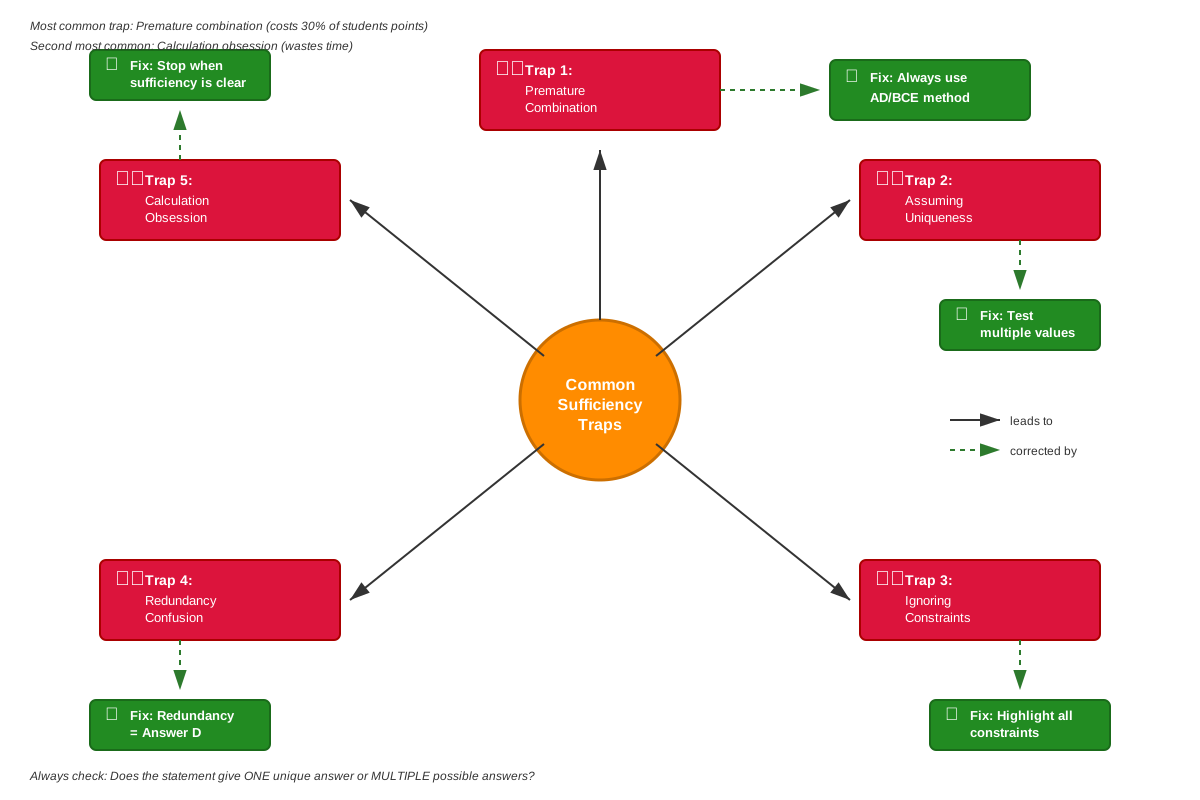
Common Traps to Avoid:
- Don't assume figures are drawn to scale
- Don't carry information from Statement (1) when evaluating Statement (2) alone
- Don't assume variables are positive unless explicitly stated
- Don't confuse "sufficient to determine" with "sufficient to easily calculate"
Memory Techniques
AD/BCE Mnemonic: "Always Decide first, Before Considering Everything"—reminds you to evaluate Statement (1) first, which leads to the AD or BCE path
Answer Choice Mnemonic: "Alone, Balone, Combined, Dual, Either"
- A: Statement 1 alone works
- B: Statement 2 alone works
- C: Combined they work
- D: Dual sufficiency (both alone work)
- E: Either way, not sufficient
Sufficiency Check Visualization: Picture a target with a single bullseye. Sufficient information hits the bullseye exactly. Insufficient information scatters around the target (multiple possibilities). Use this mental image when evaluating statements.
Yes/No Sufficiency Reminder: "Definite Determines Sufficiency" (DDS)—for yes/no questions, a Definite answer (yes or no) Determines Sufficiency
Equation Counting Rule: "Equations Equal Variables" (EEV)—you generally need as many independent Equations as Variables to solve for all values. One equation, one variable = sufficient. Two equations, two variables = sufficient (if independent).
Summary
Sufficiency logic is the analytical framework that enables efficient evaluation of Data Sufficiency questions on the GMAT. Rather than solving for specific answers, this approach focuses on determining whether given information is adequate to answer a question definitively. The systematic AD/BCE method provides a decision tree: evaluate Statement (1) alone to determine if possible answers are AD or BCE, then evaluate Statement (2) alone to narrow further, and only evaluate both together if both individually proved insufficient. Critical distinctions include recognizing that sufficiency doesn't require calculation (only establishing that a unique answer exists), understanding that definite "no" answers are sufficient for yes/no questions, and avoiding premature combination of statements. Mastery requires disciplined application of the systematic approach, recognition of when to stop calculating, and careful attention to constraints like integer requirements or positive value specifications that often determine sufficiency. This topic represents one of the highest-yield areas for GMAT preparation because it appears in 30-40% of quantitative questions and rewards logical analysis over computational effort, creating opportunities for both improved accuracy and time efficiency.
Key Takeaways
- Sufficiency means definiteness, not calculation—stop working once you establish a unique answer exists
- The AD/BCE method is non-negotiable—evaluate Statement (1) alone first, then Statement (2) alone, then together only if necessary
- For yes/no questions, "definitely yes" and "definitely no" are equally sufficient—don't bias toward positive answers
- Never consider statements together until confirming both are individually insufficient—this prevents missing simpler sufficient statements
- One equation with one variable is always sufficient; two independent equations with two variables are always sufficient
- The five answer choices are standardized and appear with roughly equal frequency—don't develop answer choice biases
- Time efficiency comes from stopping calculation at sufficiency determination—this discipline separates high scorers from average performers
Related Topics
Systems of Equations: Understanding when systems are solvable (sufficient) vs. underdetermined (insufficient) directly applies sufficiency logic to algebraic contexts. Mastering sufficiency logic provides the framework for quickly evaluating equation systems without solving them.
Number Properties and Constraints: Integer constraints, positive/negative specifications, and divisibility rules often determine sufficiency. Deeper study of number properties enhances the ability to recognize when constraints narrow possibilities to unique values.
Geometric Sufficiency: Determining what information defines unique geometric figures (e.g., what determines a unique triangle or circle) represents a specialized application of sufficiency logic requiring geometric knowledge.
Inequality Analysis: Understanding when inequalities provide sufficient constraints to answer comparison questions extends sufficiency logic to non-equality relationships.
Statistical Sufficiency: Determining whether data sets contain adequate information to calculate means, medians, standard deviations, or other statistics applies sufficiency logic to data analysis contexts.
Practice CTA
Now that you understand the principles of sufficiency logic, the next crucial step is application. Attempt the practice questions associated with this topic to reinforce the AD/BCE method and develop the discipline to stop calculating at sufficiency determination. Each practice question provides an opportunity to strengthen your systematic approach and build the pattern recognition that leads to rapid, accurate evaluation. The flashcards will help cement the key distinctions and trigger words that appear repeatedly on the GMAT. Remember: sufficiency logic is a skill that improves dramatically with deliberate practice—each question you analyze systematically builds the mental framework that will serve you throughout the Data Insights section. Your investment in mastering this high-yield topic will pay dividends across 30-40% of your GMAT questions!
Sign up free to keep reading
Create a free AnvayaPrep account to finish this GMAT guide on Sufficiency logic — plus flashcards and practice questions.