Overview
Testing values is one of the most powerful and frequently used strategies in GMAT Data Sufficiency questions. This technique involves strategically selecting specific numbers to substitute into algebraic expressions or inequalities to determine whether a statement provides sufficient information to answer a question. Rather than attempting to solve problems algebraically—which can be time-consuming and error-prone—GMAT testing values allows test-takers to quickly evaluate the sufficiency of given statements by examining concrete examples.
The testing values approach is particularly valuable in Data Sufficiency because these questions don't require you to find the actual answer; you only need to determine whether enough information exists to find a unique answer. By choosing smart test values—including positive and negative numbers, fractions, zero, and one—you can often expose insufficiency in seconds. This strategy transforms abstract algebraic relationships into tangible numerical scenarios that are easier to evaluate under time pressure.
Within the broader Data Insights section, testing values serves as a bridge between pure algebraic manipulation and logical reasoning. It complements other Data Sufficiency strategies such as statement combination analysis and sufficiency pattern recognition. Mastering this technique is essential because it appears across multiple question types, including those involving inequalities, absolute values, even/odd properties, and algebraic expressions. Students who become proficient at testing values typically see significant score improvements in the Quantitative and Data Insights sections.
Learning Objectives
- [ ] Identify when testing values is the most efficient strategy for a Data Sufficiency question
- [ ] Explain the logical foundation of testing values and why it reveals sufficiency or insufficiency
- [ ] Apply testing values systematically to GMAT questions involving algebraic expressions and inequalities
- [ ] Select strategic test values (including edge cases) that efficiently expose insufficiency
- [ ] Distinguish between situations where testing values is superior to algebraic approaches
- [ ] Recognize patterns in answer choices that signal the need for testing values
- [ ] Evaluate multiple test cases to confirm or refute statement sufficiency
Prerequisites
- Basic algebra: Understanding variables, expressions, and equation manipulation is essential because testing values requires substituting numbers into algebraic expressions
- Integer properties: Knowledge of positive/negative numbers, even/odd integers, and zero is necessary for selecting appropriate test values
- Data Sufficiency format: Familiarity with the unique answer choice structure (A/B/C/D/E) and the concept of sufficiency versus solving is required
- Inequality operations: Understanding how inequalities behave with different operations helps predict which test values will be most revealing
- Fraction and decimal operations: Competence with non-integer values is needed since these often serve as critical test cases
Why This Topic Matters
Testing values represents a fundamental shift in problem-solving approach that distinguishes high-scoring GMAT test-takers from average performers. In real-world business and analytical contexts, professionals frequently need to evaluate whether available data is sufficient for decision-making without necessarily computing exact answers—precisely the skill Data Sufficiency questions assess.
On the GMAT, approximately 40-50% of Data Sufficiency questions can be efficiently solved or verified using testing values. This technique appears most frequently in questions involving:
- Algebraic inequalities and expressions
- Questions asking "Is x > 0?" or similar comparative queries
- Problems involving absolute values
- Even/odd and positive/negative property questions
- Percentage and ratio sufficiency problems
The GMAT specifically designs Data Sufficiency questions to reward strategic thinking over computational prowess. Questions that appear algebraically complex often become straightforward when approached with well-chosen test values. Furthermore, testing values serves as an excellent verification method even when algebraic solutions seem clear, helping catch subtle errors that could cost valuable points. The ability to quickly test values and recognize patterns of sufficiency or insufficiency can save 30-45 seconds per question—time that accumulates significantly across the exam.
Core Concepts
The Fundamental Principle of Testing Values
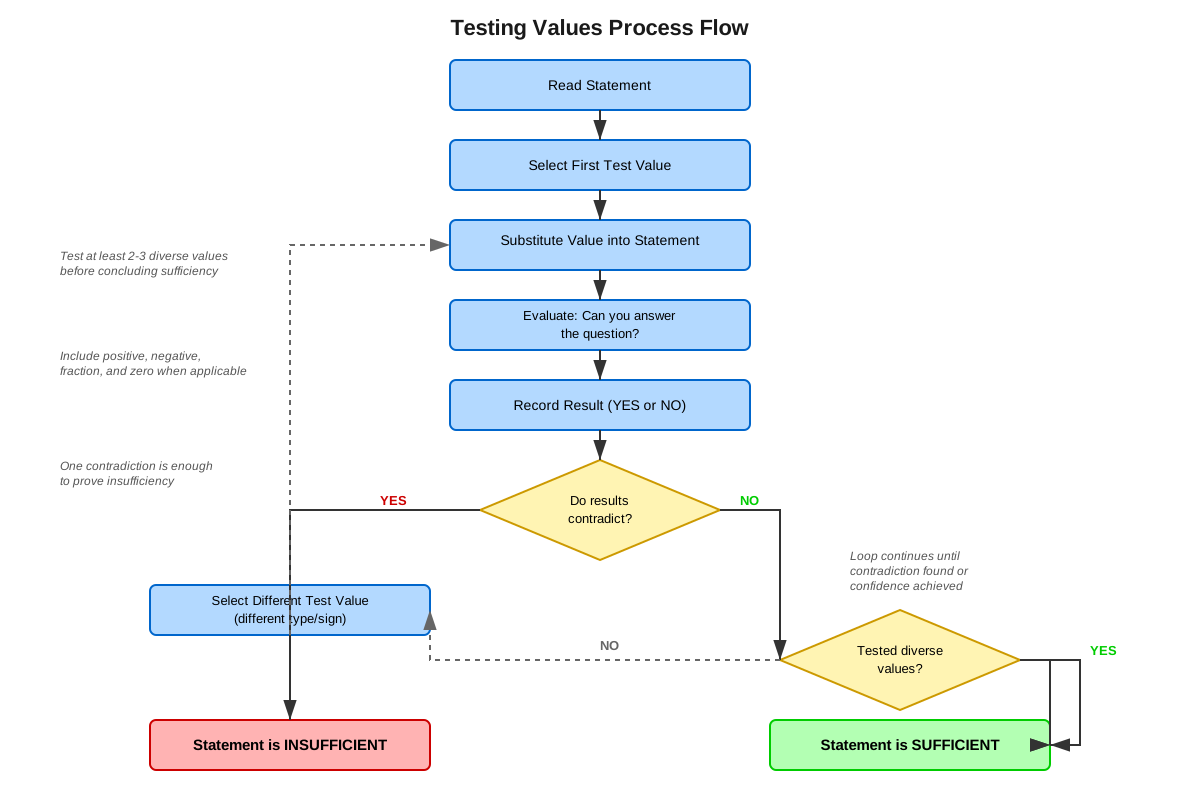
The core logic behind testing values rests on a simple principle: if a statement is sufficient, it must lead to the same answer regardless of which valid values you test. Conversely, if you can find two different valid values that produce different answers to the question, the statement is insufficient. This approach transforms the abstract question "Is there enough information?" into the concrete task "Can I find values that give different results?"
When applying testing values, you're essentially conducting a logical experiment. Each test value represents a hypothesis about what the data allows. If all your test values consistently point to "yes" or consistently point to "no," the statement is likely sufficient. If some values yield "yes" while others yield "no," you've proven insufficiency.
Strategic Selection of Test Values
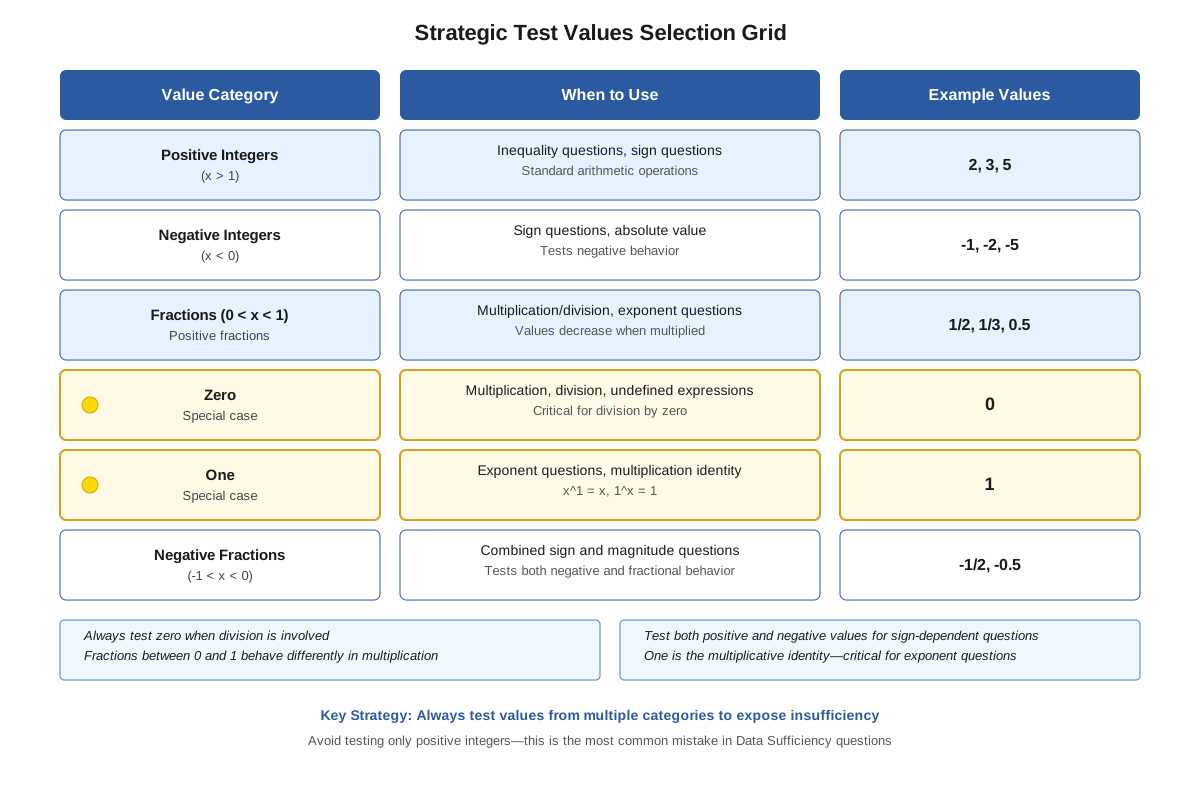
Not all test values are equally useful. Strategic test value selection involves choosing numbers that are most likely to expose insufficiency or confirm sufficiency quickly. The most powerful test values include:
| Test Value Type | When to Use | Why It's Powerful |
|---|---|---|
| Positive integers | First test for most questions | Easiest to calculate with; establishes baseline |
| Negative integers | Questions involving multiplication, division, or inequalities | Sign changes can reverse inequality directions |
| Zero | Almost always test when allowed | Unique properties (neither positive nor negative; multiplication yields zero) |
| One | Questions involving exponents or multiplication | Identity properties can reveal special cases |
| Fractions (0 < x < 1) | Questions about size comparisons or exponents | Squaring makes smaller; reciprocals become larger |
| Fractions (x > 1) | Similar contexts as above | Opposite behavior from fractions less than 1 |
| Negative fractions | Complex inequality questions | Combines properties of negatives and fractions |
The Testing Values Process
A systematic approach to testing values follows these steps:
- Read the question stem carefully to understand what specific question is being asked (e.g., "Is x > 5?" or "What is the value of x?")
- Analyze each statement independently (for Statement 1 and Statement 2) to identify constraints on the variables
- Select your first test value based on the constraints, typically starting with simple positive integers
- Calculate the result and note whether it answers the question as "yes," "no," or provides a specific value
- Select a contrasting test value that still satisfies the statement's constraints but differs in key properties (sign, magnitude, integer vs. fraction)
- Compare results: If both values give the same answer type, test one more value to increase confidence; if they give different answers, the statement is insufficient
- For combined statements (C), test values that satisfy both constraints simultaneously
Recognizing When to Test Values
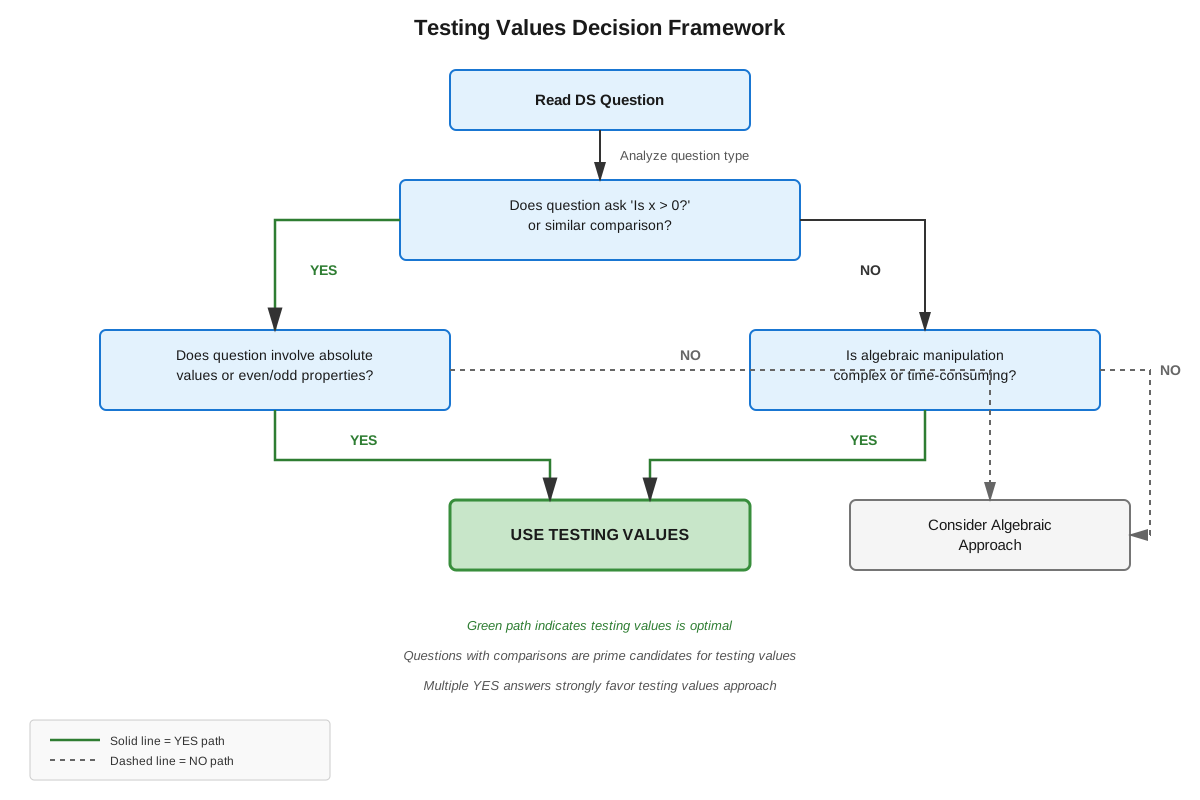
Certain question characteristics signal that testing values will be more efficient than algebra:
- Questions asking "Is x positive?" or similar yes/no questions about properties
- Statements containing inequalities rather than equations
- Multiple variables with no clear path to isolation
- Absolute value expressions that create multiple cases
- Even/odd or positive/negative property questions
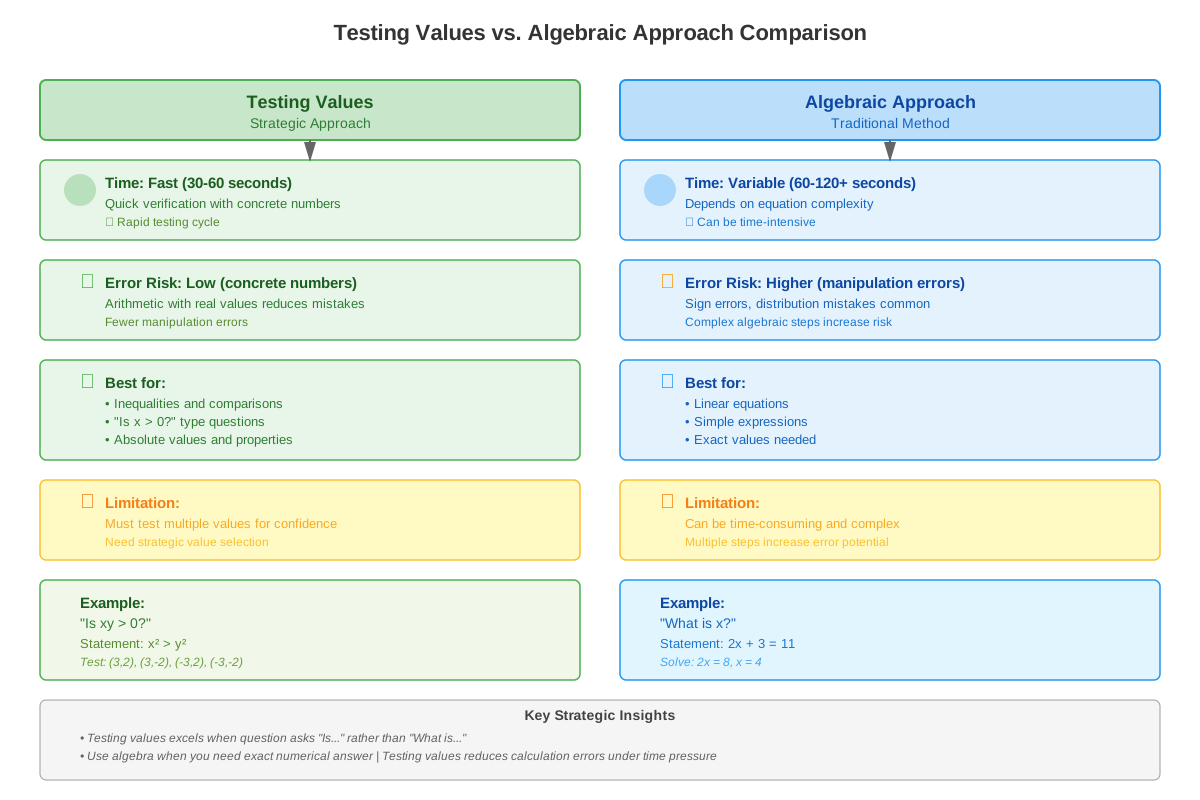
- Questions where algebraic manipulation seems complex or time-consuming
Conversely, testing values may be less efficient when:
- Statements provide equations with a single variable that can be easily solved
- The question asks for a specific numerical value and statements provide direct equations
- The algebra is straightforward and leads to a clear answer in 15-20 seconds
Edge Cases and Boundary Values
Edge cases are values at the boundaries of allowed ranges or with special mathematical properties. These are disproportionately likely to expose insufficiency:
- Zero: When testing inequalities like x > 0, zero sits at the boundary
- One: The multiplicative identity; x¹ = x, which can behave differently than other exponents
- Negative one: Combines properties of negatives with the magnitude of one
- Very large and very small values: Can reveal behavior at extremes
- Boundary values of given ranges: If a statement says 2 < x < 10, test values near 2 and near 10
Common Testing Values Patterns
Through extensive GMAT practice, certain patterns emerge:
Pattern 1: Sign Ambiguity
When a statement allows both positive and negative values for a variable, and the question asks about sign or comparison to zero, the statement is typically insufficient.
Pattern 2: Magnitude Ambiguity
When a statement constrains a variable to a range (e.g., x > 3) but the question requires a specific value, the statement is insufficient unless additional constraints narrow it to one value.
Pattern 3: Fraction vs. Integer Behavior
Questions involving squaring, reciprocals, or comparisons often hinge on whether values are fractions between 0 and 1 versus integers greater than 1.
Concept Relationships
Testing values connects intimately with several other Data Sufficiency concepts. The technique builds directly on algebraic manipulation skills—you must understand what values are permitted by a statement's constraints before you can test them. It also relies heavily on number properties knowledge, since selecting strategic test values requires understanding how different types of numbers (positive, negative, fractions, zero) behave in various operations.
The relationship flows as follows: Algebraic constraints → define the domain of possible values → strategic test value selection → calculation and comparison → sufficiency determination. This process often works in parallel with statement combination analysis, where you first test each statement independently, then test values that satisfy both statements together to evaluate option C.
Testing values also connects to inequality reasoning. When statements contain inequalities, testing values helps visualize the range of possibilities and whether that range is narrow enough to answer the question. Additionally, the technique interfaces with logical reasoning in Data Sufficiency: each test value represents a logical case, and finding contradictory cases proves insufficiency through counterexample.
The strategy serves as both a primary solving method and a verification tool for algebraic solutions. Even when algebra seems to provide a clear answer, testing a few values can confirm your work and catch errors in sign manipulation or inequality reversal.
High-Yield Facts
- ⭐ If you can find two valid test values that produce different answers to the question, the statement is definitively insufficient
- ⭐ Always test zero when it's allowed by the constraints—it has unique properties that frequently expose insufficiency
- ⭐ Test both positive and negative values when the statement doesn't restrict sign—sign differences often determine sufficiency
- ⭐ Fractions between 0 and 1 behave oppositely to integers greater than 1 when squared or used as exponents
- ⭐ Testing values is most powerful for yes/no questions rather than "what is the value" questions
- Testing three strategically chosen values (positive, negative, and zero or fraction) typically reveals insufficiency if it exists
- When statements involve inequalities, test values at the boundaries and in the middle of the allowed range
- For combined statements (evaluating C), only test values that satisfy both constraints simultaneously
- If a statement provides an equation with one variable, algebra is usually faster than testing values
- Testing values works equally well for verifying that a statement IS sufficient—if all valid test values give the same answer, sufficiency is likely
- Negative fractions (like -1/2) combine properties of both negatives and fractions, making them powerful test cases
- When testing values for Statement 2, ignore Statement 1 completely—evaluate each independently first
- The number 1 is particularly revealing for questions involving exponents, since x¹ = x for all x
- If the question asks "Is xy > 0?", test cases where both are positive, both are negative, and one of each sign
- Testing values can save significant time on questions that would require complex algebraic manipulation
Quick check — test yourself on Testing values so far.
Try Flashcards →Common Misconceptions
Misconception: Testing one or two values that give the same answer proves a statement is sufficient.
Correction: Testing values can prove insufficiency (by finding contradictory cases) but cannot definitively prove sufficiency. To confirm sufficiency through testing, you need to test comprehensively across different types of values (positive, negative, fractions, zero) and ensure all give consistent answers. However, algebraic reasoning is more reliable for proving sufficiency.
Misconception: You should always start testing with the number 2 or another small positive integer.
Correction: While small positive integers are often a good starting point, the most strategic first test value depends on the question. For questions about sign, start with a positive and negative value. For questions involving exponents or multiplication, consider starting with 1 or 0. Strategic selection based on question type is more important than always using the same starting value.
Misconception: If testing values seems to take too long, the approach must be wrong for that question.
Correction: Testing values should typically take 30-60 seconds for most questions. If it's taking longer, you may be testing too many values or calculating unnecessarily complex numbers. Choose simpler test values (like 2, -2, 0, 1, 1/2) that make arithmetic easy, and remember you only need to find one contradictory case to prove insufficiency.
Misconception: When evaluating Statement 1 and Statement 2 together (option C), you should test the same values you used for each individual statement.
Correction: When evaluating combined statements, you must test values that satisfy both constraints simultaneously. The values that worked for Statement 1 alone might not satisfy Statement 2's constraints, and vice versa. You need to find values in the intersection of both statements' allowed ranges.
Misconception: Testing values only works for algebra questions, not for word problems.
Correction: Testing values is equally powerful for Data Sufficiency word problems involving rates, percentages, ratios, and other quantitative relationships. Translate the word problem into mathematical constraints, then test values within those constraints just as you would for pure algebra questions.
Misconception: If a statement gives an inequality like x > 5, you only need to test one value greater than 5 to determine sufficiency.
Correction: An inequality defines a range of infinite values. If the question asks for a specific value of x, one test value cannot prove sufficiency—you need to recognize that infinitely many values satisfy x > 5, so the statement is insufficient for determining a unique value. However, if the question asks "Is x > 3?", then x > 5 is sufficient because all values greater than 5 are also greater than 3.
Misconception: Decimal values like 1.5 or 2.7 are good test values.
Correction: While decimals are valid, they often make arithmetic more cumbersome without providing additional insight. Simple fractions (1/2, 1/3, 3/2) or integers are usually more efficient test values that reveal the same patterns with easier calculations.
Worked Examples
Example 1: Sign and Magnitude Question
Question: Is x² > x?
Statement 1: x > 0
Statement 2: x ≠ 1
Solution using Testing Values:
First, understand what the question asks: We need to determine whether x squared is greater than x itself.
Evaluating Statement 1: x > 0
Let's test positive values since that's what the statement allows:
Test value 1: x = 2
- x² = 4
- Is 4 > 2? Yes
Test value 2: x = 1/2
- x² = 1/4
- Is 1/4 > 1/2? No (since 1/4 = 0.25 and 1/2 = 0.5)
We found two values that satisfy Statement 1 (both are positive) but give different answers to the question. With x = 2, the answer is "yes." With x = 1/2, the answer is "no."
Statement 1 is INSUFFICIENT.
Evaluating Statement 2: x ≠ 1
This statement allows any value except 1, including positive, negative, fractions, and zero.
Test value 1: x = 2
- x² = 4
- Is 4 > 2? Yes
Test value 2: x = 0
- x² = 0
- Is 0 > 0? No
Again, we found contradictory results. Statement 2 is INSUFFICIENT.
Evaluating Statements 1 and 2 Together:
Combined constraints: x > 0 AND x ≠ 1
Test value 1: x = 2 (satisfies both: positive and not equal to 1)
- x² = 4
- Is 4 > 2? Yes
Test value 2: x = 1/2 (satisfies both: positive and not equal to 1)
- x² = 1/4
- Is 1/4 > 1/2? No
Even together, the statements allow contradictory cases. Combined statements are INSUFFICIENT.
Answer: E (Neither statement alone nor both together are sufficient)
Key insight: This question hinges on understanding that x² > x when x > 1 or x < 0, but x² < x when 0 < x < 1. The fraction test value was crucial for exposing this behavior.
Example 2: Product Sign Question
Question: Is the product abc positive?
Statement 1: ab > 0
Statement 2: bc > 0
Solution using Testing Values:
The question asks about the sign of a three-variable product.
Evaluating Statement 1: ab > 0
For a product to be positive, either both factors are positive or both are negative.
Test case 1: a = 2, b = 3, c = 1
- ab = 6 > 0 ✓ (satisfies statement)
- abc = 6 (positive)
- Answer to question: Yes
Test case 2: a = 2, b = 3, c = -1
- ab = 6 > 0 ✓ (satisfies statement)
- abc = -6 (negative)
- Answer to question: No
Statement 1 tells us nothing about c, so we can make abc positive or negative. Statement 1 is INSUFFICIENT.
Evaluating Statement 2: bc > 0
Test case 1: a = 1, b = 2, c = 3
- bc = 6 > 0 ✓ (satisfies statement)
- abc = 6 (positive)
- Answer: Yes
Test case 2: a = -1, b = 2, c = 3
- bc = 6 > 0 ✓ (satisfies statement)
- abc = -6 (negative)
- Answer: No
Statement 2 tells us nothing about a. Statement 2 is INSUFFICIENT.
Evaluating Statements 1 and 2 Together:
Combined: ab > 0 AND bc > 0
From ab > 0: either (a > 0 and b > 0) or (a < 0 and b < 0)
From bc > 0: either (b > 0 and c > 0) or (b < 0 and c < 0)
Test case 1: a = 2, b = 3, c = 4
- ab = 6 > 0 ✓
- bc = 12 > 0 ✓
- abc = 24 (positive)
- Answer: Yes
Test case 2: a = -2, b = -3, c = -4
- ab = 6 > 0 ✓
- bc = 12 > 0 ✓
- abc = -24 (negative)
- Answer: No
Both test cases satisfy both statements, but give different answers. Combined statements are INSUFFICIENT.
Answer: E
Key insight: This problem demonstrates that even when statements seem to provide significant constraints, testing values can reveal hidden ambiguities. The all-negative case was the critical test that exposed insufficiency.
Exam Strategy
When approaching GMAT Data Sufficiency questions, develop a systematic decision framework for when to employ testing values:
Trigger Words and Phrases:
- "Is x positive/negative?"
- "Is x > y?"
- "Is the product/sum positive?"
- "Is x even/odd?"
- Any question with absolute values
- Statements containing inequalities (>, <, ≥, ≤) rather than equations
Strategic Approach:
- Spend 10-15 seconds assessing whether testing values or algebra will be faster. If the algebraic path seems complex or involves multiple cases, choose testing values.
- For each statement, test 2-3 strategically different values: Start with a simple positive integer, then test a contrasting value (negative, fraction, or zero). If these give the same answer, test one more to increase confidence.
- Use simple numbers: Favor 2, -2, 1, -1, 0, 1/2, and -1/2. These make arithmetic fast and are sufficient to expose most insufficiencies.
- Track your results systematically: Write down each test value and its result (Yes/No or the calculated value). This prevents confusion and helps you see patterns.
- For combined statements, be careful: Only test values that satisfy BOTH constraints simultaneously. Don't assume values that worked for Statement 1 will work for the combination.
Process of Elimination Tips:
- If you find contradictory test values for Statement 1, immediately eliminate A and D
- If you find contradictory test values for Statement 2, immediately eliminate B and D
- If both statements individually are insufficient but you're running short on time, make an educated guess between C and E based on whether the statements seem to complement each other
Time Allocation:
- Initial assessment and question understanding: 15 seconds
- Testing Statement 1: 30-45 seconds
- Testing Statement 2: 30-45 seconds
- Testing combined (if needed): 30-45 seconds
- Total target time: 2 minutes or less
If you find yourself spending more than 2.5 minutes, make your best guess and move on. Testing values should accelerate your solving, not slow it down.
Memory Techniques
ZERO-FUN Mnemonic for essential test values:
- Zero (0)
- Even positive (2)
- Reciprocal/fraction (1/2)
- One (1)
- Fraction greater than 1 (3/2)
- Unit negative (-1)
- Negative integer (-2)
The "PNF-Z" Visualization: Picture a number line with four key regions to test:
- Positive integers (right side, far from zero)
- Negative integers (left side, far from zero)
- Fractions between -1 and 1 (close to zero on both sides)
- Zero (the center point)
"Same Answer = Sufficient" Rhyme: When all your test values give the same answer, sufficiency is likely at hand. When answers differ, insufficiency is clear.
The "Boundary Hunter" Strategy: Remember to hunt at boundaries—test values at the edges of allowed ranges, not just in the middle. Boundaries are where insufficiency hides.
CASE Acronym for systematic testing:
- Choose a simple first value
- Analyze the result
- Select a contrasting value
- Evaluate for consistency
Summary
Testing values is an indispensable strategy for GMAT Data Sufficiency questions that transforms abstract algebraic problems into concrete numerical evaluations. The technique's power lies in its ability to quickly prove insufficiency by finding contradictory cases—two valid values that produce different answers to the question. Strategic test value selection is crucial: always consider positive and negative integers, zero, one, and fractions between 0 and 1, as these values have distinct mathematical properties that frequently expose hidden insufficiencies. The systematic process involves testing each statement independently with 2-3 contrasting values, then testing combined statements with values that satisfy both constraints simultaneously. While testing values can suggest sufficiency when all tested values give consistent answers, it definitively proves insufficiency when contradictory cases emerge. This approach is most powerful for yes/no questions involving inequalities, sign determination, and property questions, though it applies broadly across Data Sufficiency question types. Mastery requires practice in selecting strategic values quickly, performing efficient calculations, and recognizing patterns that signal when testing values will be more efficient than algebraic manipulation.
Key Takeaways
- Testing values proves insufficiency definitively by finding contradictory cases, but only suggests sufficiency when all tested values align
- Always test zero, positive values, negative values, and fractions (especially between 0 and 1) when constraints allow
- If two valid test values produce different answers to the question, the statement is insufficient—no further testing needed
- Testing values is most efficient for yes/no questions with inequalities, sign questions, and problems involving absolute values
- When evaluating combined statements (option C), only test values that satisfy both constraints simultaneously
- Strategic test value selection (simple numbers like 2, -2, 1, 0, 1/2) makes calculations fast and reveals patterns efficiently
- The technique should take 30-60 seconds per statement; if it's taking longer, simplify your test values or reconsider your approach
Related Topics
Inequality Manipulation: Understanding how inequalities behave under various operations (multiplication by negatives, taking reciprocals) enhances your ability to predict which test values will be most revealing and helps verify your testing values results algebraically.
Number Properties (Even/Odd, Positive/Negative): Deep knowledge of how different number types behave in operations directly improves test value selection and helps you recognize which properties are being tested in each question.
Absolute Value Concepts: Testing values is particularly powerful for absolute value questions, which often create multiple cases. Mastering absolute value behavior helps you choose test values that efficiently explore all cases.
Statement Combination Analysis: This advanced Data Sufficiency skill involves understanding how statements interact and when their combination provides sufficiency. Testing values serves as the primary tool for evaluating combined statements.
Algebraic Manipulation: While testing values often replaces algebra, understanding algebraic solutions helps you verify your testing values results and recognize when algebra might be faster for certain question types.
Practice CTA
Now that you understand the testing values strategy, it's time to cement your mastery through deliberate practice. Work through the practice questions systematically, applying the CASE framework and testing strategic values for each statement. Pay special attention to questions where your initial instinct was to use algebra—these often provide the greatest learning opportunities when solved with testing values. Use the flashcards to reinforce your memory of strategic test values and common patterns. Remember, testing values is a skill that improves dramatically with practice; each question you solve builds pattern recognition that makes future questions faster and easier. Your investment in mastering this technique will pay dividends throughout the Data Insights section and significantly boost your GMAT score. Start practicing now!
Sign up free to keep reading
Create a free AnvayaPrep account to finish this GMAT guide on Testing values — plus flashcards and practice questions.