Overview
Word problems DS (Data Sufficiency word problems) represent one of the most challenging and frequently tested question types in the GMAT Data Insights section. These questions combine the analytical rigor of Data Sufficiency with the real-world context of word problems, requiring test-takers to translate verbal descriptions into mathematical relationships and then determine whether given information is sufficient to answer a specific question. Unlike traditional Problem Solving questions that require calculating a definitive answer, GMAT word problems DS demand that students evaluate the adequacy of information without necessarily solving for exact values.
The complexity of word problems DS stems from their multi-layered nature: students must first comprehend the scenario presented in plain language, identify the relevant variables and relationships, formulate the question being asked, and then systematically evaluate whether each statement (alone or combined) provides sufficient information to answer that question. This process tests reading comprehension, logical reasoning, mathematical translation, and strategic thinking simultaneously—making it a comprehensive assessment of quantitative reasoning abilities.
Within the broader Data Insights framework, word problems DS serve as a bridge between pure mathematical reasoning and practical application. They appear across various mathematical domains including algebra, arithmetic, geometry, and statistics, often incorporating multiple concepts within a single question. Mastering this topic is essential not only for achieving a competitive GMAT score but also for developing the analytical skills necessary for business school coursework and real-world problem-solving in management contexts.
Learning Objectives
- [ ] Identify Word problems DS question types and distinguish them from other Data Sufficiency formats
- [ ] Explain the systematic approach to analyzing word problems DS, including variable identification and relationship mapping
- [ ] Apply Word problems DS strategies to GMAT questions across various mathematical domains
- [ ] Translate verbal descriptions into mathematical equations and inequalities efficiently
- [ ] Evaluate statement sufficiency without performing unnecessary calculations
- [ ] Recognize common trap patterns and misleading information in word problems DS
- [ ] Integrate multiple mathematical concepts within a single word problem DS context
Prerequisites
- Basic Data Sufficiency format and answer choices: Understanding the five standard DS answer choices (A, B, C, D, E) is fundamental to evaluating statement sufficiency in any context
- Algebraic manipulation and equation solving: Word problems require translating scenarios into equations, making algebraic fluency essential for proper setup
- Arithmetic operations and number properties: Many word problems involve rates, ratios, percentages, and integer properties that require solid arithmetic foundations
- Reading comprehension skills: Extracting relevant information from verbal descriptions is the first critical step in approaching any word problem
- Logical reasoning: Data Sufficiency inherently tests the ability to evaluate logical relationships between given information and required conclusions
Why This Topic Matters
Word problems DS questions constitute approximately 30-40% of all Data Sufficiency questions on the GMAT, making them one of the highest-yield areas for focused preparation. The GMAT uses word problems to assess whether candidates can apply mathematical reasoning to business-relevant scenarios—a skill directly applicable to case studies, financial analysis, and strategic decision-making in MBA programs and professional settings.
In real-world business contexts, managers rarely encounter problems presented as pure equations. Instead, they must extract quantitative relationships from verbal descriptions, determine what information is needed to make decisions, and recognize when they have sufficient data to proceed—exactly the skills tested by word problems DS. Whether analyzing market research data, evaluating investment opportunities, or optimizing operational processes, the ability to translate verbal scenarios into mathematical frameworks is invaluable.
On the GMAT, word problems DS appear in various forms: work and rate problems, mixture problems, age problems, distance-rate-time scenarios, profit and loss situations, set theory applications, and probability contexts. The exam frequently combines multiple concepts within a single question, such as a work problem that also involves ratios or a distance problem incorporating algebraic inequalities. Questions typically range from 2-3 minutes in difficulty, with more complex scenarios requiring careful organization of multiple variables and relationships. The ability to quickly identify the question type, set up the appropriate framework, and evaluate sufficiency without over-calculating is what separates high scorers from average performers.
Core Concepts
The Data Sufficiency Framework for Word Problems
The fundamental structure of word problems DS follows the standard Data Sufficiency format but adds layers of complexity through verbal presentation. Each question consists of a scenario description, a specific question, and two statements labeled (1) and (2). The five answer choices remain constant:
- (A) Statement (1) ALONE is sufficient, but statement (2) alone is not sufficient
- (B) Statement (2) ALONE is sufficient, but statement (1) alone is not sufficient
- (C) BOTH statements TOGETHER are sufficient, but NEITHER statement ALONE is sufficient
- (D) EACH statement ALONE is sufficient
- (E) Statements (1) and (2) TOGETHER are NOT sufficient
The critical distinction in word problems DS is that the scenario itself often contains essential information that must be integrated with the statements. Students must carefully parse the initial description to identify given information, constraints, and the precise question being asked.
Translation Process: From Words to Mathematics
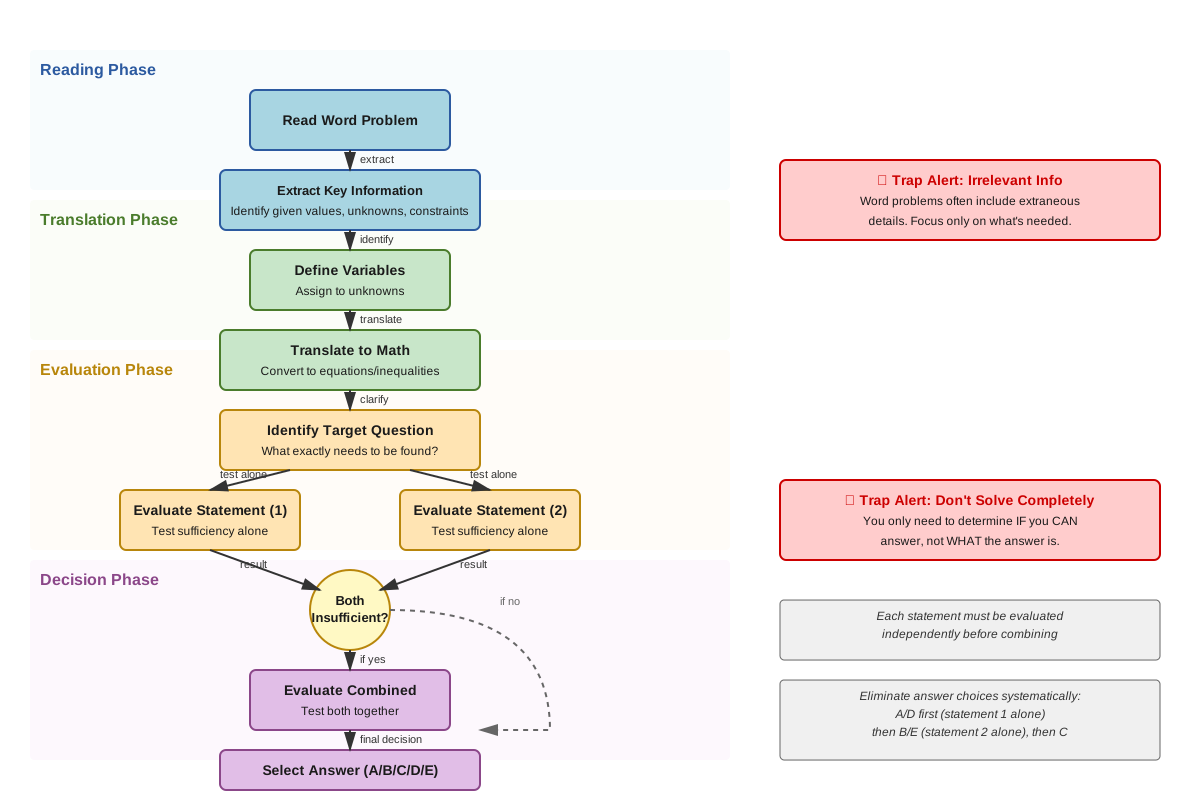
The cornerstone skill for word problems DS is mathematical translation—converting verbal descriptions into algebraic expressions, equations, or inequalities. This process involves several systematic steps:
- Identify all variables: Assign letters to unknown quantities mentioned in the problem
- Extract given relationships: Translate verbal phrases into mathematical expressions
- Formulate the target question: Express what needs to be determined in mathematical terms
- Recognize constraints: Identify any restrictions on variables (positive integers, distinct values, etc.)
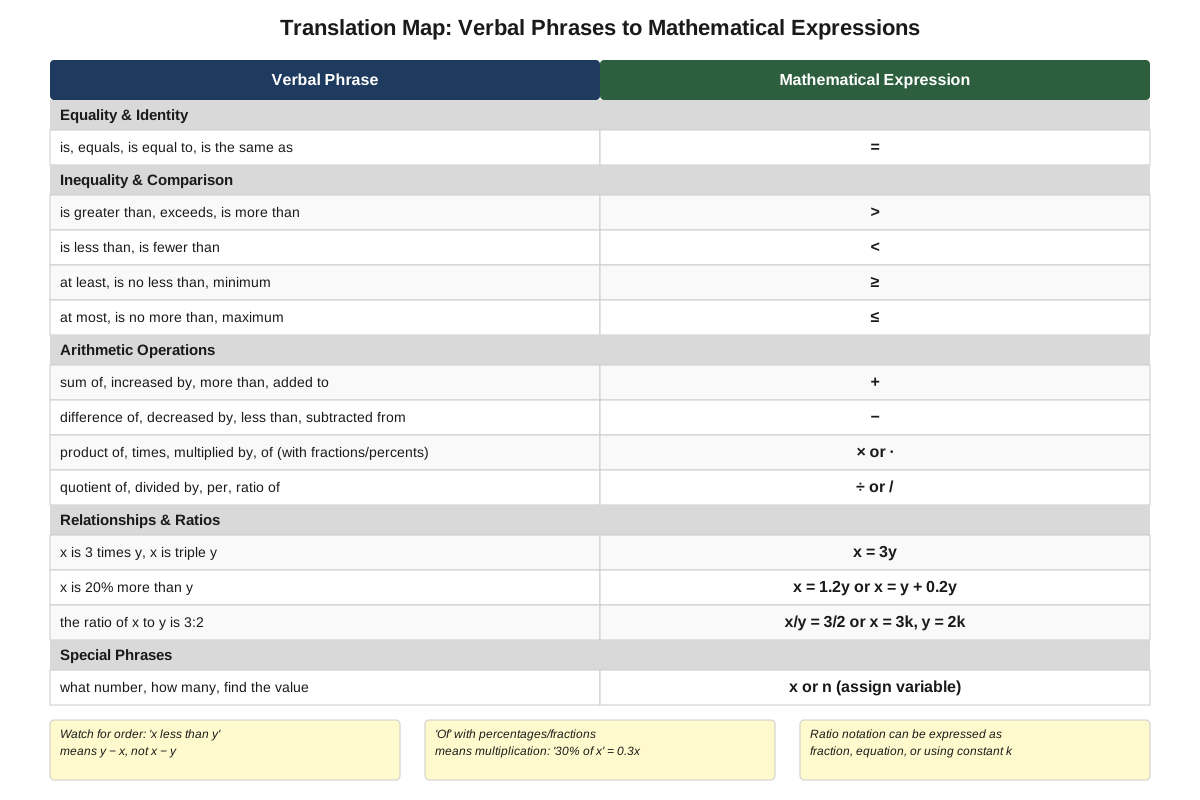
Common translation patterns include:
| Verbal Phrase | Mathematical Expression |
|---|---|
| "x is 5 more than y" | x = y + 5 |
| "the sum of two numbers is 20" | a + b = 20 |
| "twice the difference" | 2(x - y) |
| "the ratio of x to y is 3:2" | x/y = 3/2 or 2x = 3y |
| "x percent of y" | (x/100) × y |
| "x increased by 20%" | x × 1.20 or x + 0.20x |
| "the product of consecutive integers" | n(n+1) or n(n+1)(n+2) |
Sufficiency Evaluation Without Solving
A crucial insight for word problems DS is that determining sufficiency rarely requires calculating the final answer. Instead, students should ask: "Could I solve this if I needed to?" This approach saves significant time and reduces calculation errors.
To evaluate sufficiency:
- Count unknowns vs. equations: For linear systems, n independent equations are needed for n unknowns
- Check for unique solutions: Ensure statements don't allow multiple possible answers
- Verify information relevance: Confirm that statements actually address the question asked
- Test boundary cases: Consider whether extreme values affect sufficiency
For example, if asked "What is the value of x?" and given "x² = 25," this is insufficient because x could be 5 or -5 (two possible values). However, if the problem context establishes that x represents a person's age, the constraint that x must be positive makes the statement sufficient.
Common Word Problem Categories
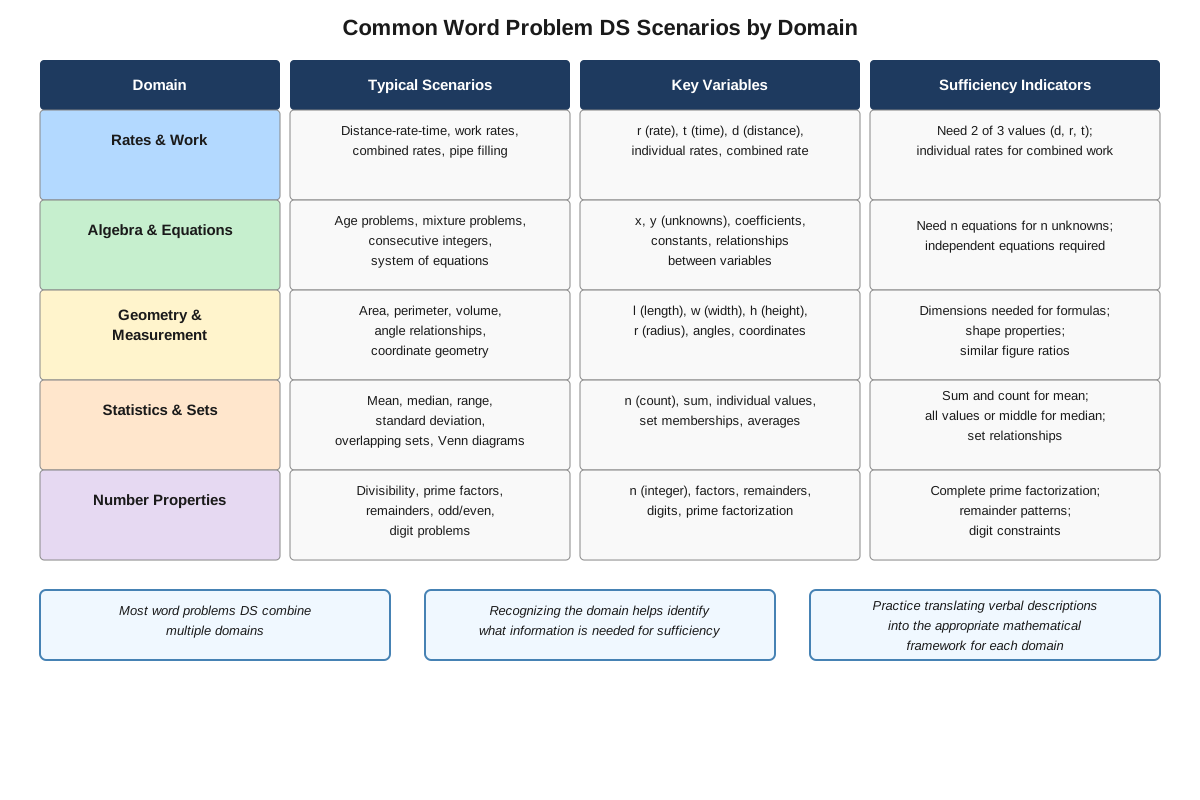
Work and Rate Problems: These involve individuals or machines completing tasks at specified rates. The fundamental formula is: Work = Rate × Time. Key sufficiency considerations include whether you can determine individual rates, combined rates, or time to completion.
Distance-Rate-Time Problems: Based on the relationship Distance = Rate × Time, these problems often involve relative motion (objects moving toward or away from each other). Sufficiency typically requires knowing two of the three variables for each object.
Mixture Problems: Involving combinations of substances with different properties (concentrations, prices, etc.), these require tracking both quantities and weighted averages. The key equation structure is: (Amount₁)(Property₁) + (Amount₂)(Property₂) = (Total Amount)(Average Property).
Age Problems: These establish relationships between people's ages at different time points. Setting up a clear timeline and using consistent variable definitions (current ages vs. ages at specific times) is essential.
Profit and Revenue Problems: Based on relationships like Profit = Revenue - Cost or Percent Profit = (Profit/Cost) × 100, these test understanding of business metrics and percentage calculations.
The AD/BCE Decision Tree
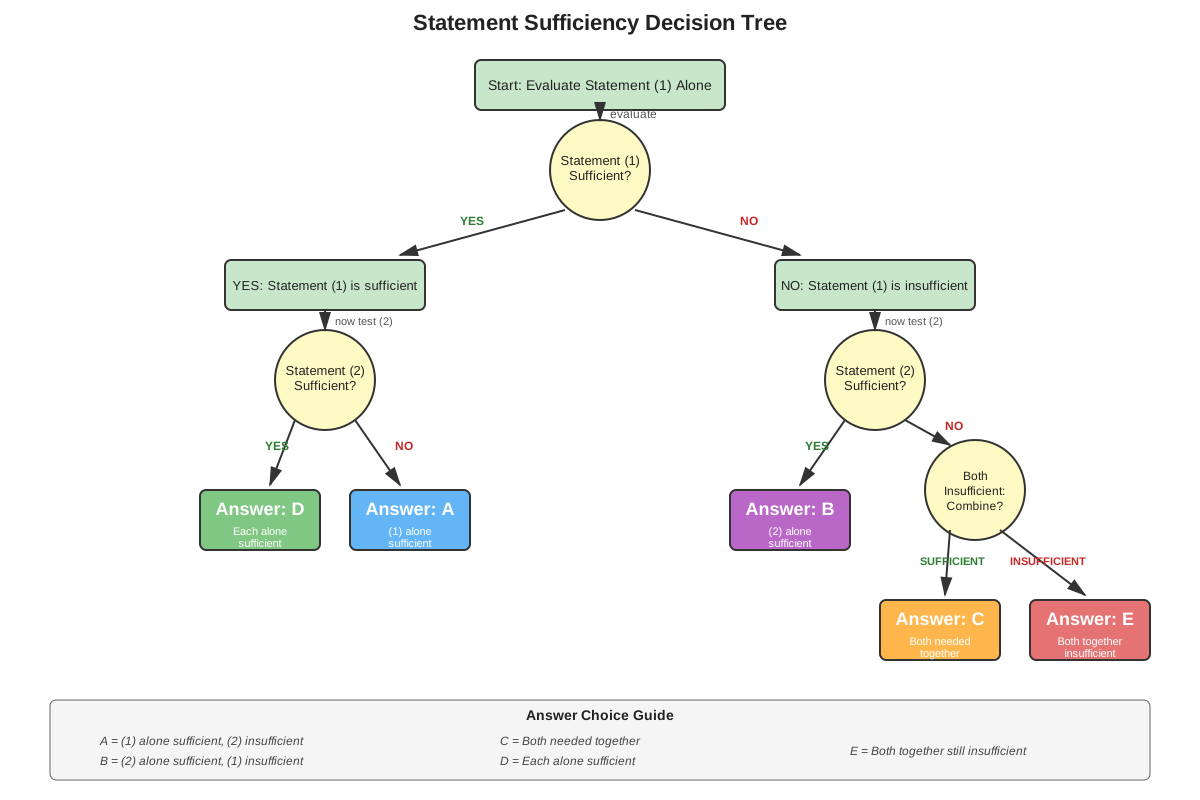
An efficient systematic approach to word problems DS uses the AD/BCE decision tree:
- Evaluate Statement (1) alone: If sufficient, the answer is A or D. If insufficient, the answer is B, C, or E.
- Evaluate Statement (2) alone: If sufficient (and Statement 1 was sufficient), answer is D. If sufficient (and Statement 1 was insufficient), answer is B. If insufficient (and Statement 1 was sufficient), answer is A. If insufficient (and Statement 1 was insufficient), proceed to step 3.
- Evaluate both statements together: If sufficient together, answer is C. If still insufficient, answer is E.
This methodical approach prevents errors and ensures no possibility is overlooked.
Information Integration and Hidden Constraints
Word problems DS often contain implicit constraints that affect sufficiency. For example:
- Number of people must be positive integers
- Percentages represent values between 0 and 100
- Time cannot be negative
- Physical quantities have logical bounds (a person's age, speed limits, etc.)
Additionally, information from the question stem must be integrated with statement information. A common error is evaluating statements in isolation without considering what the problem setup already establishes.
Concept Relationships
The concepts within word problems DS form an interconnected framework where translation skills enable sufficiency evaluation, which in turn depends on understanding problem categories and their characteristic equation structures. The relationship flows as follows:
Reading Comprehension → Variable Identification → Mathematical Translation → Equation Formulation → Sufficiency Analysis → Answer Selection
Each word problem category (work, distance, mixture, etc.) represents a specific application of this general framework, with category-specific formulas and relationships. Understanding these categories allows for pattern recognition, which accelerates the translation process.
The connection to prerequisite topics is direct: algebraic manipulation skills enable equation formulation and simplification; arithmetic fluency supports quick evaluation of whether numerical relationships provide unique solutions; and logical reasoning underpins the entire sufficiency evaluation process.
Word problems DS also connect forward to more advanced Data Insights topics, including multi-source reasoning (where information must be synthesized from multiple sources) and table analysis (where word problem scenarios are presented alongside data tables). The translation and sufficiency evaluation skills developed here transfer directly to these more complex formats.
Within the broader GMAT quantitative reasoning framework, word problems DS bridge the gap between abstract mathematical concepts and practical application, preparing students for the case-based reasoning prevalent in business school curricula.
High-Yield Facts
⭐ The question stem in word problems DS often contains critical information that must be combined with the statements—never evaluate statements in isolation from the problem setup
⭐ For linear equations, n independent equations are needed to solve for n unknowns; this principle is the foundation of most sufficiency evaluations
⭐ A statement that allows multiple possible answers is INSUFFICIENT, even if it narrows down the possibilities
⭐ Implicit constraints (positive integers, distinct values, logical bounds) can make seemingly insufficient information actually sufficient
⭐ You do not need to calculate the final answer to determine sufficiency—only verify that you could solve if needed
- Work problems use the formula: 1/Time₁ + 1/Time₂ = 1/Time_combined for combined work rates
- Distance problems involving objects moving toward each other use: Relative Rate = Rate₁ + Rate₂
- Mixture problems require tracking both total quantity and weighted average properties
- Age problems benefit from creating a simple table with rows for each person and columns for different time periods
- Percent change problems require knowing the original value; knowing only the final value and percent change is insufficient to determine the original
- In ratio problems, knowing the ratio and one actual value is sufficient to determine all values
- Statement (2) must be evaluated independently of Statement (1), even if Statement (1) seems to provide useful context
- "At least" and "at most" create inequalities rather than equations, which typically require additional constraints for sufficiency
- Problems asking "how many" or "what is the value" require unique numerical answers, while "is x > y?" questions only need yes/no determinacy
- Combined rate problems where entities work against each other (filling/draining, opposing forces) use: Net Rate = Rate₁ - Rate₂
Quick check — test yourself on Word problems DS so far.
Try Flashcards →Common Misconceptions
Misconception: If a statement provides useful information, it must be sufficient.
Correction: A statement is only sufficient if it enables you to answer the specific question asked with a unique value or definitive yes/no. Partial information, even if helpful, is insufficient.
Misconception: When evaluating Statement (2), you can use information from Statement (1).
Correction: Each statement must be evaluated independently first. Only after determining that both statements alone are insufficient should you consider them together for answer choice C.
Misconception: If you can't immediately see how to solve the problem, the statements must be insufficient.
Correction: Sufficiency means a solution exists and is unique, not that you must actually calculate it. Focus on whether enough information is present, not on performing the calculation.
Misconception: In word problems, all numerical information provided is necessary and sufficient.
Correction: Word problems often include extraneous information or provide insufficient data intentionally. Critical evaluation of what's actually needed is essential.
Misconception: If two equations can be formed, any two unknowns can be solved.
Correction: The equations must be independent (not multiples of each other) and linear in the unknowns. Two equations with three unknowns, or dependent equations, are insufficient.
Misconception: Percentage problems are sufficient if you know the percentage and one value.
Correction: You must know which value you have (the base, the result, or the part) and what you're solving for. "x is 20% more than y" requires different information than "x is 20% of y."
Misconception: In rate problems, knowing the combined rate is equivalent to knowing individual rates.
Correction: Combined rate alone is insufficient to determine individual rates without additional information. For example, if two workers together complete a job in 6 hours, their individual rates could be 1/8 and 1/24, or 1/10 and 1/15, or infinite other combinations.
Misconception: Word problems DS always require setting up equations.
Correction: Some problems are best approached through logical reasoning, testing cases, or recognizing patterns rather than formal algebraic setup.
Worked Examples
Example 1: Work Rate Problem
Question: Working together, John and Mary can complete a project in 12 hours. How long would it take John to complete the project working alone?
(1) Mary can complete the project alone in 20 hours.
(2) John works 1.5 times as fast as Mary.
Solution:
First, translate the problem setup. Let J = John's time alone (in hours) and M = Mary's time alone (in hours). Their rates are 1/J and 1/M respectively.
The combined work equation is: 1/J + 1/M = 1/12
The question asks for the value of J.
Evaluating Statement (1): M = 20
Substituting into the combined equation:
1/J + 1/20 = 1/12
This is one equation with one unknown (J), which can be solved:
1/J = 1/12 - 1/20 = (5 - 3)/60 = 2/60 = 1/30
Therefore, J = 30 hours.
Statement (1) is SUFFICIENT.
Evaluating Statement (2): John's rate is 1.5 times Mary's rate
This means: 1/J = 1.5 × (1/M), or equivalently, M = 1.5J
Substituting into the combined equation:
1/J + 1/(1.5J) = 1/12
1/J + 2/(3J) = 1/12
(3 + 2)/(3J) = 1/12
5/(3J) = 1/12
3J = 60
J = 20 hours
Statement (2) is also SUFFICIENT.
Answer: D (Each statement alone is sufficient)
Key Learning Points: This problem demonstrates that sufficiency can be achieved through different types of information—either a direct value (Statement 1) or a relationship between variables (Statement 2). Both provide enough information to create a solvable equation when combined with the problem setup.
Example 2: Age Problem with Constraints
Question: Is Sarah currently older than 30?
(1) Five years ago, Sarah was twice as old as her daughter is now.
(2) Sarah's daughter is currently between 10 and 15 years old.
Solution:
Let S = Sarah's current age and D = daughter's current age.
The question asks: Is S > 30?
Evaluating Statement (1): S - 5 = 2D
This gives us one equation with two unknowns. We can express S in terms of D:
S = 2D + 5
To determine if S > 30, we need to know if 2D + 5 > 30, or equivalently, if D > 12.5.
However, Statement (1) alone doesn't tell us D's value or range. While we know D must be positive (a person's age), D could be 10 (making S = 25, which is not > 30) or D could be 15 (making S = 35, which is > 30).
Statement (1) is INSUFFICIENT.
Evaluating Statement (2): 10 < D < 15
This provides a range for D but no relationship to S. Without knowing how S and D are related, we cannot determine Sarah's age.
Statement (2) is INSUFFICIENT.
Evaluating Both Together:
From Statement (1): S = 2D + 5
From Statement (2): 10 < D < 15
Combining these:
- If D = 10: S = 2(10) + 5 = 25 (not > 30)
- If D = 15: S = 2(15) + 5 = 35 (is > 30)
Since D is between 10 and 15, S is between 25 and 35. We cannot definitively answer whether S > 30 because it depends on D's exact value within the range.
Both statements together are INSUFFICIENT.
Answer: E (Statements together are not sufficient)
Key Learning Points: This problem illustrates that having a relationship and a range doesn't always provide sufficiency if the range spans the critical threshold. The question asks for a definitive yes or no, but the combined information allows for both possibilities. This is a common trap where students assume that combining statements must lead to sufficiency.
Exam Strategy
When approaching word problems DS on the GMAT, implement this systematic strategy:
Step 1: Read the entire question carefully (30-45 seconds)
- Identify the scenario type (work, distance, mixture, etc.)
- Note all given information in the problem stem
- Underline or mentally note the specific question being asked
- Identify implicit constraints (positive integers, logical bounds)
Step 2: Set up the framework before reading statements (15-30 seconds)
- Assign variables to unknowns
- Write down key relationships or formulas
- Translate the question into mathematical terms
- Determine what information would be sufficient (how many equations needed, what type of data)
Step 3: Evaluate Statement (1) alone (30-45 seconds)
- Combine statement information with problem stem
- Determine if you could solve (don't actually solve unless necessary)
- Eliminate answer choices: if sufficient, eliminate B, C, E; if insufficient, eliminate A, D
Step 4: Evaluate Statement (2) alone (30-45 seconds)
- Ignore Statement (1) completely
- Combine Statement (2) with problem stem only
- Further narrow answer choices based on sufficiency
Step 5: If needed, evaluate both together (20-30 seconds)
- Only necessary if both statements alone were insufficient
- Determine if combined information provides sufficiency
- Choose between C and E
Trigger words and phrases to watch for:
- "At least" / "at most": Creates inequalities rather than equations
- "Distinct" / "different": Eliminates the possibility of equal values
- "Positive integer" / "whole number": Restricts solution set
- "Ratio of x to y": Can be expressed as x/y or x = ky
- "Percent more/less than": Requires identifying the base value
- "Average" / "mean": Requires sum and count
- "Consecutive": Allows expressing multiple unknowns in terms of one variable
Process-of-elimination tips:
- If Statement (1) is sufficient, immediately eliminate B, C, and E
- If Statement (1) is insufficient, immediately eliminate A and D
- Never choose C without verifying that both statements alone are insufficient
- If statements provide the same information in different forms, the answer is likely D
- If statements seem to contradict each other, re-read carefully—they never actually contradict
Time allocation:
- Aim for 2 minutes per word problem DS question
- If setup takes longer than 45 seconds, the problem may be more complex—budget accordingly
- Don't spend more than 30 seconds on actual calculation; focus on sufficiency evaluation
- If stuck after 2.5 minutes, make an educated guess and move on
Memory Techniques
The "VQSE" Framework for approaching any word problem DS:
- Variables: Identify and define all unknowns
- Question: Translate the specific question into mathematical terms
- Statements: Evaluate each systematically
- Eliminate: Use the AD/BCE decision tree
The "WIRED" Mnemonic for common problem types:
- Work and rate problems
- Interest and investment problems
- Ratio and proportion problems
- Equation-based scenarios (age, number problems)
- Distance, rate, and time problems
The "COIN" Check for sufficiency evaluation:
- Count: Do you have enough equations for the unknowns?
- One: Does the information lead to one unique answer?
- Independent: Are equations/statements truly independent?
- Necessary: Does the information actually address what's asked?
Visualization for combined work: Imagine two pipes filling a pool. The combined rate is how fast the pool fills with both pipes open. If you know the combined rate and one individual rate, you can determine the other.
The "Ratio Reality": When given a ratio like 3:2, remember you know the relationship but not the actual values. Visualize this as knowing the shape of a rectangle (proportions) but not its size (actual dimensions). You need one actual value to determine all others.
Summary
Word problems DS represent a sophisticated integration of reading comprehension, mathematical translation, and logical reasoning that tests a candidate's ability to analyze real-world scenarios quantitatively. Success requires a systematic approach: carefully extracting information from verbal descriptions, translating scenarios into mathematical frameworks, and evaluating whether given statements provide sufficient information to answer specific questions without necessarily calculating final answers. The key insight is that sufficiency evaluation focuses on whether a unique solution exists, not on computing that solution. Understanding common problem categories (work, distance, mixture, age, profit) and their characteristic equation structures enables pattern recognition and efficient setup. The AD/BCE decision tree provides a methodical evaluation framework that prevents errors and ensures comprehensive analysis. Critical skills include recognizing implicit constraints, integrating problem stem information with statements, evaluating statements independently before combining them, and distinguishing between helpful information and truly sufficient information. Mastery of word problems DS requires practice in translation, strategic thinking about what information is needed, and disciplined application of the sufficiency evaluation framework across diverse scenarios.
Key Takeaways
- Word problems DS require three distinct skills: reading comprehension to extract information, mathematical translation to formulate relationships, and logical analysis to evaluate sufficiency without over-calculating
- The problem stem contains essential information that must be integrated with statements; never evaluate statements in isolation from the scenario setup
- Sufficiency means a unique answer exists, not that you must calculate it; focus on whether you could solve, not on actually solving
- Use the AD/BCE decision tree systematically: evaluate Statement (1) alone, then Statement (2) alone, then both together only if needed, eliminating answer choices at each step
- Implicit constraints matter: positive integers, logical bounds, and contextual restrictions can make seemingly insufficient information actually sufficient
- Common problem categories (work, distance, mixture, age) have characteristic formulas and equation structures that enable rapid setup and pattern recognition
- Independent evaluation is crucial: Statement (2) must be assessed without using information from Statement (1) until you reach the "both together" evaluation stage
Related Topics
Problem Solving Word Problems: While this guide focuses on Data Sufficiency format, the translation and setup skills transfer directly to Problem Solving questions where you must calculate actual answers. Mastering word problems DS provides a foundation for efficient Problem Solving approaches.
Multi-Source Reasoning: Advanced Data Insights questions that combine word problem scenarios with multiple information sources (tables, graphs, text passages). The translation and information integration skills from word problems DS are essential prerequisites.
Quantitative Comparison: Though not in GMAT format, understanding sufficiency evaluation helps with any question type requiring comparison without full calculation.
Systems of Equations: Many word problems DS reduce to determining whether you have sufficient equations to solve for unknowns, making deeper study of linear systems valuable.
Inequalities and Constraints: Word problems frequently involve ranges and bounds rather than exact values, making inequality manipulation skills important for advanced mastery.
Practice CTA
Now that you've mastered the conceptual framework for word problems DS, it's time to solidify your understanding through deliberate practice. Attempt the practice questions associated with this topic, focusing on applying the systematic approach outlined in this guide rather than rushing to answers. Use the flashcards to reinforce key formulas, translation patterns, and sufficiency evaluation principles. Remember that excellence in word problems DS comes from pattern recognition developed through repeated exposure to diverse scenarios—each practice question strengthens your ability to quickly identify problem types and evaluate sufficiency efficiently. Your investment in mastering this high-yield topic will pay dividends across the entire GMAT Data Insights section. Start practicing now to transform these concepts into automatic skills!
Sign up free to keep reading
Create a free AnvayaPrep account to finish this GMAT guide on Word problems DS — plus flashcards and practice questions.