Overview
Axes interpretation is a foundational skill within the GMAT Data Insights section that requires test-takers to accurately read, understand, and extract information from the axes of various graphical representations. This skill goes far beyond simply identifying what is labeled on the x-axis and y-axis; it demands careful attention to scale, units of measurement, intervals, starting points, and the relationship between visual representation and numerical values. On the GMAT, GMAT axes interpretation questions frequently appear in Graphics Interpretation problems, where a single misreading of an axis can cascade into incorrect answers across multiple related questions.
The importance of mastering axes interpretation cannot be overstated. Graphics Interpretation questions typically present two statements with drop-down menus, and both statements often rely on accurate extraction of data from the same graph. A student who misinterprets the scale of an axis—for example, failing to notice that values are in thousands or that the y-axis doesn't start at zero—will systematically arrive at incorrect conclusions despite having strong analytical skills. This makes axes interpretation a high-leverage skill: investing time to master it yields disproportionate returns in accuracy and confidence.
Within the broader Data Insights framework, axes interpretation serves as the critical first step in all graphical analysis. Before applying any quantitative reasoning, identifying trends, or making comparisons, students must correctly decode what the graph is actually showing. This skill connects directly to other Graphics Interpretation competencies such as trend analysis, data comparison, and rate of change calculations. It also supports Multi-Source Reasoning questions where graphs appear alongside tables and text passages, requiring integration of multiple data formats.
Learning Objectives
- [ ] Identify axes interpretation elements including labels, scales, units, and intervals
- [ ] Explain axes interpretation principles and how they affect data extraction from graphs
- [ ] Apply axes interpretation to GMAT questions involving various graph types
- [ ] Recognize non-standard axis configurations including logarithmic scales, broken axes, and dual axes
- [ ] Calculate actual values from graphical representations accounting for scale factors and units
- [ ] Detect misleading visual representations caused by axis manipulation
Prerequisites
- Basic graph literacy: Understanding of standard graph types (bar charts, line graphs, scatter plots) is essential because axes interpretation builds on recognizing these fundamental formats
- Numerical reasoning: Comfort with arithmetic operations, percentages, and unit conversions enables quick calculation of actual values from scaled representations
- Attention to detail: The ability to carefully read labels and notice small details directly determines success in identifying axis characteristics that affect interpretation
Why This Topic Matters
In professional contexts, axes interpretation is crucial for business analytics, financial reporting, scientific research, and data-driven decision-making. Executives regularly encounter graphs in presentations where the axis configuration can dramatically affect perception—a sales chart with a y-axis starting at 90% rather than 0% can make modest growth appear explosive. The GMAT tests this skill because business school graduates must be able to critically evaluate data presentations and avoid being misled by visual manipulation.
On the GMAT, axes interpretation appears in approximately 60-70% of Graphics Interpretation questions, making it one of the most frequently tested Data Insights skills. The exam typically includes 2-3 Graphics Interpretation question sets in the Data Insights section, with each set containing two statements. This means that axes interpretation directly impacts 4-6 individual answer selections per exam. Questions commonly present graphs with non-zero starting points, unusual intervals, scaled units (thousands, millions, percentages), or dual y-axes showing different variables.
The GMAT specifically designs axes to test whether students read carefully under time pressure. Common presentations include: scatter plots with both axes representing different units; line graphs where the y-axis represents percentage change rather than absolute values; bar charts with logarithmic scales; and combination charts with two y-axes (one on each side) measuring different variables. The exam rewards students who systematically check axis properties before attempting to extract data or identify trends.
Core Concepts
Components of Graph Axes
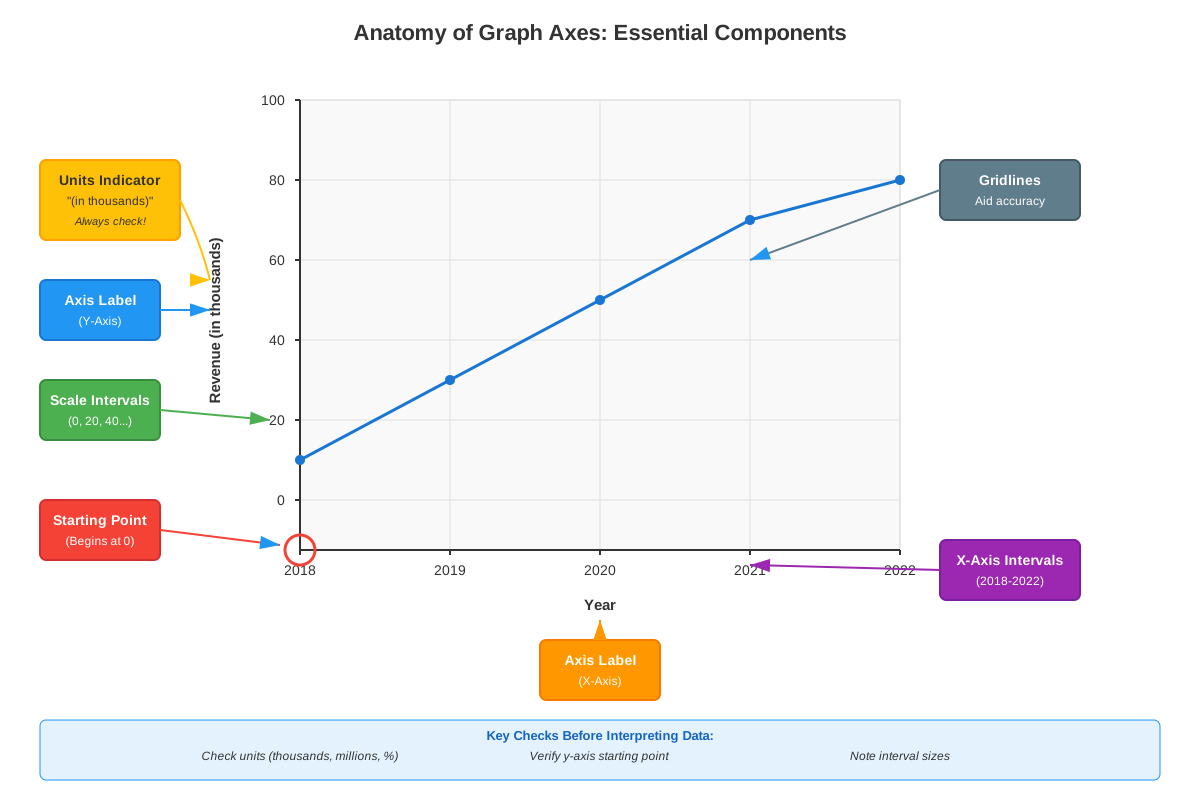
Every graph axis contains several critical components that must be identified and understood before data extraction can occur. The axis label identifies what variable is being measured and appears along or near the axis line. This label provides the conceptual meaning of the data—for example, "Revenue," "Temperature," or "Market Share." The units of measurement specify how the variable is quantified and may appear in parentheses after the label (e.g., "Revenue ($ millions)") or in a legend. Missing or misreading units is one of the most common sources of error in GMAT questions.
The scale refers to the numerical progression along the axis and determines how visual distance translates to actual value differences. A linear scale increases by constant intervals (0, 10, 20, 30...), while a logarithmic scale increases by constant ratios (1, 10, 100, 1000...). The interval is the numerical difference between adjacent marked points on the axis. On the GMAT, intervals are not always uniform or intuitive—an axis might show 0, 5, 15, 30, 50, reflecting non-linear spacing designed to test careful reading.
The origin or starting point of an axis significantly affects visual interpretation. While many graphs start at zero, GMAT questions frequently present axes with non-zero origins to test whether students notice this detail. A graph showing values from 95 to 100 will make small differences appear visually dramatic, potentially misleading hasty readers. The range encompasses the span from minimum to maximum values displayed, and understanding this range is essential for calculating percentages or relative changes.
Scale Factors and Unit Multipliers
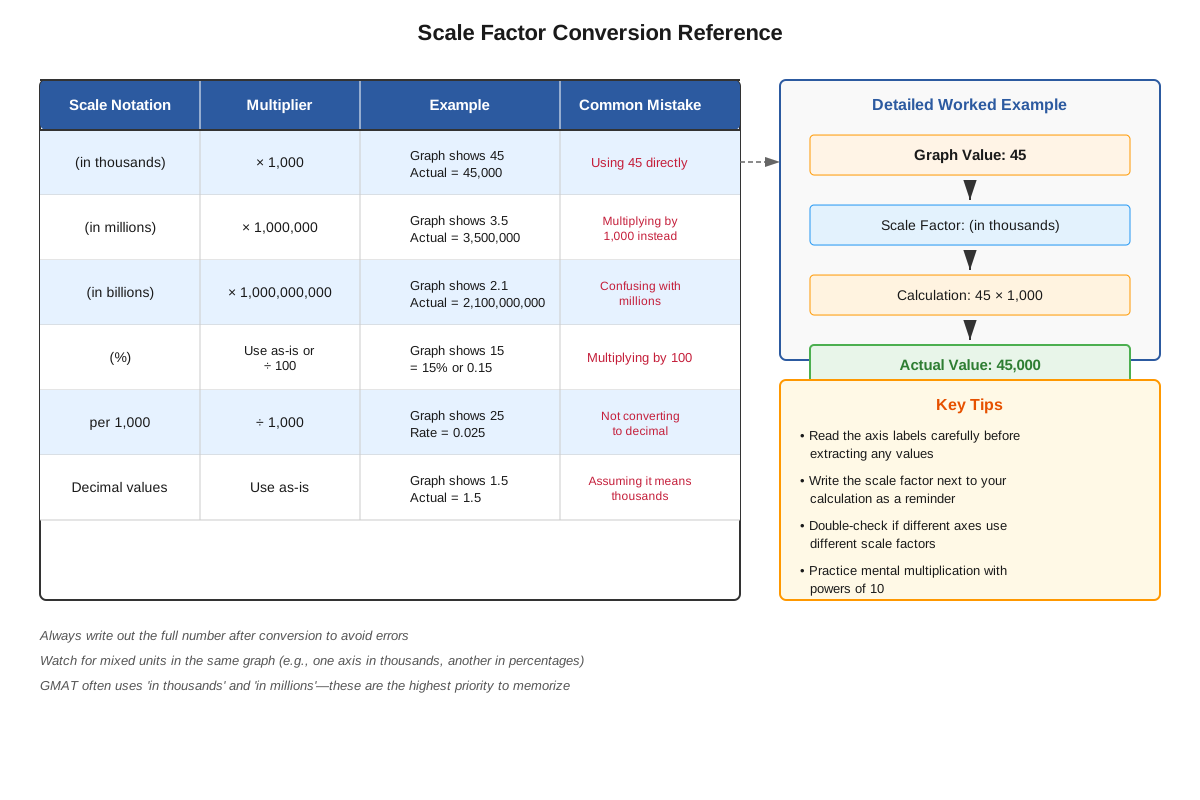
GMAT graphs frequently employ scale factors where displayed numbers must be multiplied to obtain actual values. A y-axis labeled "Revenue ($ thousands)" showing a value of 250 represents $250,000 in actual revenue. Common scale factors include thousands (K), millions (M), billions (B), and percentages (%). Students must identify these multipliers before performing any calculations, as forgetting to apply them leads to answers that are off by factors of 10, 100, or 1000.
The placement of unit information varies across GMAT questions. Sometimes units appear in the axis label itself: "Population (millions)." Other times, they appear in a graph title: "Company Revenue, 2015-2020 (in thousands of dollars)." Occasionally, units are indicated only in a legend or footnote, requiring students to scan the entire graphic before beginning analysis. This variability is intentional—the GMAT tests whether students systematically check all components of a graph rather than making assumptions.
When graphs display percentages, students must determine what the percentage represents. An axis labeled "Growth Rate (%)" shows percentage change, not absolute values. An axis labeled "Market Share (%)" shows what portion of a total market each entity controls. Confusing these concepts leads to fundamental misinterpretation of the data. Additionally, percentage axes may span 0-100% or may show a restricted range like 20-30%, which dramatically affects visual perception of differences.
Non-Standard Axis Configurations
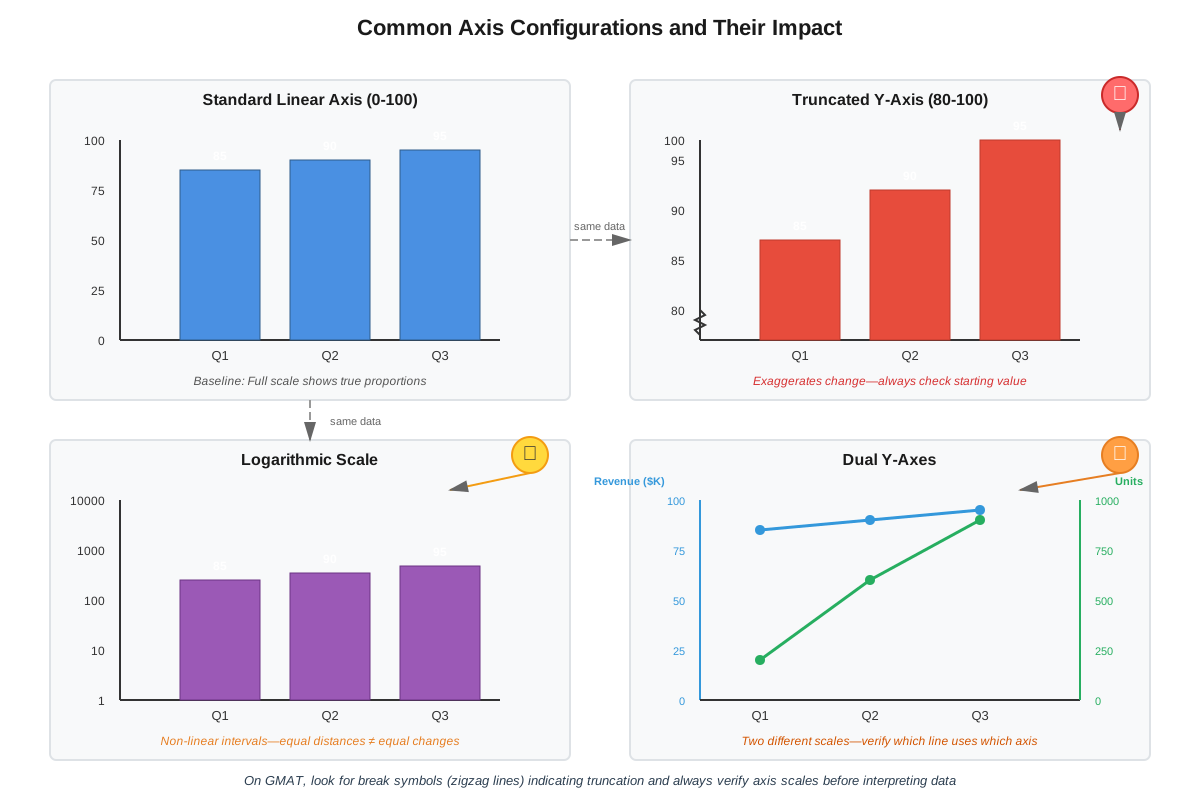
Broken axes contain discontinuities indicated by a zigzag or break symbol, showing that a portion of the scale has been omitted. For example, an axis might show 0-10, then break, then continue at 90-100, omitting the 10-90 range. This technique allows graphs to display data with extreme outliers or widely separated clusters without wasting space. On the GMAT, broken axes test whether students recognize that visual distances don't correspond to actual value differences across the break.
Dual axes appear when a single graph displays two different variables that require different scales. Typically, one y-axis appears on the left side of the graph and another on the right side, each with its own scale and units. A common example shows revenue (left axis, in millions) and profit margin (right axis, as percentage) on the same graph over time. GMAT questions with dual axes specifically test whether students correctly match each data series to its corresponding axis—a critical skill because the two scales are usually incompatible.
Logarithmic scales increase multiplicatively rather than additively, with each interval representing a tenfold increase (or other constant ratio). These scales are useful for displaying data spanning several orders of magnitude, such as population sizes ranging from thousands to billions. On a logarithmic scale, the visual distance from 1 to 10 equals the distance from 10 to 100 and from 100 to 1000. GMAT questions rarely use true logarithmic scales but may present non-uniform intervals that require careful calculation rather than visual estimation.
Reading Values from Axes
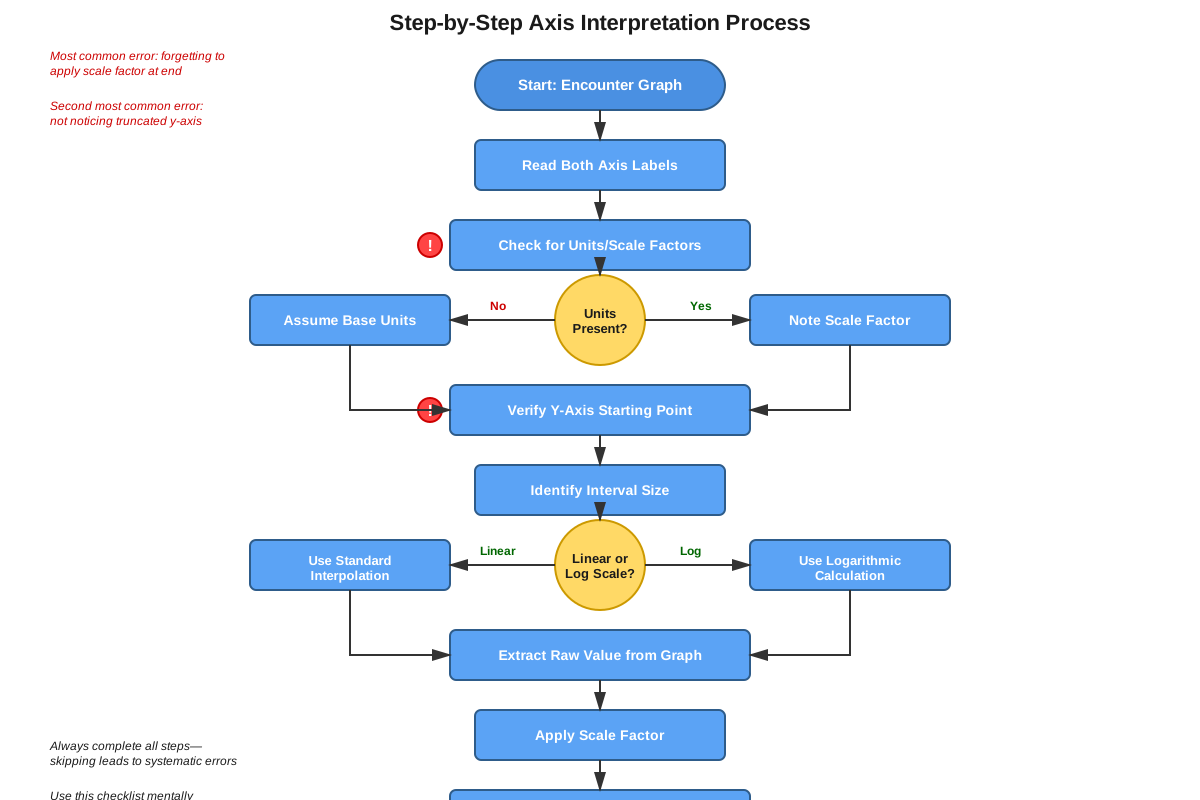
Extracting precise values from GMAT graphs requires systematic technique. First, identify the relevant axis and confirm its label, units, and scale. Second, locate the data point of interest on the graph. Third, trace horizontally (for y-axis values) or vertically (for x-axis values) to the axis. Fourth, identify which interval the point falls within. Fifth, estimate the position within that interval as a fraction or percentage. Sixth, calculate the actual value accounting for scale factors.
For example, if a bar reaches approximately 60% of the way between 40 and 50 on a y-axis labeled "Sales ($ thousands)," the calculation proceeds: interval size = 10, position within interval = 0.6 × 10 = 6, value = 40 + 6 = 46, actual sales = 46 × $1,000 = $46,000. This systematic approach prevents errors and works consistently across different graph types.
When data points fall between marked intervals, estimation is necessary. The GMAT typically designs questions so that precise reading yields values that clearly match one answer choice over others. If a student's reading produces a value that falls exactly between two answer choices, this signals an error in axis interpretation—likely a missed scale factor or misread interval. Students should return to verify axis properties rather than guessing between close options.
Axis Orientation and Direction
While most graphs follow standard conventions (x-axis horizontal, y-axis vertical, values increasing left-to-right and bottom-to-top), GMAT questions occasionally present variations. Some graphs show time progressing right-to-left, particularly when displaying historical data. Others use inverted scales where higher positions represent lower values—common in rankings where #1 is "better" than #10. Students must check the direction of increase for each axis rather than assuming standard orientation.
Horizontal bar charts rotate the typical configuration, with categories on the y-axis and values on the x-axis. This rotation doesn't change the interpretation principles but can cause momentary confusion under time pressure. The key is to identify which axis represents the independent variable (usually categories or time) and which represents the dependent variable (usually measured quantities).
Concept Relationships
Axes interpretation serves as the foundational skill upon which all other Graphics Interpretation competencies depend. The relationship flows as follows: Axes Interpretation → enables → Data Extraction → enables → Trend Analysis → enables → Comparative Analysis → enables → Quantitative Conclusions. Without accurate axes interpretation, every subsequent analytical step produces flawed results, making this the critical first link in the chain.
Within axes interpretation itself, component identification precedes value calculation. Students must first recognize what is being measured (axis labels) and how it's being measured (units and scale) before attempting to read specific values. The relationship is: Label Identification → Unit Recognition → Scale Analysis → Value Extraction → Calculation with Scale Factors.
Axes interpretation connects to prerequisite knowledge of basic graph literacy by adding layers of complexity. While basic graph literacy covers standard configurations, axes interpretation addresses the non-standard presentations that appear on standardized tests. It also connects forward to Multi-Source Reasoning questions where students must integrate information from graphs, tables, and text—accurate axes interpretation ensures the graphical data is correctly understood before integration occurs.
Quick check — test yourself on Axes interpretation so far.
Try Flashcards →High-Yield Facts
⭐ The y-axis starting point is frequently non-zero on GMAT graphs, making small differences appear visually exaggerated
⭐ Scale factors (thousands, millions, percentages) appear in axis labels or graph titles and must be applied to all values extracted from that axis
⭐ Dual-axis graphs require matching each data series to its correct axis, which is typically indicated by color-coding or explicit labels
⭐ Intervals between marked points on an axis are not always uniform; each interval must be calculated individually
⭐ Units of measurement may differ between x-axis and y-axis, requiring separate identification for each
- Logarithmic or non-linear scales change the relationship between visual distance and actual value difference
- Broken axes contain discontinuities that make visual comparisons across the break invalid
- Percentage axes may represent different concepts (growth rate, market share, proportion) depending on context
- Axis ranges that exclude zero create visual impressions that may not reflect the true magnitude of differences
- Time axes may progress in either direction and may use irregular intervals (quarterly, annual, specific dates)
Common Misconceptions
Misconception: All graph axes start at zero → Correction: GMAT graphs frequently use non-zero starting points to focus on a specific range of values. Always check where the axis begins before interpreting visual differences as proportional to actual differences.
Misconception: The visual height or length of bars/lines directly represents the actual value → Correction: Visual representation must be interpreted through the axis scale and units. A bar that appears twice as tall as another may represent values that differ by any amount depending on the scale and starting point.
Misconception: Units are the same for all axes on a graph → Correction: Different axes may measure different variables in different units. Dual-axis graphs specifically use different scales and units for left and right y-axes, requiring careful matching of data series to axes.
Misconception: Intervals between marked points are always equal → Correction: GMAT graphs may use non-uniform intervals (e.g., 0, 5, 15, 30, 60) to test careful reading. Calculate each interval individually rather than assuming constant spacing.
Misconception: If units aren't explicitly stated, assume standard units (dollars, whole numbers, etc.) → Correction: Missing unit information should prompt a search of the entire graphic including title, legend, and footnotes. If units truly aren't specified, the question will be answerable without them, but this is rare.
Misconception: Percentage axes always range from 0% to 100% → Correction: Percentage axes may show restricted ranges (e.g., 45%-55%) to focus on small variations. The full 0-100% range is not required and is often not shown.
Worked Examples
Example 1: Scale Factor Application
Question: A bar graph titled "Regional Sales Performance" shows a y-axis labeled "Revenue ($ thousands)" with marks at 0, 50, 100, 150, and 200. The bar for Region A reaches approximately 75% of the way between the 100 and 150 marks. What is Region A's actual revenue?
Solution:
Step 1: Identify axis properties
- Label: Revenue
- Units: $ thousands (scale factor of 1,000)
- Interval: 50 (between each marked point)
- Relevant interval: 100 to 150
Step 2: Calculate position within interval
- Bar reaches 75% of the way from 100 to 150
- Distance = 0.75 × 50 = 37.5
- Value on axis = 100 + 37.5 = 137.5
Step 3: Apply scale factor
- Axis shows 137.5
- Units are "thousands"
- Actual revenue = 137.5 × $1,000 = $137,500
Answer: Region A's revenue is $137,500
This example demonstrates the complete process: identifying the scale factor in the axis label, calculating the precise value from visual position, and applying the multiplier to obtain the actual value. The 75% estimation is typical of GMAT precision requirements.
Example 2: Dual-Axis Interpretation
Question: A line graph shows "Company Performance 2015-2020" with two lines: a solid line and a dashed line. The left y-axis is labeled "Revenue ($ millions)" with marks at 0, 5, 10, 15, 20. The right y-axis is labeled "Profit Margin (%)" with marks at 0, 5, 10, 15, 20. The legend indicates the solid line represents Revenue and the dashed line represents Profit Margin. In 2018, the solid line is at the 12 mark and the dashed line is at the 8 mark. What was the company's revenue and profit margin in 2018?
Solution:
Step 1: Match data series to axes
- Solid line = Revenue → uses left y-axis
- Dashed line = Profit Margin → uses right y-axis
Step 2: Read solid line value (Revenue)
- Solid line at 12 on left axis
- Left axis: "Revenue ($ millions)"
- Revenue = 12 × $1,000,000 = $12,000,000
Step 3: Read dashed line value (Profit Margin)
- Dashed line at 8 on right axis
- Right axis: "Profit Margin (%)"
- Profit Margin = 8%
Answer: In 2018, revenue was $12 million and profit margin was 8%
This example illustrates the critical skill of matching data series to the correct axis on dual-axis graphs. Note that both axes happen to show the same numerical marks (0-20), which is a common GMAT trap—students who don't carefully match series to axes might incorrectly assign revenue to the right axis or profit margin to the left axis. The different units (millions vs. percentages) make these values incompatible despite the identical numerical scales.
Exam Strategy
When approaching Graphics Interpretation questions on the GMAT, implement a systematic pre-reading routine before attempting to answer any statements. Spend 15-20 seconds examining the graph: identify the graph type, read all axis labels completely, note units and scale factors, check the starting point of each axis, and verify whether dual axes are present. This upfront investment prevents errors and actually saves time by eliminating the need to re-examine the graph for each statement.
Trigger phrases that signal axes interpretation challenges include: "approximately how many," "closest to," "in thousands," "as a percentage of," and "according to the graph." When you see these phrases, immediately verify that you've correctly identified units and scale factors. The word "approximately" indicates that precise reading with estimation is required—the answer choices will be spaced far enough apart that careful reading yields a clear answer.
For process of elimination, calculate your answer before looking at the choices when possible. If your calculated value doesn't closely match any option, this signals an axis interpretation error—likely a missed scale factor or misread interval. Return to verify axis properties rather than selecting the "closest" answer. When answer choices differ by factors of 10, 100, or 1000, this strongly suggests a scale factor is being tested.
Time allocation for Graphics Interpretation questions should be approximately 2.5 minutes per question set (which contains two statements). Spend 20 seconds on initial graph examination, then 1 minute per statement. If axes interpretation is complex (dual axes, unusual scales), allocate an extra 10-15 seconds to the initial examination phase. This prevents rushing through axis identification, which is the highest-leverage activity for accuracy.
When graphs contain multiple data series (multiple lines or bar groups), create a mental or written note matching each series to its axis and units before reading statements. For dual-axis graphs, physically point to or mark which axis corresponds to which series. This external organization reduces cognitive load and prevents mid-problem confusion about which scale applies to which data.
Memory Techniques
Use the acronym LUISO to remember the five critical axis properties to check: Label (what variable), Units (how measured), Intervals (spacing between marks), Starting point (origin value), Orientation (direction of increase). Before extracting any data, verify all five LUISO components for each relevant axis.
For remembering to apply scale factors, visualize the mnemonic "Thousands Make Millions Big": Thousands, Millions, Billions are the three most common scale factors on GMAT graphs. When you see any of these words, mentally add the appropriate number of zeros to every value you extract (3 zeros for thousands, 6 for millions, 9 for billions).
To avoid dual-axis confusion, use the phrase "Left Line, Right Rate" as a reminder that graphs often place absolute quantities (like revenue) on the left axis and rates or percentages (like growth rate or profit margin) on the right axis. While not universal, this pattern appears frequently enough to serve as a useful default assumption that you then verify against the actual graph.
For non-zero starting points, visualize a "floating baseline" rather than a graph anchored at zero. This mental image reminds you that visual proportions don't reflect actual proportions when the baseline floats above zero. When you notice a non-zero start, mentally flag the graph as "floating" to maintain awareness throughout your analysis.
Summary
Axes interpretation is the foundational skill for all GMAT Graphics Interpretation questions, requiring systematic identification of axis labels, units, scale factors, intervals, starting points, and orientation before any data extraction or analysis occurs. The GMAT specifically tests this skill by presenting non-standard configurations including non-zero origins, scale factors requiring multiplication, dual axes with different units, and non-uniform intervals. Success requires a disciplined approach: examine all axis properties before reading statements, apply scale factors to every extracted value, match data series to correct axes on dual-axis graphs, and calculate values systematically rather than relying on visual estimation alone. The most common errors stem from overlooking scale factors (thousands, millions, percentages) and failing to notice non-zero starting points, both of which cause answers to be off by large factors. Students who invest time in careful axis examination before attempting calculations achieve significantly higher accuracy than those who rush into analysis, making this a high-leverage skill for GMAT Data Insights performance.
Key Takeaways
- Always identify all five LUISO components (Label, Units, Intervals, Starting point, Orientation) before extracting data from any graph
- Scale factors in axis labels (thousands, millions, percentages) must be applied to every value extracted from that axis
- Non-zero starting points make visual differences appear exaggerated; always check where axes begin
- Dual-axis graphs require careful matching of each data series to its corresponding axis using legends or color coding
- Intervals between marked points may be non-uniform; calculate each interval individually rather than assuming equal spacing
- Systematic axis examination takes 15-20 seconds but prevents errors that cost far more time to correct
- When calculated values don't match answer choices, the error is usually in axis interpretation (missed scale factor or misread interval) rather than in arithmetic
Related Topics
Trend Analysis in Graphics Interpretation builds directly on axes interpretation by using correctly extracted values to identify patterns of increase, decrease, or stability over time. Mastering axes interpretation ensures the values used for trend analysis are accurate.
Data Sufficiency with Graphical Information extends axes interpretation to questions where students must determine whether graphical data provides sufficient information to answer a question, requiring deep understanding of what information axes convey.
Multi-Source Reasoning with Mixed Data Formats integrates axes interpretation with table reading and text analysis, requiring students to extract data from graphs and combine it with information from other sources.
Rate and Ratio Calculations from Graphs applies axes interpretation to compute derived quantities like growth rates, ratios between variables, or per-unit values, all of which depend on accurate initial data extraction.
Practice CTA
Now that you've mastered the principles of axes interpretation, it's time to apply these skills to realistic GMAT questions. Attempt the practice questions associated with this topic, focusing on implementing the systematic LUISO approach for every graph you encounter. Use the flashcards to reinforce recognition of common axis configurations and scale factors. Remember: axes interpretation is a high-leverage skill where careful attention to detail yields disproportionate improvements in accuracy. Each practice question is an opportunity to build the disciplined habits that lead to confident, correct performance on test day. You've built the foundation—now strengthen it through deliberate practice!
Sign up free to keep reading
Create a free AnvayaPrep account to finish this GMAT guide on Axes interpretation — plus flashcards and practice questions.