Overview
Graphs are a critical component of the GMAT Quantitative Reasoning section, appearing in both Problem Solving and Data Sufficiency questions. These visual representations of data require test-takers to interpret, analyze, and extract quantitative information from various chart types including bar graphs, line graphs, pie charts, scatter plots, and combination graphs. The ability to quickly and accurately read GMAT graphs is essential because these questions test not only mathematical computation skills but also data literacy, pattern recognition, and the capacity to synthesize information from multiple sources.
On the GMAT, graph questions typically present real-world business scenarios involving sales data, demographic information, financial trends, or operational metrics. These questions assess whether candidates can move fluidly between visual and numerical representations of data—a skill fundamental to business decision-making. Graph problems often combine multiple mathematical concepts, requiring test-takers to calculate percentages, ratios, rates of change, averages, and proportions while interpreting visual information under time pressure.
Understanding graphs connects directly to broader Quantitative Reasoning competencies including statistics, probability, arithmetic operations, and word problems. Graph interpretation serves as a bridge between pure calculation and applied problem-solving, mirroring the data-driven analytical work performed in graduate business programs and professional settings. Mastery of this topic significantly impacts overall GMAT performance, as graph questions appear with high frequency and often carry medium to high difficulty ratings that can differentiate strong candidates from average performers.
Learning Objectives
- [ ] Identify different types of graphs commonly appearing on the GMAT
- [ ] Explain the components, scales, and data relationships presented in various graph formats
- [ ] Apply graph interpretation skills to solve GMAT Problem Solving and Data Sufficiency questions
- [ ] Analyze trends, patterns, and comparative relationships within single and multiple graph displays
- [ ] Calculate derived values (percentages, ratios, differences, averages) from graphical data
- [ ] Evaluate the sufficiency of graphical information to answer specific quantitative questions
- [ ] Recognize common graph-based traps and misleading visual representations
Prerequisites
- Basic arithmetic operations: Essential for performing calculations with values extracted from graphs, including addition, subtraction, multiplication, and division
- Percentage calculations: Required to interpret pie charts and calculate percentage changes, percentage of totals, and percentage increases/decreases
- Ratio and proportion concepts: Necessary for comparing values across different categories or time periods shown in graphs
- Coordinate system understanding: Helpful for interpreting scatter plots and line graphs with x and y axes
- Average (mean) calculations: Frequently needed when analyzing data trends or comparing multiple data points from graphs
Why This Topic Matters
Graph interpretation represents a fundamental business skill that the GMAT tests extensively because MBA programs and business careers demand constant engagement with data visualization. Executives, consultants, analysts, and managers regularly make decisions based on graphical presentations of sales figures, market trends, financial performance, and operational metrics. The ability to quickly extract insights from visual data directly correlates with professional effectiveness in data-driven environments.
On the GMAT, graph questions appear in approximately 15-20% of Quantitative Reasoning questions, making them one of the most frequently tested topics. These questions typically appear as integrated problem-solving scenarios where a single graph or set of graphs supports 2-4 related questions. The GMAT presents graphs in various formats: vertical and horizontal bar charts, line graphs showing trends over time, pie charts displaying proportional relationships, combination graphs merging multiple chart types, and occasionally scatter plots or histograms. Data Sufficiency questions may present graphs as given information while asking whether additional statements provide sufficient data to answer specific questions.
Graph questions commonly appear in contexts involving business performance metrics (quarterly sales, revenue growth, market share), demographic data (population distributions, survey results), financial information (budget allocations, expense breakdowns), and operational statistics (production volumes, efficiency metrics). The GMAT specifically designs these questions to test whether candidates can move beyond surface-level reading to perform multi-step calculations, identify trends, make comparisons across categories, and recognize when visual scales or presentations might be misleading.
Core Concepts
Types of Graphs on the GMAT
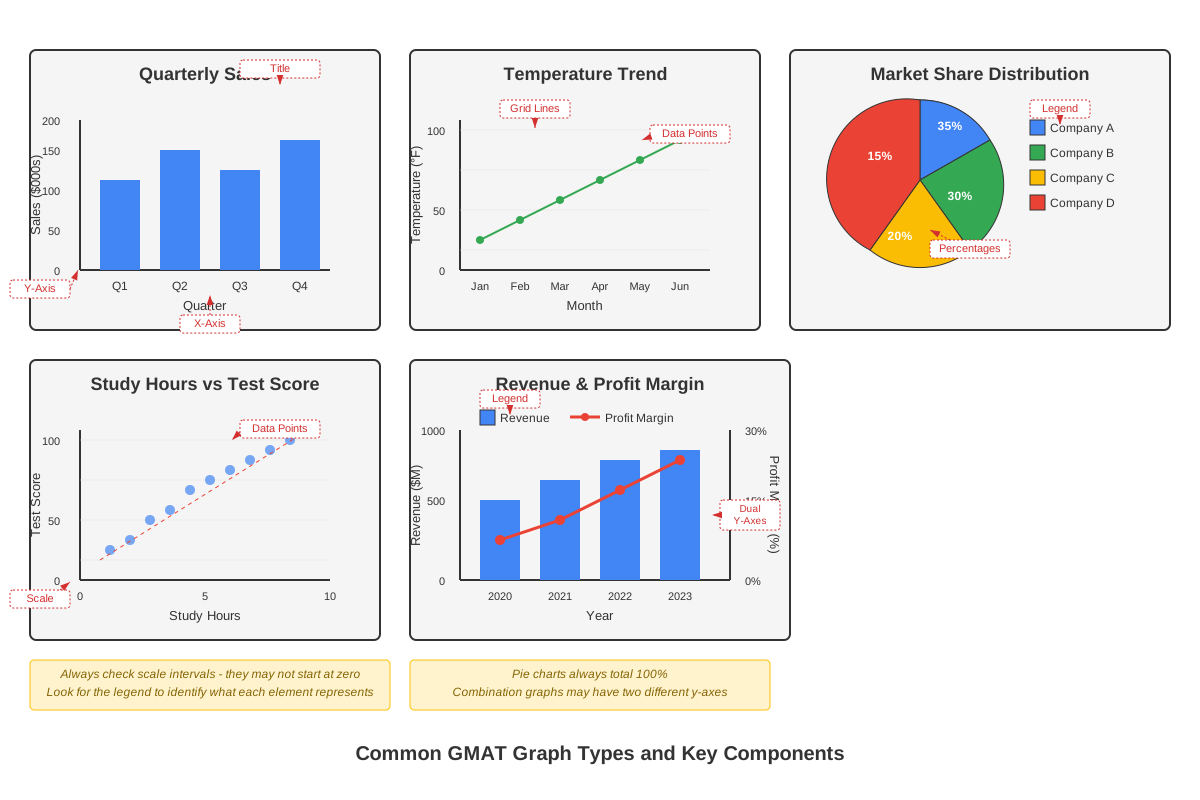
The GMAT employs several standard graph types, each serving specific data representation purposes. Bar graphs (also called bar charts) use rectangular bars to compare quantities across different categories. Bars may be oriented vertically or horizontally, and the length or height of each bar corresponds to the value it represents. Bar graphs excel at showing comparisons between discrete categories such as sales by region, products by revenue, or performance across different time periods.
Line graphs display data points connected by lines, typically showing how values change over continuous intervals, most commonly time. These graphs are ideal for illustrating trends, growth patterns, or cyclical variations. The GMAT frequently uses line graphs to present multi-year data, monthly performance metrics, or any scenario where understanding the rate and direction of change matters as much as the absolute values.
Pie charts (or circle graphs) represent parts of a whole, with each slice showing a category's proportion of the total. The entire circle represents 100% of the data set, and each wedge's size corresponds to its percentage contribution. Pie charts appear frequently in GMAT questions involving budget allocations, market share distributions, demographic breakdowns, or any scenario requiring proportional analysis.
Combination graphs merge multiple graph types in a single display, such as bars showing actual values alongside a line showing percentage growth, or multiple line graphs on the same axes comparing different data series. These complex visualizations test the ability to track multiple variables simultaneously and understand relationships between different data sets.
Scatter plots show individual data points plotted on a coordinate system, useful for identifying correlations, clusters, or outliers. While less common than other graph types, scatter plots occasionally appear in GMAT questions testing pattern recognition or relationship analysis between two variables.
Graph Components and Reading Strategies
Every graph contains essential components that must be identified and understood before attempting calculations. The title provides context about what data the graph represents. Axes labels identify what variables are being measured—the horizontal (x-axis) typically shows categories or time periods, while the vertical (y-axis) shows quantities or values. The scale determines how values map to visual positions; careful attention to scale is critical because GMAT questions often use non-standard scales (starting at values other than zero, using intervals other than 1, 10, or 100) to test careful reading.
Legends or keys explain what different colors, patterns, or line styles represent when multiple data series appear on the same graph. Data labels sometimes appear directly on bars, points, or pie slices, providing exact values. When labels are absent, values must be estimated by reading the scale carefully—the GMAT typically designs graphs so that precise reading yields exact values rather than requiring estimation.
The units of measurement must be identified, as graphs may present data in thousands, millions, percentages, or other units. A common GMAT trap involves presenting axis labels like "Sales (in thousands)" while asking questions about actual sales figures, requiring multiplication by 1,000.
Extracting and Calculating from Graphs
Direct reading involves identifying specific values from the graph by locating the appropriate bar height, line position, or pie slice size. For bar graphs, trace from the top of the bar horizontally to the y-axis to read the value. For line graphs, locate the point corresponding to the desired x-value and trace to the y-axis. For pie charts, use the percentage shown or calculate it from the slice's proportion of the circle.
Comparative analysis requires finding differences, ratios, or rankings between values. To find the difference between two bars, read both values and subtract. To find a ratio, divide one value by another. To identify the largest or smallest value, visually scan for the tallest/shortest bar or steepest/flattest line segment.
Percentage calculations are extremely common in GMAT graph questions. To find what percentage one value is of another, divide the part by the whole and multiply by 100. To find percentage increase or decrease, use the formula: ((New Value - Old Value) / Old Value) × 100. For pie charts, percentages are often given directly, but questions may ask for the actual quantity represented by a slice, requiring multiplication of the percentage by the total.
Trend analysis involves identifying patterns over time or across categories. Look for increasing or decreasing patterns, cyclical variations, or inflection points where trends change direction. The GMAT may ask about the period with the greatest increase, the average rate of change, or predictions based on observed trends.
Multi-Step Graph Problems
Complex GMAT graph questions require combining multiple pieces of information through sequential calculations. A typical multi-step problem might require: (1) reading two values from different parts of a graph, (2) calculating their sum or difference, (3) using that result to find a percentage or ratio, and (4) comparing the final answer to other values or answer choices.
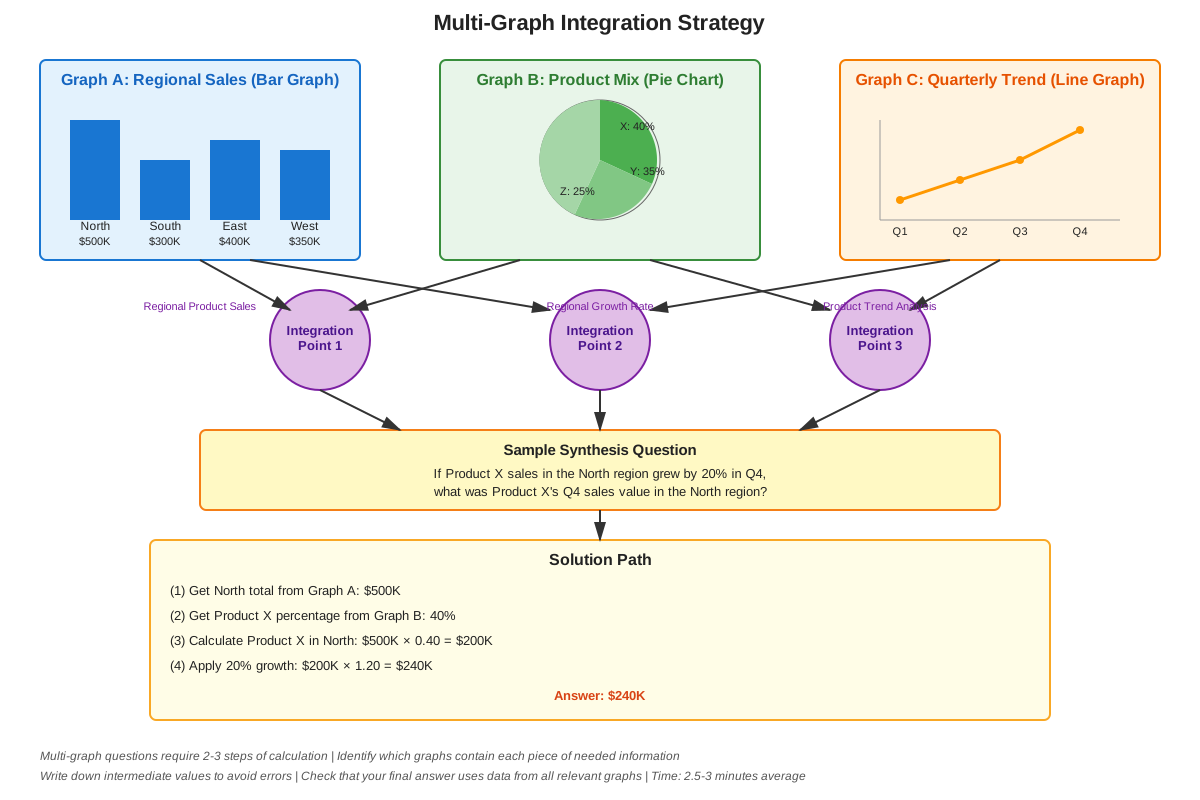
When working with multiple graphs, information must be synthesized across different visualizations. One graph might show total sales by year while another shows the percentage breakdown by product category, requiring multiplication to find specific product sales in a particular year. The key strategy involves identifying what information each graph provides and determining the calculation sequence needed to reach the answer.
Scale and Visual Perception Traps
The GMAT deliberately designs graphs to test careful reading rather than visual intuition. Non-zero baselines make differences appear more dramatic than they actually are—a bar graph starting at 90 rather than 0 will make a change from 95 to 100 look much larger visually than it actually is proportionally. Irregular intervals on axes (such as 0, 10, 30, 60, 100) require careful counting rather than assuming equal spacing. Compressed or expanded scales can make trends appear steeper or flatter than they truly are.
Aspect ratio manipulation affects how steep lines appear in line graphs—the same data can look like rapid growth or gradual increase depending on the height-to-width ratio of the graph. The GMAT tests whether candidates read actual values rather than relying on visual impressions.
Concept Relationships
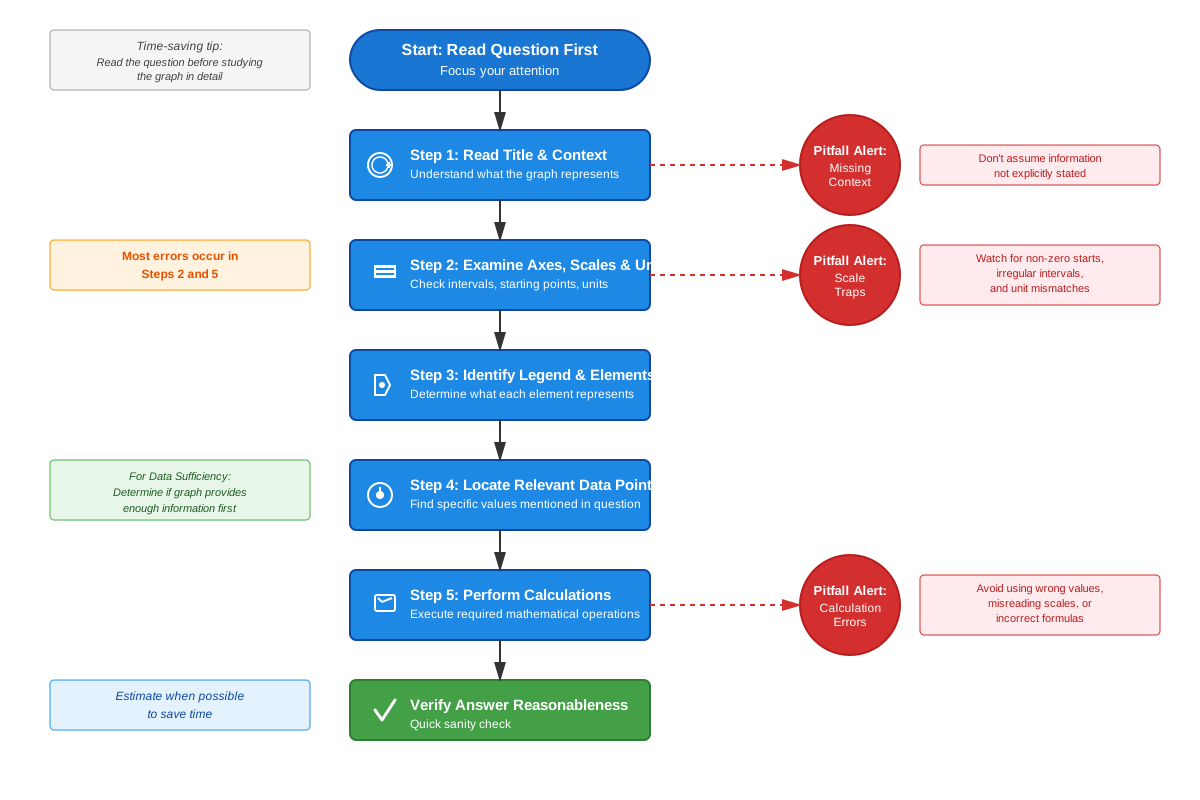
Graph interpretation integrates multiple quantitative concepts into a unified analytical framework. The relationship flow typically follows this pattern: Graph identification → Component recognition → Value extraction → Mathematical operations → Answer derivation.
Different graph types connect to specific mathematical operations: Bar graphs → Comparison and ranking → Difference and ratio calculations; Line graphs → Trend analysis → Rate of change and slope concepts; Pie charts → Part-whole relationships → Percentage and proportion calculations.
The connection to prerequisite knowledge operates as follows: Basic arithmetic enables value extraction and calculation; Percentage skills allow interpretation of pie charts and growth rates; Ratio understanding facilitates comparative analysis; Coordinate concepts support line graph and scatter plot interpretation.
Graph questions often bridge to other GMAT topics: Statistics (calculating means, medians, ranges from graphical data), Word problems (graphs provide the numerical context for real-world scenarios), Data Sufficiency (graphs serve as Statement 1 or 2, or as given information requiring additional data), and Probability (graphs may show frequency distributions or outcome data).
The progression from simple to complex follows: Single graph, direct reading → Single graph, calculated values → Single graph, multi-step problems → Multiple graphs, integrated analysis → Graphs with Data Sufficiency reasoning.
Quick check — test yourself on Graphs so far.
Try Flashcards →High-Yield Facts
⭐ Bar graphs compare discrete categories; line graphs show continuous change over time; pie charts display parts of a whole summing to 100%
⭐ Always check the scale on both axes—GMAT graphs frequently use non-zero baselines and irregular intervals to test careful reading
⭐ When axis labels show units like "in thousands" or "in millions," multiply extracted values by the appropriate factor before calculating
⭐ Percentage increase = ((New - Old) / Old) × 100; this differs from percentage point change, which is simply New - Old when values are already percentages
⭐ In pie charts, the actual quantity represented by a slice = (Percentage/100) × Total; conversely, Percentage = (Part/Total) × 100
- The tallest bar or highest point is not always the answer—questions often ask for greatest increase, largest percentage, or other derived values rather than absolute maximum
- When comparing values across multiple years or categories, organize data systematically in a table or list to avoid confusion
- Combination graphs require identifying which axis and scale apply to each data series—bars and lines may use different y-axes
- If a graph shows data for years 2015-2020 and asks about "the three-year period," clarify whether this means three consecutive years or three specific years
- Scatter plots with positive correlation show points trending upward from left to right; negative correlation shows downward trending; no correlation shows random distribution
- When graphs lack specific data labels, values can typically be read exactly by careful scale reading—the GMAT rarely requires estimation
- Questions asking "approximately" or "closest to" signal that minor reading errors won't affect the answer, but precise reading is still preferable
- Multiple graphs in a single question set share a common context—information from one graph often combines with another to answer specific questions
Common Misconceptions
Misconception: Visual size directly represents proportional difference—if one bar looks twice as tall as another, the value is twice as large.
Correction: Visual proportions only reflect actual proportional differences when the scale starts at zero and uses regular intervals. Always read actual values from the scale rather than relying on visual estimation, especially when baselines are non-zero.
Misconception: In pie charts, the largest slice always represents more than 50% of the total.
Correction: The largest slice is simply larger than any other individual slice but may represent less than 50% of the total. For example, if five slices represent 25%, 22%, 20%, 18%, and 15%, the 25% slice is largest but well under half.
Misconception: A steeper line in a line graph always means better performance or higher values.
Correction: Steepness indicates rate of change, not absolute value. A line can be steep while representing low values, or flat while representing high values. Additionally, steepness perception depends on scale—the same data appears steeper or flatter based on axis scaling.
Misconception: When a graph shows "Sales (in thousands)," a bar reaching the 50 mark represents $50 in sales.
Correction: The value must be multiplied by the unit factor—50 on a scale measured "in thousands" represents 50,000. This is one of the most common traps in GMAT graph questions.
Misconception: Percentage increase and percentage point increase are the same thing.
Correction: Percentage increase is calculated relative to the original value: ((New - Old)/Old) × 100. Percentage point increase is the simple arithmetic difference between two percentages. If market share grows from 20% to 25%, that's a 5 percentage point increase but a 25% increase (5/20 × 100).
Misconception: All data points on a graph are equally important for answering the question.
Correction: GMAT questions target specific data points, time periods, or categories. Efficient test-takers identify exactly which values are needed before extracting data, avoiding unnecessary reading and calculation.
Misconception: Graphs always provide sufficient information to answer the question.
Correction: In Data Sufficiency questions, graphs may provide some information while additional statements provide other necessary data. The graph alone may be insufficient, requiring integration with Statement 1 or Statement 2.
Worked Examples
Example 1: Multi-Step Bar Graph Analysis
Question: The bar graph below shows the quarterly revenue (in millions of dollars) for Company X in 2022. Q1 revenue was $12 million, Q2 was $15 million, Q3 was $18 million, and Q4 was $21 million. What was the percentage increase in revenue from Q1 to Q4?
Solution:
Step 1: Identify the relevant values from the graph.
- Q1 revenue = $12 million
- Q4 revenue = $21 million
Step 2: Calculate the absolute increase.
- Increase = Q4 - Q1 = $21 million - $12 million = $9 million
Step 3: Apply the percentage increase formula.
- Percentage increase = ((New Value - Old Value) / Old Value) × 100
- Percentage increase = (($21 - $12) / $12) × 100
- Percentage increase = ($9 / $12) × 100
- Percentage increase = 0.75 × 100 = 75%
Answer: The revenue increased by 75% from Q1 to Q4.
Key Learning Points: This problem demonstrates the essential distinction between absolute increase ($9 million) and percentage increase (75%). The percentage increase is calculated relative to the starting value (Q1), not the ending value or the average. This type of question maps to the learning objective of applying graph interpretation to GMAT calculations and reinforces the importance of using the correct formula for percentage change.
Example 2: Integrated Pie Chart and Calculation Problem
Question: A pie chart shows the budget allocation for a company's $800,000 annual budget. The chart shows: Marketing 25%, Operations 30%, Research 20%, Administration 15%, and Other 10%. If the company decides to increase the Marketing budget by 20% while keeping the total budget unchanged, how much money (in dollars) must be reduced from other categories?
Solution:
Step 1: Calculate the current Marketing budget.
- Marketing percentage = 25%
- Current Marketing budget = 25% of $800,000 = 0.25 × $800,000 = $200,000
Step 2: Calculate the new Marketing budget after a 20% increase.
- Increase = 20% of $200,000 = 0.20 × $200,000 = $40,000
- New Marketing budget = $200,000 + $40,000 = $240,000
Step 3: Determine the amount that must be reduced from other categories.
- Since the total budget remains $800,000, the increase in Marketing must come from other categories
- Amount to be reduced = $40,000
Answer: $40,000 must be reduced from other categories.
Key Learning Points: This problem integrates pie chart interpretation with percentage calculations and logical reasoning about budget constraints. It demonstrates that understanding the part-whole relationship in pie charts enables calculation of actual dollar amounts from percentages. The problem also tests the recognition that in a fixed-total scenario, increases in one category necessitate decreases elsewhere—a common business reasoning pattern on the GMAT.
Exam Strategy
When approaching GMAT graph questions, begin with a systematic 30-second orientation phase before attempting calculations. Read the title, axis labels, legend, and units carefully to understand what data the graph presents and how it's measured. Identify the scale intervals and check whether axes start at zero or another value. This upfront investment prevents costly errors from misreading scales or units.
Trigger words that signal specific approaches include: "approximately" (allows minor estimation), "greatest increase" (requires comparing differences, not absolute values), "percentage" (demands ratio calculations, not simple differences), "average" (requires summing values and dividing), "ratio" (requires division of two values), and "total" (may require summing multiple categories or time periods).
For Data Sufficiency questions with graphs, treat the graph as given information available for both statements. Determine what additional information would be needed to answer the question, then evaluate whether each statement provides that information. Common patterns include: graphs showing percentages but questions asking for actual quantities (requiring total values), graphs showing totals but questions asking for subcategories (requiring breakdown information), or graphs showing one time period but questions asking about another (requiring additional data points).
Process of elimination works effectively when answer choices span a wide range. Quickly estimate whether the answer should be in the tens, hundreds, thousands, or higher, eliminating choices of wrong magnitude. For percentage questions, determine whether the answer should be less than 50%, between 50-100%, or greater than 100%, eliminating impossible ranges. When comparing values, identify which should be larger before calculating, eliminating reversed relationships.
Time allocation should follow this pattern: 30 seconds for graph orientation, 45 seconds for identifying relevant data and planning the calculation approach, 45 seconds for performing calculations, and 30 seconds for checking the answer against the question and eliminating obvious errors. For question sets with multiple questions about the same graph, invest more time in initial orientation since it supports all subsequent questions.
Common traps to avoid include: answering a different question than asked (finding the value when asked for the percentage, or vice versa), using the wrong base for percentage calculations, forgetting to multiply by unit factors, comparing visual sizes rather than reading actual values, and performing calculations with values from wrong categories or time periods.
Memory Techniques
SCALE - A mnemonic for graph reading essentials:
- Start point: Check if axes begin at zero
- Components: Identify title, labels, legend, units
- Axes: Read both x and y carefully
- Legend: Understand what colors/patterns represent
- Exact values: Read precisely, don't estimate visually
"PERCENT = PART/TOTAL" - Remember that percentage calculations always require identifying the part and the whole, then dividing part by total and multiplying by 100. For percentage increase, the "total" is the original value, not the new value.
The "Thousand-Million" check - Before finalizing any answer involving units like "in thousands" or "in millions," visualize the actual number with all zeros written out. If the graph shows 50 and the unit is "thousands," write "50,000" to avoid the common error of answering "50."
Bar = Compare, Line = Trend, Pie = Proportion - Associate each graph type with its primary purpose to quickly identify what kind of analysis the question likely requires.
"New minus Old, over Old" - For percentage increase/decrease, remember the formula structure: the difference goes in the numerator, the original (old) value goes in the denominator.
Visual anchoring - When reading scales, place your finger or pencil on the graph and trace horizontally or vertically to the axis to avoid reading the wrong value, especially when multiple bars or lines are close together.
Summary
Graphs represent a high-frequency, high-impact topic on the GMAT Quantitative Reasoning section, testing the ability to extract, interpret, and calculate with visually presented data. Mastery requires recognizing the five main graph types (bar, line, pie, combination, and scatter), understanding their components (titles, axes, scales, legends, units), and executing accurate calculations involving direct reading, comparisons, percentages, ratios, and trends. The GMAT specifically tests careful reading through non-zero baselines, irregular scales, and unit factors that trap careless test-takers. Success demands systematic orientation to each graph's structure before attempting calculations, precise value extraction rather than visual estimation, and correct application of formulas for percentage change, proportions, and derived values. Graph questions frequently integrate multiple mathematical concepts and may span several related questions in a set, making efficient and accurate interpretation essential for strong performance. The ability to move fluidly between visual and numerical representations while avoiding common traps distinguishes high scorers from average performers on this critical topic.
Key Takeaways
- Always perform a systematic 30-second orientation reading the title, axes, scale, legend, and units before attempting any calculations on graph questions
- Check whether axes start at zero and identify the interval size—non-zero baselines and irregular intervals are common GMAT traps designed to test careful reading
- When units are expressed as "in thousands" or "in millions," multiply all extracted values by the appropriate factor before performing calculations or selecting answers
- Percentage increase = ((New - Old) / Old) × 100, where "Old" is the original value; this differs from simple difference and from percentage point change
- Bar graphs enable categorical comparison, line graphs show trends over time, and pie charts represent parts of a whole—match the graph type to the analytical approach required
- Read exact values from scales rather than relying on visual proportions, as visual size only reflects actual proportions when scales start at zero with regular intervals
- For multi-graph problems, identify what information each graph provides and determine the calculation sequence needed to integrate data across visualizations
Related Topics
Statistics and Data Analysis builds directly on graph interpretation skills by introducing measures of central tendency (mean, median, mode) and dispersion (range, standard deviation) that may be calculated from graphical data or used to create graphs. Mastering graphs provides the foundation for understanding how statistical measures relate to visual data distributions.
Tables and Data Interpretation extends graph skills to tabular formats, requiring similar careful reading of row and column headers, units, and values. The analytical approaches developed for graphs transfer directly to table-based questions, which often appear alongside graphs in integrated reasoning scenarios.
Rates and Ratios connects to graph interpretation through slope calculations in line graphs (rate of change), comparative analysis in bar graphs (ratios between categories), and proportional reasoning in pie charts. Graph questions frequently require rate and ratio calculations as intermediate or final steps.
Percentages and Percent Change represents perhaps the most frequent calculation type in graph questions. Deep mastery of percentage concepts enables quick, accurate analysis of pie charts, growth trends, and comparative changes across categories or time periods shown in graphs.
Word Problems and Applied Mathematics often incorporate graphs as the source of numerical data for real-world scenarios. The ability to extract relevant information from graphs and apply it to problem-solving contexts is essential for complex, multi-step GMAT questions that integrate quantitative reasoning with practical business situations.
Practice CTA
Now that you've mastered the core concepts of graph interpretation for the GMAT, it's time to solidify your understanding through active practice. Attempt the practice questions associated with this topic, focusing on applying the systematic orientation approach, careful scale reading, and accurate calculation techniques covered in this guide. Use the flashcards to reinforce high-yield facts, formulas, and common traps until graph analysis becomes automatic. Remember that graph questions reward methodical, careful reading over speed—invest the time to orient yourself properly, and the calculations will follow naturally. Your ability to confidently interpret and analyze graphs will significantly boost your Quantitative Reasoning score and prepare you for the data-driven analytical work that defines business school and professional success. Start practicing now to transform graph questions from challenging obstacles into reliable scoring opportunities!
Sign up free to keep reading
Create a free AnvayaPrep account to finish this GMAT guide on Graphs — plus flashcards and practice questions.