Overview
Bar charts are one of the most fundamental and frequently tested data visualization tools in the GMAT Data Insights section. These graphical representations use rectangular bars to display categorical data, with bar lengths or heights proportional to the values they represent. Mastery of bar chart interpretation is non-negotiable for GMAT success, as these charts appear across multiple question types including Multi-Source Reasoning, Table Analysis, and Graphics Interpretation questions.
Understanding GMAT bar charts requires more than simply reading values off axes. Test-makers design questions that demand synthesis of multiple data points, calculation of percentages and ratios, identification of trends, and comparison across categories. The GMAT frequently combines bar charts with other data presentations or embeds them within complex business scenarios requiring quantitative reasoning and critical thinking. Students who can rapidly extract relevant information from bar charts while avoiding common interpretation errors gain significant competitive advantage on test day.
Bar charts serve as a gateway to understanding more complex data visualizations in the Data Insights section. The skills developed through bar chart analysis—identifying scales, comparing magnitudes, recognizing patterns, and performing mental calculations—transfer directly to interpreting line graphs, scatter plots, and combination charts. Additionally, bar chart questions often integrate concepts from quantitative reasoning, such as percentages, ratios, and basic statistics, making them an excellent bridge between pure mathematics and data-driven decision making that business schools value.
Learning Objectives
- [ ] Identify bar charts and distinguish them from other graphical representations
- [ ] Explain the components, structure, and purpose of bar charts in data presentation
- [ ] Apply bar chart interpretation skills to solve GMAT Data Insights questions accurately and efficiently
- [ ] Analyze grouped and stacked bar charts to extract comparative information
- [ ] Calculate derived values (percentages, ratios, differences) from bar chart data
- [ ] Recognize common bar chart manipulation techniques used in GMAT questions
- [ ] Evaluate the accuracy of statements based on bar chart evidence
Prerequisites
- Basic arithmetic operations: Essential for calculating differences, sums, and products when comparing bar values
- Percentage calculations: Required for determining percentage increases, decreases, and proportional relationships between categories
- Ratio and proportion concepts: Necessary for comparing relative magnitudes and establishing relationships between data points
- Scale reading and estimation: Fundamental for extracting approximate values when exact numbers aren't labeled
- Basic statistical terminology: Understanding terms like "average," "median," and "range" enables proper interpretation of aggregate data
Why This Topic Matters
Bar charts represent one of the most practical data visualization tools in business, research, and policy-making contexts. Executives use bar charts to compare sales performance across regions, researchers employ them to display experimental results across treatment groups, and analysts rely on them to communicate trends to stakeholders. The ability to quickly interpret bar charts translates directly to real-world professional competencies that MBA programs seek to develop.
On the GMAT, bar charts appear in approximately 25-35% of Data Insights questions, making them one of the highest-yield topics for focused study. Questions involving bar charts typically appear in Graphics Interpretation sets (where students must complete statements based on graphical data), Multi-Source Reasoning questions (where bar charts combine with text and tables), and occasionally in Table Analysis questions. The median difficulty of bar chart questions ranges from 550 to 650 on the GMAT scale, with more complex questions reaching 700+ difficulty through multi-step reasoning requirements or integration with other data sources.
Common GMAT presentations include: single bar charts showing one variable across categories; grouped bar charts comparing multiple variables side-by-side; stacked bar charts showing component breakdowns; horizontal bar charts for ranking or comparison; and combination presentations where bar charts appear alongside tables or other graphs. Test-makers frequently design questions requiring students to identify the category with the greatest percentage change, calculate ratios between non-adjacent bars, or determine which statement must be true based on the visual evidence. Understanding these patterns enables strategic preparation and confident execution on test day.
Core Concepts
Structure and Components of Bar Charts
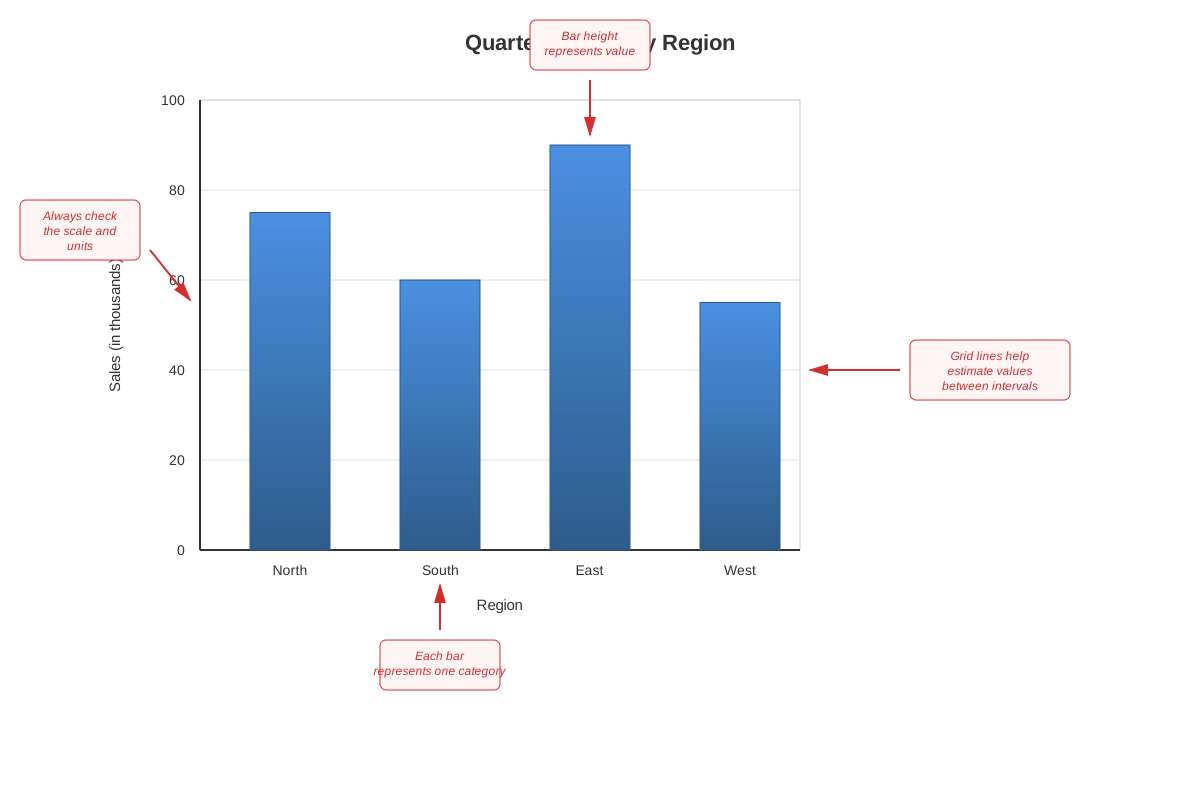
A bar chart (also called a bar graph) consists of rectangular bars positioned along two perpendicular axes. The categorical axis (typically horizontal for vertical bar charts) displays discrete categories such as years, products, regions, or demographic groups. The value axis (typically vertical for vertical bar charts) displays the quantitative scale representing the measured variable. Each bar's length or height corresponds to the value for its category, enabling visual comparison of magnitudes.
Critical components include: the chart title identifying the data being presented; axis labels specifying what each axis represents; axis scales showing the numerical range and intervals; bar labels identifying each category; and often a legend when multiple data series appear. GMAT bar charts may also include gridlines to facilitate value reading, though test-makers sometimes omit these to increase difficulty by requiring estimation skills.
Vertical vs. Horizontal Bar Charts
Vertical bar charts (column charts) position bars upward from a horizontal baseline, with categories along the x-axis and values along the y-axis. These work best for time-series data or when category names are short. Horizontal bar charts orient bars from left to right, with categories along the y-axis and values along the x-axis. Horizontal orientation proves superior for long category names or when ranking items from highest to lowest.
The orientation choice doesn't affect data interpretation fundamentally, but GMAT questions may use either format. Students must quickly identify which axis represents categories versus values, as misreading axes constitutes a common error source. Both formats follow identical interpretation principles: longer bars represent larger values, and comparisons involve assessing relative bar lengths.
Simple Bar Charts
Simple bar charts display a single variable across multiple categories, creating the most straightforward visualization type. For example, a simple bar chart might show annual revenue for five consecutive years, with each bar representing one year's total. Interpretation involves reading individual values, identifying maximum and minimum values, calculating differences between categories, and recognizing trends (increasing, decreasing, or fluctuating patterns).
GMAT questions on simple bar charts often require: identifying which category has the highest or lowest value; calculating the difference or ratio between two specific categories; determining percentage changes between consecutive categories; or finding the average across all categories. Mental math and estimation skills prove crucial, as calculators aren't permitted and exact calculations may be time-prohibitive.
Grouped Bar Charts
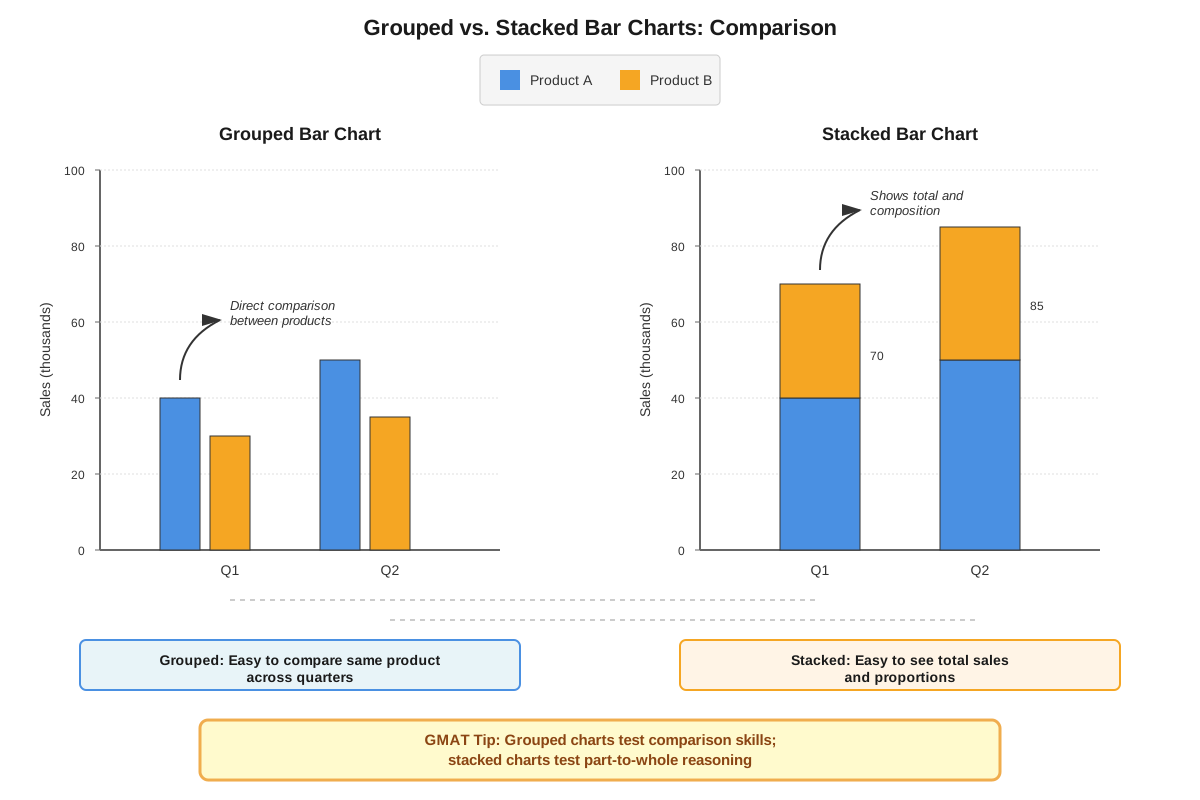
Grouped bar charts (clustered bar charts) display multiple related variables side-by-side for each category, enabling direct comparison both within and across categories. For instance, a grouped bar chart might show quarterly sales for three products, with three bars (one per product) grouped at each quarter position. Different colors or patterns distinguish the variables, with a legend identifying each.
Interpreting grouped bar charts requires tracking multiple dimensions simultaneously. Students must: compare bars within the same group (e.g., which product had highest sales in Q1); compare the same variable across groups (e.g., how Product A's sales changed from Q1 to Q4); identify overall trends for each variable; and calculate aggregate values (e.g., total sales across all products in Q2). GMAT questions frequently ask which variable showed the greatest percentage increase or which category had the smallest difference between variables.
Stacked Bar Charts
Stacked bar charts partition each bar into segments representing component parts of a total, with segments stacked vertically (or horizontally). Each segment's height represents its contribution to the category total, and the full bar height represents the sum of all components. For example, a stacked bar chart might show total company revenue by year, with each bar divided into segments for different product lines.
Stacked bar charts excel at showing both part-to-whole relationships and total values simultaneously. However, they present interpretation challenges: while the bottom segment's values are easy to read (starting from zero), upper segments require subtracting the lower boundary from the upper boundary. GMAT questions exploit this difficulty by asking about middle or top segments, requiring careful value extraction. Students must distinguish between questions asking about individual components versus total values.
Scale Interpretation and Estimation
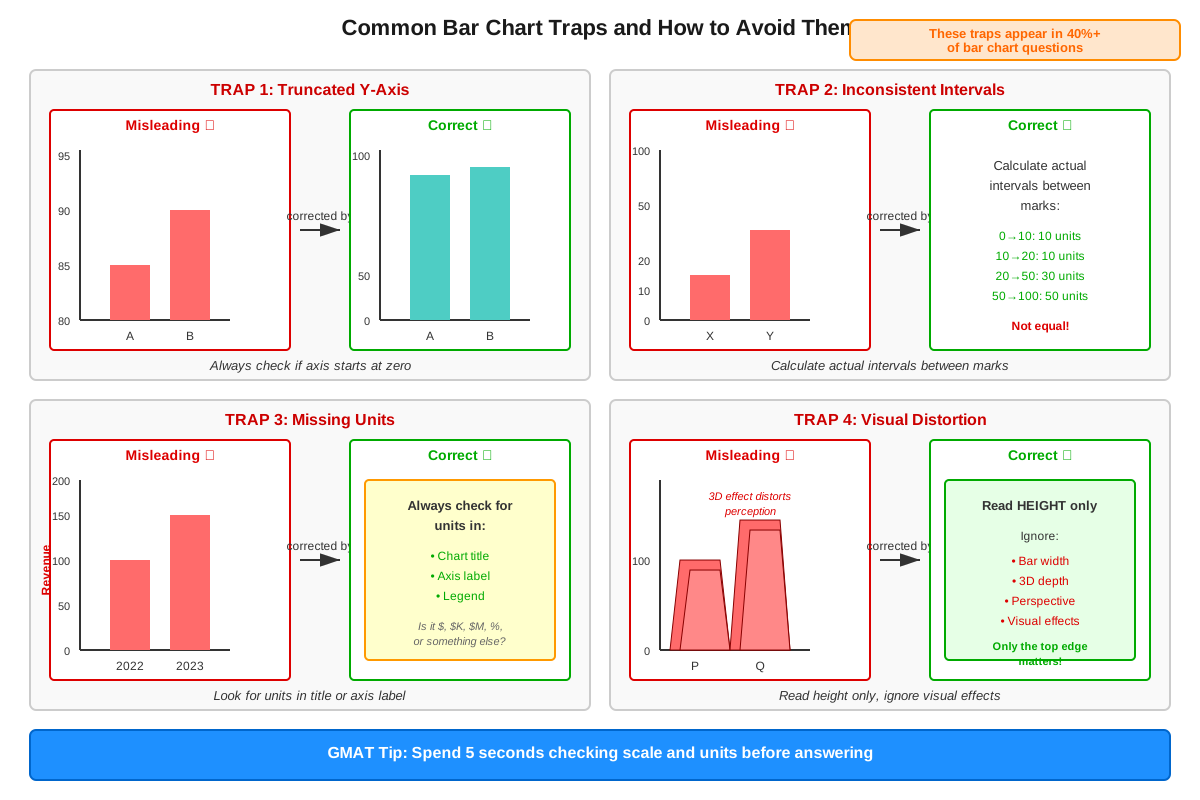
The scale on the value axis determines how bar heights translate to numerical values. GMAT bar charts may use various scale intervals (1, 2, 5, 10, 25, 50, 100, etc.), and recognizing the interval size is essential for accurate reading. Some charts begin at zero, while others use a truncated scale starting at a non-zero value to emphasize differences between similar values—a technique that can visually exaggerate differences.
Estimation skills become critical when bar heights fall between gridlines or when exact values aren't labeled. Students should practice estimating to the nearest scale interval and determining whether a bar is closer to one gridline or another. GMAT questions sometimes provide answer choices spaced sufficiently far apart that precise reading isn't necessary, rewarding efficient estimation over time-consuming precision.
Reading Values and Making Calculations
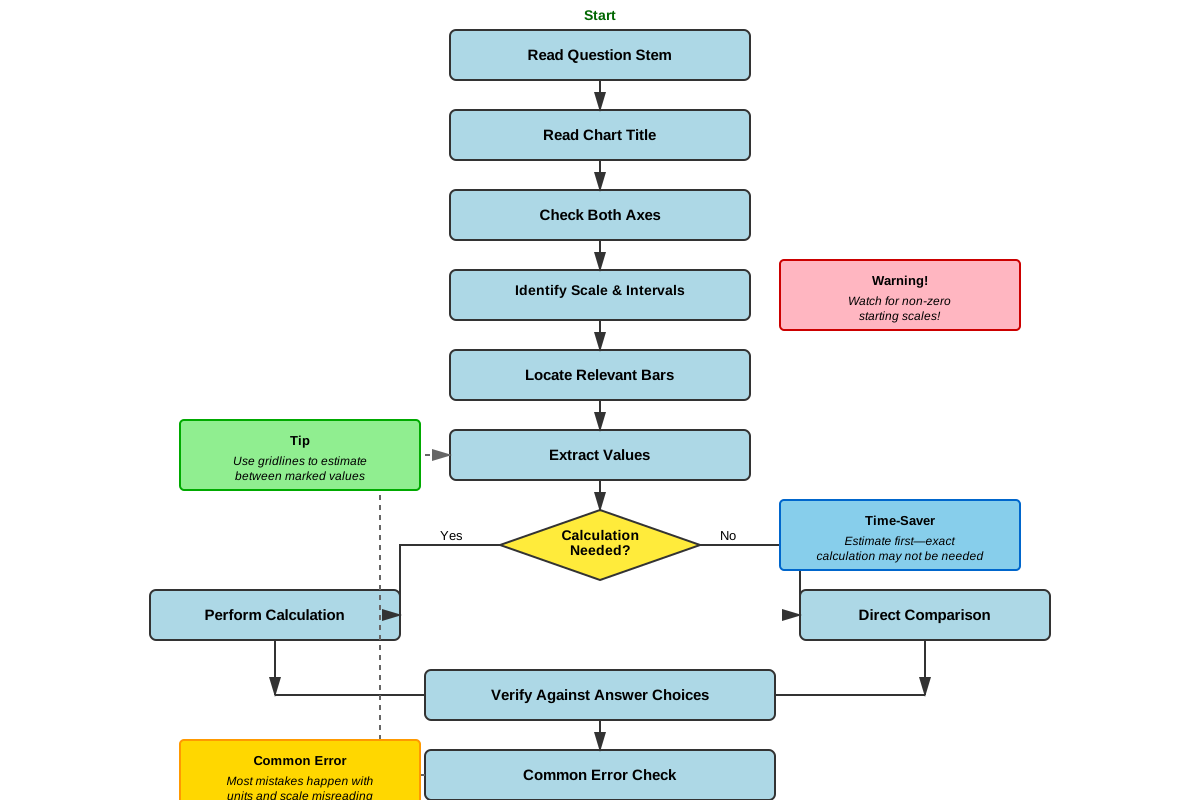
Extracting data from bar charts involves: locating the relevant bar(s); tracing horizontally (for vertical charts) or vertically (for horizontal charts) to the value axis; reading or estimating the value; and performing required calculations. Common calculations include:
- Absolute differences: Subtracting one bar's value from another
- Percentage changes: Calculating (New - Old) / Old × 100%
- Ratios: Dividing one value by another
- Totals: Summing multiple bar values
- Averages: Summing values and dividing by the count
- Proportions: Determining what fraction one value represents of a total
GMAT questions frequently require multi-step calculations combining several operations. For example: "By what percentage did Category A's value exceed the average of Categories B, C, and D?" This requires calculating the average of three values, finding the difference, and computing a percentage—all based on estimated bar readings.
Concept Relationships
Bar chart interpretation builds hierarchically from fundamental to advanced skills. Scale reading forms the foundation, enabling value extraction from individual bars. Value extraction enables comparison between bars, which leads to calculation of derived quantities (differences, ratios, percentages). These calculations support trend analysis and pattern recognition across multiple categories.
The relationship between simple, grouped, and stacked bar charts represents increasing complexity: simple bar charts → grouped bar charts (adding a second dimension of comparison) → stacked bar charts (adding part-to-whole relationships). Each type builds on skills from simpler types while introducing additional interpretation challenges.
Bar chart skills connect to broader Data Insights competencies: table analysis (both require extracting and comparing numerical values), line graphs (both show trends over time), pie charts (both display categorical data), and scatter plots (both use two-dimensional axes). The quantitative reasoning required for bar chart calculations directly applies to problem-solving questions involving percentages, ratios, and statistics.
Textual relationship map:
Scale identification → Value reading → Individual bar interpretation → Cross-bar comparison → Calculation of derived values → Statement evaluation → Answer selection
Quick check — test yourself on Bar charts so far.
Try Flashcards →High-Yield Facts
⭐ Bar length or height is directly proportional to the value represented—longer bars always indicate larger values when using the same scale.
⭐ The scale interval must be identified before reading any values—misreading the scale (e.g., thinking each gridline represents 10 when it represents 100) causes systematic errors.
⭐ In grouped bar charts, the legend identifies which color/pattern corresponds to which variable—always check the legend before making comparisons.
⭐ Stacked bar charts show both component values and totals—the top of the highest segment represents the sum of all components.
⭐ Percentage change calculations require the original value as the denominator—(New - Old) / Old, not (New - Old) / New.
- Horizontal bar charts and vertical bar charts contain identical information, just oriented differently—interpretation principles remain the same.
- When bars don't start at zero (truncated scale), visual differences appear exaggerated compared to actual numerical differences.
- Estimation is often sufficient for GMAT questions—answer choices are typically spaced to allow approximate readings.
- The category with the tallest bar has the maximum value; the shortest bar has the minimum value—this enables quick identification without precise reading.
- Calculating the difference between two bars requires subtraction; calculating the ratio requires division—don't confuse these operations.
- When comparing percentage changes across categories, the category with the largest absolute change may not have the largest percentage change—percentage change depends on the starting value.
- Missing bars or gaps in the chart indicate zero or no data for that category—don't assume missing data equals the baseline value.
- Gridlines facilitate reading but aren't always present—practice estimating values without gridlines.
- Multiple bar charts in the same question set may use different scales—always verify the scale for each chart independently.
- The order of categories (left to right or top to bottom) may be chronological, alphabetical, or ranked by value—understanding the ordering principle aids interpretation.
Common Misconceptions
Misconception: All bar charts start at zero on the value axis.
Correction: GMAT bar charts may use truncated scales starting at non-zero values to emphasize differences between similar values. Always check where the value axis begins, as truncated scales can make small differences appear visually dramatic.
Misconception: In stacked bar charts, each segment's height can be read directly from the value axis.
Correction: Only the bottom segment starts at zero and can be read directly. For upper segments, subtract the lower boundary value from the upper boundary value to find the segment's actual value. For example, if a segment extends from 40 to 65 on the axis, its value is 25, not 65.
Misconception: The tallest bar in a grouped bar chart represents the category with the highest total.
Correction: In grouped bar charts, each bar represents a single variable within a category, not a total. To find the category with the highest total, you must sum all bars within each group and compare those sums.
Misconception: Percentage change and percentage point change are the same.
Correction: Percentage change is relative: (New - Old) / Old × 100%. Percentage point change is absolute: New% - Old%. If a value increases from 20% to 30%, that's a 10 percentage point increase but a 50% percentage change.
Misconception: When a bar appears twice as tall as another, the value is exactly double.
Correction: This is only true when the scale starts at zero. With truncated scales, visual proportions don't match numerical proportions. A bar extending from 80 to 100 appears the same height as one extending from 0 to 20, but represents values of 100 vs. 20, not a 1:1 ratio.
Misconception: All bars in a chart use the same scale.
Correction: While most GMAT bar charts use consistent scales, occasionally dual-axis charts appear with different scales on left and right sides. Always verify which bars correspond to which axis.
Misconception: Estimation is less accurate than precise calculation.
Correction: For GMAT purposes, strategic estimation is often more efficient and equally effective. When answer choices differ by 10% or more, estimating to the nearest major gridline provides sufficient accuracy while saving valuable time.
Worked Examples
Example 1: Simple Bar Chart Analysis
Question: The bar chart shows annual smartphone sales (in millions) for Company X from 2018 to 2022. In 2018, sales were 120 million; 2019: 145 million; 2020: 135 million; 2021: 160 million; 2022: 180 million. In which year did Company X experience the greatest percentage increase in sales compared to the previous year?
Solution:
Step 1: Identify that we need percentage increases, not absolute increases. The formula is (New - Old) / Old × 100%.
Step 2: Calculate percentage change for each year compared to its previous year:
- 2019 vs. 2018: (145 - 120) / 120 = 25/120 ≈ 20.8%
- 2020 vs. 2019: (135 - 145) / 145 = -10/145 ≈ -6.9% (decrease)
- 2021 vs. 2020: (160 - 135) / 135 = 25/135 ≈ 18.5%
- 2022 vs. 2021: (180 - 160) / 160 = 20/160 = 12.5%
Step 3: Compare the percentage increases (ignoring 2020's decrease): 20.8% > 18.5% > 12.5%
Step 4: Identify 2019 as having the greatest percentage increase.
Key insight: The absolute increase from 2021 to 2022 (20 million) was smaller than from 2018 to 2019 (25 million), but we must calculate percentages relative to the starting value. This question tests whether students confuse absolute and relative changes—a common GMAT trap.
Example 2: Grouped Bar Chart with Multiple Comparisons
Question: A grouped bar chart displays quarterly revenue (in thousands) for three products. Q1: Product A = 80, Product B = 60, Product C = 90. Q2: Product A = 85, Product B = 75, Product C = 85. Q3: Product A = 95, Product B = 80, Product C = 80. Q4: Product A = 100, Product B = 90, Product C = 75. Which of the following statements is true?
I. Product A showed consistent revenue growth across all quarters.
II. Product C had the highest total revenue across all four quarters.
III. The difference between the highest and lowest revenue in Q4 was greater than in Q1.
Solution:
Step 1: Evaluate Statement I by checking if Product A increased each quarter:
Q1 to Q2: 80 → 85 (increase)
Q2 to Q3: 85 → 95 (increase)
Q3 to Q4: 95 → 100 (increase)
Statement I is TRUE.
Step 2: Evaluate Statement II by calculating total revenue for each product:
Product A total: 80 + 85 + 95 + 100 = 360
Product B total: 60 + 75 + 80 + 90 = 305
Product C total: 90 + 85 + 80 + 75 = 330
Product A has the highest total (360), not Product C.
Statement II is FALSE.
Step 3: Evaluate Statement III by finding the range in each quarter:
Q1 range: 90 - 60 = 30
Q4 range: 100 - 75 = 25
Q4's range (25) is less than Q1's range (30).
Statement III is FALSE.
Answer: Only Statement I is true.
Key insight: This question requires tracking multiple dimensions (products across quarters) and performing different types of calculations (trend analysis, summation, range calculation). Organized note-taking prevents errors when juggling multiple data points. The question also demonstrates how GMAT questions combine true and false statements to test comprehensive understanding.
Exam Strategy
Initial Assessment (5-10 seconds): Upon encountering a bar chart question, immediately identify: (1) chart type (simple, grouped, or stacked), (2) what the axes represent, (3) the scale and intervals on the value axis, and (4) the legend if present. This orientation prevents misinterpretation and guides your approach.
Trigger Words and Phrases: Watch for these high-frequency GMAT phrases that signal specific operations:
- "Greatest/largest increase" → Calculate differences and compare
- "Highest percentage change" → Calculate percentage changes, not absolute differences
- "Approximately" → Estimation is acceptable; don't waste time on precision
- "Ratio of X to Y" → Divide X by Y in that specific order
- "Total" or "sum" → Add multiple values
- "Average" or "mean" → Sum and divide by count
- "Closest to" → Round to the nearest answer choice
Process of Elimination: For statement evaluation questions (common in Graphics Interpretation), evaluate the easiest statement first to build confidence and potentially eliminate answer choices. If a statement involves simple reading of a single bar, verify it before tackling statements requiring complex calculations. For questions with numerical answer choices, eliminate obviously incorrect magnitudes before calculating precisely.
Time Management: Allocate approximately 2-2.5 minutes per bar chart question. Spend 15-20 seconds understanding the chart, 60-90 seconds extracting and calculating required values, and 30-45 seconds selecting and confirming your answer. If a calculation becomes complex, check whether estimation would suffice given the answer choice spacing. Don't pursue precision beyond what the question requires.
Common Traps to Avoid:
- Reading the wrong axis or misidentifying which axis represents values
- Forgetting to check the scale interval (assuming each gridline = 1 when it actually = 10)
- Calculating absolute differences when percentage changes are requested
- Using the wrong denominator in percentage change calculations
- In stacked charts, reading upper segment values directly instead of calculating segment height
- Comparing visual bar heights when scales differ or don't start at zero
Strategic Shortcuts: When comparing multiple bars, look for patterns before calculating. If all values are increasing, the last category has the maximum. If asked for the "closest to" a value, eliminate answers that are obviously too high or too low before calculating. For percentage change questions, if the absolute change is the same for two categories, the one with the smaller starting value has the larger percentage change.
Memory Techniques
SCALE Acronym for initial bar chart assessment:
- Structure: Identify chart type (simple, grouped, stacked)
- Categories: Note what the categorical axis represents
- Axis: Determine which axis shows values
- Legend: Check for color/pattern coding
- Examine: Verify the scale intervals and starting point
Percentage Change Formula Mnemonic: "New Over Old" → (New - Old) / Old
Remember: The denominator is always the Old (original) value, not the new value.
Stacked Bar Reading: Visualize "Subtract Segments" → For any segment except the bottom, subtract the lower boundary from the upper boundary to find its value.
Comparison Priority: "Absolute Before Percentage" → When questions ask about "greatest increase," first determine if they want absolute or percentage. Absolute = simple subtraction; Percentage = requires division by original.
Grouped vs. Stacked:
- Grouped = bars Go side-by-side (like a group of people standing next to each other)
- Stacked = bars Sit on top of each other (like a stack of pancakes)
Summary
Bar charts represent essential data visualization tools that appear frequently throughout the GMAT Data Insights section, requiring students to extract, compare, and calculate values from graphical representations. Mastery involves understanding three primary chart types—simple bar charts showing one variable across categories, grouped bar charts comparing multiple variables side-by-side, and stacked bar charts displaying component breakdowns of totals. Success requires systematic skills: identifying chart structure and components, reading scales accurately, extracting values through direct reading or estimation, comparing bars within and across categories, and performing calculations including differences, ratios, percentages, and averages. Common GMAT question patterns include identifying maximum or minimum values, calculating percentage changes, determining ratios between categories, and evaluating statement accuracy based on visual evidence. Students must avoid frequent pitfalls such as misreading scales, confusing absolute and percentage changes, incorrectly reading stacked bar segments, and pursuing unnecessary precision when estimation suffices. Strategic approaches include rapid initial assessment using the SCALE framework, recognizing trigger words that signal specific operations, efficient time allocation of 2-2.5 minutes per question, and leveraging process of elimination for statement evaluation questions.
Key Takeaways
- Bar charts use rectangular bar lengths or heights to represent quantitative values across categorical data, with three main types: simple, grouped, and stacked
- Always verify the scale interval and starting point before reading values—truncated scales and varying intervals are common sources of error
- Percentage change calculations require the original value as the denominator: (New - Old) / Old × 100%, not (New - Old) / New
- In stacked bar charts, only the bottom segment can be read directly; upper segments require subtracting the lower boundary from the upper boundary
- Strategic estimation often provides sufficient accuracy for GMAT questions—prioritize efficiency over unnecessary precision when answer choices are widely spaced
- Grouped bar charts enable both within-category comparisons (across variables) and across-category comparisons (same variable over time or categories)
- Common GMAT traps include confusing absolute differences with percentage changes, misreading scales, and comparing visual proportions when scales don't start at zero
Related Topics
Line Graphs: Building on bar chart skills, line graphs display continuous data and trends over time, requiring similar value-reading abilities but adding slope interpretation and trend analysis. Mastering bar charts provides the foundation for understanding how data points connect to show rates of change.
Pie Charts: While bar charts excel at comparing absolute values across categories, pie charts emphasize proportional relationships and part-to-whole comparisons. Understanding both visualization types enables comprehensive data interpretation across different presentation formats.
Table Analysis: Bar charts often appear alongside data tables in Multi-Source Reasoning questions, requiring integration of graphical and tabular information. Skills in extracting and comparing values transfer directly between these formats.
Scatter Plots: Advanced data visualization combining two quantitative variables, scatter plots build on the two-axis framework introduced in bar charts while adding correlation and distribution analysis.
Multi-Source Reasoning: This question type frequently combines bar charts with text passages and tables, requiring synthesis of information across multiple sources—the ultimate application of bar chart interpretation skills.
Practice CTA
Now that you've mastered the fundamentals of bar chart interpretation, it's time to solidify your skills through deliberate practice. Attempt the practice questions associated with this topic, focusing on applying the SCALE framework for initial assessment and the strategic approaches outlined in the exam strategy section. Use the flashcards to reinforce high-yield facts and formulas, particularly percentage change calculations and the distinctions between chart types. Remember: bar chart questions reward systematic thinking and efficient execution—qualities you develop through focused practice. Each question you work through builds the pattern recognition and calculation speed that separate good GMAT scores from great ones. You've got this!
Sign up free to keep reading
Create a free AnvayaPrep account to finish this GMAT guide on Bar charts — plus flashcards and practice questions.