Overview
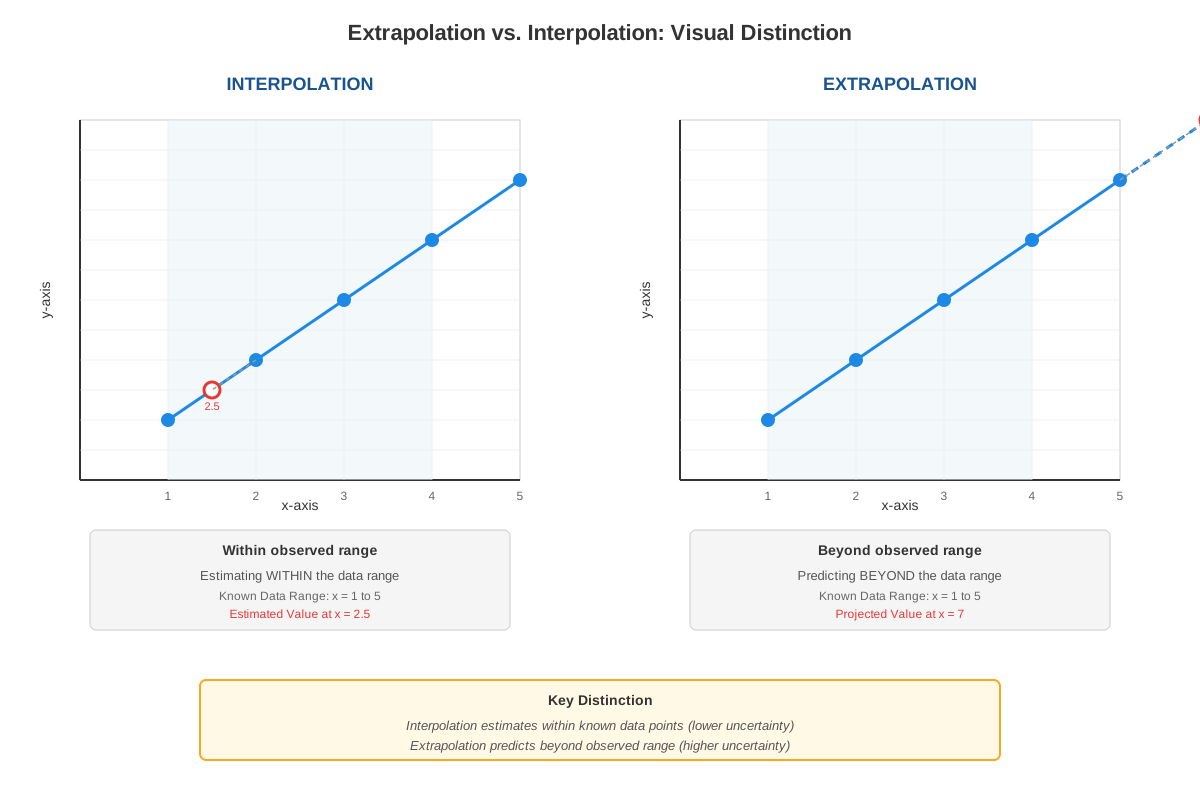
Extrapolation is a critical analytical skill tested in the GMAT Data Insights section, particularly within Graphics Interpretation questions. This technique involves extending known data patterns beyond the observed range to make predictions or estimates about values that fall outside the given dataset. Unlike interpolation, which estimates values within the existing data range, extrapolation requires test-takers to project trends forward or backward based on established patterns in charts, graphs, and tables.
On the GMAT, GMAT extrapolation questions assess a candidate's ability to analyze visual data representations, identify underlying trends, and make logical inferences about data points that aren't explicitly shown. These questions frequently appear in two-part analysis formats where students must complete statements by selecting values from dropdown menus based on their extrapolated calculations. The ability to extrapolate accurately demonstrates quantitative reasoning, pattern recognition, and the capacity to make data-driven predictions—skills essential for business school success and real-world decision-making.
Extrapolation connects fundamentally to other Data Insights concepts including trend analysis, rate of change calculations, and graphical interpretation. Mastering this topic enables students to tackle complex multi-source reasoning questions and table analysis problems where complete datasets aren't provided. The skill bridges quantitative reasoning with critical thinking, requiring both mathematical precision and logical judgment about when extrapolation is appropriate and reliable.
Learning Objectives
- [ ] Identify extrapolation scenarios in GMAT Data Insights questions
- [ ] Explain the difference between extrapolation and interpolation
- [ ] Apply extrapolation techniques to solve GMAT Graphics Interpretation questions
- [ ] Evaluate the reliability and limitations of extrapolated predictions
- [ ] Calculate extrapolated values using linear and non-linear trends
- [ ] Recognize when extrapolation assumptions are violated or inappropriate
Prerequisites
- Basic graph reading skills: Understanding axes, scales, and coordinate systems is essential for identifying the data points from which extrapolation begins
- Linear equations and slope concepts: Calculating rates of change and extending linear trends requires comfort with slope-intercept form and linear relationships
- Percentage calculations: Many extrapolation questions involve percentage growth rates or compound changes over time
- Pattern recognition: Identifying whether trends are linear, exponential, or follow other patterns determines the appropriate extrapolation method
Why This Topic Matters
Extrapolation represents a fundamental business analytics skill that managers and consultants use daily to forecast sales, predict market trends, estimate future costs, and make strategic decisions based on historical data. In corporate settings, professionals regularly extend known performance metrics to project quarterly results, anticipate resource needs, and evaluate investment opportunities. The GMAT tests this skill because business school curricula heavily emphasize data-driven decision-making and predictive analytics.
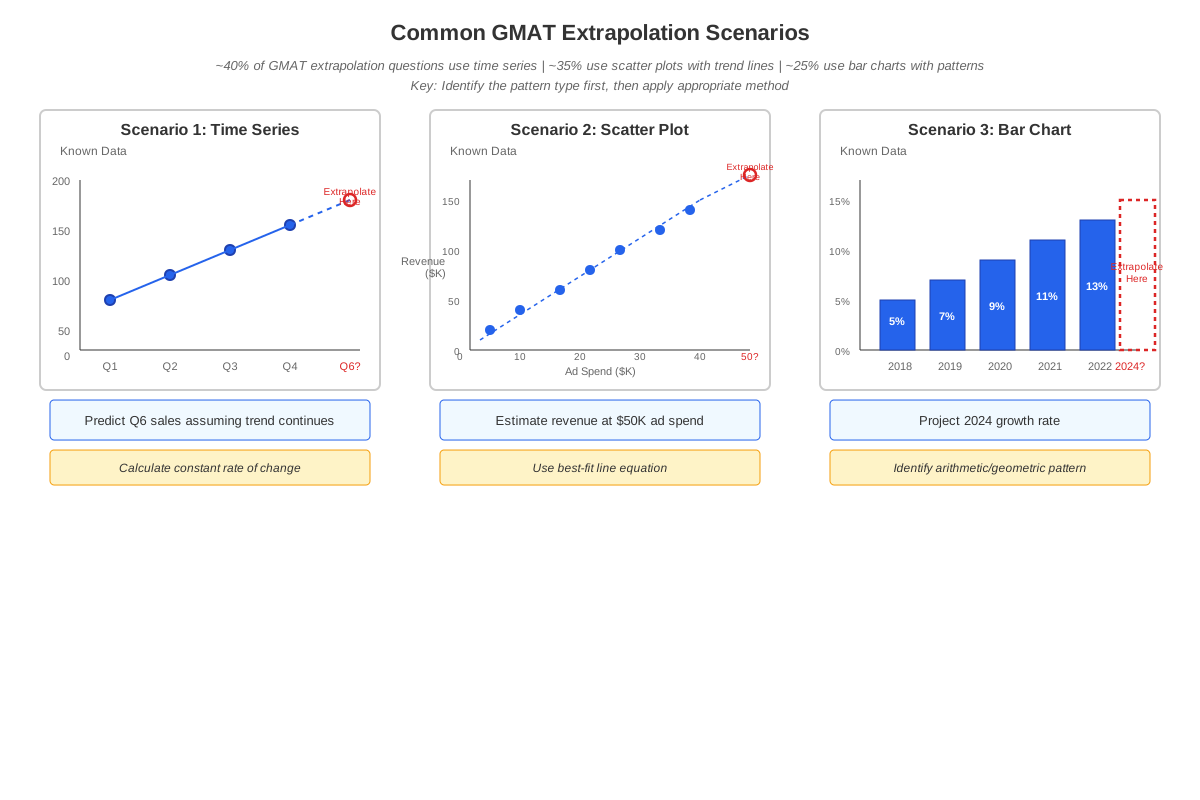
On the GMAT, extrapolation appears in approximately 15-20% of Data Insights questions, making it a high-frequency topic that significantly impacts section scores. These questions most commonly appear in Graphics Interpretation formats where students must complete two statements by selecting correct values from dropdown menus. The questions typically present line graphs, scatter plots, or bar charts showing trends over time or across categories, then ask students to predict values for time periods or categories not explicitly shown in the visualization.
Common exam scenarios include: projecting sales figures for future quarters based on historical growth rates, estimating population values for years beyond the dataset, predicting market share percentages if current trends continue, and calculating expected values for variables outside the measured range. The GMAT specifically tests whether students can distinguish between reasonable extrapolations (extending clear, stable trends over short distances) and unreliable ones (projecting volatile data far beyond the observed range).
Core Concepts
Definition and Fundamental Principles
Extrapolation is the process of estimating unknown values by extending a known sequence of values or facts beyond the area that is known with certainty. In the context of GMAT Data Insights, this means using patterns observed in graphical data to predict values that fall outside the range of the presented dataset. The fundamental assumption underlying extrapolation is that the pattern or trend observed within the known data will continue in the same manner beyond the observed range.
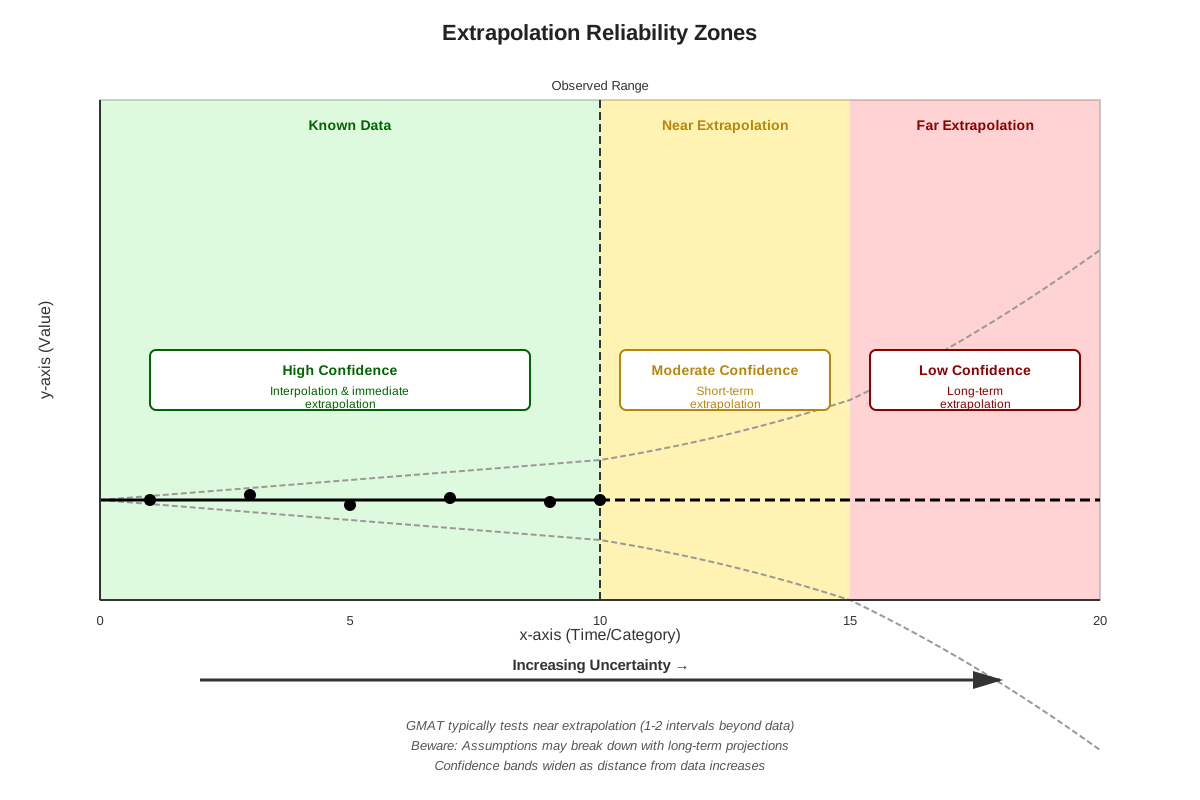
The reliability of extrapolation depends critically on three factors: the stability of the underlying trend, the distance of the extrapolation from known data, and the presence of external factors that might disrupt the pattern. Short-range extrapolations from stable, well-established trends tend to be more reliable than long-range projections from volatile or limited datasets.
Linear Extrapolation
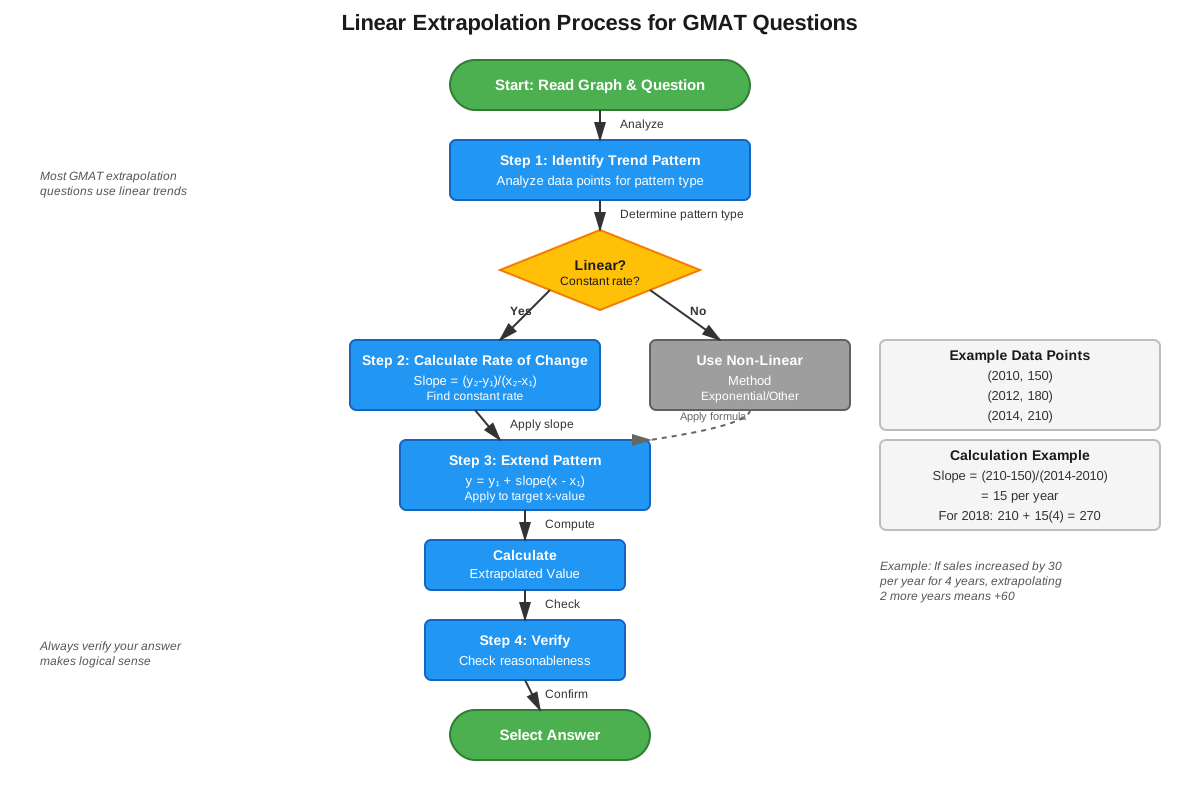
Linear extrapolation is the most common type tested on the GMAT. This method assumes that the relationship between variables follows a straight line, meaning the rate of change remains constant. When examining a line graph or scatter plot, linear extrapolation involves:
- Identifying two or more points that establish the trend
- Calculating the slope (rate of change) between these points
- Extending the line beyond the known data range
- Reading or calculating the value at the desired point
For example, if a company's revenue increased from $200 million in Year 1 to $250 million in Year 2, the linear rate of increase is $50 million per year. Extrapolating to Year 3 would predict revenue of $300 million, assuming the same rate continues.
Non-Linear Extrapolation
While less common on the GMAT, non-linear extrapolation involves extending curved trends such as exponential growth, logarithmic patterns, or polynomial relationships. These questions require recognizing that the rate of change itself is changing. For instance, exponential growth patterns show increasing rates of change over time—each period's growth is a percentage of the previous value rather than a fixed amount.
When encountering curved trend lines, students must identify whether the curve represents accelerating growth (exponential), decelerating growth (logarithmic), or cyclical patterns. The GMAT typically provides enough visual information to determine the pattern type without requiring complex calculations.
Extrapolation vs. Interpolation
Understanding the distinction between these two techniques is crucial for GMAT success:
| Aspect | Extrapolation | Interpolation |
|---|---|---|
| Data Range | Beyond the observed data | Within the observed data |
| Risk Level | Higher uncertainty | Lower uncertainty |
| Assumptions | Trend continues unchanged | Pattern holds between points |
| GMAT Frequency | High | Moderate |
| Reliability | Decreases with distance | Generally stable |
Identifying Extrapolation Opportunities
On the GMAT, certain visual and textual cues signal extrapolation questions:
- Graphs with time series data where questions ask about future or past periods not shown
- Scatter plots with trend lines where questions reference values beyond the plotted points
- Bar charts showing sequential data with questions about the "next" category
- Phrases like "if the trend continues," "projected value," "estimated for," or "assuming the same rate"
Calculating Extrapolated Values
The systematic approach to calculating extrapolated values involves:
- Identify the known points: Locate at least two clear data points that establish the trend
- Calculate the rate of change: Determine the slope or growth rate between points
- Determine the distance: Calculate how many units (years, categories, etc.) beyond the data you need to project
- Apply the rate: Multiply the rate of change by the distance and add to (or subtract from) the last known value
- Verify reasonableness: Check whether the answer makes logical sense given the context
Limitations and Reliability Considerations
The GMAT occasionally tests understanding of when extrapolation becomes unreliable. Key limitations include:
- Distance decay: Predictions become less reliable as they move further from known data
- Assumption violations: External factors may disrupt established trends (market changes, policy shifts, technological disruptions)
- Data volatility: Highly variable data produces unreliable extrapolations
- Sample size: Trends based on only two or three points are less reliable than those based on many observations
- Boundary effects: Physical, economic, or logical limits may prevent trends from continuing indefinitely
Concept Relationships
Extrapolation builds directly upon fundamental graph reading skills, as students must first accurately interpret the presented data before extending it. The relationship flows: Graph Reading → Pattern Recognition → Trend Analysis → Extrapolation → Prediction Evaluation.
Within the Graphics Interpretation unit, extrapolation connects closely to rate of change calculations. Understanding whether a trend shows constant rate (linear), increasing rate (exponential), or decreasing rate (logarithmic) determines the appropriate extrapolation method. This relationship can be mapped as: Rate of Change Analysis → Trend Classification → Extrapolation Method Selection → Value Calculation.
Extrapolation also relates to the broader Data Insights skill of making inferences from incomplete information. Both table analysis and multi-source reasoning questions may require extrapolating from partial datasets to answer questions about scenarios not explicitly covered in the provided materials. The connection follows: Incomplete Data Recognition → Pattern Identification → Logical Extension → Inference Validation.
The topic connects backward to prerequisite knowledge of linear equations, where the slope-intercept form (y = mx + b) provides the mathematical foundation for linear extrapolation. It connects forward to more advanced business analytics concepts like forecasting, regression analysis, and predictive modeling that students will encounter in business school quantitative courses.
High-Yield Facts
⭐ Extrapolation extends data patterns beyond the observed range, while interpolation estimates values within the range
⭐ Linear extrapolation assumes a constant rate of change and is the most common type on the GMAT
⭐ The reliability of extrapolation decreases as the distance from known data increases
⭐ Phrases like "if the trend continues" or "assuming the same rate" signal extrapolation questions
⭐ Extrapolated values should always be verified for logical reasonableness given the context
- Exponential extrapolation involves percentage-based growth where each period's increase is proportional to the previous value
- GMAT extrapolation questions typically appear in Graphics Interpretation with dropdown menu answer formats
- Scatter plots with trend lines are common visual formats for testing extrapolation skills
- Extrapolation questions often combine multiple skills: graph reading, rate calculation, and logical reasoning
- The GMAT may test recognition of when extrapolation is inappropriate due to data volatility or external factors
- Time series data (values plotted over sequential time periods) is the most frequent context for extrapolation questions
- Calculating the slope between two clear points provides the foundation for linear extrapolation
- Non-linear extrapolation questions provide sufficient visual cues to identify the pattern type without complex mathematics
Quick check — test yourself on Extrapolation so far.
Try Flashcards →Common Misconceptions
Misconception: Extrapolation and interpolation are the same process → Correction: Extrapolation projects beyond the known data range and carries higher uncertainty, while interpolation estimates values between known points within the dataset and is generally more reliable.
Misconception: All trends can be reliably extrapolated indefinitely into the future → Correction: Extrapolation reliability decreases with distance from known data, and external factors, physical limits, or changing conditions often prevent trends from continuing unchanged over long periods.
Misconception: Extrapolation always requires complex mathematical calculations → Correction: GMAT extrapolation questions typically involve straightforward rate-of-change calculations or visual estimation from clearly presented trend lines; the test emphasizes logical reasoning over computational complexity.
Misconception: If a graph shows any upward trend, extrapolated values will always be higher than the last observed point → Correction: The direction of extrapolation depends on which direction you're projecting; extrapolating backward in time from an upward trend yields lower values, and the rate of change determines the magnitude of difference.
Misconception: Extrapolation requires identifying the exact mathematical formula underlying the data → Correction: The GMAT tests practical extrapolation skills based on visual pattern recognition and basic rate calculations, not deriving complex equations; recognizing whether a trend is approximately linear or curved is sufficient.
Misconception: More data points always make extrapolation more accurate → Correction: While more data generally helps establish trends, highly volatile data with many points can be less reliable for extrapolation than stable data with fewer points; consistency of the pattern matters more than quantity alone.
Worked Examples
Example 1: Linear Extrapolation from a Line Graph
Question: The graph below shows a company's annual revenue from 2018 to 2022. If the trend continues at the same rate, what would be the projected revenue for 2024?
Year    Revenue ($ millions)
2018    120
2019    145
2020    170
2021    195
2022 220Solution:
Step 1: Identify the pattern. Examining the data, we see consistent increases:
- 2018 to 2019: 145 - 120 = 25 million increase
- 2019 to 2020: 170 - 145 = 25 million increase
- 2020 to 2021: 195 - 170 = 25 million increase
- 2021 to 2022: 220 - 195 = 25 million increase
Step 2: Recognize this as linear growth with a constant rate of change of $25 million per year.
Step 3: Determine the distance to extrapolate. From 2022 to 2024 is 2 years.
Step 4: Calculate the extrapolated value:
- 2023 projected revenue: 220 + 25 = 245 million
- 2024 projected revenue: 245 + 25 = 270 million
Alternatively: 220 + (25 × 2) = 270 million
Step 5: Verify reasonableness. The answer of $270 million continues the established pattern logically and represents reasonable business growth.
Answer: $270 million
Connection to Learning Objectives: This example demonstrates identifying extrapolation (projecting beyond 2022), explaining the process (linear trend with constant rate), and applying the technique to calculate a specific value.
Example 2: Evaluating Extrapolation Reliability
Question: A scatter plot shows the relationship between advertising spending (x-axis, in thousands of dollars) and monthly sales (y-axis, in units sold) for a product. The data points range from $10,000 to $50,000 in advertising spending, showing a clear positive linear trend. The trend line equation is approximately y = 2x + 1000. Which of the following statements is most accurate?
A) Extrapolating to predict sales at $100,000 advertising spending would be highly reliable
B) Extrapolating to predict sales at $60,000 advertising spending would be reasonably reliable
C) The trend line cannot be used for any extrapolation beyond $50,000
D) Extrapolation is only valid for advertising spending below $10,000
Solution:
Step 1: Understand the known data range: $10,000 to $50,000 (a $40,000 range).
Step 2: Evaluate each option's extrapolation distance and reasonableness:
Option A: $100,000 is $50,000 beyond the maximum observed value—double the entire observed range. This represents long-range extrapolation with high uncertainty. Market saturation, diminishing returns, or other factors likely prevent the linear trend from continuing indefinitely. Not reliable.
Option B: $60,000 is $10,000 beyond the maximum observed value—only 25% beyond the known range. This represents short-range extrapolation from a well-established trend. While some uncertainty exists, this is a reasonable projection assuming no major market changes. Most reliable option.
Option C: This is too absolute. Short-range extrapolation from stable trends is a standard analytical practice. Too restrictive.
Option D: This suggests backward extrapolation below the minimum value, which faces similar reliability issues as forward extrapolation, plus the data shows the trend within the $10,000-$50,000 range, not below it. Incorrect direction and logic.
Step 3: Apply the reliability principle that short-range extrapolation from stable trends is reasonably reliable, while long-range extrapolation carries high uncertainty.
Answer: B
Connection to Learning Objectives: This example addresses evaluating the reliability and limitations of extrapolated predictions and recognizing when extrapolation assumptions might be violated.
Exam Strategy
When approaching GMAT extrapolation questions, follow this systematic process:
Step 1: Identify the question type. Look for trigger phrases: "if the trend continues," "projected," "estimated," "assuming the same rate," or questions asking about time periods/categories beyond the graph's range. These signal extrapolation rather than direct data reading.
Step 2: Examine the graph carefully. Identify the axes, scale, units, and the range of data presented. Note the first and last data points clearly, as these define the boundary between interpolation (within) and extrapolation (beyond).
Step 3: Determine the trend type. Is the pattern linear (straight line or consistent changes), exponential (accelerating curve), or another pattern? For GMAT purposes, assume linear unless the visual clearly shows curvature.
Step 4: Calculate the rate of change. For linear trends, find the slope using any two clear points: (change in y) / (change in x). For time series, this often simplifies to the change per time period.
Step 5: Apply the rate systematically. Count how many units beyond the data you need to project, multiply by the rate, and add to (or subtract from) the last known value. Show your work mentally to avoid arithmetic errors.
Exam Tip: When dropdown menus offer answer choices, eliminate options that violate the trend direction (e.g., decreasing values when the trend is clearly increasing) or that represent unreasonably large jumps from the last known data point.
Time allocation: Graphics Interpretation questions typically allow 2.5 minutes per two-part question. Spend approximately:
- 30 seconds reading and understanding the graph
- 45 seconds on the first statement (often more straightforward)
- 60 seconds on the second statement (often requires extrapolation)
- 15 seconds reviewing both answers for logical consistency
Process-of-elimination tips:
- Eliminate answers that reverse the trend direction
- Eliminate extreme values that project far beyond reasonable extension of the pattern
- Eliminate answers that ignore the established rate of change
- When uncertain between two close values, choose the one requiring shorter-range extrapolation
Common trigger words to watch for:
- "If this trend continues..."
- "Projected value for..."
- "Estimated... for [year/category beyond the data]"
- "Assuming the same rate..."
- "Expected to reach... in [future period]"
- "Would have been... in [past period before data begins]"
Memory Techniques
EXTRA Mnemonic for the extrapolation process:
- Examine the graph and identify the range
- X-amine the trend type (linear, exponential, etc.)
- Track the rate of change between clear points
- Reach beyond the data by applying the rate
- Assess whether the answer is reasonable
Visual Memory Aid: Picture extrapolation as "extra-polation"—you're going the "extra" distance beyond the poles (endpoints) of your data. Interpolation stays "inter" (between) the poles.
The Distance-Reliability Rule: Remember "near is clear, far is fear"—short-range extrapolations near the data are clearer and more reliable, while long-range extrapolations far from the data should inspire caution.
Linear vs. Exponential Recognition: Linear trends show the same absolute change each period (adding a constant), while exponential trends show the same percentage change each period (multiplying by a constant). Remember: "Linear adds, exponential multiplies."
Summary
Extrapolation is a high-yield GMAT Data Insights skill that involves extending observed data patterns beyond the known range to predict values for time periods, categories, or variables not explicitly shown in graphs or tables. The technique requires identifying stable trends, calculating rates of change, and systematically applying those rates to project values forward or backward from the dataset boundaries. Linear extrapolation, which assumes constant rates of change, represents the most common type tested on the GMAT and appears frequently in Graphics Interpretation questions with dropdown menu formats. Success requires not only mechanical calculation skills but also judgment about extrapolation reliability—recognizing that short-range projections from stable trends are reasonably reliable while long-range projections carry increasing uncertainty. The GMAT tests whether students can distinguish extrapolation from interpolation, apply appropriate calculation methods, and evaluate when assumptions underlying extrapolation might be violated by external factors or data volatility. Mastering this topic enables students to tackle approximately 15-20% of Data Insights questions and demonstrates the data-driven decision-making skills essential for business school success.
Key Takeaways
- Extrapolation projects data patterns beyond the observed range, while interpolation estimates values within the range—understanding this distinction is fundamental to GMAT success
- Linear extrapolation, assuming constant rates of change, is the most frequently tested type and requires calculating slope between clear points then extending the pattern
- Reliability decreases with extrapolation distance; short-range projections from stable trends are reasonably reliable, while long-range projections carry high uncertainty
- Trigger phrases like "if the trend continues" or "assuming the same rate" signal extrapolation questions requiring pattern extension rather than direct data reading
- Systematic process: identify the trend type, calculate the rate of change, determine the projection distance, apply the rate, and verify reasonableness
- Always evaluate whether extrapolated values make logical sense given the context—eliminate extreme values that represent unreasonable extensions
- Graphics Interpretation questions with dropdown menus are the most common format for testing extrapolation skills on the GMAT
Related Topics
Interpolation: The complementary skill of estimating values within the observed data range; mastering extrapolation naturally leads to understanding interpolation, and together these techniques provide complete coverage of estimation from graphical data.
Rate of Change and Slope Calculations: The mathematical foundation underlying linear extrapolation; deeper understanding of slope concepts enhances extrapolation accuracy and speed.
Exponential Growth and Decay: Advanced pattern recognition for non-linear trends; after mastering linear extrapolation, students can tackle questions involving accelerating or decelerating patterns.
Regression Analysis and Trend Lines: The statistical methods that formalize extrapolation techniques; understanding these concepts provides theoretical grounding for the practical extrapolation skills tested on the GMAT.
Forecasting and Predictive Analytics: Business applications of extrapolation that students will encounter in MBA coursework; GMAT extrapolation skills directly transfer to case studies and quantitative business courses.
Practice CTA
Now that you've mastered the concepts, techniques, and strategies for GMAT extrapolation questions, it's time to reinforce your learning through active practice. Attempt the practice questions associated with this topic, focusing on applying the systematic process outlined in the exam strategy section. Use the flashcards to drill high-yield facts and common misconceptions until you can identify extrapolation scenarios instantly and calculate projected values confidently. Remember that extrapolation appears in 15-20% of Data Insights questions—your investment in mastering this topic will directly impact your GMAT score. Each practice question you complete builds the pattern recognition and calculation speed essential for test-day success. You've got this!
Sign up free to keep reading
Create a free AnvayaPrep account to finish this GMAT guide on Extrapolation — plus flashcards and practice questions.