Overview
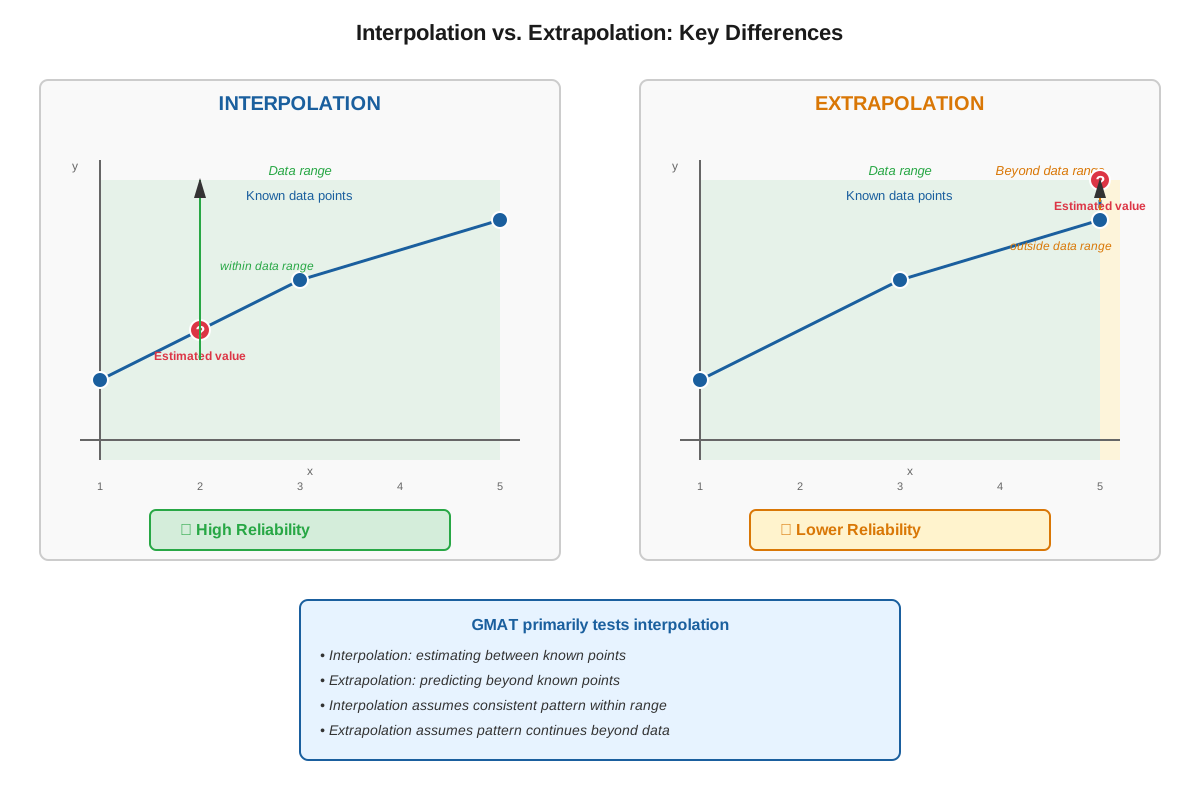
Interpolation is a fundamental analytical skill tested extensively in the GMAT Data Insights section, particularly within Graphics Interpretation questions. This technique involves estimating unknown values that fall between two known data points on a graph, chart, or table. Unlike extrapolation, which extends beyond the given data range, interpolation works within the boundaries of provided information, making it a more reliable and frequently tested skill on standardized exams.
The GMAT regularly presents candidates with complex visual data representations—scatter plots, line graphs, bar charts, and multi-axis displays—where not every data point is explicitly labeled or where precise values must be determined from visual inspection. GMAT interpolation questions assess a test-taker's ability to read graphical information accurately, estimate intermediate values proportionally, and apply logical reasoning to derive answers that aren't immediately obvious from the visual display. This skill bridges quantitative reasoning with data interpretation, making it essential for success in the Data Insights section.
Mastering interpolation connects directly to broader Data Insights competencies, including reading and interpreting various graph types, understanding scale and proportion, and making data-driven inferences. This topic serves as a foundation for more complex analytical tasks such as trend analysis, rate of change calculations, and comparative data evaluation—all critical components of the GMAT's integrated reasoning framework.
Learning Objectives
- [ ] Identify Interpolation in various graphical representations and data displays
- [ ] Explain Interpolation methodology and the mathematical principles underlying estimation between data points
- [ ] Apply Interpolation to GMAT questions involving line graphs, scatter plots, and other visual data formats
- [ ] Distinguish between interpolation and extrapolation in exam contexts
- [ ] Calculate interpolated values using proportional reasoning and linear approximation
- [ ] Evaluate the accuracy and appropriateness of interpolation techniques for different data patterns
Prerequisites
- Basic graph reading skills: Understanding axes, scales, labels, and coordinate systems is essential for locating data points and estimating intermediate values
- Proportional reasoning: Interpolation relies heavily on understanding ratios and proportions to estimate values between known points
- Linear relationships: Familiarity with how values change consistently between two points enables accurate estimation
- Fraction and decimal operations: Precise interpolation often requires calculating fractional distances along axes or between gridlines
Why This Topic Matters
Interpolation represents one of the most practical analytical skills tested on the GMAT because it mirrors real-world business decision-making. Executives, analysts, and managers regularly work with incomplete datasets, requiring them to make reasonable estimates based on available information. Whether projecting quarterly performance between reported periods, estimating market share from visual presentations, or determining resource allocation from trend data, interpolation skills prove invaluable in professional contexts.
On the GMAT specifically, interpolation appears in approximately 15-25% of Data Insights questions, making it a high-frequency topic that significantly impacts overall scores. The exam typically presents interpolation challenges through:
- Graphics Interpretation questions where candidates must select values from dropdown menus based on visual data analysis
- Multi-Source Reasoning questions combining graphical and tabular data requiring cross-referencing and estimation
- Table Analysis questions where sorting and interpolating between data ranges becomes necessary
- Integrated reasoning scenarios that blend quantitative and verbal analysis with visual interpretation
The GMAT favors interpolation questions because they efficiently test multiple competencies simultaneously: visual-spatial reasoning, numerical estimation, proportional thinking, and attention to detail. Questions often feature graphs without gridlines at every interval, unlabeled intermediate points, or scales requiring careful calculation—all designed to assess genuine analytical capability rather than simple data lookup.
Core Concepts
Definition and Fundamental Principles
Interpolation is the process of estimating an unknown value that falls between two known values within a dataset. The term derives from the Latin "inter" (between) and "polire" (to polish), suggesting the refinement of information between established points. In GMAT contexts, interpolation most commonly involves visual data interpretation where test-takers must determine values not explicitly marked on graphs or charts.
The fundamental assumption underlying interpolation is that data behaves predictably between known points. For GMAT purposes, this typically means assuming linear interpolation—the simplest form where values change at a constant rate between two points. While real-world data may follow curved or non-linear patterns, GMAT questions generally present scenarios where linear approximation provides sufficiently accurate estimates.
Linear Interpolation Methodology
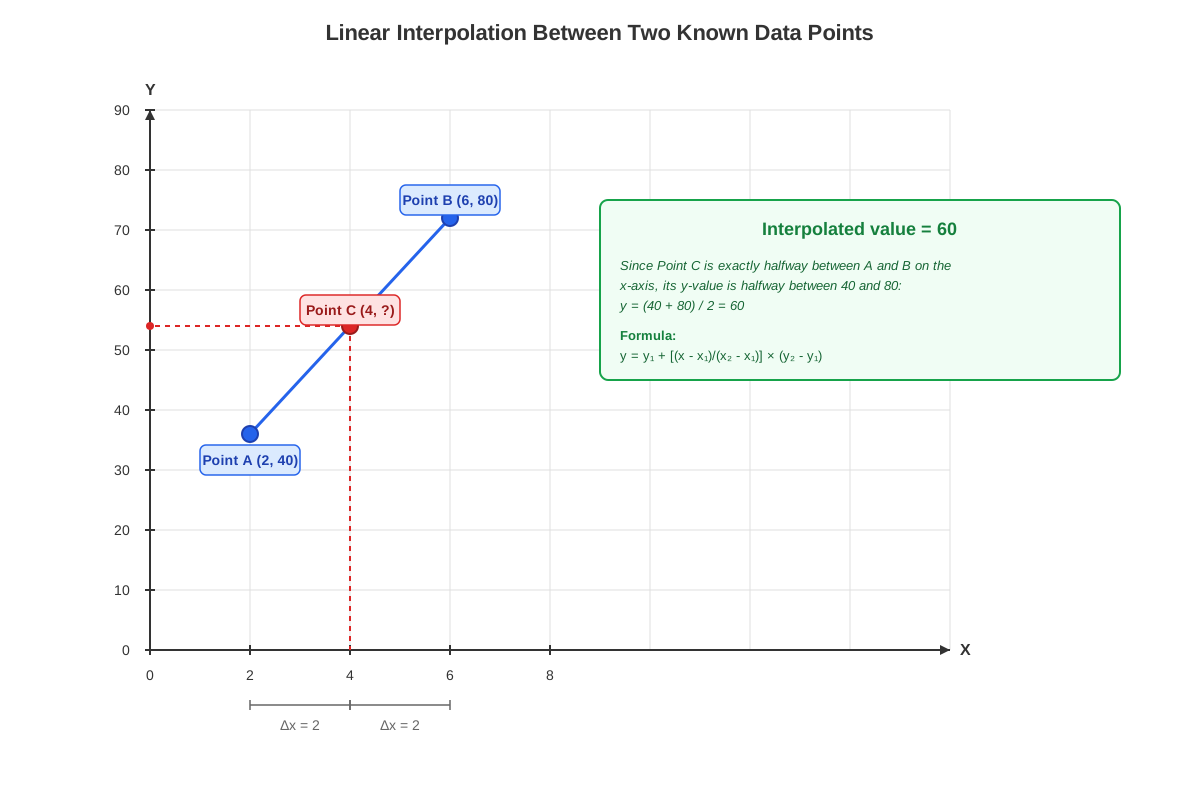
Linear interpolation follows a straightforward proportional relationship. Given two known points (x₁, y₁) and (x₂, y₂), the interpolated value y at position x can be calculated using:
y = y₁ + (x - x₁) × [(y₂ - y₁) / (x₂ - x₁)]However, on the GMAT, candidates rarely need to apply this formula explicitly. Instead, the exam tests conceptual understanding through visual estimation and proportional reasoning. The key insight is recognizing that if point x lies halfway between x₁ and x₂, then y should lie approximately halfway between y₁ and y₂ (assuming linear change).
Visual Interpolation Techniques
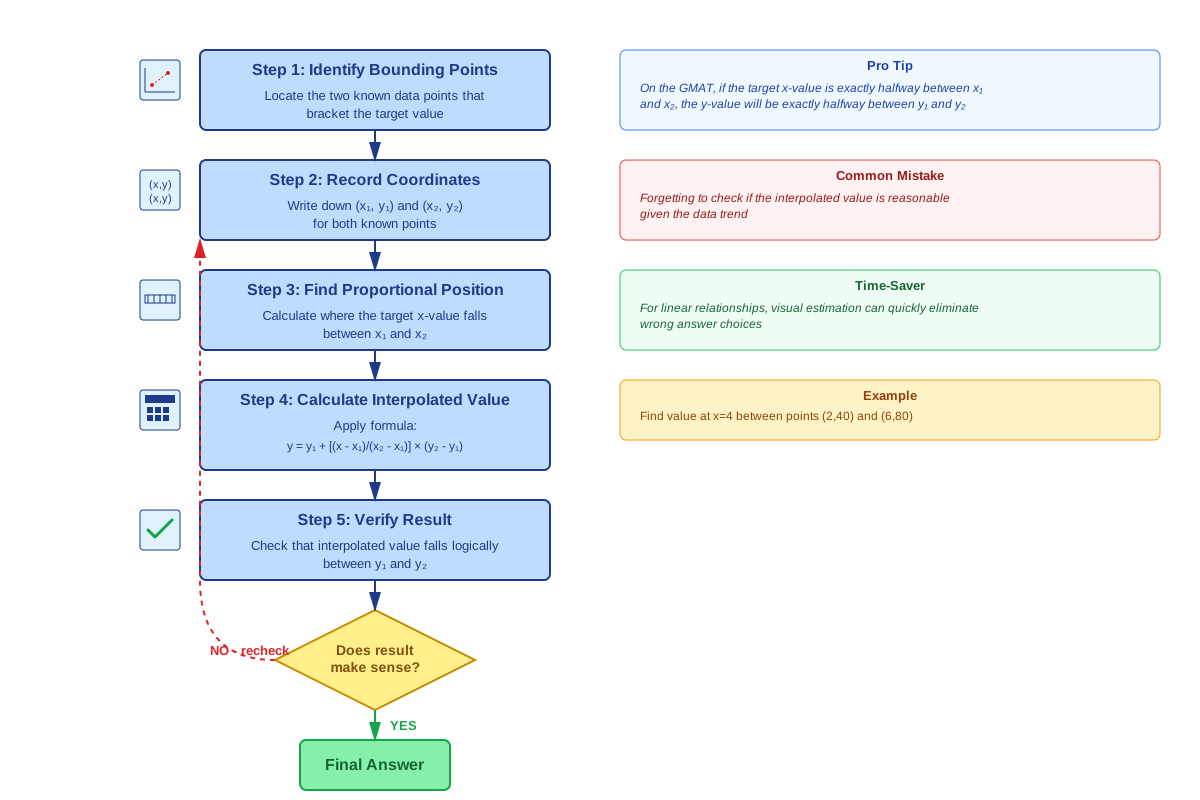
When working with GMAT graphics, effective interpolation requires systematic visual analysis:
- Identify the bounding points: Locate the two known data points that bracket the target value
- Assess the scale: Determine the total range between the bounding points
- Estimate relative position: Judge where the target falls proportionally between the bounds
- Calculate the interpolated value: Apply proportional reasoning to determine the estimate
For example, if a line graph shows sales of $200,000 in January and $300,000 in March, interpolating February's sales would involve recognizing that February falls halfway between these months, suggesting approximately $250,000 (assuming linear growth).
Types of Graphs Requiring Interpolation
Different graphical formats present unique interpolation challenges:
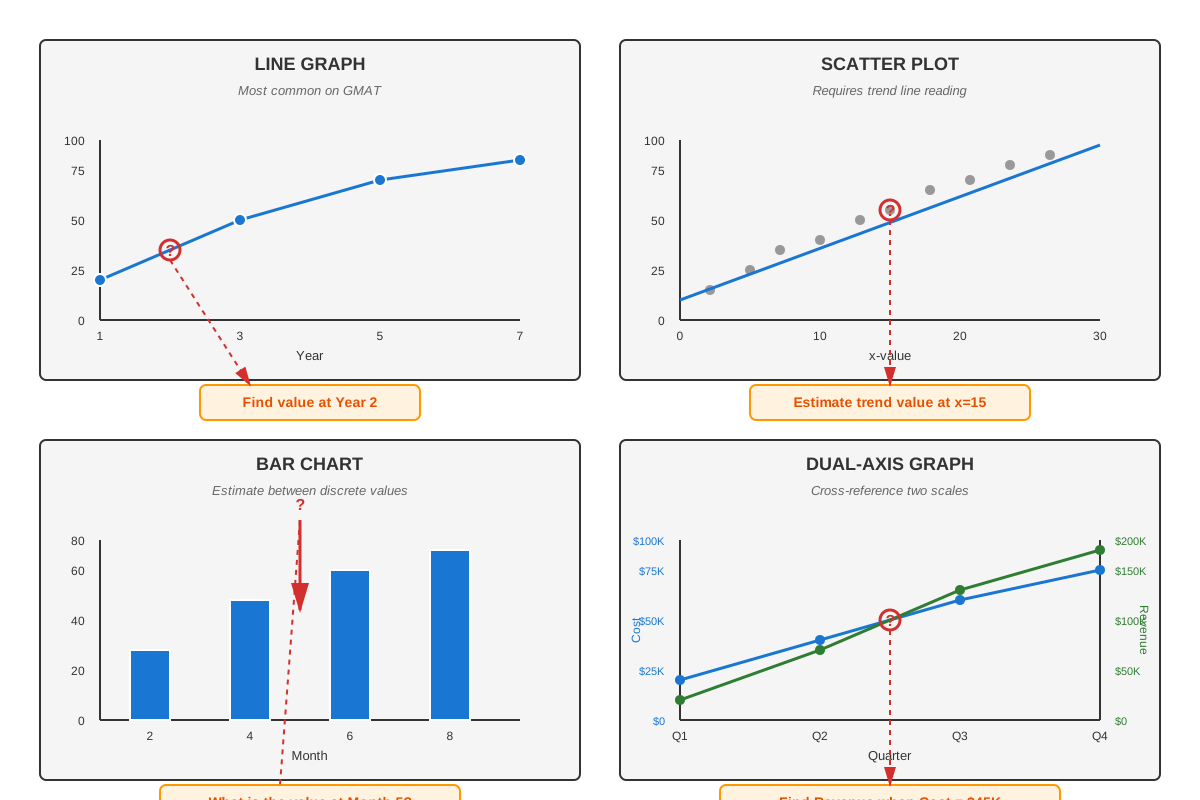
| Graph Type | Interpolation Challenge | GMAT Frequency |
|---|---|---|
| Line graphs | Estimating values along continuous lines between marked points | Very High |
| Scatter plots | Determining trend values where no actual data point exists | High |
| Bar charts | Estimating values when bars fall between gridlines | Medium |
| Multi-axis graphs | Coordinating interpolation across different scales simultaneously | Medium |
| Curved line graphs | Judging non-linear patterns between points | Low-Medium |
Precision and Accuracy Considerations
GMAT interpolation questions typically design answer choices to accommodate reasonable estimation variance. The exam recognizes that visual interpolation involves some imprecision, so incorrect answer choices usually differ significantly from the correct answer—often by 10-20% or more. This design allows candidates who apply sound interpolation principles to confidently select correct answers without requiring perfect precision.
However, certain question types demand greater accuracy, particularly when:
- Gridlines are clearly marked at regular intervals
- The question asks for specific numerical values rather than ranges
- Multiple interpolation steps must be combined
- The scale uses logarithmic or non-linear progression
Common Interpolation Scenarios
Between gridlines: Many GMAT graphs show major gridlines (e.g., at 0, 100, 200) but require estimating values at intermediate positions (e.g., 150). Success requires mentally subdividing the space proportionally.
Along trend lines: Scatter plots often include trend lines or lines of best fit. Interpolation involves finding where a vertical line from a specific x-value would intersect the trend line, then reading the corresponding y-value.
Time-series data: Questions frequently present data across time periods (months, quarters, years) and ask about intermediate periods. Understanding that time progresses uniformly helps establish proportional relationships.
Percentage and ratio scales: Some graphs use percentage scales (0-100%) or ratio scales (0-1.0). Interpolation on these scales requires recognizing that the same proportional principles apply regardless of the units.
Multi-Step Interpolation
Advanced GMAT questions may require interpolating multiple times within a single problem:
- First interpolating to find a value on one graph
- Then using that interpolated value as input for a second calculation or graph
- Finally interpolating again to reach the final answer
These multi-step scenarios test whether candidates can maintain accuracy through sequential estimations and avoid compounding errors.
Concept Relationships
Interpolation serves as a bridge concept connecting several Data Insights competencies. At its foundation, interpolation builds directly on graph reading skills—the ability to understand axes, scales, and coordinate systems. Without accurate graph reading, interpolation becomes impossible because the bounding points cannot be correctly identified.
Interpolation → enables → Trend Analysis: Once values can be estimated between known points, patterns and trends become visible. Understanding whether data increases linearly, exponentially, or follows other patterns depends on interpolating multiple intermediate points.
Proportional Reasoning → supports → Interpolation: The mathematical foundation of interpolation rests on proportional relationships. Recognizing that "halfway between" in position means "halfway between" in value exemplifies this connection.
Interpolation → contrasts with → Extrapolation: While interpolation estimates within known data ranges, extrapolation projects beyond them. GMAT questions sometimes test whether candidates recognize when they're being asked to interpolate (safer, more reliable) versus extrapolate (riskier, less certain).
Interpolation + Scale Reading → enables → Precise Value Determination: Combining interpolation skills with careful attention to scale markings, units, and intervals allows candidates to move from rough estimates to specific numerical answers.
The relationship map flows as: Basic Graph Reading → Scale Understanding → Point Identification → Proportional Reasoning → Interpolation → Trend Analysis → Complex Data Insights
High-Yield Facts
⭐ Interpolation estimates values between two known data points, while extrapolation projects beyond the data range
⭐ Linear interpolation assumes constant rate of change between points—the default assumption for GMAT questions
⭐ When a target value falls halfway between two known points, the interpolated value falls approximately halfway between their y-values
⭐ GMAT answer choices typically differ by 10-20% or more, accommodating reasonable estimation variance
⭐ Interpolation accuracy depends on correctly identifying the two bounding points that bracket the target value
- Gridlines on GMAT graphs may not appear at every interval, requiring mental subdivision of spaces
- Time-series interpolation assumes uniform time progression between marked periods
- Multi-axis graphs may require interpolating on one axis while reading precisely from another
- Scatter plot interpolation often involves estimating where a trend line would intersect a specific x-value
- Percentage scales (0-100%) follow the same interpolation principles as absolute value scales
- Bar chart interpolation requires estimating bar heights that fall between gridlines
- Curved lines require visual judgment about the path between points, not just straight-line distance
- Scale breaks or non-uniform intervals can complicate interpolation and require extra attention
- Reading interpolated values to the nearest marked gridline often provides sufficient accuracy
- Combining interpolated values with other calculations may compound estimation errors
Quick check — test yourself on Interpolation so far.
Try Flashcards →Common Misconceptions
Misconception: Interpolation and extrapolation are the same process → Correction: Interpolation estimates within the known data range (between points), while extrapolation projects beyond the data range. Interpolation is generally more reliable because it doesn't assume patterns continue indefinitely. GMAT questions favor interpolation because it requires less assumption.
Misconception: Interpolated values must be perfectly precise to be correct → Correction: GMAT interpolation questions design answer choices to accommodate reasonable visual estimation. If you've applied sound proportional reasoning and your estimate falls clearly closer to one answer choice than others, that's typically correct. Perfect precision isn't expected or required.
Misconception: All interpolation follows straight lines between points → Correction: While linear interpolation is the GMAT default, some graphs show curved relationships. When a line visibly curves between points, interpolation should follow the curve's path, not cut straight across. However, the exam usually makes this distinction clear through visual presentation.
Misconception: The midpoint between two x-values always corresponds to the midpoint between their y-values → Correction: This is only true for linear relationships. If data changes non-linearly (exponentially, logarithmically), the midpoint x-value may correspond to a y-value that's not at the midpoint. Always assess whether the relationship appears linear before applying this shortcut.
Misconception: Interpolation is just guessing → Correction: Effective interpolation applies systematic proportional reasoning, not random guessing. By identifying bounding points, assessing relative position, and calculating proportional values, interpolation produces reliable estimates that consistently lead to correct answers on the GMAT.
Misconception: You need to memorize the interpolation formula → Correction: While the mathematical formula exists, GMAT questions test conceptual understanding through visual analysis rather than formula application. Focus on proportional reasoning and visual estimation skills rather than memorizing equations.
Worked Examples
Example 1: Line Graph Interpolation
Question: The line graph below shows a company's quarterly revenue over two years. The graph shows Q1 2022 revenue at $400,000 and Q3 2022 revenue at $520,000. If revenue grew linearly between these quarters, what was the approximate revenue in Q2 2022?
Solution:
Step 1: Identify the known bounding points
- Q1 2022: $400,000
- Q3 2022: $520,000
- Target: Q2 2022 (falls between Q1 and Q3)
Step 2: Assess the position of the target
Q2 falls exactly halfway between Q1 and Q3 (one quarter after Q1, one quarter before Q3)
Step 3: Calculate the total change
$520,000 - $400,000 = $120,000 increase over two quarters
Step 4: Apply proportional reasoning
Since Q2 is halfway between Q1 and Q3, and growth is linear, Q2 revenue should be halfway between the two values:
$400,000 + ($120,000 ÷ 2) = $400,000 + $60,000 = $460,000
Step 5: Verify reasonableness
$460,000 falls exactly between $400,000 and $520,000, confirming our interpolation
Answer: Q2 2022 revenue was approximately $460,000
Connection to Learning Objectives: This example demonstrates identifying interpolation opportunities (Q2 falls between known quarters), explaining the methodology (proportional reasoning with linear assumption), and applying interpolation to reach a specific answer.
Example 2: Scatter Plot with Trend Line
Question: A scatter plot displays the relationship between advertising spend (x-axis, in thousands) and sales revenue (y-axis, in millions). The trend line passes through the point ($30K, $2.5M) and ($50K, $3.5M). Using the trend line, what sales revenue would you expect at an advertising spend of $40K?
Solution:
Step 1: Identify the bounding points on the trend line
- Lower bound: $30K advertising → $2.5M sales
- Upper bound: $50K advertising → $3.5M sales
- Target: $40K advertising
Step 2: Determine the target's relative position
$40K is halfway between $30K and $50K
($40K - $30K) = $10K above the lower bound
($50K - $40K) = $10K below the upper bound
Therefore, $40K represents the 50% position between bounds
Step 3: Calculate the sales range
$3.5M - $2.5M = $1.0M sales difference across the $20K advertising range
Step 4: Interpolate the sales value
Since $40K is at the 50% position, sales should be 50% of the way from $2.5M to $3.5M:
$2.5M + (50% × $1.0M) = $2.5M + $0.5M = $3.0M
Step 5: Verify using alternative calculation
Average of bounds: ($2.5M + $3.5M) ÷ 2 = $3.0M ✓
Answer: Expected sales revenue at $40K advertising spend is $3.0M
Connection to Learning Objectives: This example shows interpolation application in scatter plots with trend lines, demonstrates the mathematical principles of proportional estimation, and illustrates how to verify interpolated answers using alternative approaches.
Exam Strategy
Systematic Approach to Interpolation Questions
When encountering GMAT questions requiring interpolation, follow this strategic sequence:
- Scan for explicit values first: Before interpolating, check whether the exact value you need is already marked on the graph
- Identify the bounding points: Locate the two known values that bracket your target
- Assess linearity: Quickly determine whether the relationship appears linear or curved between points
- Estimate proportional position: Judge where your target falls relative to the bounds (halfway, one-third, etc.)
- Calculate or estimate: Apply proportional reasoning to determine the interpolated value
- Compare to answer choices: Select the answer closest to your estimate
Trigger Words and Phrases
Watch for these indicators that interpolation will be required:
- "approximately" or "estimate" (signals that visual estimation is acceptable)
- "between [year/period] and [year/period]" (indicates target falls within a range)
- "based on the trend line" (directs attention to interpolating along a fitted line)
- "closest to" (acknowledges estimation variance)
- "if the pattern continues" within the data range (interpolation, not extrapolation)
- Questions asking about unlabeled points on graphs
- References to intermediate time periods not explicitly shown
Process of Elimination Tips
Eliminate extreme values: If interpolating between 100 and 200, immediately eliminate answer choices below 100 or above 200—interpolation stays within bounds.
Eliminate values requiring unrealistic precision: If visual estimation suggests "somewhere around 150," eliminate answers like 147.3 or 152.7 that imply false precision from visual data.
Check proportionality: If your target is clearly closer to one bound than the other, eliminate answers that don't reflect this relationship. For example, if interpolating at a point 75% of the way from the lower to upper bound, the answer should be approximately 75% of the way between the y-values.
Verify scale consistency: Ensure your interpolated value respects the graph's scale. If gridlines represent increments of 50, your answer should align with this scale structure.
Time Allocation Advice
Interpolation questions typically require 1.5-2 minutes when approached efficiently. Allocate time as follows:
- 15-20 seconds: Reading the question and identifying what needs to be interpolated
- 20-30 seconds: Locating bounding points and assessing the graph structure
- 30-45 seconds: Performing the interpolation calculation or estimation
- 15-20 seconds: Comparing your result to answer choices and selecting
- 10-15 seconds: Quick verification that your answer makes logical sense
If interpolation requires multiple steps or involves complex graphs, allow up to 2.5 minutes. However, if you find yourself spending more than 3 minutes, you may be over-thinking the problem—GMAT interpolation questions reward efficient proportional reasoning over elaborate calculations.
Memory Techniques
The "BRACE" Mnemonic for Interpolation
Bounds: Identify the two points that bracket your target
Relative position: Determine where the target falls proportionally
Assume linearity: Unless the graph clearly curves, use linear interpolation
Calculate proportionally: Apply the same proportion to both axes
Evaluate reasonableness: Check that your answer makes logical sense
Visualization Strategy: The Mental Ruler
Imagine placing a ruler between two known points. If you need to find a value at the 40% mark along this ruler, the y-value should also be at approximately the 40% mark between the two known y-values. This mental image reinforces the proportional relationship central to interpolation.
The "Halfway Shortcut"
For targets that fall exactly halfway between two points, remember: "Halfway across means halfway up" (in linear relationships). This shortcut enables rapid calculation by simply averaging the two known values: (y₁ + y₂) ÷ 2.
The "Stay Inside" Reminder
Create a mental boundary around the known data range. Interpolation always stays inside this boundary, while extrapolation ventures outside. Visualizing this boundary helps prevent confusion between the two concepts.
Summary
Interpolation represents a critical Data Insights skill that enables test-takers to estimate unknown values falling between known data points on graphs, charts, and visual displays. The GMAT tests interpolation extensively because it efficiently assesses multiple competencies: visual-spatial reasoning, proportional thinking, numerical estimation, and analytical judgment. Linear interpolation—assuming constant rate of change between points—serves as the default approach for GMAT questions unless visual evidence suggests otherwise. Success requires systematically identifying bounding points, assessing the target's relative position, applying proportional reasoning, and selecting answers that reflect reasonable estimation variance. Unlike extrapolation, which projects beyond known data and involves greater uncertainty, interpolation works within established boundaries, making it more reliable and more frequently tested. The exam designs answer choices to accommodate visual estimation imprecision, typically spacing incorrect options 10-20% away from correct answers. Mastering interpolation connects directly to broader data interpretation skills and enables confident handling of Graphics Interpretation, Multi-Source Reasoning, and Table Analysis questions throughout the Data Insights section.
Key Takeaways
- Interpolation estimates values between known data points using proportional reasoning and linear approximation
- The GMAT tests interpolation in 15-25% of Data Insights questions, making it a high-frequency, high-impact topic
- Linear interpolation assumes constant rate of change—the default for GMAT unless graphs show clear curvature
- Effective interpolation follows the BRACE sequence: Bounds, Relative position, Assume linearity, Calculate proportionally, Evaluate reasonableness
- Answer choices accommodate estimation variance; perfect precision isn't required, just sound proportional reasoning
- Interpolation differs fundamentally from extrapolation: interpolation stays within known data bounds (safer), extrapolation projects beyond them (riskier)
- Visual estimation skills combined with proportional thinking enable rapid, accurate interpolation without complex calculations
Related Topics
Extrapolation: Building on interpolation concepts, extrapolation extends estimation beyond known data ranges. Understanding the distinction between these techniques and recognizing when each is appropriate enhances overall data interpretation capability.
Trend Analysis: Interpolation skills enable identification of patterns and trends across data points. Mastering interpolation provides the foundation for more sophisticated trend recognition and projection.
Rate of Change Calculations: Determining how quickly values change between points relies on interpolation to establish intermediate values, then calculating the rate of change across intervals.
Multi-Source Reasoning: Advanced GMAT questions combine graphical data requiring interpolation with tabular information and text passages, testing integrated analytical skills.
Scale and Proportion: Deeper understanding of mathematical scaling, logarithmic scales, and proportional relationships enhances interpolation accuracy across diverse graph types.
Practice CTA
Now that you've mastered the concepts, techniques, and strategies for interpolation, it's time to solidify your understanding through active practice. Attempt the practice questions designed specifically for this topic, focusing on applying the BRACE method and proportional reasoning to real GMAT-style scenarios. Use the flashcards to reinforce key definitions, common misconceptions, and high-yield facts until they become automatic. Remember: interpolation is a skill that improves dramatically with deliberate practice—each question you work through builds the visual estimation and proportional thinking abilities that will serve you throughout the Data Insights section. Your investment in mastering this high-frequency topic will pay dividends on test day!
Sign up free to keep reading
Create a free AnvayaPrep account to finish this GMAT guide on Interpolation — plus flashcards and practice questions.