Overview
Slope is one of the most fundamental and frequently tested concepts in GMAT Quantitative Reasoning, appearing in coordinate geometry, data sufficiency, and problem-solving questions. Understanding slope is essential for analyzing linear relationships between variables, interpreting graphs, and solving equations involving lines in the coordinate plane. The GMAT slope questions test not only computational ability but also conceptual understanding of how slope represents rate of change, direction, and the relationship between two points or variables.
Mastery of slope extends beyond simple calculation—it requires recognizing parallel and perpendicular relationships, understanding how slope connects to linear equations, and interpreting what slope means in real-world contexts. GMAT questions often embed slope within more complex scenarios involving distance, rate, profit analysis, or geometric figures in the coordinate plane. Students who develop strong intuition about slope can quickly eliminate incorrect answer choices and identify the most efficient solution paths.
Within the broader Quantitative Reasoning framework, slope serves as a bridge between algebra and geometry. It connects directly to linear equations (particularly slope-intercept and point-slope forms), coordinate geometry, and function analysis. A solid grasp of slope enables students to tackle questions involving systems of equations, optimization problems, and geometric properties of figures plotted on coordinate axes—all high-frequency question types on the GMAT.
Learning Objectives
- [ ] Identify slope from graphs, equations, and coordinate pairs
- [ ] Explain slope as a measure of steepness and rate of change
- [ ] Apply slope to GMAT questions involving lines, graphs, and coordinate geometry
- [ ] Calculate slope using the slope formula for any two given points
- [ ] Determine relationships between lines (parallel, perpendicular) using slope
- [ ] Interpret the meaning of positive, negative, zero, and undefined slopes in context
- [ ] Convert between different forms of linear equations using slope
Prerequisites
- Coordinate plane fundamentals: Understanding x and y axes, quadrants, and ordered pairs (x, y) is essential for plotting points and visualizing slope
- Basic algebra: Manipulating equations and solving for variables enables working with slope formulas and linear equations
- Fraction operations: Slope calculations frequently result in fractions that require simplification and comparison
- Ratio and rate concepts: Slope represents a ratio of vertical to horizontal change, making ratio understanding crucial
Why This Topic Matters
Slope appears in approximately 10-15% of GMAT Quantitative Reasoning questions, making it a high-yield topic that directly impacts scores. Questions involving slope appear in multiple formats: pure coordinate geometry problems, data sufficiency questions requiring determination of line relationships, and word problems where slope represents real-world rates like cost per unit, speed, or profit margins.
In practical applications, slope represents any situation involving constant rate of change: the relationship between hours worked and wages earned, the connection between production quantity and total cost, or the rate at which temperature changes over time. Business school candidates encounter slope concepts regularly in economics (supply and demand curves), finance (linear depreciation), and operations (production functions).
On the GMAT, slope questions commonly appear as:
- Direct calculation problems asking for the slope between two points
- Data sufficiency questions testing whether enough information exists to determine a line's slope
- Problems involving parallel or perpendicular lines in geometric figures
- Graph interpretation questions requiring slope analysis
- Word problems where slope represents a rate or relationship between variables
The GMAT particularly favors questions that test conceptual understanding rather than rote calculation, such as determining whether a slope is positive or negative without computing exact values, or recognizing that perpendicular slopes are negative reciprocals.
Core Concepts
Definition and Formula
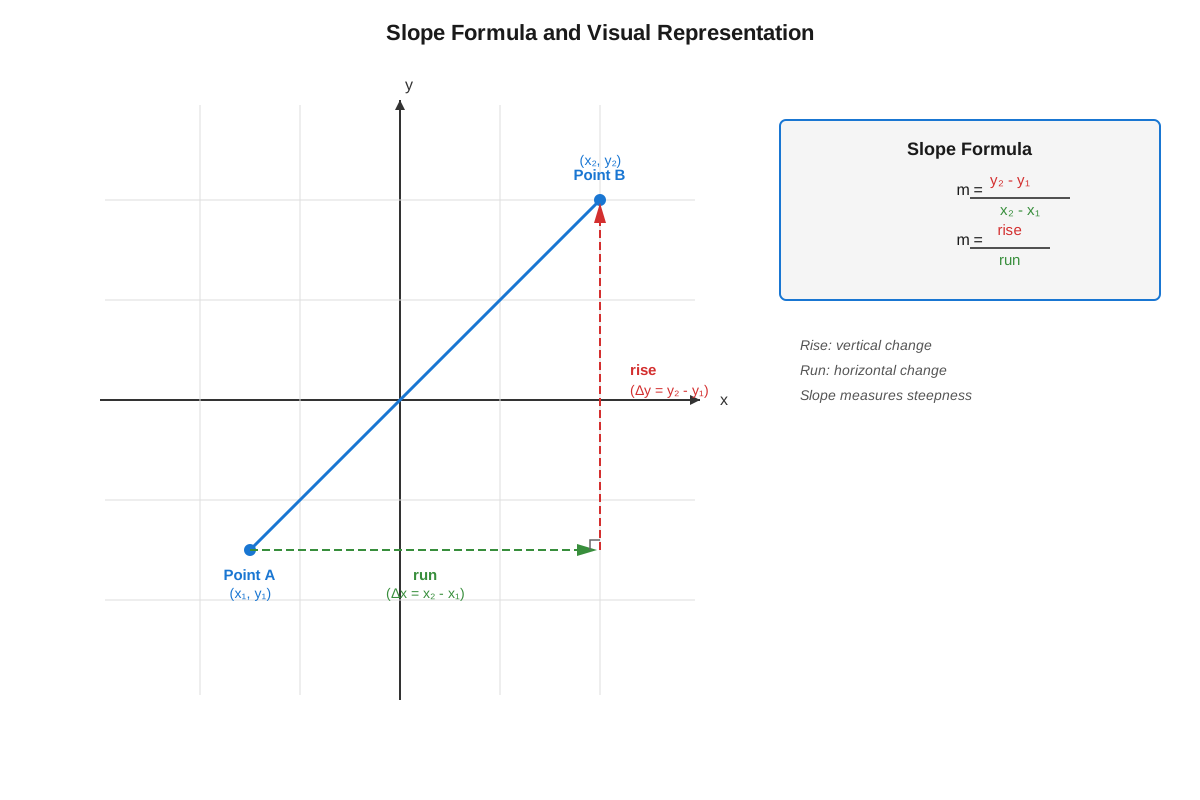
Slope measures the steepness and direction of a line, quantifying how much the line rises or falls as it moves horizontally across the coordinate plane. Mathematically, slope represents the ratio of vertical change (rise) to horizontal change (run) between any two points on a line.
The slope formula for a line passing through points (x₁, y₁) and (x₂, y₂) is:
m = (y₂ - y₁) / (x₂ - x₁)where m represents the slope. The numerator (y₂ - y₁) represents the vertical change or "rise," while the denominator (x₂ - x₁) represents the horizontal change or "run."
Key properties of the slope formula:
- The order of points doesn't matter as long as consistency is maintained (subtracting coordinates in the same order)
- Slope is constant for any two points on the same line
- The formula applies to all non-vertical lines
Types of Slope
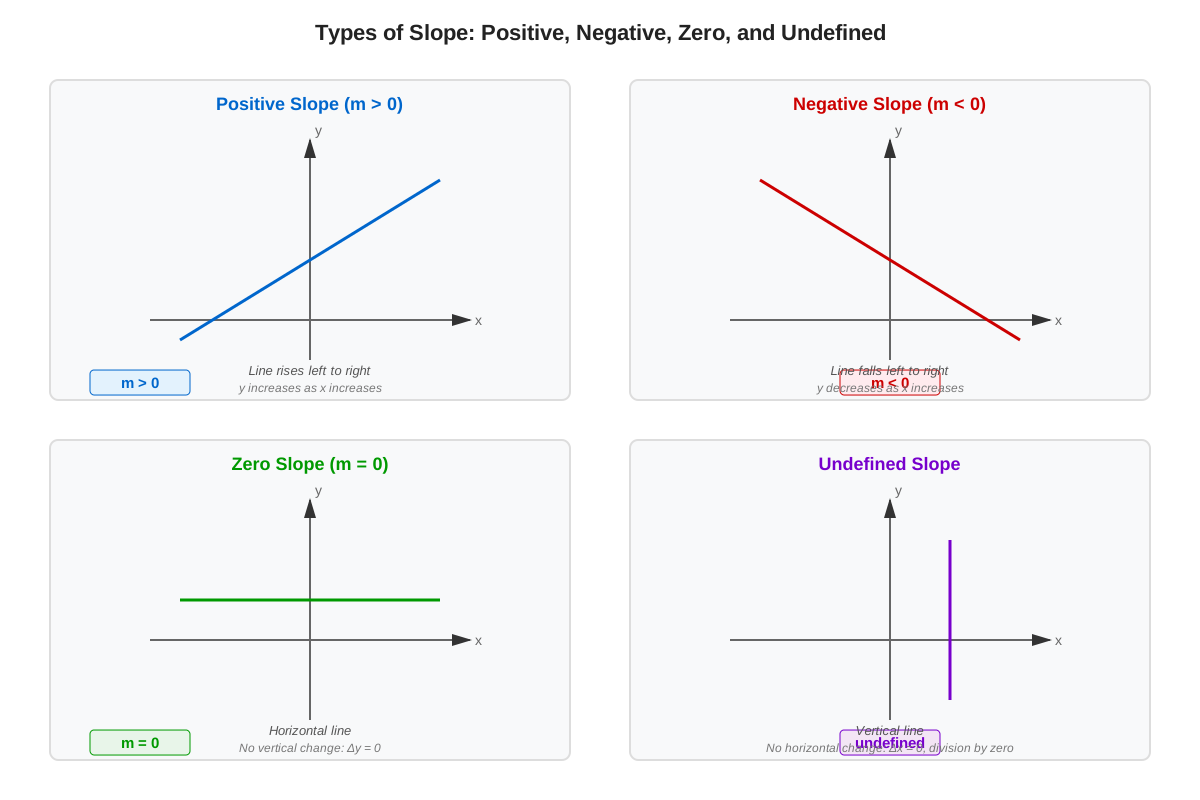
Understanding the four categories of slope is essential for quick visual analysis and elimination strategies:
| Slope Type | Value | Visual Characteristic | Example |
|---|---|---|---|
| Positive slope | m > 0 | Line rises from left to right | m = 2, m = 1/3 |
| Negative slope | m < 0 | Line falls from left to right | m = -3, m = -1/2 |
| Zero slope | m = 0 | Horizontal line | y = 5 |
| Undefined slope | No value | Vertical line | x = 3 |
Positive slopes indicate that as x increases, y increases. The steeper the line rises, the larger the positive slope value. A slope of 3 is steeper than a slope of 1/2.
Negative slopes indicate that as x increases, y decreases. The magnitude indicates steepness: a slope of -4 is steeper (falls more rapidly) than a slope of -1/4.
Zero slope occurs when the line is perfectly horizontal (parallel to the x-axis). The y-coordinate remains constant regardless of x-value, resulting in y₂ - y₁ = 0, making the entire fraction equal to zero.
Undefined slope occurs for vertical lines (parallel to the y-axis). The x-coordinate remains constant, making x₂ - x₁ = 0, which creates division by zero—an undefined operation.
Slope and Linear Equations
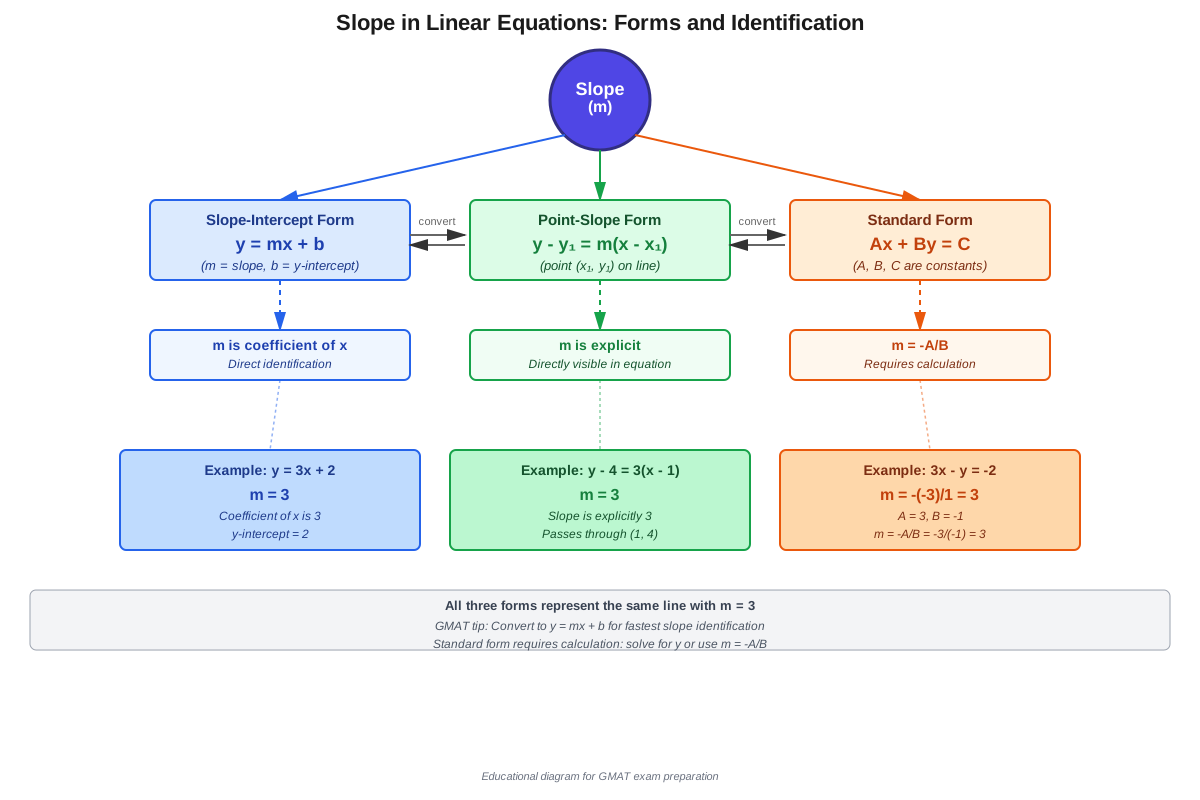
Slope appears in multiple forms of linear equations, each useful for different problem types:
Slope-intercept form: y = mx + b
- m represents the slope
- b represents the y-intercept (where the line crosses the y-axis)
- Most useful for quickly identifying slope and graphing
Point-slope form: y - y₁ = m(x - x₁)
- m represents the slope
- (x₁, y₁) represents a known point on the line
- Most useful when given a point and slope
Standard form: Ax + By = C
- Slope can be extracted as m = -A/B
- Useful for certain algebraic manipulations
Converting between forms requires algebraic manipulation while preserving the slope value. For GMAT purposes, recognizing slope in any form enables quick problem-solving.
Parallel and Perpendicular Lines
The relationship between slopes determines whether lines are parallel, perpendicular, or neither—a frequently tested concept on the GMAT.
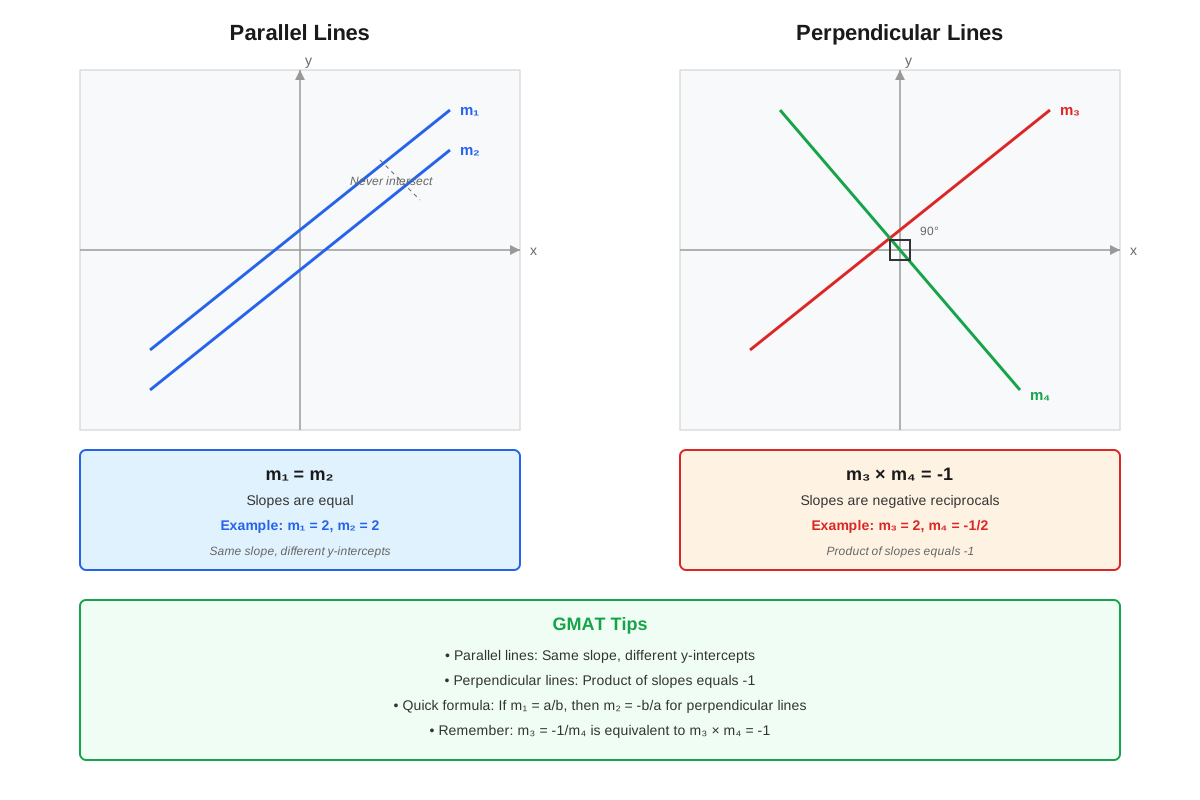
Parallel lines have identical slopes but different y-intercepts:
- If line 1 has slope m₁ and line 2 has slope m₂, the lines are parallel when m₁ = m₂
- Parallel lines never intersect
- Example: y = 3x + 2 and y = 3x - 5 are parallel (both have slope 3)
Perpendicular lines have slopes that are negative reciprocals:
- If line 1 has slope m₁ and line 2 has slope m₂, the lines are perpendicular when m₁ × m₂ = -1
- Equivalently, m₂ = -1/m₁
- Perpendicular lines intersect at 90-degree angles
- Example: y = 2x + 1 and y = -1/2x + 3 are perpendicular (2 × -1/2 = -1)
Special cases:
- Horizontal lines (slope = 0) are perpendicular to vertical lines (undefined slope)
- A line with slope 1 is perpendicular to a line with slope -1
Slope as Rate of Change
Beyond pure geometry, slope represents rate of change—how one quantity changes relative to another. This interpretation is crucial for word problems and data analysis questions.
When the x-axis represents time and the y-axis represents distance, slope represents speed or velocity. When x represents quantity produced and y represents total cost, slope represents marginal cost per unit. This conceptual understanding allows students to:
- Interpret slope values in context
- Determine whether a positive or negative slope makes sense for a given scenario
- Compare rates by comparing slopes
- Predict values using slope as a constant rate
Concept Relationships
The concepts within slope form a hierarchical structure: Slope definition and formula → serves as foundation for → Calculating specific slope values → which enables → Classifying slope types → leading to → Understanding parallel and perpendicular relationships → culminating in → Applying slope to real-world rate problems.
Slope connects directly to prerequisite knowledge of the coordinate plane (providing the framework for plotting points and visualizing lines) and ratio concepts (since slope is fundamentally a ratio). Moving forward, slope knowledge enables mastery of linear equations, systems of equations (where parallel lines indicate no solution and different slopes guarantee one solution), and optimization problems involving linear relationships.
The relationship between slope and linear equations is bidirectional: knowing slope helps write equations, while equations reveal slope. This interconnection means GMAT questions often test both concepts simultaneously, requiring students to move fluidly between geometric and algebraic representations.
Parallel and perpendicular relationships extend slope concepts into geometric reasoning, connecting to properties of rectangles, squares, and other figures in the coordinate plane. Understanding that perpendicular slopes multiply to -1 enables quick verification of right angles without measuring.
Quick check — test yourself on Slope so far.
Try Flashcards →High-Yield Facts
⭐ The slope formula is m = (y₂ - y₁)/(x₂ - x₁), representing rise over run
⭐ Parallel lines have equal slopes; perpendicular lines have slopes that are negative reciprocals
⭐ Positive slope means the line rises from left to right; negative slope means it falls
⭐ Horizontal lines have slope = 0; vertical lines have undefined slope
⭐ In slope-intercept form y = mx + b, the coefficient m is the slope
- Slope is constant for all point pairs on the same line
- Steeper lines have larger absolute slope values
- The slope of a line perpendicular to slope m is -1/m
- If two lines have slopes m₁ and m₂, they're perpendicular when m₁ × m₂ = -1
- A line passing through the origin has equation y = mx (y-intercept = 0)
- Slope represents rate of change in applied problems
- Lines with slope 1 make 45-degree angles with the x-axis
- The sign of slope depends on the direction of the line, not its steepness
- Converting from standard form Ax + By = C to slope-intercept form yields slope m = -A/B
- Two points determine exactly one line and therefore one unique slope
Common Misconceptions
Misconception: Slope is always calculated as (x₂ - x₁)/(y₂ - y₁) → Correction: Slope is rise over run, meaning vertical change over horizontal change: (y₂ - y₁)/(x₂ - x₁). Reversing this produces the reciprocal of the actual slope.
Misconception: A steeper line always has a larger slope value → Correction: Steepness relates to the absolute value of slope. A line with slope -5 is steeper than a line with slope 2, even though -5 < 2. Compare |−5| = 5 versus |2| = 2.
Misconception: Vertical lines have slope equal to zero → Correction: Vertical lines have undefined slope (division by zero), while horizontal lines have slope equal to zero. This distinction is critical for data sufficiency questions.
Misconception: Perpendicular lines have slopes that are reciprocals → Correction: Perpendicular lines have slopes that are negative reciprocals. If one line has slope 3, a perpendicular line has slope -1/3, not 1/3.
Misconception: The slope between points (2, 3) and (5, 7) differs from the slope between (5, 7) and (2, 3) → Correction: Slope is independent of point order as long as subtraction order is consistent. Both calculations yield the same result: (7-3)/(5-2) = 4/3 and (3-7)/(2-5) = -4/-3 = 4/3.
Misconception: In the equation 2x + 3y = 6, the slope is 2 → Correction: To find slope from standard form, convert to slope-intercept form or use m = -A/B. Here, m = -2/3, not 2.
Misconception: A line with greater y-intercept has greater slope → Correction: Y-intercept and slope are independent. A line y = x + 10 has slope 1, while y = 5x + 1 has slope 5, despite the smaller y-intercept.
Worked Examples
Example 1: Calculating Slope and Identifying Relationships
Problem: Line L passes through points A(2, 5) and B(6, 13). Line M has equation y = 2x + 7. Are lines L and M parallel, perpendicular, or neither?
Solution:
Step 1: Calculate the slope of line L using the slope formula.
- Points: A(2, 5) means x₁ = 2, y₁ = 5
- Points: B(6, 13) means x₂ = 6, y₂ = 13
- m_L = (y₂ - y₁)/(x₂ - x₁) = (13 - 5)/(6 - 2) = 8/4 = 2
Step 2: Identify the slope of line M from its equation.
- Line M: y = 2x + 7 is in slope-intercept form y = mx + b
- Therefore, m_M = 2
Step 3: Compare the slopes to determine the relationship.
- m_L = 2 and m_M = 2
- Since the slopes are equal, the lines are parallel
Answer: Lines L and M are parallel.
Connection to learning objectives: This problem requires identifying slope from both coordinate pairs and equations, then applying slope concepts to determine line relationships—addressing all three primary learning objectives.
Example 2: Data Sufficiency with Perpendicular Lines
Problem: In the coordinate plane, line P passes through point (3, 4). Is line P perpendicular to line Q, which has equation 2x + 6y = 12?
(1) Line P passes through point (6, 5)
(2) Line P has a y-intercept of 1
Solution:
First, determine the slope of line Q:
- Convert 2x + 6y = 12 to slope-intercept form
- 6y = -2x + 12
- y = -1/3x + 2
- Slope of Q: m_Q = -1/3
For line P to be perpendicular to line Q, its slope must be the negative reciprocal of -1/3:
- m_P = -1/(-1/3) = 3
Now evaluate each statement:
Statement (1): Line P passes through point (6, 5)
- We know P passes through (3, 4) and (6, 5)
- Calculate slope: m_P = (5 - 4)/(6 - 3) = 1/3
- Since 1/3 ≠ 3, line P is NOT perpendicular to line Q
- Statement (1) is SUFFICIENT to answer "no"
Statement (2): Line P has a y-intercept of 1
- P passes through (3, 4) and (0, 1) [y-intercept means x = 0]
- Calculate slope: m_P = (4 - 1)/(3 - 0) = 3/3 = 1
- Since 1 ≠ 3, line P is NOT perpendicular to line Q
- Statement (2) is SUFFICIENT to answer "no"
Answer: D (Each statement alone is sufficient)
Connection to learning objectives: This data sufficiency problem requires extracting slope from an equation in standard form, understanding perpendicular slope relationships, and calculating slope from points—demonstrating comprehensive slope mastery in a GMAT-specific format.
Exam Strategy
Trigger Words: Watch for "rate of change," "steepness," "parallel," "perpendicular," "passes through," "linear relationship," and "constant rate"—all signal slope concepts.
Approach sequence for GMAT slope questions:
- Identify what's given: Points, equation, graph, or verbal description
- Determine what's asked: Specific slope value, relationship between lines, or sufficiency of information
- Choose the most efficient method: Direct calculation, visual analysis, or algebraic manipulation
- Check reasonableness: Does the sign make sense? Is the magnitude appropriate?
For data sufficiency questions involving slope:
- Recognize that two points always determine a unique slope (sufficient)
- One point alone never determines slope (insufficient)
- Parallel/perpendicular relationships require knowing or determining both slopes
- Y-intercept alone doesn't determine slope; slope and one point determine y-intercept
Process of elimination tips:
- Eliminate answers with wrong sign (positive vs. negative) by visual inspection
- If a line rises left to right, eliminate zero, negative, and undefined options
- For perpendicular questions, eliminate any answer that isn't a negative reciprocal
- For parallel questions, eliminate any answer that doesn't match the given slope exactly
Time allocation:
- Simple slope calculation: 30-45 seconds
- Parallel/perpendicular determination: 60-90 seconds
- Complex data sufficiency with slope: 90-120 seconds
- If calculation becomes complex, look for conceptual shortcuts or estimation
Common shortcuts:
- For perpendicular slopes, flip and negate: 2/3 becomes -3/2
- For parallel lines, slopes must match exactly—no calculation needed
- Count rise and run on graphs rather than using the formula when possible
- Recognize special slopes: 1, -1, 0, undefined
Memory Techniques
Mnemonic for slope formula: "You Rise before you Run" → Y's on top (numerator), X's on bottom (denominator): (y₂ - y₁)/(x₂ - x₁)
Mnemonic for perpendicular slopes: "Flip and Negate" → Take the reciprocal (flip) and change the sign (negate)
Visual memory aid: Picture a hill:
- Climbing uphill (left to right) = positive slope
- Descending downhill (left to right) = negative slope
- Flat ground = zero slope
- Cliff face (straight up) = undefined slope
Acronym for slope types: PNZU
- Positive (rises)
- Negative (falls)
- Zero (horizontal)
- Undefined (vertical)
Memory pattern for parallel vs. perpendicular:
- Parallel = Perfectly Paired (same slope)
- Perpendicular = Product = Negative one (slopes multiply to -1)
Visualization for negative reciprocal: Imagine a coordinate plane divided into quadrants. If one line has positive slope in quadrants I and III, its perpendicular line has negative slope in quadrants II and IV—they're "opposite" in both direction and fraction.
Summary
Slope is a foundational concept in GMAT Quantitative Reasoning that measures the steepness and direction of lines in the coordinate plane. Calculated as the ratio of vertical change to horizontal change using the formula m = (y₂ - y₁)/(x₂ - x₁), slope appears in multiple question formats including direct calculation, data sufficiency, and applied rate problems. Understanding the four types of slope (positive, negative, zero, and undefined) enables quick visual analysis and answer elimination. Parallel lines share identical slopes, while perpendicular lines have slopes that are negative reciprocals, multiplying to -1. Beyond pure geometry, slope represents rate of change in real-world contexts, making it essential for interpreting linear relationships between variables. Mastery requires both computational accuracy and conceptual understanding of how slope connects to linear equations, geometric relationships, and practical applications—skills that directly translate to higher GMAT scores.
Key Takeaways
- Slope formula m = (y₂ - y₁)/(x₂ - x₁) calculates rise over run between any two points on a line
- Positive slopes rise left to right; negative slopes fall; horizontal lines have slope 0; vertical lines have undefined slope
- Parallel lines have equal slopes; perpendicular lines have slopes that multiply to -1 (negative reciprocals)
- Slope appears in multiple equation forms but is most visible in slope-intercept form y = mx + b
- Two points always determine a unique slope, making many data sufficiency questions solvable
- Slope represents rate of change in applied problems, connecting geometry to real-world scenarios
- Visual analysis of slope direction and steepness enables rapid answer elimination on GMAT questions
Related Topics
Linear Equations: Mastering slope enables working with all forms of linear equations (slope-intercept, point-slope, standard form) and understanding how to convert between them—essential for algebra questions.
Systems of Equations: Slope determines whether two lines intersect (different slopes = one solution), are parallel (same slope = no solution), or are identical (same slope and intercept = infinite solutions).
Coordinate Geometry: Slope extends to finding equations of lines, determining distances, and analyzing geometric figures plotted on coordinate planes—a high-frequency GMAT topic.
Functions and Graphs: Understanding slope as rate of change provides foundation for analyzing more complex functions, including quadratic and exponential relationships.
Distance and Midpoint Formulas: These coordinate geometry concepts work alongside slope to solve comprehensive problems involving points and lines in the plane.
Practice CTA
Now that you've mastered the fundamentals of slope, it's time to cement your understanding through active practice. Attempt the practice questions to apply these concepts in GMAT-style formats, including both problem-solving and data sufficiency questions. Use the flashcards to reinforce key formulas, relationships, and strategies until they become automatic. Remember: slope appears in 10-15% of GMAT Quantitative questions—your investment in mastering this topic will directly impact your score. Approach each practice problem methodically, and you'll develop the speed and accuracy needed for test day success!
Sign up free to keep reading
Create a free AnvayaPrep account to finish this GMAT guide on Slope — plus flashcards and practice questions.