Overview
Drawing conclusions is a critical reasoning skill tested extensively in the GMAT Data Insights section, particularly within Multi-Source Reasoning questions. This skill requires test-takers to synthesize information from multiple sources—such as text passages, tables, graphs, and emails—and determine what can be logically inferred or concluded based solely on the evidence presented. Unlike other question types that test comprehension or calculation, GMAT drawing conclusions questions assess the ability to make sound judgments without overstepping the boundaries of what the data actually supports.
The GMAT places significant emphasis on this skill because it mirrors real-world business decision-making, where professionals must evaluate complex information from various sources and reach defensible conclusions. In the Multi-Source Reasoning format, students encounter 2-3 tabbed pages of information and must navigate between them to answer questions that test their ability to integrate data, identify patterns, and draw appropriate inferences. The challenge lies not only in understanding each source individually but in recognizing how pieces of information interact and what they collectively imply.
Mastering drawing conclusions connects directly to other Data Insights competencies, including data interpretation, critical reasoning, and analytical writing. This skill serves as a bridge between raw data analysis and strategic thinking—students must move beyond simply reading charts or understanding text to actively evaluating what those sources mean when considered together. Success in this area requires disciplined thinking: knowing the difference between what must be true, what could be true, and what the data simply doesn't address.
Learning Objectives
- [ ] Identify Drawing conclusions questions in GMAT Multi-Source Reasoning formats
- [ ] Explain the logical principles that govern valid versus invalid conclusions
- [ ] Apply Drawing conclusions strategies to GMAT questions involving multiple data sources
- [ ] Distinguish between conclusions that are directly supported by evidence and those that require unsupported assumptions
- [ ] Evaluate answer choices by systematically checking each against all relevant data sources
- [ ] Recognize common trap answers that go beyond what the data permits
- [ ] Synthesize information across text, numerical data, and graphical representations to reach sound conclusions
Prerequisites
- Basic reading comprehension: Understanding complex business passages is essential because Multi-Source Reasoning presents dense, professional-level text that must be parsed accurately before conclusions can be drawn.
- Data interpretation fundamentals: Students must be able to read tables, charts, and graphs correctly, as conclusions often depend on numerical relationships or trends shown visually.
- Logical reasoning basics: Familiarity with concepts like necessary versus sufficient conditions, correlation versus causation, and valid inference patterns provides the foundation for evaluating which conclusions are justified.
- Multi-tasking with tabbed information: The ability to navigate between multiple information sources efficiently is crucial since drawing conclusions requires synthesizing data that may be spread across different tabs.
Why This Topic Matters
Drawing conclusions represents one of the most authentic business skills tested on the GMAT. In corporate environments, executives and managers constantly face situations where they must review reports, financial data, market research, and correspondence to make informed decisions. The ability to determine what the evidence actually supports—without jumping to unwarranted conclusions—separates effective decision-makers from those who make costly errors based on assumptions or incomplete analysis.
On the GMAT, drawing conclusions questions appear in approximately 30-40% of Multi-Source Reasoning sets, making this one of the highest-frequency question types in Data Insights. These questions typically present as "Which of the following can be properly concluded?" or "The information provided most strongly supports which of the following?" formats. They may also appear as three-part questions where students must evaluate whether each of three statements is supported by the data.
Common manifestations in exam passages include: business case studies where students must determine what a company's financial data implies about its performance; research scenarios where experimental results must be interpreted; market analysis situations where trends must be identified; and organizational communications where policy implications must be understood. The GMAT deliberately includes answer choices that sound plausible but extend beyond what the data actually demonstrates, testing whether students can maintain logical discipline under time pressure.
Core Concepts
What Constitutes a Valid Conclusion
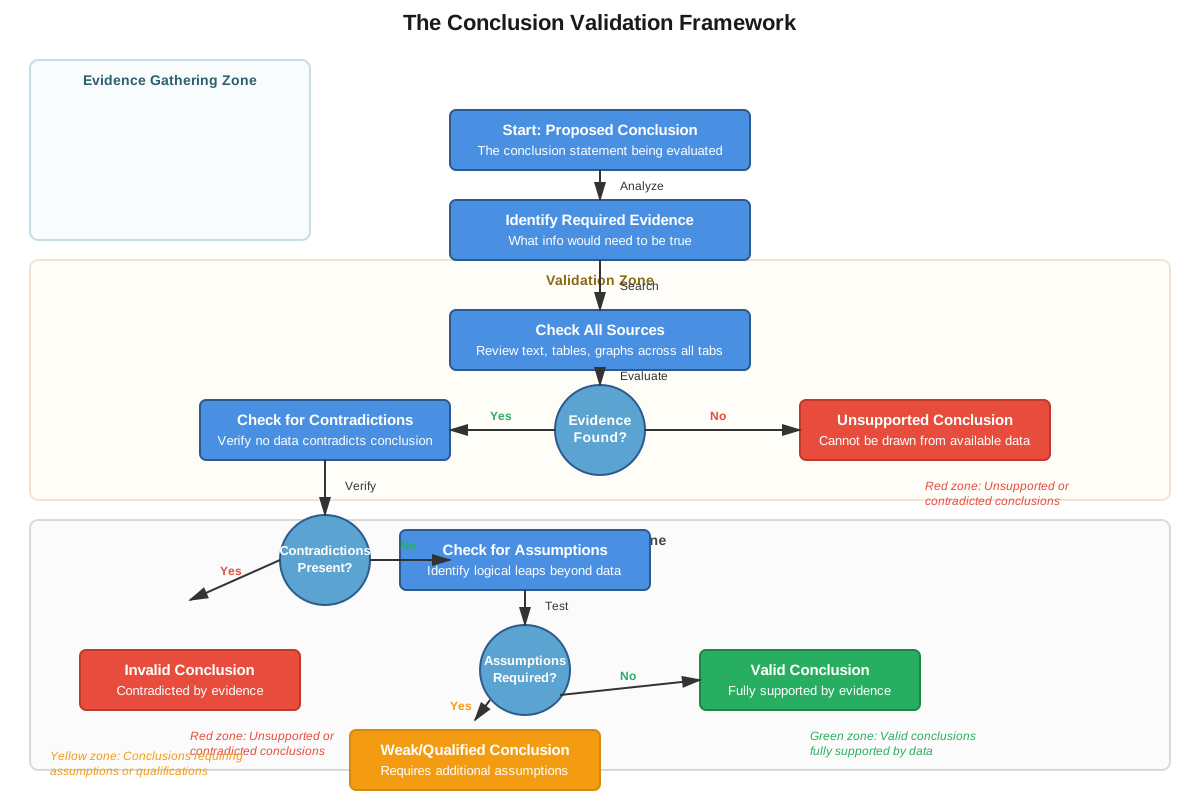
A valid conclusion is a statement that must be true or is strongly supported based on the information provided, without requiring additional assumptions or external knowledge. The fundamental principle is that conclusions must stay within the boundaries of what the evidence explicitly states or necessarily implies. On the GMAT, this means that every element of a correct conclusion can be traced directly back to specific information in the source materials.
Valid conclusions typically fall into three categories:
- Direct restatements: Conclusions that paraphrase information explicitly stated in the sources
- Necessary inferences: Conclusions that must logically follow from combining two or more pieces of information
- Supported generalizations: Conclusions that accurately summarize patterns or trends shown in the data
The key distinction is between what the data proves versus what it suggests. GMAT drawing conclusions questions reward conservative, evidence-based thinking rather than creative interpretation.
The Scope Limitation Principle
One of the most critical concepts in drawing conclusions is understanding scope—the boundaries of what the data addresses. A conclusion that introduces new topics, time periods, populations, or variables not covered in the source material exceeds the appropriate scope. For example, if data discusses Company X's performance in 2022, a conclusion about Company X's performance in 2023 would be out of scope unless the sources provide forward-looking information.
Scope violations include:
- Temporal scope: Making claims about time periods not covered in the data
- Population scope: Extending conclusions to groups not included in the study or analysis
- Geographic scope: Applying findings to locations not mentioned in the sources
- Causal scope: Claiming causation when only correlation is demonstrated
Test-takers must vigilantly check whether each element of a potential conclusion falls within the scope of the provided information.
Distinguishing Between Must Be True, Could Be True, and Not Supported
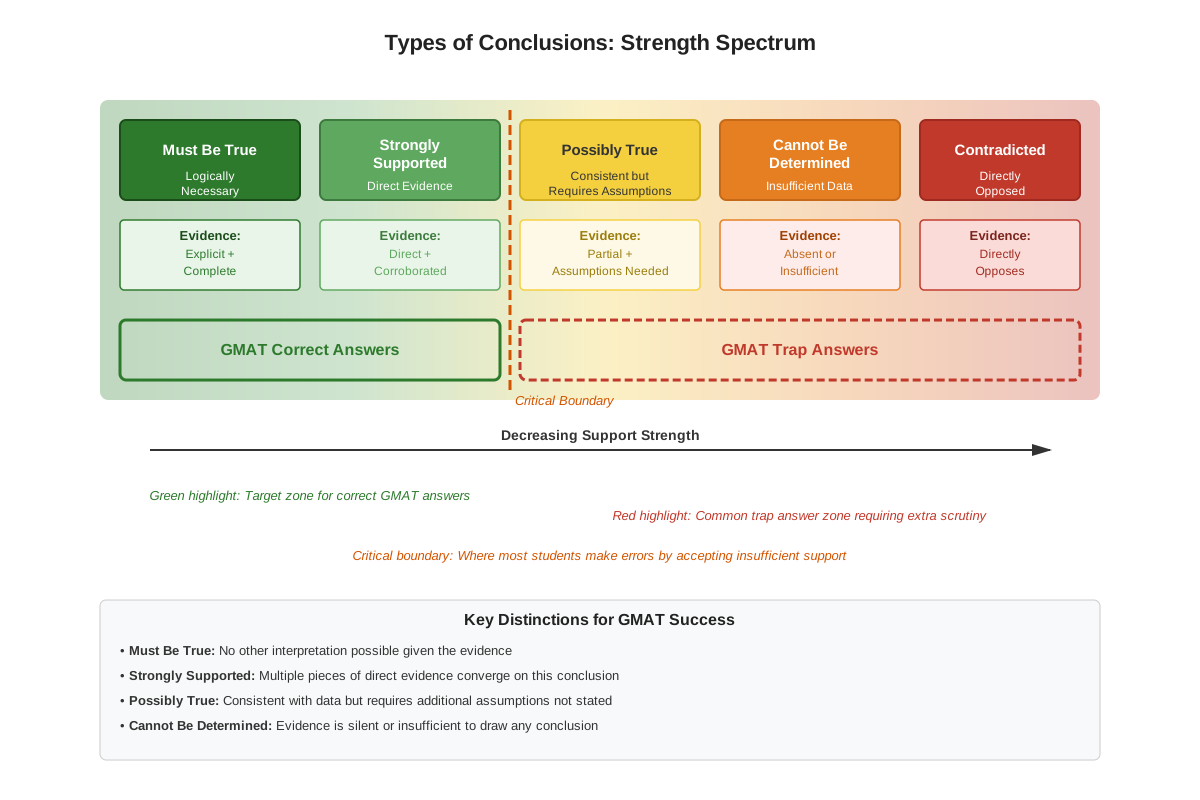
GMAT drawing conclusions questions require precise understanding of logical certainty levels:
| Certainty Level | Definition | Example Signal |
|---|---|---|
| Must be true | The conclusion is logically necessary given the evidence | "Can be properly concluded," "must be true" |
| Could be true | The conclusion is consistent with the evidence but not proven | "Could be true," "is possible" |
| Strongly supported | The conclusion is highly likely though not absolutely certain | "Most strongly supports," "best supported by" |
| Not supported | The conclusion requires assumptions not present in the data | No evidence connects to the claim |
Most GMAT questions ask for what "can be properly concluded" or what is "most strongly supported," which means the correct answer must be either necessarily true or have strong evidentiary backing. Answers that are merely possible or consistent with the data are typically incorrect unless the question specifically asks what "could be true."
Synthesis Across Multiple Sources
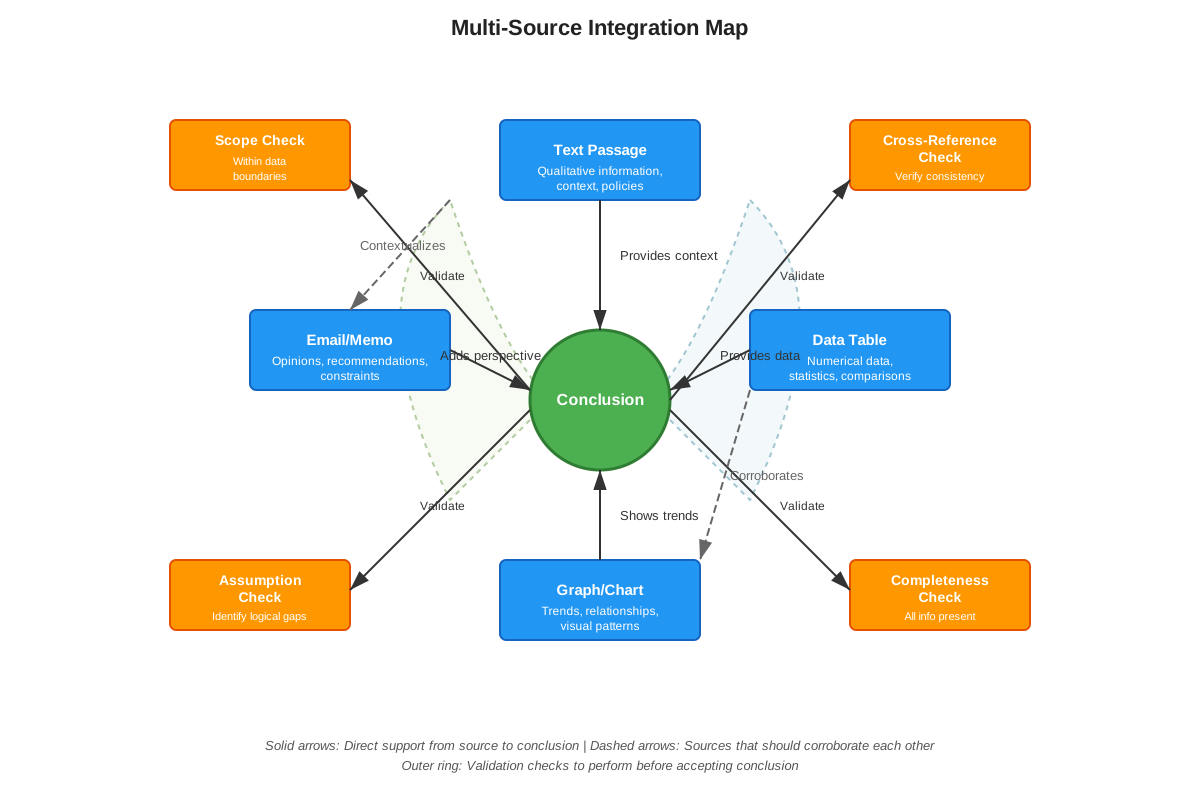
Multi-Source Reasoning questions require information synthesis—the process of combining data from different tabs to reach conclusions that no single source alone would support. This involves:
- Identifying relevant information across all tabs
- Recognizing relationships between data points from different sources
- Combining information to form a complete picture
- Drawing conclusions based on the integrated understanding
For example, one tab might present a company's revenue figures, another tab might discuss its cost structure, and a third might contain an email about pricing strategy. A valid conclusion might require combining the revenue data with the cost information to determine profitability, then using the pricing strategy information to explain why profitability changed.
Avoiding Unwarranted Assumptions
An assumption is an unstated premise that must be true for a conclusion to follow from the evidence. GMAT drawing conclusions questions are designed to punish test-takers who make assumptions, even reasonable-sounding ones. The correct answer requires no assumptions beyond what the sources provide.
Common unwarranted assumptions include:
- Assuming trends will continue into the future
- Assuming correlation implies causation
- Assuming what's true for a sample applies to the entire population
- Assuming conditions remain constant when they might change
- Assuming intentions or motivations not stated in the sources
The discipline of drawing conclusions without assumptions requires constantly asking: "Does the data actually tell me this, or am I filling in gaps with my own reasoning?"
Quantitative Versus Qualitative Conclusions
Drawing conclusions from quantitative data (numbers, percentages, financial figures) requires mathematical precision. Students must accurately interpret what numerical relationships mean:
- If revenue increased 20% and costs increased 25%, profit margins decreased
- If 60% of respondents prefer Option A and 40% prefer Option B, Option A is more popular
- If sales were $5M in Q1 and $6M in Q2, sales increased by $1M (or 20%)
Drawing conclusions from qualitative data (descriptions, opinions, policies) requires careful attention to language:
- Understanding the strength of claims (definite vs. tentative language)
- Recognizing conditional statements ("if X, then Y")
- Identifying the scope of policies or recommendations
- Distinguishing facts from opinions or predictions
Many GMAT questions require synthesizing both quantitative and qualitative information to reach valid conclusions.
Concept Relationships
The concepts within drawing conclusions form a logical hierarchy: Valid conclusion principles serve as the foundation, establishing what makes a conclusion legitimate. This foundation supports scope limitation, which defines the boundaries within which conclusions must operate. Understanding scope enables proper distinction between certainty levels (must be true vs. could be true), which directly affects how students evaluate answer choices.
Information synthesis builds on all these concepts, requiring students to apply valid conclusion principles while respecting scope and certainty levels across multiple sources. Finally, avoiding unwarranted assumptions acts as a quality control mechanism, ensuring that the synthesis process doesn't introduce unsupported elements.
The relationship to prerequisite topics flows as follows: Basic reading comprehension → enables understanding of source material → which allows data interpretation → which provides the raw material for logical reasoning → which enables drawing conclusions. Each prerequisite skill feeds into the conclusion-drawing process.
Drawing conclusions also connects forward to other GMAT skills: mastering this topic strengthens critical reasoning abilities (evaluating arguments), enhances integrated reasoning performance (combining data types), and improves analytical writing (supporting claims with evidence).
High-Yield Facts
⭐ A valid conclusion must be supported by explicit information in the sources or by necessary logical inference from that information—no assumptions allowed.
⭐ Scope violations are the most common reason answer choices are incorrect; always verify that every element of a conclusion is addressed in the source material.
⭐ "Can be properly concluded" and "most strongly supported" require high evidentiary standards—the correct answer must be nearly certain, not merely possible.
⭐ When synthesizing across multiple tabs, the correct conclusion often requires information from at least two different sources.
⭐ Correlation does not imply causation; if data shows two variables moving together, you cannot conclude one causes the other without explicit causal language in the sources.
- Extreme language in answer choices (always, never, only, must, impossible) is often incorrect unless the sources use equally definitive language.
- Comparative conclusions (X is better than Y, A increased more than B) require explicit comparative data in the sources.
- Temporal conclusions about the future require forward-looking statements in the sources; past trends alone don't justify predictions.
- If an answer choice introduces new concepts or variables not mentioned in any source, it's almost certainly incorrect.
- The correct answer to drawing conclusions questions is often less exciting or dramatic than wrong answers, which tend to overstate what the data shows.
- When sources conflict or present different perspectives, valid conclusions must acknowledge the disagreement rather than choosing one side.
- Percentage changes and absolute changes are different; conclusions must match the type of data presented.
- "Some" and "all" have precise logical meanings; conclusions using "all" require universal evidence, while "some" requires only one confirmed instance.
Quick check — test yourself on Drawing conclusions so far.
Try Flashcards →Common Misconceptions
Misconception: If a conclusion sounds reasonable or matches real-world knowledge, it must be correct.
Correction: GMAT drawing conclusions questions test only what the provided sources support, not what's true in the real world. A conclusion might be factually accurate in reality but still incorrect if the sources don't support it. Students must ignore outside knowledge and rely solely on the given information.
Misconception: If data shows a trend over several time periods, it's valid to conclude the trend will continue.
Correction: Past trends don't justify conclusions about the future unless the sources explicitly project forward or state that conditions will remain constant. A company's revenue might have grown for five consecutive years, but concluding it will grow in year six requires additional evidence about future conditions.
Misconception: If most of an answer choice is supported by the data, it's close enough to be correct.
Correction: Every element of the correct conclusion must be supported. If an answer choice contains three claims and two are supported but one isn't, the entire answer is wrong. GMAT drawing conclusions questions require complete accuracy, not partial correctness.
Misconception: Combining information from multiple sources means making creative connections between loosely related ideas.
Correction: Synthesis means combining information that directly relates to the same topic, variable, or question. The connections must be logical and explicit, not speculative. If Tab 1 discusses marketing expenses and Tab 2 discusses employee satisfaction, you cannot conclude that marketing expenses affect employee satisfaction unless a source establishes that relationship.
Misconception: "Could be true" and "must be true" are essentially the same for GMAT purposes.
Correction: These represent fundamentally different logical standards. "Could be true" means consistent with the data but not proven; "must be true" means logically necessary given the data. Most GMAT questions ask for what can be "properly concluded" or is "most strongly supported," which aligns with "must be true" or "almost certainly true," not merely "could be true."
Misconception: If the sources don't explicitly contradict a conclusion, it's valid.
Correction: Lack of contradiction is insufficient; the sources must actively support the conclusion with positive evidence. Just because data doesn't rule out a possibility doesn't mean that possibility can be properly concluded.
Misconception: Longer, more detailed answer choices are more likely to be correct because they seem more thorough.
Correction: Length is irrelevant to correctness. In fact, longer answer choices often include additional details that go beyond what the sources support, making them incorrect. The correct answer might be the shortest option if it's the only one that stays within the scope of the evidence.
Worked Examples
Example 1: Business Performance Analysis
Source Material:
Tab 1 - Financial Summary:
TechCorp's revenue in 2021 was $45 million, increasing to $54 million in 2022. Operating expenses were $38 million in 2021 and $43 million in 2022. The company launched a new product line in March 2022.
Tab 2 - Market Report:
The technology sector experienced average revenue growth of 15% in 2022. Customer demand for cloud-based solutions increased significantly throughout the year. TechCorp's main competitor, DataSys, reported revenue of $62 million in 2022.
Tab 3 - CEO Email:
"Our 2022 performance exceeded expectations. The new product line contributed substantially to our growth, though we also saw strong performance in our traditional offerings. We plan to expand our sales team in 2023 to capitalize on market opportunities."
Question: Which of the following can be properly concluded from the information provided?
A) TechCorp's profit margin increased from 2021 to 2022.
B) TechCorp's revenue growth rate in 2022 exceeded the technology sector average.
C) The new product line was the primary driver of TechCorp's revenue increase.
D) TechCorp will achieve higher revenue in 2023 than in 2022.
E) DataSys is more profitable than TechCorp.
Solution:
Let's evaluate each answer systematically:
Choice A: Calculate profit margins:
- 2021: Revenue $45M - Expenses $38M = Profit $7M; Margin = 7/45 = 15.6%
- 2022: Revenue $54M - Expenses $43M = Profit $11M; Margin = 11/54 = 20.4%
The profit margin did increase. However, we need to verify this is properly supported. The calculation is straightforward from Tab 1 data. This conclusion is valid.
Choice B: Calculate TechCorp's growth rate:
- Growth = (54-45)/45 = 9/45 = 20%
- Sector average = 15%
- 20% > 15%
This conclusion is valid and directly supported by combining Tab 1 and Tab 2 data.
Choice C: The CEO states the new product line "contributed substantially" but also mentions "strong performance in our traditional offerings." The word "primary" means "main" or "most important," but the sources don't establish that the new product line was more important than traditional offerings. This conclusion exceeds the scope of what's stated.
Choice D: The CEO mentions plans to expand the sales team and "capitalize on market opportunities," but this doesn't guarantee higher revenue. Future performance requires assumptions about market conditions, execution success, and other factors not addressed in the sources. This conclusion is not supported.
Choice E: We know DataSys's revenue ($62M) but have no information about their expenses or profit. Revenue alone doesn't determine profitability. This conclusion requires information not provided.
Correct Answers: Both A and B are valid conclusions. If this were a single-answer question, B would likely be preferred as it requires synthesis across tabs, which is more characteristic of Multi-Source Reasoning questions.
Example 2: Research Study Interpretation
Source Material:
Tab 1 - Study Design:
Researchers surveyed 500 employees at manufacturing companies in the Midwest region about workplace satisfaction. Respondents rated satisfaction on a scale of 1-10. The survey was conducted in January 2023. Response rate was 62%.
Tab 2 - Results Table:
| Factor | Average Rating | % Rating 8-10 |
|---|---|---|
| Compensation | 6.2 | 28% |
| Work-Life Balance | 7.8 | 54% |
| Career Development | 5.9 | 22% |
| Management Quality | 7.1 | 41% |
Tab 3 - Researcher Notes:
"Work-life balance received the highest ratings, with over half of respondents giving scores of 8 or above. Compensation and career development were areas of concern. These findings align with preliminary interviews we conducted, where employees frequently mentioned appreciation for flexible scheduling policies."
Question: Evaluate each of the following statements as either Supported or Not Supported by the information provided:
- Work-life balance is the aspect of employment that manufacturing workers in the Midwest value most highly.
- More than half of the surveyed employees rated work-life balance as 8 or higher.
- Manufacturing companies in the Midwest should prioritize improving compensation and career development opportunities.
Solution:
Statement 1: Not Supported
While work-life balance received the highest average rating (7.8) among the factors studied, this doesn't mean it's what workers "value most highly." The study measured satisfaction with current conditions, not what workers value or prioritize. Additionally, the study only examined four factors—there might be other aspects of employment (job security, benefits, workplace safety) that workers value even more highly but weren't included in this survey. The conclusion oversteps what the data demonstrates.
Statement 2: Supported
Tab 2 explicitly states that 54% of respondents rated work-life balance 8-10, and 54% is indeed more than half (50%). This is a direct restatement of provided data and is clearly supported.
Statement 3: Not Supported
While the data shows that compensation and career development received lower ratings, concluding that companies "should prioritize" improving these areas requires several assumptions:
- That improving low-rated areas is the best strategy (perhaps maintaining high-rated areas is more important)
- That improvement is feasible or cost-effective
- That these ratings reflect actual problems rather than high employee expectations
- That addressing these issues would improve overall satisfaction or business outcomes
The researcher notes that these are "areas of concern," but this observation doesn't constitute a recommendation for action. Prescriptive conclusions (what should be done) require more than descriptive data (what currently is).
Exam Strategy
Systematic Approach to Drawing Conclusions Questions:
- Read the question stem first to understand what type of conclusion you're looking for (must be true, strongly supported, could be true, etc.)
- Survey all tabs quickly to understand what information is available and where it's located
- Identify the relevant sources for the specific question—not all tabs will be necessary for every question
- Read answer choices strategically, eliminating obvious scope violations first
- For remaining choices, verify each element against the source material, checking off each claim as supported or unsupported
- Be especially suspicious of answer choices that sound impressive, use extreme language, or make predictions
Trigger Words and Phrases:
Watch for these question stems that signal drawing conclusions questions:
- "Which of the following can be properly concluded?"
- "The information provided most strongly supports which statement?"
- "Based on the information given, which must be true?"
- "The data best support which of the following conclusions?"
Be alert to trap answer language:
- Extreme qualifiers: always, never, only, all, none, impossible, certain
- Causal language: causes, leads to, results in, is responsible for (when only correlation is shown)
- Temporal extensions: will, is likely to, predicts, in the future (without forward-looking source data)
- Scope expansions: everyone, everywhere, in all cases (when data covers limited scope)
Process of Elimination Strategy:
Eliminate answer choices that:
- Introduce new concepts not mentioned in any source (fastest elimination)
- Exceed temporal scope (making claims about time periods not covered)
- Exceed population scope (applying findings to groups not studied)
- Claim causation when only correlation is demonstrated
- Make predictions without forward-looking information in sources
- Use extreme language not matched by equally strong language in sources
Time Allocation:
For a typical Multi-Source Reasoning set with 3 questions:
- Initial tab review: 90 seconds
- Per question: 90-120 seconds
- Total: 5-6 minutes for the set
For drawing conclusions questions specifically, allocate slightly more time (up to 120 seconds) because verification requires careful checking against sources. However, if you find yourself re-reading sources multiple times, you're likely overthinking—trust your systematic elimination process.
When Stuck Between Two Answers:
- Check which answer requires fewer assumptions
- Verify that every single word in each answer is supported
- Look for subtle scope violations (wrong time period, wrong population, wrong degree of certainty)
- Choose the more conservative, less dramatic conclusion
- If both seem equally supported, check whether one requires synthesis across multiple tabs (more likely correct in Multi-Source Reasoning)
Memory Techniques
SCOPE Acronym for Checking Conclusions:
- Sources: Does every element trace back to the provided sources?
- Causation: Am I claiming causation when only correlation is shown?
- Overstating: Am I using stronger language than the sources support?
- Predictions: Am I making future claims without forward-looking data?
- Extensions: Am I applying findings beyond the studied population or time period?
The "Point to It" Technique:
For each element of a potential conclusion, physically point to (or mentally note) where in the sources that information appears. If you can't point to it, the conclusion isn't supported. This kinesthetic approach helps maintain discipline about evidence requirements.
The Three-Check System:
Before selecting an answer, verify:
- ✓ Scope Check: All elements within the boundaries of the sources
- ✓ Logic Check: The conclusion follows logically from the evidence
- ✓ Assumption Check: No unstated premises required
Visualization: The Evidence Boundary
Imagine a circle representing everything the sources tell you. Valid conclusions must stay entirely within this circle. Visualize answer choices as either inside the circle (supported), partially outside (scope violation), or completely outside (not supported). This mental model helps quickly identify scope problems.
The "Must/Could/Not" Sorting Method:
When evaluating answer choices, mentally sort them into three buckets:
- Must be true (or strongly supported): Keep for final consideration
- Could be true (but not proven): Eliminate unless question specifically asks for possibilities
- Not supported: Eliminate immediately
This sorting process speeds up elimination and focuses attention on the most promising choices.
Summary
Drawing conclusions in GMAT Multi-Source Reasoning requires disciplined, evidence-based thinking that stays strictly within the boundaries of what the provided sources support. Success depends on understanding that valid conclusions must be directly supported by explicit information or necessary logical inference, without requiring assumptions or external knowledge. The core challenge is synthesizing information across multiple tabs—text passages, tables, graphs, and correspondence—while maintaining rigorous standards about what can properly be concluded. Test-takers must distinguish between different levels of logical certainty (must be true versus could be true), recognize scope limitations (temporal, population, geographic, and causal), and avoid common traps like mistaking correlation for causation or extending past trends into future predictions. The systematic approach involves identifying relevant sources, verifying each element of potential conclusions against the evidence, and eliminating answers that introduce new concepts, exceed scope, or require unwarranted assumptions. Mastering this skill requires practice in conservative, precise thinking—choosing conclusions that are fully supported even if they seem less interesting than alternatives that overstate what the data demonstrates.
Key Takeaways
- Valid conclusions must be supported by explicit source information or necessary logical inference—no assumptions, no matter how reasonable they seem
- Scope violations (temporal, population, geographic, causal) are the most common reason answer choices are incorrect
- "Can be properly concluded" and "most strongly supported" require high evidentiary standards, not mere possibility or consistency
- Synthesis across multiple sources is essential, but connections must be logical and explicit, not speculative
- Correlation does not imply causation unless sources explicitly establish a causal relationship
- Every element of a correct conclusion must be verifiable against the sources—partial support is insufficient
- Conservative, less dramatic conclusions are typically correct over exciting claims that overstate the evidence
Related Topics
Critical Reasoning - Assumption Questions: Understanding what conclusions require in terms of unstated premises directly connects to recognizing when drawing conclusions questions present answers that depend on unwarranted assumptions. Mastering drawing conclusions strengthens the ability to identify gaps between evidence and claims.
Data Sufficiency: Both question types require determining what can be known from given information versus what requires additional data. The logical discipline developed in drawing conclusions transfers directly to evaluating whether statements provide sufficient information.
Reading Comprehension - Inference Questions: While reading comprehension focuses on single passages, the skill of determining what can be properly inferred versus what goes beyond the text is identical to drawing conclusions in Multi-Source Reasoning.
Integrated Reasoning - Graphics Interpretation: Drawing conclusions from graphical data requires the same principles of staying within scope and avoiding unwarranted assumptions, but applies them specifically to visual information representation.
Quantitative Reasoning - Problem Solving: Many drawing conclusions questions involve numerical relationships, and the precision required in mathematical reasoning reinforces the discipline needed to draw only supported conclusions.
Practice CTA
Now that you understand the principles and strategies for drawing conclusions in Multi-Source Reasoning, it's time to apply this knowledge to actual GMAT-style questions. The practice questions and flashcards will help you internalize the systematic approach, recognize common traps, and build the speed and confidence needed for test day. Remember: drawing conclusions is a skill that improves dramatically with deliberate practice. Each question you work through strengthens your ability to distinguish between what the data proves and what it merely suggests. Approach the practice materials with the same disciplined, evidence-based thinking you've learned here, and you'll see measurable improvement in your accuracy and efficiency. You've got this!
Sign up free to keep reading
Create a free AnvayaPrep account to finish this GMAT guide on Drawing conclusions — plus flashcards and practice questions.