Overview
Source prioritization is a critical skill within the Data Insights section of the GMAT, specifically tested through Multi-Source Reasoning questions. This competency requires test-takers to efficiently navigate multiple information sources—such as emails, memos, tables, graphs, and reports—and determine which sources contain the most relevant data for answering specific questions. Unlike traditional reading comprehension where information flows linearly, Multi-Source Reasoning presents information across tabs or pages, demanding strategic decision-making about where to look first and which sources merit deeper analysis.
The GMAT tests source prioritization because it mirrors real-world business scenarios where professionals must synthesize information from various documents, stakeholder communications, and data presentations to make informed decisions. In a typical Multi-Source Reasoning question set, students encounter 2-3 sources (often presented as tabs) followed by multiple questions. Success depends not on reading every word of every source, but on quickly identifying which source likely contains the answer to each specific question. This skill becomes particularly crucial under time pressure, as inefficient source navigation can consume valuable minutes that could be allocated to other questions.
Within the broader Data Insights framework, GMAT source prioritization connects directly to information synthesis, critical reasoning, and data interpretation. It builds upon foundational skills in identifying relevant versus irrelevant information, understanding document types and their typical contents, and recognizing question stems that signal specific information needs. Mastering source prioritization enhances overall performance across all Multi-Source Reasoning questions and develops transferable skills applicable to Table Analysis and Graphics Interpretation questions where multiple data representations require strategic attention allocation.
Learning Objectives
By the end of this study guide, students should be able to:
- [ ] Identify source prioritization as a distinct skill within Multi-Source Reasoning questions
- [ ] Explain source prioritization strategies and their rationale for GMAT success
- [ ] Apply source prioritization to GMAT questions efficiently and accurately
- [ ] Analyze question stems to predict which source types will contain relevant information
- [ ] Evaluate the relative utility of different sources based on document type and content preview
- [ ] Develop a systematic approach to navigating multi-source question sets under time constraints
Prerequisites
Students should have familiarity with:
- Basic GMAT question formats: Understanding how Data Insights questions are structured helps recognize when source prioritization becomes necessary
- Document type recognition: Ability to distinguish between emails, financial statements, charts, and reports enables faster source selection
- Reading comprehension fundamentals: Core skills in identifying main ideas and supporting details transfer to multi-source contexts
- Time management principles: Awareness of pacing requirements creates urgency for efficient source navigation strategies
Why This Topic Matters
In professional business environments, executives and analysts regularly face information overload from multiple channels—financial reports, market research, internal communications, and external data sources. The ability to quickly identify which documents contain decision-critical information separates effective professionals from those who waste time reviewing irrelevant materials. Source prioritization directly simulates this real-world competency, making it one of the most practically applicable skills tested on the GMAT.
From an exam perspective, Multi-Source Reasoning questions appear in approximately 20-25% of Data Insights sections, with each question set typically containing 3-4 questions. Since the Data Insights section significantly impacts overall GMAT scores, and Multi-Source Reasoning represents a substantial portion of this section, mastering source prioritization can directly improve performance on 4-6 questions per exam. Given that each Data Insights question carries equal weight, efficient source navigation can save 2-3 minutes per question set—time that compounds across the entire exam.
Common manifestations in GMAT passages include:
- Three-tab presentations: Email correspondence, financial data table, and strategic memo requiring cross-referencing
- Mixed document types: Combining qualitative sources (meeting notes, proposals) with quantitative sources (spreadsheets, graphs)
- Chronological sequences: Multiple communications over time where later sources reference or contradict earlier ones
- Stakeholder perspectives: Different viewpoints from various departments or external parties requiring synthesis
- Data-heavy scenarios: Technical specifications, market research findings, and operational metrics requiring selective attention
Core Concepts
Understanding Source Prioritization
Source prioritization refers to the strategic process of determining which information sources to consult first, which to examine thoroughly, and which to reference only as needed when answering Multi-Source Reasoning questions. Rather than reading all sources sequentially and completely before attempting questions, effective test-takers develop a question-first approach that matches information needs to likely source locations.
The fundamental principle underlying source prioritization is efficiency through selectivity. GMAT Multi-Source Reasoning questions deliberately present more information than necessary to answer any single question. This design tests whether candidates can avoid the trap of comprehensive reading and instead adopt a targeted information-gathering strategy. The skill involves three core components: rapid source assessment, question-stem analysis, and strategic navigation.
The Source Assessment Framework
When first encountering a Multi-Source Reasoning question set, effective test-takers spend 15-20 seconds conducting a rapid source scan. This involves:
- Identifying source types: Quickly categorize each tab as qualitative (text-heavy communications) or quantitative (data tables, charts)
- Noting source titles: Tab labels often indicate content (e.g., "Q3 Financial Results" vs. "CEO Memo")
- Previewing structure: Glance at formatting—paragraphs suggest narrative information, while tables suggest specific data points
- Recognizing relationships: Determine if sources are independent or if later sources reference earlier ones
This initial assessment creates a mental map of the information landscape, enabling faster navigation when questions arise. The investment of 15-20 seconds upfront typically saves 60-90 seconds across the question set.
Question-Stem Analysis for Source Selection
The most critical source prioritization skill involves reverse-engineering information needs from question stems. Different question types signal different source requirements:
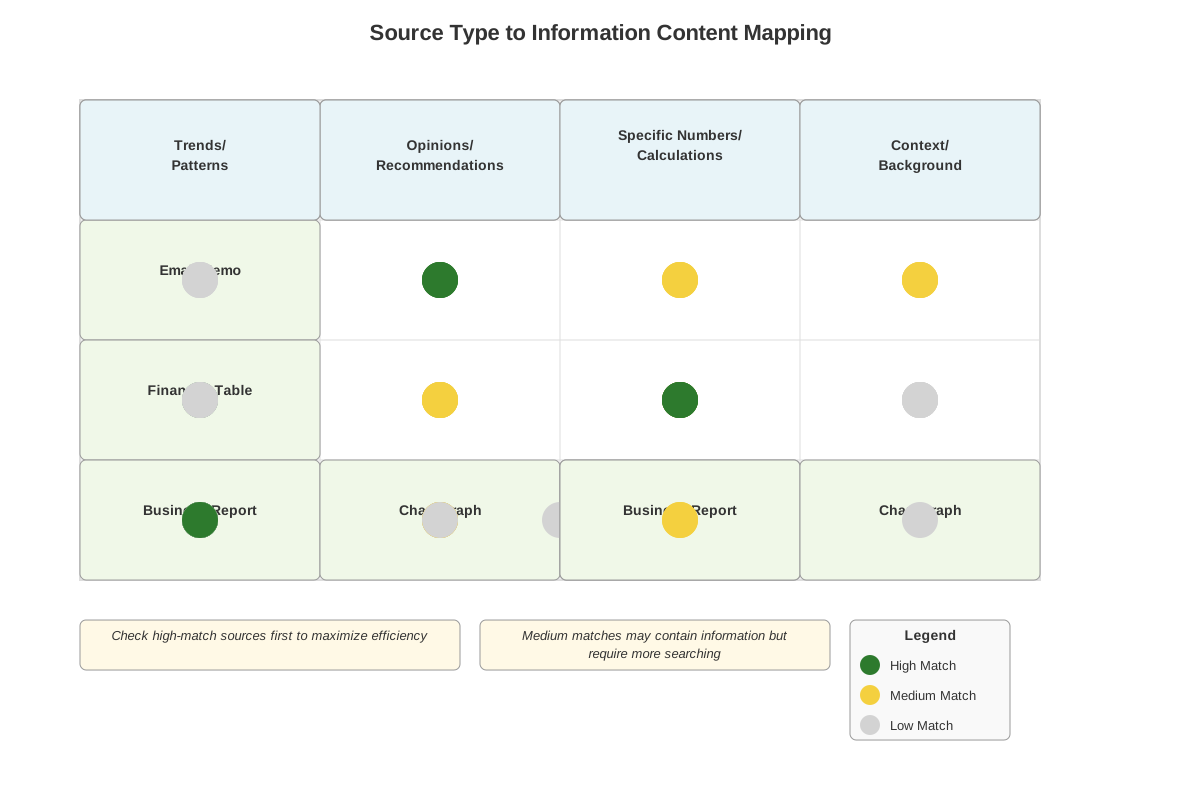
| Question Type | Likely Source | Reasoning |
|---|---|---|
| Specific data requests (numbers, dates, percentages) | Tables, charts, financial statements | Quantitative sources contain precise figures |
| Opinion or recommendation questions | Emails, memos, proposals | Qualitative sources express viewpoints |
| Comparison questions | Tables with multiple rows/columns | Structured data enables direct comparison |
| Chronological or causal questions | Text documents with narrative flow | Qualitative sources explain sequences and relationships |
| Definition or policy questions | Formal documents, reports | Official sources contain authoritative information |
By analyzing the question stem before consulting sources, test-takers can predict with 70-80% accuracy which source will contain the answer, dramatically reducing search time.
The Strategic Navigation Process
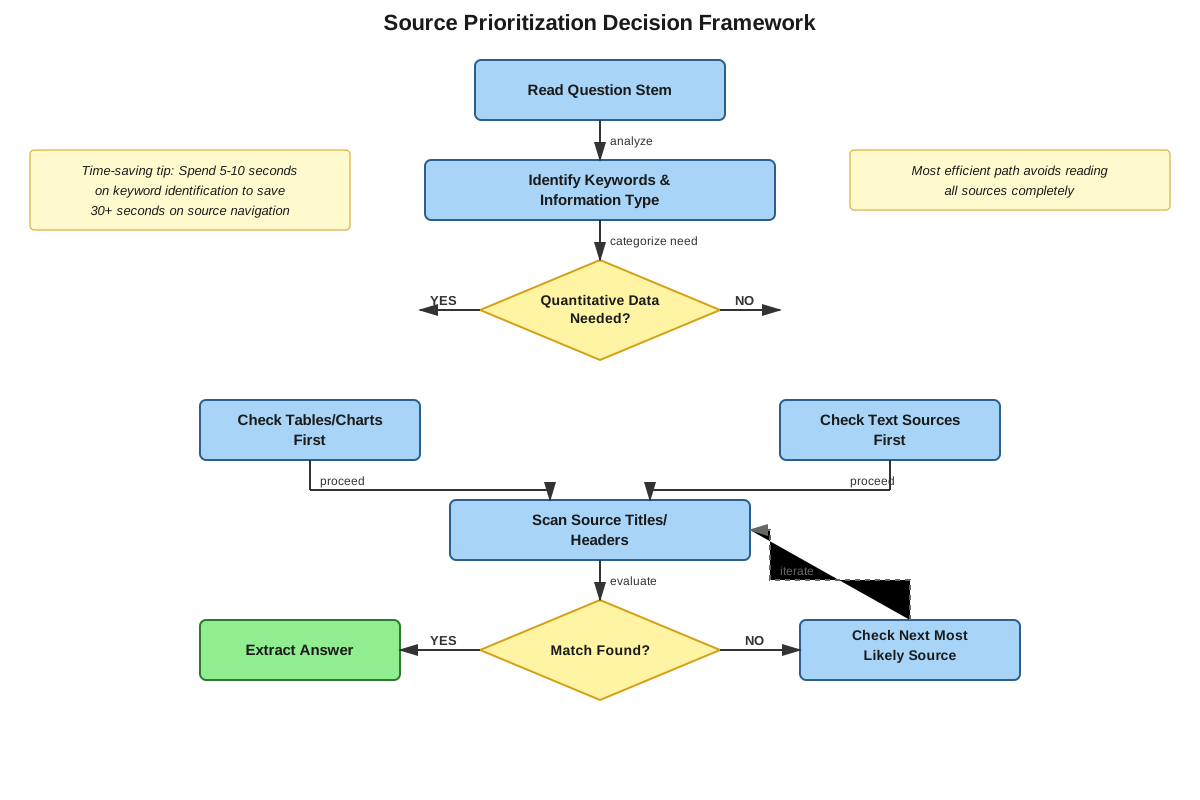
Effective source prioritization follows a systematic approach:
- Read the question stem completely: Understand exactly what information is required
- Identify key terms and concepts: Note specific names, numbers, or topics mentioned
- Predict the most likely source: Based on question type and key terms, hypothesize which source to check first
- Scan the predicted source: Look for key terms or relevant sections rather than reading comprehensively
- Verify or pivot: If the predicted source contains the answer, proceed; if not, move to the next most likely source
- Cross-reference when necessary: Some questions require synthesizing information from multiple sources
This process transforms source navigation from random searching into a hypothesis-driven investigation, significantly improving both speed and accuracy.
Source Type Characteristics
Understanding typical content patterns for different document types enhances prediction accuracy:
Emails and Memos: Typically contain opinions, recommendations, concerns, and informal data references. These sources often explain context, motivations, or interpersonal dynamics. They're ideal for questions about stakeholder perspectives or reasoning behind decisions.
Financial Statements and Data Tables: Contain precise numerical information organized systematically. These sources answer questions requiring specific figures, calculations, or data comparisons. They rarely provide context or explanation.
Reports and Proposals: Blend qualitative analysis with supporting data. These sources often contain both narrative explanations and embedded tables or figures. They're useful for questions requiring both understanding and data support.
Charts and Graphs: Present trends, relationships, or distributions visually. These sources efficiently answer questions about patterns, changes over time, or relative magnitudes.
The Elimination Strategy
When source prioritization proves challenging, test-takers can employ source elimination by identifying which sources definitely won't contain the answer:
- Questions about specific numerical values eliminate purely qualitative sources
- Questions about opinions or recommendations eliminate pure data tables
- Questions about recent developments eliminate sources dated earlier than the timeframe in question
- Questions about specific departments or individuals eliminate sources from unrelated parties
This negative approach narrows the search space, making the remaining sources more manageable.
Time Allocation Principles
Effective source prioritization requires disciplined time management:
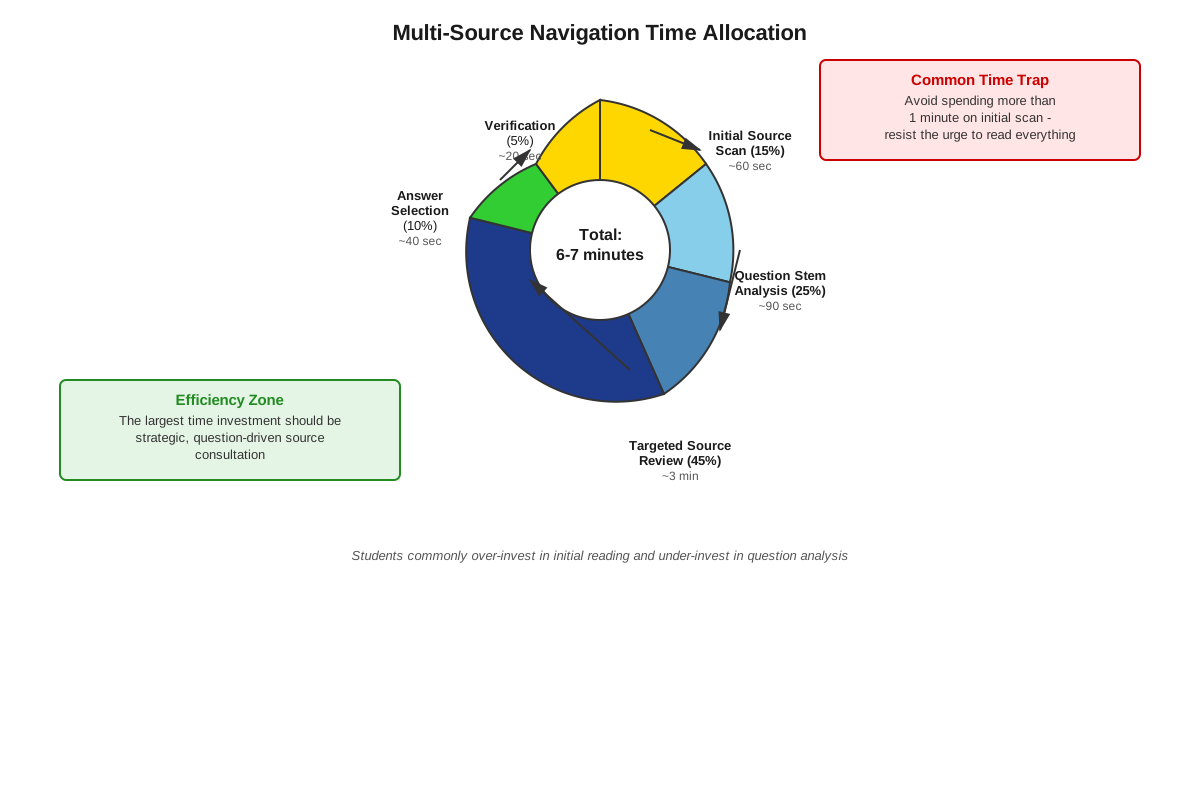
- Initial source scan: 15-20 seconds maximum
- Per question: 60-90 seconds including source consultation and answer selection
- Complete question set: 4-5 minutes for a typical 3-source, 4-question set
Test-takers should avoid spending more than 30 seconds searching for information within sources. If the answer isn't found quickly, it's more efficient to make an educated guess and move forward than to exhaustively search all sources.
Concept Relationships
Source prioritization serves as the foundational skill that enables efficient execution of all Multi-Source Reasoning tasks. The relationship flows as follows:
Document Type Recognition → Source Assessment → Question Analysis → Source Prioritization → Information Extraction → Answer Selection
Document type recognition (prerequisite knowledge) enables rapid source assessment, which creates the mental framework for source prioritization. Question analysis then activates this framework, directing attention to the most promising sources. Successful source prioritization leads to efficient information extraction, which ultimately enables accurate answer selection.
Within the broader Data Insights section, source prioritization connects to:
- Table Analysis: Similar skills in identifying relevant rows/columns within complex data tables
- Graphics Interpretation: Parallel competency in determining which visual elements contain answer-relevant information
- Two-Part Analysis: Related skill of matching question requirements to available information
The skill also reinforces critical reasoning abilities tested throughout the GMAT, particularly the capacity to identify relevant versus irrelevant information—a competency that appears in Verbal Reasoning passages and Quantitative Problem Solving questions.
High-Yield Facts
⭐ Multi-Source Reasoning questions always present more information than necessary to answer any single question—source prioritization is essential, not optional.
⭐ Question stems contain predictive clues about which source type will contain the answer—analyze the question before consulting sources.
⭐ Quantitative questions (requesting specific numbers or calculations) almost always require consulting data tables or charts rather than text documents.
⭐ The most efficient approach is question-first, not source-first—read questions before thoroughly reading all sources.
⭐ Source titles and tab labels provide critical information about content—use these to guide initial predictions about where to find answers.
- Spending 15-20 seconds on initial source assessment saves 60-90 seconds across the question set.
- Approximately 30% of Multi-Source Reasoning questions require consulting only one source, while 60% require two sources, and 10% require all three.
- Email and memo sources typically contain opinions, recommendations, and contextual information rather than precise data.
- Financial statements and data tables contain precise numerical information but rarely explain context or reasoning.
- If information isn't found in the predicted source within 20-30 seconds, pivot to the next most likely source rather than exhaustively searching.
- Later sources in chronological sequences often reference or update information from earlier sources, making them more comprehensive.
- Questions asking about "according to Source 2" explicitly direct attention, eliminating the need for source prioritization.
- Cross-referencing multiple sources is most commonly required for inference questions or questions asking about relationships between different pieces of information.
- The GMAT deliberately includes distracting information in sources to test whether candidates can maintain focus on question-relevant data.
- Effective source prioritization can reduce time per Multi-Source Reasoning question set from 6-7 minutes to 4-5 minutes.
Quick check — test yourself on Source prioritization so far.
Try Flashcards →Common Misconceptions
Misconception: All sources must be read thoroughly before attempting any questions.
Correction: The most efficient approach involves reading question stems first, then consulting only the sources necessary to answer each specific question. Comprehensive reading wastes time on irrelevant information.
Misconception: Source prioritization means permanently ranking sources from most to least important.
Correction: Source priority changes with each question based on what information that specific question requires. A source that's critical for one question may be irrelevant for the next.
Misconception: Quantitative sources (tables, charts) are always more important than qualitative sources (emails, memos).
Correction: Source importance depends entirely on the question being asked. Opinion and recommendation questions require qualitative sources, while data-specific questions require quantitative sources.
Misconception: If the predicted source doesn't immediately reveal the answer, the prediction was wrong and a different approach is needed.
Correction: Sometimes the predicted source is correct but requires more careful reading or is organized unexpectedly. Spend 20-30 seconds searching the predicted source before pivoting.
Misconception: Source prioritization is only useful for difficult questions; straightforward questions don't require this strategy.
Correction: Source prioritization improves efficiency on all Multi-Source Reasoning questions, regardless of difficulty. Even when answers are straightforward, finding them quickly requires knowing where to look.
Misconception: The order in which sources are presented (Tab 1, Tab 2, Tab 3) indicates their relative importance.
Correction: Source presentation order doesn't correlate with importance. The GMAT deliberately varies source ordering to test whether candidates can independently assess relevance.
Misconception: Source prioritization means skipping sources entirely.
Correction: Source prioritization means strategically determining which sources to consult for each question and in what order, not permanently ignoring any sources. Different questions may require different sources.
Worked Examples
Example 1: Financial Decision Scenario
Source Setup:
- Tab 1: Email from CFO to CEO discussing concerns about Q3 performance and recommending budget cuts
- Tab 2: Q3 Financial Results table showing revenue, expenses, and profit margins by department
- Tab 3: Memo from Marketing Director proposing increased advertising spend for Q4
Question: According to the financial data, which department had the highest profit margin in Q3?
Source Prioritization Process:
- Question Analysis: The question explicitly requests "financial data" and asks for a specific metric (profit margin) by department. This is a quantitative, data-specific question.
- Source Prediction: Tab 2 (Q3 Financial Results table) is the most likely source because:
- It's explicitly labeled as containing financial results
- Tables organize data by categories (departments)
- Profit margins are numerical metrics found in financial statements
- Source Consultation: Navigate directly to Tab 2, locate the profit margin column, and scan for the highest value.
- Answer Selection: Identify the department with the highest profit margin without reading Tabs 1 or 3.
Time Saved: By going directly to Tab 2, this question can be answered in 30-40 seconds. Reading all three sources first would consume 2-3 minutes.
Key Lesson: Quantitative questions with specific data requests almost always require consulting data tables first, not narrative sources.
Example 2: Recommendation Synthesis Scenario
Source Setup:
- Tab 1: Market Research Report showing customer preferences and competitor analysis
- Tab 2: Email from Product Manager recommending Feature A based on development costs
- Tab 3: Email from Sales Director recommending Feature B based on customer demand
Question: Which recommendation is most strongly supported by the market research data?
Source Prioritization Process:
- Question Analysis: This question requires synthesizing information from multiple sources—specifically connecting recommendations (Tabs 2 and 3) with supporting data (Tab 1). It's asking which recommendation aligns with evidence.
- Source Prediction: This question requires a two-step approach:
- First, identify what the market research shows (Tab 1)
- Then, determine which recommendation aligns with that data (Tabs 2 or 3)
- Strategic Navigation:
- Step 1: Consult Tab 1 to understand what the market research indicates about customer preferences or competitive positioning
- Step 2: Briefly review Tabs 2 and 3 to understand what each person recommends
- Step 3: Match the market research findings to the recommendation that aligns with that evidence
- Answer Selection: Choose the recommendation that's supported by the market research data, even if the other recommendation might have merit based on different criteria.
Time Investment: This question legitimately requires consulting all three sources but in a strategic sequence. Total time: 90-120 seconds.
Key Lesson: Synthesis questions require multiple sources, but strategic sequencing (data first, then recommendations) is more efficient than reading sources in presentation order. Start with the source containing objective evidence, then evaluate subjective recommendations against that evidence.
Exam Strategy
Approaching Multi-Source Reasoning Questions
When encountering a Multi-Source Reasoning question set, follow this systematic approach:
- Conduct the 15-second source scan: Quickly note source types and titles without reading content
- Read the first question stem completely: Understand exactly what's being asked
- Predict the most likely source: Based on question type and key terms
- Navigate to that source and scan strategically: Look for key terms and relevant sections
- Answer the question: Select the best answer based on the information found
- Repeat for subsequent questions: Each question may require different sources
Trigger Words and Phrases
Certain question language signals specific source types:
Quantitative Source Triggers:
- "According to the financial data..."
- "What percentage..."
- "How many..."
- "Which department had the highest/lowest..."
- "Calculate..."
- "The data shows that..."
Qualitative Source Triggers:
- "The author recommends..."
- "According to [person's name]..."
- "The main concern expressed..."
- "Which of the following opinions..."
- "The reason given for..."
- "The proposal suggests..."
Multi-Source Triggers:
- "Which statement is supported by both..."
- "The data contradicts which claim..."
- "Based on the information in all sources..."
- "Which recommendation aligns with..."
Process of Elimination Tips
When source prioritization is challenging:
- Eliminate sources by type: If the question asks for an opinion, eliminate pure data tables; if it asks for specific numbers, eliminate narrative-only sources
- Eliminate by timeframe: If the question asks about recent developments, eliminate sources dated earlier
- Eliminate by scope: If the question asks about a specific department or topic, eliminate sources focused on different areas
- Use explicit source references: Questions stating "According to Source 2" eliminate the need for prioritization
Time Allocation Advice
Exam Tip: Allocate no more than 5 minutes per Multi-Source Reasoning question set (typically 3 sources, 4 questions). This breaks down to approximately 75 seconds per question, including source consultation time.
If you've spent 30 seconds searching for information and haven't found it, make an educated guess and move forward. The time cost of exhaustive searching exceeds the benefit of finding one answer, especially when that time could be invested in questions where you can perform more efficiently.
Red Flag: If you find yourself reading an entire source word-for-word, you've abandoned source prioritization. Refocus on the specific question and scan for relevant information only.
Memory Techniques
The QUEST Acronym for Source Prioritization
Question first - Always read the question stem before diving into sources
Understand what's needed - Identify whether you need data, opinions, or both
Estimate the source - Predict which source type will contain the answer
Scan strategically - Look for key terms, don't read comprehensively
Time-box your search - Spend no more than 30 seconds per source consultation
The Source Type Matrix Visualization
Visualize a 2x2 matrix:
                Quantitative  |  Qualitative
Data-focused    Tables/Charts |  Reports
Opinion-focused Projections   |  Emails/Memos
When you encounter a question, mentally place it in this matrix to predict source type.
The "Tab Title Tells" Reminder
Create a mental habit: "The tab title tells me what's inside." Train yourself to always read tab labels carefully, as they're deliberately designed to guide source selection.
The Three-Second Source Scan Pattern
For each source, spend exactly three seconds noting:
- Type (table, email, report)
- Topic (what it's about)
- Timeframe (when it's from, if relevant)
This creates a mental index for rapid retrieval when questions arise.
Summary
Source prioritization is the strategic skill of determining which information sources to consult, in what order, when answering Multi-Source Reasoning questions on the GMAT Data Insights section. Rather than reading all sources comprehensively before attempting questions, effective test-takers analyze question stems to predict which sources will contain relevant information, then navigate directly to those sources. This approach transforms Multi-Source Reasoning from a time-consuming reading exercise into an efficient information-retrieval task. The core principle involves matching question types to source types: quantitative questions requiring specific data point to tables and charts, while qualitative questions about opinions or recommendations direct attention to emails and memos. Success requires conducting a brief initial source scan to create a mental map, analyzing each question stem to identify information needs, predicting the most likely source, and strategically scanning that source for relevant content. When executed effectively, source prioritization reduces time per question set from 6-7 minutes to 4-5 minutes while maintaining or improving accuracy, making it one of the highest-yield skills for GMAT Data Insights success.
Key Takeaways
- Source prioritization is question-driven, not source-driven: Always read the question stem before consulting sources to understand what information you need
- Different question types signal different source types: Quantitative questions require data tables; qualitative questions require narrative sources like emails and memos
- The 15-second initial scan creates efficiency: Briefly noting source types and titles before reading questions enables faster navigation later
- Strategic scanning beats comprehensive reading: Look for key terms and relevant sections rather than reading sources word-for-word
- Time-boxing prevents diminishing returns: Spend no more than 30 seconds searching any single source before pivoting to alternatives
- Tab titles and source labels are deliberate guides: The GMAT provides these clues to help efficient test-takers navigate quickly
- Practice transforms source prioritization from strategy to instinct: Repeated application develops automatic pattern recognition that accelerates performance under exam pressure
Related Topics
Multi-Source Reasoning - Information Synthesis: After mastering source prioritization to find relevant information, the next skill involves combining information from multiple sources to draw conclusions or make inferences. This builds directly on efficient source navigation.
Table Analysis - Data Navigation: Similar prioritization skills apply when working with complex tables containing multiple rows and columns. The ability to quickly identify relevant data sections transfers directly from Multi-Source Reasoning.
Critical Reasoning - Relevant Information Identification: The broader skill of distinguishing relevant from irrelevant information appears throughout the GMAT. Source prioritization represents a specific application of this general critical thinking competency.
Time Management - Strategic Resource Allocation: Source prioritization exemplifies the broader principle of allocating limited time to highest-value activities, a skill that applies across all GMAT sections and question types.
Practice CTA
Now that you understand the principles and strategies of source prioritization, the most important step is deliberate practice. Attempt the practice questions associated with this topic, focusing not just on getting correct answers but on executing the source prioritization process efficiently. Time yourself on each question set to build awareness of your pacing. Review both correct and incorrect answers to understand which source prioritization decisions were effective and which need refinement.
Remember: source prioritization is a skill that improves dramatically with practice. Your first attempts may feel awkward or slow, but consistent application will develop the pattern recognition and instincts that enable top performers to navigate Multi-Source Reasoning questions with confidence and speed. Each practice question set is an opportunity to refine your approach and build the efficiency that translates directly to GMAT success. You've got this!
Sign up free to keep reading
Create a free AnvayaPrep account to finish this GMAT guide on Source prioritization — plus flashcards and practice questions.