Overview
Percentages in tables represent one of the most frequently tested concepts in the GMAT Data Insights section, appearing in Table Analysis questions where candidates must interpret, calculate, and compare percentage-based data across multiple rows and columns. This topic requires students to move beyond simple percentage calculations and develop the ability to extract meaningful insights from complex tabular data, often under time pressure. Mastery of this skill is essential because GMAT questions frequently present business scenarios, demographic data, or financial information in table format where percentage relationships reveal critical patterns and trends.
The ability to work with percentages in tables is fundamental to success on the GMAT because it combines quantitative reasoning with data interpretation skills. Questions may require calculating percentages from raw numbers, determining what percentage one value represents of another, finding percentage changes over time, or comparing percentage distributions across categories. The GMAT tests not only computational accuracy but also the ability to identify which calculations are necessary and to recognize relationships between different percentage values within the same dataset.
Understanding GMAT percentages in tables connects directly to broader Data Insights competencies including ratio analysis, data sufficiency reasoning, and multi-source reasoning. This topic serves as a bridge between pure quantitative skills and the analytical thinking required for business school success, as tables with percentage data mirror the types of reports and dashboards that managers encounter in real business contexts. Strong performance on these questions demonstrates both mathematical proficiency and the practical judgment needed to extract actionable insights from structured data.
Learning Objectives
- [ ] Identify percentages in tables and distinguish between given percentages and values requiring calculation
- [ ] Explain the relationships between different percentage values within a table and their significance
- [ ] Apply percentages in tables to GMAT questions involving comparison, calculation, and interpretation
- [ ] Calculate percentage changes, percentage point differences, and compound percentage effects from tabular data
- [ ] Determine base values and reference points when working with percentages in multi-dimensional tables
- [ ] Synthesize information from multiple rows and columns to answer complex percentage-based questions
Prerequisites
- Basic percentage calculations: Understanding how to convert between percentages, decimals, and fractions is essential for all table-based percentage work
- Ratio and proportion concepts: Many percentage problems in tables involve comparing parts to wholes, requiring solid ratio reasoning
- Table reading skills: The ability to navigate rows, columns, and headers efficiently is necessary to locate relevant data points
- Arithmetic operations: Proficiency with multiplication, division, addition, and subtraction enables quick calculation of percentage-based values
- Percentage change formula: Knowing how to calculate increases and decreases as percentages provides the foundation for time-series analysis in tables
Why This Topic Matters
In real-world business contexts, professionals constantly encounter data presented in tables with percentage information—from market share reports and financial statements to demographic analyses and performance dashboards. The ability to quickly interpret percentage data, identify trends, and make comparisons across categories is a core competency for managers, consultants, and analysts. GMAT questions on this topic simulate these practical scenarios, testing whether candidates can extract insights from data presentations they will encounter throughout their business careers.
On the GMAT, percentages in tables appear with high frequency across multiple question types within the Data Insights section. Approximately 30-40% of Table Analysis questions involve percentage calculations or interpretations, making this one of the highest-yield topics for focused study. These questions also appear in Multi-Source Reasoning passages where tables containing percentage data must be cross-referenced with text or other exhibits. The difficulty level ranges from straightforward percentage calculations to complex multi-step problems requiring synthesis of information from multiple cells.
Common question formats include: determining which category has the highest percentage growth, calculating what percentage one subgroup represents of a larger group, identifying percentage point differences versus percentage changes, finding values when only percentages and totals are given, and comparing percentage distributions across different time periods or categories. The GMAT frequently tests the distinction between relative percentages (comparing parts within a whole) and absolute values, as well as the critical difference between percentage change and percentage point change—a distinction that trips up many test-takers.
Core Concepts
Understanding Percentage Representation in Tables
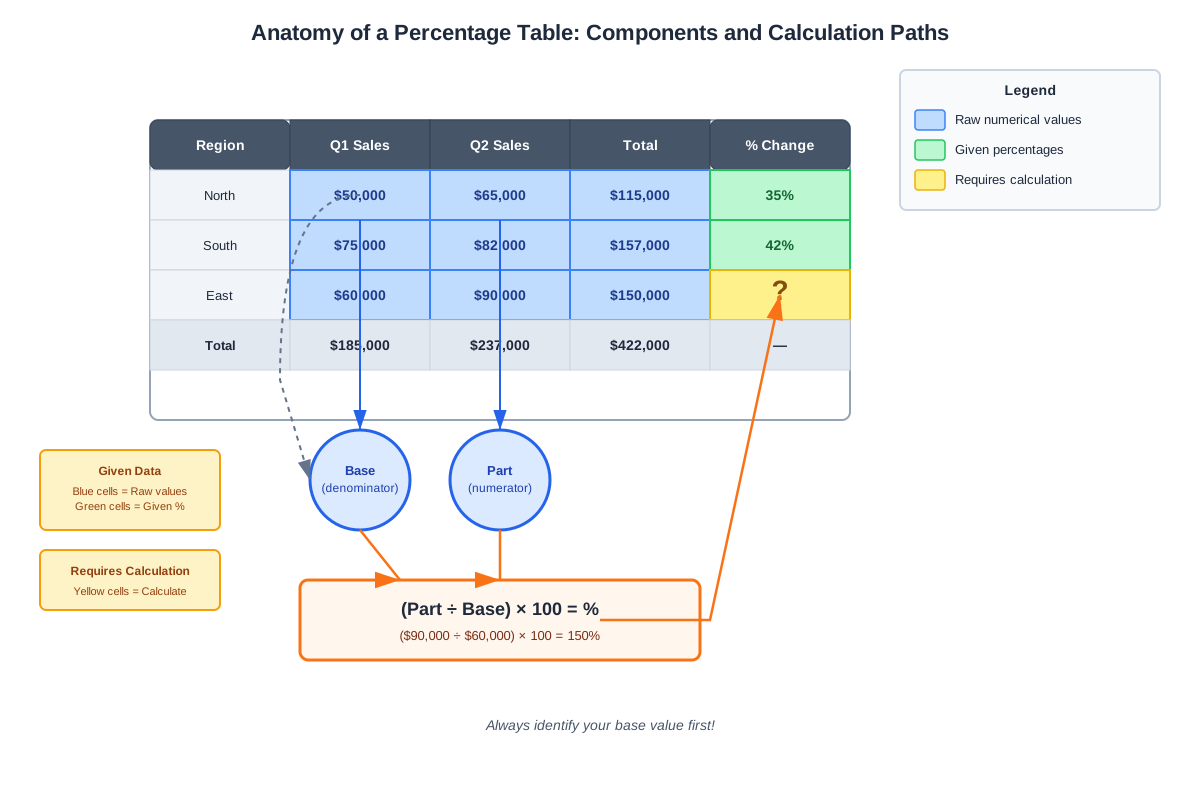
When working with percentages in tables, the first critical skill is identifying what each percentage value represents. Tables may present percentages in several forms: as standalone percentage values, as parts of a whole that sum to 100%, as growth rates or changes over time, or as comparative metrics between categories. Each cell containing a percentage must be interpreted in context—understanding both the numerator (what is being measured) and the denominator (the base or reference value).
Tables often mix absolute values with percentages, requiring students to determine which calculations are necessary. For example, a table might show total sales in dollars alongside the percentage each product category contributes to those sales. To find the actual dollar value for a specific category, one must multiply the total by the corresponding percentage. Conversely, when given two absolute values, calculating what percentage one represents of the other requires division followed by multiplication by 100.
Calculating Percentages from Table Data
The fundamental percentage calculation formula remains: (Part / Whole) × 100 = Percentage. In table contexts, identifying the "part" and "whole" requires careful reading of row and column headers. Consider a table showing regional sales data—if asked what percentage the Northeast region represents of total sales, the Northeast value is the part and the sum of all regions is the whole.
Percentage = (Value of Interest / Total Value) × 100GMAT questions frequently require reverse calculations: given a percentage and a total, find the actual value. This uses the rearranged formula:
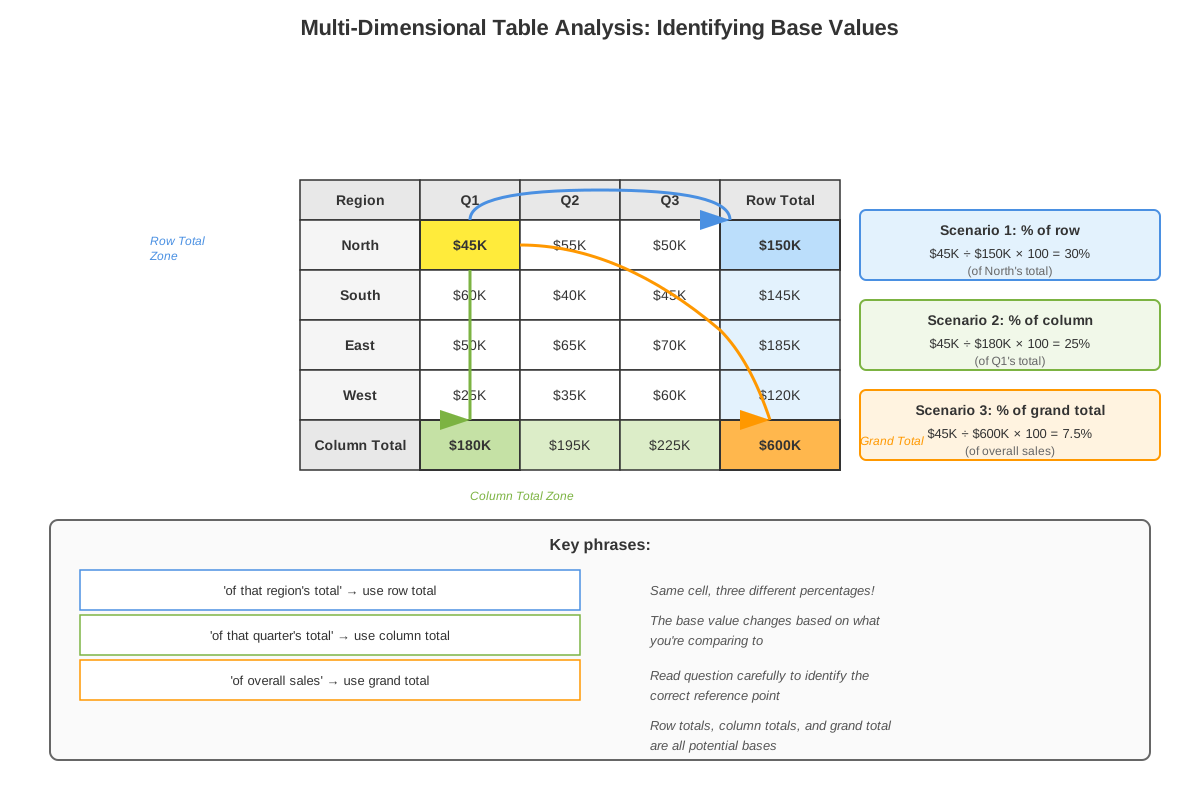
Actual Value = (Percentage / 100) × Total ValueWhen tables present data across multiple dimensions (such as years and categories), students must be precise about which total serves as the denominator. A value might represent one percentage of its row total and a different percentage of its column total.
Percentage Change vs. Percentage Point Change
One of the most commonly tested distinctions in GMAT percentages in tables is between percentage change and percentage point change. This difference is crucial and frequently appears in trap answer choices.
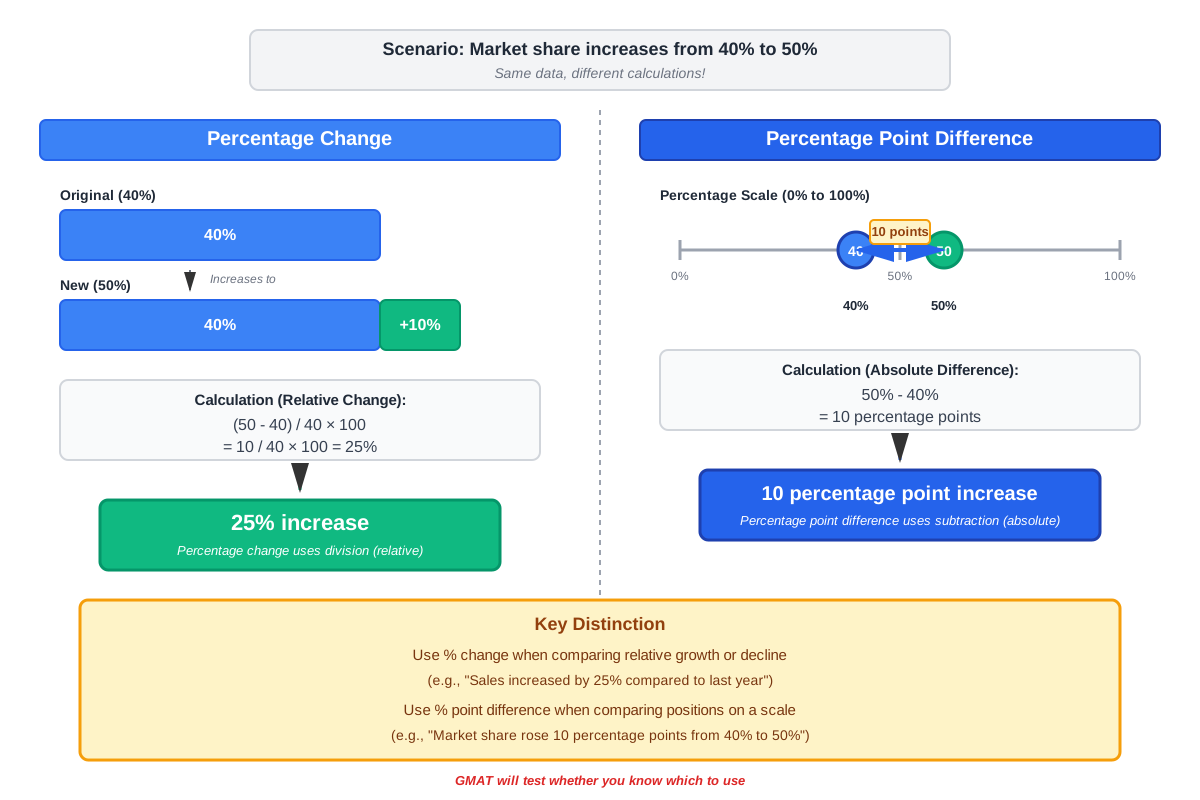
Percentage change measures the relative change in a value:
Percentage Change = ((New Value - Old Value) / Old Value) × 100Percentage point change measures the absolute difference between two percentages:
Percentage Point Change = New Percentage - Old PercentageFor example, if market share increases from 20% to 25%, the percentage point change is 5 percentage points, but the percentage change is 25% (since 5 is 25% of the original 20). The GMAT exploits this confusion by offering both values as answer choices.
Comparing Percentages Across Categories
Tables often require comparing percentage values across different rows or columns. When making such comparisons, students must verify that percentages share the same base. Comparing 30% of $1,000 with 40% of $500 is not simply comparing 30% to 40%—the absolute values are $300 and $200 respectively, making the 30% value actually larger.
When tables show percentage distributions (where each row or column sums to 100%), comparing across categories requires attention to whether the totals are equal. If Category A shows 60% male and Category B shows 55% male, but Category A has 1,000 people while Category B has 2,000 people, Category B actually has more males in absolute terms despite the lower percentage.
Multi-Step Percentage Calculations
Complex GMAT questions often require chaining multiple percentage calculations together. For instance, finding what percentage Category X represents of Subcategory Y, which itself is a percentage of Total Z, requires multiplying percentages:
Final Percentage = (Percentage 1 / 100) × (Percentage 2 / 100) × 100When tables show year-over-year growth rates, calculating cumulative growth over multiple periods requires compound percentage calculations, not simple addition. If a value grows by 10% in Year 1 and 20% in Year 2, the total growth is not 30% but rather 32% (1.10 × 1.20 = 1.32).
Percentage Composition and Distribution
Tables frequently display how a total breaks down into component percentages. These composition tables show what percentage each part contributes to the whole, with all percentages in a row or column summing to 100%. Understanding these distributions enables quick identification of the largest or smallest contributors and facilitates comparisons across different totals.
When analyzing percentage distributions, students should recognize that a small percentage of a large total may exceed a large percentage of a small total. This concept appears frequently in questions asking which category has the highest absolute value when only percentages and totals are provided.
Working with Incomplete Data
GMAT tables sometimes present incomplete information, requiring students to derive missing values from the given percentages and totals. If a table shows four categories with three percentage values given and states that these represent all categories, the fourth percentage can be calculated by subtracting the sum of the three from 100%.
Similarly, if row totals and some individual cell values are given, missing cells can often be determined through subtraction or by using percentage relationships. This skill connects directly to Data Sufficiency questions where determining whether enough information exists to solve a problem is itself the challenge.
Concept Relationships
The concepts within percentages in tables form an interconnected system where each skill builds upon others. Basic percentage identification serves as the foundation → enabling percentage calculations from raw data → which then supports percentage change analysis → ultimately allowing for complex multi-step comparisons across table dimensions.
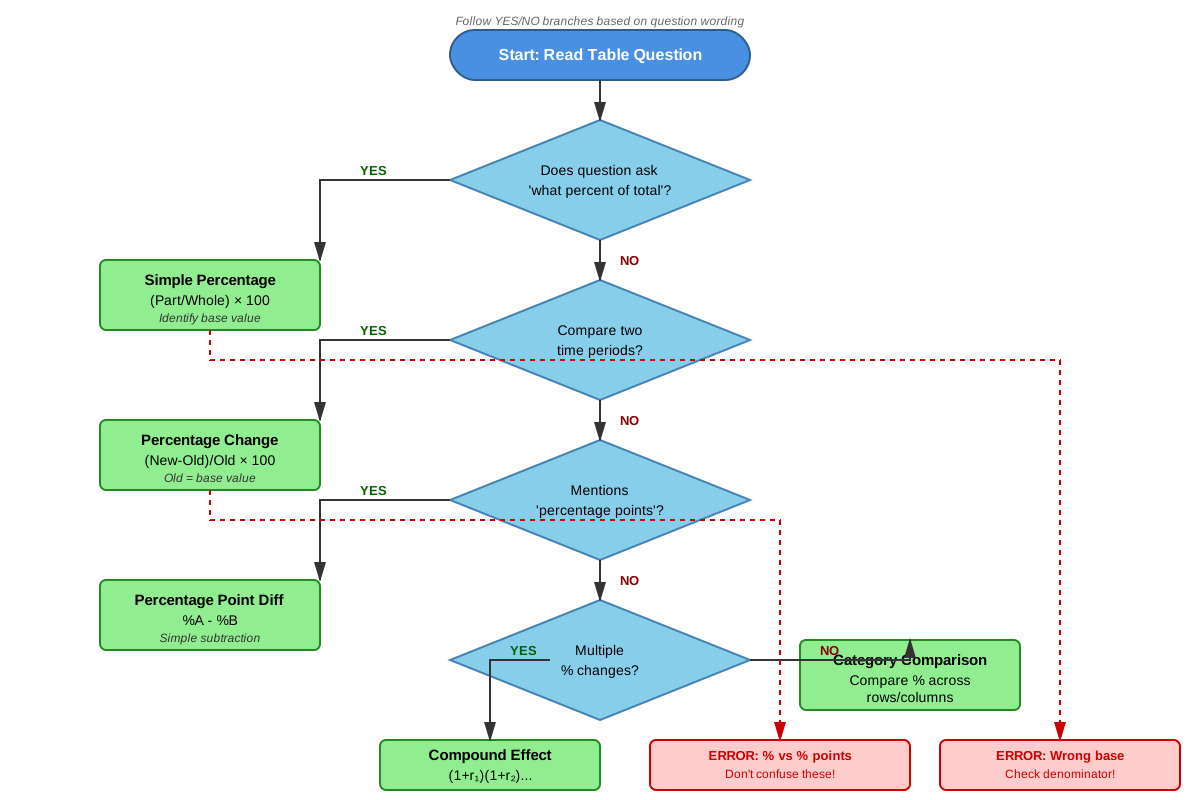
The relationship between percentage change and percentage point change represents a critical branching point where students must consciously choose the appropriate calculation method based on question wording. Both concepts connect back to the fundamental understanding of what constitutes the base or reference value in any percentage calculation.
Percentage composition and distribution analysis links directly to ratio concepts from prerequisite knowledge, as percentages are simply ratios expressed in a standardized format. This connection extends to proportion reasoning, where setting up equations to solve for unknown values requires understanding the multiplicative relationships between percentages and absolute values.
The skill of working with incomplete data synthesizes all other concepts, requiring students to recognize which calculations are possible given available information and which relationships between cells can reveal missing values. This meta-skill connects to broader Data Insights competencies around data sufficiency and logical reasoning.
Multi-step percentage calculations represent the highest level of complexity, integrating calculation accuracy, conceptual understanding of compounding effects, and the ability to track intermediate results while working toward a final answer. These problems often combine percentage change over time with cross-category comparisons, requiring students to maintain clear mental models of what each calculation represents.
Quick check — test yourself on Percentages in tables so far.
Try Flashcards →High-Yield Facts
⭐ Percentage point change and percentage change are different: A change from 20% to 25% is a 5 percentage point increase but a 25% relative increase
⭐ When comparing percentages across categories, always verify the base values are comparable: 30% of 1,000 exceeds 40% of 500
⭐ Percentages in a composition table (showing distribution) must sum to 100%: This property enables calculation of missing values
⭐ To find an actual value from a percentage: multiply the percentage (as a decimal) by the total: Value = (Percentage ÷ 100) × Total
⭐ Percentage changes do not add linearly: A 10% increase followed by a 10% increase yields a 21% total increase, not 20%
- When a table shows "% of total," the denominator is the sum of all categories, not the row or column subtotal
- Percentage growth rates in tables typically represent year-over-year changes unless otherwise specified
- The phrase "what percent greater" requires calculating the difference and expressing it as a percentage of the original value
- If a value increases by X% then decreases by X%, the final value is less than the original (not equal)
- Tables showing market share percentages across competitors should sum to 100% only if all market participants are included
- Percentage margins (like profit margin) are calculated as (Part ÷ Whole) × 100, where the whole is typically revenue or sales
- When tables present both percentages and absolute values, cross-checking calculations using both can verify accuracy
- The largest percentage increase does not necessarily correspond to the largest absolute increase
- Weighted averages of percentages require multiplying each percentage by its corresponding total before averaging
- Percentage distributions can be compared directly only when the totals are equal or when the question asks about relative composition
Common Misconceptions
Misconception: Percentage change and percentage point change are the same thing → Correction: Percentage change measures relative change from the original value ((New - Old) / Old × 100), while percentage point change is simply the arithmetic difference between two percentages (New % - Old %). A change from 40% to 50% is a 10 percentage point increase but a 25% relative increase.
Misconception: Percentages can be added directly to find cumulative effects → Correction: Successive percentage changes multiply, not add. A 20% increase followed by a 30% increase results in a 56% total increase (1.20 × 1.30 = 1.56), not 50%. Each percentage change applies to the new base created by the previous change.
Misconception: The category with the highest percentage always has the highest absolute value → Correction: Absolute value depends on both the percentage and the total. A category representing 15% of $10,000 ($1,500) exceeds a category representing 25% of $5,000 ($1,250). Always consider the base when comparing percentages across different totals.
Misconception: If a value decreases by X% then increases by X%, it returns to the original value → Correction: The final value will be less than the original because the percentage increase applies to a smaller base. For example, if 100 decreases by 20% to 80, then increases by 20%, it becomes 96 (20% of 80 is 16), not 100.
Misconception: All percentages in a table row or column must sum to 100% → Correction: Only composition or distribution tables (showing how a whole breaks into parts) sum to 100%. Tables showing growth rates, margins, or other percentage metrics do not have this constraint. Always read headers carefully to understand what each percentage represents.
Misconception: "50% more than" and "50% of" mean the same thing → Correction: "50% more than X" equals 1.5X (the original plus half again), while "50% of X" equals 0.5X (half the original). The phrase "more than" indicates addition to the original, while "of" indicates multiplication only.
Worked Examples
Example 1: Multi-Step Percentage Calculation with Comparison
Question: The table below shows sales data for three product categories across two years. In which category did the absolute dollar increase from 2022 to 2023 represent the highest percentage of that category's 2022 sales?
| Category | 2022 Sales | 2023 Sales | % Change |
|---|---|---|---|
| Electronics | $450,000 | $540,000 | 20% |
| Clothing | $300,000 | $375,000 | 25% |
| Home Goods | $250,000 | $287,500 | 15% |
Solution:
This question tests the understanding that the "% Change" column already provides the answer to what percentage the increase represents of 2022 sales. However, let's verify this understanding by calculating one example and then identifying the highest.
For Electronics:
- Absolute increase = $540,000 - $450,000 = $90,000
- Percentage of 2022 sales = ($90,000 / $450,000) × 100 = 20%
For Clothing:
- Absolute increase = $375,000 - $300,000 = $75,000
- Percentage of 2022 sales = ($75,000 / $300,000) × 100 = 25%
For Home Goods:
- Absolute increase = $287,500 - $250,000 = $37,500
- Percentage of 2022 sales = ($37,500 / $250,000) × 100 = 15%
Answer: Clothing had the highest percentage increase at 25%.
Key Insight: The question asks for the increase "as a percentage of 2022 sales," which is precisely what percentage change measures. The trap would be comparing absolute dollar increases ($90,000 vs. $75,000 vs. $37,500), which would incorrectly suggest Electronics. This example demonstrates why understanding what percentages represent is crucial—the largest absolute increase does not correspond to the largest percentage increase.
Example 2: Percentage Point vs. Percentage Change
Question: The table shows market share data for three companies over two years.
| Company | 2022 Market Share | 2023 Market Share |
|---|---|---|
| Alpha Corp | 35% | 42% |
| Beta Inc | 40% | 44% |
| Gamma LLC | 25% | 14% |
Which statement is correct?
A) Alpha Corp experienced the largest percentage point increase
B) Beta Inc experienced the largest percentage increase
C) Gamma LLC's market share decreased by 11 percentage points
D) Alpha Corp's market share increased by 20%
Solution:
Let's evaluate each statement systematically:
Statement A: Percentage point changes
- Alpha Corp: 42% - 35% = 7 percentage points
- Beta Inc: 44% - 40% = 4 percentage points
- Gamma LLC: 14% - 25% = -11 percentage points (decrease)
Alpha Corp had the largest percentage point increase (7 points). Statement A is TRUE.
Statement B: Percentage changes (relative changes)
- Alpha Corp: ((42 - 35) / 35) × 100 = (7 / 35) × 100 = 20%
- Beta Inc: ((44 - 40) / 40) × 100 = (4 / 40) × 100 = 10%
- Gamma LLC: ((14 - 25) / 25) × 100 = (-11 / 25) × 100 = -44%
Alpha Corp had the largest percentage increase (20%), not Beta Inc. Statement B is FALSE.
Statement C: Gamma LLC's percentage point change
- 14% - 25% = -11 percentage points
This is correct—the market share decreased by 11 percentage points. Statement C is TRUE.
Statement D: Alpha Corp's percentage change
- As calculated above: 20%
Statement D is TRUE.
Answer: Statements A, C, and D are all correct. If this were a multiple-answer question (common in GMAT Data Insights), all three would be selected. Statement B is the only false statement.
Key Insight: This example illustrates the critical distinction between percentage point change (arithmetic difference) and percentage change (relative change). Alpha Corp's 7 percentage point increase represents a 20% relative increase because 7 is 20% of the original 35. Understanding both concepts and when each applies is essential for avoiding trap answers.
Exam Strategy
When approaching GMAT questions involving percentages in tables, begin by carefully reading all column and row headers to understand what each cell represents. Identify whether percentages are given or must be calculated, and note whether the question asks for percentages, percentage changes, percentage points, or absolute values. This initial orientation prevents the common error of performing the wrong calculation type.
Trigger phrases to watch for include: "what percent greater" (requires percentage change calculation), "percentage point difference" (arithmetic subtraction of percentages), "what percentage of the total" (requires identifying the correct denominator), "by what percent did X increase" (percentage change formula), and "X percent more than Y" (multiply Y by 1.0X). Each phrase signals a specific calculation approach, and misinterpreting these triggers leads directly to trap answers.
For process of elimination, immediately eliminate answer choices that violate logical constraints. If comparing percentages across categories with different totals, eliminate choices that ignore the base values. If a question asks for percentage change and an answer choice shows the percentage point change (or vice versa), eliminate it. When questions involve successive percentage changes, eliminate choices that simply add the percentages rather than compounding them.
Time allocation for table analysis questions should follow a 30-60-90 second rule: spend 30 seconds understanding the table structure and question, 60 seconds performing calculations, and reserve 30 seconds for verification. If a calculation extends beyond 90 seconds total, consider whether there's a more efficient approach or whether estimation can narrow answer choices. Many GMAT percentage questions are designed to be solved through reasoning rather than extensive calculation.
Develop a systematic approach for multi-step problems: (1) identify what the question asks for, (2) determine what information is given, (3) identify what intermediate calculations are needed, (4) perform calculations in logical order, (5) verify the answer makes sense in context. Writing down intermediate results prevents errors in complex calculations and allows quick verification if time permits.
Memory Techniques
PERCENTAGE CHANGE mnemonic - "NEW OVER OLD": Remember that percentage change always uses the formula (New - Old) / Old × 100. The denominator is always the OLD (original) value. Visualize "climbing from the old value up to the new value" to remember that you're measuring change relative to where you started.
Percentage Point vs. Percentage Change - "POINT = PLAIN, CHANGE = COMPARE": Percentage POINT change is the PLAIN arithmetic difference (just subtract). Percentage CHANGE requires COMPARING to the original (divide by original). The word "point" suggests something simple and direct, while "change" suggests a more complex comparison.
Base Value Identification - "PERCENT OF WHAT?": When calculating any percentage, always ask "percent of WHAT?" The answer to "what" is your denominator. This question forces identification of the correct base value, preventing errors in multi-dimensional tables.
Composition Tables - "PARTS TO WHOLE = 100": Visualize a pie chart where all slices must complete the circle. If a table shows how something breaks down into components, those components must sum to 100%. This visualization helps identify missing values and verify calculations.
Successive Percentages - "MULTIPLY THE MULTIPLIERS": Convert each percentage to its multiplier (20% increase = 1.20, 15% decrease = 0.85) and multiply them together. This prevents the error of adding percentages. Visualize each change creating a new base for the next change, like climbing stairs where each step is a different height.
Summary
Mastering percentages in tables for the GMAT requires integrating computational accuracy with conceptual understanding of what different percentage values represent. Success depends on distinguishing between percentage changes (relative measures) and percentage point changes (absolute differences), recognizing when percentages share comparable bases, and accurately performing multi-step calculations that may involve composition analysis, growth rates, or cross-category comparisons. The most critical skills include identifying the correct denominator for any percentage calculation, understanding that successive percentage changes compound rather than add, and recognizing that the highest percentage does not necessarily correspond to the highest absolute value when totals differ. GMAT questions exploit common misconceptions by offering trap answers that result from confusing these concepts, making careful question interpretation as important as calculation accuracy. Students who develop systematic approaches to table analysis—reading headers carefully, identifying what calculations are required before beginning computation, and verifying that answers make logical sense—will efficiently navigate even complex percentage-based questions within the time constraints of the exam.
Key Takeaways
- Percentage change (relative) and percentage point change (absolute difference) are fundamentally different concepts that GMAT questions frequently test through trap answers
- Always identify the base value (denominator) before calculating any percentage; in tables, this requires careful attention to row and column headers
- Percentages cannot be meaningfully compared across categories unless the base values are equal or the question specifically asks about relative composition
- Successive percentage changes multiply rather than add; a 10% increase followed by a 20% increase yields a 32% total increase, not 30%
- Composition tables where percentages represent parts of a whole must sum to 100%, enabling calculation of missing values through subtraction
- The largest percentage value does not necessarily represent the largest absolute value when comparing across different totals
- Systematic question analysis—identifying what is asked, what is given, and what calculations are needed—prevents errors and saves time on complex multi-step problems
Related Topics
Ratio and Proportion in Tables: Building on percentage skills, this topic explores how ratios between table values reveal relationships and enable predictions. Mastering percentages provides the foundation for ratio analysis since percentages are standardized ratios.
Weighted Averages and Distributions: This advanced topic requires calculating averages when different categories have different weights, often presented as percentages in tables. Understanding percentage composition is prerequisite to weighted average calculations.
Growth Rate Analysis: Extending percentage change concepts, this topic covers compound annual growth rates (CAGR), exponential growth patterns, and trend analysis across multiple time periods in tabular data.
Data Sufficiency with Tables: This question type tests whether given information is sufficient to answer percentage-based questions, requiring deep understanding of what calculations are possible with different combinations of data points.
Multi-Source Reasoning: These complex questions require synthesizing percentage information from tables with text passages and other exhibits, representing the highest level of Data Insights integration.
Practice CTA
Now that you've mastered the core concepts of percentages in tables, it's time to reinforce your learning through active practice. Attempt the practice questions designed specifically for this topic, focusing on applying the systematic approaches and avoiding the common misconceptions covered in this guide. Use the flashcards to drill the high-yield facts and formulas until they become automatic. Remember that GMAT success comes not just from understanding concepts but from developing the speed and accuracy to apply them under timed conditions. Each practice question you complete builds the pattern recognition and confidence needed to excel on test day. You've built a strong foundation—now strengthen it through deliberate practice!
Sign up free to keep reading
Create a free AnvayaPrep account to finish this GMAT guide on Percentages in tables — plus flashcards and practice questions.