Overview
Weighted averages represent one of the most frequently tested arithmetic concepts on the GMAT Quantitative Reasoning section. Unlike simple averages where each data point contributes equally to the final result, weighted averages account for the relative importance or frequency of different values. This concept appears in approximately 10-15% of GMAT quantitative questions and serves as a foundation for more complex problem-solving scenarios involving mixtures, rates, and combined work problems.
Understanding GMAT weighted averages is essential because these questions test not only computational ability but also logical reasoning and the capacity to set up equations from word problems. The GMAT frequently disguises weighted average problems within contexts such as class grade calculations, investment portfolio returns, mixture problems (combining solutions of different concentrations), and population statistics. Mastering this topic enables test-takers to quickly recognize problem patterns and apply efficient solution strategies rather than relying on time-consuming algebraic manipulations.
Within the broader Quantitative Reasoning framework, weighted averages bridge fundamental arithmetic operations with algebraic problem-solving and ratio concepts. This topic connects directly to percentages, ratios, proportions, and linear equations—all high-yield GMAT areas. The ability to manipulate weighted average formulas and understand the underlying logic of how different weights affect outcomes is crucial for achieving scores in the 700+ range, as these concepts frequently appear in medium to difficult questions that separate top performers from average test-takers.
Learning Objectives
- [ ] Identify weighted averages in various GMAT problem contexts
- [ ] Explain weighted averages and how they differ from simple arithmetic means
- [ ] Apply weighted averages to GMAT questions across multiple problem types
- [ ] Calculate weighted averages using both the formula method and the deviation method
- [ ] Determine unknown weights or values when given a weighted average
- [ ] Recognize and solve mixture problems using weighted average principles
- [ ] Apply the weighted average concept to optimize time management on complex multi-step problems
Prerequisites
- Basic arithmetic operations: Addition, subtraction, multiplication, and division form the computational foundation for all weighted average calculations
- Simple averages (arithmetic mean): Understanding how to calculate (sum of values)/(number of values) is essential because weighted averages build upon this concept
- Ratios and proportions: Weights are often expressed as ratios, and solving weighted average problems frequently requires setting up proportional relationships
- Basic algebra: Setting up and solving linear equations with one or two variables is necessary for problems where weights or values are unknown
- Fractions and decimals: Converting between these forms and performing operations with them is required for accurate weighted average calculations
Why This Topic Matters
Weighted averages appear extensively in real-world applications that the GMAT draws upon for question contexts. Financial analysts use weighted averages to calculate portfolio returns where different investments represent different proportions of total capital. Educators compute weighted grade point averages where exams, homework, and projects carry different percentages of the final grade. Chemists and pharmacists work with mixture problems that are fundamentally weighted average calculations. Manufacturing quality control, demographic analysis, and economic indicators all rely on weighted average principles.
On the GMAT specifically, weighted average questions appear in approximately 3-5 questions per exam, making them high-yield study material. These questions typically appear as Problem Solving questions worth 2-3 minutes each, though they also emerge in Data Sufficiency format where recognizing the weighted average structure can quickly lead to the correct sufficiency determination. The GMAT tests weighted averages through several common question types: direct calculation problems, reverse problems (finding weights or component values), mixture problems, combined rate problems, and optimization scenarios.
The exam frequently embeds weighted average concepts within word problems about class demographics, product pricing strategies, investment returns, travel scenarios involving different speeds or distances, and work problems involving different productivity rates. Recognizing the weighted average structure beneath these varied contexts is a critical skill that distinguishes high-scoring test-takers. Questions often require students to move beyond rote formula application to demonstrate conceptual understanding—for instance, determining whether a weighted average must fall closer to one value than another based on the relative weights.
Core Concepts
The Weighted Average Formula
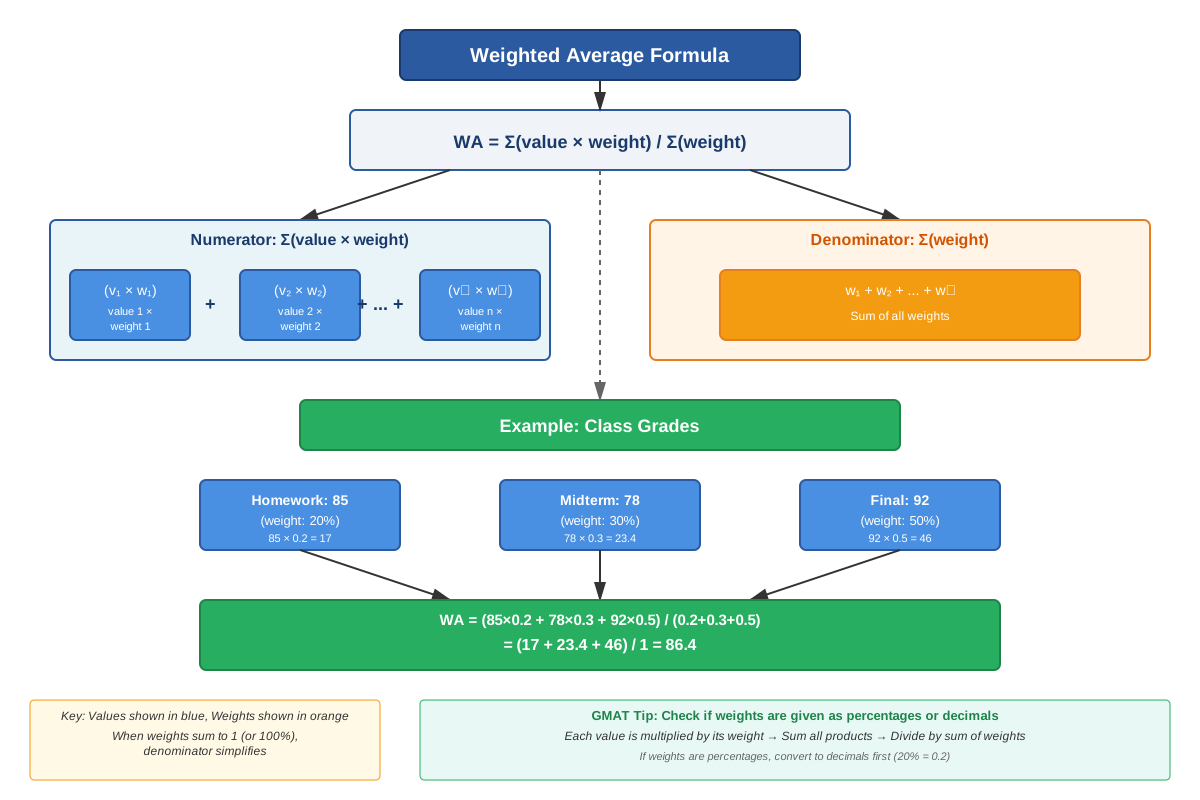
The fundamental weighted average formula calculates a mean where different data points contribute unequally to the final result. The standard formula is:
Weighted Average = (w₁ × v₁ + w₂ × v₂ + ... + wₙ × vₙ) / (w₁ + w₂ + ... + wₙ)Where:
- v₁, v₂, ..., vₙ represent the individual values
- w₁, w₂, ..., wₙ represent the corresponding weights (frequencies, quantities, or importance factors)
The numerator represents the total "weighted sum" while the denominator represents the total weight. This formula reduces to the simple average when all weights are equal (each weight = 1).
Example: A student scores 85 on a midterm (worth 40% of the grade) and 92 on a final exam (worth 60% of the grade). The weighted average is:
Weighted Average = (0.40 × 85 + 0.60 × 92) / (0.40 + 0.60)
                 = (34 + 55.2) / 1
                 = 89.2
Note that when weights are expressed as percentages that sum to 100%, the denominator equals 1, simplifying calculations.
Understanding Weight Distribution
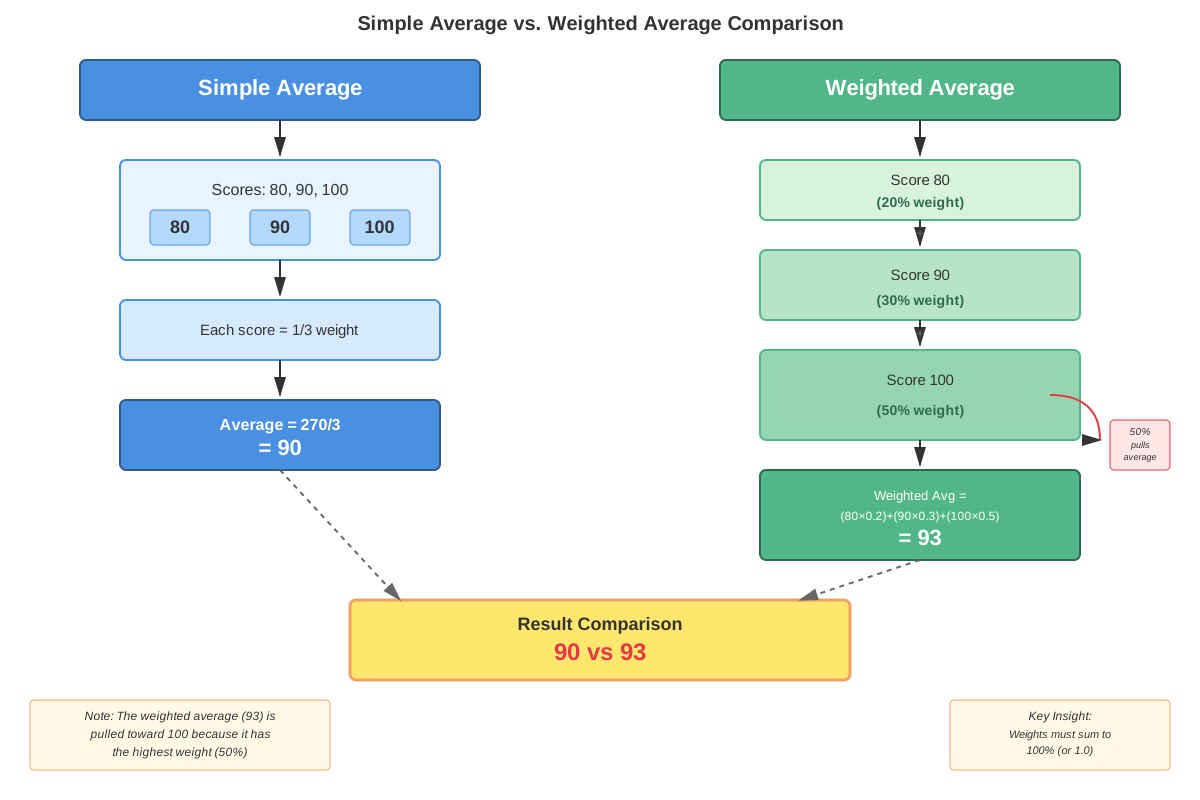
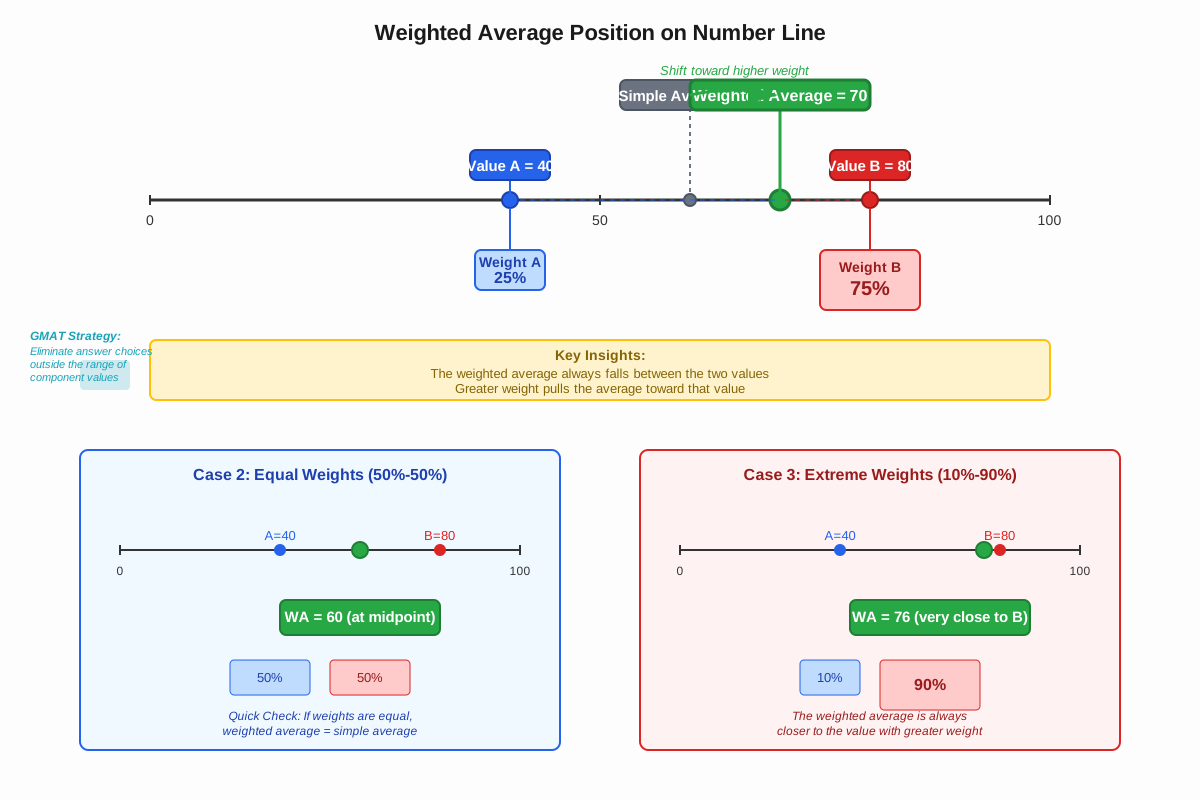
The position of a weighted average relative to its component values depends entirely on the weight distribution. The weighted average always falls between the minimum and maximum values being averaged, and it gravitates toward values with larger weights.
Key principle: If two groups with different averages are combined, the overall weighted average will be closer to the average of the larger group. For instance, if 20 students average 80 points and 80 students average 90 points, the combined average will be much closer to 90 than to 80 because the second group has four times the weight.
This principle enables quick estimation and elimination of answer choices on the GMAT. If a problem asks for the weighted average of 30 items at $50 and 70 items at $80, test-takers can immediately eliminate any answer choice below $50 or above $80, and should expect the answer to be closer to $80 than to $50.
The Deviation Method (Weighted Average Shortcut)
The deviation method provides an efficient alternative approach, particularly useful when dealing with two groups or when one value can serve as a reference point. This method calculates how far the weighted average deviates from a reference value:
Weighted Average = Reference Value + (Weighted Sum of Deviations / Total Weight)Example: Combining 40 liters of 20% alcohol solution with 60 liters of 35% alcohol solution.
Using 20% as the reference:
- First solution: 40 liters at 0% deviation from reference = 0
- Second solution: 60 liters at +15% deviation from reference = 900
- Weighted average = 20% + (900/100) = 20% + 9% = 29%
This method is particularly powerful for two-group problems and can significantly reduce calculation time.
The Weighted Average Position Formula (Two Groups)
For problems involving exactly two groups, a specialized formula determines the weighted average's position:
(A - W) / (W - B) = w₂ / w₁Where:
- A = average of first group
- B = average of second group
- W = weighted average
- w₁ = weight of first group
- w₂ = weight of second group
This formula reveals that the ratio of distances from the weighted average to each group average equals the inverse ratio of the weights. This relationship enables solving for unknown weights or values efficiently.
Example: If 30% alcohol solution is mixed with 50% alcohol solution to create 45% alcohol solution, what is the ratio of the two solutions?
(30 - 45) / (45 - 50) = w₂ / w₁
-15 / -5 = w₂ / w₁
3 / 1 = w₂ / w₁
The ratio is 1:3 (30% solution : 50% solution).
Mixture Problems as Weighted Averages
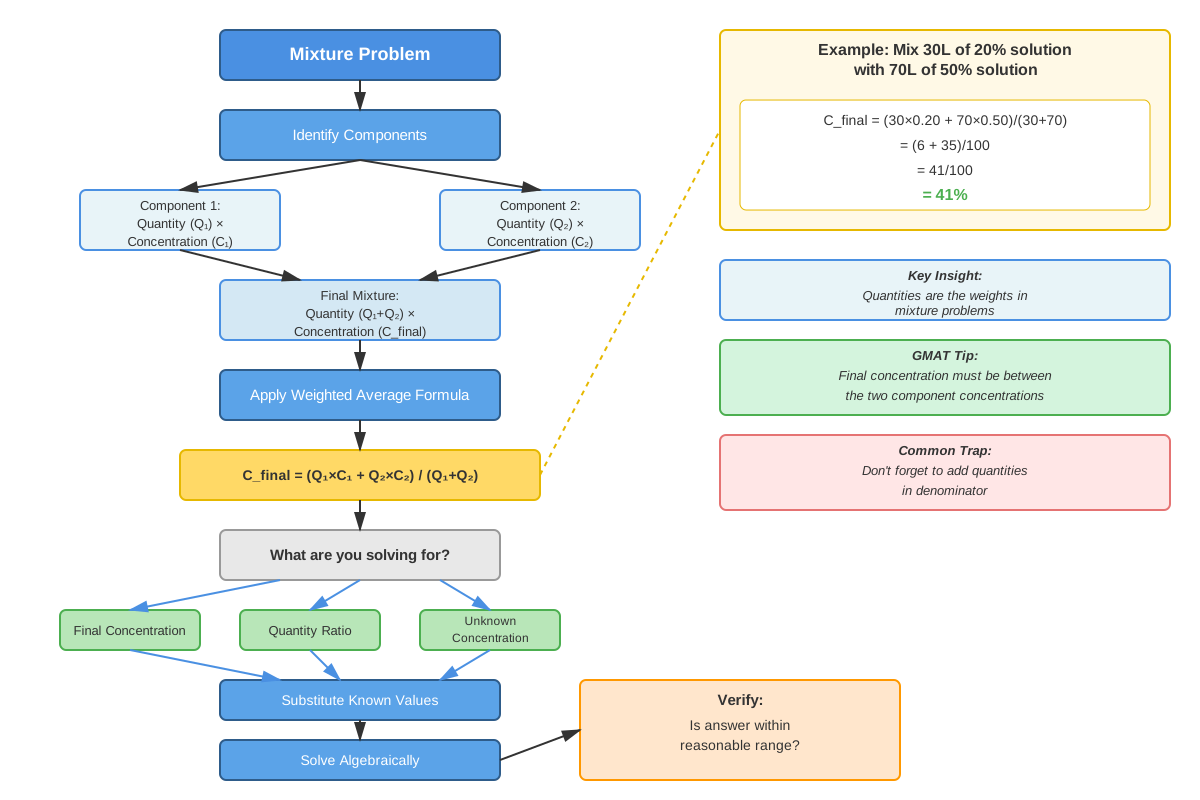
Mixture problems represent a major category of GMAT weighted average questions. These involve combining substances with different properties (concentration, price, quality rating) to achieve a target property in the mixture.
The key insight is recognizing that the final mixture's property is the weighted average of the component properties, where the weights are the quantities of each component.
Common mixture problem types:
- Concentration problems (mixing solutions of different alcohol, salt, or chemical percentages)
- Price problems (combining products at different prices to achieve a target average price)
- Alloy problems (mixing metals with different purity levels)
Reverse Weighted Average Problems
Many GMAT questions provide the weighted average and ask test-takers to determine component values or weights. These reverse problems require algebraic manipulation of the weighted average formula.
Strategy for reverse problems:
- Assign variables to unknown quantities
- Set up the weighted average equation
- Use any additional constraints provided in the problem
- Solve the resulting equation(s)
These problems often appear in Data Sufficiency format, where recognizing that you need exactly as many independent equations as unknowns helps determine sufficiency quickly.
Weighted Averages in Rate Problems
Rate problems involving different speeds, work rates, or productivity levels often require weighted average thinking. When different portions of a task occur at different rates, the overall average rate is a weighted average where time or distance serves as the weight.
Important distinction: For rate problems, be careful about what serves as the weight. If traveling different distances at different speeds, distance is the weight. If traveling for different times at different speeds, time is the weight. The average speed is NOT the simple average of the speeds.
Concept Relationships
The core concepts within weighted averages form an interconnected framework. The fundamental weighted average formula serves as the foundation from which all other concepts derive. Understanding weight distribution principles enables quick estimation and answer elimination, while the deviation method provides a computational shortcut that builds on the same underlying mathematics as the standard formula.
The two-group position formula represents a specialized application of the general weighted average formula, optimized for the most common GMAT scenario. This formula connects directly to mixture problems, which are simply weighted averages disguised in practical contexts. Reverse weighted average problems flip the standard calculation, requiring algebraic manipulation skills that build on prerequisite knowledge of linear equations.
Relationship map:
- Basic arithmetic and simple averages → Weighted average formula
- Weighted average formula → Weight distribution principles
- Weighted average formula → Deviation method (alternative approach)
- Weighted average formula → Two-group position formula (specialized case)
- Two-group position formula → Mixture problems (practical application)
- Weighted average formula → Reverse problems (algebraic manipulation)
- Weighted average formula → Rate problems (application with time/distance weights)
These concepts connect to prerequisite topics through ratios (weight relationships), algebra (solving for unknowns), and percentages (expressing weights and concentrations). They extend forward to more advanced topics including statistics (weighted standard deviation), probability (expected value), and optimization problems.
Quick check — test yourself on Weighted averages so far.
Try Flashcards →High-Yield Facts
⭐ The weighted average always falls between the minimum and maximum values being averaged, never outside this range
⭐ The weighted average is closer to the value with the larger weight; if one group is three times larger than another, the weighted average will be three times closer to the larger group's average
⭐ When weights are expressed as percentages summing to 100%, the denominator in the weighted average formula equals 1
⭐ For two groups, the ratio of distances from the weighted average to each group average equals the inverse ratio of the weights: (A - W)/(W - B) = w₂/w₁
⭐ In mixture problems, the quantity of each component serves as its weight, and the final mixture property is the weighted average of component properties
- When all weights are equal, the weighted average equals the simple arithmetic mean
- The weighted average formula can be rearranged to solve for any unknown variable: a component value, a weight, or the weighted average itself
- For rate problems involving different speeds over different distances, distance serves as the weight, not time
- Adding a value equal to the current weighted average does not change the weighted average, regardless of the weight added
- If two groups have the same average, their combined weighted average equals that common average regardless of the group sizes
- The weighted average of percentages or decimals follows the same formula as the weighted average of whole numbers
- In Data Sufficiency questions, you need as many independent equations as unknowns to determine a unique weighted average
Common Misconceptions
Misconception: The weighted average of two values is always their simple average.
Correction: The weighted average equals the simple average only when the weights are equal. When weights differ, the weighted average gravitates toward the value with the larger weight. For example, the weighted average of 10 (weight 1) and 20 (weight 3) is 17.5, not 15.
Misconception: When combining groups, you can average the group averages to find the overall average.
Correction: You cannot simply average the averages unless the groups are equal in size. If 10 students average 80 and 20 students average 90, the overall average is not 85 (the average of 80 and 90), but rather 86.67, which is closer to 90 because that group is larger.
Misconception: In rate problems, average speed equals the average of the speeds.
Correction: Average speed is total distance divided by total time, which is a weighted average where distance (or time, depending on the problem) serves as the weight. If you drive 60 mph for 30 miles and 40 mph for 30 miles, your average speed is not 50 mph but rather 48 mph because you spent more time at the slower speed.
Misconception: The weighted average can fall outside the range of values being averaged.
Correction: The weighted average must always fall between (or equal to) the minimum and maximum values. If a calculated weighted average falls outside this range, an error has occurred in the calculation. This principle provides a quick reasonableness check.
Misconception: Weights must always be expressed as percentages.
Correction: Weights can be expressed as any positive numbers—whole numbers, fractions, decimals, or percentages. The key is maintaining consistency within a problem. Weights of 2 and 3 produce the same weighted average as weights of 40% and 60%, or 0.4 and 0.6.
Misconception: In mixture problems, you can add concentrations directly.
Correction: Concentrations cannot be added; you must calculate the total amount of the substance (concentration × quantity) for each component, sum these amounts, then divide by the total quantity. Mixing 10 liters of 20% solution with 10 liters of 30% solution yields 25% solution, not 50% solution.
Worked Examples
Example 1: Classic Two-Group Weighted Average
Problem: A company has two divisions. Division A has 120 employees with an average salary of $65,000. Division B has 80 employees with an average salary of $78,000. What is the average salary across the entire company?
Solution:
Step 1: Identify the values and weights
- Value 1 (v₁) = $65,000, Weight 1 (w₁) = 120 employees
- Value 2 (v₂) = $78,000, Weight 2 (w₂) = 80 employees
Step 2: Apply the weighted average formula
Weighted Average = (w₁ × v₁ + w₂ × v₂) / (w₁ + w₂)
                 = (120 × 65,000 + 80 × 78,000) / (120 + 80)
                 = (7,800,000 + 6,240,000) / 200
                 = 14,040,000 / 200
                 = $70,200
Step 3: Verify reasonableness
The answer $70,200 falls between $65,000 and $78,000 ✓
It's closer to $65,000 than to $78,000 because Division A is larger (120 vs 80) ✓
Alternative approach using deviation method:
Using $65,000 as reference:
- Division A: 120 employees at $0 deviation = 0
- Division B: 80 employees at $13,000 deviation = 1,040,000
- Weighted average = $65,000 + (1,040,000 / 200) = $65,000 + $5,200 = $70,200 ✓
Connection to learning objectives: This example demonstrates identifying a weighted average problem (two groups with different averages), explaining how the larger group pulls the overall average closer to its value, and applying the formula correctly.
Example 2: Mixture Problem with Unknown Ratio
Problem: A chemist needs to create a 15-liter solution that is 32% acid. She has a 20% acid solution and a 50% acid solution available. How many liters of each solution should she mix?
Solution:
Step 1: Set up variables
Let x = liters of 20% solution
Then (15 - x) = liters of 50% solution (since total must be 15 liters)
Step 2: Recognize this as a weighted average problem
The final 32% concentration is the weighted average of 20% and 50%, where the weights are the quantities in liters.
Step 3: Set up the weighted average equation
32 = (20x + 50(15 - x)) / 15Step 4: Solve for x
32 × 15 = 20x + 50(15 - x)
480 = 20x + 750 - 50x
480 = 750 - 30x
30x = 270
x = 9
Step 5: Find both quantities
- 20% solution: 9 liters
- 50% solution: 15 - 9 = 6 liters
Step 6: Verify
(9 × 20 + 6 × 50) / 15 = (180 + 300) / 15 = 480 / 15 = 32% ✓Alternative approach using the two-group position formula:
(20 - 32) / (32 - 50) = w₂ / w₁
-12 / -18 = w₂ / w₁
2 / 3 = w₂ / w₁
This means the ratio of 20% solution to 50% solution is 3:2.
With 15 total liters: (3/5) × 15 = 9 liters of 20% solution, (2/5) × 15 = 6 liters of 50% solution ✓
Connection to learning objectives: This example applies weighted averages to a mixture problem, demonstrates solving for unknown weights (quantities), and shows two different solution methods that both leverage weighted average principles.
Exam Strategy
When approaching GMAT weighted averages questions, begin by identifying whether the problem involves a weighted average situation. Trigger words include "average," "mean," "mixture," "combined," "overall," "total," and contexts involving different groups, rates, concentrations, or prices. Questions about class grades with different assignment weights, investment portfolios with different allocations, or travel problems with different speeds over different distances all signal weighted average applications.
Step-by-step approach:
- Identify the values and weights: Determine what is being averaged (values) and what makes each value more or less important (weights). Weights might be quantities, frequencies, time periods, or percentages.
- Determine what's being asked: Are you calculating the weighted average, finding a component value, or determining weights? This dictates your solution strategy.
- Choose your method: For straightforward calculations, use the standard formula. For two-group problems, consider the deviation method or position formula. For mixture problems with unknowns, set up algebraic equations.
- Estimate before calculating: Use weight distribution principles to estimate the answer's position. This enables quick elimination of unreasonable answer choices and provides a check on your final calculation.
- Verify reasonableness: Ensure your answer falls within the appropriate range and gravitates toward the correct side based on weight distribution.
Process of elimination tips:
- Immediately eliminate any answer choice outside the range of values being averaged
- If one group is significantly larger, eliminate choices too close to the smaller group's average
- For mixture problems, eliminate concentrations that would require negative quantities of components
- In Data Sufficiency, recognize that you need exactly as many independent equations as unknowns
Time allocation advice:
Budget 2-3 minutes for weighted average Problem Solving questions. If you recognize the two-group structure, the position formula can save 30-45 seconds compared to the standard formula. For Data Sufficiency questions, spend 15-20 seconds determining the structure (how many unknowns, what information is provided) before evaluating each statement. Don't waste time calculating exact values in Data Sufficiency if you can determine sufficiency through structural analysis alone.
Common trap answers:
- The simple average of the values (ignoring weights)
- The average of the weights (nonsensical but appears as a distractor)
- Results from arithmetic errors like forgetting to divide by total weight
- In mixture problems, the sum of concentrations rather than the weighted average
Memory Techniques
Mnemonic for the weighted average formula: "WAVE" - Weights × Amounts, Values Everywhere
Remember: Multiply each weight by its value, sum these products, then divide by the sum of weights.
Visualization strategy: Picture a seesaw or balance beam. The weighted average is the fulcrum point. Heavier weights (larger groups) pull the balance point toward their side. This physical analogy helps remember that weighted averages gravitate toward larger weights.
The "Closer-To" rule: Create a mental image of the weighted average as a person standing on a line between two groups. The person always stands closer to the larger group. If Group A has 3 times as many people as Group B, the weighted average stands 3 times closer to Group A's position.
Acronym for mixture problem steps: "SAVE"
- Set up variables for unknown quantities
- Apply the weighted average formula
- Verify the total quantity constraint
- Evaluate and check your answer
Memory hook for the two-group position formula: "The distance ratio is the inverse weight ratio" - the ratio of distances from the weighted average to each group average equals the flipped ratio of the weights. Remember: distances and weights go in opposite directions.
Percentage weight shortcut: When weights are percentages summing to 100%, remember "The denominator disappears" - you can skip dividing by the sum of weights because it equals 1.
Summary
Weighted averages represent a critical GMAT Quantitative Reasoning concept that appears in multiple question formats and contexts. The fundamental principle involves calculating a mean where different values contribute unequally based on their weights—frequencies, quantities, or importance factors. The standard formula multiplies each value by its weight, sums these products, and divides by the total weight. Understanding weight distribution principles enables quick estimation: weighted averages always fall between the minimum and maximum values and gravitate toward values with larger weights. For two-group problems, specialized approaches like the deviation method and position formula provide efficient alternatives to the standard formula. Mixture problems, rate problems, and reverse problems all apply weighted average principles in different contexts. Success on GMAT weighted average questions requires recognizing the underlying structure, choosing the most efficient solution method, and verifying that answers fall within reasonable ranges based on weight distribution.
Key Takeaways
- Weighted averages account for the relative importance of different values through weights, unlike simple averages where all values contribute equally
- The weighted average always falls between the minimum and maximum values and is pulled toward values with larger weights
- For two groups, the ratio of distances from the weighted average to each group average equals the inverse ratio of the weights: (A - W)/(W - B) = w₂/w₁
- Mixture problems are weighted average problems where quantities serve as weights and the final mixture property is the weighted average of component properties
- Multiple solution methods exist (standard formula, deviation method, position formula); choosing the most efficient method for each problem saves valuable time
- Estimation based on weight distribution enables quick elimination of unreasonable answer choices and provides a check on calculations
- In Data Sufficiency questions, count unknowns and independent equations to determine sufficiency without performing complete calculations
Related Topics
Ratios and Proportions: Weighted averages frequently involve ratio relationships between weights, and solving mixture problems often requires setting up proportions. Mastering weighted averages strengthens ratio manipulation skills.
Percentages: Many weighted average problems express weights, concentrations, or values as percentages. Converting between percentages, decimals, and fractions becomes essential for efficient calculation.
Work and Rate Problems: Combined work problems where different workers have different productivity rates use weighted average principles where time or work completed serves as the weight.
Statistics and Data Analysis: Weighted averages extend to more advanced statistical concepts including weighted standard deviation, weighted variance, and expected value in probability.
Optimization Problems: Some GMAT questions ask for maximum or minimum weighted averages subject to constraints, combining weighted average concepts with inequality reasoning.
Algebraic Word Problems: Weighted averages provide excellent practice in translating word problems into algebraic equations, a skill that transfers to many other GMAT question types.
Practice CTA
Now that you've mastered the core concepts of weighted averages, it's time to reinforce your understanding through active practice. Attempt the practice questions associated with this topic, focusing on recognizing weighted average structures in different contexts and applying the most efficient solution methods. Use the flashcards to drill high-yield facts and formulas until they become automatic. Remember that weighted averages appear in approximately 10-15% of GMAT quantitative questions—your investment in mastering this topic will pay dividends on test day. Challenge yourself to solve problems using multiple methods to build flexibility and deepen your conceptual understanding. You've built a strong foundation; now solidify it through deliberate practice!
Sign up free to keep reading
Create a free AnvayaPrep account to finish this GMAT guide on Weighted averages — plus flashcards and practice questions.