Overview
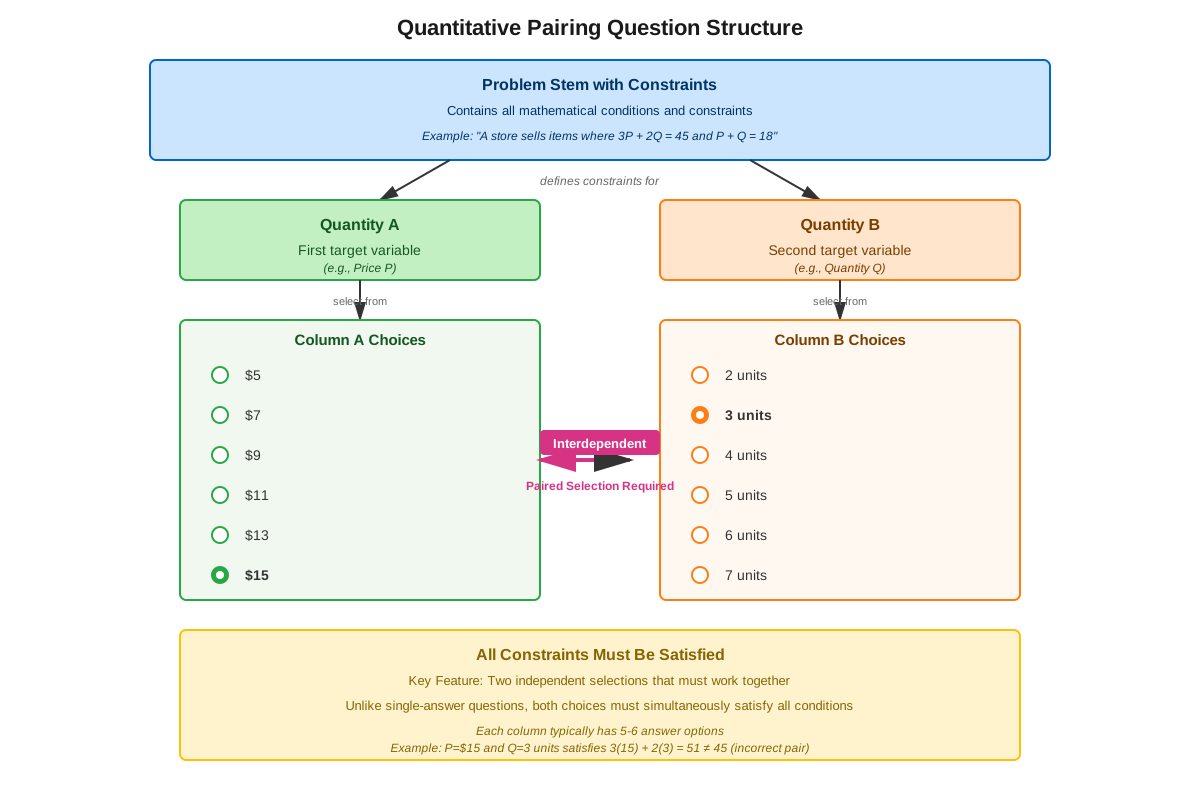
Quantitative pairing represents a critical question format within the GMAT Data Insights section, specifically appearing in Two-Part Analysis questions. This question type requires test-takers to simultaneously evaluate two related but distinct quantitative values, variables, or solutions that together satisfy a complex set of conditions or constraints. Unlike traditional problem-solving questions that ask for a single answer, quantitative pairing challenges students to identify two interdependent answers from separate columns of answer choices, where each selection must work in harmony with the other to satisfy all given conditions.
The essence of GMAT quantitative pairing lies in its demand for integrated analytical thinking. Students must not only solve for multiple unknowns but also verify that their paired selections satisfy all constraints simultaneously. This format tests mathematical reasoning, logical deduction, and the ability to manage multiple variables under time pressure. Questions may involve systems of equations, optimization problems, algebraic relationships, ratio and proportion scenarios, or business mathematics contexts where two related quantities must be determined together.
Mastery of quantitative pairing is essential for GMAT success because these questions appear regularly in the Data Insights section and carry significant weight in overall scoring. This topic builds upon fundamental quantitative reasoning skills while introducing the added complexity of coordinated decision-making. It connects directly to other Data Insights concepts such as table analysis and multi-source reasoning, where synthesizing information from multiple sources to reach coordinated conclusions is paramount. The ability to handle quantitative pairing efficiently distinguishes high-scoring candidates from average performers.
Learning Objectives
- [ ] Identify quantitative pairing question formats and structural characteristics in GMAT Two-Part Analysis questions
- [ ] Explain the logical framework and mathematical relationships that govern quantitative pairing problems
- [ ] Apply quantitative pairing strategies to solve GMAT questions efficiently and accurately
- [ ] Evaluate answer choice combinations systematically to determine which pairs satisfy all given constraints
- [ ] Construct algebraic representations of paired relationships from word problems and business scenarios
- [ ] Analyze the interdependence between paired values to eliminate impossible combinations quickly
Prerequisites
- Basic algebra and equation solving: Essential for setting up and manipulating the mathematical relationships between paired quantities
- Systems of equations: Required to understand how two variables interact and constrain each other within a problem
- Ratio and proportion concepts: Frequently appear in quantitative pairing scenarios involving comparative relationships
- Word problem translation skills: Necessary to convert business scenarios and verbal descriptions into mathematical expressions
- Logical reasoning fundamentals: Critical for evaluating whether answer combinations satisfy multiple conditions simultaneously
Why This Topic Matters
Quantitative pairing questions appear in approximately 15-20% of Data Insights questions on the GMAT, making them one of the most frequently tested formats within Two-Part Analysis. These questions directly assess a candidate's ability to handle the complex, multi-variable decision-making scenarios that business school curricula and management careers demand. In real-world business contexts, professionals regularly face situations requiring simultaneous optimization of multiple related variables—such as determining both price and quantity to maximize profit, or allocating resources across two departments while satisfying budget and performance constraints.
The GMAT specifically uses quantitative pairing to evaluate higher-order thinking skills that distinguish exceptional candidates. Unlike straightforward calculation problems, these questions require strategic thinking about relationships, constraints, and interdependencies. Business schools value this skill because it mirrors the analytical demands of case studies, financial modeling, and strategic planning exercises that form the core of MBA education.
On the exam, quantitative pairing appears most commonly in scenarios involving: business optimization problems (pricing, production, resource allocation), algebraic systems with two unknowns, ratio and proportion relationships between two quantities, investment or financial planning with multiple variables, and mixture or work-rate problems requiring coordinated solutions. The questions typically present a scenario followed by a table with two columns of answer choices, where students must select one answer from each column such that the pair satisfies all stated conditions.
Core Concepts
Structure of Quantitative Pairing Questions
Quantitative pairing questions follow a distinctive format that sets them apart from other GMAT question types. The problem presents a scenario containing multiple constraints or conditions, followed by a two-column answer table. Each column represents a different variable, quantity, or aspect of the solution. Students must select exactly one answer from each column, and the selected pair must simultaneously satisfy all conditions stated in the problem.
The answer choices are typically arranged in ascending or descending order within each column, facilitating systematic evaluation. Importantly, the relationship between the two columns is not arbitrary—the values are interdependent, meaning the validity of one selection depends on what is chosen in the other column. This interdependence is the defining characteristic of quantitative pairing and the source of its complexity.
Types of Quantitative Relationships in Pairing Problems
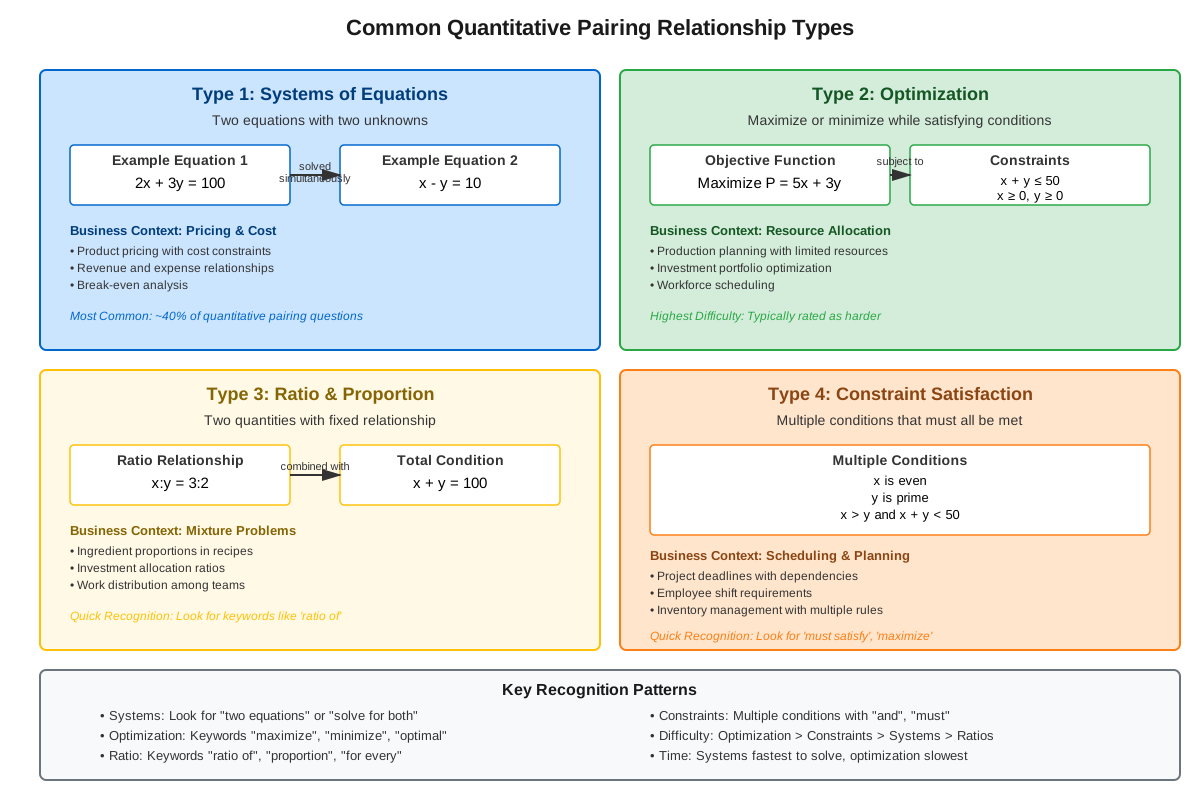
Linear relationships form the most common category, where two variables are connected through addition, subtraction, or proportional relationships. For example, if x + y = 100 and x - y = 20, the paired values must satisfy both equations simultaneously. These problems often involve systems of linear equations that can be solved through substitution or elimination methods.
Optimization relationships require finding paired values that maximize or minimize some objective function while satisfying constraints. A typical scenario might ask for the price and quantity that maximize revenue given a demand function and cost structure. These problems test understanding of how changes in one variable affect the optimal value of another.
Ratio and proportion relationships connect two quantities through multiplicative relationships. Problems might specify that two investments must maintain a certain ratio while achieving a combined return, or that two ingredients must be mixed in specific proportions while meeting total quantity requirements.
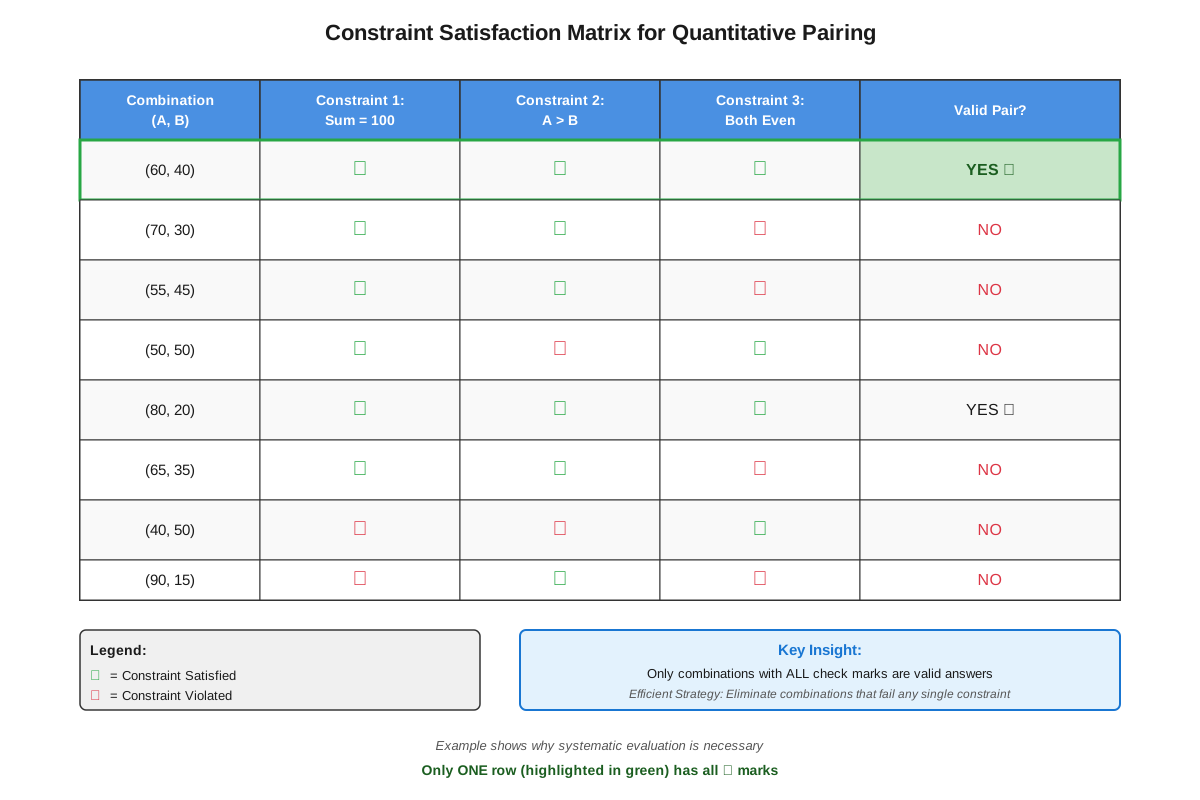
Constraint satisfaction problems present multiple conditions that must all be met simultaneously. The paired values might need to satisfy inequality constraints, divisibility requirements, or logical conditions. Success requires systematically checking each potential pair against all stated constraints.
Solution Strategies for Quantitative Pairing
The algebraic approach involves translating the problem into mathematical equations or inequalities, then solving for the two unknowns. This method works best when the problem provides clear quantitative relationships that can be expressed symbolically. Students should define variables clearly, write out all constraints as equations, and solve the system to find the unique pair that satisfies all conditions.
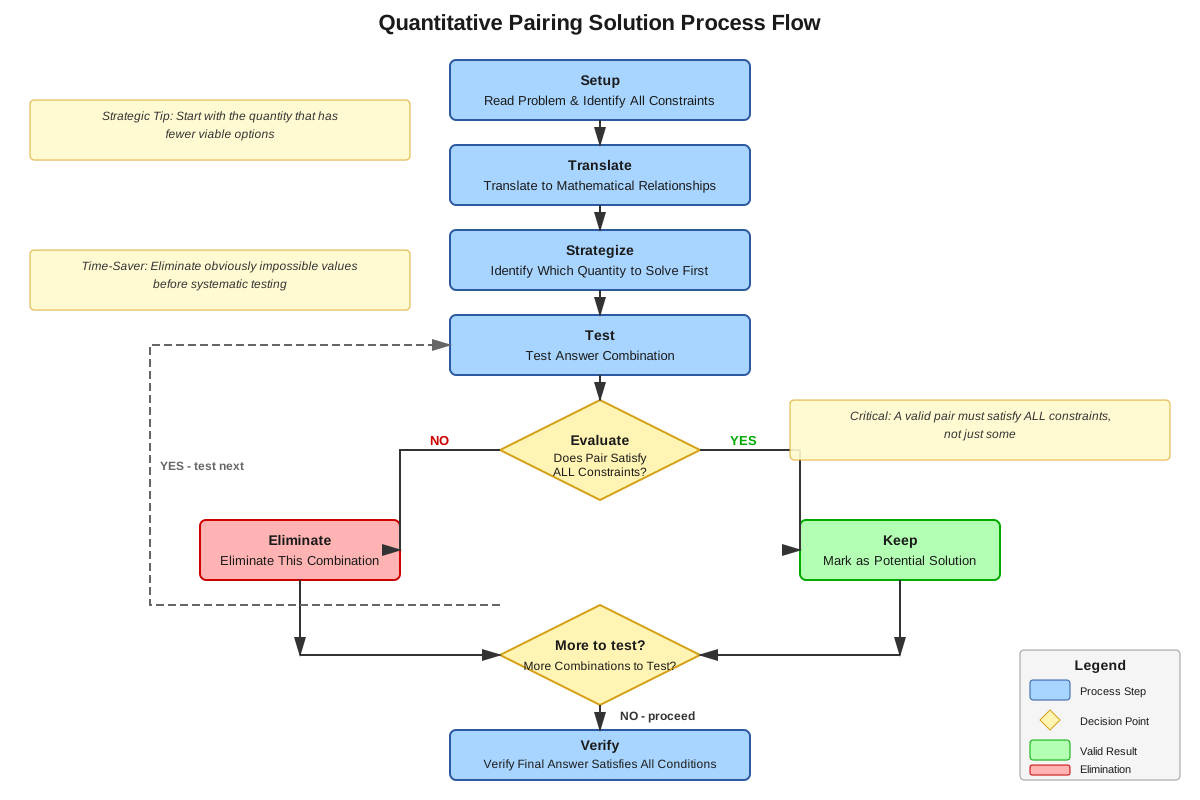
The systematic testing approach involves strategically evaluating answer choice combinations. Rather than testing all possible pairs (which could mean checking 25 or more combinations), students should identify the most restrictive constraint and use it to eliminate impossible values in one column first. Then, for remaining candidates, test combinations against other constraints. This approach is particularly effective when algebraic manipulation would be time-consuming or when constraints are complex.
The logical elimination approach uses reasoning about relationships to rule out impossible combinations without calculation. For example, if the problem states that one value must be larger than the other, all pairs where this relationship doesn't hold can be eliminated immediately. If a sum must be even, pairs with odd sums are eliminated. This approach often works in combination with other methods to narrow possibilities quickly.
Common Mathematical Contexts
Business and economics scenarios frequently appear in quantitative pairing questions. These might involve determining price and quantity, cost and revenue, or investment amounts in two different assets. Understanding basic business relationships—such as revenue = price × quantity, or profit = revenue - cost—is essential for setting up these problems correctly.
Mixture and solution problems require determining amounts of two components that achieve desired concentrations or properties. These problems test understanding of weighted averages and the principle that total quantity equals the sum of components.
Work and rate problems involve two workers, machines, or processes operating together or separately. Students must understand how individual rates combine and how time, rate, and work completed relate to each other.
Number property problems might require finding two integers that satisfy specific divisibility, prime factorization, or arithmetic sequence conditions. These problems test number sense and the ability to work with constraints on integer values.
Concept Relationships
Quantitative pairing builds directly upon foundational algebra skills, particularly systems of equations, which provide the mathematical framework for expressing relationships between two unknowns. The concept extends basic equation-solving by adding the complexity of coordinated selection from discrete answer choices rather than calculating exact values.
Within the Two-Part Analysis question type, quantitative pairing represents the mathematical reasoning variant, while other Two-Part Analysis questions might focus on verbal reasoning or integrated reasoning. All share the common structure of coordinated dual selection but differ in the type of reasoning required.
The relationship flow can be mapped as: Basic Algebra → Systems of Equations → Constraint Satisfaction → Quantitative Pairing → Complex Multi-Variable Decision Making. Each step adds layers of complexity and real-world applicability.
Quantitative pairing also connects horizontally to other Data Insights topics. Table Analysis questions may require similar evaluation of multiple variables, though without the paired selection format. Multi-Source Reasoning questions might embed quantitative pairing logic within more complex scenarios involving multiple data sources. Graphics Interpretation questions share the need to extract quantitative relationships from presented information.
The skills developed through quantitative pairing—systematic evaluation of combinations, constraint checking, and relationship analysis—transfer directly to the Quantitative Reasoning section, particularly to problem-solving questions involving multiple variables or optimization scenarios.
High-Yield Facts
- ⭐ Quantitative pairing questions always require selecting exactly one answer from each of two columns, where the pair must satisfy all stated conditions simultaneously
- ⭐ The most efficient approach typically involves identifying the most restrictive constraint first and using it to eliminate impossible values before testing combinations
- ⭐ Answer choices within each column are usually arranged in numerical order (ascending or descending), which facilitates systematic evaluation
- ⭐ The two values in a quantitative pairing question are interdependent—the validity of one selection depends on what is chosen in the other column
- ⭐ Testing all possible combinations is rarely necessary or time-efficient; strategic elimination can reduce possibilities to 2-3 pairs that need verification
- When a problem involves a sum or difference, testing extreme values (largest and smallest options) first can quickly reveal patterns
- If one constraint involves a product or quotient, checking whether answer choices are factors or multiples can eliminate options rapidly
- Business context problems often involve the relationship: Profit = Revenue - Cost, or Revenue = Price × Quantity
- For ratio problems, the actual values must maintain the specified ratio while also satisfying any absolute quantity constraints
- Integer constraint problems require checking divisibility and remainder conditions for each potential pair
- When time is limited, verifying that a selected pair satisfies the most complex or restrictive constraint first prevents wasted effort on invalid combinations
Quick check — test yourself on Quantitative pairing so far.
Try Flashcards →Common Misconceptions
Misconception: Each column can be solved independently, then the answers combined.
Correction: The two values are interdependent and must be evaluated as pairs. A value that seems correct in isolation may not work when paired with any valid option from the other column. Always verify that the selected pair satisfies all constraints together.
Misconception: The correct answer pair will be the one where both values are in the middle of their respective ranges.
Correction: The correct pair's position in the answer choice ordering is unpredictable and problem-dependent. Extreme values (highest or lowest options) are just as likely to be correct as middle values. Avoid positional bias and evaluate based on mathematical relationships only.
Misconception: If a pair satisfies one constraint, it's likely the correct answer.
Correction: The correct pair must satisfy ALL stated constraints simultaneously. A common trap involves pairs that satisfy the most obvious constraint but violate a secondary condition. Systematically check every constraint before confirming an answer.
Misconception: Quantitative pairing questions always involve systems of linear equations.
Correction: While linear systems are common, quantitative pairing encompasses diverse mathematical relationships including inequalities, optimization problems, ratio relationships, number properties, and logical constraints. The solution approach must adapt to the specific mathematical context.
Misconception: Testing combinations randomly is as efficient as any other approach.
Correction: Strategic testing based on constraint analysis is significantly more efficient. Identifying which constraint is most restrictive, which eliminates the most options, or which is easiest to check first can reduce the number of combinations requiring full verification from 25+ to just 2-3.
Misconception: The problem will explicitly state which value goes in which column.
Correction: While column headers indicate what each selection represents, the problem may require careful reading to understand which quantity corresponds to which column. Misaligning variables with columns is a common source of errors.
Worked Examples
Example 1: Business Optimization Problem
Problem: A company produces two products, A and B. The profit per unit is $15 for Product A and $20 for Product B. The company has 200 hours of labor available, and Product A requires 2 hours per unit while Product B requires 4 hours per unit. The company must produce at least 30 units total. In the table below, select the number of units of Product A and the number of units of Product B that would maximize total profit while satisfying all constraints.
| Product A Units | Product B Units |
|---|---|
| 20 | 30 |
| 30 | 35 |
| 40 | 40 |
| 50 | 45 |
| 60 | 50 |
Solution Process:
First, identify all constraints:
- Labor constraint: 2A + 4B ≤ 200 (where A = units of Product A, B = units of Product B)
- Minimum production: A + B ≥ 30
- Objective: Maximize profit = 15A + 20B
Since we want to maximize profit and Product B has higher profit per unit ($20 vs $15), we should produce as much B as possible within the labor constraint. However, Product B also uses more labor (4 hours vs 2 hours), so we need to find the optimal balance.
Let's test the combinations systematically, starting with options that have higher B values:
Testing A=20, B=50: Labor used = 2(20) + 4(50) = 40 + 200 = 240 hours. This exceeds 200 hours available. Eliminated.
Testing A=40, B=40: Labor used = 2(40) + 4(40) = 80 + 160 = 240 hours. Exceeds constraint. Eliminated.
Testing A=60, B=50: Labor used = 2(60) + 4(50) = 120 + 200 = 320 hours. Exceeds constraint. Eliminated.
Testing A=30, B=35: Labor used = 2(30) + 4(35) = 60 + 140 = 200 hours. Exactly meets constraint. ✓
Total units = 30 + 35 = 65 ≥ 30. ✓
Profit = 15(30) + 20(35) = 450 + 700 = $1,150
Testing A=20, B=30: Labor used = 2(20) + 4(30) = 40 + 120 = 160 hours. Within constraint. ✓
Total units = 20 + 30 = 50 ≥ 30. ✓
Profit = 15(20) + 20(30) = 300 + 600 = $900
Testing A=50, B=45: Labor used = 2(50) + 4(45) = 100 + 180 = 280 hours. Exceeds constraint. Eliminated.
Among feasible options, A=30 and B=35 uses all available labor and generates the highest profit of $1,150.
Answer: Product A = 30 units, Product B = 35 units
This example demonstrates the optimization relationship type and shows how systematic testing combined with constraint checking leads to the correct paired answer.
Example 2: System of Equations with Constraints
Problem: Two investments, X and Y, have a combined value of $50,000. Investment X earns 6% annual interest, while Investment Y earns 8% annual interest. The total annual interest from both investments is $3,400. Additionally, Investment X must be at least $10,000, and Investment Y must be at least $15,000. Select the amount invested in X and the amount invested in Y.
| Investment X | Investment Y |
|---|---|
| $10,000 | $15,000 |
| $15,000 | $20,000 |
| $20,000 | $25,000 |
| $25,000 | $30,000 |
| $30,000 | $35,000 |
Solution Process:
Set up the system of equations:
- X + Y = 50,000 (total investment)
- 0.06X + 0.08Y = 3,400 (total interest)
- X ≥ 10,000 (minimum for X)
- Y ≥ 15,000 (minimum for Y)
From equation 1: Y = 50,000 - X
Substitute into equation 2:
0.06X + 0.08(50,000 - X) = 3,400
0.06X + 4,000 - 0.08X = 3,400
-0.02X = -600
X = 30,000
Therefore: Y = 50,000 - 30,000 = 20,000
Verify constraints:
- X = $30,000 ≥ $10,000 ✓
- Y = $20,000 ≥ $15,000 ✓
- Total = $30,000 + $20,000 = $50,000 ✓
- Interest = 0.06(30,000) + 0.08(20,000) = 1,800 + 1,600 = $3,400 ✓
Answer: Investment X = $30,000, Investment Y = $20,000
This example illustrates the algebraic approach to quantitative pairing, where solving the system of equations directly yields the answer, which is then verified against all constraints. This method is most efficient when the mathematical relationships are clearly defined and algebraically tractable.
Exam Strategy
When approaching quantitative pairing questions on the GMAT, begin by carefully reading the entire problem to identify all constraints and relationships. Underline or mentally note each distinct condition that the paired values must satisfy. Count the constraints—problems typically have 2-4 conditions that must all be met simultaneously.
Trigger phrases that signal quantitative pairing questions include: "select the value for X and the value for Y," "choose one option from each column," "determine both quantities," and "identify the pair that satisfies." The presence of a two-column answer table is the definitive structural indicator.
Prioritize constraints by restrictiveness. The most restrictive constraint—the one that eliminates the most answer options—should guide your initial evaluation. For example, if one constraint is an inequality that only 2-3 answer choices satisfy, start there. If another constraint is a simple sum that most pairs satisfy, save it for final verification.
Use the strategic testing sequence:
- Identify the most restrictive or easiest-to-check constraint
- Eliminate values in one column that cannot satisfy this constraint regardless of pairing
- For remaining values, identify which pairings are possible
- Test these candidate pairs against remaining constraints
- Verify the final pair against ALL constraints before confirming
Time management is critical. Quantitative pairing questions should take approximately 2.5-3 minutes. If algebraic solution is straightforward, use it—solving a system of two equations is often faster than testing multiple combinations. However, if algebra becomes complex, switch to strategic testing. Never spend more than 30 seconds on an approach that isn't yielding progress.
For process of elimination, recognize that eliminating even one value from each column reduces possible combinations significantly. With 5 options per column, eliminating one from each reduces combinations from 25 to 16—a 36% reduction. Eliminating two from each column leaves only 9 combinations to consider.
Watch for trap answers where a pair satisfies the most obvious constraint but violates a subtle secondary condition. The GMAT deliberately includes such pairs to catch students who don't verify all constraints. Always perform a final check of your selected pair against every stated condition.
Memory Techniques
Use the acronym PAIRS to remember the systematic approach:
- Prioritize the most restrictive constraint
- Analyze relationships between the two variables
- Identify impossible values in each column
- Reduce combinations through strategic elimination
- Satisfy all constraints with your final selection
Visualize quantitative pairing questions as a matching puzzle where two pieces must fit together perfectly. Just as a puzzle piece that looks right in isolation might not connect properly, an answer choice that seems correct for one column might not pair validly with any option in the other column.
For business optimization problems, remember "PRICE × QUANTITY = REVENUE" and "REVENUE - COST = PROFIT" as the fundamental relationships. Visualize these as a chain where changing one link affects the others.
For constraint satisfaction, use the "ALL or FALL" rule: the correct pair satisfies ALL constraints, or it FALLS (is incorrect). This reminds you to check every condition, not just the most obvious one.
Create a mental image of a two-column checklist where you mark off constraints as you verify them for a candidate pair. This visualization helps ensure systematic verification and prevents overlooking conditions.
Summary
Quantitative pairing represents a distinctive and high-value question format within GMAT Data Insights, requiring test-takers to identify two interdependent values that simultaneously satisfy multiple constraints. Success demands both mathematical proficiency and strategic thinking—students must translate complex scenarios into mathematical relationships, systematically evaluate answer combinations, and verify that selected pairs meet all stated conditions. The most efficient approach combines algebraic problem-solving when relationships are clear with strategic testing when constraints are complex, always prioritizing the most restrictive conditions to eliminate impossible combinations quickly. Mastery requires understanding diverse mathematical contexts including business optimization, systems of equations, ratio relationships, and constraint satisfaction problems. The key to excellence lies in recognizing that the two values are never independent—they must work together as a coordinated pair, making verification against all constraints simultaneously the critical final step before confirming any answer.
Key Takeaways
- Quantitative pairing questions require selecting one answer from each of two columns where the pair must satisfy all constraints simultaneously—the values are interdependent, not independent
- Strategic efficiency comes from identifying the most restrictive constraint first and using it to eliminate impossible values before testing combinations
- The correct approach varies by problem type: use algebraic solution for clear systems of equations, strategic testing for complex constraints, and logical elimination for relationship-based problems
- Always verify that your selected pair satisfies every stated constraint—trap answers commonly satisfy obvious conditions while violating subtle secondary requirements
- Business context problems typically involve fundamental relationships like Revenue = Price × Quantity and Profit = Revenue - Cost
- Time management requires limiting quantitative pairing questions to 2.5-3 minutes and switching approaches if one method isn't yielding progress within 30 seconds
- The answer choices' numerical ordering (ascending or descending) facilitates systematic evaluation and should be leveraged in your testing strategy
Related Topics
Systems of Inequalities: Extends quantitative pairing concepts to scenarios with multiple inequality constraints, requiring understanding of feasible regions and boundary conditions. Mastering quantitative pairing provides the foundation for handling more complex multi-constraint optimization problems.
Multi-Source Reasoning: Incorporates quantitative pairing logic within scenarios requiring synthesis of information from multiple tables, graphs, or text sources. The paired selection skills transfer directly while adding the complexity of information integration.
Optimization Problems in Quantitative Reasoning: Builds on the optimization relationships encountered in quantitative pairing, extending to calculus-based optimization and more sophisticated business scenarios in the Quantitative section.
Table Analysis: Shares the requirement to evaluate multiple variables and their relationships, though without the paired selection format. Skills in identifying patterns and testing combinations transfer between these question types.
Algebraic Word Problems: Provides the foundational translation skills necessary for converting quantitative pairing scenarios into mathematical expressions and equations.
Practice CTA
Now that you've mastered the concepts and strategies for quantitative pairing, it's time to solidify your understanding through practice. Attempt the practice questions designed specifically for this topic, focusing on applying the systematic approaches you've learned. Use the flashcards to reinforce high-yield facts and common trap patterns. Remember, quantitative pairing questions reward both mathematical precision and strategic thinking—each practice problem you solve builds the pattern recognition and efficiency that will serve you on test day. Approach practice deliberately, analyzing not just whether you got the answer right, but whether you used the most efficient method and verified all constraints systematically. Your investment in focused practice now will translate directly into points on the GMAT.
Sign up free to keep reading
Create a free AnvayaPrep account to finish this GMAT guide on Quantitative pairing — plus flashcards and practice questions.