Overview
Functions represent one of the most frequently tested algebraic concepts on the GMAT Quantitative Reasoning section. A function is a mathematical relationship that assigns exactly one output value to each input value, creating a systematic rule that transforms numbers according to a specific pattern. On the GMAT, gmat functions questions appear in various formats, from straightforward function evaluation problems to complex questions involving function composition, inverse functions, and abstract function notation that tests logical reasoning as much as mathematical computation.
Understanding functions is essential for GMAT success because these questions test multiple skills simultaneously: pattern recognition, algebraic manipulation, logical reasoning, and the ability to work with abstract notation. Function problems often serve as vehicles for testing other algebraic concepts such as equations, inequalities, and coordinate geometry. The GMAT frequently presents functions using non-standard notation (such as f#g or f@g) to assess whether test-takers truly understand the underlying concept rather than relying on memorized formulas.
Functions connect to virtually every other area of GMAT Quantitative Reasoning. They build upon foundational algebra skills like substitution and equation solving, while also appearing in coordinate geometry questions involving graphs and in word problems requiring translation between verbal descriptions and mathematical notation. Mastering functions provides the analytical framework needed for tackling Data Sufficiency questions that require determining what information is necessary to evaluate a function at specific points or to determine function properties.
Learning Objectives
- [ ] Identify Functions and distinguish them from non-function relationships
- [ ] Explain Functions using proper mathematical terminology and notation
- [ ] Apply Functions to GMAT questions across Problem Solving and Data Sufficiency formats
- [ ] Evaluate composite functions and nested function operations
- [ ] Determine function values using non-standard notation and custom-defined operations
- [ ] Analyze function properties including domain, range, and one-to-one relationships
- [ ] Solve equations involving functions and inverse operations
Prerequisites
- Basic algebraic manipulation: Substituting values into expressions and simplifying is fundamental to evaluating functions at specific input values
- Order of operations (PEMDAS): Essential for correctly evaluating complex function expressions with multiple operations
- Equation solving: Required for finding input values that produce specific outputs or for working with inverse functions
- Coordinate plane basics: Helpful for understanding functions graphically and recognizing function behavior visually
- Exponent and radical rules: Necessary for working with polynomial and radical functions commonly appearing on the GMAT
Why This Topic Matters
Functions appear in approximately 10-15% of GMAT Quantitative Reasoning questions, making them a high-yield topic that directly impacts scores. Beyond their frequency, function questions often appear as medium-to-difficult problems that help differentiate candidates scoring in the 650+ range. Mastering functions demonstrates the analytical thinking and abstract reasoning skills that business schools value, as these same skills apply to analyzing business models, understanding input-output relationships in operations, and interpreting data transformations in analytics.
In real-world business contexts, functions model countless relationships: cost functions relating production quantity to total cost, revenue functions connecting price to sales volume, and utility functions in economics describing consumer preferences. Understanding functions provides the mathematical foundation for optimization problems, break-even analysis, and predictive modeling—all critical skills in management consulting, finance, and operations.
On the GMAT, function questions typically appear in three formats: (1) standard function notation requiring evaluation or manipulation, (2) custom-defined operations using symbols like ⊕, ⊗, or # that test whether students understand the concept versus memorized procedures, and (3) Data Sufficiency questions asking whether given information is sufficient to determine function values or properties. The exam particularly favors questions involving function composition, where one function's output becomes another function's input, and questions requiring students to work backward from outputs to determine inputs.
Core Concepts
Definition and Notation
A function is a rule that assigns to each element in a set of inputs (called the domain) exactly one element in a set of outputs (called the range). The fundamental characteristic distinguishing functions from general relationships is this "exactly one output" requirement—each input must produce one and only one output, though multiple inputs may produce the same output.
Standard function notation uses the form f(x), read as "f of x," where:
- f is the function name
- x is the input variable (also called the independent variable or argument)
- f(x) represents the output value (also called the dependent variable)
For example, if f(x) = 2x + 3, then:
- f(5) = 2(5) + 3 = 13
- f(-2) = 2(-2) + 3 = -1
- f(0) = 2(0) + 3 = 3
Function Evaluation
Function evaluation means finding the output when given a specific input. The process involves substituting the input value for every occurrence of the variable in the function's rule, then simplifying using proper order of operations.
Key steps for function evaluation:
- Identify the function rule and the input value
- Replace every instance of the variable with the input value (use parentheses)
- Simplify using order of operations (PEMDAS)
- State the final output value
Example: If g(x) = x² - 4x + 7, find g(3)
- g(3) = (3)² - 4(3) + 7
- g(3) = 9 - 12 + 7
- g(3) = 4
Functions can accept various types of inputs, including expressions. If asked to find g(a + 2) for the same function:
- g(a + 2) = (a + 2)² - 4(a + 2) + 7
- g(a + 2) = a² + 4a + 4 - 4a - 8 + 7
- g(a + 2) = a² + 3
Custom-Defined Operations
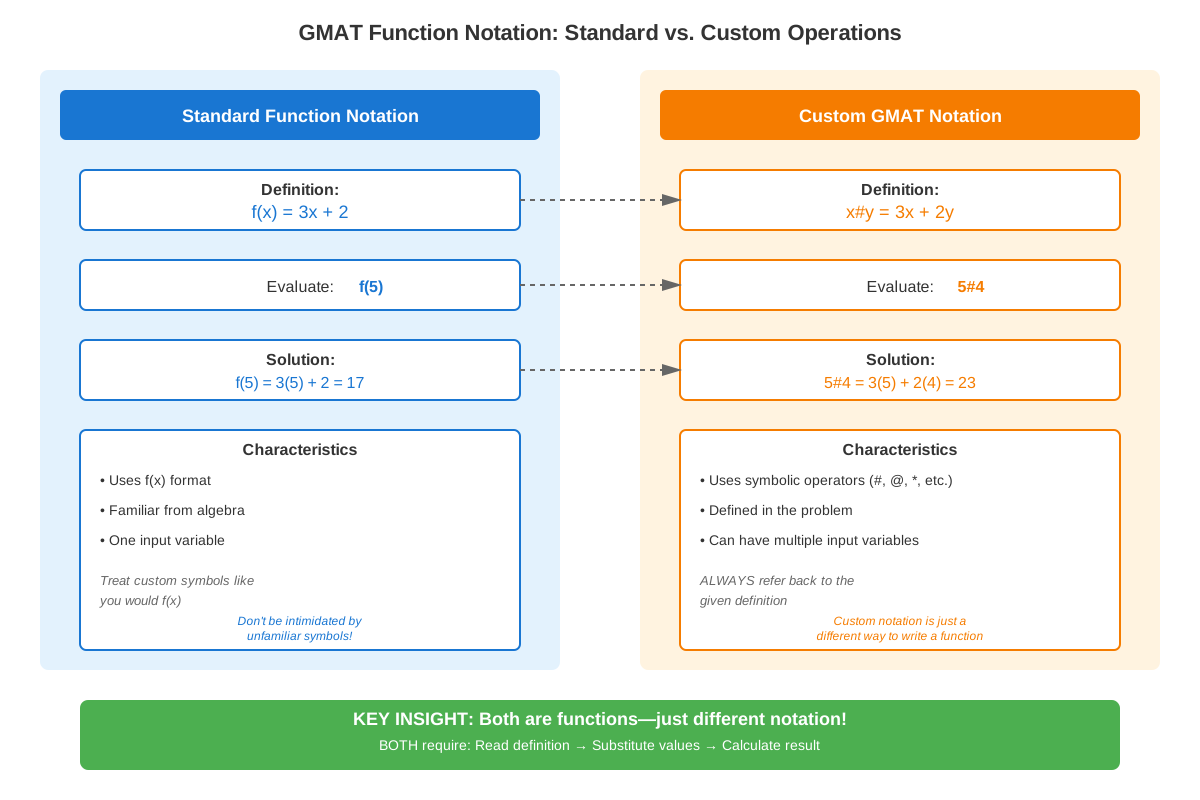
The GMAT frequently tests functions using custom-defined operations with non-standard symbols. These questions assess conceptual understanding rather than memorized procedures. The test will define an operation using a symbol (like ⊕, ⊗, #, @, or *) and provide the rule, then ask you to apply it.
Example definition: For all integers x and y, define x⊕y = x² + 2y
To evaluate 3⊕5:
- Substitute x = 3 and y = 5 into the definition
- 3⊕5 = (3)² + 2(5) = 9 + 10 = 19
The key insight is that the symbol is merely notation—the definition provides the actual mathematical operations to perform. Always refer back to the given definition and substitute carefully.
Function Composition
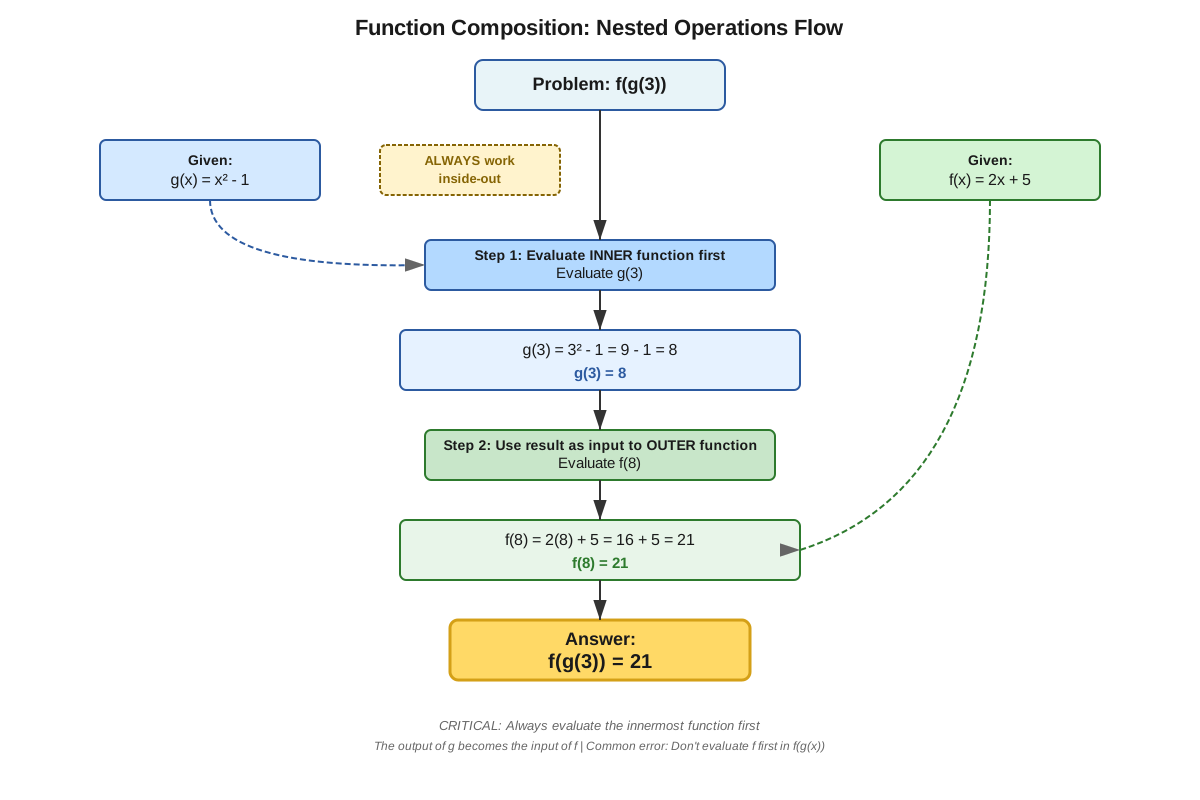
Function composition involves applying one function to the result of another function. The notation f(g(x)), read as "f of g of x," means:
- First evaluate g(x)
- Then use that result as the input to f
The order matters critically: f(g(x)) generally does not equal g(f(x)).
Example: If f(x) = 2x + 1 and g(x) = x² - 3, find f(g(4))
- First find g(4): g(4) = (4)² - 3 = 16 - 3 = 13
- Then find f(13): f(13) = 2(13) + 1 = 26 + 1 = 27
- Therefore, f(g(4)) = 27
Alternatively, you can find the general composition formula first:
- f(g(x)) = f(x² - 3) = 2(x² - 3) + 1 = 2x² - 6 + 1 = 2x² - 5
- Then f(g(4)) = 2(4)² - 5 = 32 - 5 = 27
Domain and Range
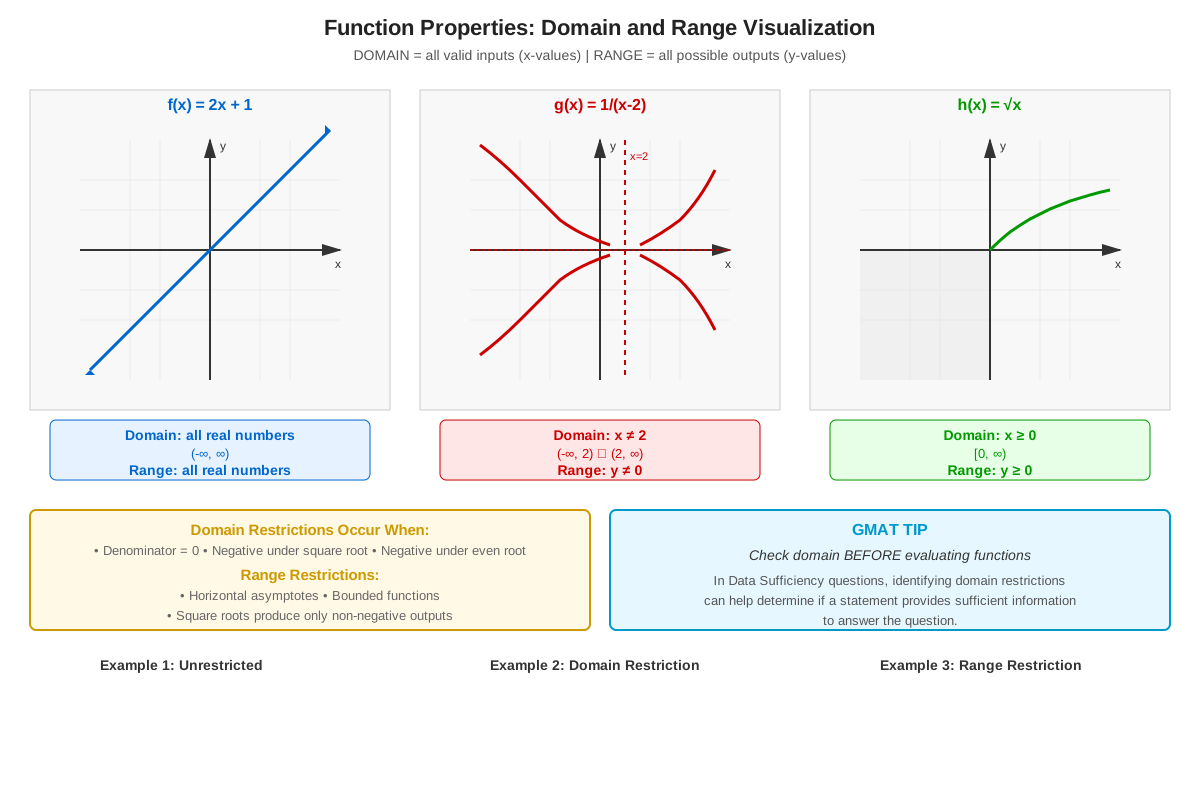
The domain of a function is the set of all possible input values for which the function is defined. The range is the set of all possible output values the function can produce.
Common domain restrictions on the GMAT:
- Cannot divide by zero: For f(x) = 1/(x - 3), x ≠ 3
- Cannot take the square root of a negative number (in real numbers): For f(x) = √(x - 5), x ≥ 5
- Cannot take the logarithm of zero or negative numbers: For f(x) = log(x), x > 0
When determining domain, identify all values that would make the function undefined, then exclude them.
Inverse Functions
An inverse function, denoted f⁻¹(x), reverses the operation of the original function. If f(a) = b, then f⁻¹(b) = a. The inverse function "undoes" what the original function does.
To find an inverse function algebraically:
- Replace f(x) with y
- Swap x and y
- Solve for y
- Replace y with f⁻¹(x)
Example: Find the inverse of f(x) = 2x - 6
- Write as y = 2x - 6
- Swap: x = 2y - 6
- Solve: x + 6 = 2y, so y = (x + 6)/2
- Therefore, f⁻¹(x) = (x + 6)/2
Not all functions have inverses. A function must be one-to-one (each output corresponds to exactly one input) to have an inverse function.
Function Properties and Patterns
The GMAT tests recognition of function properties:
| Property | Definition | Example |
|---|---|---|
| Even function | f(-x) = f(x) for all x | f(x) = x² |
| Odd function | f(-x) = -f(x) for all x | f(x) = x³ |
| Linear function | f(x) = mx + b | f(x) = 3x - 2 |
| Quadratic function | f(x) = ax² + bx + c | f(x) = x² - 4x + 3 |
| Periodic function | f(x + p) = f(x) for some period p | f(x) = sin(x) |
Recognizing these patterns helps predict function behavior and solve problems more efficiently.
Concept Relationships
Function concepts build upon each other in a logical hierarchy. Basic function evaluation forms the foundation, requiring only substitution and algebraic simplification. This leads to custom-defined operations, which test the same evaluation skills but with unfamiliar notation, emphasizing conceptual understanding over procedural memory.
Function composition extends basic evaluation by creating chains of operations: single function evaluation → composition of two functions → composition of three or more functions. This progression increases complexity while using the same fundamental substitution principle.
Domain and range concepts connect to function evaluation by identifying which inputs are valid and which outputs are possible. Understanding domain restrictions requires knowledge of algebraic constraints (division by zero, square roots of negatives), linking functions to prerequisite algebra topics.
Inverse functions represent the culmination of function understanding, requiring students to work backward from outputs to inputs and to understand the bidirectional nature of function relationships. This connects to equation solving (a prerequisite) and provides foundation for more advanced topics like logarithms and exponential functions.
The relationship map flows as:
Basic Algebra (substitution, equation solving) → Function Evaluation → Custom Operations & Composition → Domain/Range Analysis → Inverse Functions → Applications in Word Problems and Data Sufficiency
Quick check — test yourself on Functions so far.
Try Flashcards →High-Yield Facts
⭐ A function assigns exactly one output to each input—this is the defining characteristic that distinguishes functions from general relations
⭐ When evaluating f(expression), substitute the entire expression for every occurrence of the variable, using parentheses to maintain proper order of operations
⭐ For function composition f(g(x)), always evaluate the inner function first (g(x)), then use that result as input to the outer function (f)
⭐ Custom-defined operations are just functions with unusual notation—always refer back to the given definition and substitute values according to that rule
⭐ The domain excludes values that make the function undefined: division by zero, square roots of negatives, and logarithms of non-positive numbers
- Function notation f(x) does not mean f times x—it means the output of function f when the input is x
- f(a + b) generally does not equal f(a) + f(b) unless the function is linear with no constant term
- The inverse function f⁻¹(x) is not the same as 1/f(x); the notation f⁻¹ represents the inverse operation, not a reciprocal
- For a function to have an inverse, it must be one-to-one (each output corresponds to exactly one input)
- When a function is defined piecewise (different rules for different input ranges), carefully identify which piece applies to the given input
- If f(x) = c for some constant c, then f is a constant function and produces the same output regardless of input
- The range of a function depends on both the function rule and the domain; restricting the domain can restrict the range
Common Misconceptions
Misconception: f(x + 2) = f(x) + f(2) → Correction: Function evaluation requires substituting the entire expression (x + 2) into the function rule, not distributing the function over addition. If f(x) = x², then f(x + 2) = (x + 2)² = x² + 4x + 4, which does not equal f(x) + f(2) = x² + 4.
Misconception: The notation f⁻¹(x) means 1/f(x) → Correction: The superscript -1 in function notation indicates the inverse function, not a reciprocal. The inverse function reverses the original function's operation. If f(x) = 2x, then f⁻¹(x) = x/2, not 1/(2x).
Misconception: f(g(x)) and g(f(x)) are always equal → Correction: Function composition is not commutative; order matters. If f(x) = x + 3 and g(x) = 2x, then f(g(x)) = 2x + 3 but g(f(x)) = 2(x + 3) = 2x + 6. These are different functions.
Misconception: All functions have inverses → Correction: Only one-to-one functions (where each output corresponds to exactly one input) have inverse functions. For example, f(x) = x² is not one-to-one over all real numbers because f(2) = f(-2) = 4, so it doesn't have an inverse function without restricting the domain.
Misconception: When a custom operation is defined as x⊕y = x² + y², then 3⊕4 can be calculated using the Pythagorean theorem → Correction: Custom operations define their own rules independent of familiar mathematical relationships. Even though 3² + 4² = 5² happens to be true, this is coincidental. Always use only the given definition: 3⊕4 = 3² + 4² = 9 + 16 = 25.
Misconception: The domain of a function is always all real numbers → Correction: Many functions have restricted domains due to mathematical constraints. For f(x) = 1/(x - 5), the domain excludes x = 5. For g(x) = √(x + 3), the domain requires x ≥ -3. Always check for values that would make the function undefined.
Worked Examples
Example 1: Custom-Defined Operation with Composition
Problem: For all positive integers x and y, let x#y be defined as x#y = (x + y)/(xy). What is the value of (2#3)#4?
Solution:
Step 1: Understand the definition. The operation x#y means we add x and y, then divide by their product.
Step 2: Evaluate the inner operation first: 2#3
- Using the definition: 2#3 = (2 + 3)/(2 × 3)
- 2#3 = 5/6
Step 3: Now evaluate (5/6)#4
- Using the definition with x = 5/6 and y = 4:
- (5/6)#4 = (5/6 + 4)/[(5/6) × 4]
- (5/6)#4 = (5/6 + 24/6)/(20/6)
- (5/6)#4 = (29/6)/(20/6)
- (5/6)#4 = 29/6 × 6/20
- (5/6)#4 = 29/20
Answer: 29/20 or 1.45
Key Learning: This problem tests both custom operations (Learning Objective 2) and composition concepts (Learning Objective 4). The critical insight is to work from the inside out, evaluating 2#3 first, then using that result in the next operation. Always substitute carefully into the given definition.
Example 2: Function with Domain Restrictions
Problem: If f(x) = (x² - 9)/(x - 3), what is the value of f(5)?
Solution:
Step 1: Recognize that this function has a potential domain restriction. The denominator x - 3 equals zero when x = 3, so x = 3 is not in the domain.
Step 2: Since we're asked to find f(5), and 5 ≠ 3, we can proceed with evaluation.
Step 3: Substitute x = 5 into the function:
- f(5) = (5² - 9)/(5 - 3)
- f(5) = (25 - 9)/2
- f(5) = 16/2
- f(5) = 8
Step 4: Alternative approach—simplify the function first (when x ≠ 3):
- f(x) = (x² - 9)/(x - 3)
- f(x) = (x + 3)(x - 3)/(x - 3)
- f(x) = x + 3 (for x ≠ 3)
- Therefore, f(5) = 5 + 3 = 8
Answer: 8
Key Learning: This problem addresses Learning Objectives 1, 2, and 6 by testing function identification, evaluation, and domain analysis. The function appears complex but simplifies significantly. The GMAT often includes such problems to test whether students recognize algebraic simplification opportunities. Note that even though f(x) simplifies to x + 3, the original function is still undefined at x = 3, so that restriction remains.
Exam Strategy
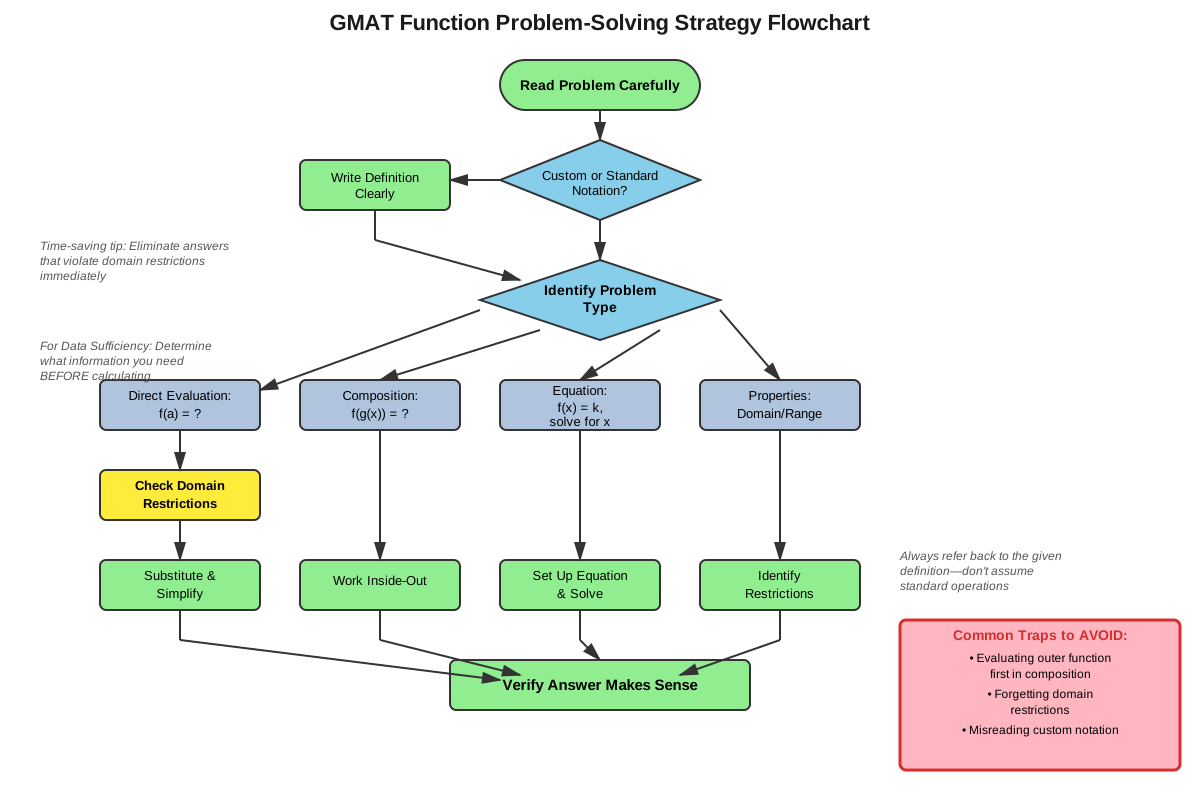
When approaching GMAT function questions, follow this systematic process:
Step 1: Identify what type of function question you're facing
- Standard notation (f(x) = ...): Use direct substitution
- Custom operation (x⊕y = ...): Refer to the given definition
- Composition (f(g(x))): Work inside-out
- Data Sufficiency: Determine what information is needed
Step 2: Watch for trigger words and phrases
- "For all integers/numbers x and y" → signals custom operation definition
- "What is f(g(3))?" → signals composition; evaluate inner function first
- "For what value of x does f(x) = 10?" → signals inverse thinking; work backward
- "What is the domain/range?" → check for restrictions and possible outputs
Step 3: Use parentheses liberally when substituting
This prevents order-of-operations errors. When finding f(x - 2) where f(x) = x², write f(x - 2) = (x - 2)², not x - 2².
Step 4: For Data Sufficiency questions, determine what you need
- To evaluate f(a), you need either the value of a and the function rule, or the direct statement of f(a)
- To determine if a function is one-to-one, you need to verify that different inputs never produce the same output
- To find an inverse, you need the complete function rule and confirmation it's one-to-one
Step 5: Simplify when possible, but watch for domain restrictions
Many GMAT functions can be simplified algebraically, but restrictions from the original form still apply.
Time allocation: Allocate 2 minutes for standard function evaluation problems, 2.5-3 minutes for composition or custom operation problems with multiple steps, and 2-2.5 minutes for Data Sufficiency function questions.
Process of elimination tips:
- Eliminate answers that ignore domain restrictions
- For composition problems, eliminate answers that evaluate functions in the wrong order
- For custom operations, eliminate answers that apply standard mathematical operations instead of the given definition
- Check extreme values (like 0, 1, or -1) to eliminate incorrect answer choices quickly
Memory Techniques
FIDO - Function evaluation process:
- Find the function rule
- Identify the input value
- Drop the input into the rule (substitute)
- Operate and simplify
COIN - For composition f(g(x)):
- Center first (evaluate the inner/center function g(x))
- Outer next (use that result in the outer function f)
- Inside-out order
- Never reverse the order
DAZE - Domain restrictions to check:
- Division by zero (denominators ≠ 0)
- Absolute value (usually no restrictions, but check context)
- Zero under square root (expression ≥ 0)
- Exponents and logs (special restrictions for logs: argument > 0)
Visualization strategy: Picture a function as a machine with an input hopper and output chute. Whatever you drop into the input hopper gets transformed according to the machine's rule and comes out the output chute. For composition, imagine two machines in series—the output of the first machine drops directly into the input of the second machine.
Custom operations acronym - READ:
- Refer to the definition
- Examine what values you're given
- Apply the definition exactly as stated
- Don't assume standard operations
Summary
Functions represent a fundamental algebraic concept that appears frequently on the GMAT, testing both computational skills and conceptual understanding. A function is a rule assigning exactly one output to each input, typically expressed as f(x) where x is the input and f(x) is the output. Success with GMAT functions requires mastering several interconnected skills: evaluating functions by substituting values into given rules, working with custom-defined operations that use non-standard notation, composing functions by evaluating them in sequence from inside-out, and understanding domain restrictions that limit valid inputs. The GMAT particularly emphasizes custom operations to test whether students understand the underlying concept rather than relying on memorized procedures. Function composition requires careful attention to order, as f(g(x)) differs from g(f(x)). Domain analysis involves identifying values that make functions undefined, typically from division by zero or square roots of negative numbers. Students must also distinguish between inverse functions (which reverse operations) and reciprocals (which are multiplicative inverses). Mastering these concepts enables success on approximately 10-15% of Quantitative Reasoning questions and provides essential foundations for more advanced mathematical reasoning.
Key Takeaways
- A function assigns exactly one output to each input; this one-to-one correspondence is the defining characteristic of functions
- Function evaluation requires substituting the entire input expression for every occurrence of the variable, using parentheses to maintain proper order of operations
- Custom-defined operations are simply functions with unusual notation—always refer back to the given definition rather than applying standard mathematical operations
- Function composition f(g(x)) must be evaluated inside-out: first find g(x), then use that result as input to f
- Domain restrictions arise from mathematical constraints: division by zero, square roots of negative numbers, and logarithms of non-positive values must be excluded
- Inverse functions reverse the original function's operation and exist only for one-to-one functions where each output corresponds to exactly one input
- GMAT function questions test conceptual understanding through non-standard notation and multi-step problems requiring careful substitution and algebraic manipulation
Related Topics
Sequences and Series: Functions provide the foundation for understanding sequences, which are functions with natural number domains. Mastering function notation and evaluation enables progression to arithmetic and geometric sequences.
Coordinate Geometry: Functions can be represented graphically on the coordinate plane, where f(x) represents the y-coordinate for each x-coordinate. Understanding functions enables analysis of lines, parabolas, and other curves.
Inequalities with Functions: Solving inequalities involving functions (like f(x) > 5) requires combining function evaluation skills with inequality manipulation techniques.
Word Problems with Functions: Many GMAT word problems implicitly involve functions, such as cost functions, revenue functions, and distance-rate-time relationships. Function mastery enables translation between verbal descriptions and mathematical models.
Exponential and Logarithmic Functions: These special function types build upon general function concepts while introducing unique properties and rules that appear in higher-difficulty GMAT questions.
Practice CTA
Now that you've mastered the core concepts of functions, it's time to solidify your understanding through practice. Attempt the practice questions to apply these concepts to GMAT-style problems, and use the flashcards to reinforce key definitions and procedures. Remember, functions appear in 10-15% of Quantitative Reasoning questions, making them a high-yield topic worthy of your focused attention. Each practice problem you solve builds the pattern recognition and problem-solving speed essential for GMAT success. You've built a strong conceptual foundation—now transform that knowledge into points through deliberate practice!
Sign up free to keep reading
Create a free AnvayaPrep account to finish this GMAT guide on Functions — plus flashcards and practice questions.