Overview
Linear equations form the cornerstone of algebraic problem-solving on the GMAT Quantitative Reasoning section. These fundamental mathematical expressions represent relationships where variables appear only to the first power, creating straight-line graphs when plotted. Mastery of linear equations is not merely an isolated skill—it serves as the foundation for solving systems of equations, understanding coordinate geometry, interpreting data sufficiency questions, and tackling word problems that constitute a significant portion of the GMAT's quantitative challenges.
The GMAT tests linear equations extensively because they assess logical reasoning, pattern recognition, and systematic problem-solving abilities that business schools value in prospective students. Questions involving GMAT linear equations appear in multiple formats: straightforward algebraic manipulation, word problems requiring equation setup, data sufficiency scenarios testing conceptual understanding, and integrated reasoning questions combining multiple mathematical concepts. Understanding linear equations enables test-takers to approach approximately 20-25% of quantitative questions with confidence.
Within the broader Quantitative Reasoning framework, linear equations connect directly to functions, inequalities, coordinate geometry, and systems of equations. They provide the algebraic foundation necessary for understanding more complex topics like quadratic equations and optimization problems. The ability to quickly identify, manipulate, and solve linear equations under time pressure distinguishes high-scoring GMAT candidates from average performers, making this topic essential for achieving competitive scores in the 700+ range.
Learning Objectives
- [ ] Identify linear equations in standard form, slope-intercept form, and within word problems
- [ ] Explain the properties and characteristics that define linear equations versus other equation types
- [ ] Apply linear equations to GMAT questions including problem-solving and data sufficiency formats
- [ ] Manipulate linear equations efficiently using algebraic operations to isolate variables
- [ ] Translate word problems into linear equations and solve for unknown quantities
- [ ] Recognize when multiple approaches exist for solving linear equations and select the most efficient method
- [ ] Evaluate data sufficiency questions involving linear equations to determine when information is adequate
Prerequisites
- Basic algebraic operations: Addition, subtraction, multiplication, and division with variables are essential for manipulating equations and isolating unknowns
- Order of operations (PEMDAS): Proper sequencing of mathematical operations ensures accurate equation solving and prevents calculation errors
- Properties of equality: Understanding that performing the same operation on both sides maintains equality is fundamental to all equation-solving techniques
- Fraction and decimal operations: Many GMAT linear equations involve rational numbers requiring fluency with fraction arithmetic
- Negative number rules: Correctly handling negative coefficients and constants prevents sign errors that commonly derail solutions
Why This Topic Matters
Linear equations appear in countless real-world applications that business professionals encounter daily. Financial modeling, break-even analysis, cost-revenue relationships, supply-demand equilibrium, and resource allocation all rely on linear relationships. When business analysts project sales growth, calculate pricing strategies, or optimize production schedules, they employ linear equations as fundamental tools. This practical relevance explains why the GMAT emphasizes linear equations—they directly correlate with quantitative skills MBA students need.
On the GMAT specifically, linear equations appear in approximately 15-20% of Quantitative Reasoning questions across both Problem Solving and Data Sufficiency formats. Test-takers encounter them in pure algebraic form, embedded within word problems about rates and work, disguised in coordinate geometry questions, and as components of systems of equations. The exam particularly favors questions that combine linear equations with other concepts, testing whether candidates can recognize underlying linear relationships within complex scenarios.
Common GMAT question patterns include: solving for a variable given constraints, determining whether provided information sufficiently defines a unique solution, translating verbal descriptions into equations, finding intersection points of lines, and working with proportional relationships. Data Sufficiency questions frequently test conceptual understanding by asking whether given statements provide enough information to solve for unknowns, requiring recognition of when linear equations have unique solutions versus infinite or no solutions. The versatility of linear equation applications makes them one of the highest-yield topics for focused study.
Core Concepts
Definition and Standard Forms
A linear equation is an algebraic equation in which each term is either a constant or the product of a constant and a single variable raised to the first power. The general form of a linear equation in one variable is:
ax + b = cwhere a, b, and c are constants and a ≠ 0. The defining characteristic is that the variable appears only to the first power (x¹), never squared, cubed, or in any other exponential form, and never in denominators, under radicals, or within absolute value expressions.
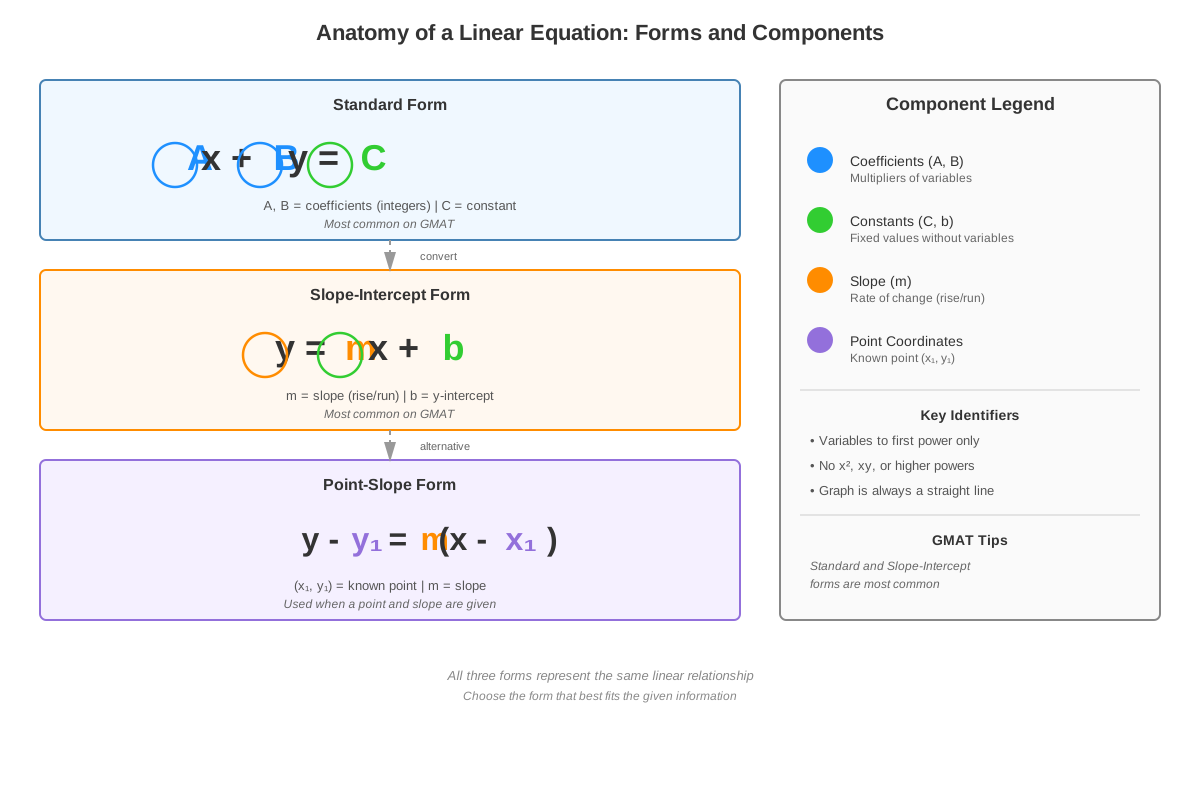
For linear equations in two variables, several standard forms exist:
| Form | Equation | Key Features | Best Used When |
|---|---|---|---|
| Standard Form | Ax + By = C | Both variables on left side; integer coefficients preferred | Finding intercepts quickly |
| Slope-Intercept Form | y = mx + b | Slope (m) and y-intercept (b) immediately visible | Graphing or comparing slopes |
| Point-Slope Form | y - y₁ = m(x - x₁) | Uses known point (x₁, y₁) and slope m | Writing equations from given information |
Solving Linear Equations in One Variable
The fundamental process for solving linear equations follows these systematic steps:
- Simplify both sides: Distribute multiplication over parentheses and combine like terms
- Collect variable terms: Move all terms containing the variable to one side using addition/subtraction
- Collect constant terms: Move all constants to the opposite side
- Isolate the variable: Divide or multiply both sides by the coefficient of the variable
- Verify the solution: Substitute the answer back into the original equation
Consider the equation: 3(2x - 4) + 5 = 2x + 9
- Distribute: 6x - 12 + 5 = 2x + 9
- Simplify: 6x - 7 = 2x + 9
- Collect variables: 6x - 2x = 9 + 7
- Simplify: 4x = 16
- Solve: x = 4
Properties of Linear Equations
Linear equations possess several critical properties that GMAT questions frequently test:
- Unique solution property: A linear equation in one variable with non-zero coefficient has exactly one solution
- Equivalence under operations: Adding, subtracting, multiplying, or dividing both sides by the same non-zero value produces an equivalent equation
- Proportionality: If ax = b, then x is directly proportional to b and inversely proportional to a
- Graphical representation: Linear equations in two variables graph as straight lines with constant slope
- Closure under addition: The sum of two linear equations is another linear equation
Special Cases and Edge Conditions
GMAT questions sometimes test understanding of unusual scenarios:
Identity equations occur when simplification yields a true statement like 0 = 0, indicating infinitely many solutions. For example: 2(x + 3) = 2x + 6 simplifies to 2x + 6 = 2x + 6, true for all x values.
Contradiction equations simplify to false statements like 5 = 3, indicating no solution exists. For example: 3x + 7 = 3x + 2 simplifies to 7 = 2, which is impossible.
Equations with parameters contain additional variables treated as constants. Solving 3x + k = 15 for x yields x = (15 - k)/3, expressing the solution in terms of the parameter k.
Linear Equations in Word Problems
Translating verbal descriptions into mathematical equations represents a crucial GMAT skill. The process involves:
- Identify the unknown: Determine what quantity the problem asks to find and assign it a variable
- Identify relationships: Extract mathematical relationships from the verbal description
- Translate phrases: Convert common phrases into mathematical operations
- Set up the equation: Express the relationship as an equation
- Solve and interpret: Find the solution and verify it makes sense in context
Common translation patterns include:
- "is," "equals," "results in" → =
- "more than," "increased by," "sum of" → +
- "less than," "decreased by," "difference" → −
- "times," "product of," "multiplied by" → ×
- "divided by," "quotient of," "ratio of" → ÷
- "what number," "how many," "find the value" → x (the unknown)
Systems Involving Linear Equations
While systems of equations constitute a separate topic, understanding how individual linear equations function within systems is essential. Two linear equations in two variables can have:
- One unique solution: Lines intersect at exactly one point (different slopes)
- No solution: Lines are parallel (same slope, different intercepts)
- Infinitely many solutions: Lines are identical (same slope and intercept)
This understanding proves particularly valuable for Data Sufficiency questions asking whether given information determines unique values.
Concept Relationships
Linear equations serve as the foundational building block connecting multiple algebraic concepts. The relationship flow begins with basic algebraic operations (prerequisite knowledge) → enables manipulation of linear equations → which leads to solving systems of equations → which extends to coordinate geometry applications → ultimately supporting optimization and function analysis.
Within the topic itself, understanding the definition of linear equations enables recognition of standard forms, which facilitates efficient solving techniques. Mastery of one-variable equations provides the foundation for two-variable equations, which then connect to graphical interpretations. Word problem translation skills integrate all these components, requiring simultaneous application of definition recognition, equation setup, and solving procedures.
Linear equations connect backward to prerequisite topics through their reliance on properties of equality, order of operations, and arithmetic with signed numbers. They connect forward to inequalities (which use similar solving techniques with additional rules), quadratic equations (which reduce to linear equations in certain cases), and functions (where linear functions represent the simplest function type). The coordinate geometry relationship is particularly strong: every linear equation in two variables corresponds to a line in the coordinate plane, and every non-vertical line corresponds to a linear equation.
The progression follows: Basic algebra → Linear equations (one variable) → Linear equations (two variables) → Systems of linear equations → Linear inequalities → Linear programming. Each stage builds directly on the previous, making linear equations an essential gateway topic.
High-Yield Facts
⭐ A linear equation in one variable with a non-zero coefficient always has exactly one solution
⭐ The slope-intercept form y = mx + b immediately reveals slope (m) and y-intercept (b)
⭐ Multiplying or dividing both sides of an equation by zero is invalid and creates errors
⭐ Two linear equations in two variables need different slopes to have a unique solution
⭐ Word problems stating "more than" require careful attention to order: "5 more than x" means x + 5, not 5 + x (though equivalent, the setup matters for complex problems)
- Linear equations never contain variables with exponents other than 1 (no x², √x, or 1/x terms)
- Adding the same quantity to both sides of an equation preserves equality and is always valid
- When solving equations with fractions, multiplying both sides by the LCD eliminates denominators efficiently
- If ax = ay and a ≠ 0, then x = y (division property of equality)
- The equation of a horizontal line is y = k (constant), while a vertical line is x = k
- Parallel lines have equal slopes but different y-intercepts
- Perpendicular lines have slopes that are negative reciprocals (m₁ × m₂ = -1)
- Distributing negative signs requires changing the sign of every term: -(3x - 5) = -3x + 5
- Equations with absolute values may not be linear: |x| = 5 has two solutions, but isn't a linear equation
- In Data Sufficiency, one linear equation with one variable is always sufficient to solve for that variable
Quick check — test yourself on Linear equations so far.
Try Flashcards →Common Misconceptions
Misconception: Moving a term to the other side of an equation changes its sign automatically → Correction: The sign changes because you're actually adding or subtracting the term from both sides. Understanding the underlying operation (adding the opposite) prevents errors. For 3x + 5 = 11, you subtract 5 from both sides, yielding 3x = 6, not 3x = 16.
Misconception: Linear equations can have variables in denominators or exponents → Correction: By definition, linear equations have variables only to the first power in numerator positions. The equation 5/x = 10 is not linear (it's rational), and x² = 16 is not linear (it's quadratic). Only equations like 5x = 10 or x/5 = 10 qualify as linear.
Misconception: All equations have solutions → Correction: Some equations are contradictions with no solution (like x + 3 = x + 7, which simplifies to 3 = 7), while others are identities with infinitely many solutions (like 2x + 4 = 2(x + 2), true for all x). Recognizing these special cases is crucial for Data Sufficiency questions.
Misconception: When solving word problems, any equation that uses the given numbers is correct → Correction: The equation must accurately represent the relationships described. If "John has 5 more apples than Mary" and Mary has x apples, John has x + 5, not 5x or 5 - x. Careful translation of verbal relationships into mathematical operations is essential.
Misconception: Multiplying both sides by a variable is always safe → Correction: Multiplying by a variable that could equal zero may introduce extraneous solutions or lose solutions. For example, solving x = 2x by multiplying both sides by x gives x² = 2x², which has x = 0 as a solution, but x = 0 doesn't satisfy the original equation. Division by variables poses similar risks.
Misconception: The equation 2x + 3y = 12 can be solved for unique values of x and y → Correction: One linear equation with two variables has infinitely many solution pairs. You need two independent equations (a system) to find unique values. This concept appears frequently in GMAT Data Sufficiency questions testing whether given information is sufficient.
Worked Examples
Example 1: Multi-Step Equation with Distribution
Problem: Solve for x: 4(2x - 3) - 5(x - 2) = 3x + 14
Solution:
Step 1: Distribute the coefficients across parentheses
- 4(2x - 3) = 8x - 12
- -5(x - 2) = -5x + 10
- Equation becomes: 8x - 12 - 5x + 10 = 3x + 14
Step 2: Combine like terms on the left side
- 8x - 5x = 3x
- -12 + 10 = -2
- Simplified equation: 3x - 2 = 3x + 14
Step 3: Collect variable terms on one side
- Subtract 3x from both sides: 3x - 3x - 2 = 3x - 3x + 14
- Result: -2 = 14
Step 4: Analyze the result
- The statement -2 = 14 is false regardless of x value
- This is a contradiction equation with no solution
Key Insight: This example demonstrates that not all equations have solutions. Recognizing contradictions quickly saves time on the GMAT. This connects to Learning Objective 2 (Explain linear equations) by showing special cases that test conceptual understanding.
Example 2: Word Problem Translation and Solution
Problem: A taxi charges a flat fee of $3.50 plus $0.75 per mile. If Sarah's taxi ride cost $18.50, how many miles did she travel?
Solution:
Step 1: Identify the unknown and assign a variable
- Let m = number of miles traveled
Step 2: Identify the cost components
- Flat fee: $3.50 (constant, doesn't depend on miles)
- Variable cost: $0.75 per mile, so $0.75m for m miles
- Total cost: $18.50
Step 3: Set up the equation
- Flat fee + Variable cost = Total cost
- 3.50 + 0.75m = 18.50
Step 4: Solve for m
- Subtract 3.50 from both sides: 0.75m = 15.00
- Divide both sides by 0.75: m = 15.00 ÷ 0.75
- Calculate: m = 20
Step 5: Verify and interpret
- Check: 3.50 + 0.75(20) = 3.50 + 15.00 = 18.50 ✓
- Answer: Sarah traveled 20 miles
Key Insight: This example illustrates the complete process of translating a real-world scenario into a linear equation and solving it, directly addressing Learning Objective 3 (Apply linear equations to GMAT questions). The verification step is crucial for catching calculation errors under time pressure.
Example 3: Data Sufficiency Application
Problem: What is the value of x?
Statement (1): 3x + 7 = 22
Statement (2): 2x - 5 = 9
Solution:
Analyze Statement (1) alone:
- 3x + 7 = 22
- Subtract 7: 3x = 15
- Divide by 3: x = 5
- This is one linear equation with one variable, which always has a unique solution
- Statement (1) is SUFFICIENT alone
Analyze Statement (2) alone:
- 2x - 5 = 9
- Add 5: 2x = 14
- Divide by 2: x = 7
- Wait—this gives x = 7, but Statement (1) gave x = 5
- Each statement independently provides a unique value
- Statement (2) is SUFFICIENT alone
Evaluate together:
- Both statements are sufficient independently
- However, they give different values (x = 5 vs. x = 7)
- This indicates the statements describe different scenarios or contain contradictory information
- Answer: D (Each statement alone is sufficient)
Key Insight: In Data Sufficiency, one linear equation with one unknown is always sufficient to determine that variable's value. This example reinforces the unique solution property and demonstrates how to approach GMAT Data Sufficiency questions systematically, connecting to Learning Objective 3.
Exam Strategy
When approaching GMAT linear equations questions, employ these strategic techniques to maximize accuracy and efficiency:
Recognition triggers: Identify linear equation questions by watching for phrases like "solve for," "find the value of," "what is x," or "determine the unknown." In Data Sufficiency, questions asking "What is the value of [variable]?" often involve linear equations. Word problems containing rates, costs, ages, or consecutive integers frequently require linear equation setup.
Immediate assessment: Before solving, quickly determine whether you're dealing with one equation and one variable (always solvable), one equation and multiple variables (infinitely many solutions unless additional constraints exist), or special cases (identities or contradictions). This assessment is particularly crucial for Data Sufficiency questions where recognizing sufficiency patterns saves significant time.
Solution approach selection: Choose between algebraic manipulation and strategic substitution based on the question format. For Problem Solving with numerical answer choices, backsolving (testing answer choices) sometimes proves faster than algebraic solving, especially when the equation setup is complex but verification is simple. For Data Sufficiency, focus on whether you can solve rather than actually solving completely.
Efficiency techniques:
- When equations contain fractions, immediately multiply through by the LCD to eliminate denominators
- For equations with decimals, consider multiplying by powers of 10 to work with integers
- Combine like terms before moving terms across the equals sign
- Keep track of negative signs meticulously, as sign errors are the most common mistake
Process of elimination for Problem Solving:
- Eliminate answers that have wrong units or unreasonable magnitudes
- If the equation involves only positive quantities, eliminate negative answers
- For word problems, eliminate answers that violate stated constraints (e.g., if the problem states "more than 10," eliminate answers ≤ 10)
Time allocation: Allocate approximately 2 minutes per linear equation question. Spend 20-30 seconds reading and understanding, 60-90 seconds solving, and 10-20 seconds verifying. If a solution isn't emerging within 90 seconds, make an educated guess and move forward rather than consuming excessive time.
Verification shortcuts: Instead of substituting your answer back into the original equation (time-consuming), verify that your answer satisfies the problem's constraints and produces reasonable results. For word problems, check that the answer makes logical sense in context.
Memory Techniques
SOLVE mnemonic for equation-solving steps:
- Simplify both sides (distribute and combine like terms)
- Organize variables on one side, constants on the other
- Line up the equation in simplest form
- Variable isolation through multiplication/division
- Evaluate by substituting back to verify
Form recognition acronym - SPS:
- Standard form: Ax + By = C (both variables left side)
- Point-slope form: y - y₁ = m(x - x₁) (uses a point)
- Slope-intercept: y = mx + b (slope and intercept visible)
Translation memory aid: Create mental associations for common phrases:
- "More than" → Picture addition (+) symbol
- "Less than" → Picture subtraction (−) symbol
- "Times/product" → Picture multiplication (×) symbol
- "Per" → Picture division (÷) symbol or fraction bar
Visualization for word problems: Draw a simple diagram or table organizing given information. For age problems, create a timeline; for distance problems, sketch the scenario; for mixture problems, draw containers. Visual organization reduces translation errors.
The "Opposite Operation" reminder: Remember that solving equations means "undoing" operations in reverse order of PEMDAS. If the equation has x + 5, subtract 5 (opposite of addition). If it has 3x, divide by 3 (opposite of multiplication). This mental model prevents the common error of performing the same operation instead of the inverse.
Special cases memory: Think "Identity = Infinite solutions" and "Contradiction = Can't solve (no solution)." The matching first letters help recall which special case produces which result.
Summary
Linear equations represent algebraic expressions where variables appear only to the first power, forming the foundation of GMAT quantitative reasoning. Mastery requires three core competencies: recognizing linear equations in various forms (standard, slope-intercept, and within word problems), understanding their defining properties (unique solutions for one variable, equivalence under operations, and graphical representation as straight lines), and applying systematic solving techniques (simplification, variable isolation, and verification). The GMAT tests linear equations extensively through both direct algebraic problems and word problems requiring translation of verbal descriptions into mathematical expressions. Success demands fluency with algebraic manipulation, careful attention to sign changes when moving terms, and recognition of special cases including contradictions (no solution) and identities (infinite solutions). Data Sufficiency questions particularly test conceptual understanding of when information suffices to determine unique solutions. Strategic approaches include choosing between algebraic solving and backsolving based on question format, eliminating denominators early, and verifying answers against problem constraints rather than through complete substitution. The ability to quickly set up and solve linear equations under time pressure distinguishes high-scoring candidates and enables progression to more complex topics including systems of equations, inequalities, and coordinate geometry.
Key Takeaways
- Linear equations contain variables only to the first power, never squared, in denominators, or under radicals—this defining characteristic enables recognition in any format
- One linear equation with one variable always has exactly one solution (unless it's a special case: contradiction with no solution or identity with infinite solutions)
- Systematic solving follows consistent steps: simplify both sides, collect variable terms on one side, collect constants on the other, isolate the variable, and verify the solution
- Word problem success requires careful translation of verbal phrases into mathematical operations, with particular attention to order (e.g., "5 more than x" means x + 5)
- Data Sufficiency questions test whether information is adequate to solve for unknowns—one linear equation with one variable is always sufficient, but one equation with two variables is not
- Strategic efficiency techniques include eliminating fractions by multiplying by LCD, working with integers when possible, and choosing between algebraic solving and backsolving based on question structure
- Common error prevention focuses on tracking negative signs carefully, avoiding multiplication/division by variables that might equal zero, and recognizing that not all equations have solutions
Related Topics
Systems of Linear Equations: Building on single linear equations, systems involve two or more equations with multiple variables. Mastering individual linear equations is essential before tackling solution methods including substitution, elimination, and graphical interpretation. Systems appear frequently in GMAT word problems involving multiple constraints.
Linear Inequalities: These extend linear equations by replacing the equals sign with inequality symbols (<, >, ≤, ≥). The solving process mirrors linear equations with one critical difference: multiplying or dividing by negative numbers reverses the inequality direction. Understanding linear equations provides the foundation for inequality manipulation.
Coordinate Geometry: Every linear equation in two variables corresponds to a line in the coordinate plane. Topics include finding slopes, intercepts, distances between points, and equations of lines through given points. Linear equations provide the algebraic foundation for geometric visualization.
Functions: Linear functions (f(x) = mx + b) represent the simplest function type and directly apply linear equation concepts. Understanding how to evaluate, compose, and graph linear functions builds naturally from linear equation mastery.
Absolute Value Equations: While equations like |x| = 5 aren't technically linear (they have two solutions), solving them requires breaking them into linear equations (x = 5 or x = -5). Linear equation skills transfer directly to this more complex topic.
Practice CTA
Now that you've mastered the core concepts of linear equations, it's time to solidify your understanding through active practice. Attempt the practice questions designed specifically for this topic, focusing on applying the systematic solving techniques and translation strategies you've learned. Use the flashcards to reinforce high-yield facts and special cases until recognition becomes automatic. Remember: GMAT success comes not just from understanding concepts but from executing them accurately under time pressure. Each practice problem you solve builds the pattern recognition and procedural fluency that will serve you on test day. Challenge yourself to explain your reasoning for each step—this metacognitive approach transforms mechanical solving into deep understanding. You've built a strong foundation; now strengthen it through deliberate practice!
Sign up free to keep reading
Create a free AnvayaPrep account to finish this GMAT guide on Linear equations — plus flashcards and practice questions.