Overview
Mixtures problems represent a critical category of quantitative reasoning questions on the GMAT, testing a student's ability to analyze situations where two or more substances, solutions, or groups are combined or separated. These problems require understanding proportions, ratios, weighted averages, and algebraic reasoning—all fundamental skills that appear across multiple question types in the Quantitative section. GMAT mixtures questions typically involve scenarios such as combining liquids with different concentrations, mixing groups with different characteristics, or diluting solutions, and they demand both conceptual clarity and computational precision.
Mastering mixtures problems is essential for GMAT success because they appear regularly in both Problem Solving and Data Sufficiency formats, often at medium to high difficulty levels. These questions test multiple mathematical competencies simultaneously: the ability to set up equations from word problems, manipulate algebraic expressions, work with percentages and ratios, and apply logical reasoning to complex scenarios. Students who develop systematic approaches to mixtures problems gain confidence in tackling multi-step quantitative challenges that mirror the analytical thinking valued in business school curricula.
Within the broader landscape of GMAT Quantitative Reasoning, mixtures problems bridge several arithmetic and algebraic concepts. They build upon foundational knowledge of ratios, proportions, and percentages while incorporating algebraic equation-solving and weighted average calculations. Understanding mixtures also prepares students for related topics such as work-rate problems, distance-rate-time questions, and other scenarios involving combined quantities. The logical framework developed through mixtures problems—identifying what's being combined, tracking individual components, and determining final compositions—transfers directly to more complex quantitative reasoning challenges throughout the exam.
Learning Objectives
- [ ] Identify Mixtures problems by recognizing key characteristics and trigger words in GMAT questions
- [ ] Explain Mixtures concepts including concentration, dilution, replacement, and combination principles
- [ ] Apply Mixtures problem-solving strategies to GMAT questions using algebraic and weighted average methods
- [ ] Construct and solve equations representing mixture scenarios with multiple components
- [ ] Calculate final concentrations, quantities, and ratios after mixing or separating substances
- [ ] Distinguish between different mixture problem types and select the most efficient solution approach
- [ ] Analyze Data Sufficiency questions involving mixtures to determine statement sufficiency
Prerequisites
- Ratios and Proportions: Essential for understanding the relationship between components in a mixture and how they change when substances are combined
- Percentages and Decimal Conversions: Required for working with concentrations expressed as percentages and converting between different representations
- Basic Algebra and Equation Solving: Necessary for setting up and solving equations that represent mixture scenarios with unknown quantities
- Weighted Averages: Fundamental for understanding how the final mixture's properties depend on both the quantities and characteristics of individual components
- Fractions and Fraction Operations: Important for expressing concentrations and performing calculations involving parts of a whole
Why This Topic Matters
Mixtures problems have significant real-world applications across business, science, and everyday decision-making. In business contexts, understanding mixtures relates to inventory management (combining products with different costs), financial portfolio analysis (mixing investments with different returns), and production planning (blending raw materials with varying qualities). Pharmaceutical companies must calculate precise concentrations when formulating medications, food manufacturers blend ingredients to achieve target nutritional profiles, and chemical engineers design processes involving solution concentrations—all scenarios that mirror GMAT mixtures problems.
On the GMAT specifically, mixtures questions appear in approximately 5-8% of Quantitative Reasoning sections, making them a high-yield topic for focused study. These problems typically appear at the 600-750 difficulty range, meaning they serve as differentiators for students aiming for competitive scores. The GMAT presents mixtures in both straightforward calculation formats and complex Data Sufficiency scenarios where determining what information is needed becomes as important as performing calculations.
Common GMAT manifestations include: combining solutions with different alcohol or salt concentrations; mixing nuts, candies, or other items with different prices to achieve a target average cost; replacing portions of a mixture with pure substances or different concentrations; and determining the composition of groups when subgroups with different characteristics are combined. The exam frequently embeds mixtures concepts within word problems that require careful translation from verbal descriptions to mathematical representations, testing reading comprehension alongside quantitative skills.
Core Concepts
Understanding Mixture Fundamentals
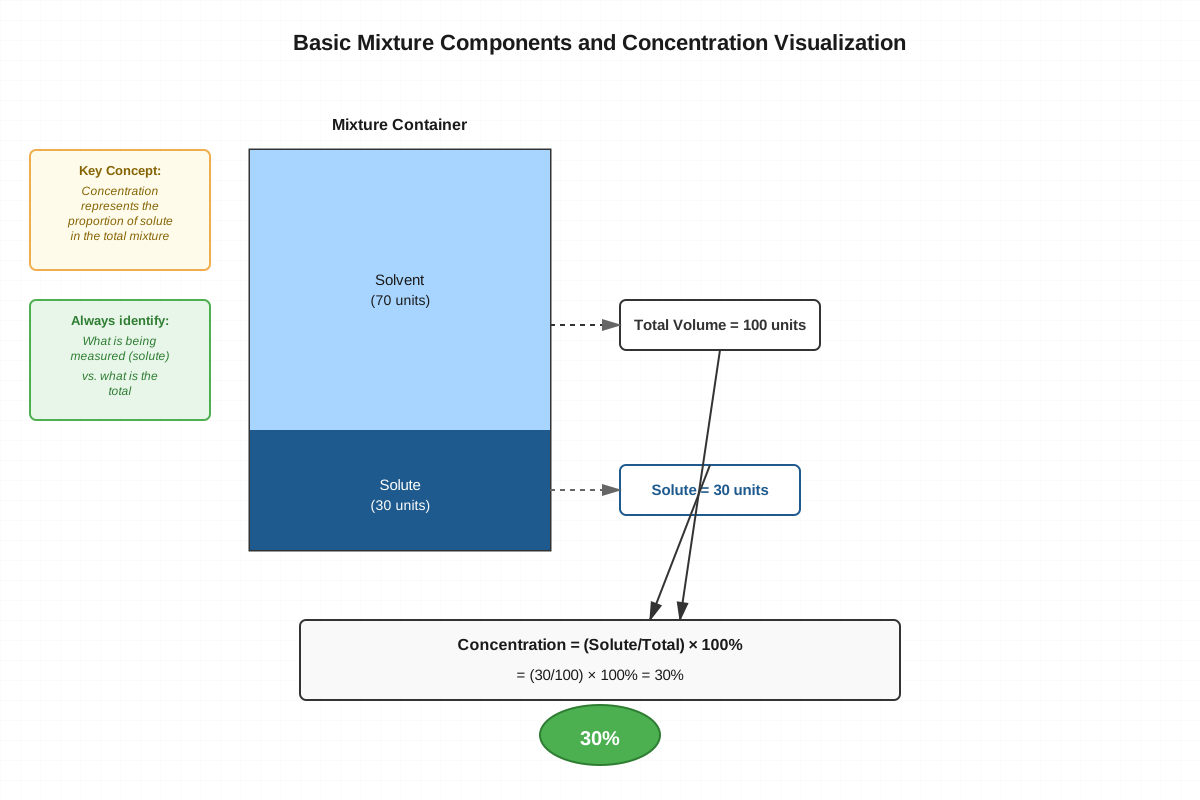
A mixture in GMAT contexts refers to any combination of two or more components that results in a new entity with properties determined by the individual parts. The fundamental principle underlying all mixtures problems is the conservation of quantity: the total amount of each component before mixing equals the total amount after mixing. This principle allows us to set up equations tracking how individual substances contribute to the final mixture.
Mixtures problems involve three key elements: the quantity of each component (volume, weight, or number of items), the concentration or characteristic of each component (percentage of a substance, price per unit, or proportion with a certain property), and the resulting mixture with its own quantity and concentration. Understanding how these elements interact forms the foundation for solving all mixtures problems.
Types of Mixture Problems
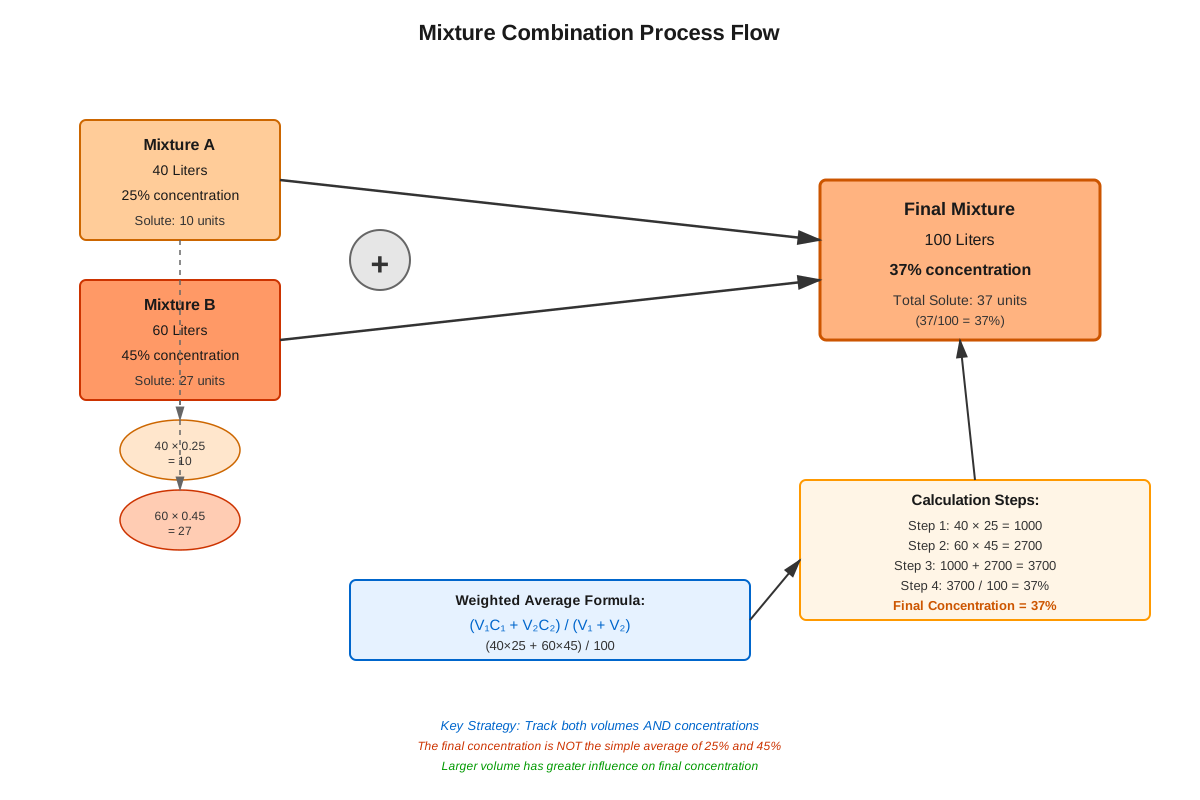
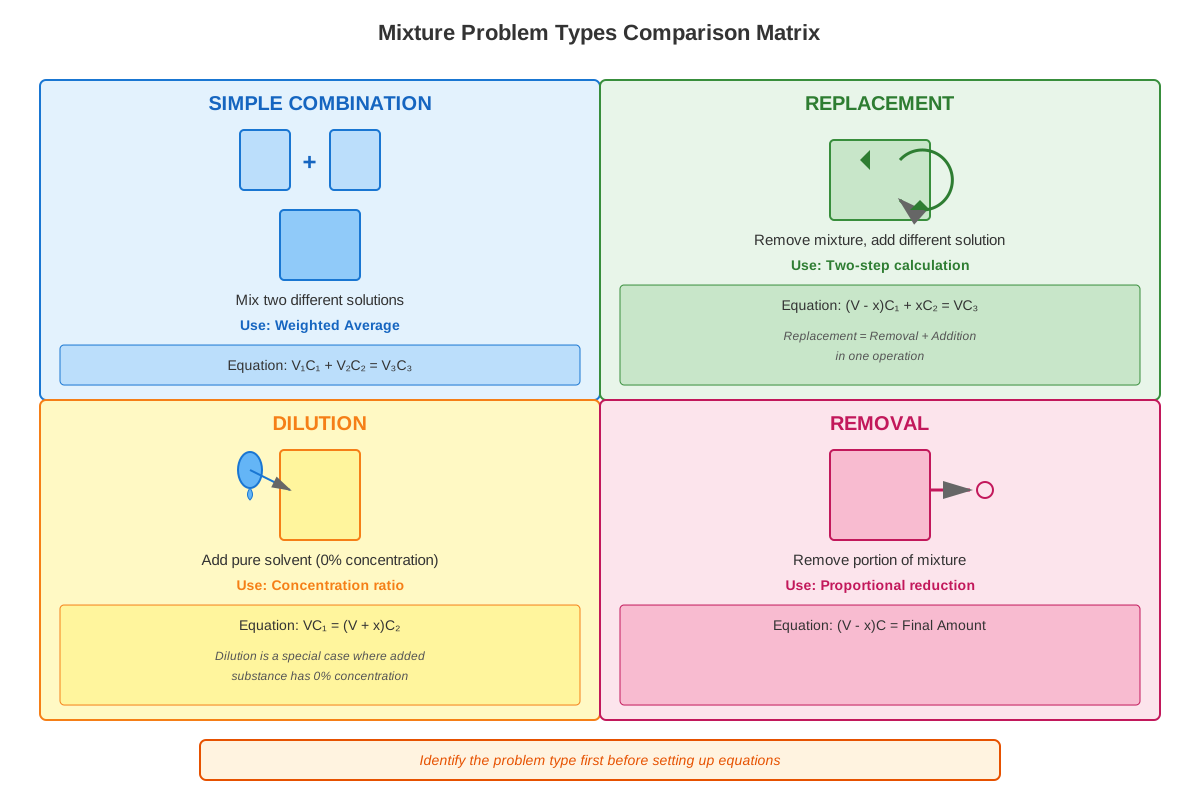
Combination Problems involve mixing two or more substances to create a new mixture. For example, combining 10 liters of 20% salt solution with 15 liters of 35% salt solution creates a new solution whose concentration must be calculated. The key equation follows the pattern:
(Quantity₁ × Concentration₁) + (Quantity₂ × Concentration₂) = (Total Quantity × Final Concentration)Replacement Problems involve removing a portion of a mixture and replacing it with another substance (often pure or a different concentration). These problems require two-step thinking: first calculating what remains after removal, then determining the new composition after replacement. If you remove 5 liters from a 20-liter mixture and replace it with pure water, you must account for both the reduction in the original substance and the dilution effect.
Dilution Problems are special cases where a pure substance (like water) is added to a mixture, reducing the concentration of other components without removing anything. The total quantity increases while the absolute amount of the solute remains constant, causing concentration to decrease.
Alligation Method Problems involve finding the ratio in which two components should be mixed to achieve a target average. This method provides an elegant shortcut for certain mixture scenarios, particularly those involving prices or concentrations.
The Weighted Average Approach
Many mixtures problems can be solved using the weighted average concept. When combining substances, the final concentration represents a weighted average of the individual concentrations, where the weights are the quantities:
Final Concentration = (Q₁C₁ + Q₂C₂)/(Q₁ + Q₂)This approach is particularly powerful because it connects mixtures to the broader concept of averages, making problems more intuitive. The final concentration must always fall between the individual concentrations (assuming positive quantities), which provides a useful reasonableness check for answers.
Setting Up Mixture Equations
The systematic approach to mixtures involves:
- Identify what's being mixed: Determine the components, their quantities, and their concentrations
- Define variables: Assign variables to unknown quantities (often the amount of one component or the final concentration)
- Write the conservation equation: Express that the total amount of the key substance before mixing equals the amount after mixing
- Solve algebraically: Manipulate the equation to find the unknown value
- Verify reasonableness: Check that the answer makes logical sense given the problem constraints
Concentration Representations
GMAT mixtures problems express concentrations in multiple ways, and fluency in converting between them is essential:
| Representation | Example | Interpretation |
|---|---|---|
| Percentage | 25% alcohol | 25 parts alcohol per 100 parts total |
| Decimal | 0.25 alcohol | 0.25 parts alcohol per 1 part total |
| Ratio | 1:3 alcohol to water | 1 part alcohol for every 3 parts water (25% alcohol) |
| Fraction | 1/4 alcohol | 1 part alcohol out of 4 total parts |
Converting between these representations correctly is crucial, especially when the problem mixes different formats. A ratio of 1:3 alcohol to water means alcohol comprises 1/(1+3) = 1/4 = 25% of the total mixture.
The Alligation Method
Alligation provides a visual and computational shortcut for finding the ratio in which two components should be mixed to achieve a target average. The method involves:
- Write the two concentrations on the left, with the higher concentration on top
- Write the target concentration in the middle
- Calculate the difference between the target and each concentration (cross-differences)
- These differences represent the ratio in which the components should be mixed (inverted)
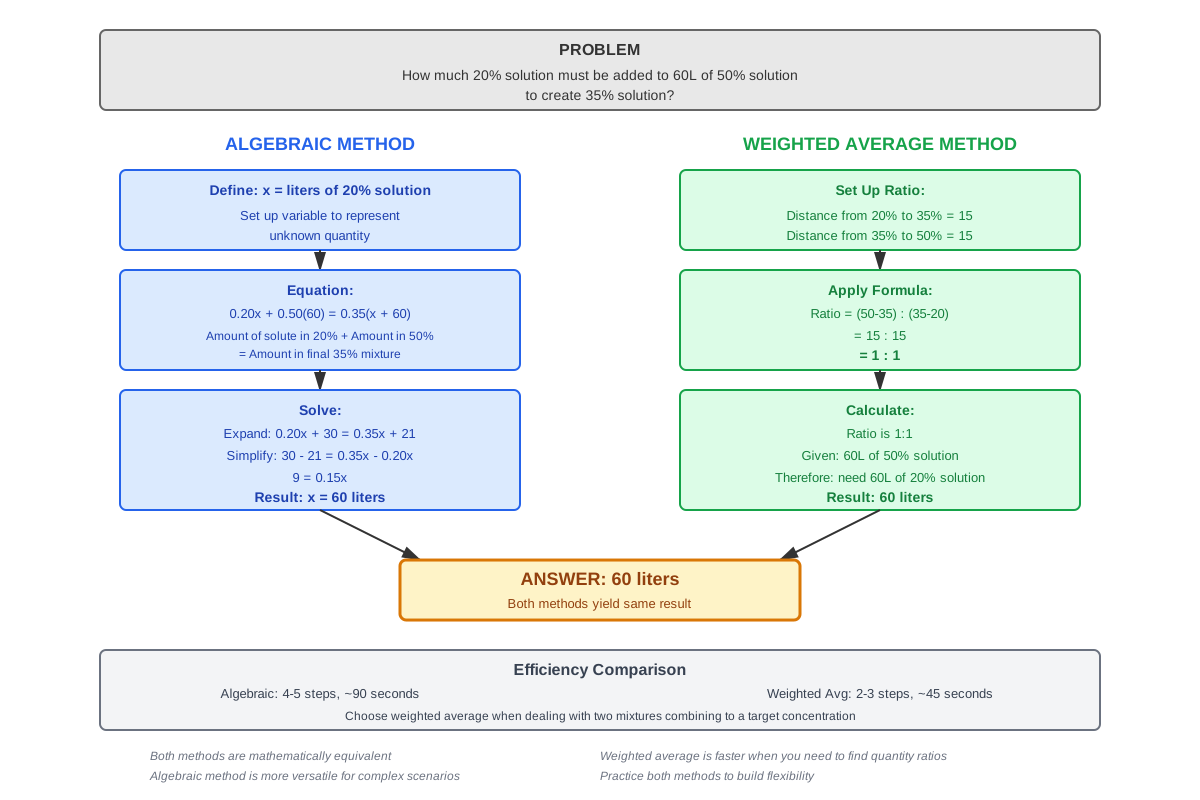
For example, to mix 20% and 50% solutions to get 35%:
- Difference between 50% and 35% = 15
- Difference between 35% and 20% = 15
- Ratio = 15:15 = 1:1 (equal parts)
This method is particularly efficient for GMAT questions asking for ratios rather than specific quantities.
Replacement and Successive Operations
When a mixture undergoes multiple operations (repeated replacements or successive additions), tracking the concentration after each step becomes critical. After removing a fraction f of a mixture and replacing it with a pure substance, the new concentration follows:
New Concentration = Original Concentration × (1 - f)For repeated operations, this compounds: after n identical replacements of fraction f, the concentration becomes:
Final Concentration = Original Concentration × (1 - f)ⁿUnderstanding this exponential decay pattern helps solve complex multi-step mixture problems efficiently.
Concept Relationships
The core concepts within mixtures problems form an interconnected framework. Combination problems serve as the foundation, establishing the basic principle that component contributions sum to create the final mixture. This principle directly leads to the weighted average approach, which reframes combinations as average calculations where quantities serve as weights. The weighted average concept then connects to alligation, which provides a ratio-based shortcut for achieving target averages.
Replacement problems build upon combination principles by adding a removal step before the addition, requiring students to track how the mixture composition changes through multiple operations. This naturally extends to dilution problems, which are special cases of replacement where the added substance has zero concentration of the solute. Understanding dilution prepares students for successive operations, where the exponential relationship between repeated actions and final concentration emerges.
All mixture concepts connect back to prerequisite knowledge: ratios and proportions provide the language for expressing relationships between components; percentages offer the most common concentration representation; algebra supplies the tools for setting up and solving equations; and weighted averages bridge mixtures to broader statistical thinking. These connections extend forward to related GMAT topics: work-rate problems (combining workers with different rates), distance-rate-time scenarios (average speed calculations), and profit-loss questions (mixing items with different costs).
The relationship map flows: Basic Combination Principles → Weighted Average Framework → Alligation Shortcut Method → Replacement Scenarios → Dilution Cases → Successive Operations, with each concept building upon and extending the previous ones while maintaining the fundamental conservation principle.
High-Yield Facts
⭐ The final concentration of a mixture always falls between the concentrations of the individual components being mixed (for positive quantities)
⭐ The weighted average formula for mixtures: Final Concentration = (Q₁C₁ + Q₂C₂)/(Q₁ + Q₂), where Q represents quantity and C represents concentration
⭐ When replacing a fraction f of a mixture with a pure substance, the new concentration = Original Concentration × (1 - f)
⭐ In alligation problems, the ratio of quantities mixed is inversely proportional to the differences from the target concentration
⭐ The total amount of pure substance (solute) remains constant during dilution; only the concentration changes as total volume increases
- When mixing items with different prices, the weighted average price equals the total cost divided by the total quantity
- Converting a ratio of components (like 2:3 alcohol to water) to a percentage requires dividing the component amount by the total: 2/(2+3) = 40%
- In Data Sufficiency mixture problems, knowing the ratio of quantities and the individual concentrations is sufficient to determine the final concentration
- Successive identical replacements follow an exponential decay pattern: Final = Original × (1 - f)ⁿ
- The alligation method works for any weighted average scenario, not just chemical mixtures (prices, speeds, ages, etc.)
- When a problem states "pure" substance, interpret this as 100% concentration of that substance (or 0% of everything else)
- Mixture problems often require converting between volume, weight, and percentage—ensure units are consistent throughout calculations
Quick check — test yourself on Mixtures so far.
Try Flashcards →Common Misconceptions
Misconception: When mixing equal volumes of 20% and 40% solutions, the result is 30% because it's the arithmetic average.
Correction: This is only true when the quantities are equal. The final concentration is indeed 30% in this case, but if quantities differ, you must use the weighted average formula. Many students incorrectly apply simple averaging when quantities are unequal.
Misconception: A ratio of 1:4 alcohol to water means the solution is 1/4 = 25% water.
Correction: A 1:4 ratio means 1 part alcohol to 4 parts water, making the total 5 parts. The alcohol concentration is 1/5 = 20%, and water is 4/5 = 80%. Always add ratio components to find the total before calculating percentages.
Misconception: Removing 25% of a 40% solution and replacing it with water creates a 30% solution (40% - 25% = 15%, then 40% - 15% = 25%... this logic is flawed).
Correction: Removing 25% means 75% of the original solution remains. The new concentration is 40% × 0.75 = 30%. The percentage removed refers to quantity, not concentration reduction.
Misconception: In alligation, the differences calculated represent the actual quantities to be mixed.
Correction: The differences represent the ratio of quantities, not absolute amounts. If alligation gives 2:3, you could mix 2L:3L, 4L:6L, or any quantities in that ratio. Additional information is needed to determine specific volumes.
Misconception: When a problem says "10 liters of solution is 30% alcohol," students sometimes calculate 10 × 0.30 = 3 liters of alcohol, then forget that the remaining 7 liters is water, treating the 3 liters as the total solution.
Correction: Always distinguish between the amount of solute (3 liters alcohol) and the total solution (10 liters). The 3 liters is part of the 10 liters, not separate from it.
Misconception: Doubling the volume of a mixture by adding pure solvent cuts the concentration in half.
Correction: This is actually correct! If you have 10L of 40% solution and add 10L of water, you get 20L of 20% solution. However, students sometimes apply this incorrectly when the added substance isn't pure (0% concentration).
Worked Examples
Example 1: Combination Problem with Weighted Average
Problem: A chemist mixes 6 liters of a 25% acid solution with 4 liters of a 40% acid solution. What is the concentration of acid in the resulting mixture?
Solution:
Step 1: Identify the components and their properties
- Solution 1: 6 liters at 25% acid concentration
- Solution 2: 4 liters at 40% acid concentration
- Unknown: Final concentration of the mixture
Step 2: Calculate the amount of pure acid in each solution
- Pure acid in Solution 1 = 6 × 0.25 = 1.5 liters
- Pure acid in Solution 2 = 4 × 0.40 = 1.6 liters
- Total pure acid = 1.5 + 1.6 = 3.1 liters
Step 3: Calculate total volume
- Total volume = 6 + 4 = 10 liters
Step 4: Calculate final concentration
- Final concentration = Total pure acid / Total volume = 3.1 / 10 = 0.31 = 31%
Alternative approach using weighted average formula:
Final Concentration = (6 × 0.25 + 4 × 0.40) / (6 + 4)
                    = (1.5 + 1.6) / 10
                    = 3.1 / 10
= 31%Verification: The answer of 31% falls between 25% and 40%, which makes sense. It's closer to 25% than 40% because we used more of the 25% solution (6L vs 4L), which aligns with our weighted average expectation.
Connection to Learning Objectives: This example demonstrates identifying a mixture problem (combining two solutions), explaining the principle (conservation of pure acid), and applying the weighted average method to solve it.
Example 2: Replacement Problem with Multiple Steps
Problem: A 20-liter container is filled with a mixture that is 30% alcohol. If 5 liters of this mixture is removed and replaced with pure alcohol, what is the new percentage of alcohol in the container?
Solution:
Step 1: Determine the initial amount of pure alcohol
- Initial pure alcohol = 20 × 0.30 = 6 liters
Step 2: Calculate alcohol removed
- When 5 liters of the 30% mixture is removed, the alcohol removed = 5 × 0.30 = 1.5 liters
- Remaining alcohol = 6 - 1.5 = 4.5 liters
- Remaining total volume = 20 - 5 = 15 liters
Step 3: Calculate alcohol added
- Pure alcohol added = 5 liters (since we're adding pure alcohol, which is 100% alcohol)
- New total alcohol = 4.5 + 5 = 9.5 liters
Step 4: Calculate new concentration
- Total volume returns to 20 liters (we removed 5L and added 5L back)
- New concentration = 9.5 / 20 = 0.475 = 47.5%
Alternative approach using the replacement formula:
- After removing fraction f = 5/20 = 1/4 of the mixture, the remaining alcohol concentration in that portion is still 30%
- Alcohol from original mixture = 20 × 0.30 × (1 - 1/4) = 20 × 0.30 × 0.75 = 4.5 liters
- Alcohol from pure addition = 5 × 1.00 = 5 liters
- Total = 4.5 + 5 = 9.5 liters in 20 liters = 47.5%
Verification: The new concentration (47.5%) is higher than the original (30%), which makes sense because we replaced some of the mixture with pure alcohol. The increase is substantial but not to 100%, which is reasonable given we only replaced 1/4 of the mixture.
Connection to Learning Objectives: This problem requires identifying a replacement scenario, explaining how removal and addition affect concentration differently, and applying multi-step algebraic reasoning to track the changing composition.
Exam Strategy
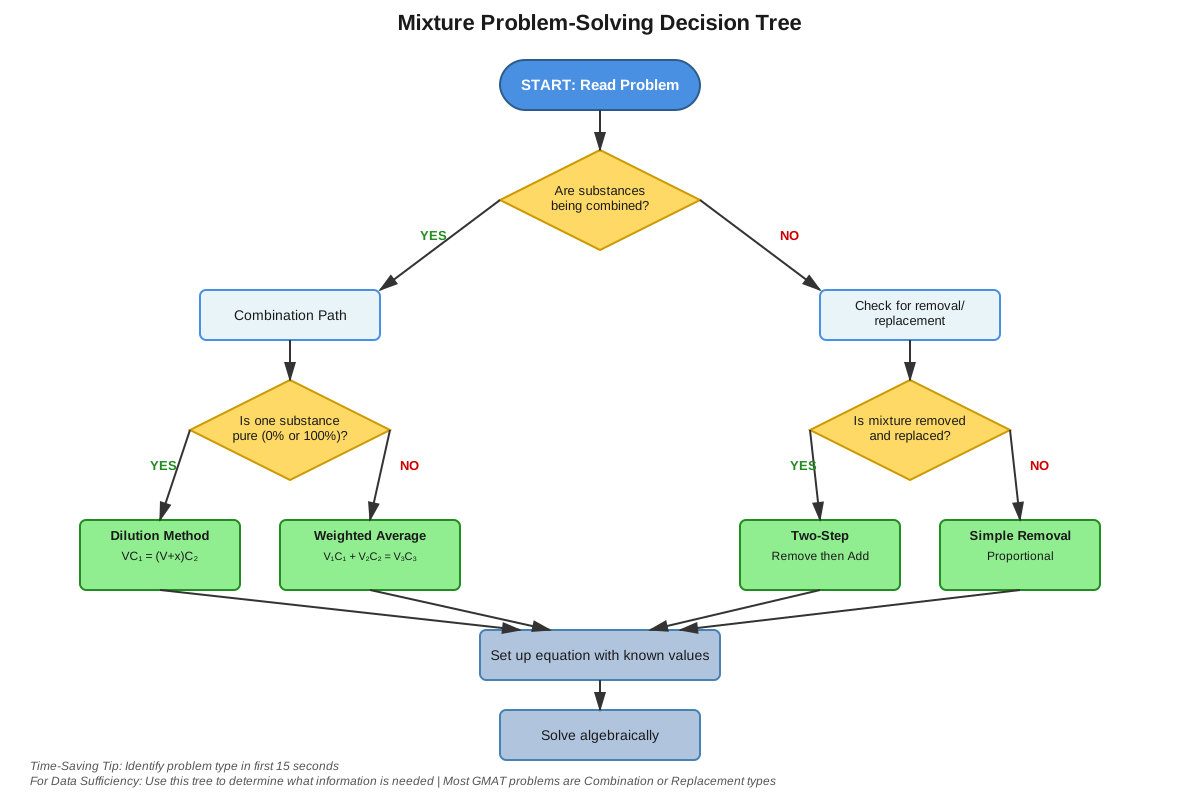
When approaching GMAT mixtures questions, begin by identifying the problem type (combination, replacement, dilution, or alligation) based on trigger words. Look for phrases like "mixed together" or "combined" (combination), "removed and replaced" (replacement), "added water" or "diluted" (dilution), and "in what ratio" (alligation). This classification immediately suggests which solution approach will be most efficient.
Trigger words and phrases to watch for include: "concentration," "solution," "mixture," "pure," "percentage," "combined," "mixed," "replaced," "diluted," "ratio," "average price," and "final composition." Questions asking "what percent" or "what is the concentration" typically require calculating the weighted average, while questions asking "how much" or "what quantity" require setting up and solving equations for unknown volumes.
For Problem Solving questions, follow this systematic approach:
- Read carefully and identify what's being mixed and what's being asked
- Write down known quantities and concentrations
- Define a variable for any unknown quantity
- Set up the conservation equation (amount before = amount after)
- Solve algebraically
- Check that your answer is reasonable (falls within expected bounds)
For Data Sufficiency questions, recognize that you typically need three pieces of information to determine a final concentration: the quantities of each component and their individual concentrations (or equivalent information). Statement analysis should focus on whether you can determine these values, not on actually calculating the answer. Often, knowing ratios of quantities combined with concentration information is sufficient, even without absolute values.
Process-of-elimination tips: Immediately eliminate answer choices that fall outside the range of the individual concentrations being mixed (unless negative quantities are involved, which is rare). If mixing 20% and 50% solutions, the answer must be between 20% and 50%. Also eliminate choices that would require impossible scenarios (like negative volumes or concentrations above 100% when mixing solutions below 100%).
Time allocation: Allocate 2-2.5 minutes for straightforward mixture problems and up to 3 minutes for complex multi-step scenarios. If you find yourself spending more than 3 minutes, consider whether you've chosen the most efficient approach. Sometimes switching from algebraic methods to alligation or vice versa can save significant time. For Data Sufficiency, spend 30-45 seconds understanding the question, then 45-60 seconds per statement, leaving time for combination analysis.
Strategic shortcuts: When quantities are equal, the final concentration is simply the arithmetic average of individual concentrations. When the problem asks for a ratio (alligation scenarios), you can often avoid calculating specific quantities entirely. If you're stuck on the algebra, try working backwards from answer choices, especially in Problem Solving—calculate what the result would be if each answer were correct and see which matches the problem conditions.
Memory Techniques
Mnemonic for mixture problem steps: "I-D-W-S-V" = Identify components, Define variables, Write equation, Solve algebraically, Verify reasonableness. This ensures you follow a systematic approach rather than jumping directly to calculations.
Visualization strategy: Picture mixtures as two containers being poured into a third. Visualize the darker liquid (higher concentration) and lighter liquid (lower concentration) creating a medium shade (intermediate concentration). The more of the darker liquid you add, the darker the final mixture—this intuitive image helps you estimate whether your calculated answer makes sense.
Acronym for alligation: "C-D-R" = Concentrations on sides, Differences calculated crosswise, Ratio inverted. This reminds you of the three steps in applying the alligation method.
Memory aid for replacement formula: "What remains is what you keep"—When you remove fraction f, you keep fraction (1-f). So the remaining concentration is Original × (1-f). For successive replacements, you keep (1-f) each time, giving you (1-f)ⁿ for n replacements.
Percentage-ratio conversion trick: For a ratio like 2:3, remember "part over total"—the first component is 2/(2+3) = 2/5 of the total. Create a mental image of a pie divided into 5 slices, with 2 slices being one component and 3 being the other.
Weighted average visualization: Imagine a seesaw with weights (quantities) at different positions (concentrations). The balance point (final concentration) is closer to the heavier weight. This helps you estimate whether your answer should be closer to one concentration or the other based on relative quantities.
Summary
Mixtures problems on the GMAT test the ability to analyze scenarios where substances or groups with different characteristics are combined, separated, or replaced. The fundamental principle underlying all mixtures is conservation: the total amount of each component before any operation equals the total amount afterward. Success requires identifying the problem type (combination, replacement, dilution, or alligation), setting up appropriate equations that track quantities and concentrations, and solving systematically using either algebraic methods or weighted average approaches. The final concentration of any mixture represents a weighted average of the individual concentrations, where the weights are the quantities mixed, and this value must fall between the extremes of the components being combined. Mastery involves fluency in converting between different concentration representations (percentages, decimals, ratios, fractions), recognizing trigger words that indicate specific problem types, and applying efficient solution strategies including the alligation method for ratio problems and exponential formulas for successive operations. Understanding these concepts enables students to tackle both straightforward calculation problems and complex Data Sufficiency scenarios where determining what information is needed becomes as important as performing the calculations themselves.
Key Takeaways
- Mixtures problems fundamentally involve tracking how quantities and concentrations combine according to the principle that the amount of each component is conserved through mixing operations
- The weighted average formula (Q₁C₁ + Q₂C₂)/(Q₁ + Q₂) provides the most versatile approach for calculating final concentrations in combination problems
- Replacement problems require two-step thinking: first calculate what remains after removal, then determine the new composition after addition
- The alligation method offers an efficient shortcut for finding the ratio in which components should be mixed to achieve a target concentration
- Final concentrations always fall between the individual concentrations being mixed (for positive quantities), providing a critical reasonableness check
- Converting between concentration representations (percentages, ratios, decimals, fractions) accurately is essential, particularly distinguishing between part-to-part ratios and part-to-whole percentages
- For Data Sufficiency questions, recognize that knowing the ratio of quantities and individual concentrations is typically sufficient to determine final concentration, even without absolute values
Related Topics
Weighted Averages: Mixtures problems are a specific application of weighted average concepts. Mastering mixtures provides the foundation for understanding how averages depend on both values and their frequencies or quantities, which extends to statistics problems and data interpretation questions.
Ratio and Proportion: Advanced ratio problems often involve changing ratios when quantities are added or removed, directly building on mixture principles. Understanding how ratios transform through operations is essential for both mixtures and more complex ratio scenarios.
Work-Rate Problems: These problems involve "mixing" workers with different rates to determine combined productivity, using the same weighted average and combination principles as mixtures. The conceptual framework transfers directly between these topics.
Distance-Rate-Time with Average Speed: Calculating average speed when traveling different distances at different rates requires weighted average thinking identical to mixtures, where distances serve as weights and speeds as the values being averaged.
Profit and Loss with Mixed Goods: Problems involving selling items with different costs or profit margins to achieve target averages use the same mathematical framework as mixtures, with prices replacing concentrations.
Practice CTA
Now that you've mastered the core concepts, strategies, and common pitfalls of mixtures problems, it's time to solidify your understanding through active practice. Attempt the practice questions designed specifically for this topic, focusing on applying the systematic approaches you've learned. Work through each problem methodically, identifying the problem type before jumping to calculations, and always verify that your answers fall within reasonable bounds. Use the flashcards to reinforce key formulas, trigger words, and common misconceptions until they become automatic. Remember: mixtures problems reward systematic thinking and careful setup more than computational speed—invest time in understanding the problem structure, and the calculations will follow naturally. Your ability to confidently tackle these high-yield GMAT questions will significantly boost your Quantitative Reasoning score!
Sign up free to keep reading
Create a free AnvayaPrep account to finish this GMAT guide on Mixtures — plus flashcards and practice questions.