Overview
Profit and loss is a fundamental topic in GMAT Quantitative Reasoning that tests a candidate's ability to understand and calculate financial outcomes in business transactions. This topic appears frequently on the exam, typically in the form of word problems that require students to determine selling prices, cost prices, profit percentages, loss percentages, and break-even points. Mastery of GMAT profit and loss concepts is essential because these questions often combine multiple arithmetic operations with percentage calculations, requiring both computational accuracy and conceptual clarity.
The importance of profit and loss questions on the GMAT extends beyond simple arithmetic. These problems test logical reasoning, the ability to set up equations from word problems, and the skill to work backward from given information to find unknown values. Questions may involve single transactions, multiple successive transactions, or scenarios with discounts and markups. Understanding the relationships between cost price, selling price, profit, and loss forms the foundation for tackling more complex percentage problems and real-world business scenarios.
Within the broader Quantitative Reasoning section, profit and loss connects directly to percentages, ratios, and basic algebra. These questions often appear as Problem Solving items but can also be embedded in Data Sufficiency questions where students must determine whether given information is sufficient to calculate profit or loss. The topic's practical nature makes it highly testable, as it mirrors real business decisions and financial calculations that MBA candidates will encounter in their careers.
Learning Objectives
- [ ] Identify profit and loss in various business transaction scenarios
- [ ] Explain the relationships between cost price, selling price, profit, and loss
- [ ] Apply profit and loss formulas to GMAT questions efficiently
- [ ] Calculate profit and loss percentages accurately in single and multiple transactions
- [ ] Determine cost price or selling price when given profit/loss information
- [ ] Solve problems involving successive discounts and markups
- [ ] Analyze break-even scenarios and determine optimal pricing strategies
Prerequisites
- Basic percentage calculations: Essential for computing profit/loss percentages and understanding markup/markdown relationships
- Algebraic equation solving: Required to set up and solve equations when working backward from selling price to cost price
- Ratio and proportion: Needed to understand the proportional relationships between different price points
- Decimal and fraction operations: Necessary for precise calculations involving percentages and conversions
Why This Topic Matters
Profit and loss concepts have direct real-world applications in business, retail, manufacturing, and personal finance. Every business transaction involves these principles, from determining product pricing strategies to evaluating investment returns. Understanding these concepts enables better financial decision-making, whether negotiating salaries, evaluating business opportunities, or analyzing company performance.
On the GMAT, profit and loss questions appear with high frequency, typically accounting for 3-5 questions per exam. These questions appear primarily as Problem Solving items (60-70% of the time) but also feature in Data Sufficiency questions (30-40%). The exam tests this topic because it assesses multiple competencies simultaneously: reading comprehension of word problems, mathematical reasoning, percentage fluency, and the ability to work with abstract relationships.
Common question formats include: calculating profit percentage when given cost and selling prices; determining the selling price needed to achieve a target profit; finding the original cost when given selling price and loss percentage; solving problems with successive transactions; and analyzing scenarios with discounts, taxes, and commissions. Questions may also involve comparing multiple scenarios or determining break-even points where profit equals zero.
Core Concepts
Fundamental Definitions
Cost Price (CP) represents the amount paid to acquire, produce, or manufacture an item. This includes all expenses incurred to bring the product to a sellable condition, such as purchase price, transportation costs, and manufacturing expenses. The cost price serves as the baseline for all profit and loss calculations.
Selling Price (SP) is the amount for which an item is sold to a customer. This is the revenue received from the transaction and determines whether a profit or loss occurs. The relationship between selling price and cost price determines the financial outcome of any transaction.
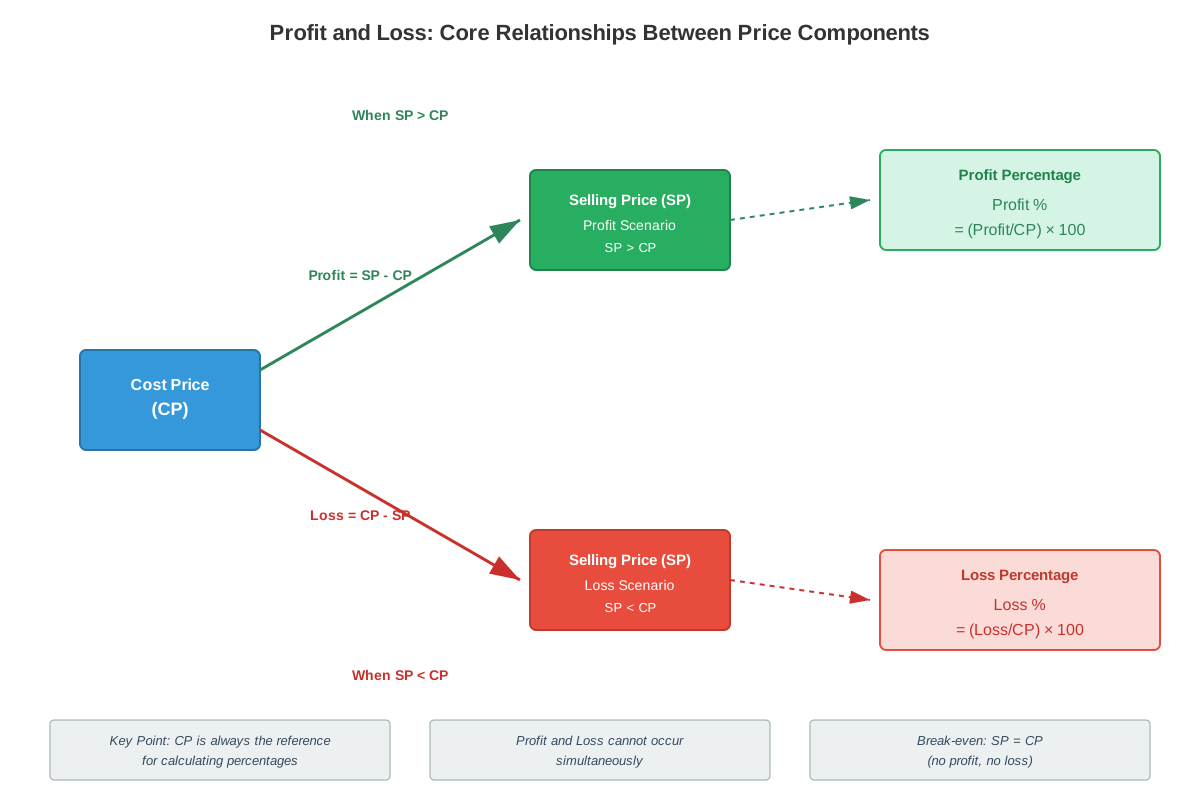
Profit occurs when the selling price exceeds the cost price. The profit amount equals the difference: Profit = SP - CP. A transaction generates profit when goods are sold for more than their acquisition or production cost, representing a positive financial outcome.
Loss occurs when the cost price exceeds the selling price. The loss amount equals the difference: Loss = CP - SP. A transaction results in loss when goods are sold for less than their cost, representing a negative financial outcome.
Core Formulas
Profit = Selling Price - Cost Price (when SP > CP)
Loss = Cost Price - Selling Price (when CP > SP)

Profit Percentage = (Profit / Cost Price) × 100
Loss Percentage = (Loss / Cost Price) × 100

Selling Price = Cost Price + Profit
Selling Price = Cost Price - Loss

Selling Price = Cost Price × (1 + Profit%/100)
Selling Price = Cost Price × (1 - Loss%/100)
Calculating Profit and Loss Percentages
Profit and loss percentages are always calculated based on the cost price unless explicitly stated otherwise. This is a critical point that distinguishes these calculations from other percentage problems. When an item costing $100 is sold for $120, the profit percentage is 20% (calculated as 20/100 × 100), not based on the selling price.
To find profit percentage: divide the profit amount by the cost price and multiply by 100. For example, if CP = $500 and SP = $650, then Profit = $150, and Profit% = (150/500) × 100 = 30%.
To find loss percentage: divide the loss amount by the cost price and multiply by 100. For example, if CP = $800 and SP = $720, then Loss = $80, and Loss% = (80/800) × 100 = 10%.
Working Backward from Selling Price
Many GMAT questions provide the selling price and profit/loss percentage, requiring calculation of the cost price. This requires algebraic manipulation of the standard formulas.
If SP and profit percentage are known:
CP = SP / (1 + Profit%/100)If SP and loss percentage are known:
CP = SP / (1 - Loss%/100)For example, if an item is sold for $540 at a 20% profit, the cost price is: CP = 540 / (1 + 0.20) = 540 / 1.20 = $450.
Markup and Markdown
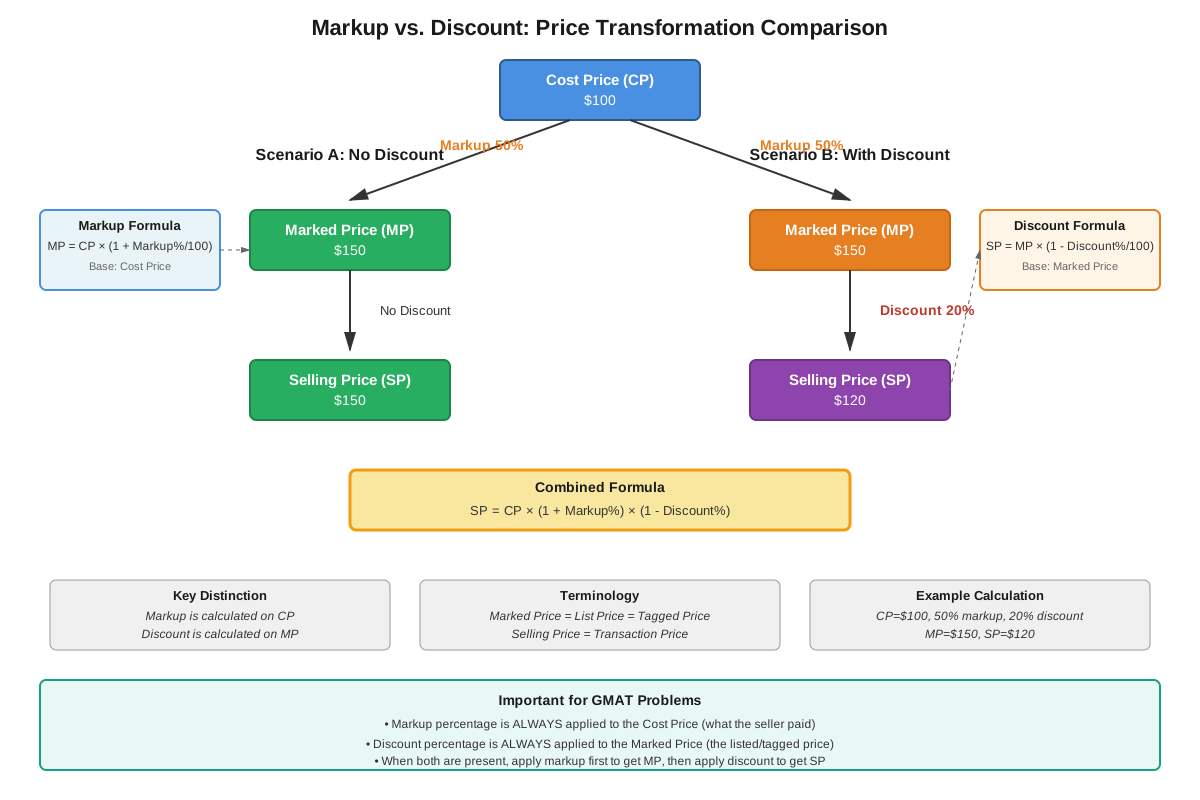
Markup refers to the amount or percentage added to the cost price to determine the marked price (list price). The marked price is the price displayed before any discounts. Markup is calculated on the cost price.
Markdown or discount is the reduction from the marked price to arrive at the selling price. Discounts are typically calculated on the marked price, not the cost price.
The relationship can be expressed as:
Marked Price = Cost Price + Markup
Selling Price = Marked Price - Discount
Successive Transactions
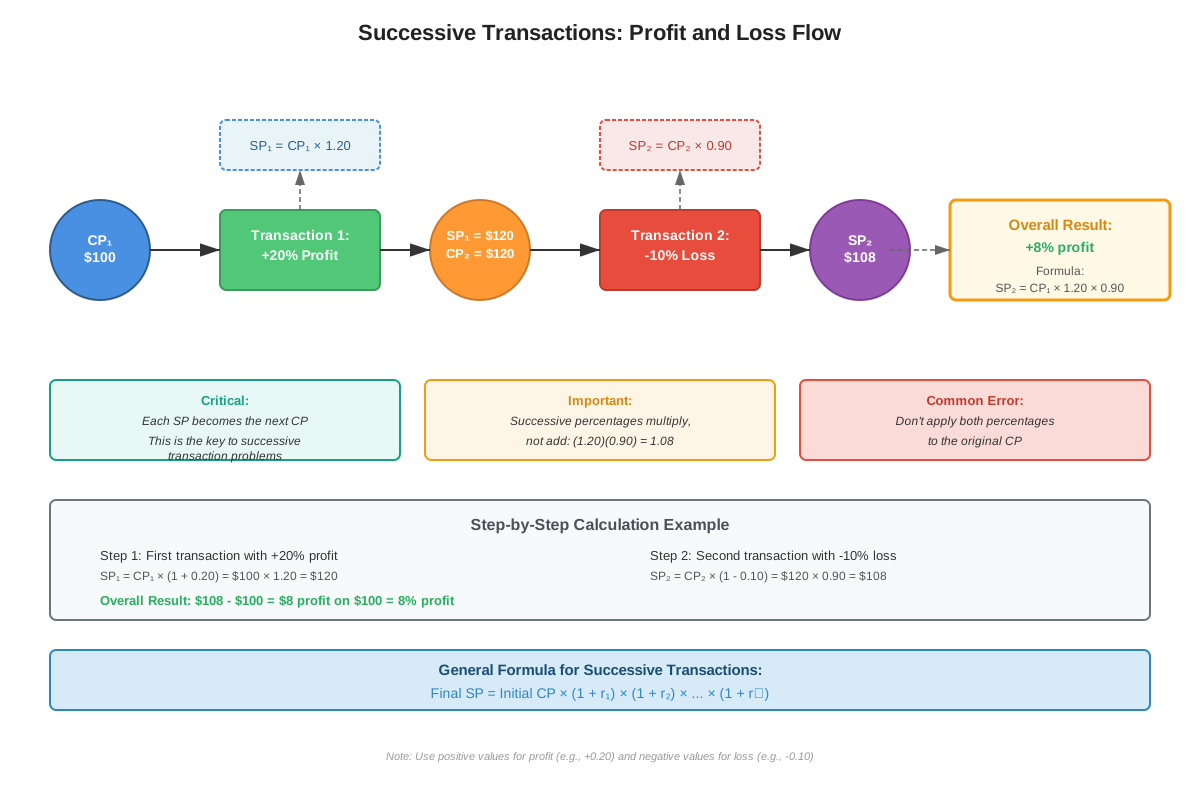
When items are bought and sold multiple times in succession, each transaction's selling price becomes the next transaction's cost price. The overall profit or loss is calculated from the original cost price to the final selling price.
For successive profit/loss percentages, the calculations compound. If an item undergoes a profit of x% followed by a profit of y%, the net effect is not simply (x + y)%. Instead:
Net multiplier = (1 + x/100) × (1 + y/100)Discount and Profit Combined
A common scenario involves marking up an item above cost price, then offering a discount, with the final selling price still yielding a profit. These problems require careful tracking of each step:
- Calculate Marked Price from Cost Price using markup percentage
- Calculate Selling Price from Marked Price using discount percentage
- Calculate Profit/Loss by comparing final Selling Price to original Cost Price
| Transaction Type | Formula | Example (CP = $100) |
|---|---|---|
| 20% Profit | SP = 100 × 1.20 | SP = $120 |
| 20% Loss | SP = 100 × 0.80 | SP = $80 |
| 25% Markup, 10% Discount | MP = 100 × 1.25 = 125; SP = 125 × 0.90 | SP = $112.50 |
| Break-even | SP = CP | SP = $100 |
Concept Relationships
The core concepts in profit and loss form an interconnected system where each element depends on others. Cost Price serves as the foundation → from which Profit or Loss is calculated → by comparing to Selling Price. The percentage calculations (Profit% or Loss%) → always reference back to Cost Price as the base → creating a consistent framework for all calculations.
Markup concepts → extend the basic profit/loss framework → by introducing Marked Price as an intermediate step → before Discount is applied → to reach the final Selling Price. This creates a chain: Cost Price → Marked Price → Selling Price → Profit/Loss calculation.
Successive transactions → build upon single transaction concepts → by treating each selling price → as the next cost price → requiring compound calculations rather than simple addition. This connects to prerequisite knowledge of percentages and demonstrates why percentage changes don't simply add together.
The topic connects to broader Quantitative Reasoning through its reliance on percentage calculations (prerequisite), algebraic manipulation (for working backward), and ratio reasoning (for understanding proportional relationships). It also serves as foundation for more advanced topics like compound interest and investment returns, which use similar percentage-based growth calculations.
Quick check — test yourself on Profit and loss so far.
Try Flashcards →High-Yield Facts
⭐ Profit and loss percentages are always calculated on Cost Price unless explicitly stated otherwise
⭐ When SP > CP, there is profit; when CP > SP, there is loss; when SP = CP, it's break-even
⭐ Formula: SP = CP × (1 + Profit%/100) or SP = CP × (1 - Loss%/100)
⭐ To find CP when SP and profit% are known: CP = SP / (1 + Profit%/100)
⭐ Successive percentage changes multiply, they don't add: two 10% profits ≠ 20% profit
- A 50% loss requires a 100% profit on the reduced price to break even
- Discount percentages are calculated on Marked Price, not Cost Price
- If an item is sold at x% profit and y% loss in two transactions, net effect = [(100+x)(100-y)/100] - 100
- Break-even point occurs when total revenue equals total cost (Profit = 0)
- When comparing profit percentages, always ensure they're calculated on the same base
- A 20% markup followed by 20% discount results in a net loss of 4%
- If selling price is the same for two items, one at x% profit and other at x% loss, there is always an overall loss
- Profit on the whole = Sum of individual profits (when dealing with multiple items)
Common Misconceptions
Misconception: Profit percentage is calculated on selling price → Correction: Profit percentage is always calculated on cost price unless the question explicitly states "profit on selling price" or "profit margin." The standard formula is (Profit/CP) × 100, not (Profit/SP) × 100.
Misconception: A 20% profit followed by 20% loss brings you back to the original price → Correction: Successive percentage changes compound multiplicatively. Starting with $100: after 20% profit = $120; after 20% loss on $120 = $96. The net result is a 4% loss, not break-even, because the second percentage operates on a different base.
Misconception: If two items are sold at the same price, one at 10% profit and another at 10% loss, the overall result is break-even → Correction: This scenario always results in an overall loss. The item sold at a loss had a higher cost price than the item sold at profit, so the loss amount exceeds the profit amount even though the selling prices are equal.
Misconception: Discount percentage and loss percentage are the same thing → Correction: Discount is calculated on marked price (list price), while loss is calculated on cost price. An item can be sold at a discount and still generate profit if the marked price was sufficiently above cost price.
Misconception: Adding profit percentages from successive transactions gives the total profit percentage → Correction: Percentages multiply in successive transactions. If you make 10% profit then 20% profit, the total is not 30% but rather (1.10 × 1.20) - 1 = 0.32 or 32% profit.
Misconception: A 50% discount means 50% loss → Correction: Discount is reduction from marked price, not cost price. If an item costs $60, is marked at $100, and sold at 50% discount ($50), there is still a loss of only $10 (16.67% loss), not 50% loss.
Worked Examples
Example 1: Finding Cost Price from Selling Price and Profit Percentage
Problem: A retailer sells a laptop for $1,440 and makes a 20% profit. What was the cost price of the laptop?
Solution:
Step 1: Identify the given information
- Selling Price (SP) = $1,440
- Profit Percentage = 20%
- Cost Price (CP) = ?
Step 2: Recall the relationship between SP, CP, and Profit%
When there is profit: SP = CP × (1 + Profit%/100)
Step 3: Substitute the known values
$1,440 = CP × (1 + 20/100)
$1,440 = CP × (1.20)
Step 4: Solve for CP
CP = $1,440 / 1.20
CP = $1,200
Step 5: Verify the answer
If CP = $1,200 and profit is 20%, then:
Profit amount = $1,200 × 0.20 = $240
SP = CP + Profit = $1,200 + $240 = $1,440 ✓
Answer: The cost price of the laptop was $1,200.
Connection to Learning Objectives: This problem demonstrates the ability to work backward from selling price to cost price, applying the core profit formula in reverse—a critical skill for GMAT profit and loss questions.
Example 2: Successive Discounts and Final Profit
Problem: A merchant marks an article 40% above its cost price. He then offers a discount of 20% on the marked price. If the cost price is $500, what is the merchant's profit percentage?
Solution:
Step 1: Identify given information
- Cost Price (CP) = $500
- Markup = 40% above CP
- Discount = 20% on Marked Price
- Find: Profit Percentage
Step 2: Calculate Marked Price
Marked Price = CP + 40% of CP
Marked Price = CP × (1 + 40/100)
Marked Price = $500 × 1.40
Marked Price = $700
Step 3: Calculate Selling Price after discount
Discount = 20% of Marked Price
Selling Price = Marked Price - 20% of Marked Price
Selling Price = Marked Price × (1 - 20/100)
Selling Price = $700 × 0.80
Selling Price = $560
Step 4: Calculate Profit
Profit = SP - CP
Profit = $560 - $500
Profit = $60
Step 5: Calculate Profit Percentage
Profit% = (Profit / CP) × 100
Profit% = ($60 / $500) × 100
Profit% = 12%
Alternative approach using multipliers:
Net multiplier = (1.40) × (0.80) = 1.12
This means SP = 1.12 × CP, indicating 12% profit
Answer: The merchant's profit percentage is 12%.
Connection to Learning Objectives: This problem integrates markup, discount, and profit calculations, demonstrating how to track price changes through multiple steps—a common GMAT scenario that tests comprehensive understanding of profit and loss relationships.
Exam Strategy
Trigger Words: Watch for "cost price," "selling price," "marked price," "list price," "profit," "loss," "gain," "discount," "markdown," "markup," "overhead," and percentage indicators like "20% above," "15% below," or "at a profit of."
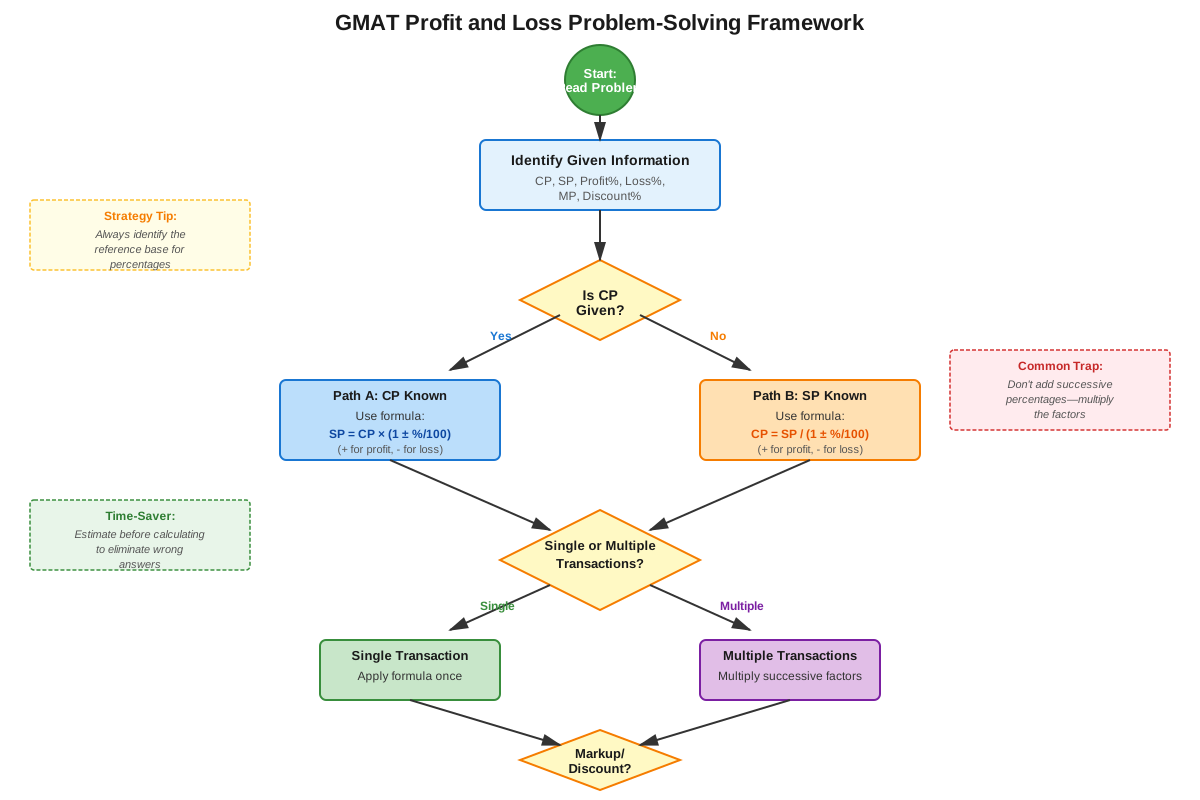
When approaching GMAT profit and loss questions, first identify what is given and what needs to be found. Create a simple notation system: write "CP = ?", "SP = $X", "P% = Y%" to organize information. This prevents confusion between different price points and percentages.
Step-by-step approach:
- Read carefully to distinguish between cost price, marked price, and selling price
- Identify whether the question involves profit or loss
- Note whether percentages are given or need to be calculated
- Determine if the problem involves single or successive transactions
- Set up the appropriate formula before calculating
- Verify that your answer makes logical sense (e.g., profit means SP > CP)
Process of elimination tips:
- Eliminate answers where selling price is less than cost price when profit is mentioned
- Rule out options where the profit/loss percentage seems unreasonably high or low
- Check if answer choices are testing the common misconception of adding successive percentages
- Verify that percentage calculations use the correct base (usually cost price)
Time allocation: Allocate 2-2.5 minutes for straightforward profit/loss calculations and up to 3 minutes for complex problems involving multiple steps or successive transactions. If a problem requires more than three distinct calculations, consider whether there's a more efficient approach using multipliers.
Common shortcuts:
- Use multipliers for successive changes: instead of calculating each step separately, multiply factors (e.g., 1.20 × 0.90 for 20% increase then 10% decrease)
- Recognize that "sold at cost price" means break-even (no profit, no loss)
- Remember that equal selling prices with equal profit and loss percentages always result in overall loss
- For quick estimation, round percentages to nearby values that are easier to calculate
Memory Techniques
Mnemonic for basic formulas - "SPCP": Selling Price Compared to Cost Price
- SP > CP = Profit (SP is "superior")
- CP > SP = Loss (CP is "larger")
Acronym for problem-solving steps - "IDSVC":
- Identify what's given
- Determine what's needed
- Set up the formula
- Verify the calculation
- Check if answer makes sense
Visualization for successive changes: Picture a staircase where each step represents a transaction. The height changes at each step, but you must track from the original ground level (original CP) to your final position (final SP) to know total profit or loss.
Memory aid for percentage base: "Profit Percentage uses Purchase price" (Cost Price is purchase price). This reminds you that profit percentage is calculated on cost price.
Pattern recognition: Remember "40-20 = 12" as a quick reference: 40% markup followed by 20% discount yields 12% profit. This pattern (1.40 × 0.80 = 1.12) helps you quickly verify calculations or estimate answers.
Summary
Profit and loss is a high-yield GMAT topic that tests the ability to work with cost prices, selling prices, and percentage calculations in business transaction scenarios. The fundamental principle is that profit occurs when selling price exceeds cost price, while loss occurs when cost price exceeds selling price. All profit and loss percentages are calculated based on cost price unless explicitly stated otherwise. Key formulas include SP = CP × (1 + Profit%/100) for profit scenarios and SP = CP × (1 - Loss%/100) for loss scenarios. Working backward from selling price to cost price requires algebraic manipulation: CP = SP / (1 + Profit%/100). Complex problems involve successive transactions, markups, and discounts, requiring careful tracking of each price transformation. Successive percentage changes multiply rather than add, which is a critical concept for avoiding common errors. Mastery requires understanding the relationships between all price points, fluency with percentage calculations, and the ability to set up equations from word problems efficiently.
Key Takeaways
- Profit and loss percentages are always calculated on cost price as the base, not selling price
- The core relationship: Profit = SP - CP (when SP > CP) and Loss = CP - SP (when CP > SP)
- Use multipliers for efficiency: SP = CP × (1 + P%/100) for profit, SP = CP × (1 - L%/100) for loss
- Successive percentage changes compound multiplicatively; never simply add percentages from multiple transactions
- Distinguish carefully between cost price, marked price, and selling price in multi-step problems
- When working backward from SP to CP, divide by the multiplier: CP = SP / (1 + P%/100)
- Equal selling prices with equal profit and loss percentages always result in an overall loss
Related Topics
Percentages and Percentage Change: Profit and loss is fundamentally an application of percentage concepts. Deepening understanding of percentage increase/decrease, percentage points, and compound percentage changes will strengthen profit and loss problem-solving abilities.
Ratios and Proportions: The relationship between cost price and selling price can be expressed as ratios. Understanding ratio manipulation helps solve problems where profit/loss is given as a ratio rather than a percentage.
Simple and Compound Interest: These topics extend profit and loss concepts to time-based scenarios, where money "grows" through interest rather than through sales transactions. The mathematical framework is similar.
Mixtures and Allegations: This advanced topic uses similar weighted average concepts to determine overall profit/loss when items with different cost prices are combined and sold.
Break-even Analysis: A business application that determines the point where total revenue equals total cost, building directly on profit and loss foundations to analyze business viability.
Practice CTA
Now that you've mastered the core concepts of profit and loss, it's time to solidify your understanding through practice. Attempt the practice questions to apply these formulas and strategies to GMAT-style problems. Use the flashcards to reinforce key formulas and relationships until they become automatic. Remember, profit and loss questions are highly testable on the GMAT, and consistent practice will build both speed and accuracy. Each problem you solve strengthens your pattern recognition and deepens your conceptual understanding. You're building essential skills that will serve you throughout the Quantitative Reasoning section—keep practicing!
Sign up free to keep reading
Create a free AnvayaPrep account to finish this GMAT guide on Profit and loss — plus flashcards and practice questions.