Overview
Prime numbers form one of the foundational pillars of number theory and appear with remarkable frequency throughout the GMAT Quantitative Reasoning section. Understanding prime numbers is not merely about memorizing a list of values; it requires developing an intuitive grasp of divisibility, factorization, and the unique properties that distinguish primes from composite numbers. On the GMAT, gmat prime numbers questions test both computational accuracy and conceptual understanding, often embedding prime number concepts within problems involving factors, multiples, divisibility rules, and number properties.
The significance of prime numbers extends far beyond isolated arithmetic questions. They serve as the building blocks for all integers through prime factorization, making them essential for solving problems involving least common multiples (LCM), greatest common divisors (GCD), perfect squares, and counting factors. GMAT test-makers frequently design questions that require recognizing whether a number is prime, identifying the prime factorization of composite numbers, or applying prime number properties to solve complex word problems. Questions may appear in both Problem Solving and Data Sufficiency formats, with the latter often testing whether students truly understand the defining characteristics of primes.
Mastery of prime numbers creates a cascade effect throughout Quantitative Reasoning performance. This topic connects directly to divisibility rules, factorization techniques, exponent manipulation, and even probability questions involving number properties. Students who develop strong prime number intuition can solve problems more efficiently, recognize patterns more quickly, and eliminate incorrect answer choices with greater confidence. The investment in thoroughly understanding this topic yields returns across multiple question types and difficulty levels on the GMAT.
Learning Objectives
- [ ] Identify prime numbers accurately and efficiently up to at least 100
- [ ] Explain the fundamental properties and characteristics that define prime numbers
- [ ] Apply prime number concepts to solve GMAT questions involving factorization and divisibility
- [ ] Determine whether a given number is prime using systematic testing methods
- [ ] Utilize prime factorization to solve problems involving LCM, GCD, and factor counting
- [ ] Recognize common GMAT traps and misconceptions related to prime numbers
- [ ] Analyze Data Sufficiency statements involving prime number properties
Prerequisites
- Basic multiplication and division: Essential for testing divisibility and understanding factor relationships
- Understanding of factors and multiples: Prime numbers are defined by their factor properties, making this foundational knowledge critical
- Divisibility rules: Enables quick elimination of non-prime candidates without lengthy calculations
- Integer properties: Primes are a subset of integers with specific characteristics that distinguish them from other integer categories
Why This Topic Matters
Prime numbers represent one of the most frequently tested arithmetic concepts on the GMAT, appearing in approximately 15-20% of Quantitative Reasoning questions either directly or as an underlying component of more complex problems. The GMAT tests prime number knowledge across multiple question formats: straightforward identification questions, prime factorization applications, problems involving the number of factors, and sophisticated Data Sufficiency questions that require deep conceptual understanding rather than mere computation.
In real-world applications, prime numbers underpin modern cryptography, computer security, and digital communications. While the GMAT does not test these applications directly, understanding that primes have practical significance can help students appreciate why this topic deserves serious attention. More immediately relevant to test-takers, prime number mastery enables faster problem-solving across numerous question types, from simplifying fractions to determining whether a number is a perfect square.
Common GMAT question patterns involving prime numbers include: determining how many prime numbers exist within a given range; identifying the prime factorization of a number and using it to count total factors; solving for unknown variables when given information about prime factors; evaluating whether expressions yield prime results; and analyzing Data Sufficiency statements where prime number properties determine sufficiency. Questions often combine prime number concepts with other topics such as remainders, consecutive integers, or algebraic expressions, testing the ability to integrate multiple concepts simultaneously.
Core Concepts
Definition of Prime Numbers
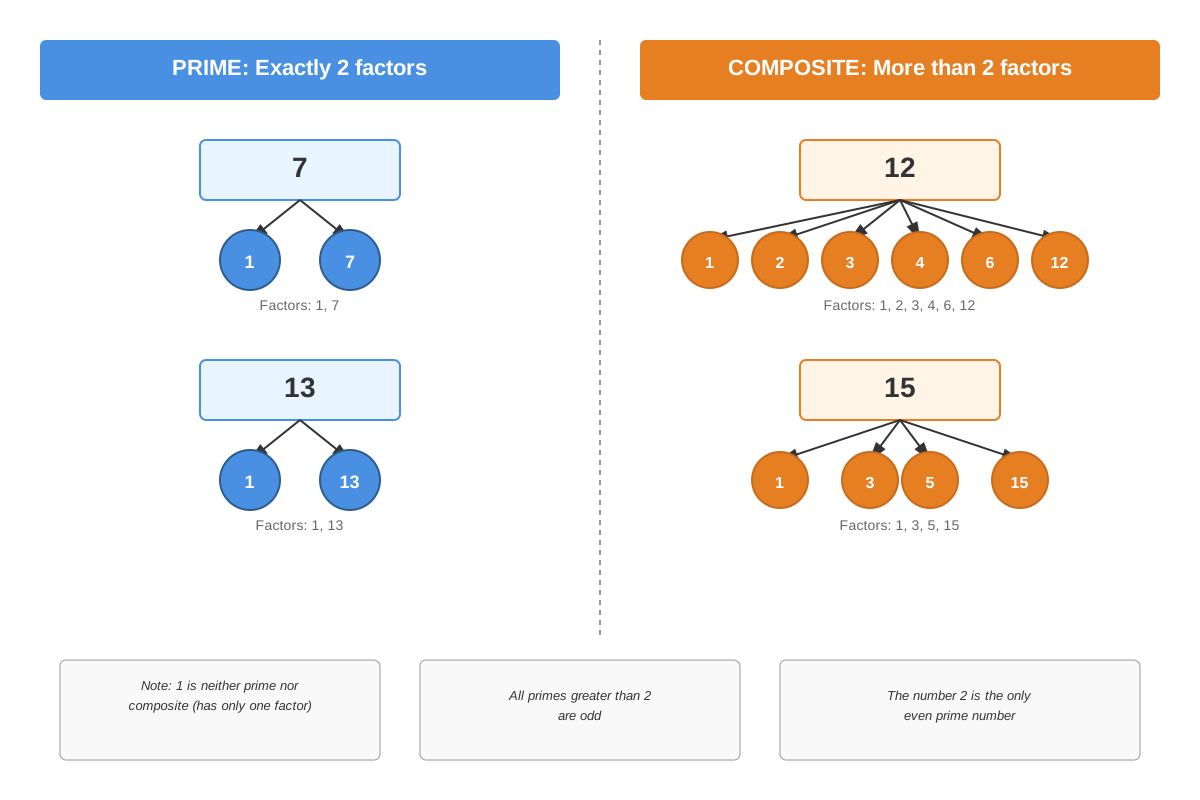
A prime number is a positive integer greater than 1 that has exactly two distinct positive divisors: 1 and itself. This definition contains several critical components that students must internalize. First, prime numbers must be greater than 1, which immediately excludes 0 and 1 from consideration. Second, the requirement of "exactly two" divisors is precise—no more, no fewer. Third, these divisors must be "distinct," meaning they are different values (though for primes, the only divisors are 1 and the number itself).
The number 2 holds special status as the only even prime number. Every other even number has at least three divisors (1, 2, and itself), disqualifying them from prime status. This makes 2 unique among primes and a frequent source of GMAT trap answers. All other prime numbers are odd, though not all odd numbers are prime (9, 15, 21, 25, 27, etc., are odd but composite).
Composite numbers serve as the counterpart to primes. A composite number is a positive integer greater than 1 that has more than two positive divisors. For example, 12 is composite because its divisors include 1, 2, 3, 4, 6, and 12. Every positive integer greater than 1 is either prime or composite—these categories are mutually exclusive and collectively exhaustive for integers above 1.
Prime Numbers Up to 100
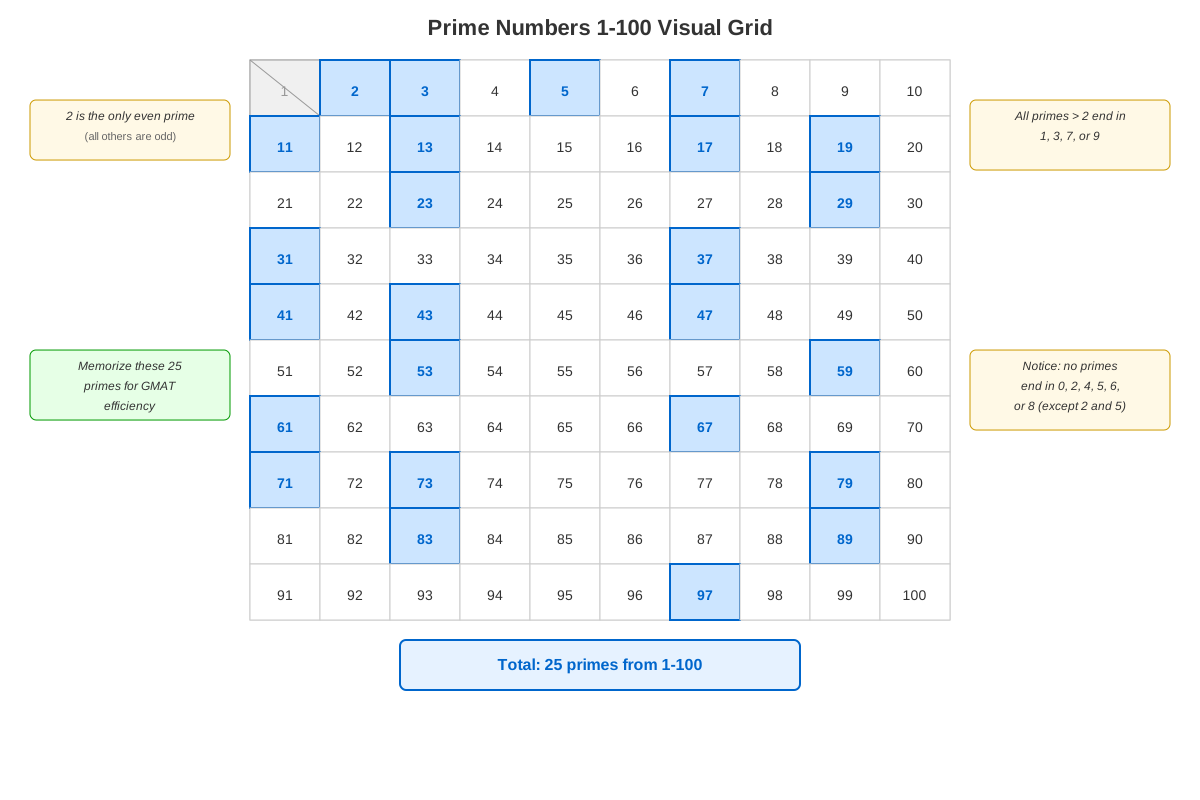
For GMAT purposes, students should memorize all prime numbers up to 100 and be able to quickly identify them. There are exactly 25 prime numbers in this range:
2, 3, 5, 7, 11, 13, 17, 19, 23, 29, 31, 37, 41, 43, 47, 53, 59, 61, 67, 71, 73, 79, 83, 89, 97
Notice several patterns: after 2, all primes are odd; primes become less frequent as numbers increase; many primes end in 1, 3, 7, or 9 (though not all numbers ending in these digits are prime). Familiarity with this list enables rapid problem-solving and helps students avoid calculation errors under time pressure.
Testing for Primality
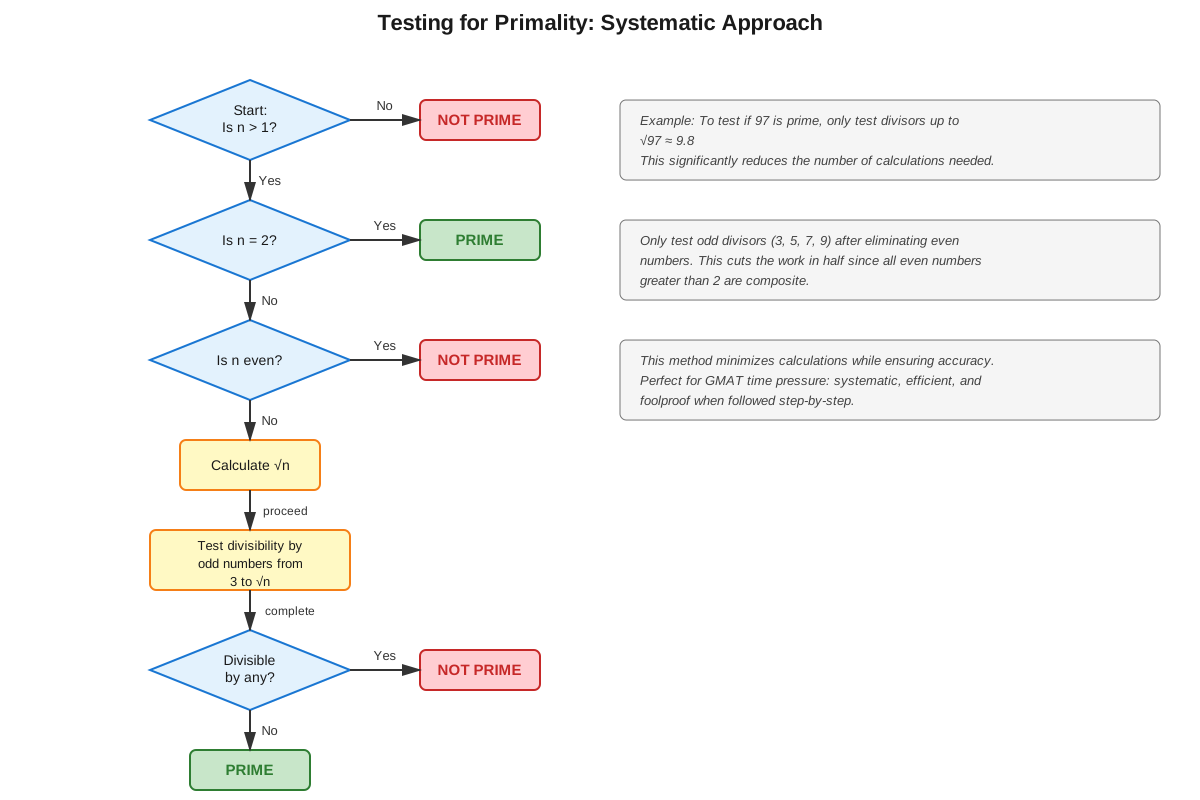
To determine whether a number n is prime, test divisibility by all prime numbers up to √n. If n is not divisible by any prime up to its square root, then n is prime. This method works because if n has a factor greater than √n, it must also have a corresponding factor less than √n.
Example: To test whether 89 is prime, calculate √89 ≈ 9.4. Test divisibility by primes up to 9: {2, 3, 5, 7}. Since 89 is odd, it's not divisible by 2. Sum of digits: 8 + 9 = 17 (not divisible by 3). Doesn't end in 0 or 5 (not divisible by 5). Testing 89 ÷ 7 = 12.71... (not divisible by 7). Therefore, 89 is prime.
Prime Factorization
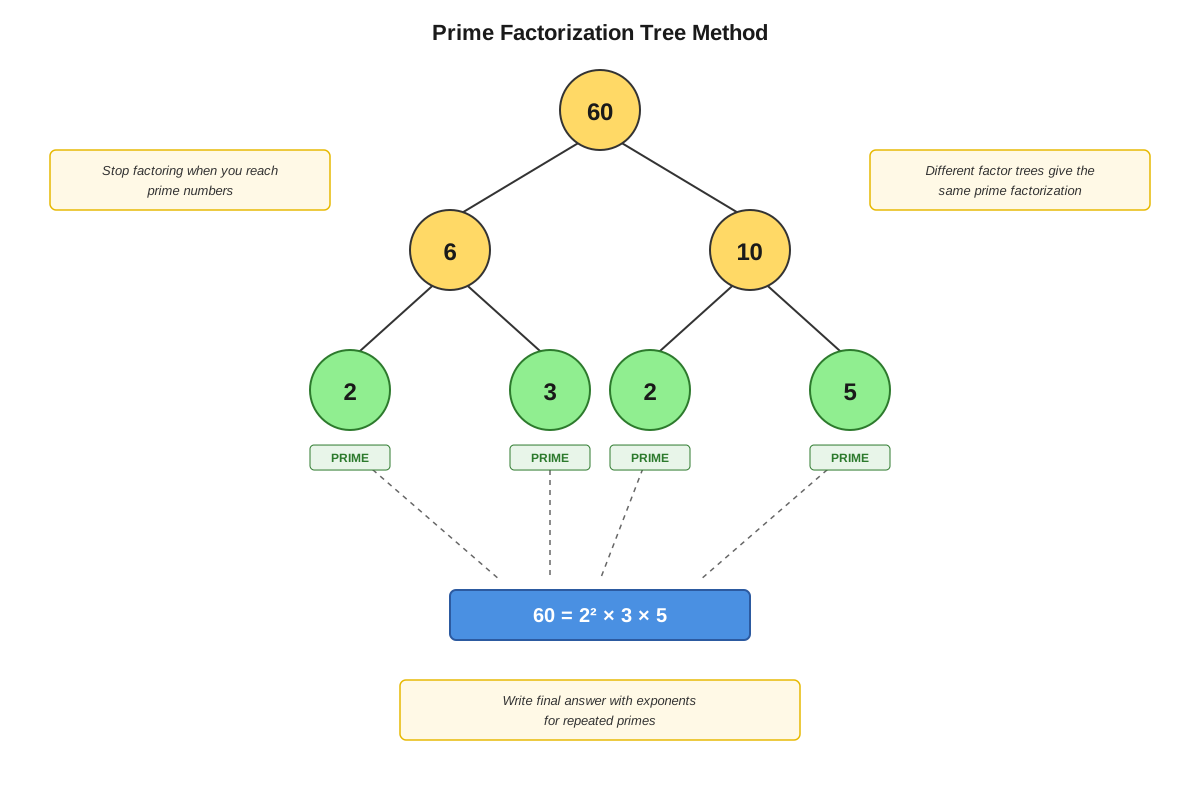
Every composite number can be expressed uniquely as a product of prime numbers raised to various powers. This representation is called prime factorization or prime decomposition. The Fundamental Theorem of Arithmetic guarantees that this factorization is unique (aside from the order of factors).
Example: 360 = 2³ × 3² × 5¹
Prime factorization serves as the foundation for numerous GMAT problem types:
- Counting factors: If n = p₁^a × p₂^b × p₃^c, then the number of factors = (a+1)(b+1)(c+1)
- Finding GCD: Take the lowest power of each common prime factor
- Finding LCM: Take the highest power of each prime factor present in any number
- Determining perfect squares: All exponents in prime factorization must be even
Special Cases and Edge Cases
The number 1 is neither prime nor composite. This is a deliberate mathematical convention that preserves the uniqueness of prime factorization. If 1 were considered prime, then every number would have infinitely many prime factorizations (e.g., 6 = 2 × 3 = 1 × 2 × 3 = 1 × 1 × 2 × 3, etc.).
Negative numbers are not classified as prime or composite. The definition of prime numbers applies only to positive integers greater than 1. While negative numbers have factors, the prime number classification system does not extend to them.
Zero is not prime because it has infinitely many divisors (every non-zero integer divides 0). It also fails the requirement of being greater than 1.
Properties of Prime Numbers
Prime numbers exhibit several important properties frequently tested on the GMAT:
- Infinite quantity: There are infinitely many prime numbers (proven by Euclid)
- Distribution: Primes become less frequent as numbers increase, but never stop appearing
- Sum properties: The sum of two primes is even except when one prime is 2
- Product properties: The product of any two primes is always composite (unless considering 1, which isn't prime)
- Consecutive primes: The only consecutive integers that are both prime are 2 and 3
Twin Primes and Prime Gaps
Twin primes are pairs of prime numbers that differ by 2, such as (3, 5), (5, 7), (11, 13), (17, 19), (29, 31), and (41, 43). While not frequently tested directly, understanding that primes can be close together helps with range-counting questions.
The prime gap refers to the difference between consecutive primes. As numbers increase, prime gaps generally increase, though irregularly. The gap between 2 and 3 is 1 (the smallest possible), while larger gaps exist between higher primes.
Concept Relationships
Prime numbers serve as the atomic building blocks of all integers, creating a hierarchical relationship where primes → prime factorization → composite numbers. Understanding this progression is essential: primes cannot be broken down further, but they combine to create all other positive integers through multiplication.
The relationship flows as follows: Prime Numbers → enable → Prime Factorization → enables → Factor Counting, GCD, and LCM → enables → Divisibility Analysis and Number Properties. Each level depends on the previous, making prime number mastery foundational.
Prime numbers connect directly to divisibility rules (prerequisite knowledge) because testing for primality requires checking divisibility by smaller primes. They also connect to perfect squares, since a number is a perfect square if and only if all exponents in its prime factorization are even. This relationship extends to perfect cubes (all exponents divisible by 3) and higher powers.
Within the topic itself, the concepts interconnect tightly: the definition of primes → determines which numbers are prime → enables prime factorization → which applies to factor counting, GCD/LCM problems, and divisibility questions. Each concept reinforces the others, creating a cohesive knowledge structure.
High-Yield Facts
⭐ 2 is the only even prime number; all other primes are odd
⭐ 1 is neither prime nor composite by mathematical convention
⭐ There are exactly 25 prime numbers between 1 and 100
⭐ To test if n is prime, check divisibility by all primes up to √n
⭐ Every composite number has a unique prime factorization (Fundamental Theorem of Arithmetic)
- The smallest prime number is 2
- The smallest odd prime number is 3
- All prime numbers greater than 3 can be expressed as 6k ± 1 for some integer k
- The sum of two prime numbers is even unless one of them is 2
- If p is prime and p divides ab, then p divides a or p divides b (or both)
- Prime numbers greater than 2 always end in 1, 3, 7, or 9 (though not all numbers ending in these digits are prime)
- The product of two distinct primes has exactly four factors: 1, each prime, and their product
- Consecutive primes (except 2 and 3) differ by at least 2
- A number is a perfect square if all exponents in its prime factorization are even
- The number of factors of n = p₁^a × p₂^b × p₃^c is (a+1)(b+1)(c+1)
Quick check — test yourself on Prime numbers so far.
Try Flashcards →Common Misconceptions
Misconception: 1 is a prime number because it's only divisible by 1 and itself.
Correction: 1 is neither prime nor composite by definition. Prime numbers must have exactly two distinct divisors, but for 1, the divisors "1" and "itself" are the same number, giving it only one divisor.
Misconception: All odd numbers are prime.
Correction: While all primes except 2 are odd, many odd numbers are composite. Examples include 9 (3 × 3), 15 (3 × 5), 21 (3 × 7), 25 (5 × 5), and 27 (3 × 3 × 3).
Misconception: Large numbers are more likely to be prime than small numbers.
Correction: The opposite is true. Prime numbers become less frequent as numbers increase. For example, there are 25 primes below 100, but only 21 primes between 100 and 200.
Misconception: If a number ends in 1, 3, 7, or 9, it must be prime.
Correction: While all primes greater than 5 end in these digits, not all numbers ending in these digits are prime. For example, 21, 27, 33, 39, 49, 51, 57, 63, 69, 77, 81, 87, 91, 93, and 99 all end in 1, 3, 7, or 9 but are composite.
Misconception: To test if a number is prime, you must check divisibility by all smaller numbers.
Correction: You only need to check divisibility by prime numbers up to the square root of the number being tested. This dramatically reduces calculation time.
Misconception: The sum of any two prime numbers is always odd.
Correction: The sum of two primes is even when one of them is 2 (the only even prime). For example, 2 + 3 = 5 (odd), but 2 + 5 = 7 (odd), while 3 + 5 = 8 (even), and 5 + 7 = 12 (even).
Misconception: Negative numbers can be prime.
Correction: By definition, prime numbers are positive integers greater than 1. The classification of prime and composite does not apply to negative numbers, zero, or fractions.
Worked Examples
Example 1: Prime Identification and Application
Question: How many prime numbers are there between 40 and 60, inclusive?
Solution:
Step 1: List all numbers in the range and systematically eliminate composites.
Step 2: Eliminate even numbers (except 2, but 2 is not in this range): 41, 43, 45, 47, 49, 51, 53, 55, 57, 59
Step 3: Test remaining odd numbers for primality:
- 41: √41 ≈ 6.4, so test primes up to 6 (2, 3, 5)
- Not even, digit sum = 5 (not divisible by 3), doesn't end in 0 or 5
- 41 is prime
- 43: √43 ≈ 6.6
- Not even, digit sum = 7 (not divisible by 3), doesn't end in 0 or 5
- 43 is prime
- 45: Ends in 5, divisible by 5 → composite
- 47: √47 ≈ 6.9
- Not even, digit sum = 11 (not divisible by 3), doesn't end in 0 or 5
- 47 is prime
- 49: 49 = 7 × 7 → composite
- 51: Digit sum = 6, divisible by 3 → composite
- 53: √53 ≈ 7.3, test primes up to 7 (2, 3, 5, 7)
- Not even, digit sum = 8 (not divisible by 3), doesn't end in 0 or 5
- 53 ÷ 7 = 7.57... (not divisible)
- 53 is prime
- 55: Ends in 5, divisible by 5 → composite
- 57: Digit sum = 12, divisible by 3 → composite
- 59: √59 ≈ 7.7, test primes up to 7
- Not even, digit sum = 14 (not divisible by 3), doesn't end in 0 or 5
- 59 ÷ 7 = 8.43... (not divisible)
- 59 is prime
Answer: There are 5 prime numbers between 40 and 60: {41, 43, 47, 53, 59}
Connection to Learning Objectives: This example demonstrates the systematic identification of prime numbers using divisibility rules and primality testing, directly addressing the objectives of identifying and explaining prime numbers.
Example 2: Prime Factorization Application
Question: What is the smallest positive integer that is divisible by both 12 and 18 and has exactly 12 factors?
Solution:
Step 1: Find the LCM of 12 and 18 using prime factorization.
- 12 = 2² × 3¹
- 18 = 2¹ × 3²
- LCM = 2² × 3² = 4 × 9 = 36
Step 2: Determine the number of factors of 36.
- 36 = 2² × 3²
- Number of factors = (2+1)(2+1) = 3 × 3 = 9 factors
Step 3: Since 36 has only 9 factors but we need 12 factors, we must find the smallest multiple of 36 with exactly 12 factors.
Step 4: Express 12 as a product of positive integers to find possible exponent patterns:
- 12 = 12 × 1 → n = p¹¹ (too large)
- 12 = 6 × 2 → n = p⁵ × q¹ or p¹ × q⁵
- 12 = 4 × 3 → n = p³ × q² or p² × q³
- 12 = 3 × 2 × 2 → n = p² × q¹ × r¹
Step 5: Test multiples of 36 systematically:
- 36 = 2² × 3² → 9 factors (too few)
- 72 = 2³ × 3² → (3+1)(2+1) = 4 × 3 = 12 factors ✓
Step 6: Verify that 72 is divisible by both 12 and 18:
- 72 ÷ 12 = 6 ✓
- 72 ÷ 18 = 4 ✓
Answer: The smallest positive integer meeting all conditions is 72.
Connection to Learning Objectives: This example applies prime factorization to solve a complex GMAT-style problem involving LCM and factor counting, demonstrating how prime number concepts integrate with other arithmetic topics.
Exam Strategy
When approaching GMAT questions involving prime numbers, begin by identifying the question type: direct prime identification, prime factorization application, or property-based reasoning. For direct identification questions, use divisibility rules to quickly eliminate candidates before performing detailed calculations. Remember that checking divisibility by 2, 3, and 5 eliminates the vast majority of composite numbers.
Trigger words and phrases that signal prime number questions include: "prime factors," "prime factorization," "exactly two factors," "divisible only by," "smallest prime," "largest prime," "how many primes," and "product of primes." In Data Sufficiency questions, watch for statements providing information about the number of factors, divisibility properties, or whether a number is prime—these often provide sufficient information when combined with prime number properties.
For process of elimination, remember these strategies:
- Eliminate answer choices that include 1 as a prime number
- Eliminate choices that classify even numbers (except 2) as prime
- For "how many primes" questions, eliminate unreasonably high or low counts
- For prime factorization questions, verify that the product of suggested factors equals the original number
Time allocation: Straightforward prime identification should take 30-45 seconds. Prime factorization problems typically require 60-90 seconds. Complex applications involving LCM, GCD, or factor counting may require up to 2 minutes. If a problem requires testing multiple large numbers for primality, consider whether there's a more efficient approach using properties rather than brute-force calculation.
Exam Tip: Memorize primes up to 100 before test day. This investment saves significant time and prevents errors during the actual exam. Create flashcards or use spaced repetition to ensure automatic recall.
For Data Sufficiency questions, recognize that information about prime factors often provides more constraint than it initially appears. For example, knowing that a number has exactly two prime factors immediately tells you it can be expressed as p^a × q^b, which limits possibilities significantly.
Memory Techniques
Mnemonic for primes up to 30: "Two Three Five Seven Eleven Thirteen Seventeen Nineteen Twenty-three Twenty-nine" → Remember the phrase "Two Times Five Smart Elephants Tried Singing Nineteen Tunes Together" where each first letter corresponds to a prime (with numbers spelled out).
Visualization strategy: Picture prime numbers as "atomic" building blocks that cannot be broken down further, while composite numbers are "molecules" made by combining these atoms. This mental model reinforces that primes are fundamental and indivisible.
Pattern recognition: Remember that all primes greater than 3 follow the pattern 6k ± 1. While not all numbers of this form are prime, all primes (except 2 and 3) fit this pattern. This helps quickly eliminate candidates: 6k, 6k+2, 6k+3, and 6k+4 are all composite.
Acronym for testing primality: SQRT - Start with Quick divisibility rules, Reduce candidates, Test up to square root. This reminds you of the efficient testing process.
Finger counting technique: For primes up to 30, use your fingers to count: left pinky = 2, left ring = 3, left middle = 5, left index = 7, left thumb = 11, right thumb = 13, right index = 17, right middle = 19, right ring = 23, right pinky = 29. This kinesthetic memory aid helps during mental recall.
Summary
Prime numbers are positive integers greater than 1 with exactly two distinct divisors: 1 and themselves. They serve as the fundamental building blocks of all integers through prime factorization, making them essential for solving GMAT questions involving factors, multiples, divisibility, GCD, and LCM. The number 2 is the only even prime, while 1 is neither prime nor composite by mathematical convention. To test whether a number is prime, check divisibility by all primes up to its square root—if none divide evenly, the number is prime. There are 25 prime numbers below 100 that students should memorize for efficient problem-solving. Prime factorization uniquely expresses every composite number as a product of primes raised to various powers, enabling systematic approaches to counting factors, finding GCD/LCM, and determining perfect squares. GMAT questions test both computational accuracy in identifying primes and conceptual understanding of prime properties, particularly in Data Sufficiency formats where recognizing the implications of prime-related information determines sufficiency.
Key Takeaways
- Prime numbers have exactly two distinct positive divisors (1 and themselves) and must be greater than 1
- The number 2 is the only even prime; 1 is neither prime nor composite
- Test primality by checking divisibility by primes up to the square root of the candidate number
- Every composite number has a unique prime factorization (Fundamental Theorem of Arithmetic)
- Memorize all 25 primes below 100 for rapid problem-solving on test day
- Prime factorization enables systematic solutions for factor counting, GCD, LCM, and perfect square problems
- The number of factors of n = p₁^a × p₂^b × p₃^c equals (a+1)(b+1)(c+1)
Related Topics
Divisibility and Remainders: Understanding prime numbers deepens comprehension of divisibility rules and remainder patterns, as primes represent numbers with minimal divisibility properties.
Greatest Common Divisor (GCD) and Least Common Multiple (LCM): Prime factorization provides the most efficient method for calculating GCD and LCM, making prime number mastery prerequisite knowledge for these topics.
Perfect Squares, Cubes, and Higher Powers: Recognizing that perfect powers require specific exponent patterns in prime factorization builds directly on prime number knowledge.
Number Properties and Integer Constraints: Many advanced GMAT problems combine prime number properties with other integer characteristics, requiring integrated understanding across multiple arithmetic concepts.
Counting Methods and Combinatorics: Factor counting and divisor problems often appear in counting contexts, connecting prime numbers to combinatorial reasoning.
Practice CTA
Now that you've mastered the core concepts of prime numbers, it's time to solidify your understanding through active practice. Attempt the practice questions associated with this topic, focusing on applying the systematic approaches and strategies outlined in this guide. Use flashcards to drill prime number identification until recall becomes automatic—this investment will pay dividends in speed and accuracy on test day. Remember that prime numbers appear across numerous question types, so recognizing their role in complex problems is just as important as identifying individual primes. Challenge yourself with increasingly difficult problems, and review any mistakes carefully to identify conceptual gaps. Your ability to quickly and accurately work with prime numbers will significantly enhance your overall Quantitative Reasoning performance. Stay focused, practice deliberately, and watch your confidence grow!
Sign up free to keep reading
Create a free AnvayaPrep account to finish this GMAT guide on Prime numbers — plus flashcards and practice questions.